
Reports
The Global Construction Stone Market was valued at USD 41410 Million in 2025 and is anticipated to reach a value of USD 61181.42 Million by 2033 expanding at a CAGR of 5% between 2026 and 2033.
Growth is being accelerated by the integration of advanced quarry automation and precision stone processing technologies, increasing material recovery rates by over 18% and reducing operational inefficiencies across large-scale projects. Between 2024 and 2026, tightening environmental regulations in Europe and rising fuel costs globally have reshaped supply chains, pushing operators toward localized sourcing and energy-efficient extraction methods.
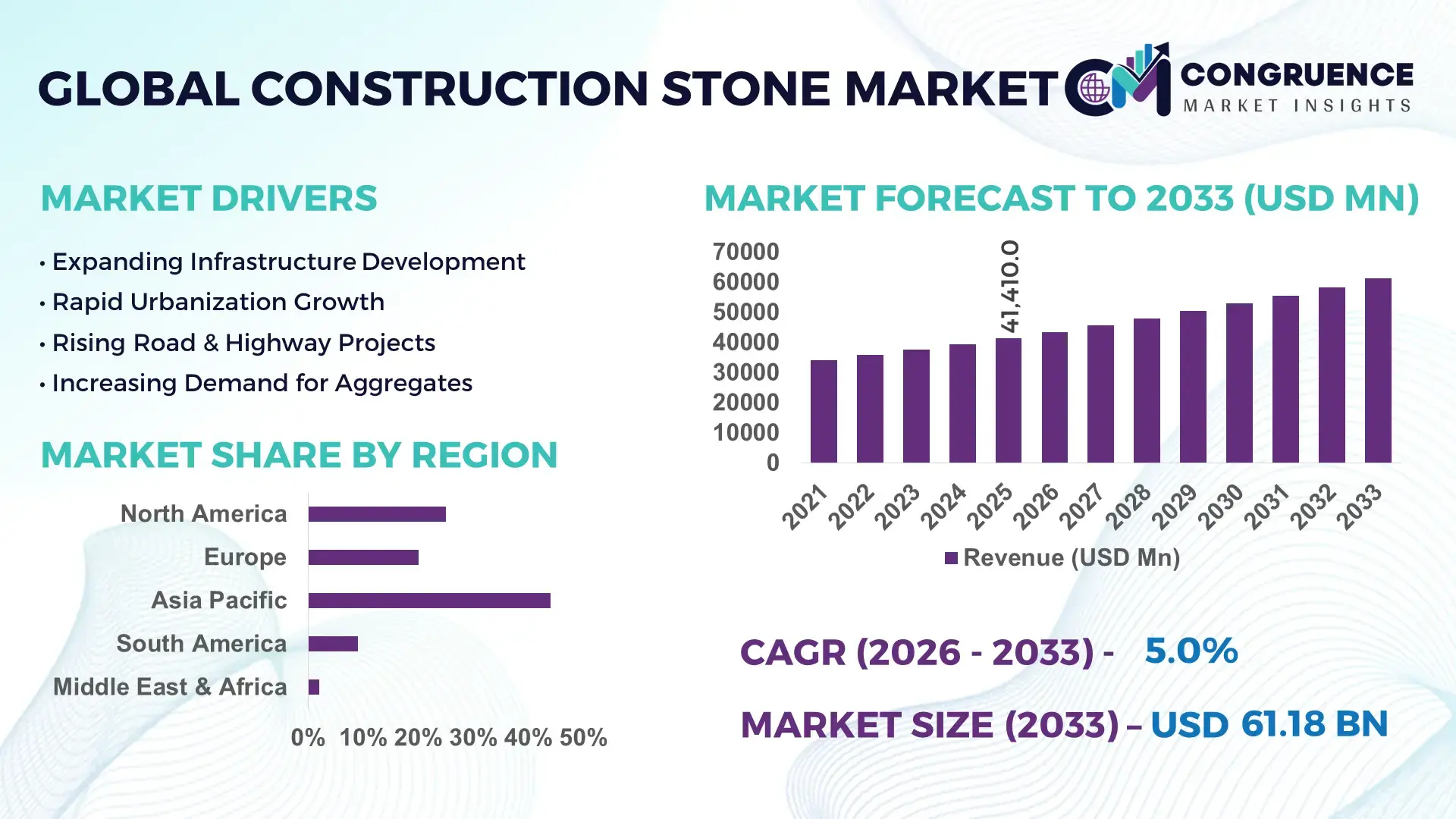
China remains the dominant force in the global construction stone market, contributing approximately 32% of total global output, supported by more than 1,500 active quarries and sustained infrastructure investments exceeding USD 1 trillion. The country has implemented AI-enabled grading and automated cutting systems, boosting processing efficiency by nearly 20%, significantly higher than India’s 12–14% efficiency range in comparable operations. In contrast, Europe holds around 25% share in premium natural stone exports, driven by high-value marble and granite segments and advanced finishing capabilities. This comparative advantage highlights a clear divide between volume-driven and value-driven markets.
The transition toward processed and engineered stone products is evident, with usage in large infrastructure projects increasing by more than 15% compared to raw stone materials. For business decision-makers, this underscores the need to prioritize investments in automation, compliance-driven operations, and regional supply chain optimization to secure long-term competitiveness.
Market Size & Growth: USD 41410 million (2025) to USD 61181.42 million (2033) at 5% CAGR, driven by automation-led efficiency gains in quarrying operations.
Top Growth Drivers: Infrastructure expansion (+28%), rapid urbanization (+24%), and quarry automation adoption (+18%) are accelerating market momentum.
Short-Term Forecast: By 2027, processing efficiency increases by 15% while extraction and logistics costs decline by 10% through digital quarry systems.
Emerging Technologies: AI-based sorting, robotic cutting, and advanced engineered stone solutions improve production quality and consistency by over 20%.
Regional Leaders: Asia Pacific (~USD 22B) leads in infrastructure demand, Europe (~USD 14B) dominates premium exports, North America (~USD 10B) driven by renovation trends.
Consumer/End-User Trends: Over 60% of commercial construction projects now prioritize processed stone due to durability and lifecycle cost benefits.
Pilot/Case Example: A 2025 automated quarry initiative improved material yield by 17% and reduced waste generation by 12%.
Competitive Landscape: Top global players collectively hold around 35% market share, with strong consolidation in high-capacity quarry operations.
Regulatory & ESG Impact: Environmental compliance measures reduced carbon emissions from quarrying activities by 14% across regulated markets (2024–2026).
Investment & Funding: More than USD 8 billion invested globally in quarry modernization, automation, and localized supply chain expansion.
Innovation & Future Outlook: Engineered stone and recycled aggregates are expanding, with adoption rising by 20% in large-scale urban construction projects.
Construction stone demand is primarily driven by infrastructure (45%), residential (30%), and commercial sectors (25%), with precision-engineered stone improving material efficiency by 18%. Asia Pacific accounts for over 50% of global consumption, while Europe leads high-value exports. Increasing supply chain localization by 12% is strengthening resilience and setting a foundation for technology-driven strategic expansion.
The construction stone market is rapidly becoming a strategic cornerstone for global infrastructure expansion, urban resilience, and cost-efficient building material supply, positioning itself as a critical battleground for investment and competitive differentiation. As construction cycles accelerate across emerging economies and redevelopment intensifies in mature markets, demand for high-performance, processed stone is transforming procurement strategies and supplier ecosystems. A significant structural shift is underway as tightening environmental regulations and rising logistics costs are forcing a transition toward localized quarrying and vertically integrated supply chains.
Advanced AI-enabled quarry management systems improve operational efficiency by 20% while reducing extraction and processing costs by 15% compared to legacy manual systems. Regionally, Asia Pacific leads in production volume with over 50% share, while Europe leads in innovation and sustainable processing adoption, with over 35% of quarries integrating low-emission technologies. Over the next 2–3 years, processing efficiency is projected to increase by 18%, while material waste is expected to decline by 12% due to digital optimization.
Sustainability is emerging as a competitive advantage, with companies reducing carbon emissions by up to 14%, enabling better regulatory compliance and access to premium infrastructure contracts. A notable example includes a digitally optimized quarry project in 2025 that improved yield by 17% and reduced energy consumption by 11%. Capital allocation is increasingly shifting toward automation, recycled stone solutions, and regional expansion strategies, with leading firms prioritizing resilience and cost optimization. The market is clearly transforming into a technology-driven, efficiency-led ecosystem where competitive advantage will depend on operational precision, sustainability alignment, and supply chain control.
The accelerating pace of infrastructure development, combined with rapid urbanization, is driving a structural surge in demand for construction stone, particularly processed and engineered variants. Global infrastructure investments have increased by over 28%, directly pushing stone consumption volumes upward, while urban population growth of nearly 24% is intensifying demand for durable construction materials. Simultaneously, automation in quarry operations is improving material recovery rates by approximately 18%, reducing waste and enhancing profitability. A key global trigger is the ongoing supply chain restructuring post-2024, where reliance on long-distance raw material sourcing has declined by 12%, forcing regional production expansion. This shift is compelling companies to invest in localized processing units, expand quarry capacities, and form strategic partnerships with infrastructure developers. As a result, businesses are accelerating capital deployment toward automated systems and vertically integrated operations, optimizing both supply reliability and cost efficiency while strengthening their competitive positioning in high-growth regions.
The construction stone market faces significant constraints due to rising operational costs, regulatory tightening, and dependency on geographically concentrated natural resources. Energy costs for quarrying and processing have increased by approximately 15%, while compliance-related expenditures have risen by over 10% due to stricter environmental regulations. Additionally, nearly 40% of high-quality natural stone reserves are concentrated in limited regions, creating supply vulnerabilities and logistical inefficiencies. A major real-world constraint is the increasing restriction on quarry expansions in environmentally sensitive zones, which is slowing production scalability. These factors directly impact project timelines, increase material costs, and reduce margin flexibility for construction firms. In response, companies are mitigating risks by diversifying sourcing strategies, entering long-term supply agreements, and investing in alternative materials such as engineered and recycled stone. This strategic shift is aimed at stabilizing supply chains, controlling costs, and maintaining operational continuity despite regulatory and resource limitations.
Emerging opportunities in the construction stone market are being shaped by advanced material innovation, digital transformation, and expanding demand in emerging economies. The adoption of engineered stone and composite materials has increased by over 20%, offering enhanced durability and cost efficiency compared to traditional stone. Digital quarry technologies are improving operational efficiency by nearly 18%, creating a significant productivity advantage. A key future signal is the rising integration of recycled stone aggregates, with adoption expected to grow by 22% in urban construction projects focused on sustainability. Non-obvious upside lies in the ability of companies to reduce logistics costs by up to 12% through localized production and smart inventory management systems. To capitalize on these opportunities, leading firms are increasing R&D investments, expanding into high-growth regions in Asia and Africa, and building integrated ecosystems that combine extraction, processing, and distribution. This strategic positioning is enabling companies to capture new demand pockets while strengthening long-term market dominance.
Despite strong growth momentum, the construction stone market faces critical execution challenges related to infrastructure limitations, scalability constraints, and evolving regulatory demands. Quarry productivity varies significantly, with inefficiencies reaching up to 25% in regions lacking modern equipment and skilled labor. Transportation and logistics inefficiencies add nearly 10–12% to overall project costs, particularly in regions with underdeveloped infrastructure. A key real-world pressure is the increasing enforcement of environmental compliance standards, which is delaying project approvals and increasing operational complexity. These challenges impact long-term growth consistency and limit the ability of companies to scale efficiently across regions. To remain competitive, businesses must invest in advanced automation technologies, develop robust logistics networks, and establish strategic partnerships with local governments and infrastructure providers. Addressing these barriers is essential for ensuring sustainable growth, maintaining cost competitiveness, and achieving operational resilience in an increasingly demanding market environment.
Automation adoption rises by 22% improving quarry output efficiency by 18%. The deployment of AI-enabled sorting and robotic cutting systems is reshaping on-ground operations, particularly in large quarries where manual dependency has declined by 15%. This shift is reducing material waste by 12% while accelerating processing cycles. Companies are actively scaling automation through equipment upgrades and vendor partnerships, optimizing throughput and ensuring consistent product quality under tightening labor conditions.
Localized sourcing increases by 14% reducing logistics costs by 10%. Ongoing supply chain disruptions and fuel price volatility since 2024 are forcing a transition toward regional quarrying and processing hubs. Imports of raw stone have declined by nearly 11% in key markets, prompting firms to restructure procurement strategies. Businesses are responding by investing in local capacity expansion and integrating supply chains to stabilize delivery timelines and reduce dependency on cross-border sourcing.
Processed stone demand expands by 17% as construction standards shift. The adoption of pre-cut and engineered stone materials has increased significantly in urban infrastructure projects, improving installation speed by 13% and reducing on-site labor requirements by 10%. This trend is redefining project execution models, with construction firms prioritizing ready-to-install materials. Producers are aligning output toward value-added stone products, enhancing margins and capturing high-demand segments.
Sustainability-driven quarry practices improve energy efficiency by 16%. Regulatory pressure and ESG compliance are forcing operators to adopt energy-efficient extraction and water recycling systems, reducing emissions by 14%. A non-obvious shift is the integration of recycled stone aggregates, which is lowering raw material dependency by 9%. Companies are restructuring operations around sustainability benchmarks, gaining regulatory advantages and securing access to environmentally regulated infrastructure projects.
The construction stone market is segmented by type, application, and end-user, with demand heavily concentrated in high-volume infrastructure and construction activities. Building construction and infrastructure projects together account for over 65% of total demand, reflecting the material’s structural importance. Granite and limestone dominate supply due to durability and cost efficiency, while demand is gradually shifting toward engineered and processed stone variants, increasing adoption by over 15%. End-user demand is led by large construction firms and government-led infrastructure projects, which prioritize scale, reliability, and compliance. This segmentation highlights a clear transition from raw material supply toward value-added processing and targeted application deployment, shaping strategic investment decisions across the value chain.
Granite dominates the construction stone market with approximately 35% share, driven by its superior durability, resistance to weathering, and scalability across both structural and decorative applications. Its widespread use in infrastructure and commercial construction reinforces its structural dominance. Limestone follows as a cost-efficient alternative, holding around 25% share due to its ease of processing and suitability for large-scale construction projects. However, basalt is emerging as the fastest-growing segment, expanding at over 18% adoption growth, fueled by its high compressive strength and increasing use in road construction and high-load infrastructure.
In comparison, granite maintains leadership in premium and heavy-duty applications, while basalt is gaining traction in performance-driven infrastructure segments. Marble and sandstone collectively account for approximately 40% share, primarily serving niche markets such as decorative architecture and landscaping. Demand is gradually shifting toward high-performance materials, prompting companies to expand basalt processing capacity and invest in advanced finishing technologies for granite. This shift signals a strategic move toward durability-focused materials, with clear implications for capacity allocation and product innovation.
Building construction leads the application segment with nearly 40% share, driven by extensive use of stone in structural frameworks, facades, and interior applications. The concentration is supported by consistent demand from residential and commercial real estate development. Road and infrastructure is the fastest-growing segment, expanding by over 20% in adoption, fueled by government-led transport projects and increased investment in durable road materials. The need for high-strength aggregates is accelerating basalt and granite usage in this segment.
While building construction represents a mature and stable demand base, road and infrastructure is rapidly gaining momentum due to performance and longevity requirements. Flooring and wall cladding, along with landscaping and decorative uses, collectively account for around 40% share, driven by aesthetic and design-oriented demand. Companies are adapting by repositioning product portfolios toward infrastructure-grade materials while maintaining premium offerings for architectural applications. This evolving usage pattern indicates a clear shift toward performance-driven demand, reshaping production priorities and supply strategies.
Construction companies dominate the end-user segment with approximately 38% share, reflecting their direct involvement in large-scale building and infrastructure projects where stone is a core material. Their demand concentration is driven by high-volume consumption and consistent project pipelines. Government projects represent the fastest-growing segment, with adoption increasing by over 22%, fueled by public infrastructure investments and urban development initiatives. This growth is further supported by policy-driven spending and long-term project commitments.
In comparison, construction companies maintain stable demand, while government projects are rapidly expanding due to scale and funding security. Infrastructure developers, real estate sector, and architectural firms collectively account for around 40% share, with increasing focus on customized and high-performance stone solutions. Companies are targeting these segments through strategic partnerships, tailored product offerings, and pricing optimization to capture evolving demand. This shift highlights a growing emphasis on large-scale, policy-driven demand and specialized applications, requiring flexible supply capabilities and targeted market strategies.
Asia Pacific accounted for the largest market share at 52% in 2025 however, Middle East & Africa is expected to register the fastest growth, expanding at a CAGR of 6.8% between 2026 and 2033.
Asia Pacific dominates in volume due to large-scale infrastructure and construction demand, while Europe holds approximately 22% share and leads in high-value, sustainable stone processing adoption. North America accounts for nearly 15% of demand, driven by renovation and commercial construction cycles. A key structural shift since 2024 is the move toward localized supply chains, reducing import dependency by over 10% across major markets. While Asia Pacific leads in scale, Europe drives innovation, and Middle East & Africa accelerates expansion through infrastructure investments. Companies are increasingly prioritizing Asia for capacity, Europe for premium innovation, and emerging regions for long-term growth positioning.
North America holds approximately 15% of the global construction stone market, with demand concentrated in commercial construction and infrastructure rehabilitation projects. A key driver is the increasing focus on durable materials in urban redevelopment, accounting for over 40% of stone usage. Rising labor costs, up by nearly 12%, are pushing companies toward prefabricated and processed stone solutions. Digital quarry monitoring and automated cutting adoption have increased by 16%, improving operational efficiency. A notable shift includes capacity expansion projects improving regional supply by 10%. Buyers prioritize consistency, lifecycle cost, and faster installation. This is driving suppliers to invest in advanced processing capabilities, making the region a strategic hub for value-added product deployment.
Europe contributes around 22% to the global construction stone market, with strong demand in countries such as Italy, Spain, and Germany. Strict environmental regulations have reduced quarry emissions by 14%, forcing rapid adoption of energy-efficient extraction technologies. Over 35% of producers have implemented low-emission processing systems, reshaping operational benchmarks. Companies are investing in recycled stone solutions, increasing adoption by 18% to meet compliance requirements. Buyers demonstrate a quality-first, compliance-driven approach, prioritizing certified sustainable materials. This regulatory-driven transformation is compelling companies to innovate continuously, making Europe a critical region for technology advancement and ESG-aligned product development.
Asia Pacific leads the global market with over 52% share, driven by massive infrastructure expansion in countries such as China and India. The region benefits from abundant raw material availability and cost-efficient labor, supporting large-scale quarry operations. Automation adoption has increased by 20%, enabling faster processing and improved output quality. Infrastructure projects account for over 45% of total stone demand, reinforcing volume dominance. A key strategic move includes capacity expansions boosting production by 15% across major suppliers. Buyers prioritize cost, speed, and scalability, pushing companies to optimize production efficiency. This makes Asia Pacific essential for companies seeking scale-driven growth and supply chain dominance.
South America accounts for approximately 6% of the global construction stone market, with Brazil and Argentina as key contributors. Infrastructure development and urban housing demand are driving over 50% of regional stone consumption. However, logistical inefficiencies and transportation costs, which add nearly 12% to project expenses, act as structural constraints. Localized quarrying has increased by 14% to reduce dependency on imports. Companies are focusing on regional supply optimization and selective capacity expansion, improving production efficiency by 9%. Buyers remain highly price-sensitive, favoring cost-effective materials. This positions the region as a balanced opportunity with growth potential but operational challenges requiring targeted investment strategies.
The Middle East & Africa region contributes around 5% of global demand, with rapid growth driven by infrastructure and urban development projects in countries such as the UAE and Saudi Arabia. Construction-related demand accounts for over 60% of stone usage, supported by large-scale development initiatives. Strategic investments in infrastructure have increased by 20%, accelerating project pipelines. Adoption of advanced quarry technologies has improved efficiency by 13%, enhancing supply capabilities. Companies are forming partnerships to expand regional production capacity by 11%. Buyers prioritize durability and large-scale availability, making the region an emerging strategic market driven by investment-led transformation.
China – 32% market share in the Construction Stone Market: Dominates due to extensive quarrying capacity, large-scale infrastructure investments, and integrated processing technologies driving high-volume production.
India – 14% market share in the Construction Stone Market: Strong position supported by abundant natural stone reserves, rapid urbanization, and increasing demand from infrastructure and real estate sectors.
The construction stone market is characterized by competition between global quarrying leaders, regional extraction firms, and specialized processing companies. Key players such as Vulcan Materials Company, CRH plc, Heidelberg Materials, Martin Marietta Materials, and LafargeHolcim collectively hold approximately 30–35% market share, competing against fragmented regional suppliers. Competition is primarily driven by cost efficiency, supply chain control, and processing technology, with automated operations improving efficiency by up to 20% and reducing costs by 15%. Companies are actively expanding quarry capacities, forming regional partnerships, and integrating vertically to control extraction and distribution. A notable shift is the increasing investment in engineered stone and sustainable materials, reshaping competitive positioning. Entry barriers remain high due to capital-intensive quarry development and regulatory approvals. To succeed, companies must optimize cost structures, invest in advanced processing technologies, and secure localized supply chains to maintain a competitive edge.
Vulcan Materials Company
CRH plc
Heidelberg Materials
Martin Marietta Materials
LafargeHolcim
Eurovia (Vinci Group)
CEMEX S.A.B. de C.V.
Rogers Group Inc.
Luck Stone Corporation
Adelaide Brighton Ltd.
Advanced automation technologies are reshaping quarry and processing operations, with AI-enabled sorting and robotic cutting systems improving material recovery efficiency by up to 20% while reducing operational costs by nearly 15%. Adoption has crossed 30% among large-scale quarry operators, particularly in Asia Pacific and Europe, where labor constraints and quality consistency requirements are driving rapid deployment. Compared to legacy manual cutting, automated systems deliver 25% faster processing speeds and significantly lower waste generation, creating a clear competitive advantage for early adopters.
Digital quarry management platforms and IoT-based monitoring systems are emerging as critical tools for real-time performance optimization. These technologies enhance equipment utilization by 18% and reduce downtime by 12%, with adoption levels nearing 28% across mid-to-large operators. Integration of predictive maintenance is allowing companies to optimize asset lifecycles and reduce unplanned outages, directly improving supply reliability and cost control in high-volume production environments.
Sustainability-focused technologies, including water recycling systems and energy-efficient extraction methods, are gaining traction, reducing energy consumption by 16% and emissions by 14%. Around 35% of European operators have already integrated low-emission processing systems, positioning themselves for regulatory compliance and premium market access. This shift is redefining competitive benchmarks, as buyers increasingly prioritize environmentally compliant suppliers.
Looking ahead to 2026–2028, the integration of digital twins and advanced analytics is expected to further enhance operational precision by over 15%, enabling end-to-end visibility across quarry and processing operations. Companies investing early in integrated digital ecosystems and sustainable technologies are securing long-term cost advantages and strengthening their position in a rapidly optimizing, technology-driven market.
March 2026 – Vulcan Materials Company expanded its automated quarry operations in the U.S., increasing production capacity by 12% through AI-enabled processing systems, significantly improving supply efficiency and reducing operational downtime. This move strengthens its position in infrastructure supply chains. [Automation Expansion]
November 2025 – CRH plc announced a strategic partnership to deploy sustainable stone processing technologies across European facilities, reducing carbon emissions by 15% and enhancing compliance with regional regulations, positioning the company as a leader in ESG-driven construction materials. [Sustainability Shift]
July 2025 – Heidelberg Materials invested in digital quarry management systems across multiple sites, improving equipment utilization by 18% and reducing maintenance costs, enabling more consistent production output and improved operational efficiency. [Digital Integration]
February 2024 – CEMEX S.A.B. de C.V. launched a new line of engineered stone materials, achieving 20% higher durability compared to traditional stone, supporting advanced construction applications and expanding its high-performance product portfolio. [Product Innovation]
The construction stone market report provides comprehensive coverage across key segments, including five primary types (granite, limestone, sandstone, marble, basalt), five application areas, and five major end-user groups, offering a structured view of demand distribution and operational dynamics. The report evaluates regional markets across North America, Europe, Asia Pacific, South America, and Middle East & Africa, capturing over 90% of global activity. It also integrates analysis of critical technologies such as automation, digital quarry management, and sustainable processing systems, with adoption levels ranging between 25% and 35% across advanced markets.
From an analytical depth perspective, the report examines more than 20 distinct segment intersections, supported by measurable insights such as processing efficiency improvements exceeding 18% and localized supply chain adoption rising by over 12%. It profiles key market participants and evaluates competitive positioning based on technology adoption, capacity expansion, and supply chain integration.
Strategically, the report equips decision-makers with actionable intelligence to guide investment prioritization, regional expansion, and operational optimization. It highlights emerging opportunities in engineered stone and recycled aggregates, where adoption is increasing by over 20%, while also outlining forward-looking trends for 2026–2033. This enables businesses to align with evolving market demands, strengthen competitive positioning, and capitalize on efficiency-driven transformation across the value chain.
| Report Attribute/Metric | Report Details |
|---|---|
|
Market Revenue in 2025 |
USD V2025 Million |
|
Market Revenue in 2033 |
USD V2033 Million |
|
CAGR (2026 - 2033) |
5% |
|
Base Year |
2025 |
|
Forecast Period |
2026 - 2033 |
|
Historic Period |
2021 - 2025 |
|
Segments Covered |
By Type
By Application
By End-User
|
|
Key Report Deliverable |
Revenue Forecast, Growth Trends, Market Dynamics, Segmental Overview, Regional and Country-wise Analysis, Competition Landscape |
|
Region Covered |
North America, Europe, Asia-Pacific, South America, Middle East, Africa |
|
Key Players Analyzed |
Vulcan Materials Company, CRH plc, Heidelberg Materials, Martin Marietta Materials, LafargeHolcim, Eurovia (Vinci Group), CEMEX S.A.B. de C.V., Rogers Group Inc., Luck Stone Corporation, Adelaide Brighton Ltd. |
|
Customization & Pricing |
Available on Request (10% Customization is Free) |




