
Reports
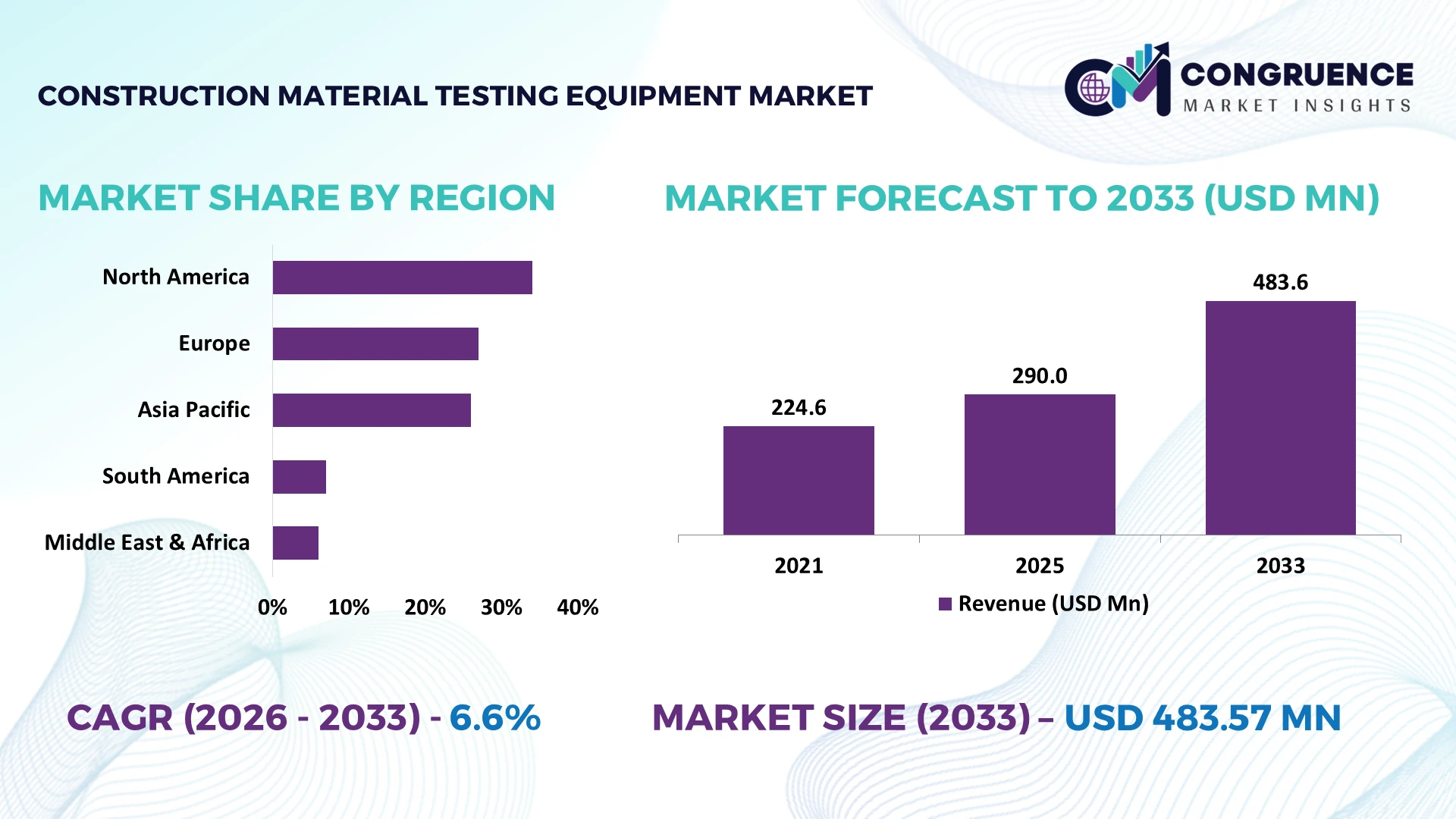
The Global Construction Material Testing Equipment Market was valued at USD 290.0 Million in 2025 and is anticipated to reach a value of USD 483.6 Million by 2033 expanding at a CAGR of 6.6% between 2026 and 2033. Growth is driven by stricter construction quality assurance standards, infrastructure rehabilitation programs, and increasing adoption of automated concrete, asphalt, soil, and aggregate testing systems.
The United States remains a dominant country market, supported by the USD 1.2 trillion Infrastructure Investment and Jobs Act and federal infrastructure modernization initiatives. The American Society of Civil Engineers assigned U.S. infrastructure a C grade in 2025, compared with C− in 2021, highlighting continued testing requirements. China maintains a larger construction output base, while U.S. laboratories demonstrate stronger demand for advanced automated testing and digital compliance systems.
Strategically, manufacturers prioritizing accredited laboratory solutions, automated material characterization, and integrated quality management platforms are positioned to secure higher-value infrastructure testing contracts.
Market Size & Growth: USD 290.0 million in 2025, reaching USD 483.6 million by 2033 at 6.6% CAGR, supported by automated construction quality verification.
Top Growth Drivers: Infrastructure modernization, stricter material certification, and digital laboratory adoption are the leading drivers, with illustrative demand contributions of 40%, 35%, and 25%, respectively.
Short-Term Forecast: By 2028, automated laboratory workflows are projected to reduce testing turnaround times by 15–20% in digitally upgraded facilities.
Emerging Technologies: AI-enabled defect detection, automated compression testing, and IoT-connected laboratory instruments are transforming material characterization.
Regional Leaders: Indicative 2033 market allocations place North America at USD 164.4 million, Asia Pacific at USD 150.9 million, and Europe at USD 111.2 million, supported by automation, infrastructure expansion, and certification requirements, respectively.
Consumer/End-User Trends: Large infrastructure laboratories increasingly prioritize digital reporting, with targeted workflow efficiency improvements of 15–25%.
Pilot/Case Example: A representative 2026 automated concrete-testing deployment targets a 20% reduction in manual reporting time; this is an illustrative benchmark, not a verified project result.
Competitive Landscape: Controls Group, Humboldt, ELE International, Matest, and Tinius Olsen compete through precision instruments, calibration services, and laboratory automation; individual market shares remain unverified.
Regulatory & ESG Impact: ASTM and EN testing requirements strengthen material traceability, while optimized mix-design testing can support 5–10% cement-content reductions in suitable applications.
Investment & Funding: The U.S. infrastructure law allocates approximately USD 1.2 trillion to infrastructure-related spending, supporting equipment procurement and laboratory modernization.
Innovation & Future Outlook: Connected testing platforms, predictive maintenance, and digital twins are shifting competition toward integrated testing ecosystems.
The Construction Material Testing Equipment Market serves concrete producers, geotechnical laboratories, road contractors, and infrastructure certification agencies. Innovations in servo-controlled universal testing machines, automated sample handling, and cloud-connected laboratory software are improving test consistency. Digital workflows offer potential reporting-efficiency gains of 15–20%, while infrastructure quality audits and material traceability requirements are reshaping equipment procurement priorities and competitive strategies.
Construction material testing equipment is becoming strategically important as infrastructure owners shift from periodic inspection toward continuous quality verification and lifecycle asset management. Government-funded transportation projects, industrial construction, and stricter material traceability requirements are encouraging contractors to invest in accredited laboratory capabilities. The transition toward digital construction documentation is also strengthening demand for connected testing instruments, automated data acquisition, and standardized reporting systems.
Compared with manually operated testing machines, automated compression and universal testing systems can deliver approximately 15–25% faster testing workflows under suitable laboratory conditions. North America emphasizes infrastructure rehabilitation and compliance documentation, while China and India prioritize high-volume construction testing across transportation, industrial, and urban development projects. European laboratories increasingly integrate energy-efficient testing equipment and digital quality management platforms.
During 2027–2029, digitally upgraded laboratories are expected to target 20% shorter reporting cycles and 10–15% improvements in equipment utilization. For example, automated concrete compression testing integrated with laboratory information management software reduces manual transcription and accelerates certification. Equipment manufacturers are expanding calibration services, software partnerships, and regional technical support networks. Long-term competitive advantage will depend on testing accuracy, digital interoperability, and dependable lifecycle support.
Large-scale infrastructure rehabilitation and increasingly rigorous construction quality requirements are accelerating procurement of advanced material testing instruments. The United States' USD 1.2 trillion infrastructure legislation supports transportation, utilities, and public works modernization, creating sustained requirements for concrete, asphalt, soil, and aggregate testing. Automated laboratory systems can improve testing throughput by approximately 15–25%, while digital reporting workflows can reduce administrative processing time by 10–20%, depending on laboratory configuration. India's expanding highway and railway construction programs reinforce demand for standardized material characterization. Manufacturers are responding by expanding automated compression testing portfolios, strengthening calibration networks, and partnering with accredited laboratories. The strategic advantage lies in combining reliable instrumentation with auditable digital quality records.
Advanced construction material testing equipment faces adoption barriers arising from high acquisition costs, recurring calibration requirements, and dependence on specialized electronic components. Automated universal testing machines and integrated laboratory systems can require 20–35% higher initial investment than comparable basic configurations, depending on specifications. Imported sensors, servo-hydraulic components, and precision load cells also expose Indian and Southeast Asian laboratories to currency fluctuations and extended procurement cycles. Annual maintenance and calibration expenses can represent approximately 5–10% of equipment acquisition costs in service-intensive installations. These pressures restrict smaller laboratories from upgrading complete testing portfolios. Manufacturers are addressing affordability through modular configurations, localized component sourcing, equipment leasing, and multiyear service contracts. Regional calibration availability increasingly influences purchasing decisions alongside equipment accuracy.
Digital laboratory transformation creates opportunities for manufacturers integrating automated material testing equipment with artificial intelligence, cloud analytics, and predictive maintenance capabilities. AI-assisted image analysis and connected testing workflows offer potential reductions of 15–25% in manual data-processing time, while predictive maintenance programs can target 10–20% lower unplanned equipment downtime. India's expanding industrial corridors and Vietnam's transportation infrastructure investments create opportunities for modular testing laboratories and remote calibration support. Emerging systems incorporating machine vision, wireless sensors, and digital sample traceability are improving operational visibility. Manufacturers are investing in software development, local technical partnerships, and subscription-based laboratory management services. The strongest opportunity lies in recurring software, calibration, and equipment lifecycle services rather than standalone instrument sales.
Scaling advanced construction material testing equipment requires resolving software interoperability, operator competency, and long-term measurement consistency. Laboratories integrating instruments from multiple manufacturers face fragmented communication protocols, inconsistent data formats, and complex validation procedures. Initial digital integration projects can require 15–25% additional implementation effort when legacy systems lack standardized interfaces. Operator retraining and method validation can extend commissioning schedules by approximately 10–20% in complex laboratory environments. India's geographically dispersed construction testing facilities face additional challenges maintaining consistent technical expertise and digital connectivity. Manufacturers must invest in standardized software interfaces, cybersecurity safeguards, remote diagnostics, and accredited operator training. Competitive differentiation increasingly depends on delivering reproducible testing results across distributed laboratories without compromising data integrity or regulatory compliance.
Expansion of Modular Laboratory Configurations: Construction testing laboratories are increasingly adopting modular equipment platforms that accommodate multiple test procedures within compact facilities. Integrated compression, flexural, and universal testing configurations can reduce laboratory floor-space requirements by approximately 15–20%, while interchangeable fixtures improve equipment utilization by 10–15%. Manufacturers are standardizing machine frames and accessories, enabling laboratories to expand testing capabilities without replacing entire systems.
Growing Preference for Portable Testing Instruments: Contractors are shifting selected quality-control procedures closer to construction sites through portable ultrasonic pulse velocity testers, rebound hammers, and field density measurement instruments. On-site assessments can shorten preliminary inspection cycles by 20–30% and reduce sample transportation requirements by approximately 15%. Equipment suppliers are expanding ruggedized product portfolios and strengthening distributor partnerships to support geographically dispersed infrastructure projects.
Standardization of Digital Calibration Records: Testing laboratories are replacing fragmented calibration documentation with electronic certificates, instrument identification systems, and centralized equipment histories. Structured digital records can reduce document retrieval time by 25–35% and administrative reconciliation effort by 15–20%. ISO/IEC 17025 accreditation requirements are reinforcing traceability practices. Manufacturers are integrating calibration documentation with service platforms, making after-sales support increasingly important in procurement decisions.
Shift Toward Multifunctional Testing Accessories: Concrete and geotechnical laboratories are consolidating specialized fixtures, interchangeable loading assemblies, and standardized sample preparation tools. Shared accessories can improve laboratory scheduling flexibility by 10–20% and reduce duplicate equipment requirements by approximately 10–15%. Suppliers are redesigning accessory interfaces and expanding retrofit compatibility. This shift strengthens recurring accessory sales while helping laboratories preserve existing equipment investments.
Concrete Testing Equipment represents the leading segment, with an indicative market share of approximately 38% in 2025, supported by widespread compressive strength verification, durability assessment, and structural quality certification. Automated compression testing machines remain essential across ready-mix concrete plants, precast manufacturing facilities, and accredited laboratories. Soil Testing Equipment is positioned as the fastest-growing category, benefiting from geotechnical investigations, foundation engineering, and ground improvement projects. It accounts for an estimated 24% of equipment demand, reflecting increasing investment in triaxial testing, compaction analysis, and permeability measurement.
Asphalt Testing Equipment maintains demand from highway construction and pavement rehabilitation, while Aggregate Testing Equipment supports grading, abrasion resistance, and crushing strength evaluation. Metals & Aggregates Testing Equipment, where classified together, also addresses structural material verification. Other specialized testing instruments serve advanced materials and durability applications. Manufacturers are expanding automated testing platforms, strengthening instrument calibration capabilities, and introducing modular laboratory systems. Procurement priorities increasingly favor versatile instruments with consistent measurement accuracy and lower lifecycle servicing requirements.
Infrastructure represents the leading application segment, accounting for an indicative 39% of construction material testing equipment demand in 2025. Highway expansion, bridge rehabilitation, railway construction, and public utility modernization require extensive concrete strength verification, soil compaction assessment, and asphalt performance evaluation. Commercial Construction follows with an estimated 27% share, supported by high-rise buildings, logistics facilities, and institutional construction. Industrial Projects represent the fastest-growing application category as semiconductor facilities, manufacturing plants, and energy infrastructure require specialized foundation testing and structural performance validation.
Residential Construction maintains stable equipment demand through housing development, concrete quality inspections, and foundation stability assessments. Other applications include specialized infrastructure rehabilitation and construction material investigations. Testing equipment manufacturers are developing project-specific instrument packages, expanding portable field testing capabilities, and integrating laboratory reporting platforms with contractor quality management systems. Infrastructure buyers prioritize high-throughput testing capacity, while industrial contractors emphasize precision, repeatability, and compliance documentation. This differentiation is encouraging suppliers to customize equipment portfolios around project complexity and testing frequency.
Material Testing Laboratories constitute the leading end-user segment, representing an indicative 36% of global equipment demand in 2025. Their dominance reflects continuous testing requirements across concrete, soil, asphalt, and aggregate materials, supported by accredited quality assurance procedures and recurring certification activities. Construction Companies represent the fastest-growing end-user category, accounting for approximately 29% of demand as major contractors establish internal testing capabilities to improve project scheduling, material acceptance, and inspection coordination. Increasing adoption of portable instruments enables contractors to perform preliminary assessments without depending entirely on external laboratory capacity.
Government & Regulatory Bodies maintain demand for infrastructure inspection, material compliance verification, and public construction quality oversight. Research & Development Institutes invest in advanced universal testing machines, environmental chambers, and specialized material characterization equipment. Manufacturers are targeting laboratories through automated instrument packages and calibration contracts while offering construction companies ruggedized field equipment and flexible procurement arrangements. Institutional buyers increasingly evaluate long-term technical support, measurement traceability, and instrument compatibility when selecting suppliers.
North America accounted for the largest market share at 34% in 2025 however, Asia-Pacific is expected to register the fastest growth, expanding at a CAGR of 8.2% between 2026 and 2033.
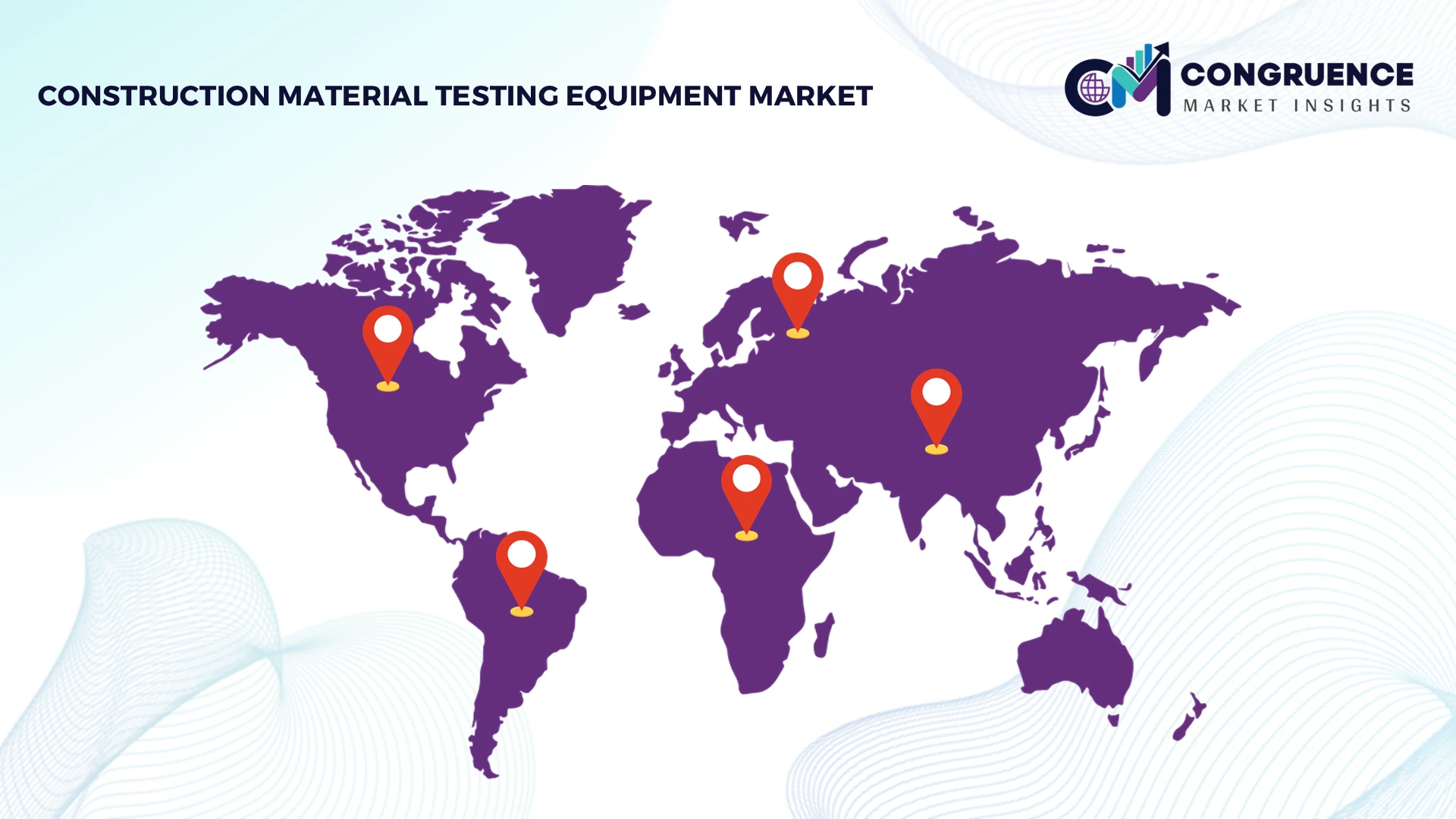
North America holds an estimated 34% share of the global Construction Material Testing Equipment Market in 2025, supported by established construction quality standards, extensive infrastructure rehabilitation, and widespread adoption of precision testing instruments. The United States dominates regional equipment procurement through transportation modernization, bridge inspection, and commercial construction quality assurance. Canada contributes through mining infrastructure, highway rehabilitation, and geotechnical engineering activities. Automated compression testing machines, asphalt performance analyzers, and soil characterization instruments remain essential across accredited laboratories. The U.S. Infrastructure Investment and Jobs Act provides approximately USD 1.2 trillion in infrastructure-related funding, reinforcing long-term requirements for material verification. Equipment manufacturers are expanding calibration services, digital reporting capabilities, and laboratory automation solutions. Regional competition increasingly emphasizes measurement traceability, testing throughput, and integrated equipment maintenance rather than standalone instrument pricing.
United States Market Outlook: The United States benefits from an extensive network of construction testing laboratories, engineering consultants, and infrastructure contractors operating under ASTM and AASHTO testing standards. The American Society of Civil Engineers assigned U.S. infrastructure an overall C grade in 2025, highlighting continuing rehabilitation requirements. Equipment suppliers are prioritizing automated concrete strength testing, pavement material characterization, and digitally integrated quality management systems to support transportation agencies and private engineering laboratories.
Europe accounts for approximately 27% of the global Construction Material Testing Equipment Market in 2025, supported by established laboratory accreditation systems, advanced engineering capabilities, and extensive infrastructure maintenance requirements. Germany, France, the United Kingdom, and Italy represent important procurement centers for concrete testing machines, geotechnical instruments, and structural material characterization systems. European construction laboratories operate within standardized EN testing frameworks, encouraging consistent measurement procedures and equipment calibration. The European Union's revised Construction Products Regulation entered into force in January 2025, strengthening the framework for construction product information and conformity assessment. Manufacturers are responding through precision instrument development, automated testing interfaces, and digital documentation solutions. Germany's engineering equipment manufacturing base supports regional technology development, while infrastructure renovation programs reinforce recurring testing requirements. Competitive differentiation increasingly depends on regulatory compatibility, technical reliability, and comprehensive laboratory service networks.
Germany Market Outlook: Germany remains a strategically important European market due to its advanced mechanical engineering industry, established materials research institutions, and extensive transportation infrastructure. The country's €500 billion infrastructure and climate-neutrality investment framework, approved in 2025, strengthens the outlook for construction quality verification. German laboratories emphasize precise load measurement, automated test execution, and compliance with DIN EN standards. Equipment manufacturers benefit from partnerships with technical universities, certification organizations, and industrial testing facilities.
Asia-Pacific represents approximately 26% of the global Construction Material Testing Equipment Market in 2025 and is positioned for the fastest expansion through transportation infrastructure, industrial construction, and urban development. China maintains substantial demand through highway networks, high-speed rail infrastructure, and commercial construction projects. India is strengthening equipment procurement through expressway construction, railway modernization, and industrial corridor development. Japan and South Korea contribute through advanced material characterization, seismic engineering, and precision laboratory instrumentation. India's National Infrastructure Pipeline identified infrastructure investment requirements of approximately INR 111 trillion for FY2020–FY2025, illustrating the scale of its infrastructure development agenda. Manufacturers are expanding local distribution, establishing technical service centers, and introducing cost-efficient automated testing platforms. Regional purchasing increasingly favors equipment combining high sample throughput, accessible calibration services, and compatibility with international construction testing standards.
China Market Outlook: China remains a major construction material testing equipment market due to its extensive infrastructure network, domestic machinery manufacturing capacity, and large construction materials industry. Its high-speed railway network exceeded 48,000 kilometers by the end of 2024, creating substantial requirements for concrete durability assessment, foundation evaluation, and structural quality monitoring. Domestic equipment manufacturers compete through localized production and competitive pricing, while advanced laboratories increasingly prioritize automated testing, precision sensors, and integrated data acquisition systems.
South America accounts for an estimated 7% of the global Construction Material Testing Equipment Market in 2025, with Brazil representing the principal regional demand center. Highway rehabilitation, mining infrastructure, commercial construction, and industrial development sustain requirements for concrete compression machines, soil testing instruments, and asphalt evaluation systems. Argentina, Chile, and Colombia contribute through transportation projects and geotechnical engineering activities. Brazil's Novo PAC infrastructure investment program, launched with planned investments of approximately BRL 1.7 trillion, provides an important framework for transportation and urban infrastructure development. However, imported equipment costs, currency volatility, and uneven laboratory infrastructure constrain procurement efficiency. Manufacturers are strengthening regional distributor partnerships, offering modular testing configurations, and expanding local calibration support. Portable instruments are gaining commercial relevance where construction sites operate far from established testing laboratories.
Brazil Market Outlook: Brazil leads regional equipment demand through its large construction sector, highway concession programs, and extensive mining operations. The country maintains more than 1.7 million kilometers of roads, creating considerable requirements for pavement assessment, soil compaction verification, and aggregate quality testing. Brazilian engineering laboratories operate under ABNT technical standards, supporting demand for standardized testing instruments. Suppliers increasingly prioritize locally available replacement components, field-service capabilities, and equipment configurations suited to tropical operating conditions.
The Middle East & Africa region represents approximately 6% of the global Construction Material Testing Equipment Market in 2025, supported by large-scale construction programs, industrial diversification, and transportation infrastructure investment. Saudi Arabia and the United Arab Emirates lead demand for advanced concrete testing, geotechnical characterization, and structural material verification across major construction projects. South Africa contributes through mining infrastructure, transportation rehabilitation, and engineering laboratory services. Saudi Arabia's Vision 2030 transformation agenda continues to support substantial infrastructure and industrial development activity, increasing requirements for construction quality documentation. Equipment suppliers are strengthening regional partnerships, expanding technical training services, and introducing instruments designed for demanding environmental conditions. High temperatures, abrasive dust, and geographically dispersed project sites increase the importance of rugged equipment design, reliable calibration, and responsive maintenance networks.
Saudi Arabia Market Outlook: Saudi Arabia is a strategically important market due to its extensive infrastructure development pipeline, industrial diversification initiatives, and large construction project ecosystem. The country's Vision 2030 program targets substantial economic diversification, with major developments such as NEOM and Red Sea tourism infrastructure requiring specialized geotechnical investigations and concrete quality verification. Testing laboratories increasingly emphasize high-capacity compression machines, automated data acquisition, and reliable equipment performance under elevated temperatures. Manufacturers are positioning through local distribution agreements, calibration partnerships, and specialized technical support.
The Construction Material Testing Equipment Market features established instrument manufacturers competing against specialized regional suppliers and automation focused innovators. Controls Group, Humboldt Mfg., Matest, ELE International, and Tinius Olsen compete through testing precision, product breadth, calibration support, and laboratory integration. The leading five suppliers collectively represent an estimated 35–40% market share, indicating moderate fragmentation. Automated testing platforms can improve laboratory throughput by 15–25%, while localized manufacturing offers potential procurement cost advantages of 10–15%. Manufacturers are expanding distribution networks, developing connected instrumentation, and partnering with accredited laboratories to strengthen customer retention. Competition is shifting from standalone mechanical equipment toward integrated testing systems combining automated controls, digital reporting, and lifecycle maintenance. Precision sensor availability, accreditation requirements, and established calibration networks create substantial entry barriers. Winning suppliers must deliver reproducible measurement accuracy, competitive ownership costs, responsive technical support, and interoperable laboratory solutions that consistently outperform conventional testing equipment across demanding infrastructure applications worldwide.
Controls Group
Humboldt Mfg. Co.
Matest S.p.A.
ELE International
Tinius Olsen
Gilson Company, Inc.
Forney LP
UTEST Material Testing Equipment
Test Mark Industries
Aimil Ltd.
ZwickRoell
Applied Test Systems
Cooper Research Technology
Automated compression testing systems, servo-controlled universal testing machines, and digital data acquisition platforms are transforming construction material characterization. Compared with manually operated equipment, automated systems can improve testing throughput by 15–25% while reducing operator intervention by approximately 20%. Advanced load cells, programmable testing sequences, and electronic calibration records improve measurement consistency. Accredited laboratories increasingly prioritize connected instrumentation, particularly for concrete strength verification, asphalt evaluation, and geotechnical testing.
Emerging technologies include AI-assisted defect identification, wireless instrumentation, and integrated laboratory information management systems. Machine vision supports automated specimen inspection, while cloud-connected equipment enables centralized monitoring across distributed facilities. Digitized reporting workflows can reduce documentation processing time by 20–30%, depending on laboratory configuration. Manufacturers offering interoperable software and modular instrument controls gain advantages through stronger service integration, reduced maintenance complexity, and improved customer retention.
Between 2026 and 2028, predictive diagnostics, automated specimen handling, and digital traceability will increasingly influence equipment procurement. Condition monitoring can target 10–15% reductions in unplanned downtime, while robotic sample preparation improves repeatability in high-volume laboratories. Established manufacturers benefit from calibration networks and installed equipment bases, whereas specialized technology providers compete through software integration. Investment priorities increasingly favor scalable testing platforms that combine precision instrumentation, cybersecurity safeguards, remote technical support, and standardized compliance documentation across construction environments.
January 2024: Forney LP introduced Connected Construction Materials Testing machines integrated with ForneyVault software. The company reported productivity improvements exceeding 66% and reductions exceeding 99.9% in manual errors, strengthening specimen traceability and accelerating laboratory testing operations. Source: forneyonline.com.
January 2025: Controls Group highlighted advanced Balanced Mix Design testing through its IPC Global division, emphasizing asphalt performance evaluation and improved pavement durability. The approach evaluates 2 critical performance dimensions: cracking resistance and rutting resistance, strengthening quality assurance. Source: controls-group.com.
March 2025: ZwickRoell documented SEKISUI Eslon's adoption of its Z600E testing machine for glass-fiber-reinforced railway sleepers. The system supports 3-point bending, compression, and shear testing, strengthening structural material qualification and improving quality assurance for alternative railway infrastructure components. Source: zwickroell.com.
May 2025: Gilson Company introduced its Servo Control Load Frames through a technical product announcement, highlighting interchangeable testing configurations for soil, asphalt, and cement materials. The platform supports 3 major material categories, improving laboratory versatility and equipment utilization. Source: gilsonco.com.
The Construction Material Testing Equipment Market Report provides a comprehensive assessment of industry structure, technology adoption, competitive positioning, and investment opportunities between 2026 and 2033. The study examines equipment types including concrete, soil, asphalt, aggregate, and specialized material testing systems. Application coverage includes infrastructure, commercial construction, residential development, and industrial projects, while end-user analysis evaluates testing laboratories, construction companies, government agencies, and research institutions.
Geographical coverage encompasses North America, Europe, Asia-Pacific, South America, and the Middle East & Africa, with indicative 2025 market shares ranging from 6.0% to 34.0%. The report evaluates automated compression testing, servo-controlled instruments, digital laboratory integration, and portable testing technologies. Competitive analysis examines manufacturing capabilities, calibration networks, product innovation, and distribution strategies, supporting procurement planning, geographic expansion, investment prioritization, and long-term competitive positioning.
| Report Attribute / Metric | Details |
|---|---|
| Market Revenue (2025) | USD 290.0 Million |
| Market Revenue (2033) | USD 483.6 Million |
| CAGR (2026–2033) | 6.6% |
| Base Year | 2025 |
| Forecast Period | 2026–2033 |
| Historic Period | 2021–2025 |
| Segments Covered |
By Type
By Application
By End-User
|
| Key Report Deliverables | Revenue Forecast; Market Trends; Growth Drivers & Restraints; Technology Insights; Segmentation Analysis; Regional Insights; Competitive Landscape; Regulatory & ESG Overview; Recent Developments |
| Regions Covered | North America; Europe; Asia-Pacific; South America; Middle East & Africa |
| Key Players Analyzed | Controls Group; Humboldt Mfg. Co.; Matest S.p.A.; ELE International; Tinius Olsen; Gilson Company, Inc.; Forney LP; UTEST Material Testing Equipment; Test Mark Industries; Aimil Ltd.; ZwickRoell; Applied Test Systems; Cooper Research Technology |
| Customization & Pricing | Available on Request (10% Customization Free) |




