
Reports
The Global Construction Machinery Battery Market was valued at USD 1,465.0 Million in 2025 and is anticipated to reach a value of USD 8,720.9 Million by 2033 expanding at a CAGR of 24.98% between 2026 and 2033. Growth is propelled by tightening emissions rules on diesel off-highway equipment and rapid OEM rollout of larger-pack electric loaders and excavators.
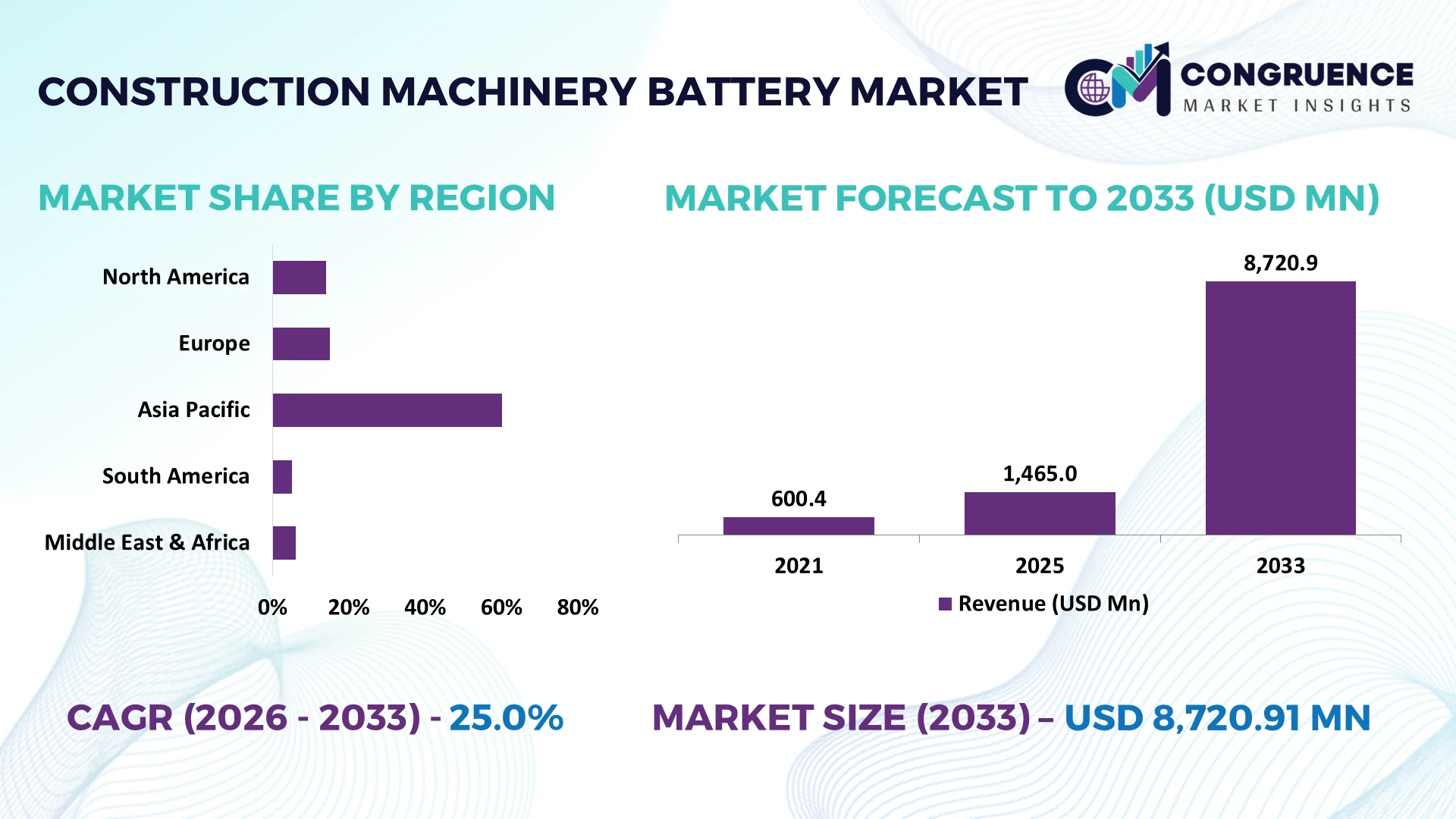
China anchors global dominance, commanding roughly 60% of Asia-Pacific market value with over 42% electric wheeled-loader penetration versus under 1% in the United States; domestic OEMs LiuGong and XCMG together control about 50% of China's battery-loader output and are accelerating exports to Europe and Australia. Beijing's grid and charging buildout for mining electrification further compounds this lead.
For competitors, the strategic implication is clear: scale, cost control, and supply-chain localization in China set the benchmark, while Western OEMs must defend premium segments through system-level integration and service depth.
Market Size & Growth: Valued at USD 1,465.0 Million in 2025, forecast to reach USD 8,720.9 Million by 2033, expanding at 24.98% CAGR; LFP chemistry adoption for high-cycle off-highway duty cycles is the primary volume driver.
Top Growth Drivers: Urban low-emission zones driving 31.5% electric mini-excavator adoption in EU city projects; 22.8% electric loader penetration in North American municipal fleets under IRA incentives; 41% battery cost decline versus 2022 levels.
Short-Term Forecast: By 2028, total cost of ownership parity for compact electric loaders narrows to within 8% of diesel equivalents, while fleet uptime rises 12% on fast-charging standardization.
Emerging Technologies: Fifth-generation fast-charge packs achieving 3C rates reducing recharge downtime by 40%; liquid-cooled 706 kWh packs enabling 40-tonne electric loader operation; AI-driven battery management software for duty-cycle optimization.
Regional Leaders: China at USD 879.0 Million with 42% electric wheeled-loader penetration; Europe at USD 293.0 Million with 31.5% mini-excavator adoption in urban projects; North America at USD 220.0 Million with 22.8% loader penetration in municipal fleets.
Consumer/End-User Trends: 68% of European contractors piloting electric machines require overnight-charging compatibility as a precondition; 54% of Chinese mining operators prioritize battery-swap capability over fixed charging.
Pilot/Case Example: 2026 LiuGong 8110TE 40-tonne electric loader deployment in UK quarry trials; 706 kWh LFP pack delivers full-shift runtime with under-60-minute recharge, achieving 95% machine availability versus 88% diesel baseline.
Competitive Landscape: Chinese OEMs hold approximately 50% combined share of global electric wheeled-loader production; key players include LiuGong, XCMG, Volvo CE, Caterpillar, and Microvast Power.
Regulatory & ESG Impact: EU Carbon Border Adjustment Mechanism transitional taxation raises diesel equipment holding costs, driving 2.3x increase in European electric procurement intent within 18 months.
Investment & Funding: Caterpillar committed approximately USD 1 billion to a North Carolina compact equipment facility; Ultium Cells allocated USD 1 billion for lithium-manganese-rich cell retooling targeting 33% energy density gains over LFP.
Innovation & Future Outlook: Solid-state and sodium-ion chemistries enter off-highway validation; strategic shift toward battery-as-a-service and OEM-owned charging ecosystems redefines contractor procurement economics.
The Construction Machinery Battery Market is pivoting from component supply to integrated energy systems, with demand concentrated in electric loaders and mini-excavators for urban and mining duty cycles. Fifth-generation packs now deliver 3C fast-charging and 706 kWh capacity, compressing recharge windows below 60 minutes for heavy platforms. A critical operational constraint persists: over seven competing fast-charge protocols remain in active deployment across global sites, inflating cross-brand infrastructure costs and slowing fleet standardization. This interoperability gap will shape procurement decisions and partnership strategies as operators scale electric fleets.
Battery performance now determines machine competitiveness in construction equipment, not merely energy supply. The shift from diesel to electric drivetrains is restructuring OEM value chains, charging infrastructure partnerships, and aftermarket service models simultaneously. Manufacturers that control battery integration, thermal management, and charging ecosystems capture margin; those that outsource entirely risk commoditization.
Technology comparison underscores the stakes: electric drivetrains convert 80–90% of energy to useful work versus 20–40% for diesel, while maintenance costs decline 25–50% on electric platforms. Regional deployment patterns diverge sharply. China's 42% electric wheeled-loader penetration reflects state-coordinated charging buildout for mining; Europe's 31.5% mini-excavator adoption in urban projects stems from noise and emissions zoning. North America lags at under 1% electric excavator penetration outside subsidized municipal pilots.
A practical deployment model is emerging in the UK: LiuGong's 8110TE 40-tonne loader combines a 706 kWh LFP pack with 720 kW charging, achieving full-shift runtime in quarry trials. OEMs are responding by pairing machine sales with charging-as-a-service contracts and dealer technician certification programs. Strategic positioning now hinges on ecosystem orchestration—battery supply, charging access, and service capability—rather than unit price alone. Companies that build these integrated capabilities will define the competitive hierarchy through 2030.
EU Carbon Border Adjustment Mechanism taxation and municipal low-emission zones are converting diesel operating costs into liabilities. European electric mini-excavator adoption in urban projects reached 31.5%, while Chinese electric wheeled-loader penetration hit 42% on mining charging infrastructure. OEMs are responding with dedicated electric production lines: Caterpillar allocated approximately USD 1 billion to a North Carolina compact equipment facility, and Ultium Cells committed USD 1 billion to lithium-manganese-rich cell retooling delivering 33% greater energy density than LFP at comparable cost. A non-obvious insight: regulatory pressure is not uniform—China's driver is industrial charging infrastructure, not carbon pricing, creating divergent product requirements for export versus domestic models.
Purchase prices for electric construction machines remain more than double diesel equivalents, and uncertain resale values deter fleet investment. Over seven competing fast-charge protocols remain in active deployment globally, inflating infrastructure costs and cross-brand compatibility risks. In the United States, electric excavator penetration stays below 1% outside subsidized pilots, reflecting both cost barriers and sparse jobsite charging. Companies are mitigating exposure through rental fleet expansion—shifting residual risk to OEM balance sheets—and battery leasing models. A sharp operational insight: dealers report that electric machine sales cycles are 40% longer than diesel equivalents because charging infrastructure assessment is now part of every transaction.
China's mining sector charging infrastructure, originally built for electric haul trucks, now enables large wheeled-loader electrification exceeding 55 kW, a segment Western OEMs largely neglect. Battery-swap models for Chinese mining operators show 54% preference over fixed charging, creating demand for standardized pack interfaces and swap-station networks. Microvast Power's fifth-generation C-pack delivers 3C charging and extended cycle life, targeting reduced downtime in heavy-duty Indian and Southeast Asian construction and mining applications. A non-obvious strategic opening: recycling infrastructure for first-generation off-highway batteries remains unbuilt, and companies establishing collection and material recovery networks now will control a critical supply chain node when the 2028 retirement wave arrives.
Electric machine deployment requires dealer technicians trained in high-voltage safety, battery diagnostics, and charging integration—capabilities currently scarce across European and North American dealer networks. Charging interface standardization lags market growth, with seven active fast-charge protocols creating cross-brand compatibility failures at multi-OEM sites. Extreme-duty thermal management in high-dust, high-vibration mining environments remains a validation bottleneck, with IEC reliability standards updates not expected before late 2026. Companies must invest in technician certification pipelines and demand OEM consortium participation in protocol unification. A strategic insight: the first OEM to publish open charging specifications and train third-party dealers will capture disproportionate share of fleet conversions from mixed-brand contractors.
LFP Chemistry Extends Cost Dominance Lithium iron phosphate packs now represent over 55% of global EV battery deployment and cost more than 40% less per kWh than nickel-based alternatives. Chinese OEMs leverage this to price electric loaders within 25% of diesel equivalents, while European manufacturers pivot entire compact machine lines to LFP to defend margin against Chinese imports. Dealers report faster customer payback acceptance on LFP platforms, shortening quotation-to-order cycles.
Modular Pack Architectures Scale Across Fleets Doosan Infracore's 2025 electric loader series introduced modular battery systems with AI-assisted predictive maintenance, deployed in Dubai and Seoul for commercial and municipal fleets. Operators swap pack configurations by duty cycle rather than replacing entire machines, reducing fleet capital exposure. European rental firms are trialing standardized modular interfaces across mixed-brand fleets, pressuring OEMs toward open specifications.
Charging Infrastructure Becomes Procurement Gate UK battery-electric equipment sales reached just 0.4% of the 34,000-unit market in 2025, with only 140 units sold, as charging access remains the binding constraint. This forces OEMs to bundle site charging assessments into sales contracts, with dealers in Norway and the Netherlands—where subsidies cover up to 60% of purchase price—closing electric deals three times faster than UK counterparts.
Electrification Benchmarking Reshapes OEM Strategy Volvo CE ranked first among 28 global OEMs on Interact Analysis's 2026 electrification benchmark, scoring highest across machine ranges, unit sales, in-house powertrain, charging provision, and sustainability targets. The ranking signals that investors and fleet buyers now evaluate OEMs on integrated electric ecosystems—machines, charging, and service—rather than unit specifications alone.
Lithium-ion batteries command approximately 72% of construction machinery battery market share, with LFP chemistry as the dominant sub-type due to superior cycle life, thermal stability, and cost per kWh. LFP packs are more than 40% cheaper per kilowatt-hour than nickel-based alternatives, enabling OEMs to price electric compact machines closer to diesel parity. This cost-performance profile makes LFP the default choice for mini-excavators and wheeled loaders operating standard urban duty cycles. Ternary lithium batteries retain relevance in high-energy-density applications where payload constraints outweigh cost sensitivity, though their share is contracting as LFP energy density improves.
The fastest-growing type is lithium titanate oxide (LTO), which delivers 20,000 to 60,000 cycles and supports 6–10C fast charging—capabilities that justify premium pricing in 24/7 mining operations. LTO pack costs can reach USD 1,000 per kWh, but this remains economical versus replacing multiple NMC or LFP packs over a machine's service life. Sodium-ion batteries are emerging as a long-horizon LFP alternative using abundant materials, with construction and mining machinery identified as significant adoption targets in the next decade. Companies are responding by dual-sourcing: LFP for volume platforms, LTO for mining-specific models, and sodium-ion validation programs for cost-sensitive markets.
Forklifts hold approximately 13% of construction machinery battery application share, reflecting material handling's early and mature electrification trajectory. Warehouse and logistics operators have operated electric forklifts for decades, creating established charging infrastructure and dealer service networks that construction-focused OEMs now leverage. This installed base provides battery suppliers with predictable replacement demand and validation data for cycle-life performance in industrial environments.
Excavators and loaders represent the fastest-growing application segment as OEMs commercialize battery-electric models for urban and mining duty cycles. Volvo CE, CASE, Bobcat, and John Deere are broadening electric excavator and loader offerings, while Chinese manufacturers drive adoption through cost-competitive LFP platforms. Underground mining operators are accelerating battery-electric loader and haul truck deployment to reduce ventilation and cooling expenses, which constitute a substantial share of mine operating costs. Concrete machinery remains a smaller but emerging segment, with electric mixer and pump variants entering pilot deployment in European low-emission zones. Companies are adapting by prioritizing charging infrastructure partnerships for urban excavator fleets and developing high-cycle LTO packs for mining loaders.
Mining end-users represent the leading demand concentration for high-capacity construction machinery batteries, driven by ventilation cost avoidance and 24/7 operational intensity. Underground mining ventilation and cooling can consume a substantial portion of mine operating expenses, creating direct economic incentive for battery-electric loaders and haul trucks that operate without diesel emissions. Caterpillar is advancing commercialization of its battery-electric mining truck platform, while LTO chemistry adoption accelerates in this segment due to its 20,000–60,000 cycle life and fast-charging capability matching continuous mining shift patterns.
Construction contractors represent the fastest-growing end-user group, with European urban low-emission zones and noise-sensitive residential projects driving electric mini-excavator and loader procurement. California's zero-emission off-road equipment initiatives are pushing contractors toward battery-electric alternatives to maintain project eligibility. Rental fleet operators are emerging as a critical channel, absorbing residual value risk and enabling contractors to trial electric machines without capital commitment. Companies are responding by developing end-user-specific offerings: mining-grade LTO packs with 6–10C charging, contractor-friendly modular LFP platforms with overnight-charging compatibility, and rental-oriented telematics that track battery health across mixed-duty deployments.
Asia-Pacific accounted for the largest market share at 60% in 2025 however, Europe is expected to register the fastest growth, expanding at a CAGR of 26.4% between 2026 and 2033.
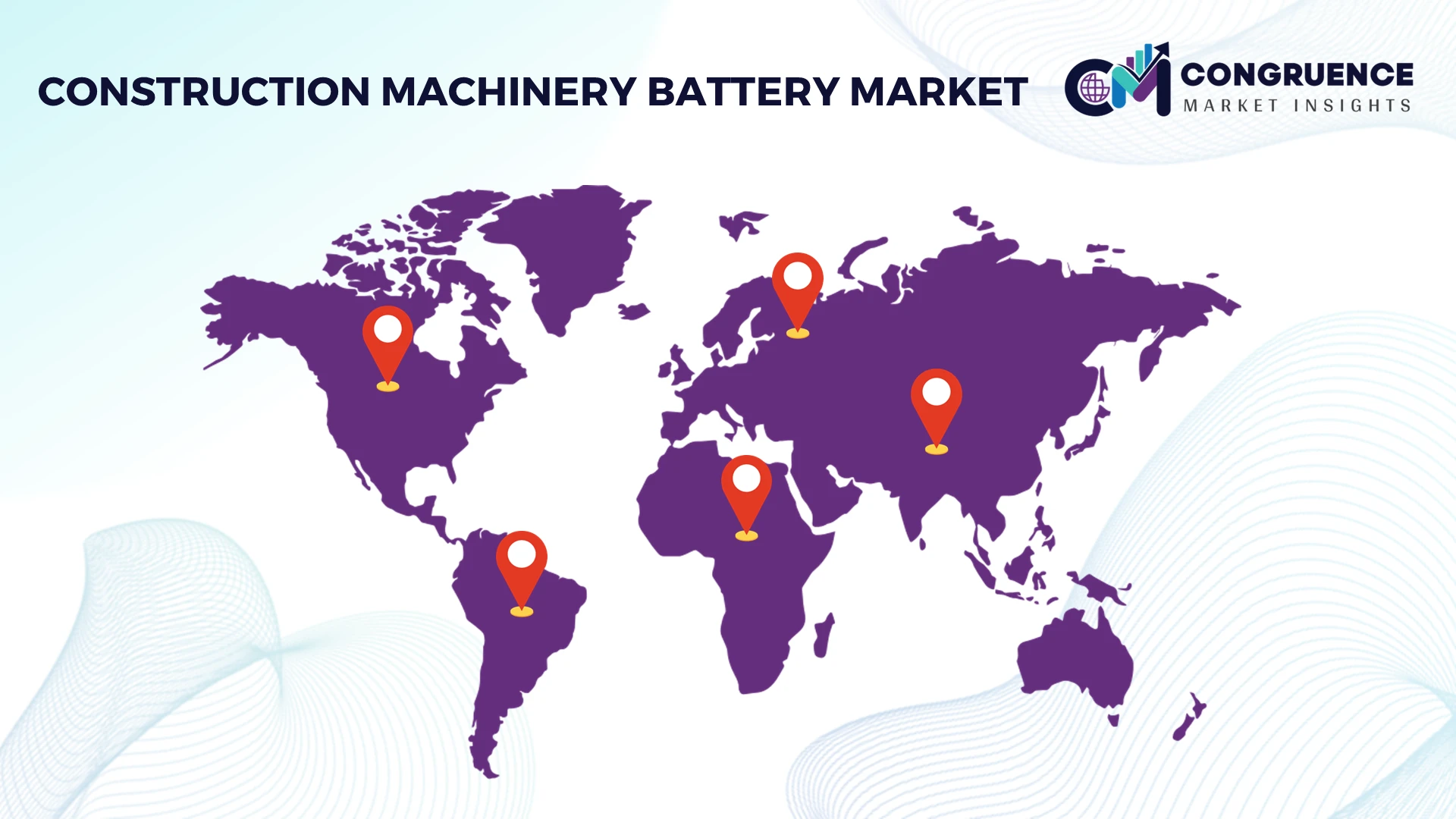
North America holds a 14% share of the global construction machinery battery market, with deployment concentrated in California and Pacific Northwest municipal fleets where zero-emission off-road mandates create procurement urgency. Battery-electric excavator penetration remains below 1% across the region, reflecting high purchase premiums and sparse jobsite charging infrastructure. Caterpillar’s roughly USD 1 billion commitment to a North Carolina compact equipment facility signals long-cycle supply localization, while Volvo CE and Bobcat prioritize compact loaders for landscaping and utility contractors. The region’s advantage lies in software integration—telematics-linked battery management enabling fleet-level charge scheduling—rather than volume manufacturing scale.
United States Market Outlook: California’s zero-emission off-road equipment rules and state-level incentive programs position the US as North America’s electrification testbed, with battery-electric construction equipment values exceeding USD 3.3 billion in 2025 and construction applications commanding 46.8% share . Contractors in Los Angeles and San Francisco Bay Area projects face compliance deadlines that make electric mini-excavators operationally necessary rather than discretionary, creating a premium market for OEMs with certified dealer service networks.
Europe commands a 15% share of global construction machinery battery demand, anchored by low-emission zone enforcement across Norwegian, Dutch, and German cities where diesel equipment faces operating restrictions and noise penalties. Battery-electric mini-excavator adoption in urban projects reached 31.5%, outpacing North America by a wide margin, though wheeled-loader penetration remains at 5% . Volvo CE’s Gothenburg production line and Liebherr’s Bischofshofen battery assembly represent localized supply chain investments reducing dependence on Asian cell imports. The region’s competitive differentiation rests on integrated charging-as-a-service contracts and dealer technician certification programs that de-risk fleet conversion for midsize contractors.
Germany Market Outlook: Germany’s Zeppelin dealer network and Bauma-driven procurement cycles make it Europe’s highest-volume battery-electric equipment market, with manufacturers leveraging the country’s engineering workforce for high-voltage safety certification and battery diagnostics training. Berlin and Munich municipal projects require noise-compliant equipment, creating steady compact excavator demand that supports domestic assembly and aftermarket service expansion.
Asia-Pacific dominates with a 60% share of global construction machinery battery demand, driven overwhelmingly by China’s 42% electric wheeled-loader penetration—a figure unmatched globally and rooted in state-coordinated mining charging infrastructure . Chinese OEMs LiuGong, XCMG, and SANY leverage LFP cell supply from CATL and EVE Energy to price electric loaders within 25% of diesel equivalents, creating a cost gap Western manufacturers cannot match without localized cell production. India and Indonesia represent secondary growth frontiers for compact electric equipment in urban infrastructure, though charging reliability and grid stability constrain deployment to semi-permanent sites. The region’s export strategy is shifting from finished machines to battery packs and charging hardware, embedding Chinese standards in global supply chains.
China Market Outlook: China’s battery-electric construction machinery ecosystem benefits from vertically integrated LFP supply, with CATL and EVE Energy collectively holding over half of global construction machinery battery share . Domestic mining operators’ 54% preference for battery-swap configurations over fixed charging has driven standardized pack interface development, creating export-ready swap-station models that Chinese OEMs are deploying in Southeast Asian and African mining projects.
South America contributes a 5% share of global construction machinery battery demand, concentrated in Chilean and Peruvian copper mining operations where ventilation cost avoidance justifies premium pricing for battery-electric loaders and haul trucks. Urban construction electrification remains nascent, with battery-electric excavator penetration below 1% across Brazil and Argentina as charging infrastructure gaps and high equipment import duties suppress adoption. Brazilian rental fleet operators are beginning to absorb residual value risk, importing Chinese compact electric loaders for São Paulo infrastructure projects. The region’s growth trajectory depends on mining sector decarbonization commitments rather than construction market dynamics, creating a bifurcated adoption pattern distinct from other regions.
Chile Market Outlook: Chile’s state-owned Codelco and private copper miners are accelerating battery-electric loader deployment to reduce underground ventilation expenses, creating a high-value niche for LTO chemistry packs with 20,000-plus cycle life. Antofagasta region mining projects require equipment capable of continuous shift operation without surface charging access, driving demand for battery-swap configurations that Chinese OEMs are positioned to supply.
Middle East & Africa holds a 6% share of global construction machinery battery demand, shaped by Saudi Vision 2030 giga-projects and UAE infrastructure programs that create theoretical volume but remain dominated by diesel fleets at 72.63% of the regional equipment market . Electric and hybrid machinery are growing from a small base, with Saudi Arabia’s rental sector expanding at double-digit rates to provide contractors access to advanced electric excavators without capital commitment. Charging infrastructure in desert environments presents thermal management challenges that LFP packs address more effectively than NMC alternatives, though battery degradation in extreme heat remains a validation bottleneck. The region’s strategic importance lies in its role as a testing ground for high-temperature battery performance rather than near-term volume.
Saudi Arabia Market Outlook: Saudi Arabia’s NEOM and Red Sea giga-projects require zero-emission equipment for LEED-certified construction zones, creating concentrated demand for battery-electric excavators and loaders despite regional diesel dominance. Riyadh’s rental fleet expansion enables contractors to trial electric machines on discrete project phases, with telematics-as-a-service models providing remote monitoring for desert site battery health and charging schedule optimization.
CATL, EVE Energy, and EnerSys collectively control over half of global construction machinery battery supply, with Chinese cell giants competing against regional pack assemblers and OEM-captive suppliers. Competition pivots on LFP cost leadership—Chinese cells undercut Western packs by 30–40% per kWh—forcing European and American players toward high-voltage integration and thermal management differentiation. OEMs like Caterpillar and Volvo CE are vertically integrating packs into machine platforms, while Microvast and Forsee Power pursue partnership-led entry through mining and heavy-duty niches. The decisive shift is from cell procurement to system orchestration: charging protocols, battery-swap standards, and aftermarket diagnostics now determine margin capture. The entry barrier is not chemistry but validated reliability data across 12,000+ duty cycles. Winning requires either cell-cost dominance or ecosystem control—players lacking both face commoditization.
CATL
EVE Energy
EnerSys
GS Yuasa
Hoppecke
Gotion High-tech
Microvast Power
Forsee Power
Farasis Energy
Ruipu Energy
CALB Group
East Penn Manufacturing
Midac SpA
LFP dominates current deployment, delivering 3,000–5,000 cycles at 40% lower cost than NMC, with over 70% of new electric construction machines specifying LFP chemistry. Adoption is near-universal in Chinese loaders and European compact excavators, where cost-per-kWh and thermal stability outweigh energy density penalties.
LTO anodes are emerging for mining haul trucks, supporting 20,000–60,000 cycles and 6–10C charging that compress downtime to minutes—a 3–5x cycle-life improvement over graphite-based LFP. Sodium-ion cells, offering LFP-comparable density at 30% lower material cost, enter validation for agricultural and remote-site machinery where lithium supply exposure is a strategic concern. Solid-state remains pre-commercial but targets 500 Wh/kg, potentially extending runtime for high-draw excavators.
Caterpillar’s May 2026 modular battery-electric power unit integrates packs, power electronics, and controls into a single platform, signaling OEMs are capturing system-level margin rather than ceding value to cell suppliers. Between 2026 and 2028, LTO commercialization in mining and sodium-ion pilot deployment in cost-sensitive markets will determine which suppliers escape LFP commoditization.
September 2026 — Microvast Power Showcased 5th-generation C-pack and MT-pack battery systems at bauma CONEXPO INDIA, targeting mining and construction with 3C fast-charging and enhanced vibration resistance for high-altitude and salt-exposure conditions; positions Microvast for South Asian heavy-duty electrification. Source: yna.co.kr
May 2026 — Caterpillar Introduced a modular battery-electric power unit at IFAT 2026 integrating batteries, power electronics, and control technologies into a single platform for construction, recycling, and municipal equipment; reduces integration complexity for OEMs adopting electrification.
March 2026 — Microvast and Iveco Group Expanded long-standing battery partnership, advancing next-generation packs for European commercial vehicle platforms; Microvast’s Huzhou 3.2 capacity comes online to support European-assembled battery solutions. Source: ir.microvast.com
May 2026 — Forsee Power and Hitachi Industrial Products Signed MoU to collaborate on hybrid and electric systems for mining vehicles, locomotives, and construction machinery, combining Hitachi’s motors and inverters with Forsee Power’s battery systems and aftermarket reach. Source: live.euronext.com
This report delivers a comprehensive assessment of the global construction machinery battery market, segmented by battery type (LFP, NMC, LTO, sodium-ion, and emerging chemistries), application (electric forklifts, excavators, loaders, and concrete machinery), and end-user (mining, construction contractors, and rental fleets). Regional coverage spans Asia-Pacific, Europe, North America, South America, and the Middle East & Africa, with country-level granularity for China, the United States, Germany, Chile, and Saudi Arabia.
Quantitative indicators include segment distribution across LFP-dominant volume platforms and LTO-led mining applications, adoption rates by machine category, deployment concentration in urban and underground environments, and company participation levels across cell supply, pack assembly, and charging infrastructure. The report supports investment planning through technology-readiness mapping, expansion strategy via region-specific adoption curves, and competitive positioning by benchmarking OEM-captive versus merchant supplier models. Strategic direction between 2026 and 2033 is framed around LTO commercialization, sodium-ion validation, and charging ecosystem control.
| Report Attribute / Metric | Details |
|---|---|
| Market Revenue (2025) | USD 1,465.0 Million |
| Market Revenue (2033) | USD 8,720.9 Million |
| CAGR (2026–2033) | 24.98% |
| Base Year | 2025 |
| Forecast Period | 2026–2033 |
| Historic Period | 2021–2025 |
| Segments Covered |
By Type
By Application
By End-User
|
| Key Report Deliverables | Revenue Forecast; Market Trends; Growth Drivers & Restraints; Technology Insights; Segmentation Analysis; Regional Insights; Competitive Landscape; Regulatory & ESG Overview; Recent Developments |
| Regions Covered | North America; Europe; Asia-Pacific; South America; Middle East & Africa |
| Key Players Analyzed | CATL; EVE Energy; EnerSys; GS Yuasa; Hoppecke; Gotion High-tech; Microvast Power; Forsee Power; Farasis Energy; Ruipu Energy; CALB Group; East Penn Manufacturing; Midac SpA |
| Customization & Pricing | Available on Request (10% Customization Free) |




