
Reports
The Global Construction Formwork Market was valued at USD 8,021.4 Million in 2025 and is anticipated to reach a value of USD 12,033.1 Million by 2033 expanding at a CAGR of 5.2% between 2026 and 2033. Growth is being driven by the replacement of timber with reusable engineered systems, high-rise construction, infrastructure modernization, and labor-saving automation that improves formwork cycle productivity.
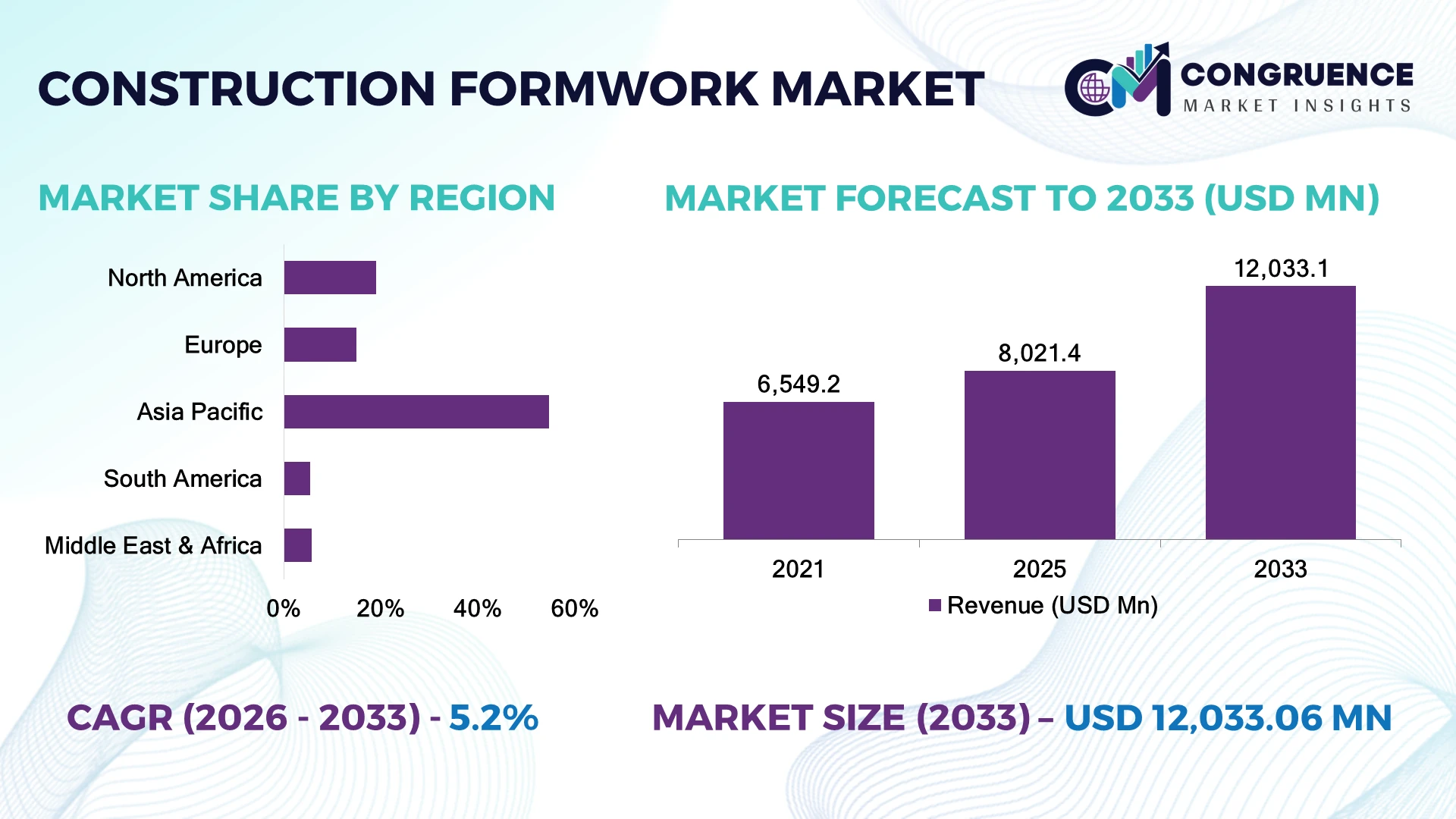
China remains the dominant country-level market, accounting for more than 50% of Asia-Pacific formwork demand, while India is the region’s fastest-expanding construction market, supported by metro, highway, housing, and industrial investment. Asia-Pacific represented approximately 54.7% of global concrete formwork demand in 2025. Advanced aluminum and modular systems are increasingly favored for repetitive projects, with reusable engineered formwork achieving substantially higher cycle counts than conventional timber. The 2025–2026 escalation in global steel tariffs has also strengthened the case for localized sourcing and material-efficient designs.
The strategic implication is that formwork suppliers with reusable systems, localized inventories, digital engineering, and automation will capture higher-value construction projects.
Market Size & Growth: USD 8.02 billion in 2025 to USD 12.03 billion by 2033 at 5.2% CAGR, driven by reusable engineered systems and high-rise construction.
Top Growth Drivers: Asia-Pacific accounts for 54.7% of demand; engineered systems represent approximately 38.5%; infrastructure applications contribute about 28.5%.
Short-Term Forecast: By 2028, automated handling and digitally coordinated formwork can improve site productivity by approximately 15–25% while reducing manual positioning requirements.
Emerging Technologies: AI-enabled fabrication, robotic formwork assembly, real-time load sensors, automated climbing systems, and BIM-integrated formwork design are moving into commercial deployment.
Regional Leaders: Asia-Pacific is positioned near USD 6.58 billion by 2033, Europe around USD 2.39 billion, and North America approximately USD 2.15 billion based on current regional shares and market expansion.
Consumer/End-User Trends: Infrastructure represents approximately 28.5% of consumption, while high-rise residential projects increasingly favor reusable aluminum and tunnel systems.
Pilot/Case Example: 2025 Indian high-rise comparisons found tunnel formwork capable of approximately 450–500 repetitions versus 200–250 for aluminum systems, strengthening economics on highly repetitive projects.
Competitive Landscape: PERI and Doka lead advanced engineered formwork, supported by ULMA, MEVA, and NOE, with engineered systems accounting for approximately 38.5% of product demand.
Regulatory & ESG Impact: Reusable systems reduce material consumption across repeated pours, while tighter safety and embodied-carbon requirements are increasing adoption of engineered, traceable formwork solutions.
Investment & Funding: Construction-technology investment is shifting toward robotics, digital fabrication, sensor-based monitoring, and modular formwork fleets, with major suppliers expanding automated solutions and rental capabilities.
Innovation & Future Outlook: The market is transitioning toward intelligent reusable systems combining BIM, automation, load monitoring, AI-assisted fabrication, and optimized material utilization.
The Construction Formwork Market is increasingly shaped by high-rise residential construction, transport infrastructure, industrial facilities, and complex concrete structures requiring predictable cycle times. Engineered reusable systems already represent approximately 38.5% of product demand, while aluminum and tunnel solutions are gaining traction where repetitive layouts justify higher initial investment. In 2026, steel-cost volatility, labor shortages, and tighter project schedules are accelerating the shift toward lighter, reusable, digitally coordinated formwork, strengthening the strategic value of integrated equipment suppliers.
Construction formwork is becoming strategically important because it directly determines concrete cycle time, labor intensity, structural accuracy, and project sequencing. With infrastructure and high-rise projects becoming more schedule-sensitive, contractors are moving away from disposable timber toward reusable engineered systems. Engineered formwork already represents approximately 38.5% of global demand, demonstrating a structural shift toward standardized, repeat-use equipment.
Technology is sharpening this transition. Tunnel systems can achieve approximately 450–500 repetitions compared with 200–250 for aluminum systems, while automated positioning and sensor-assisted systems improve handling productivity by approximately 15–25%. Asia-Pacific emphasizes high-volume deployment across China and India, whereas Europe and North America place greater emphasis on digital coordination, safety, and specialized infrastructure applications. The difference is shifting competition from equipment availability toward lifecycle economics and technical support.
Through 2026–2028, suppliers are prioritizing robotic assembly, automated climbing, BIM integration, real-time load monitoring, and AI-enabled custom fabrication. Doka’s automation portfolio and PERI’s AI-enabled custom-formwork initiatives demonstrate the move toward digitally coordinated systems. Contractors are increasingly evaluating formwork based on total project-cycle economics rather than rental price alone. The strategic advantage will belong to suppliers that combine reusable equipment, engineering expertise, local inventory, digital workflows, and responsive site support.
The shift from disposable timber toward engineered reusable formwork is strengthening demand, particularly across high-rise and infrastructure projects. Engineered systems account for approximately 38.5% of global formwork demand, while reusable aluminum and tunnel systems can achieve 200–500 casting cycles depending on design and application. In India, metro, residential, and highway construction is accelerating adoption of modular systems that reduce repetitive setup requirements. Labor shortages are reinforcing the shift toward lighter panels and mechanized handling. Manufacturers are responding by expanding rental fleets, developing modular configurations, and integrating BIM-based engineering. The strategic advantage is increasingly lifecycle productivity rather than purchase price: contractors can spread equipment costs across multiple pours while shortening structural cycles.
Formwork suppliers remain exposed to fluctuations in steel, aluminum, plywood, coatings, and transport costs, which directly affect fleet replacement and rental economics. Steel and aluminum can collectively account for approximately 50–65% of material value in engineered formwork systems, while transportation can add 5–15% to delivered equipment costs on complex projects. Global trade restrictions and freight volatility have increased procurement uncertainty, particularly for import-dependent markets. Contractors also face higher mobilization costs when equipment must move between distant projects. Suppliers are responding through regional fabrication, diversified material sourcing, refurbishment programs, and longer-term procurement contracts. The operational pressure is strongest on rental companies because underutilized fleets lock capital into equipment without generating proportional project revenue.
Digital formwork creates an opportunity to integrate equipment engineering directly with project scheduling, structural models, and site logistics. BIM-linked formwork planning can reduce coordination effort by approximately 10–20%, while automated positioning and optimized sequencing can improve cycle productivity by 15–25% on repetitive structures. India, Saudi Arabia, and Southeast Asian construction hubs offer particularly strong opportunities because large residential and infrastructure projects support standardized deployment. AI-assisted panel configuration and digital twins are emerging as next-generation tools for optimizing equipment utilization. Suppliers are investing in software platforms, sensor-enabled systems, and engineering partnerships. A less obvious opportunity is predictive fleet management: tracking panel utilization and refurbishment requirements can improve rental-fleet availability without proportional increases in physical inventory.
Increasingly complex structures are challenging the economics of standardized formwork, particularly in data centers, transport hubs, stadiums, and architecturally complex buildings. Custom components can increase engineering requirements by approximately 15–25%, while irregular geometries reduce reuse rates compared with repetitive floor layouts. Integration between BIM models, structural engineering software, and fabrication systems also remains inconsistent across project teams. Skilled formwork engineers and experienced site crews remain essential for complex climbing, shoring, and load-transfer operations. Companies must invest in parametric design, automated fabrication, technical training, and stronger contractor collaboration. The strategic challenge is balancing customization with fleet standardization: suppliers that modularize custom solutions rather than fabricate entirely bespoke systems can protect reuse rates while meeting demanding project geometries.
Aluminum Systems Gain Site Adoption: Contractors are increasing aluminum-formwork deployment on repetitive residential structures because lighter panels simplify manual handling and accelerate floor cycles. Modern systems can support approximately 200–500 repetitions, while panel weight reductions of 20–30% versus heavier steel configurations improve handling efficiency. Suppliers are expanding rental inventories around high-density housing markets.
BIM Connects Design With Installation: Formwork planning is increasingly linked to BIM models, enabling earlier clash detection, component scheduling, and installation sequencing. Digitally coordinated workflows can reduce coordination effort by approximately 10–20% and cut rework exposure on complex projects. Major contractors are requiring suppliers to provide model-compatible engineering data before equipment mobilization.
Rental Fleets Become Data-Managed: Formwork rental companies are moving from equipment availability tracking toward utilization and refurbishment analytics. Digital fleet monitoring can improve asset utilization by approximately 5–15% by identifying idle panels, maintenance requirements, and redeployment opportunities. Rising equipment costs are pushing suppliers to extract more value from existing fleets rather than relying solely on fleet expansion.
Sensorized Systems Improve Safety: Load cells, displacement sensors, and digital monitoring are increasingly being incorporated into climbing and shoring systems, particularly on high-rise projects. Real-time monitoring can reduce manual inspection frequency by approximately 20% while improving visibility into load and movement conditions. Safety requirements and increasingly complex structures are encouraging suppliers to integrate sensors with site-control platforms.
Engineered formwork systems represent approximately 38.5% of global construction formwork demand, supported by higher repeatability, structural precision, and suitability for high-rise and infrastructure projects. Steel systems remain important for heavy-duty applications, accounting for roughly 27%, while aluminum systems contribute about 22% and timber-based solutions approximately 12%. Steel retains an advantage where high load capacity and repeated industrial use are required, whereas aluminum is gaining share because lighter panels reduce handling requirements and support faster floor cycles. Companies are increasingly expanding modular product portfolios and rental fleets to capture recurring project demand.
Aluminum formwork is among the fastest-growing types, particularly in India, Southeast Asia, and Middle Eastern residential developments. Its lightweight configuration can reduce manual handling requirements by approximately 20–30% compared with heavier conventional systems. Tunnel and climbing systems are also gaining traction on repetitive structures. Manufacturers are prioritizing standardized panel dimensions, interchangeable components, and BIM-compatible engineering to improve reuse rates and reduce customization costs.
Industry productivity assessments in 2025–2026 continued to identify engineered reusable formwork as a key productivity mechanism for repetitive concrete construction, particularly where standardized floor layouts support repeated equipment cycles.
Residential construction represents approximately 34% of global construction formwork demand, making it the leading application because high-rise apartments and repetitive housing layouts provide favorable economics for reusable systems. Infrastructure follows at approximately 29%, supported by bridges, tunnels, metro systems, highways, and other concrete-intensive projects. Commercial construction contributes about 21%, while industrial applications account for roughly 16%. Residential projects favor aluminum and tunnel systems because repeated floor plates allow equipment costs to be distributed across hundreds of similar structural cycles.
Infrastructure is emerging as the fastest-growing application category as governments accelerate transportation and urban infrastructure programs. Complex bridge and tunnel projects increasingly require climbing, self-climbing, and heavy-duty engineered systems capable of handling demanding geometries. Such systems can reduce structural cycle times by approximately 15–25% compared with fragmented conventional workflows. Suppliers are responding through specialized infrastructure divisions, larger rental fleets, engineering partnerships, and project-specific formwork packages. The business implication is a shift from basic equipment supply toward integrated formwork engineering and site-support services.
Construction productivity research in 2025–2026 continued to show that repetitive formwork systems can reduce structural cycle times by roughly 15–25% on suitable high-volume projects, strengthening their use in residential and infrastructure construction.
Construction contractors represent approximately 42% of global formwork demand, reflecting their direct responsibility for project execution, cycle-time management, labor productivity, and equipment selection. Formwork rental companies account for approximately 28%, while specialized precast and concrete contractors contribute about 17%; developers and other project owners represent the remaining 13%. Contractors prioritize equipment availability, engineering support, installation speed, and total project cost, whereas rental companies focus heavily on fleet utilization, refurbishment, and redeployment.
Rental companies are becoming an increasingly important growth channel because contractors prefer flexible access to engineered systems without committing substantial capital to equipment ownership. Fleet-based procurement can reduce upfront equipment expenditure by approximately 20–30% for short-duration projects, depending on utilization and rental terms. Companies are therefore expanding regional depots, refurbishment centers, digital fleet-management systems, and technical support teams. Leading suppliers are also developing hybrid ownership-rental models and long-term framework agreements. Future competitive positioning will increasingly depend on equipment availability, rapid redeployment, engineering customization, and lifecycle support rather than equipment price alone.
Industry rental-market assessments indicate that equipment utilization and redeployment efficiency are becoming increasingly important purchasing criteria as contractors seek to limit idle equipment and manage construction-equipment capital exposure.
Asia-Pacific accounted for the largest market share at 54.7% in 2025 however, Asia-Pacific is expected to register the fastest growth, expanding at a CAGR of 6.1% between 2026 and 2033.
Infrastructure renewal is accelerating engineered and rental-based formwork deployment
North America accounts for approximately 19% of global construction formwork demand, with the United States representing the overwhelming share of regional consumption. Highway rehabilitation, bridge replacement, data centers, warehouses, and high-rise residential projects are sustaining demand for aluminum, steel, climbing, and modular systems. Contractors are increasingly prioritizing reusable equipment because skilled-labor constraints place greater emphasis on faster structural cycles and reduced site handling. Advanced engineered systems can improve repetitive construction productivity by approximately 15–25% compared with fragmented conventional workflows. Suppliers are responding through regional rental fleets, automated climbing solutions, BIM-based engineering, and expanded technical support. The strongest demand is concentrated around major construction corridors where equipment redeployment can improve fleet utilization and reduce transportation costs.
United States Market Outlook: The United States remains the dominant North American market, supported by large transportation, commercial, industrial, and residential construction programs. High-rise and infrastructure contractors increasingly use engineered climbing and modular systems to reduce repetitive setup requirements. Rental-based procurement is particularly important, allowing contractors to access specialized equipment without carrying the full capital burden of ownership.
Digital engineering and sustainability requirements are reshaping equipment selection
Europe represents approximately 15% of global construction formwork demand, with Germany, France, the United Kingdom, Italy, and Spain forming the principal markets. Mature adoption of engineered systems is shifting toward BIM-integrated planning, automated climbing, lightweight aluminum solutions, and equipment refurbishment. Stricter construction-safety requirements and embodied-carbon considerations are encouraging contractors to select reusable systems with longer service lives. Digital formwork planning can reduce coordination and rework requirements by approximately 10–20% on complex projects. Manufacturers are investing in parametric engineering, equipment tracking, and low-material designs while expanding rental and refurbishment capabilities. The market is increasingly rewarding suppliers that combine technical engineering with documented lifecycle performance rather than competing purely on equipment rental rates.
Germany Market Outlook: Germany represents a strategically important market because of its advanced engineering sector, established construction-equipment ecosystem, and strong adoption of digitally coordinated construction processes. Major contractors increasingly integrate formwork planning with BIM workflows to manage complex structural sequences. Demand for reusable systems is reinforced by stringent safety requirements and the need to control labor intensity on infrastructure and commercial projects.
High-volume construction is creating a scale advantage for modular systems
Asia-Pacific represents approximately 54.7% of global construction formwork demand, led by China and supported by India, Japan, South Korea, and Southeast Asia. China provides the region's largest construction base, while India is rapidly increasing consumption through metro systems, highways, housing, industrial parks, and commercial towers. Repetitive project layouts favor aluminum and tunnel formwork because high equipment utilization spreads initial investment across numerous structural cycles. Advanced systems can support approximately 200–500 repetitions depending on configuration and application. Manufacturers are expanding regional fabrication facilities, rental depots, and standardized panel inventories while integrating BIM with engineering workflows. The strategic advantage increasingly comes from localized equipment availability combined with large-scale manufacturing and rapid redeployment.
China Market Outlook: China remains the largest country-level market, supported by extensive residential, infrastructure, commercial, and industrial construction activity. Domestic manufacturers benefit from established fabrication capacity and access to large project pipelines. High-volume developments support extensive reuse of standardized formwork, while automated handling and digital engineering are increasingly deployed to improve labor productivity and maintain consistent structural tolerances.
Urban construction and infrastructure renewal are expanding engineered-system adoption
South America accounts for approximately 5.5% of global construction formwork demand, with Brazil representing the principal market through residential, commercial, industrial, and transportation projects. São Paulo and other major construction centers concentrate demand for aluminum, steel, and modular systems where equipment can be efficiently redeployed between projects. Reusable formwork can reduce repetitive structural cycle times by approximately 15–25%, supporting adoption among contractors facing labor and scheduling constraints. However, long-distance equipment movement can materially increase delivered costs, encouraging suppliers to establish regional depots and refurbishment facilities. Companies are increasingly combining equipment rental with engineering support and site supervision. This integrated model is particularly valuable for contractors seeking faster deployment without maintaining large permanent formwork inventories.
Brazil Market Outlook: Brazil is the largest South American market, supported by major residential, commercial, sanitation, transportation, and industrial construction programs. Its concentrated construction activity around São Paulo and other metropolitan areas supports regional equipment utilization and redeployment. Suppliers with local inventories and refurbishment capabilities can reduce mobilization time while providing contractors with flexible access to engineered aluminum and steel systems.
Mega-project pipelines are driving specialized formwork capacity and local manufacturing
Middle East & Africa represents approximately 5.3% of global construction formwork demand, with Saudi Arabia and the United Arab Emirates serving as major deployment centers. Large-scale urban, tourism, hospitality, transportation, and industrial developments require climbing, tunnel, modular, and high-load systems capable of supporting compressed construction schedules. Saudi Arabia's project pipeline is particularly suited to reusable formwork because repetitive structures can generate high equipment utilization. Engineered systems can reduce structural cycle times by approximately 15–25% on suitable projects. Suppliers are responding with dedicated rental fleets, local technical teams, regional warehouses, and project-specific engineering partnerships. Increasing localization requirements are also encouraging manufacturers to establish regional fabrication and servicing capabilities rather than relying entirely on imported equipment.
Saudi Arabia Market Outlook: Saudi Arabia is the strategically significant country because large-scale urban and infrastructure developments require high-volume formwork deployment across repetitive structures. Major construction programs favor climbing and modular systems capable of supporting accelerated floor cycles. Suppliers are increasingly establishing local technical support, equipment inventories, and project partnerships to improve response times and meet increasingly demanding construction schedules.
PERI, Doka, ULMA Construction, MEVA, and NOE compete directly in engineered formwork, while regional manufacturers and rental specialists compete on proximity and price. The top five players are estimated to control approximately 18% of global demand, leaving a fragmented field where local suppliers retain meaningful influence. Competition centers on lifecycle cost, engineering, availability, speed, and customization: reusable systems can deliver 200–500 cycles, while automated solutions can improve repetitive workflow productivity by 15–25%. PERI and Doka are pushing digital planning, automation, and integrated services; ULMA and MEVA emphasize lightweight modular systems and project-specific engineering. The competitive shift is toward rental ecosystems, sensor-enabled equipment, BIM integration, and localized inventories rather than standalone hardware. Entry barriers include engineering expertise, fleet capital, safety certification, and regional logistics. Winning requires dense service coverage, high equipment utilization, rapid engineering response, and technology that demonstrably reduces site labor, cycle time, or total installed cost across key markets.
PERI SE
Doka GmbH
ULMA Construction
MEVA Formwork Systems
NOE-Schaltechnik Georg Meyer-Keller GmbH + Co. KG
RMD Kwikform
EFCO Corp.
Alsina Formwork
MFE Formwork Technology
PASCHAL-Werk G. Maier GmbH
ULMA Architectural Solutions
Acrow Formwork & Scaffolding
Condor Group
Kumkang Kind
Current formwork technology is moving from manual panel assembly toward BIM-linked engineering, lightweight aluminum systems, automated climbing, and sensor-assisted monitoring. Digital planning can reduce coordination effort by 10–20%, while automated positioning can improve repetitive workflow productivity by 15–25%. Adoption is strongest on high-rise, infrastructure, and standardized residential projects. Doka’s DokaXbot Lift and FormDrive demonstrate the transition toward semi-automated handling and climbing systems.
Emerging platforms integrate real-time concrete-pressure sensors, load monitoring, digital twins, and cloud-based fleet management. Sensor-enabled systems can reduce manual inspection requirements by approximately 20%, while digital inventory tracking can improve equipment utilization by 5–15%. Compared with conventional paper-based planning and manual inventory control, integrated digital workflows can improve coordination efficiency by roughly 15–20%. Large rental fleets benefit most because utilization data supports faster redeployment and lower idle-equipment exposure.
Between 2026 and 2028, AI-assisted formwork configuration, robotic assembly, automated climbing, and CNC-produced custom panels will become increasingly relevant for complex structures. PERI’s DataForm.Work demonstrates software-to-CNC custom-formwork integration. Competitive advantage will shift toward suppliers combining reusable equipment, digital engineering, automation, and local technical support. Companies acting now can improve cycle predictability, reduce labor dependence, and differentiate through measurable site productivity rather than equipment price alone today.
April 2025 Doka showcased robotics, sensor technology, and automated climbing formwork at bauma, including DokaXbot Lift positioning panels up to 5.7 metres high. The rollout targets safer overhead handling and higher productivity, strengthening automation-led on-site differentiation. (Doka) Source: doka.com
February 2025 PERI launched DataForm.Work with DataB, combining automated custom-formwork design with CNC production. The joint venture is equally owned, with each partner holding 50%, creating a route to faster bespoke formwork for complex infrastructure projects. (PERI Group) Source: peri.com
March 2025 ULMA supplied ORMA, KSP, and BMK systems for Aldergrove Town Center in Canada, where BMK climbing equipment reduced crane use by 50%. The deployment demonstrates how formwork packages can lower handling requirements while maintaining efficiency. (ULMA Construction) Source: ulmaconstruction.com
June 2025 MEVA’s FormworkPress highlighted a Leeds residential project using MevaDec, where optimized material requirements improved cycle logistics and reduced handling. The system enabled panels to be repositioned efficiently, supporting scheduled completion in spring 2026 while strengthening rental-to-purchase conversion. (Meva) Source: meva.net
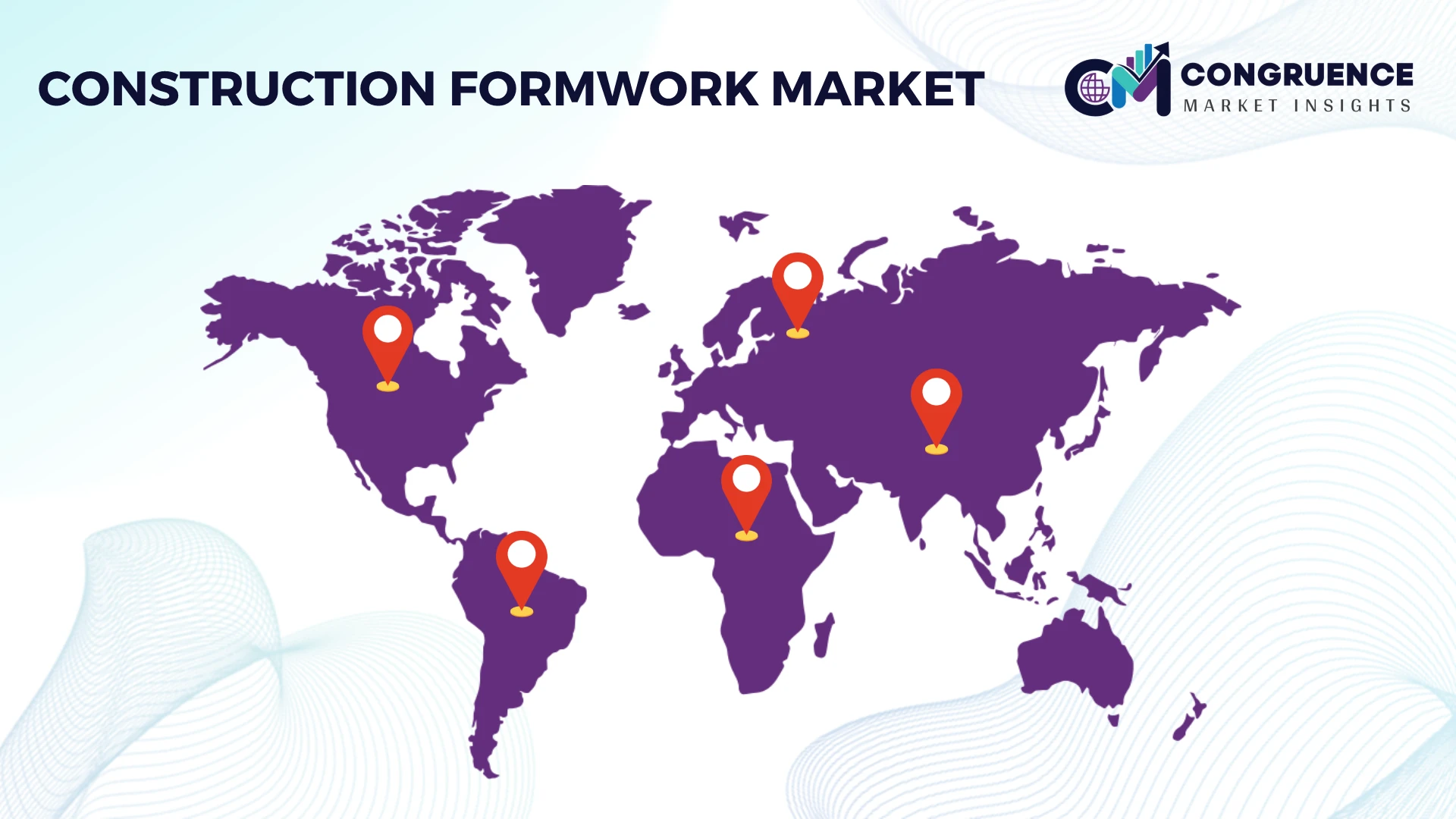
The Construction Formwork Market Report covers engineered systems, steel, aluminum, timber, tunnel, climbing, modular, and specialized formwork across residential, commercial, infrastructure, and industrial applications. End-user analysis includes contractors, formwork rental companies, specialized concrete contractors, developers, and project owners. Regional coverage spans North America, Europe, Asia-Pacific, South America, and Middle East & Africa, with country-level assessment of major construction hubs and deployment patterns.
The report evaluates BIM-integrated engineering, automated climbing, robotic handling, sensor-based monitoring, digital fleet management, lightweight systems, and CNC-enabled custom formwork. Engineered systems represent approximately 38.5% of demand, while advanced reusable solutions can support 200–500 cycles depending on configuration. Competitive analysis covers global formwork manufacturers, rental specialists, and regional suppliers, supporting technology investment, fleet expansion, market-entry planning, partnership development, pricing strategy, and competitive positioning through 2026–2033.
| Report Attribute/Metric | Report Details |
|---|---|
|
Market Revenue in 2025 |
USD 8,021.4 Million |
|
Market Revenue in 2033 |
USD 12,033.1 Million |
|
CAGR (2026 - 2033) |
5.2% |
|
Base Year |
2025 |
|
Forecast Period |
2026 - 2033 |
|
Historic Period |
2021 - 2025 |
|
Segments Covered |
By Type
By Application
By End-User
|
|
Key Report Deliverable |
Revenue Forecast, Growth Trends, Market Dynamics, Segmental Overview, Regional and Country-wise Analysis, Competition Landscape |
|
Region Covered |
North America, Europe, Asia-Pacific, South America, Middle East, Africa |
|
Key Players Analyzed |
PERI SE, Doka GmbH, ULMA Construction, MEVA Formwork Systems, NOE-Schaltechnik Georg Meyer-Keller GmbH + Co. KG, RMD Kwikform, EFCO Corp., Alsina Formwork, MFE Formwork Technology, PASCHAL-Werk G. Maier GmbH, ULMA Architectural Solutions, Acrow Formwork & Scaffolding, Condor Group, Kumkang Kind |
|
Customization & Pricing |
Available on Request (10% Customization is Free) |




