
Reports
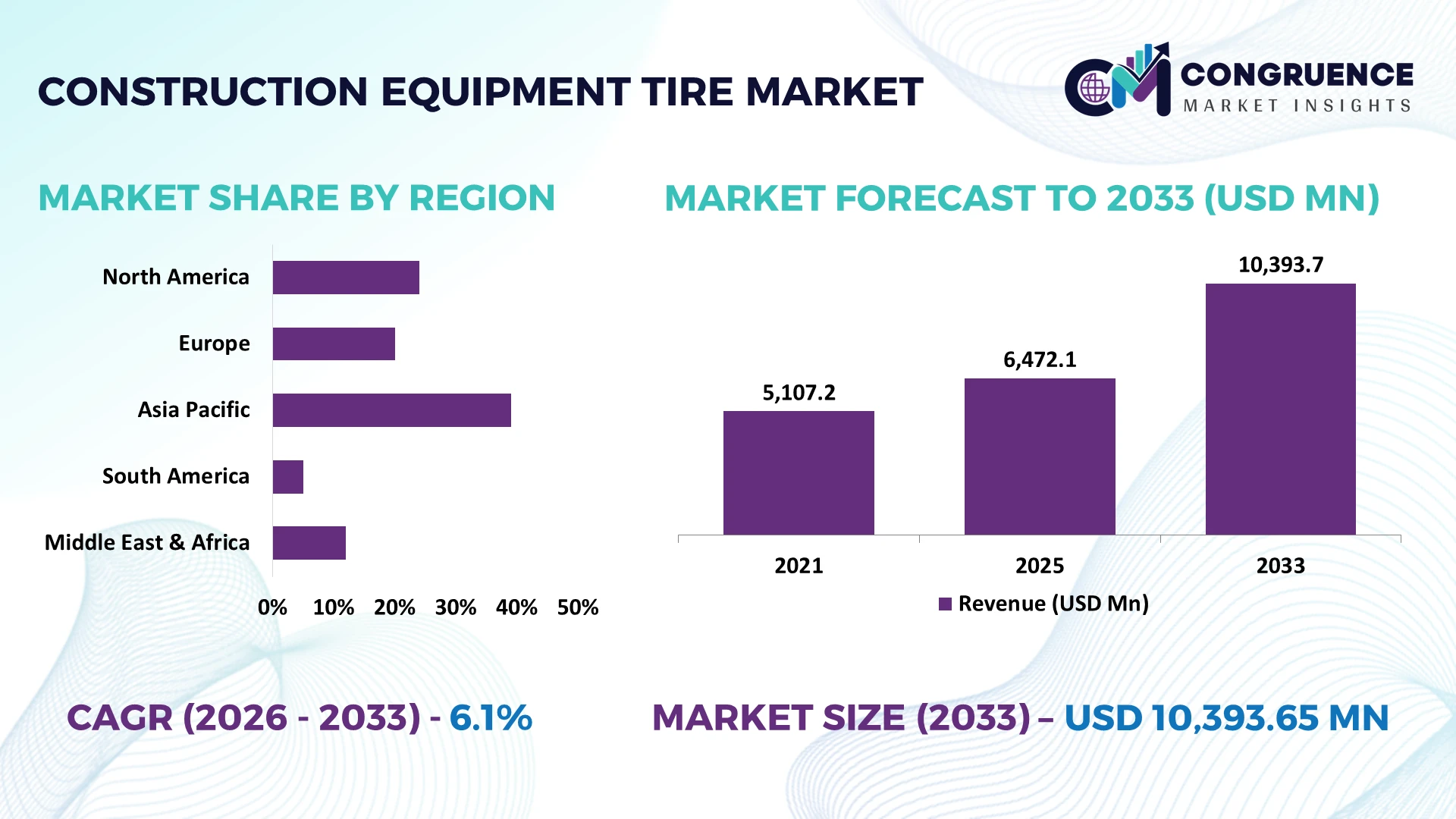
The Global Construction Equipment Tire Market was valued at USD 6472.1 Million in 2025 and is anticipated to reach a value of USD 10393.65 Million by 2033 expanding at a CAGR of 6.1% between 2026 and 2033. Growth is being driven by higher earthmoving-equipment utilization, radialization of off-highway tires, connected tire-pressure monitoring, and replacement demand from infrastructure, quarrying, mining, and road-construction fleets.
China remains the dominant construction-equipment tire demand center, supported by the world’s largest construction-machinery manufacturing ecosystem, extensive mining activity, and large infrastructure fleets. India provides the strongest regional comparison: construction-equipment sales reached 140,191 units in FY2025, including 99,159 earthmoving machines, while 98% of domestically sold equipment was locally produced. Earthmoving equipment represented 71% of Indian equipment sales, reinforcing concentrated tire consumption in excavators, loaders, and backhoe fleets. Geopolitical supply-chain localization, including stronger Asian manufacturing capacity and the EU’s deforestation-free natural-rubber requirements scheduled for application from December 2026, is increasing procurement emphasis on traceability, regional sourcing, and compliant rubber supply.
Strategically, tire manufacturers combining durable radial products, localized production, digital fleet monitoring, and traceable natural-rubber sourcing will capture the highest-value construction and earthmoving fleet contracts.
Market Size & Growth: USD 6,472.1 million in 2025 advances toward USD 10,393.65 million by 2033 at 6.1%, supported by radial OTR replacement cycles and expanding earthmoving fleets.
Top Growth Drivers: Earthmoving equipment holds 71% of Indian equipment sales, exports increased 10%, and domestic equipment production reached 98%, strengthening localized tire replacement demand.
Short-Term Forecast: By 2028, advanced monitoring and predictive-maintenance integration will increasingly reduce avoidable tire downtime, with connected systems targeting measurable improvements in utilization and maintenance scheduling.
Emerging Technologies: Connected TPMS, predictive tire analytics, advanced steel-cord structures, low-rolling-resistance compounds, and sensor-enabled fleet management are moving construction tires from replacement components toward managed productivity assets.
Regional Leaders: Analyst allocation places Asia-Pacific near USD 4.7 billion, North America around USD 2.4 billion, and Europe approximately USD 1.9 billion by 2033, led respectively by infrastructure fleets, mining utilization, and sustainability-focused replacement.
End-User Trends: India sold 99,159 earthmoving machines in FY2025, representing 71% of construction-equipment sales and concentrating tire consumption around excavators, backhoes, loaders, and quarry fleets.
Pilot/Case Example: Bridgestone’s MASTERCORE had expanded to approximately 120 mines by end-2024, while its mining-solutions network covered roughly 125 operating sites, showing rapid digital-service integration around premium OTR tires.
Competitive Landscape: Bridgestone remains a premium OTR leader alongside Michelin, Goodyear, Continental, Yokohama and specialist Asian manufacturers, with competition increasingly centered on durability, uptime analytics, dealer coverage, and total cost per operating hour.
Regulatory & ESG Impact: EU deforestation regulation now applies to covered operators from 30 December 2026, strengthening natural-rubber traceability requirements across tire supply chains serving European construction fleets.
Investment & Funding: Bridgestone committed ¥25 billion to upgrade its Kitakyushu mining and construction tire facility, which operates at approximately 170 tonnes per day, with completion scheduled by end-2027.
Innovation & Future Outlook: Michelin’s newer construction tire designs combine lower rolling resistance with longer service life, while connected-tire platforms and predictive analytics are shifting global competition toward uptime, fuel efficiency, and lifecycle economics.
Construction equipment tire demand is increasingly concentrated in excavators, loaders, graders, dumpers, quarry vehicles, and high-utilization mining fleets. Radial construction, reinforced compounds, intelligent pressure monitoring, and predictive maintenance are reshaping product specifications. India’s earthmoving segment already accounts for 71% of equipment sales, while EU rubber-traceability requirements are accelerating supply-chain transparency, creating a clear transition toward smarter, longer-life and compliance-ready tire platforms.
Construction equipment tires are becoming strategic productivity assets as contractors, quarry operators, and mining fleets prioritize uptime, payload capacity, and predictable replacement cycles rather than initial tire price. India illustrates the underlying equipment shift: FY2025 construction-equipment sales reached 140,191 units, with earthmoving machinery representing 71% of volumes and exports increasing 10%. Supply chains are simultaneously restructuring around localized production and traceable rubber sourcing, particularly as European deforestation rules extend due-diligence requirements to natural rubber.
Advanced radial designs now deliver measurable advantages over conventional tire architectures. Bridgestone’s MASTERCORE platform offers up to 5% higher durability, 10% faster operating speeds, or 15% greater load capacity through reinforced steel cord, advanced compounds, and heat-management engineering. Deployment has expanded to roughly 120 mines, demonstrating that connected, application-specific OTR tires are moving beyond pilots. India emphasizes manufacturing scale, while Japan-led suppliers retain an innovation advantage in premium mining and digital tire-management systems.
Through 2027–2028, fleet operators will increasingly combine radial tires with pressure, temperature, wear, and vehicle-operation analytics. At BHP’s Spence mine in Chile, tire durability prediction already integrates vehicle data with proprietary algorithms. Manufacturers are consequently directing investment toward sensor-enabled products, localized capacity, and mining-service partnerships. Competitive advantage will increasingly depend on selling verified uptime, load productivity, and lifecycle performance rather than tire hardware alone.
Construction tire replacement demand is being strengthened by expanding equipment utilization rather than simple fleet additions. India sold 140,191 construction machines in FY2025, up 3.3%, while earthmoving equipment increased 6% to 99,159 units and represented 71% of total sales. Backhoe loaders alone accounted for 54% of earthmoving volumes, concentrating tire wear across high-cycle excavation and material-handling applications. Export shipments also rose 10%, reinforcing India’s role as an equipment-production hub. With 98% of machines sold domestically manufactured within India, tire suppliers gain stronger OEM-fitment and aftermarket localization opportunities. Manufacturers are responding by expanding dealer coverage, developing application-specific radial patterns, and aligning replacement networks with excavator, loader, quarry, and road-construction clusters.
Natural-rubber dependence is creating a more complex procurement environment for construction tire producers serving European fleets. The EU Deforestation Regulation brings rubber within mandatory deforestation-free supply-chain controls from December 2026 for large and medium operators, while smaller operators receive only a six-month extension. Compliance therefore adds documentation, geolocation, supplier-validation, and chain-of-custody requirements to an already globally fragmented raw-material system. At the same time, India’s construction-equipment domestic sales increased only 2.7% in FY2025 versus a 10% export rise, demonstrating how uneven equipment demand can complicate tire production planning. Producers are reducing exposure through multi-country rubber sourcing, longer-term supplier agreements, localized compounding, and traceability platforms. The strategic issue is no longer rubber availability alone, but verified rubber availability at commercially predictable cost.
The strongest opportunity lies in converting construction tires from consumables into digitally managed productivity systems. Advanced MASTERCORE tires deliver up to 5% greater durability, 10% higher operating speed, or 15% additional load capacity depending on site optimization, creating measurable gains in haul-cycle productivity and replacement economics. Adoption is already commercially significant: the platform reached approximately 120 mines by the end of 2024, while Bridgestone’s mining-solutions network covered about 125 operating sites. Tire-pressure, temperature, vehicle-operation, and durability data increasingly enable predictive replacement rather than fixed-hour maintenance. Suppliers are investing in AI-based wear models, proprietary compounds, sensor integration, and partnerships with equipment manufacturers. The non-obvious opportunity is recurring digital-service income tied to uptime guarantees, not merely higher-margin premium tire sales.
Long-term competitiveness depends on reproducing premium tire performance across highly variable operating environments. Mining and construction tires must manage payload, heat, speed, cut resistance, traction, and inflation pressure simultaneously; optimizing one parameter can weaken another. MASTERCORE illustrates the engineering trade-off, allowing configurations targeting 5% higher durability, 10% greater speed, or 15% more load rather than maximizing every metric concurrently. Bridgestone’s deployment across roughly 120 mines and solution support at approximately 125 sites shows the field-engineering scale required to maintain consistent results. Companies must therefore integrate tire telemetry, site-condition mapping, technician expertise, and predictive algorithms with physical product design. The execution challenge is transforming site-specific optimization into a scalable service model without increasing operational complexity faster than productivity gains.
Application-Specific Tires Gain Ground: Manufacturers are narrowing product design around machine duty cycles instead of offering broad OTR ranges. Bridgestone’s 2025 VHS3 crane radial delivers 12% longer tire life, while Apollo expanded excavator fitments across machines from 6 to 26 tonnes. This SKU specialization reduces premature replacement and pushes suppliers toward equipment-specific compounds, casing structures, and dealer inventories.
Rental Fleets Tighten Tire Economics: Fleet purchasing is shifting toward lifecycle value as 72% of surveyed contractors rented equipment during 2025, 71% of equipment owners also used rentals, and 54% expect equal or greater rental usage. High-utilization operators are standardizing durable fitments, preventive inspection, and replacement scheduling to control downtime across machines moving repeatedly between jobsites.
Localized Equipment Ecosystems Deepen: India produced approximately 98% of construction equipment sold domestically in FY2025, while sector localization averages about 60% and exceeds 90% for selected machines. Tire suppliers are responding by placing engineering, inventory, and OEM support closer to Haryana, Tamil Nadu, Karnataka, and Maharashtra production clusters, reducing cross-border dependency and accelerating specification changes.
Low-Carbon Fleets Reshape Specifications: Electric and hybrid construction equipment represented only about 5.3% of Indian deliveries in 2025 but is scaling from a small base, while diesel retained roughly 94.7%. European rental operators are simultaneously evaluating batteries and HVO as priority transition technologies. Tire makers are adapting load ratings, rolling resistance, casing durability, and compact-machine portfolios accordingly.
Radial tires lead the Construction Equipment Tire Market with approximately 51% share in 2025, reflecting stronger heat dissipation, lower rolling resistance, improved ground contact, and longer operating life under sustained earthmoving and haulage duty. Bias tires retain roughly 30% of demand, particularly where lower acquisition cost, stiff sidewalls, cut resistance, and low-speed severe-service operation outweigh fuel and lifecycle advantages. Solid tires occupy a smaller but strategically relevant position in puncture-sensitive, compact, and material-handling applications where eliminating inflation-related downtime has operational value.
Radial is also the fastest-advancing type as contractors increasingly measure cost per operating hour rather than purchase price. Comparable radial constructions can extend service life by roughly 20–35% over bias designs under suitable operating conditions. Pneumatic tires remain essential where flotation, ride quality, traction, and surface adaptation matter, particularly for loaders and mobile construction equipment. Manufacturers are directing compound innovation, reinforced steel-belt engineering, and premium OEM fitments toward radial platforms while retaining bias and solid portfolios for application-specific niches.
Earthmoving Equipment represents the leading application, accounting for an estimated 40–45% of construction equipment tire demand when separated from the broader earthmoving-and-roadbuilding category, which held approximately 57% in 2025. Excavators, loaders, backhoes, and dump-oriented earthmoving machines generate concentrated replacement demand because high torque, abrasive terrain, repeated load cycles, and extended operating hours accelerate tread and casing wear. Mining Equipment commands a smaller unit base but disproportionately favors high-value, heat-resistant and ultra-heavy OTR tires.
Road Construction Equipment is emerging as the fastest-expanding application in several infrastructure-heavy markets; Indian road-machinery sales recorded roughly 40% annual growth during 2025. Material Handling Equipment requires high-stability products for cranes, industrial trucks, and site logistics, while Concrete Equipment supports recurring demand from mixers, pumps, and project-based fleets. Suppliers are responding by separating tread families by haul, traction, heat, surface, and load conditions rather than relying on universal designs, concentrating product development around high-utilization earthmoving and roadbuilding machines.
Construction Contractors form the largest end-user group, representing approximately 45% of construction-equipment tire consumption, reflecting their direct control of excavators, loaders, backhoes, graders, and mixed project fleets. Their purchasing increasingly prioritizes total operating cost, field availability, and casing durability rather than upfront tire pricing. Infrastructure Developers remain important buyers through large highway, metro, industrial, airport, and energy projects, while Mining Companies purchase fewer but substantially larger, higher-load tires requiring specialized field engineering and rigorous heat management.
Rental Companies represent the fastest-changing buyer group as contractors move toward flexible fleet access. During 2025, 72% of surveyed contractors reported renting equipment, 71% of equipment owners also rented, and 52% said their fleet strategy had changed during the previous year. Equipment OEMs remain strategically valuable because factory fitment establishes tire specifications before machines reach users. Tire manufacturers are therefore expanding OEM agreements, fleet-service programs, multi-brand replacement support, and application-based pricing. Rental customers increasingly reward products that survive multiple operators, terrains, and mobilization cycles with predictable maintenance requirements.
Asia-Pacific accounted for the largest market share at approximately 43% in 2025 however, Asia-Pacific is expected to register the fastest growth, expanding at a CAGR of approximately 7.0% between 2026 and 2033.
Fleet Productivity and Replacement Intensification
North America represents approximately 24% of global construction equipment tire demand, supported by large earthmoving, quarrying, highway construction, aggregates, and equipment-rental fleets. The United States dominates regional consumption as contractors increasingly evaluate tires through cost-per-hour, casing durability, and equipment uptime. Rental penetration reinforces replacement intensity: 72% of contractors surveyed by EquipmentWatch rented equipment during 2025, while 71% of equipment owners also used rental assets. Tire suppliers are consequently strengthening fleet-service networks, radial OTR portfolios, telematics integration, and application-specific products. Infrastructure renewal remains another utilization catalyst, particularly across highways, bridges, utilities, and aggregate operations. Premium suppliers increasingly differentiate through tire-pressure monitoring and predictive maintenance, while regional distributors remain critical for rapid field replacement across geographically dispersed jobsites.
United States Market Outlook: The United States combines extensive equipment ownership with a highly developed rental ecosystem. Federal infrastructure programs continue supporting road, bridge, water, and transportation construction, while large rental operators standardize tire specifications across multi-state fleets. Contractors increasingly prioritize service availability and lifecycle cost because equipment moves frequently between jobsites, creating an advantage for suppliers with nationwide distribution and mobile tire-service capabilities.
Compliance Reshapes Tire Procurement
Europe accounts for approximately 19% of construction equipment tire demand, with Germany, France, Italy, the United Kingdom, and Nordic markets supporting substantial replacement activity. Procurement is shifting toward lower rolling resistance, longer casing life, retreading compatibility, and verifiable natural-rubber sourcing. The EU Deforestation Regulation introduces traceability obligations for covered natural-rubber supply chains from December 2026, making supplier documentation increasingly relevant to tire purchasing. Electrification also changes specifications as battery-powered compact machines require tires capable of handling high instantaneous torque and additional battery weight. European rental companies are simultaneously increasing fleet-management discipline, encouraging standardized fitments and measurable lifecycle performance. Michelin, Continental and other established suppliers are strengthening sustainable-material development, connected services, and application engineering rather than competing primarily through acquisition price.
Germany Market Outlook: Germany remains strategically important through its construction-equipment manufacturing base, premium engineering ecosystem, and advanced infrastructure market. Companies including Liebherr, Wacker Neuson and major component suppliers create substantial OEM-interface opportunities. Germany’s construction sector is also progressively adopting electric compact equipment, increasing demand for low-rolling-resistance tires, reinforced structures, precise load ratings, and digitally supported maintenance across urban projects.
Manufacturing Scale Drives Tire Localization
Asia-Pacific commands approximately 43% of global construction equipment tire demand, anchored by China, India, Japan, South Korea, Indonesia, and Australia. China combines enormous construction-machinery production with mining, quarrying, municipal development, and infrastructure fleets, creating deep OEM and replacement channels. India provides additional momentum: construction-equipment sales reached 140,191 units in FY2025, including 99,159 earthmoving machines, while approximately 98% of domestically sold equipment was manufactured locally. Japan contributes premium OTR engineering through Bridgestone and Yokohama, while Australia concentrates demand in highly demanding mining applications. Suppliers are expanding local manufacturing, dealer networks, radial capacity, and OEM relationships as equipment production becomes increasingly localized. The region’s strategic advantage is its combination of manufacturing scale, infrastructure deployment, mining intensity, and increasingly sophisticated domestic tire engineering.
China Market Outlook: China remains the region’s largest operational ecosystem because domestic manufacturers such as SANY, XCMG, LiuGong and Zoomlion support enormous installed equipment fleets. Large infrastructure and quarrying operations create sustained replacement requirements across loaders, graders and articulated equipment. Domestic tire producers increasingly challenge premium international suppliers through faster localization, competitive pricing, expanding radial technology, and close integration with Chinese equipment OEM specifications.
Mining Fleets Anchor Premium Demand
South America represents approximately 7% of global construction equipment tire demand, with Brazil, Chile and Peru forming the principal operational centers. Mining creates an unusually high-value tire mix because haulage and earthmoving fleets operate under heavy payloads, abrasive surfaces, heat accumulation, and extended shifts. Chile and Peru concentrate copper-mining activity, while Brazil combines mining with road construction, agriculture-linked infrastructure, quarrying, and urban development. Digital tire-management deployment is becoming more relevant at large mines; Bridgestone has applied vehicle data and predictive tire-durability technologies at BHP’s Spence copper operation in Chile. However, imported premium-tire dependence, long logistics routes, and remote mine locations increase inventory requirements. Suppliers are responding with mine-site service capabilities, regional warehousing, technical partnerships, and condition-monitoring systems.
Brazil Market Outlook: Brazil offers the region’s broadest construction tire demand base through iron-ore mining, highways, housing, logistics infrastructure, and quarry operations. Its extensive territory makes dealer coverage and replacement availability strategically important. Mining-intensive states such as Minas Gerais and Pará create demand for large OTR products, while infrastructure contractors support higher-volume loader, backhoe, grader, and compactor tire consumption.
Megaprojects and Mining Reshape Deployment
Middle East & Africa contributes approximately 7% of global construction equipment tire demand, but its application mix is unusually diverse. Saudi Arabia and the UAE concentrate high-value construction fleets around transport, tourism, industrial, and urban megaprojects, while South Africa, Zambia, Ghana and the Democratic Republic of Congo generate demanding mining applications. Saudi Vision 2030 projects are accelerating utilization of loaders, cranes, graders, dump equipment, and earthmoving machinery across large construction sites. African mining fleets meanwhile require heat-resistant compounds, reinforced casings, and dependable field servicing in remote operating environments. Harsh temperatures and abrasive surfaces increase emphasis on tire durability rather than initial price. Suppliers are strengthening distributor partnerships, regional inventory, mobile servicing, and premium OTR product availability near major project and mining corridors.
Saudi Arabia Market Outlook: Saudi Arabia is the region’s most strategically significant construction-focused market, supported by NEOM, Riyadh development, transport infrastructure, tourism projects, and industrial diversification. Large simultaneous projects create concentrated equipment utilization and replacement requirements. Tire suppliers with heat-optimized compounds, rapid local availability, project-site servicing, and relationships with major contractors and equipment distributors hold a clear operational advantage.
Bridgestone, Michelin, Goodyear, Continental and Yokohama compete at the premium end against cost-focused Asian manufacturers including BKT and Triangle Tire. The top five suppliers collectively control approximately 48% of construction equipment tire demand, reflecting advantages in OEM relationships, compound engineering, distribution and mining-service capabilities. Premium radial products can deliver 10–20% longer operating life than conventional alternatives, while optimized designs reduce rolling resistance by roughly 5–10% under suitable applications. Regional manufacturers counter with prices typically 10–25% below premium international brands and faster localized supply. Competition increasingly centers on sensor integration, heat-resistant compounds, site-specific tread engineering and lifecycle service contracts. Bridgestone and Michelin are expanding connected tire management, while Asian producers are scaling radial capacity and OEM partnerships. Rubber traceability, specialized molds, field-service infrastructure and validation requirements remain substantial entry barriers. Winning now requires application engineering, dependable replacement availability, competitive lifecycle economics and digitally verified tire performance.
Bridgestone Corporation
Michelin
The Goodyear Tire & Rubber Company
Continental AG
Yokohama Rubber Co., Ltd.
BKT
Triangle Tire Co., Ltd.
Zhongce Rubber Group Co., Ltd.
Sailun Group Co., Ltd.
Double Coin Holdings Ltd.
Titan International, Inc.
Trelleborg AB
CEAT Limited
Apollo Tyres Ltd.
Current global construction-equipment tire technology centers on radial steel-belt architectures, advanced heat-resistant compounds, reinforced sidewalls, and digital pressure monitoring. Radial construction can deliver roughly 10–20% longer operating life than conventional bias designs in suitable duty cycles, while optimized compounds can improve wear performance by about 5–12%. Adoption is strongest across high-utilization mining, quarry, crane, loader, and earthmoving fleets, where downtime affects productivity and contractor margins.
Emerging systems combine embedded sensors, telematics, temperature monitoring, and predictive wear analytics to convert tires into managed fleet assets. Connected monitoring can reduce pressure-related operating losses by approximately 2–5%, while predictive maintenance improves replacement timing and casing utilization. Non-pneumatic structures, intelligent tread engineering, and electric-drive-ready tires are advancing as heavier battery equipment increases torque and load requirements. Premium manufacturers benefit because software-supported lifecycle services strengthen fleet relationships beyond replacement sales.
Through 2026–2028, integration between tire telemetry, equipment CAN-bus data, AI-based wear models, and autonomous fleet platforms will accelerate. Sensor-enabled OTR deployments remain concentrated in large mining and industrial fleets rather than mass construction fleets, creating expansion headroom. Companies investing now in radialization, connected diagnostics, low-heat compounds, and site-specific performance modeling gain measurable uptime advantages and stronger OEM positioning as procurement shifts toward verified cost-per-hour performance.
June 2024 Michelin agreed to sell two Sri Lankan construction-tire plants to CEAT and exit bias-tire production at Olsztyn, concentrating on radial technology. The restructuring covered two plants and sharpened specialty-tire positioning globally around higher-value construction applications. Source: michelin.com
February 2025 Goodyear completed the sale of its OTR tire business to Yokohama Rubber for approximately $905 million. The transaction transferred construction and mining tire assets, allowing Goodyear to streamline operations while materially expanding Yokohama’s specialized OTR platform. Source: sec.gov
October 2025 Bridgestone launched the VHS3 high-speed radial crane tire, delivering 12% longer tire life than the VHS2 through advanced compounds and redesigned casing architecture. The improvement strengthens fleet uptime economics for demanding mobile and all-terrain crane operations. Source: bridgestoneamericas.com
May 2026 Yokohama Rubber announced new OTR plants in India and Mexico, including an Odisha facility with 9,150-ton annual capacity. The expansion transfers acquired Goodyear production while increasing giant mining-and-construction tire capacity and strengthening resilient localized global supply. Source: y-yokohama.com
The Construction Equipment Tire Market Report evaluates radial, bias, solid, and pneumatic tires across Earthmoving Equipment, Material Handling Equipment, Road Construction Equipment, Mining Equipment, and Concrete Equipment. End-user coverage includes Construction Contractors, Mining Companies, Rental Companies, Infrastructure Developers, and Equipment OEMs. The analysis spans North America, Europe, Asia-Pacific, South America, and Middle East & Africa, while examining replacement demand, OEM fitments, radialization, specialty OTR products, and localized manufacturing.
Technology coverage includes advanced compounds, reinforced steel-belt construction, pressure and temperature sensing, predictive tire analytics, electric-drive-ready designs, and lifecycle management. With radial OTR products already representing more than 60% of broader OTR tire deployment in established applications, the report evaluates shifting product economics and procurement priorities. Between 2026 and 2033, these insights support capacity planning, geographic expansion, OEM partnerships, portfolio investment, competitive benchmarking, and positioning around high-utilization construction and mining fleets.
| Report Attribute/Metric | Report Details |
|---|---|
Market Revenue in 2025 | USD 6472.1 Million |
Market Revenue in 2033 | USD 10393.65 Million |
CAGR (2026 - 2033) | 6.1% |
Base Year | 2025 |
Forecast Period | 2026 - 2033 |
Historic Period | 2021 - 2025 |
Segments Covered | By Type
By Application
By End-User
|
Key Report Deliverable | Revenue Forecast, Growth Trends, Market Dynamics, Segmental Overview, Regional and Country-wise Analysis, Competition Landscape |
Region Covered | North America, Europe, Asia-Pacific, South America, Middle East, Africa |
Key Players Analyzed | Bridgestone Corporation, Michelin, The Goodyear Tire & Rubber Company, Continental AG, Yokohama Rubber Co., Ltd., BKT, Triangle Tire Co., Ltd., Zhongce Rubber Group Co., Ltd., Sailun Group Co., Ltd., Double Coin Holdings Ltd., Titan International, Inc., Trelleborg AB, CEAT Limited, Apollo Tyres Ltd. |
Customization & Pricing | Available on Request (10% Customization is Free) |




