
Reports
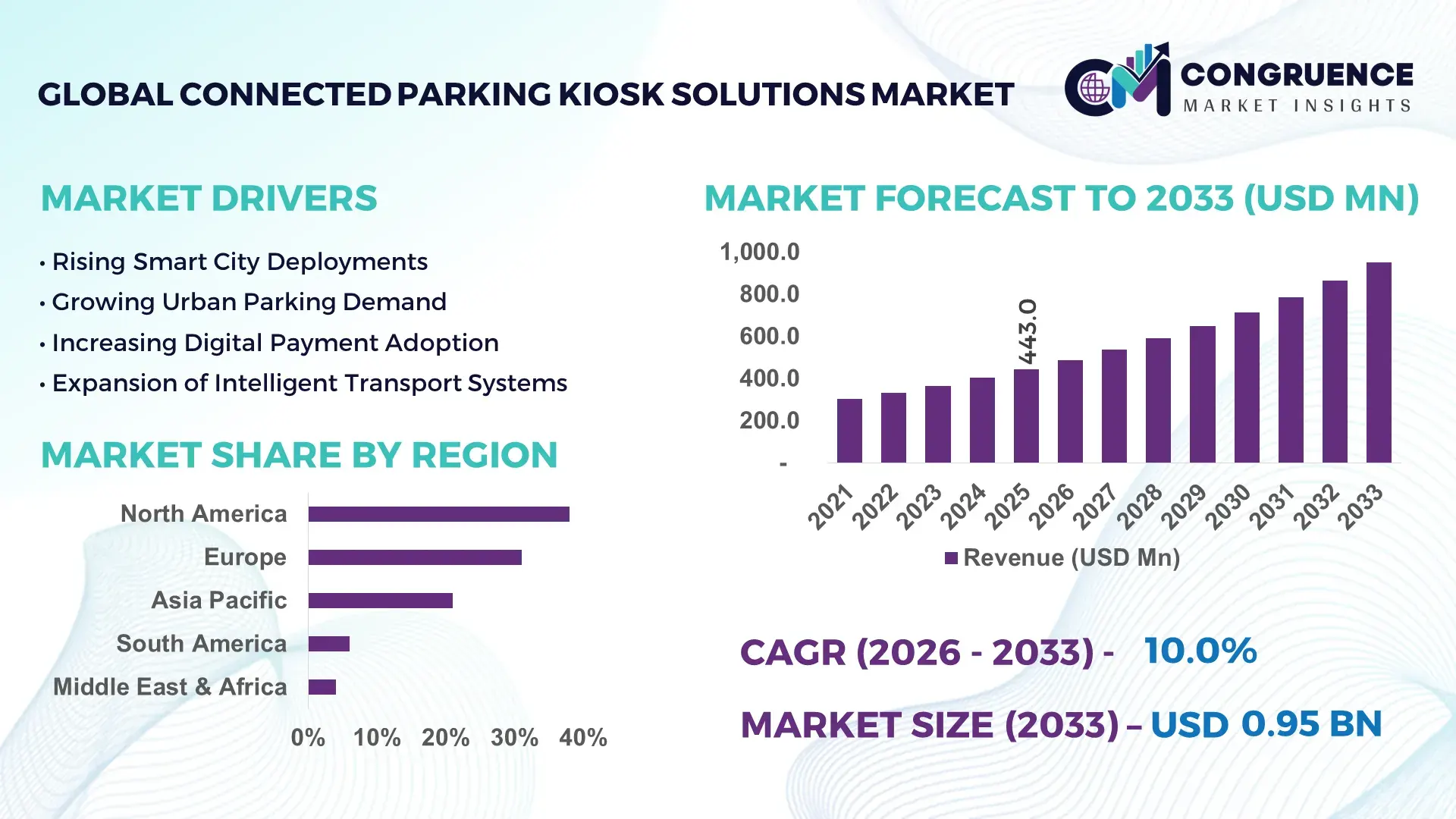
The Global Connected Parking Kiosk Solutions Market was valued at USD 443.0 Million in 2025 and is anticipated to reach a value of USD 949.6 Million by 2033 expanding at a CAGR of 10% between 2026 and 2033, according to an analysis by Congruence Market Insights. The market growth is primarily driven by rapid urbanization and the increasing deployment of smart parking infrastructure integrated with digital payment systems, IoT sensors, and real-time parking management platforms.
The United States represents the most technologically advanced environment for connected parking kiosk deployment, supported by strong municipal investments in smart mobility infrastructure. Over 2,100 U.S. cities have adopted digital or smart parking management systems integrated with kiosk-based payment and enforcement technologies. Major metropolitan areas including New York, Los Angeles, and Chicago collectively operate over 150,000 networked parking meters and kiosks, many connected to cloud-based mobility platforms. Municipal smart-city budgets across the U.S. exceeded USD 41 billion in 2024, with mobility infrastructure—including intelligent parking—accounting for nearly 18% of total allocations. Advanced kiosks equipped with contactless payment, license plate recognition integration, and real-time occupancy analytics are being deployed in municipal parking zones and airport facilities, where automated systems can process over 95% of transactions digitally, significantly improving operational efficiency and enforcement accuracy.
Market Size & Growth: The market reached USD 443.0 Million in 2025 and is projected to reach USD 949.6 Million by 2033, expanding at 10% CAGR as cities increasingly deploy IoT-enabled parking kiosks to streamline urban mobility and automate parking management.
Top Growth Drivers: Smart city infrastructure adoption growing by 62%, digital parking payment adoption exceeding 70% in urban centers, and operational efficiency improvements of 35% through automated parking management technologies.
Short-Term Forecast: By 2028, connected kiosk deployments are expected to reduce parking transaction processing times by 28% while improving municipal parking compliance rates by 22%.
Emerging Technologies: AI-driven parking analytics, license-plate recognition (LPR) integration, and edge-enabled IoT kiosks enabling real-time occupancy detection and automated enforcement.
Regional Leaders: North America projected to reach USD 350 Million by 2033 driven by smart-city parking infrastructure; Europe expected to reach USD 290 Million due to urban sustainability policies; Asia-Pacific projected at USD 210 Million fueled by high-density urban mobility solutions.
Consumer/End-User Trends: Urban commuters increasingly prefer contactless and mobile-integrated payment kiosks, with nearly 68% of parking users favoring digital payment over traditional coin-operated systems.
Pilot or Case Example: In 2024, a smart parking pilot in Barcelona implemented connected kiosks with IoT sensors, improving parking turnover rates by 32% and reducing enforcement downtime by 18%.
Competitive Landscape: Flowbird Group leads the market with approximately 28% share, followed by IPS Group, Parkeon (Flowbird), CivicSmart, and Amano Corporation competing through integrated mobility platforms and cloud-based parking solutions.
Regulatory & ESG Impact: Urban sustainability initiatives targeting 20–30% reduction in vehicle congestion are encouraging municipalities to implement smart parking kiosks integrated with traffic management platforms.
Investment & Funding Patterns: Municipal and mobility infrastructure investments exceeded USD 1.8 billion globally in smart parking projects during 2024–2025, with growing adoption of public-private partnerships.
Innovation & Future Outlook: Next-generation kiosks integrating AI analytics, solar-powered hardware, and multimodal transport platforms are expected to support dynamic parking pricing and real-time mobility data ecosystems.
Connected Parking Kiosk Solutions Market growth is influenced by transportation infrastructure, municipal smart-city programs, airport parking automation, and commercial parking management sectors. Municipal deployments account for nearly 48% of installations, while airports and transit hubs contribute 27%. Technology innovation such as solar-powered kiosks, license-plate recognition integration, and AI-driven occupancy analytics is reshaping parking operations. Growing regulatory focus on congestion reduction and digital payments is accelerating adoption, especially across North America and Europe.
The Connected Parking Kiosk Solutions Market is emerging as a critical component of urban mobility infrastructure, enabling municipalities and private operators to manage parking resources efficiently through digital platforms, automated payment systems, and real-time data analytics. Cities worldwide are increasingly integrating connected kiosks with broader intelligent transportation systems to address urban congestion, optimize parking utilization, and enhance commuter experience. Industry assessments indicate that digitally integrated parking systems improve operational efficiency by nearly 30% compared to conventional parking meters, largely due to automated payment processing and centralized monitoring.
Technological integration is redefining operational strategies within the sector. For instance, AI-enabled license plate recognition systems deliver nearly 40% faster transaction verification compared to manual ticket validation, enabling enforcement teams to improve compliance monitoring. In addition, cloud-connected kiosks allow operators to analyze occupancy trends across parking zones, facilitating dynamic pricing models that can increase space turnover by 20–25% during peak hours.
Regional deployment patterns also illustrate the market’s evolving landscape. North America dominates in volume of installed parking kiosks, while Europe leads in adoption intensity with over 65% of municipalities implementing digital parking payment systems integrated with mobile applications and urban mobility platforms. Asia-Pacific cities are also expanding deployments to manage high vehicle densities in rapidly urbanizing metropolitan areas.
Short-term technological developments indicate strong potential for efficiency improvements. By 2028, AI-driven predictive parking management platforms are expected to reduce urban parking search times by nearly 35%, lowering congestion and fuel consumption. Environmental sustainability initiatives are also shaping industry strategies, with firms committing to 30% reductions in energy consumption through solar-powered kiosks and low-power IoT connectivity by 2030.
A micro-level example demonstrates the practical impact of these innovations. In 2024, the City of Los Angeles implemented connected kiosks integrated with mobile payment and sensor networks, improving parking compliance rates by 24% while reducing manual enforcement workloads by 19%. As cities continue investing in digital infrastructure, the Connected Parking Kiosk Solutions Market is expected to become a foundational pillar supporting smart mobility, regulatory compliance, and sustainable urban growth.
The Connected Parking Kiosk Solutions Market is shaped by the increasing need for efficient urban mobility management and digital payment infrastructure within modern cities. Municipal authorities and private parking operators are shifting toward automated parking systems that integrate IoT connectivity, cloud-based management platforms, and contactless payment technologies. These systems allow real-time monitoring of parking spaces, automated fee collection, and improved enforcement efficiency. Urban vehicle populations are increasing significantly, with several metropolitan areas experiencing annual vehicle registration growth exceeding 5%, creating pressure on parking infrastructure. Connected kiosks help optimize parking utilization by providing centralized monitoring and dynamic pricing capabilities. Integration with mobile applications and license-plate recognition technologies is also transforming parking operations by reducing manual intervention and enhancing user convenience. Additionally, sustainability initiatives encouraging reduced vehicle congestion and optimized urban traffic flow are accelerating deployment of smart parking solutions. However, infrastructure modernization costs and integration complexities remain factors influencing adoption rates across different regions.
Smart-city development programs worldwide are accelerating the adoption of connected parking infrastructure as municipalities seek to improve traffic management and urban mobility. More than 1,000 smart-city projects globally now include intelligent transportation systems, many of which incorporate connected parking kiosks integrated with sensor networks and digital payment platforms. Smart parking solutions can reduce vehicle search times for parking by up to 30%, helping cities mitigate congestion and lower fuel consumption. Connected kiosks enable real-time parking occupancy monitoring, digital payment processing, and integration with enforcement systems, improving operational efficiency for municipal parking authorities. In densely populated urban centers, automated kiosks can handle over 90% of parking transactions electronically, minimizing manual ticketing operations. The adoption of cloud-connected kiosks also allows centralized monitoring of multiple parking zones simultaneously, enabling data-driven pricing and improved resource allocation. As governments allocate substantial budgets toward digital mobility infrastructure, connected parking kiosks are becoming an integral component of urban transportation modernization strategies.
Despite the operational advantages of connected parking kiosks, high upfront installation and integration costs present a significant challenge for many municipalities and parking operators. Deploying connected kiosks requires not only the physical hardware but also networking infrastructure, software integration, payment gateway systems, and maintenance support. A single advanced kiosk equipped with touchscreen interface, solar panels, wireless connectivity, and contactless payment capability can cost three to four times more than traditional parking meters. Additionally, cities often need to upgrade existing parking infrastructure and integrate kiosks with enforcement databases and mobile payment platforms. Maintenance costs also increase due to the need for periodic software updates, connectivity monitoring, and hardware servicing. Smaller municipalities with limited budgets may delay adoption due to financial constraints. In developing regions, inconsistent network connectivity and limited digital payment adoption further complicate deployment efforts. These cost-related factors slow implementation timelines and create barriers for widespread adoption across smaller urban markets.
The integration of artificial intelligence and urban mobility platforms presents significant opportunities for the Connected Parking Kiosk Solutions Market. AI-driven analytics can process parking usage patterns, enabling predictive demand forecasting and dynamic pricing strategies that optimize parking space utilization. Intelligent parking systems equipped with machine learning algorithms can analyze historical traffic and occupancy data to forecast peak demand periods with up to 85% prediction accuracy, enabling municipalities to adjust parking pricing dynamically. Additionally, integration with multimodal mobility platforms allows kiosks to function as hubs connecting public transit, bike-sharing, and ride-sharing services. Connected kiosks can also integrate license-plate recognition and automated enforcement technologies, reducing violations and improving compliance rates by more than 20%. Airports, commercial parking operators, and large event venues are increasingly adopting AI-driven parking management systems to handle high-volume vehicle flows efficiently. These technological integrations create new service models for mobility operators while enhancing the overall value proposition of connected parking kiosks.
As parking kiosks become increasingly connected to cloud platforms and digital payment systems, cybersecurity and data privacy concerns have emerged as critical challenges. Connected kiosks process large volumes of sensitive information including payment credentials, vehicle identification data, and parking transaction records. Cyberattacks targeting IoT-enabled infrastructure have increased significantly, with reports indicating that over 25% of urban IoT networks experienced attempted intrusions in recent years. Parking systems integrated with municipal databases may become vulnerable to unauthorized access if adequate cybersecurity measures are not implemented. Additionally, compliance with data protection regulations such as digital payment security standards requires continuous system monitoring and encryption upgrades. Managing software updates and ensuring secure connectivity across thousands of kiosks deployed in urban environments also adds operational complexity. For municipalities and parking operators, maintaining strong cybersecurity frameworks while ensuring seamless user experience remains a major challenge in the deployment of connected parking kiosk infrastructure.
Rapid Expansion of Contactless and Mobile Payment Integration: Contactless payment adoption has transformed parking infrastructure globally, with over 72% of newly installed parking kiosks supporting NFC-based payments and digital wallets. Cities deploying integrated payment kiosks have reported 35% faster transaction processing times and 25% reduction in cash handling costs. Mobile-integrated kiosks also enable users to extend parking sessions remotely, improving user convenience and reducing violation rates. Airports and metropolitan business districts are leading this transformation, where digital payments now account for more than 80% of parking transactions in several smart parking zones.
Growth of AI-Driven Parking Analytics and Demand Forecasting: Artificial intelligence is increasingly embedded in parking infrastructure to analyze occupancy patterns and forecast demand. AI-enabled analytics platforms can process data from thousands of parking spaces simultaneously and predict peak demand periods with up to 88% forecasting accuracy. Cities deploying predictive parking management have recorded 22% improvements in parking space utilization and 18% reductions in enforcement workload. These systems also enable dynamic pricing strategies that adjust parking fees based on real-time demand conditions.
Integration with Smart City IoT Sensor Networks: Connected parking kiosks are increasingly integrated with IoT sensor networks capable of detecting parking space occupancy. Smart sensors installed in parking spaces transmit real-time data to kiosks and centralized management platforms. In several urban deployments, IoT-enabled parking systems have improved parking turnover rates by over 30% while reducing average parking search times by 25%. Integration with urban traffic management systems also allows cities to monitor parking patterns and adjust traffic flow strategies accordingly.
Deployment of Solar-Powered and Energy-Efficient Parking Kiosks: Sustainability goals are driving the adoption of solar-powered parking kiosks equipped with low-power communication modules. More than 45% of newly deployed kiosks globally incorporate solar charging systems, reducing grid energy consumption and enabling deployment in remote areas. Energy-efficient kiosk designs can reduce operational electricity usage by up to 40%, supporting municipal carbon-reduction strategies. Solar-powered kiosks are increasingly deployed in university campuses, transportation hubs, and outdoor municipal parking zones.
The Connected Parking Kiosk Solutions Market is segmented based on type, application, and end-user categories, each reflecting specific operational requirements within urban mobility ecosystems. These kiosks enable automated parking payments, license-plate recognition integration, and centralized monitoring of parking zones. Technological innovations including cloud-based management software, IoT connectivity, and mobile payment integration are shaping demand patterns across segments. Municipal parking infrastructure remains the primary deployment environment due to the need for efficient traffic and parking management in urban centers. Commercial operators such as airports, shopping complexes, and transportation hubs also contribute significantly to demand. Application segmentation reflects diverse usage scenarios including street parking management, off-street parking facilities, and transportation hubs. End-user adoption is influenced by urban mobility policies, smart-city initiatives, and increasing digital payment penetration. As cities expand intelligent transportation systems, segmentation trends highlight a shift toward integrated solutions capable of managing multiple parking zones through centralized platforms.
Connected parking kiosks are primarily categorized into Single-Space Smart Kiosks, Multi-Space Smart Kiosks, and Mobile-Integrated Kiosk Systems. Among these, Multi-Space Smart Kiosks dominate the segment with approximately 46% share due to their ability to manage multiple parking spaces through a single centralized unit. These kiosks are commonly installed in high-density urban parking zones where centralized payment processing reduces infrastructure complexity and improves operational efficiency. Multi-space kiosks typically support multiple payment options including contactless cards, QR payments, and license-plate-based transactions, making them suitable for busy metropolitan areas. Single-Space Smart Kiosks account for around 28% of installations, particularly in areas where parking spaces are distributed across smaller zones such as university campuses and suburban parking facilities. These kiosks provide individual payment access for each parking spot and are easier to deploy in distributed layouts. Mobile-Integrated Kiosk Systems represent the fastest-growing type with approximately 12% CAGR, driven by the increasing adoption of mobile applications that allow users to initiate or extend parking sessions remotely. These systems integrate kiosks with smartphone platforms and cloud-based management systems, enabling seamless payment and enforcement processes. The remaining specialized kiosk types—including solar-powered units and AI-enabled kiosks integrated with sensor networks—collectively contribute about 26% of deployments, serving niche use cases in smart-city pilot programs and transportation hubs.
• In 2024, a large metropolitan smart-parking initiative deployed over 8,000 multi-space kiosks integrated with license-plate recognition systems, enabling automated enforcement and digital payments across municipal parking zones.
The Connected Parking Kiosk Solutions Market serves several application areas including On-Street Parking Management, Off-Street Parking Facilities, and Transportation Hub Parking Systems. On-Street Parking Management represents the largest application segment with approximately 52% adoption, as municipalities deploy kiosks to manage curbside parking zones and reduce traffic congestion caused by parking searches. Connected kiosks in on-street environments allow real-time monitoring of parking occupancy and enable enforcement teams to track violations efficiently. Off-Street Parking Facilities such as parking garages and commercial complexes account for nearly 31% of deployments. Operators of shopping malls, office complexes, and entertainment venues use connected kiosks to streamline parking payments and integrate parking management with facility management systems. Transportation Hub Parking Systems represent the fastest-growing application segment with roughly 13% CAGR, particularly in airports and major transit terminals where vehicle traffic volumes are extremely high. Automated kiosks in these environments help manage large-scale parking operations while minimizing manual staffing requirements. The remaining specialized applications—including event parking zones and university campuses—collectively contribute about 17% of deployments, often supported by temporary or mobile kiosk installations during peak events. In terms of user adoption behavior, over 64% of urban commuters prefer digital parking payments through kiosks or mobile apps, reflecting a broader shift toward contactless transactions in public infrastructure.
• In 2025, a major international airport deployed connected parking kiosks integrated with mobile reservation platforms, reducing average vehicle entry processing times by nearly 30%.
End-user adoption in the Connected Parking Kiosk Solutions Market is primarily segmented into Municipal Authorities, Commercial Parking Operators, Transportation Infrastructure Providers, and Institutional Campuses. Municipal Authorities represent the leading end-user segment with approximately 49% adoption, as city governments deploy connected kiosks to manage public parking zones and enforce parking regulations efficiently. Municipal systems often integrate kiosks with centralized traffic management platforms and digital payment networks. Commercial Parking Operators—including shopping centers, hotels, and private parking facility operators—account for around 26% of installations. These operators deploy connected kiosks to automate payment collection and reduce operational staffing requirements while improving customer convenience. Transportation Infrastructure Providers such as airports and railway stations represent the fastest-growing end-user segment with about 14% CAGR, driven by increasing passenger traffic and the need for automated parking systems capable of handling thousands of vehicles daily. Institutional campuses—including universities, hospitals, and government complexes—collectively contribute approximately 25% of deployments, where parking management systems are integrated with campus access control and security infrastructure. In terms of user adoption patterns, over 58% of parking operators globally are transitioning toward connected kiosks integrated with digital payment and enforcement systems, reflecting the broader shift toward smart mobility solutions.
• In 2024, a large university campus implemented connected parking kiosks integrated with student identification systems, reducing parking permit violations by nearly 27% while improving transaction efficiency.
North America accounted for the largest market share at 38% in 2025 however, Asia-Pacific is expected to register the fastest growth, expanding at a CAGR of 12.8% between 2026 and 2033.

North America maintains the highest deployment density of connected parking kiosks due to advanced smart-city infrastructure and large-scale municipal parking modernization programs. The region operates more than 180,000 connected parking kiosks and smart meters across major urban centers including New York, Chicago, Toronto, and Los Angeles. Europe follows with approximately 31% market share, supported by regulatory policies encouraging contactless payments and congestion reduction strategies in cities such as London, Paris, and Berlin. Asia-Pacific accounts for nearly 21% of global installations, driven by urbanization and increasing smart mobility investments in China, Japan, and India. South America represents about 6% share, with Brazil and Argentina adopting digital parking management in metropolitan regions. Meanwhile, the Middle East & Africa contributes roughly 4% of deployments, with smart-city projects in the UAE and South Africa installing networked kiosks across transportation hubs and commercial parking facilities.
North America holds approximately 38% of the global Connected Parking Kiosk Solutions Market, reflecting strong municipal adoption of digital parking infrastructure. The region operates over 180,000 smart parking kiosks and connected meters, with large deployments in metropolitan areas such as New York, San Francisco, and Toronto. Key industries driving demand include municipal parking authorities, airport operators, commercial real estate complexes, and transportation hubs. Government initiatives promoting smart-city development and digital payments have accelerated kiosk adoption, with several cities replacing coin-operated meters with cloud-connected kiosks capable of processing more than 90% of parking transactions electronically. Technological transformation includes integration of license-plate recognition, mobile payment platforms, and real-time parking analytics. For example, IPS Group, a U.S.-based smart parking technology company, has deployed over 100,000 solar-powered smart meters and kiosks globally, many across North American municipalities. Consumer behavior in the region strongly favors digital transactions, with nearly 72% of urban drivers preferring contactless or mobile-integrated parking payment systems compared with traditional cash-based methods.
Europe represents roughly 31% of the Connected Parking Kiosk Solutions Market, supported by stringent urban mobility regulations and sustainability programs. Countries including Germany, the United Kingdom, and France collectively account for nearly 60% of the region’s kiosk installations, with cities increasingly deploying integrated parking management platforms. European regulatory bodies emphasize congestion reduction and environmental sustainability, encouraging cities to adopt smart parking technologies that reduce vehicle circulation in search of parking spaces. Many municipalities have implemented digital parking infrastructure linked to low-emission zone policies and real-time traffic monitoring platforms. Technology adoption in Europe includes IoT-enabled parking sensors, mobile-based payment systems, and AI-driven analytics platforms that improve parking utilization efficiency by nearly 25%. Companies such as Flowbird Group, headquartered in France, operate extensive deployments across European cities and manage connected parking infrastructure in more than 4,500 municipalities worldwide. Consumer behavior across Europe reflects high digital adoption, with over 70% of parking payments in several major cities conducted through mobile apps or connected kiosks, reflecting strong regulatory and sustainability-driven adoption patterns.
Asia-Pacific ranks as the fastest-growing regional market and accounts for approximately 21% of global Connected Parking Kiosk Solutions installations. Countries such as China, Japan, and India are the largest consumers due to rapid urbanization and increasing vehicle ownership in metropolitan areas. China alone operates over 30 million urban parking spaces, creating substantial demand for automated parking management technologies including connected kiosks and sensor-based systems. Infrastructure modernization initiatives in Japan and South Korea emphasize integrated mobility platforms that combine parking management with urban traffic analytics. Innovation hubs in cities like Tokyo, Shenzhen, and Singapore are experimenting with AI-driven parking management systems capable of predicting parking demand with up to 85% accuracy. Local companies such as Amano Corporation, headquartered in Japan, supply advanced parking management equipment used in airports, shopping centers, and transportation hubs across the region. Consumer behavior in Asia-Pacific strongly reflects mobile-first adoption patterns, with more than 65% of urban parking transactions conducted through mobile payment platforms linked to kiosk infrastructure.
South America accounts for roughly 6% of global Connected Parking Kiosk Solutions deployments, with adoption concentrated in Brazil and Argentina, which together represent nearly 70% of the regional market. Urban infrastructure modernization programs in cities such as São Paulo and Buenos Aires are driving the transition from manual parking systems to automated kiosk-based management platforms. Municipal authorities are implementing connected kiosks to improve parking enforcement efficiency and reduce congestion in commercial districts. Infrastructure trends across the region include integration of smart meters with centralized digital payment systems and traffic monitoring networks. Government policies encouraging urban digitalization and public-private partnerships have enabled the deployment of tens of thousands of connected parking spaces in major metropolitan areas. Local parking technology providers are collaborating with international smart mobility firms to implement integrated parking management platforms. Consumer behavior reflects a gradual shift toward digital payments, with approximately 48% of urban drivers now using mobile or kiosk-based payment methods instead of traditional cash transactions.
The Middle East & Africa region represents approximately 4% of global Connected Parking Kiosk Solutions installations, with strong growth driven by large-scale smart-city initiatives and urban infrastructure modernization. Countries such as the United Arab Emirates and South Africa lead adoption due to advanced urban development projects and increasing vehicle density in major metropolitan areas. Smart-city initiatives in Dubai and Abu Dhabi include integrated parking systems that connect kiosks, mobile applications, and urban traffic management platforms. The construction and transportation sectors are key demand drivers, particularly around airports, business districts, and commercial complexes. Technological modernization across the region includes solar-powered kiosks, cloud-based parking management platforms, and contactless payment infrastructure. For example, Dubai’s smart mobility initiatives have deployed thousands of connected parking meters and kiosks across public parking zones. Consumer behavior reflects high smartphone penetration, with more than 60% of drivers preferring mobile-integrated parking payment systems over traditional ticket-based models.
United States – 34% Market Share: due to extensive municipal smart-city infrastructure, large-scale deployment of connected parking meters, and strong demand from airport and urban transportation hubs.
Germany – 12% Market Share: supported by advanced urban mobility infrastructure, strict congestion management policies, and widespread adoption of digital parking payment systems across major metropolitan cities.
The Connected Parking Kiosk Solutions Market is moderately fragmented, with more than 35 active global and regional technology providers competing through hardware innovation, software platforms, and integrated smart mobility solutions. The top five companies collectively account for approximately 55–60% of global installations, indicating a competitive yet innovation-driven market structure. Leading players differentiate themselves through integrated mobility platforms that combine parking kiosks, cloud management software, IoT sensors, and digital payment technologies.
Strategic partnerships between parking technology vendors and municipal authorities are common, as cities increasingly outsource smart parking infrastructure deployment through public-private partnership models. Technology providers are also expanding their offerings by integrating advanced capabilities such as license-plate recognition, AI-based occupancy analytics, and mobile parking payment applications. Many companies are investing heavily in solar-powered kiosk hardware, low-energy communication modules, and cloud-based parking management platforms, enabling scalable deployment across large urban parking zones.
Product innovation and geographic expansion are key competitive strategies. Vendors are launching modular kiosks that support multiple payment options including contactless cards, QR-based payments, and mobile wallet integration. Additionally, several market participants are acquiring smaller technology providers specializing in smart sensors and parking analytics to expand their capabilities. Increasing demand for data-driven urban mobility solutions is encouraging companies to integrate parking infrastructure with broader intelligent transportation systems. This trend is expected to intensify competition as vendors position themselves as comprehensive mobility technology providers rather than standalone parking equipment manufacturers.
IPS Group Inc.
Amano Corporation
CivicSmart Inc.
ParkMobile LLC
Metric Group Ltd.
Urbiotica
SKIDATA AG
Cale America Inc.
Hectronic GmbH
T2 Systems Inc.
ParkHelp Technologies
Smart Parking Limited
FlashParking Inc.
Technology innovation is playing a critical role in transforming the Connected Parking Kiosk Solutions Market by improving efficiency, user convenience, and urban mobility management capabilities. Modern parking kiosks are increasingly integrated with Internet of Things (IoT) sensors, cloud-based management systems, and digital payment platforms that allow real-time monitoring and automated fee collection. IoT connectivity enables kiosks to communicate with parking sensors installed in individual parking spaces, providing accurate occupancy data that helps operators manage thousands of parking spots simultaneously. In large urban environments, such integrated systems can monitor over 50,000 parking spaces in real time, enabling dynamic pricing strategies and optimized parking utilization.
Artificial intelligence and machine learning are also becoming integral components of advanced parking infrastructure. AI algorithms analyze historical parking patterns and predict demand fluctuations with prediction accuracy exceeding 85%, enabling municipalities to adjust pricing and enforcement strategies dynamically. License-plate recognition technology has gained significant traction as well, allowing automated vehicle identification and digital permit validation. Modern LPR systems can scan vehicle plates in less than 0.3 seconds, enabling faster transaction processing and more efficient enforcement operations.
Another key technological development is the integration of contactless and mobile payment platforms with parking kiosks. Many modern kiosks support NFC cards, QR-based payments, and mobile wallets, enabling drivers to complete transactions in under 10 seconds. Mobile application integration also allows users to remotely extend parking sessions and receive real-time notifications regarding parking availability or expiration.
Sustainability is also influencing kiosk design. Solar-powered parking kiosks equipped with energy-efficient components can reduce electricity consumption by up to 40%, making them suitable for outdoor installations without extensive electrical infrastructure. Combined with low-power wireless communication technologies such as LoRaWAN and NB-IoT, these systems enable scalable deployment across large urban environments while minimizing operational energy requirements.
• In January 2025, Flowbird Group announced that EasyPark Group completed the acquisition of Flowbird, combining digital parking payment platforms, parking kiosks, and mobility services into a single integrated urban mobility ecosystem operating across more than 20,000 cities globally. Source: www.flowbird.com
• In December 2024, Flowbird Group partnered with Risetek to deploy advanced parking management infrastructure at Ridge Hill in Yonkers, New York, integrating connected parking kiosks, digital payment technology, and real-time parking management tools to modernize commercial parking operations.
• In September 2025, IPS Group introduced the MSX™ Multi-Space Parking Kiosk, a next-generation connected parking solution supporting tap-to-pay, TEXT-TO-PAY, mobile app integration, and multilingual touchscreen interfaces, enabling municipalities and operators to deploy flexible and contactless parking payment systems.
• In November 2025, IPS Group launched a redesigned digital platform and announced the rollout of its Elevate™ parking data platform, designed to unify parking management data across systems and vendors, strengthening integrated smart-parking ecosystems for cities, universities, and private operators.
The Connected Parking Kiosk Solutions Market Report provides a comprehensive analysis of the evolving digital parking infrastructure ecosystem, focusing on hardware solutions, software platforms, and integrated mobility technologies that support automated parking management systems. The report examines key market segments including multi-space kiosks, single-space kiosks, and mobile-integrated parking kiosks, each serving different operational environments such as municipal street parking, commercial parking facilities, and transportation hubs. More than 70% of modern deployments now integrate kiosks with cloud-based management platforms, highlighting the growing importance of data-driven mobility systems.
The geographic scope of the report spans North America, Europe, Asia-Pacific, South America, and the Middle East & Africa, providing detailed insights into regional infrastructure trends and urban mobility initiatives. North America leads in total installed kiosks with over 180,000 connected devices, while Asia-Pacific is rapidly expanding installations due to increasing vehicle density and smart-city investments. The report also examines adoption patterns across key countries including the United States, Germany, China, Japan, India, Brazil, and the United Arab Emirates.
In terms of applications, the report analyzes deployments across on-street parking zones, off-street parking garages, airports, transportation terminals, commercial complexes, and institutional campuses. Each application environment presents unique operational requirements such as high-volume transaction processing, automated enforcement, or integrated mobility services. Technology trends including IoT connectivity, AI-driven parking analytics, license-plate recognition systems, and solar-powered kiosks are also evaluated to understand their impact on operational efficiency and infrastructure scalability.
Furthermore, the report explores end-user demand across municipal governments, commercial parking operators, transportation authorities, and institutional organizations, which collectively manage millions of parking spaces globally. By analyzing technology adoption patterns, infrastructure modernization strategies, and evolving consumer payment preferences, the report provides decision-makers with a holistic view of the opportunities and structural developments shaping the Connected Parking Kiosk Solutions Market.
| Report Attribute / Metric | Details |
|---|---|
| Market Revenue (2025) | USD 443.0 Million |
| Market Revenue (2033) | USD 949.6 Million |
| CAGR (2026–2033) | 10% |
| Base Year | 2025 |
| Forecast Period | 2026–2033 |
| Historic Period | 2021–2025 |
| Segments Covered |
By Type
By Application
By End-User Insights
|
| Key Report Deliverables | Revenue Forecast; Market Trends; Growth Drivers & Restraints; Technology Insights; Segmentation Analysis; Regional Insights; Competitive Landscape; Regulatory & ESG Overview; Recent Developments |
| Regions Covered | North America; Europe; Asia-Pacific; South America; Middle East & Africa |
| Key Players Analyzed | Flowbird Group; IPS Group Inc.; Amano Corporation; CivicSmart Inc.; ParkMobile LLC; Metric Group Ltd.; Urbiotica; SKIDATA AG; Cale America Inc.; Hectronic GmbH; T2 Systems Inc.; ParkHelp Technologies; Smart Parking Limited; FlashParking Inc. |
| Customization & Pricing | Available on Request (10% Customization Free) |




