
Reports
The Global Concrete Waterproofing Admixture Market was valued at USD 285.2 Million in 2025 and is anticipated to reach a value of USD 431.1 Million by 2033 expanding at a CAGR of 5.3% between 2026 and 2033. Growth is driven by rising adoption of integral crystalline, hydrophobic, and pore-blocking admixtures in underground structures, water-retaining infrastructure, tunnels, and high-durability concrete, supported by tighter durability specifications and lifecycle-cost requirements.
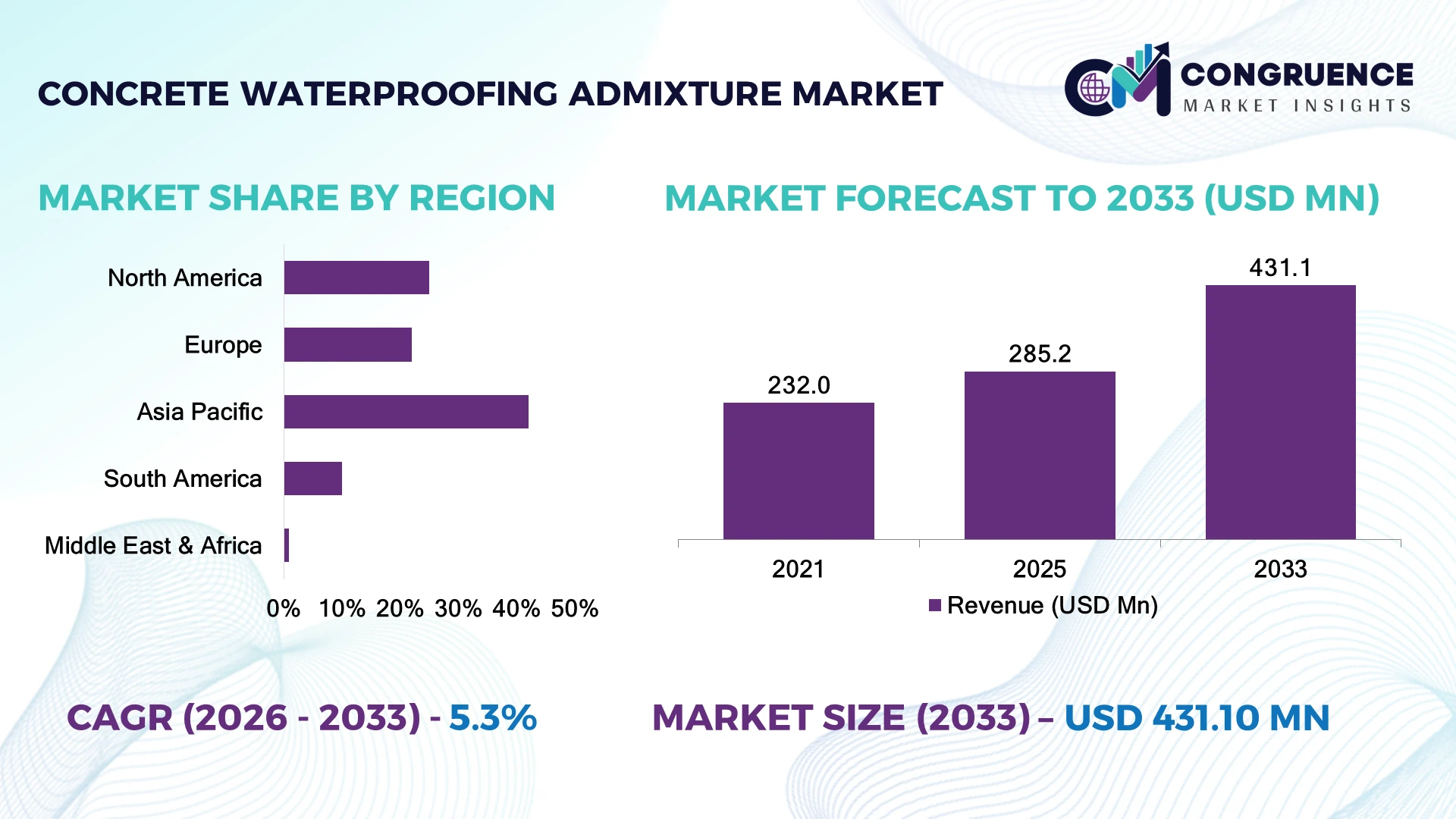
China remains the dominant country market, representing approximately 30% of global concrete waterproofing admixture consumption, supported by extensive metro, tunnel, reservoir, and high-rise construction. The United States accounts for roughly 18%, with stronger demand for rehabilitation and infrastructure resilience. Advanced admixture systems can reduce concrete permeability by 30–60% and extend protection against water ingress. Post-Red Sea freight disruptions are encouraging regional inventories and localized production.
Strategically, suppliers should prioritize crystalline chemistry, low-dosage formulations, local manufacturing, and specification-driven partnerships with concrete producers and infrastructure contractors.
Market Size & Growth: USD 285.2 Million in 2025 to USD 431.1 Million by 2033 at 5.3% CAGR, driven by infrastructure durability requirements and integral waterproofing adoption.
Top Growth Drivers: Underground construction 31%, water infrastructure 24%, commercial buildings 19%, concentrating demand around durable concrete systems.
Short-Term Forecast: By 2028, advanced admixture formulations will target 8–12% lower waterproofing-related maintenance costs and 5–10% longer service intervals.
Emerging Technologies: Crystalline admixtures, hydrophobic pore-blocking chemistry, nano-modified formulations, and digital concrete-performance monitoring are advancing waterproofing efficiency.
Regional Leaders: Asia-Pacific approaches USD 210 Million, North America USD 95 Million, and Europe USD 72 Million, with integrated waterproofing adoption accelerating in major infrastructure projects.
Consumer/End-User Trends: Approximately 35% of large infrastructure contractors are increasing use of integral waterproofing systems to reduce dependence on externally applied membranes.
Pilot/Case Example: 2025 infrastructure applications using crystalline admixtures demonstrated approximately 40–60% reductions in water permeability under controlled concrete testing conditions.
Competitive Landscape: China leads at approximately 30% share, with Sika, MAPEI, Fosroc, Penetron, and Master Builders Solutions competing through formulation performance and contractor networks.
Regulatory & ESG Impact: Durability-focused specifications can reduce rehabilitation frequency by 10–20%, supporting lower material consumption and lifecycle embodied impacts.
Investment & Funding: More than USD 1.0 Billion in related waterproofing-material and infrastructure-modernization investment is strengthening production capacity, formulation R&D, and contractor partnerships.
Innovation & Future Outlook: 2026–2028 priorities center on low-dosage crystalline chemistry, self-sealing concrete, recycled-material compatibility, digital specification tools, and lifecycle-performance guarantees.
Concrete Waterproofing Admixture is increasingly specified across underground structures, basements, tunnels, water-retaining facilities, wastewater plants, foundations, and high-rise construction where moisture ingress creates measurable lifecycle costs. Crystalline and hydrophobic formulations can reduce permeability by 30–60%, while integral systems are gaining preference over membrane-only approaches. China's infrastructure pipeline and India's urban construction expansion are strengthening localized formulation and distribution, while freight volatility is encouraging regional inventory strategies and supplier diversification. These shifts establish the market's strategic relevance for contractors, admixture manufacturers, and infrastructure developers.
Concrete waterproofing admixtures are becoming strategically important because infrastructure owners increasingly evaluate waterproofing through lifecycle durability rather than initial construction cost. Underground transport, wastewater treatment, reservoirs, foundations, and high-rise structures face substantial repair exposure when water penetrates concrete. Integral admixtures address this risk within the concrete matrix, reducing dependence on separate membrane installation and simplifying waterproofing specifications.
Technology is shifting from conventional hydrophobic additives toward crystalline and reactive pore-blocking systems. Advanced formulations can reduce water permeability by 30–60% and enable self-sealing of selected microcracks, whereas conventional surface treatments primarily create an external barrier. China emphasizes large-scale infrastructure deployment, while the United States and Europe increasingly prioritize rehabilitation, resilience, and performance-certified construction. India is strengthening adoption through metro, housing, industrial, and water-infrastructure projects.
During 2026–2028, manufacturers will focus on lower-dosage chemistry, compatibility with supplementary cementitious materials, recycled aggregates, and digital concrete-performance monitoring. A practical deployment model combines integral admixture dosing at batching plants with quality-control testing for permeability, slump, and compressive strength. Producers are expanding technical service teams, partnering with ready-mix suppliers, and developing project-specific formulations. Competitive advantage will favor companies that prove durability performance while reducing installation complexity, maintenance exposure, and total lifecycle cost.
Integral waterproofing is gaining specification priority as underground and water-retaining projects seek fewer installation interfaces and stronger durability. Crystalline and hydrophobic admixtures can reduce water permeability by approximately 30–60%, while optimized formulations lower admixture dosage requirements by 10–20%. China's metro, tunnel, and wastewater infrastructure is accelerating adoption, with contractors increasingly embedding waterproofing performance into concrete mix designs. Manufacturers are responding by expanding crystalline chemistry portfolios, conducting project-specific trials, and partnering with ready-mix producers. The strategic shift is significant: moving waterproofing into the concrete matrix reduces dependence on membrane installation quality, transferring value toward formulation performance, batching consistency, and technical support.
Specialty polymers, fatty-acid derivatives, silicates, and reactive chemicals expose admixture manufacturers to input-price volatility, with raw materials commonly representing 45–60% of formulation costs. Freight disruptions can add 8–15% to delivered specialty-chemical costs on import-dependent supply routes, particularly affecting smaller Asian and Latin American formulators. Cement chemistry variation also creates compatibility issues, with dosage adjustments of 5–10% sometimes required to maintain target workability and permeability performance. Companies are mitigating exposure through regional sourcing, dual-supplier contracts, localized blending, and broader raw-material qualification. The operational constraint is formulation consistency: aggressive cost reduction without compatibility testing can increase rejection, rework, and warranty exposure on high-value waterproofing projects.
Self-healing crystalline and reactive admixtures create an opportunity to monetize measurable durability rather than basic water resistance. Advanced systems can seal selected cracks around 0.4–0.5 mm and reduce permeability by 40–60% under suitable conditions, improving protection without additional membrane layers. India and Southeast Asia offer attractive deployment opportunities as metro, water-treatment, and below-grade construction expands. Manufacturers are investing in reactive mineral chemistry, nanotechnology, laboratory validation, and partnerships with engineering firms to secure specification approval. A non-obvious opportunity is retrofit-oriented concrete repair: admixtures integrated into repair mortars can extend asset life while reducing demolition-related material consumption. Companies that document permeability, crack-sealing, and lifecycle performance can command stronger project-level differentiation.
Integration with low-clinker cement, supplementary cementitious materials, recycled aggregates, and high-performance concrete creates technical complexity for waterproofing admixture deployment. Changes in binder chemistry can alter setting behavior by 5–10% and affect permeability performance by more than 10% without dosage optimization. India's rapid use of slag and fly ash blends and China's increasing adoption of low-carbon cement intensify formulation-validation requirements. Manufacturers must expand laboratory testing, digital mix-design tools, field monitoring, and contractor training to maintain consistency. The long-term challenge is proving waterproofing performance across heterogeneous concrete systems rather than controlled laboratory mixes. Suppliers that establish standardized compatibility protocols and project-specific dosing models will protect specification credibility and reduce field-performance disputes.
Low-Carbon Concrete Changes Formulations: Cement producers are increasing supplementary cementitious material use, forcing admixture suppliers to validate compatibility across slag, fly ash, and calcined-clay systems. Mix optimization can require 5–10% dosage adjustments, while permeability variation can exceed 10%. Manufacturers are expanding formulation libraries and laboratory testing to preserve waterproofing performance as binder compositions change.
Contractors Favor Integrated Application: Large infrastructure contractors are increasingly specifying integral waterproofing alongside structural concrete rather than relying solely on post-applied membranes. This approach can reduce waterproofing installation steps by 20–30% and limit interface-related defects. Suppliers are responding with ready-mix partnerships, dosing guidance, and project-specific technical services, strengthening specification influence at the design stage.
Digital Quality Control Expands: Concrete batching operations are adopting automated moisture, slump, temperature, and admixture-dosing controls to improve mix consistency. Advanced monitoring can reduce selected dosing deviations by 10–15% and improve batch-to-batch reproducibility. Manufacturers are integrating technical support with digital mix-design platforms, enabling contractors to adjust formulations rapidly across changing cement and aggregate conditions.
Regional Production Reduces Logistics Risk: Freight volatility is encouraging suppliers to establish localized blending and distribution hubs closer to construction markets. Regional production can reduce selected delivered-logistics costs by 8–12% and shorten replenishment cycles by several days. Companies are prioritizing dual sourcing and local inventory, particularly in India, Southeast Asia, and Latin American construction corridors.
Crystalline waterproofing admixtures represent the leading type at approximately 42% market share, supported by integral application, self-sealing capability, and strong suitability for underground structures, reservoirs, tunnels, and wastewater facilities. Hydrophobic admixtures account for about 31%, benefiting from established formulation technology and comparatively straightforward dosage economics, while pore-blocking and other reactive systems comprise the balance. Crystalline products increasingly command specification attention because they can address capillary pathways rather than simply forming a surface barrier.
The fastest-growing shift is toward reactive crystalline formulations compatible with low-clinker and supplementary-cementitious-material concrete. Recent testing combining crystalline admixture with polycarboxylate ether improved compressive strength by nearly 30% and splitting tensile strength by 15% versus the control mix. Manufacturers are therefore expanding formulation testing, compatibility programs, and contractor partnerships, shifting investment from commodity hydrophobic additives toward higher-performance integral systems.
Indian Railways' 2025 waterproofing guidance specifies integral crystalline admixtures for applications including foundations, reservoirs, bridges, tunnels, sewage plants, and underground structures, with a minimum dosage of 0.8% of cement content.
Underground structures represent the leading application at approximately 34% market share, driven by tunnels, metro systems, basements, retaining walls, and underground utilities where water ingress creates disproportionate repair costs. Water-retaining structures follow at around 26%, supported by reservoirs, wastewater treatment plants, tanks, and dams. Commercial and residential construction remain significant, but infrastructure applications are adopting integral waterproofing more aggressively because membrane failures are difficult to access after commissioning.
The fastest-growing application is wastewater and water-treatment infrastructure, where continuous exposure and stricter durability requirements favor integral protection. Indian railway specifications explicitly include sewage and water-treatment plants alongside tunnels and underground vaults, demonstrating broader institutional acceptance. Manufacturers are responding with project-specific dosing, ready-mix integration, and technical qualification programs. The business implication is a shift toward specification-led sales: winning infrastructure projects requires documented permeability, crack-sealing, chemical-resistance, and compatibility performance rather than price-based product selection alone.
A 2025 engineering study found low-carbon concrete mixtures using optimized admixture systems could achieve up to 117% longer service life in chloride-rich environments while reducing lifecycle cost by 29%, strengthening the case for durability-focused admixture design.
Infrastructure contractors and civil engineering companies form the dominant end-user group, accounting for approximately 39% of demand because they control waterproofing specifications, concrete execution, subcontractor coordination, and project-level material qualification. Ready-mix concrete producers represent roughly 25%, benefiting from increasing integration of admixture dosing into centralized batching operations. Precast manufacturers, property developers, and industrial construction firms account for the remaining demand, with precast users increasingly emphasizing factory-controlled consistency.
The fastest-growing buyer group is ready-mix producers, where automated dosing and standardized mix designs can reduce application variability by approximately 10–15%. Their influence is expanding because admixture selection is increasingly made during mix-design development rather than after concrete placement. Manufacturers are responding with laboratory support, digital mix-design tools, contractor training, and long-term supply agreements. The competitive opportunity is therefore moving toward ecosystem relationships: suppliers that secure approval with contractors and simultaneously integrate with ready-mix batching networks gain stronger specification control and recurring project demand.
India's 2025 infrastructure-material accreditation records include crystalline waterproofing systems from multiple specialist suppliers, including renewed approvals for Penetron Admix and Xypex Admix, demonstrating continuing institutional qualification of integral waterproofing technologies.
Asia-Pacific accounted for the largest market share at 42.1% in 2025 however, Middle East & Africa is expected to register the fastest growth, expanding at a CAGR of 6.8% between 2026 and 2033.
Infrastructure rehabilitation shifts demand toward integral durability systems
North America represents approximately 25% of the global Concrete Waterproofing Admixture Market, supported by infrastructure rehabilitation, underground construction, commercial development, and water-treatment projects. The United States dominates regional consumption, with contractors increasingly specifying integral crystalline systems where membrane access is difficult after construction. More than 65% of commercial projects in major specifications increasingly emphasize integral waterproofing for lifecycle maintenance reduction. Manufacturers are strengthening technical-service networks and partnering with ready-mix producers to secure project specifications earlier in the design cycle. Advanced crystalline systems are also gaining traction in bridge rehabilitation and storm-resilience projects, where water ingress directly affects reinforcement durability. The regional opportunity is shifting from volume construction toward performance-certified waterproofing, favoring suppliers able to document permeability reduction, crack-sealing performance, and long-term durability.
United States Market Outlook: The United States remains the principal North American market because federal infrastructure spending is sustaining bridge, tunnel, transit, water, and coastal-resilience construction. Large contractors increasingly favor integral systems where installation complexity and weather exposure make external membranes operationally difficult. The market also benefits from mature ready-mix networks and established specification practices, enabling premium crystalline technologies to move rapidly from laboratory validation into infrastructure procurement.
Durability regulation accelerates specification-led waterproofing
Europe accounts for approximately 22% of the global market, with Germany, France, Italy, the United Kingdom, and Benelux forming the principal demand corridor. Stringent durability expectations and lifecycle-performance requirements favor certified crystalline and pore-blocking technologies over basic hydrophobic formulations. Infrastructure modernization, underground transport, wastewater facilities, and aging-building rehabilitation are strengthening demand for integral systems. European suppliers are increasingly combining admixture formulation with technical testing and concrete-design support, while higher energy and specialty-chemical costs encourage localized blending. The strategic shift is toward performance documentation: suppliers able to demonstrate lower permeability and longer maintenance intervals gain stronger access to specification-driven projects.
Germany Market Outlook: Germany is Europe's most strategically significant market because of its dense construction-chemical ecosystem, advanced ready-mix infrastructure, and demanding concrete durability standards. Waterproofing suppliers benefit from established engineering-consultancy networks and technically sophisticated contractors. Industrial and underground construction increasingly favors admixtures compatible with supplementary cementitious materials, creating demand for formulations that maintain permeability control without compromising workability or setting behavior.
Infrastructure scale reinforces regional manufacturing advantage
Asia-Pacific holds approximately 42.1% of global demand, led by China, India, Japan, and South Korea. China remains the largest national market, while India is the fastest-expanding major deployment base as metro, water, housing, and transport infrastructure accelerates. China's 2025 infrastructure program added 3,109 kilometers of railway and 8,699 kilometers of new or rebuilt highways, sustaining demand for durability-oriented concrete materials. Manufacturers are expanding localized production, ready-mix partnerships, and contractor training to serve high-volume projects. The competitive advantage increasingly comes from combining low-cost regional manufacturing with premium crystalline formulations and automated dosing support.
China Market Outlook: China remains the region's largest market, supported by extensive metro, railway, tunnel, hydraulic, and industrial construction. Although national ready-mix concrete production declined 8.7% in 2025, infrastructure-intensive projects continue to provide high-value applications for waterproofing systems. Producers are increasingly targeting specification-controlled projects rather than relying exclusively on commodity construction volumes, strengthening demand for technically validated admixtures and localized supply.
Infrastructure resilience strengthens Brazil-centered demand
South America represents approximately 10% of global demand, with Brazil accounting for the largest national share through commercial construction, housing, transport infrastructure, water facilities, and industrial development. Waterproofing requirements are particularly important in humid and groundwater-exposed construction environments, where membrane failure can create substantial remediation costs. Regional suppliers remain more dependent on imported specialty chemicals than North American and Chinese producers, increasing the importance of inventory planning. Manufacturers are responding through local blending, distributor partnerships, and contractor training. The most attractive commercial opportunity is project-specific waterproofing for tunnels, reservoirs, foundations, and large commercial developments rather than undifferentiated residential volume.
Brazil Market Outlook: Brazil is the region's principal market because its large construction sector combines extensive concrete consumption with demanding moisture and groundwater conditions. São Paulo and other major industrial corridors provide established ready-mix, engineering, and construction-chemical networks. Suppliers are strengthening local distribution and technical support to reduce project delays caused by imported specialty-material lead times, while crystalline formulations offer a practical route to lower membrane dependence in below-grade structures.
Harsh environments accelerate high-performance waterproofing adoption
Middle East & Africa represents approximately 10% of global demand, with Saudi Arabia and the UAE driving premium construction and infrastructure applications. Commercial developments account for nearly 60% of regional demand, while desalination, reservoirs, wastewater facilities, and underground structures require stronger resistance to hydrostatic pressure and saline exposure. More than 55% of regional concrete durability challenges are associated with severe environmental conditions, increasing demand for integral protection. Suppliers are expanding local technical support, distributor networks, and project partnerships. The competitive opportunity is shifting toward performance-certified formulations capable of reducing maintenance exposure in high-temperature and chloride-rich environments.
Saudi Arabia Market Outlook: Saudi Arabia is the region's strongest market because Vision 2030 projects are expanding hospitality, residential, transport, water, and mixed-use construction at exceptional project scale. The Retal Rise development in Al-Khobar used crystalline admixture at a 1% dosage across 8,000 m³ of concrete, demonstrating direct deployment in premium coastal construction. This project-specific adoption strengthens the case for integral waterproofing where groundwater, salinity, and long service life are critical.
Sika, MAPEI, Penetron, Xypex, and Pidilite compete directly, while regional specialists such as CICO and Kryton challenge global suppliers on localized service, pricing, and project specifications. The top five players are estimated to represent about 32% of global market volume, leaving a fragmented field of regional formulators and construction-chemical distributors. Competition centers on crystalline chemistry, permeability performance, dosage economics, technical support, and supply responsiveness; advanced integral systems can reduce permeability by 30–60%, while localized production can lower selected logistics costs by 8–12%. Sika is expanding local manufacturing, Penetron and Xypex differentiate through crystalline technologies, and MAPEI competes through integrated admixture and waterproofing portfolios. Consolidation is intensifying as Saint-Gobain integrates Fosroc, while global suppliers build regional plants and technical networks. Entry barriers include formulation validation, contractor qualification, specification approvals, and ready-mix integration. Winners will combine proven durability performance, localized supply, technical service, and credible lifecycle economics to displace established specifications globally.
Sika AG
MAPEI S.p.A.
Penetron International Ltd.
Xypex Chemical Corporation
Pidilite Industries Limited
CICO Technologies Limited
Kryton International Inc.
Chembond Chemicals Limited
MYK Arment Private Limited
Cemex S.A.B. de C.V.
GCP Applied Technologies
RPM International Inc.
Crystalline capillary waterproofing, hydrophobic chemistry, and automated batching are defining current technology adoption. Crystalline systems react within concrete to seal pores and hairline cracks, while advanced dosing controls can reduce admixture variation by 10–15%. Compared with membrane-dependent waterproofing, integral systems can cut site installation steps by roughly 20–30%, shifting value toward mix-design integration and durability certification. Adoption is strongest in tunnels, reservoirs, wastewater plants, and below-grade structures.
Emerging formulations combine crystalline agents with water-reducing polymers, supplementary cementitious materials, and low-carbon binders. Optimized systems can improve permeability resistance by 30–60% while reducing selected material consumption by 5–10%. Digital mix-design platforms and sensor-enabled batching are gaining traction, with automated dosing targeted at reducing batch deviations by 10–15%. Sika, MAPEI, Penetron, Xypex, and specialist suppliers benefit where technical validation and ready-mix integration create specification barriers.
From 2026–2028, smart concrete monitoring, self-healing chemistries, and AI-assisted mix optimization will become commercially relevant. Sensor-based quality systems can identify moisture and dosage deviations before placement, potentially reducing rework by 5–10%. The competitive advantage will favor suppliers combining chemistry, digital quality control, and contractor ecosystems. Companies acting now can secure specifications for low-carbon concrete projects, where compatibility testing and lifecycle-performance evidence increasingly determine product selection and long-term procurement.
June 2025 Sika expanded local manufacturing across China, Brazil, and Morocco, including admixture production in Brazil. The multi-country expansion strengthens regional supply responsiveness, reduces logistics exposure, and supports faster delivery of localized construction-chemical solutions to customers and projects. Source: sika.com
September 2025 Master Builders Solutions inaugurated its Taloja, India manufacturing plant with 25,000 metric tons annual single-shift capacity and 300 tons storage. The facility expands localized admixture and waterproofing production, improving supply reliability and responsiveness for Indian construction customers. Source: constructionworld.in
February 2025 Saint-Gobain completed its Fosroc acquisition, adding 20 manufacturing plants and around 3,000 employees across construction chemicals. The transaction deepens access to India, Middle East, and Asia-Pacific markets, accelerating portfolio integration and regional waterproofing distribution capabilities. Source: Reuters
April 2025 Fosroc launched Conplast Crystalline as an embedded crystalline waterproofing admixture forming insoluble crystals throughout concrete pores. The product targets reservoirs, tunnels, retaining walls, tanks, and precast applications, strengthening integral waterproofing adoption and reducing dependence on surface-applied barriers. Source: gminsights.com
The Concrete Waterproofing Admixture Market Report covers crystalline, hydrophobic, pore-blocking, and other reactive formulations, with applications spanning underground structures, water-retaining infrastructure, tunnels, wastewater facilities, commercial buildings, residential construction, and industrial facilities. End-user analysis includes infrastructure contractors, ready-mix concrete producers, precast manufacturers, property developers, and industrial construction companies. Regional coverage includes North America, Europe, Asia-Pacific, South America, and Middle East & Africa, with country-level assessment of the United States, Germany, China, India, Brazil, and Saudi Arabia.
The report evaluates crystalline self-sealing chemistry, hydrophobic treatment, automated dosing, digital mix-design systems, low-carbon concrete compatibility, and emerging smart monitoring technologies. Analysis incorporates segment shares, deployment patterns, production localization, technical qualification, and competitive positioning across leading suppliers. The 2026–2033 outlook supports investment planning, capacity expansion, specification strategy, partnership development, supplier selection, and identification of high-value infrastructure applications where integral waterproofing can improve durability and reduce lifecycle exposure.
| Report Attribute/Metric | Report Details |
|---|---|
|
Market Revenue in 2025 |
USD 285.2 Million |
|
Market Revenue in 2033 |
USD 431.1 Million |
|
CAGR (2026 - 2033) |
5.3% |
|
Base Year |
2025 |
|
Forecast Period |
2026 - 2033 |
|
Historic Period |
2021 - 2025 |
|
Segments Covered |
By Type
By Application
By End-User
|
|
Key Report Deliverable |
Revenue Forecast, Growth Trends, Market Dynamics, Segmental Overview, Regional and Country-wise Analysis, Competition Landscape |
|
Region Covered |
North America, Europe, Asia-Pacific, South America, Middle East, Africa |
|
Key Players Analyzed |
Sika AG, MAPEI S.p.A., Penetron International Ltd., Xypex Chemical Corporation, Pidilite Industries Limited, CICO Technologies Limited, Kryton International Inc., Chembond Chemicals Limited, MYK Arment Private Limited, Cemex S.A.B. de C.V., GCP Applied Technologies, RPM International Inc. |
|
Customization & Pricing |
Available on Request (10% Customization is Free) |




