
Reports
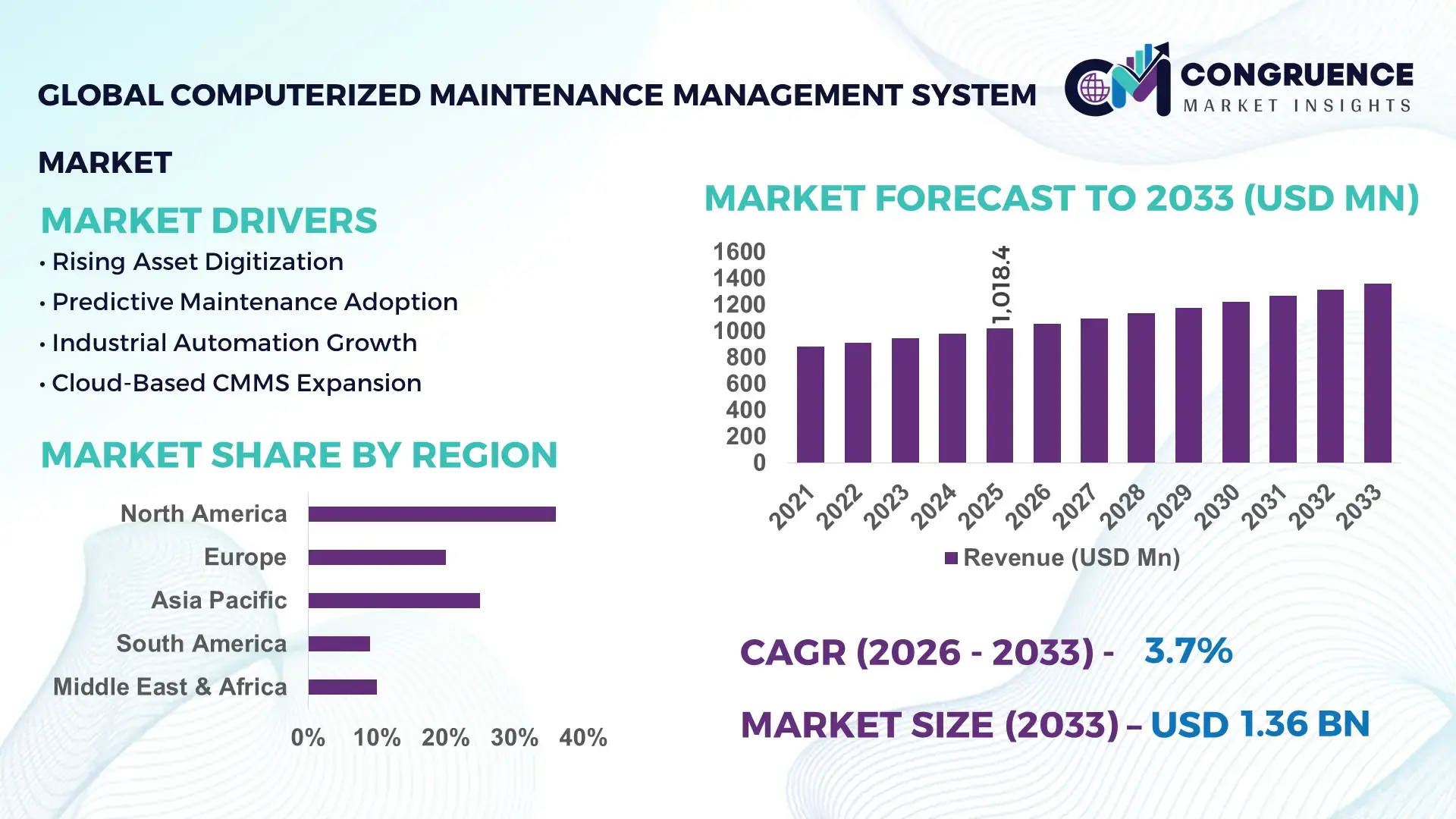
The Global Computerized Maintenance Management System Market was valued at USD 1018.37 Million in 2025 and is anticipated to reach a value of USD 1361.87 Million by 2033 expanding at a CAGR of 3.7% between 2026 and 2033. Growth is being driven by the integration of AI-enabled predictive maintenance, asset lifecycle optimization, and industrial digitalization programs across manufacturing, utilities, transportation, and energy infrastructure.
The United States remains the dominant market, accounting for approximately 31% of global CMMS deployments, supported by over USD 1 trillion in industrial and infrastructure modernization initiatives and widespread adoption across manufacturing, aviation, and utilities. In comparison, Germany benefits from Industry 4.0 penetration exceeding 55% among large manufacturers, while U.S. enterprises report up to 25% lower unplanned downtime through advanced maintenance analytics. Ongoing supply-chain resilience investments following geopolitical disruptions in Europe continue to accelerate enterprise asset management modernization.
Organizations prioritizing scalable CMMS platforms with predictive analytics and enterprise integration capabilities are positioned to improve asset reliability, reduce maintenance costs, and strengthen operational continuity.
Market Size & Growth: USD 1018.37 million in 2025, reaching USD 1361.87 million by 2033 at 3.7% CAGR, driven by AI-powered predictive maintenance and enterprise asset optimization.
Top Growth Drivers: Predictive maintenance adoption (+28%), cloud deployment expansion (+35%), and industrial digitalization programs (+22%) are accelerating implementation rates.
Short-Term Forecast: By 2028, CMMS users are expected to reduce unplanned downtime by 20% and improve maintenance productivity by 15%.
Emerging Technologies: AI diagnostics, IoT-enabled asset monitoring, and digital twins improve maintenance planning accuracy by 25–30%.
Regional Leaders: North America exceeds USD 430 million, Europe surpasses USD 340 million, and Asia-Pacific approaches USD 310 million, supported by smart factory deployments.
Consumer/End-User Trends: More than 60% of large industrial facilities now prioritize cloud-based maintenance management platforms over legacy systems.
Pilot/Case Example: In 2026, a manufacturing modernization program achieved a 22% reduction in equipment downtime through AI-integrated CMMS deployment.
Competitive Landscape: Leading vendors collectively control approximately 45% of the market, with strong competition among enterprise maintenance software providers.
Regulatory & ESG Impact: Digital maintenance programs support energy-efficiency targets, contributing to 10–18% reductions in maintenance-related energy waste.
Investment & Funding: Global investment exceeds USD 2.5 billion across software expansion, industrial automation partnerships, and maintenance digitalization initiatives.
Innovation & Future Outlook: Autonomous maintenance workflows, AI copilots, and connected asset ecosystems are expected to improve maintenance decision speed by over 30%.
Computerized Maintenance Management System solutions are gaining traction across manufacturing plants, utilities, transportation fleets, and energy facilities where asset uptime directly impacts productivity. Recent innovation centers on AI-assisted work-order automation, mobile-first maintenance applications, and IoT-connected equipment monitoring. More than 40% of new enterprise deployments now include predictive maintenance functionality, while growing regulatory focus on asset reliability and operational resilience is encouraging organizations to adopt data-driven maintenance strategies, setting the stage for broader strategic transformation.
Computerized Maintenance Management System platforms are becoming a strategic operational layer for asset-intensive industries as maintenance performance increasingly influences competitiveness, workforce productivity, and infrastructure reliability. Industrial digitalization programs, supply-chain resilience initiatives, and aging asset networks are pushing organizations to modernize maintenance operations. Manufacturing facilities, utilities, transportation operators, and energy companies are prioritizing CMMS deployment to reduce equipment failures, improve compliance tracking, and support data-driven asset management decisions across distributed operations.
Technology modernization is delivering measurable operational gains. AI-enabled CMMS platforms can reduce unplanned downtime by 20–25% and lower maintenance planning effort by nearly 30% compared with spreadsheet-based and reactive maintenance models. The United States leads large-scale enterprise deployment through advanced industrial automation investments, while Germany continues to integrate CMMS with Industry 4.0 production environments. In Japan, maintenance digitization is accelerating across aging industrial infrastructure, creating strong demand for predictive asset management tools. Over the next two to three years, cloud-based CMMS adoption is expected to exceed 65% among large industrial enterprises.
A practical example is the integration of IoT sensors with CMMS software in manufacturing plants, enabling automated work-order generation and real-time asset monitoring. Companies are expanding partnerships with automation vendors, cloud providers, and industrial analytics firms to strengthen maintenance ecosystems. Organizations that establish connected maintenance strategies today will secure stronger asset utilization, lower operating costs, and a durable competitive advantage in increasingly automated industrial environments.
The primary growth driver is the rapid shift from reactive maintenance toward predictive and condition-based maintenance strategies. More than 60% of large industrial organizations now prioritize maintenance digitalization programs, while predictive maintenance implementations have demonstrated downtime reductions of 20–25% and maintenance cost savings of up to 18%. In the United States, infrastructure modernization and manufacturing reshoring initiatives are increasing investment in asset performance management technologies. This shift creates a direct need for centralized maintenance platforms capable of managing complex asset networks. In response, software vendors are expanding AI functionality, investing in cloud-native architectures, and forming partnerships with industrial automation providers. A key strategic insight is that organizations increasingly view maintenance data as an operational intelligence asset rather than a back-office function.
Integration challenges remain a significant structural limitation, particularly among organizations operating fragmented legacy systems. Approximately 45% of industrial facilities continue to rely on multiple disconnected maintenance and asset databases, while system integration projects can increase deployment timelines by 20–30%. In Germany and Japan, older manufacturing facilities often face compatibility issues when connecting CMMS platforms with aging operational technology environments. These constraints affect deployment scalability, implementation costs, and operational continuity. To reduce risk, companies are adopting phased migration strategies, localized implementation models, and standardized API frameworks. A critical operational insight is that interoperability limitations often create higher long-term costs than software licensing, making integration capability a decisive procurement criterion.
The emergence of AI-enabled maintenance intelligence creates substantial opportunities beyond traditional work-order management. Advanced analytics can improve asset utilization by 15–20%, while machine-learning-based failure prediction can enhance maintenance planning accuracy by more than 25%. India is emerging as a high-potential deployment market due to accelerating industrial automation investments and smart manufacturing initiatives. Digital twin integration, autonomous maintenance workflows, and connected asset ecosystems are creating new value propositions for operators managing large equipment fleets. Companies are increasing R&D spending, expanding industrial software partnerships, and developing integrated platforms that combine maintenance, asset performance, and operational analytics. A notable strategic opportunity lies in monetizing maintenance data insights as a decision-support capability rather than solely as a maintenance management function.
Long-term market expansion depends on overcoming workforce capability gaps and increasing cybersecurity requirements. Studies indicate that nearly 35% of industrial organizations report shortages of personnel skilled in digital maintenance technologies, while connected industrial environments face a growing volume of cyber threats. As CMMS platforms become integrated with IoT networks, cloud infrastructure, and operational technology systems, security and governance requirements become significantly more complex. In the United States, critical infrastructure operators are strengthening cyber-resilience standards for connected maintenance environments. Companies must address these pressures through workforce training programs, secure architecture investments, and specialized technology partnerships. A major strategic challenge is achieving scalable digital maintenance operations without compromising system integrity, operational continuity, or long-term infrastructure resilience.
AI-Augmented Maintenance Workflows: Enterprises are embedding AI into maintenance scheduling, fault prioritization, and technician dispatch processes, reducing planning time by 25% and improving work-order completion rates by nearly 18%. More than 40% of new CMMS deployments now include AI-assisted functionality. Labor shortages across U.S. manufacturing facilities are accelerating adoption, prompting software vendors to expand analytics capabilities and partner with industrial automation providers to improve workforce productivity.
Mobile-First Field Operations: Mobile-based CMMS usage has increased by over 30% in asset-intensive industries as organizations seek faster field execution and real-time reporting. Technician response times have improved by approximately 20%, while paper-based maintenance records have declined significantly. Utilities and transportation operators are standardizing mobile workflows to support dispersed assets. Vendors are responding through offline functionality, workforce collaboration tools, and integration with enterprise asset management environments.
Connected Asset Monitoring Expansion: Equipment monitoring integration with CMMS platforms has surpassed 50% among large industrial facilities deploying predictive maintenance programs. Real-time sensor connectivity has reduced unexpected asset failures by 15–22% while improving maintenance planning accuracy. Supply-chain disruptions and higher equipment replacement costs are encouraging organizations to extend asset life. Companies are scaling IoT partnerships and expanding sensor-based monitoring across critical infrastructure networks.
Sustainability-Linked Maintenance Programs: Organizations are increasingly connecting maintenance performance with sustainability objectives, particularly in Germany and Japan where operational efficiency mandates are strengthening. Optimized maintenance strategies have lowered energy losses by 10–15% and improved equipment utilization by nearly 12%. A less obvious shift is the use of CMMS data for ESG reporting and audit readiness. Software providers are integrating environmental performance tracking and compliance modules into maintenance platforms.
Cloud-Based solutions represent the leading segment, accounting for an estimated 45% of deployments due to scalability, lower infrastructure requirements, and seamless integration with IoT, analytics, and enterprise software environments. Large manufacturers and utilities increasingly prefer cloud architectures because they reduce implementation complexity and support multi-site asset visibility. Adoption rates among newly deployed enterprise maintenance platforms exceed 60% in the United States. Companies are expanding cloud-native offerings, strengthening cybersecurity capabilities, and forming strategic partnerships with infrastructure providers to accelerate deployment.
Hybrid solutions are emerging as the fastest-growing segment, with adoption increasing by approximately 20% annually among organizations balancing legacy systems with modern digital capabilities. Hybrid models allow enterprises to retain critical operational data on-premises while utilizing cloud analytics and remote access tools. Web-Based platforms remain relevant for centralized operations, while Mobile-Based solutions continue gaining traction through workforce digitization initiatives. On-Premises deployments retain importance in highly regulated sectors requiring greater data control. Investment priorities are shifting toward flexible deployment architectures that improve interoperability, resilience, and long-term operational efficiency.
Asset Management remains the leading application segment because organizations increasingly depend on centralized visibility across complex equipment portfolios. More than 55% of enterprise CMMS users identify asset lifecycle optimization as their primary deployment objective. The ability to improve asset utilization by 15–20% and reduce unexpected failures makes this function operationally critical. Companies continue expanding integration between asset management modules, ERP systems, and industrial analytics platforms to improve decision-making and maintenance planning.
Equipment Monitoring is the fastest-growing application area as industrial operators adopt connected sensors and real-time diagnostics. Deployment of monitoring-enabled maintenance environments has increased by over 25% during the past two years. Preventive Maintenance remains a mature but essential use case supporting reliability initiatives, while Work Orders and Inventory Control are becoming increasingly automated through workflow orchestration. Facility Management applications continue expanding in commercial infrastructure environments. Vendors are strengthening automation, predictive analytics, and interoperability capabilities as demand shifts toward proactive maintenance execution and continuous operational intelligence.
Manufacturing represents the dominant end-user segment due to extensive equipment intensity, production continuity requirements, and growing digital factory investments. Approximately 35–40% of enterprise CMMS deployments are concentrated within manufacturing operations. Companies increasingly use maintenance platforms to reduce downtime, improve throughput, and support predictive maintenance initiatives. Integration with production systems and industrial automation environments remains a major investment priority. Vendors continue tailoring solutions through industry-specific functionality, implementation services, and ecosystem partnerships focused on operational efficiency.
Healthcare is emerging as the fastest-growing end-user segment as hospitals and medical facilities modernize asset tracking, compliance management, and equipment maintenance processes. Adoption rates within healthcare maintenance operations have increased by nearly 20% in recent years. Energy & Utilities and Oil & Gas remain major adopters due to critical infrastructure requirements, while Transportation organizations are expanding fleet maintenance digitization. Facilities Management is strengthening demand for multi-site asset visibility and service coordination. Companies are positioning competitively through sector-focused product development, subscription-based pricing models, and specialized deployment frameworks.
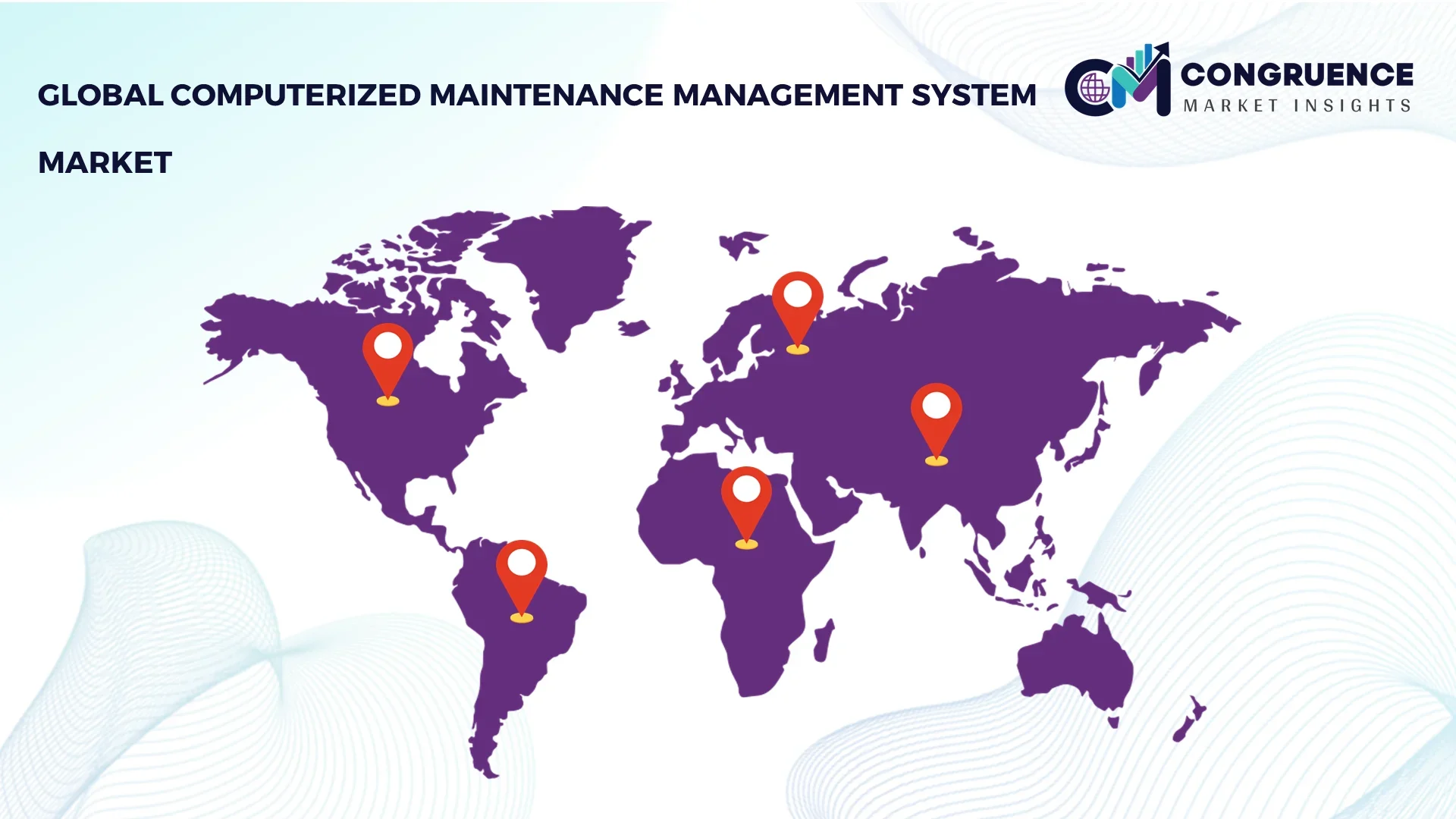
North America accounted for the largest market share at 36% in 2025 however, Asia-Pacific is expected to register the fastest growth, expanding at a CAGR of 5.2% between 2026 and 2033.
Enterprise Asset Intelligence Driving Adoption
North America maintains the leading position due to high digital maturity across manufacturing, utilities, transportation, and healthcare sectors. The region represents approximately 36% of global deployments, supported by extensive adoption of predictive maintenance and connected asset management technologies. Large enterprises continue integrating CMMS platforms with industrial IoT environments to improve equipment availability and maintenance efficiency. More than 65% of newly implemented enterprise maintenance systems incorporate cloud-based architectures. Infrastructure modernization initiatives and industrial automation investments are further strengthening deployment activity. Strategic partnerships between software providers, automation firms, and industrial operators continue accelerating platform expansion across asset-intensive industries.
United States Market Outlook: The United States remains the primary demand center due to its large industrial base, advanced digital infrastructure, and strong focus on operational reliability. Manufacturing, utilities, aviation, and logistics operators are increasingly investing in AI-enabled maintenance platforms. More than 60% of large industrial enterprises have adopted digital maintenance management systems integrated with predictive analytics. Strong technology ecosystems and ongoing industrial modernization initiatives continue reinforcing the country's leadership position in advanced maintenance software deployment.
Industry 4.0 Integration Reshaping Maintenance Operations
Europe represents approximately 29% of global market activity, supported by advanced manufacturing infrastructure and strong industrial digitalization initiatives. Organizations increasingly deploy CMMS platforms alongside smart factory environments to optimize asset utilization and compliance management. Industrial operators report maintenance efficiency improvements exceeding 15% through integrated maintenance analytics and automation programs. Sustainability objectives and equipment lifecycle optimization strategies are encouraging broader implementation across manufacturing, transportation, and energy sectors. Maintenance modernization remains closely aligned with operational efficiency and industrial resilience objectives throughout major European economies.
Germany Market Outlook: Germany serves as the region's strategic center due to its manufacturing strength and Industry 4.0 leadership. Industrial enterprises continue integrating maintenance management systems with production automation, digital twins, and connected equipment networks. More than 55% of large manufacturing facilities have implemented advanced digital maintenance initiatives. Strong engineering capabilities, industrial innovation programs, and continued factory modernization investments position Germany as a key market for enterprise maintenance technology adoption and platform innovation.
Industrial Expansion Accelerates Digital Maintenance
Asia-Pacific accounts for approximately 25% of global deployments and demonstrates the strongest momentum through rapid industrialization and infrastructure expansion. Manufacturing growth, expanding logistics networks, and smart infrastructure programs are increasing demand for maintenance digitization. Enterprise deployment activity has increased by more than 20% over the last few years as organizations modernize asset management practices. Large-scale industrial facilities increasingly implement cloud-based maintenance platforms to improve equipment reliability and workforce productivity. Vendors are strengthening local partnerships and expanding regional delivery capabilities to capture growing demand across emerging industrial hubs.
China Market Outlook: China remains the most influential market due to its extensive manufacturing ecosystem, infrastructure scale, and industrial automation investments. Smart factory initiatives continue driving maintenance software adoption across electronics, automotive, and heavy industry sectors. More than 50% of large manufacturers are actively integrating digital maintenance processes with broader industrial automation strategies. Continued investment in intelligent manufacturing and connected industrial infrastructure supports long-term deployment opportunities for advanced maintenance management platforms.
Asset Reliability Programs Strengthen Demand
South America represents approximately 5% of global market activity, with adoption concentrated in mining, energy, utilities, and manufacturing sectors. Organizations are increasingly focusing on asset reliability and maintenance efficiency to maximize productivity from existing infrastructure investments. Deployment activity has grown steadily as operators seek to reduce downtime and improve maintenance planning. Industrial modernization projects and cloud-based software adoption are expanding market opportunities despite infrastructure and budget constraints. Technology vendors are prioritizing localized service delivery, implementation support, and flexible subscription models to improve market penetration.
Brazil Market Outlook: Brazil leads regional demand through its diversified industrial base and extensive infrastructure assets. Mining operators, manufacturers, and utility companies are adopting maintenance management platforms to improve operational continuity and asset performance. Digital maintenance deployments have increased by approximately 18% among large industrial enterprises. Ongoing modernization efforts, growing cloud adoption, and increasing focus on operational efficiency continue supporting broader utilization of advanced maintenance technologies across key industrial sectors.
Infrastructure Modernization Supporting Deployment
The Middle East & Africa region accounts for roughly 5% of global market participation, driven primarily by infrastructure modernization, energy-sector investment, and industrial diversification programs. Asset-intensive industries increasingly deploy CMMS platforms to improve maintenance planning and equipment reliability. Major infrastructure developments and industrial expansion initiatives are generating demand for centralized maintenance management systems. Several large-scale industrial projects have incorporated digital asset management platforms as part of operational transformation strategies. Technology providers continue expanding regional partnerships and service capabilities to support growing enterprise requirements.
Saudi Arabia Market Outlook: Saudi Arabia represents the most strategically significant market due to extensive infrastructure investment, industrial diversification programs, and large energy-sector operations. Industrial operators are deploying advanced maintenance technologies to support reliability, operational efficiency, and long-term asset performance. Digital transformation initiatives across industrial facilities have increased maintenance technology adoption by more than 20% in recent years. Strong investment in industrial modernization and smart infrastructure continues positioning the country as a key growth center for maintenance management solutions.
The competitive landscape is led by IBM, SAP, Oracle, IFS, and Hexagon, which collectively control approximately 42% of the market. These global leaders compete against specialized CMMS providers such as UpKeep, Fiix, eMaint, Limble, and Maintenance Connection. Competition centers on predictive maintenance capabilities, cloud scalability, implementation speed, and integration depth. AI-enabled maintenance analytics improve planning efficiency by 20–25%, while cloud-native platforms reduce deployment timelines by nearly 30% compared with traditional enterprise implementations. Vendors increasingly compete through ecosystem partnerships with industrial automation, IoT, and asset-performance software providers. Recent competitive shifts favor cloud-first and mobile-centric platforms as enterprises prioritize operational visibility across distributed assets. Consolidation pressure is increasing as larger software companies expand maintenance portfolios through acquisitions and strategic alliances. The primary entry barrier remains enterprise integration complexity, particularly within legacy industrial environments. Winning requires strong interoperability, advanced analytics, scalable deployment models, and measurable operational outcomes.
IBM
SAP
Oracle
IFS
Hexagon
UpKeep
Fiix
eMaint
Limble CMMS
Maintenance Connection
Brightly Software
Dude Solutions
MPulse Software
Maintenance Care
Cloud-native CMMS platforms, mobile workforce applications, and IoT-enabled asset monitoring currently define the technology foundation of the market. More than 60% of new enterprise deployments utilize cloud architectures, while mobile maintenance workflows improve technician productivity by 18–22%. Integration with ERP, EAM, and operational technology environments has become a standard requirement, reducing maintenance administration costs by approximately 15%. Compared with legacy spreadsheet-based maintenance processes, modern cloud CMMS platforms deliver up to 30% faster work-order execution and significantly greater asset visibility across distributed facilities. Manufacturing, utilities, and transportation operators benefit most due to high asset density and operational complexity.
Emerging technologies are centered on artificial intelligence, machine learning, and predictive maintenance analytics. AI-assisted maintenance planning improves scheduling accuracy by nearly 25%, while condition-monitoring integrations reduce unplanned downtime by 20–25%. Adoption of predictive maintenance functionality has exceeded 40% among large industrial organizations. Companies are increasingly connecting CMMS platforms with digital twins and industrial IoT networks to create continuous asset intelligence environments. This shift enables maintenance teams to prioritize interventions based on equipment condition rather than fixed maintenance schedules.
Between 2026 and 2028, autonomous maintenance workflows, AI copilots, and generative maintenance recommendations will become major competitive differentiators. Early adopters are expected to achieve maintenance planning efficiency gains exceeding 30% and asset utilization improvements approaching 15%. Technology leaders capable of integrating analytics, automation, and cybersecurity into unified maintenance ecosystems will secure stronger operational performance and long-term customer retention.
April 2024 – Hexagon acquired Itus Digital to strengthen asset performance management capabilities and expand predictive maintenance functionality within its enterprise asset management portfolio. The acquired platform supports digital-twin-based asset strategies and risk prioritization, improving reliability-focused maintenance execution. Business impact: stronger integrated maintenance intelligence capabilities. Source: hexagon.com
June 2024 – Hexagon launched HxGN APM, a scalable asset performance management solution capable of supporting environments ranging from 25 assets to more than 1 million assets. The platform enables real-time failure-risk detection and proactive maintenance optimization. Business impact: enhanced enterprise-scale predictive maintenance deployment.
October 2024 – Hexagon achieved leadership recognition in a major enterprise asset management assessment covering 14 software providers and a 151-point evaluation framework. The recognition highlighted strengths in data management and integration capabilities. Business impact: increased enterprise confidence in large-scale maintenance platform adoption.
November 2025 – IBM and Kahua introduced an integration connecting IBM Maximo with asset-centric project management workflows, enabling seamless asset-data transfer from construction through operations. The integration reduces months-long handover delays and improves lifecycle asset information continuity. Business impact: faster operational readiness and maintenance planning accuracy. Source: resources.kahua.com
This report provides comprehensive analysis of the Computerized Maintenance Management System market across deployment types, applications, end-user industries, and major geographic regions. Coverage includes Cloud-Based, On-Premises, Web-Based, Mobile-Based, and Hybrid platforms, alongside key application areas such as Asset Management, Preventive Maintenance, Work Orders, Inventory Control, Facility Management, and Equipment Monitoring. The study evaluates adoption patterns, deployment priorities, technology integration trends, and competitive positioning across manufacturing, healthcare, transportation, energy & utilities, facilities management, and oil & gas sectors.
The report examines market dynamics, technology evolution, regional deployment strategies, and enterprise investment priorities between 2026 and 2033. Analysis incorporates trends such as AI-enabled maintenance, predictive analytics, IoT integration, digital twins, and mobile workforce management. More than 60% of new enterprise implementations now emphasize cloud-enabled architectures, while connected maintenance environments continue expanding across asset-intensive industries. Strategic insights support investment planning, expansion decisions, partnership evaluation, product positioning, and identification of high-opportunity segments, emerging deployment models, and competitive differentiation strategies shaping future market direction.
| Report Attribute/Metric | Report Details |
|---|---|
|
Market Revenue in 2025 |
USD 1018.37 Million |
|
Market Revenue in 2033 |
USD 1361.87 Million |
|
CAGR (2026 - 2033) |
3.7% |
|
Base Year |
2025 |
|
Forecast Period |
2026 - 2033 |
|
Historic Period |
2021 - 2025 |
|
Segments Covered |
By Type
By Application
By End-User
|
|
Key Report Deliverable |
Revenue Forecast, Growth Trends, Market Dynamics, Segmental Overview, Regional and Country-wise Analysis, Competition Landscape |
|
Region Covered |
North America, Europe, Asia-Pacific, South America, Middle East, Africa |
|
Key Players Analyzed |
IBM, SAP, Oracle, IFS, Hexagon, UpKeep, Fiix, eMaint, Limble CMMS, Maintenance Connection, Brightly Software, Dude Solutions, MPulse Software, Maintenance Care |
|
Customization & Pricing |
Available on Request (10% Customization is Free) |




