
Reports
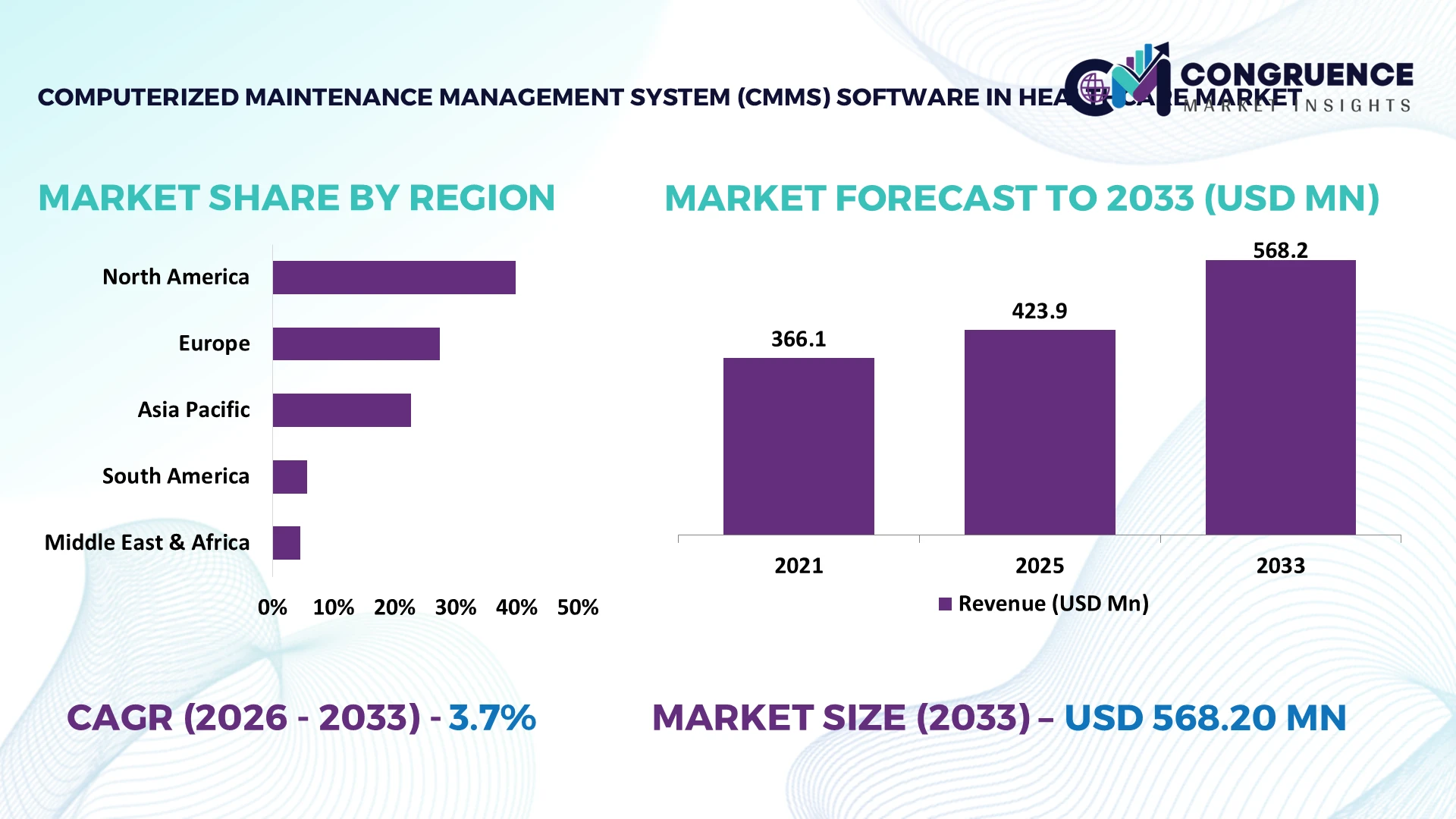
The Global Computerized Maintenance Management System (CMMS) Software in Healthcare Market was valued at USD 423.9 Million in 2025 and is anticipated to reach a value of USD 568.2 Million by 2033 expanding at a CAGR of 3.73% between 2026 and 2033. Increasing medical equipment maintenance requirements, automated regulatory compliance reporting, and predictive asset management across healthcare facilities are driving market growth.
The United States dominates healthcare CMMS software adoption, supported by over 6,000 hospitals and healthcare expenditure representing approximately 17.6% of GDP in 2023. Compared with Canada's approximately 1,300 hospitals, the United States offers significantly greater deployment scale. Federal healthcare cybersecurity initiatives, hospital infrastructure modernization, and investments in connected medical equipment are accelerating computerized maintenance management adoption.
Healthcare CMMS providers must prioritize interoperable asset management platforms, automated compliance documentation, and predictive maintenance capabilities to secure long-term hospital contracts.
Market Size & Growth: USD 423.9 million in 2025, reaching USD 568.2 million by 2033 at 3.73% CAGR, driven by predictive maintenance.
Top Growth Drivers: Equipment reliability (38%), regulatory compliance (34%), and maintenance automation (28%), based on indicative driver weightings.
Short-Term Forecast: By 2028, advanced CMMS deployments target 15–20% reductions in unplanned equipment downtime.
Emerging Technologies: AI-driven diagnostics, IoT monitoring, and mobile maintenance platforms target 20% faster work-order processing.
Regional Leaders: North America (USD 232.9 million), Europe (USD 153.4 million), and Asia Pacific (USD 136.4 million) represent indicative 2033 projections, emphasizing cloud, compliance, and digitalization, respectively.
Consumer/End-User Trends: Hospitals target over 90% preventive maintenance completion through centralized asset management.
Pilot/Case Example: A representative 2025 connected-equipment pilot targets 20% fewer emergency maintenance interventions.
Competitive Landscape: Accruent, with an indicative 12% share, competes with IBM, Brightly Software, HEMS, and TMA Systems.
Regulatory & ESG Impact: Automated inspection records support 100% maintenance documentation coverage and extended equipment lifecycles.
Investment & Funding: The USD 1.575 billion Brightly acquisition by Siemens demonstrates strategic investment in intelligent asset management.
Innovation & Future Outlook: Digital twins and predictive analytics target 15–25% maintenance efficiency improvements, strengthening outcome-based service models.
The Computerized Maintenance Management System (CMMS) Software in Healthcare Market is evolving toward integrated clinical engineering, automated work-order management, and real-time medical equipment monitoring. Mobile-enabled maintenance platforms target approximately 20% improvements in technician productivity. Increasing hospital accreditation requirements and connected equipment deployment are strengthening demand for centralized maintenance intelligence, positioning operational resilience as a critical strategic investment priority.
Healthcare CMMS software is becoming strategically important as hospitals shift from reactive equipment servicing toward integrated asset lifecycle management. Increasing medical device complexity, infrastructure modernization, and regulatory documentation requirements are transforming maintenance departments into operational performance centers. Healthcare organizations increasingly evaluate maintenance software through equipment availability, patient safety, and lifecycle cost optimization rather than administrative efficiency alone.
Compared with spreadsheet-based maintenance scheduling, automated CMMS platforms target 15–25% improvements in technician productivity through intelligent work-order prioritization and preventive maintenance scheduling. The United States benefits from established clinical engineering infrastructure, while India is expanding digital maintenance capabilities across multispecialty hospitals. Between 2026 and 2029, advanced deployments are expected to target preventive maintenance completion rates exceeding 90%, reducing dependence on emergency servicing.
For example, hospitals integrating CMMS platforms with connected imaging equipment can automatically generate service requests when operating parameters exceed predefined thresholds. Software providers are expanding investments in cloud infrastructure, medical equipment integrations, and partnerships with healthcare technology management organizations. Competitive positioning increasingly depends on converting maintenance intelligence into measurable equipment reliability, regulatory readiness, and sustainable operating cost advantages.
Growing dependence on sophisticated medical equipment is accelerating CMMS software adoption across hospitals, diagnostic centers, and ambulatory healthcare facilities. Healthcare organizations implementing structured preventive maintenance programs target 15–25% reductions in equipment downtime and maintenance completion rates exceeding 90%. In the United States, Centers for Medicare & Medicaid Services requirements for medical equipment maintenance reinforce demand for documented inspection schedules and risk-based servicing. Automated work-order allocation improves technician utilization while reducing administrative workloads by a targeted 15–20%. Companies including Accruent and Brightly Software are strengthening healthcare asset management capabilities through centralized maintenance databases and automated compliance workflows. Equipment availability increasingly influences software procurement because maintenance interruptions directly constrain diagnostic and treatment capacity.
Healthcare CMMS deployment remains constrained by fragmented asset inventories, legacy information systems, and substantial implementation requirements. Hospitals transitioning from manual maintenance processes face indicative implementation overheads of 15–25% above initial software licensing budgets, particularly when extensive equipment data migration is required. Custom integration and staff training can represent another 10–20% of project expenditure. Smaller healthcare facilities in India and other developing markets frequently operate heterogeneous medical equipment fleets with limited standardized digital interfaces. These conditions extend deployment timelines and weaken near-term investment returns. Software providers are addressing affordability through modular subscriptions, standardized application programming interfaces, and phased implementation services. Poor asset-data quality represents a significant commercial barrier because automation cannot compensate for inaccurate equipment records.
Artificial intelligence and IoT-enabled medical equipment monitoring are creating opportunities for healthcare CMMS providers to expand beyond conventional maintenance scheduling. Predictive maintenance deployments target 20–30% reductions in unexpected equipment failures and 10–15% improvements in maintenance expenditure efficiency. Japan's aging healthcare infrastructure and expanding medical automation initiatives provide attractive opportunities for condition-based asset management. Integrating sensor-generated operating data with maintenance histories enables hospitals to prioritize component replacement according to actual equipment condition rather than fixed service intervals. Companies are investing in machine learning algorithms, digital twin integration, and partnerships with medical device manufacturers. The strongest commercial opportunity lies in equipment-specific predictive intelligence that enables healthcare organizations to defer unnecessary capital replacement without compromising operational reliability.
Maintaining secure, scalable CMMS deployments across interconnected healthcare environments presents a significant long-term execution challenge. In 2023, hacking and IT incidents represented approximately 79% of large healthcare data breaches reported in the United States, highlighting vulnerabilities across digital healthcare ecosystems. Healthcare organizations implementing connected maintenance platforms must target 100% coverage of critical asset access controls and security monitoring. The increasing connectivity of medical equipment expands cybersecurity exposure while creating demand for technicians proficient in both clinical engineering and digital asset management. Software providers must strengthen role-based authentication, encrypted integrations, workforce training, and continuous security monitoring. Long-term competitiveness depends on delivering predictive maintenance intelligence without introducing additional vulnerabilities into mission-critical healthcare infrastructure.
Mobile-First Clinical Engineering Workflows: Hospitals are replacing desktop-dependent maintenance workflows with mobile applications, QR-coded asset identification, and digital service approvals. These deployments target 20–25% faster work-order completion and 15–20% lower administrative workloads. Accruent and TMA Systems are expanding mobile functionality, enabling technicians to retrieve equipment histories and complete service documentation directly at the point of maintenance.
Centralized Multisite Maintenance Operations: Healthcare networks are consolidating facility-level maintenance databases into enterprise-wide platforms, targeting 15–20% improvements in resource utilization and 10–15% reductions in duplicated service activities. Hospital consolidation in the United States is accelerating this transition. Brightly Software and IBM are strengthening centralized dashboards and cross-facility benchmarking to support standardized maintenance operations.
Digital Spare Parts Inventory Optimization: Healthcare facilities are integrating spare parts procurement with maintenance schedules, targeting 10–15% reductions in excess inventory and 15–20% fewer component shortages. Medical equipment supply-chain disruptions are encouraging automated replenishment and supplier performance tracking. CMMS providers are expanding procurement integrations, enabling hospitals to balance critical component availability against working capital requirements.
Outsourced Maintenance Service Digitization: Hospitals are extending CMMS access to third-party service contractors, targeting 20% faster service verification and over 95% documentation completeness. Shared maintenance portals improve accountability across outsourced engineering operations. Software companies are introducing contractor-specific dashboards, automated service-level agreement monitoring, and digital approval workflows, transforming maintenance records into measurable vendor performance indicators.
Web & Cloud-Based CMMS Software represents the leading segment, accounting for an estimated 65.3% of the market share in 2025, supported by deployment flexibility, centralized asset visibility, and reduced IT infrastructure requirements. Healthcare networks in the United States increasingly prioritize subscription-based maintenance platforms that enable biomedical engineers to manage equipment records across distributed facilities. Cloud-based deployment targets 20–25% reductions in internal IT administration requirements through centralized updates, automated backups, and standardized software configurations. Scalability across hospital networks strengthens its commercial attractiveness.
Web & Cloud-Based CMMS Software is also positioned as the fastest-growing segment as healthcare organizations consolidate maintenance operations and adopt remotely accessible enterprise platforms. On-Premises CMMS Software accounts for approximately 34.7% of the market, maintaining relevance among healthcare institutions requiring localized data storage, internal network accessibility, and greater infrastructure control. Accruent, IBM, and Brightly Software are expanding cloud-native capabilities, configurable security architecture, and enterprise integrations. Investment priorities increasingly favor subscription-based platforms that accommodate incremental facility expansion without requiring substantial additional infrastructure.
Preventive Maintenance represents the leading application, accounting for an estimated 42.8% of the market share in 2025, supported by recurring equipment servicing requirements, inspection scheduling, and standardized maintenance documentation. Healthcare facilities prioritize preventive maintenance software to manage imaging systems, laboratory instruments, sterilization equipment, and critical facility infrastructure. Work Order Planning remains an established application, enabling maintenance departments to allocate technician workloads, prioritize service requests, and improve operational coordination. Inventory Management supports spare parts availability, with optimized replenishment workflows targeting 10–15% reductions in excess stock.
Predictive Maintenance is positioned as the fastest-growing application as healthcare organizations increasingly incorporate equipment condition monitoring into maintenance planning. Advanced deployments target 20–30% reductions in unexpected equipment failures through operating data analysis and condition-based interventions. Other Applications, including maintenance reporting and asset lifecycle analysis, support capital expenditure planning and administrative oversight. IBM, Accruent, and eMaint are strengthening analytical capabilities, configurable scheduling engines, and inventory integrations. Competitive differentiation increasingly depends on connecting individual maintenance activities with broader equipment lifecycle decisions.
Hospitals represent the dominant end-user segment, accounting for an estimated 62.1% of the market share in 2025. Extensive medical equipment inventories, continuous clinical operations, and complex facility infrastructure generate sustained requirements for enterprise maintenance management software. Large hospital networks increasingly consolidate biomedical engineering, facility maintenance, and equipment servicing activities within integrated platforms. Centralized deployments target 15–20% improvements in technician utilization through coordinated scheduling and resource allocation. Established healthcare institutions prioritize comprehensive platforms offering configurable maintenance workflows, regulatory documentation, and equipment lifecycle visibility.
Diagnostic Laboratories are positioned as the fastest-growing end-user segment as automated testing systems and high-throughput analytical instruments increase dependence on uninterrupted equipment availability. Digital servicing platforms target equipment availability exceeding 95%, supporting consistent laboratory throughput. Clinics represent an emerging demand segment, favoring affordable subscription models and simplified maintenance scheduling over extensive enterprise configurations. Accruent, UpKeep, and TMA Systems are addressing differentiated purchasing requirements through modular software packages, mobile applications, and deployment customization. Future investment increasingly targets specialized maintenance solutions that accommodate smaller healthcare facilities without compromising functionality.
North America accounted for the largest market share at 39.8% in 2025 however, Asia-Pacific is expected to register the fastest growth, expanding at a CAGR of 5.2% between 2026 and 2033.
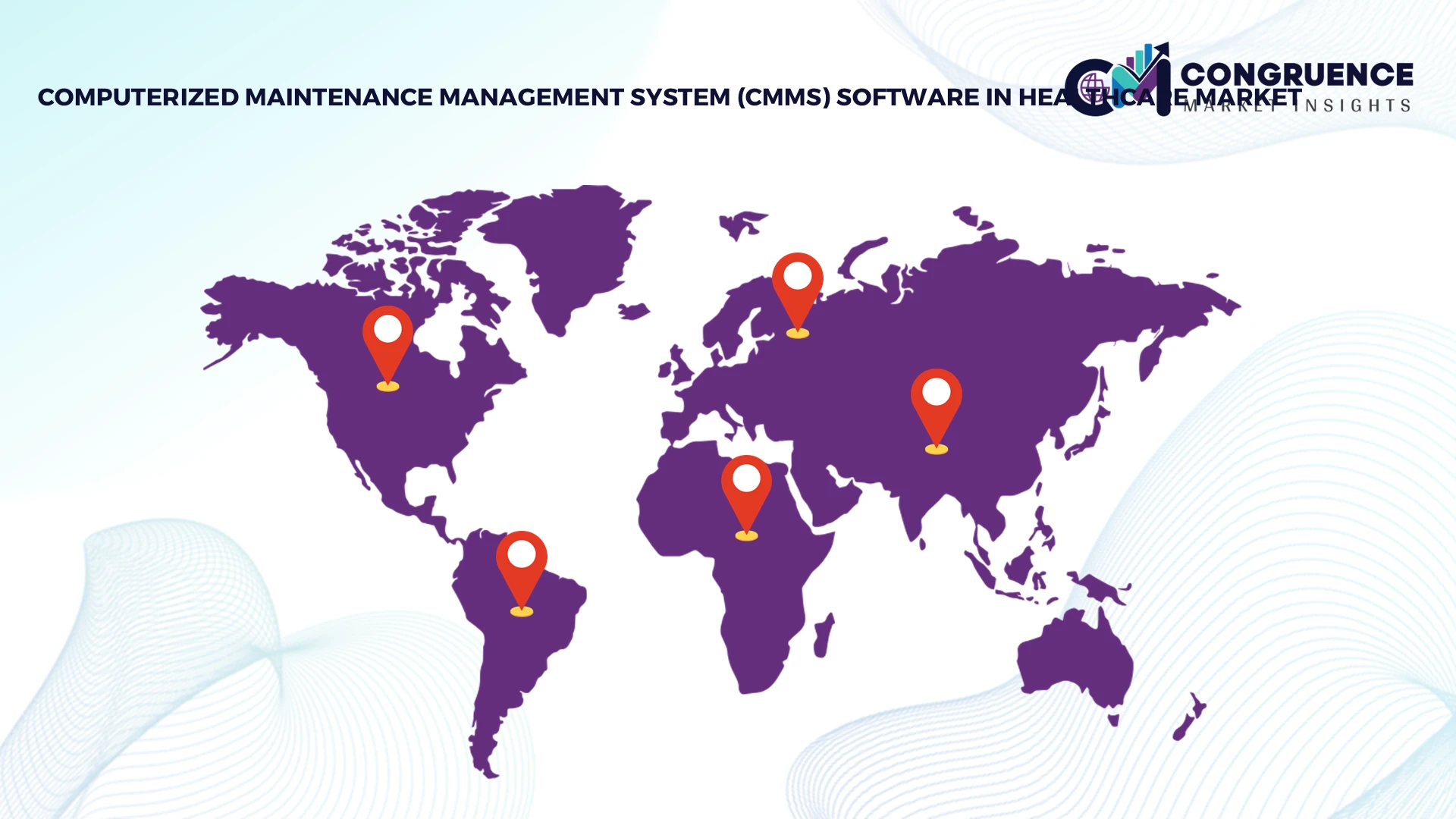
North America accounted for 39.8% of the global market share in 2025, supported by established healthcare infrastructure, advanced clinical engineering capabilities, and widespread enterprise software adoption. Hospitals across the United States and Canada increasingly integrate computerized maintenance management systems with facility management platforms, medical equipment databases, and procurement applications. Healthcare organizations are prioritizing centralized maintenance scheduling to improve equipment availability and standardize servicing across multisite hospital networks. The presence of over 6,000 hospitals in the United States provides an extensive deployment base for healthcare maintenance software. Regulatory requirements associated with medical equipment inspections and hospital accreditation further reinforce demand for automated documentation. Leading software providers, including Accruent, IBM, and Brightly Software, are expanding healthcare-specific integrations, mobile maintenance capabilities, and configurable reporting tools to strengthen enterprise customer retention.
U.S. Market Outlook: The United States leads regional demand through extensive investments in hospital modernization, connected medical devices, and healthcare information technology. National healthcare expenditure represented approximately 17.6% of GDP in 2023, supporting substantial infrastructure and equipment management requirements. Healthcare providers increasingly prioritize computerized maintenance platforms that consolidate biomedical engineering operations, contractor performance monitoring, and equipment lifecycle planning within standardized digital environments.
Europe accounted for 27.4% of the global market share in 2025, supported by established public healthcare systems, stringent medical device regulations, and increasing hospital infrastructure modernization. Healthcare institutions across Germany, France, and the United Kingdom are adopting computerized maintenance management software to standardize equipment servicing, strengthen inspection traceability, and optimize maintenance expenditure. The European Union's Medical Device Regulation reinforces requirements surrounding medical device safety and lifecycle oversight, encouraging comprehensive asset documentation. Germany's Hospital Future Act established a EUR 4.3 billion funding framework for hospital digitalization, strengthening the broader technology infrastructure supporting maintenance software integration. European healthcare organizations also prioritize equipment lifecycle extension and energy-efficient facility operations. Software providers are responding through localized cloud infrastructure, multilingual interfaces, configurable compliance modules, and partnerships with healthcare engineering service companies.
Germany Market Outlook: Germany represents a major healthcare CMMS software market, supported by approximately 1,900 hospitals and an extensive medical technology manufacturing ecosystem. Hospitals increasingly integrate maintenance management platforms with building automation systems and biomedical equipment inventories. Strong domestic engineering capabilities and stringent equipment safety requirements favor specialized software solutions offering detailed service histories, standardized inspection workflows, and comprehensive technical asset documentation.
Asia-Pacific accounted for 22.6% of the global market share in 2025, supported by expanding hospital infrastructure, increasing medical equipment installations, and accelerated healthcare digitalization. China, India, Japan, and South Korea are strengthening maintenance management capabilities as healthcare facilities deploy sophisticated diagnostic, surgical, and laboratory equipment. China's healthcare system encompassed approximately 38,000 hospitals in 2023, providing a substantial addressable base for computerized asset management platforms. Cloud-based CMMS solutions are gaining strategic relevance among expanding private hospital networks seeking standardized maintenance operations without extensive internal IT infrastructure. Japan's established medical technology ecosystem supports advanced equipment servicing applications, while India offers opportunities for affordable subscription-based platforms. Software providers are expanding regional partnerships, localized technical support, and modular deployment models to address differences in healthcare infrastructure maturity and institutional purchasing capacity.
China Market Outlook: China benefits from large-scale healthcare infrastructure investments, domestic medical equipment manufacturing, and government-supported hospital digitalization initiatives. The country recorded approximately 10.2 million beds across medical and healthcare institutions in 2023, creating extensive maintenance requirements. Healthcare organizations are increasingly adopting centralized equipment management systems, while domestic software developers compete through localized integrations, flexible pricing, and compatibility with hospital information management platforms.
South America accounted for 5.7% of the global market share in 2025, with demand concentrated across Brazil, Argentina, and Chile. Healthcare organizations are transitioning from fragmented maintenance records toward centralized digital platforms to improve equipment reliability and optimize constrained operational budgets. Brazil's extensive public and private healthcare infrastructure provides the region's largest deployment opportunity. The country's Unified Health System serves a population exceeding 200 million, generating substantial requirements for medical equipment servicing and facility maintenance. Dependence on imported medical devices and replacement components strengthens the importance of preventive maintenance scheduling and spare parts inventory visibility. However, uneven digital infrastructure and limited technology budgets constrain enterprise-wide implementation. Software providers are addressing these limitations through affordable cloud subscriptions, Portuguese and Spanish interfaces, regional distribution partnerships, and simplified mobile maintenance applications.
Brazil Market Outlook: Brazil leads regional demand through its network of more than 7,000 hospitals and expanding private diagnostic service infrastructure. Healthcare providers are prioritizing maintenance software that improves equipment utilization while reducing dependence on emergency servicing and costly component replacement. Localized deployment support, flexible subscription pricing, and integration with hospital procurement systems represent important competitive advantages for CMMS software vendors targeting Brazilian healthcare institutions.
Middle East & Africa accounted for 4.5% of the global market share in 2025, supported by hospital construction, healthcare modernization, and increasing investments in advanced medical technologies. Saudi Arabia, the United Arab Emirates, and South Africa represent important deployment markets for computerized maintenance management software. Saudi Arabia's healthcare transformation strategy under Vision 2030 includes restructuring public healthcare delivery into 20 health clusters, strengthening requirements for coordinated asset management and standardized maintenance procedures. Newly established healthcare facilities increasingly incorporate digital maintenance platforms during infrastructure commissioning rather than introducing them after operational commencement. However, uneven connectivity and limited technical expertise constrain implementation across several African markets. International software providers are expanding regional implementation partnerships, Arabic-language interfaces, cloud-based deployment capabilities, and technical training programs to address diverse healthcare infrastructure and maintenance management requirements.
Saudi Arabia Market Outlook: Saudi Arabia represents a strategically significant market through government-backed healthcare modernization and expanding private-sector participation. The country operates more than 450 hospitals, generating substantial requirements for medical equipment servicing and facility asset management. Healthcare organizations increasingly prioritize integrated maintenance platforms that support outsourced engineering services, equipment performance monitoring, and standardized operational reporting across expanding healthcare networks.
Accruent, IBM, Brightly Software, Fluke Reliability, and TMA Systems compete through enterprise asset management capabilities, healthcare specialization, and maintenance workflow automation. These leading providers collectively account for an estimated 46.5% of the global market, reflecting a moderately fragmented competitive structure. Enterprise vendors emphasize interoperability, cybersecurity, and multisite deployment, while specialized providers compete through configurable clinical engineering workflows and affordable subscriptions. Automated maintenance platforms target 15–25% improvements in technician productivity and 10–20% reductions in administrative workloads, strengthening procurement value propositions. Accruent and Brightly Software are expanding integrated asset management capabilities, while IBM emphasizes intelligent maintenance analytics and enterprise connectivity. Competitive differentiation is shifting from conventional work-order scheduling toward connected equipment intelligence and comprehensive lifecycle management. Established customer relationships, healthcare-specific integrations, and complex asset-data migration requirements create substantial entry barriers. Winning requires scalable architecture, demonstrable operational savings, reliable compliance documentation, and specialized implementation expertise that minimizes disruption across mission-critical healthcare environments during deployment.
Accruent
IBM Corporation
Brightly Software
Fluke Reliability (eMaint)
TMA Systems
HEMS (EQ2, LLC)
UpKeep Technologies
Limble CMMS
MaintainX
FMX
Asset Panda
Nuvolo
Cloud-based CMMS platforms, mobile maintenance applications, and automated work-order management represent foundational technologies supporting healthcare asset management. Cloud deployment accounts for an estimated 65.3% of market adoption, reflecting institutional preferences for scalable infrastructure and centralized accessibility. Compared with spreadsheet-based maintenance processes, mobile-enabled platforms target 20–25% faster work-order completion, while automated scheduling targets 15–20% improvements in technician utilization. Integration with hospital information systems strengthens equipment visibility and maintenance coordination across distributed healthcare facilities.
Emerging technologies include IoT-enabled condition monitoring, artificial intelligence, and machine learning algorithms. Connected medical equipment enables continuous performance assessment, supporting targeted reductions of 20–30% in unexpected equipment failures. AI-driven maintenance prioritization targets 10–15% improvements in servicing expenditure efficiency. Healthcare organizations increasingly integrate maintenance software with procurement platforms, enabling automated spare parts replenishment and improved inventory availability.
Between 2026 and 2028, digital twins, intelligent workflow assistants, and equipment-specific predictive models will reshape competitive positioning. Digital twin applications target 15–20% improvements in maintenance planning accuracy through virtual equipment performance simulation. Enterprise software providers benefit from established integration ecosystems, while specialized vendors gain advantages through healthcare-specific analytical capabilities. Investment priorities increasingly favor interoperable platforms that translate equipment intelligence into measurable operational reliability, optimized lifecycle expenditure, and improved clinical infrastructure availability across healthcare networks.
July 2025, MaintainX secured USD 150 million in Series D funding to expand artificial intelligence capabilities, equipment condition monitoring, and predictive maintenance solutions. The investment strengthens its enterprise asset management platform, supporting broader adoption across equipment-intensive industries, including healthcare. Source: getmaintainx.com
March 2025, TMA Systems acquired EQ2 HEMS, completing its fifth acquisition since 2021 and strengthening healthcare-specific maintenance capabilities. The transaction combines enterprise asset management with clinical engineering functionality, expanding integrated equipment servicing and regulatory compliance solutions for hospitals worldwide. Source: tmasystems.com
September 2024, Accruent announced an integration connecting two platforms, RedEye and Maintenance Connection, to streamline engineering documentation and maintenance operations. The integration strengthens technical information accessibility, supporting maintenance teams managing complex equipment inventories and infrastructure across asset-intensive operating environments. Source: accruent.com
June 2024, IBM released Maximo Application Suite version 9.0, with extended support available through June 2031. The release strengthens enterprise asset management modernization, providing healthcare organizations with an established software lifecycle for planning maintenance infrastructure upgrades and long-term deployment. Source: ibm.com
The Computerized Maintenance Management System (CMMS) Software in Healthcare Market Report provides comprehensive analysis across types, applications, end-users, and five major geographical regions, including North America, Europe, Asia-Pacific, South America, and Middle East & Africa. The report evaluates Web & Cloud-Based and On-Premises CMMS Software across Preventive Maintenance, Predictive Maintenance, Work Order Planning, Inventory Management, and Other Applications. End-user coverage includes Hospitals, Clinics, and Diagnostic Laboratories, examining deployment requirements and institutional purchasing behavior.
The report assesses competitive positioning, regulatory frameworks, technological advancements, and emerging opportunities involving artificial intelligence, IoT-enabled equipment monitoring, mobile maintenance applications, and digital twins. Regional assessments examine healthcare infrastructure modernization, enterprise digitalization, and software implementation patterns. Strategic insights support investment planning, geographical expansion, product differentiation, partnership development, and competitive decision-making between 2026 and 2033.
| Report Attribute / Metric | Details |
|---|---|
| Market Revenue (2025) | USD 423.9 Million |
| Market Revenue (2033) | USD 568.2 Million |
| CAGR (2026–2033) | 3.73% |
| Base Year | 2025 |
| Forecast Period | 2026–2033 |
| Historic Period | 2021–2025 |
| Segments Covered |
By Type
By Application
By End-User
|
| Key Report Deliverables | Revenue Forecast; Market Trends; Growth Drivers & Restraints; Technology Insights; Segmentation Analysis; Regional Insights; Competitive Landscape; Regulatory & ESG Overview; Recent Developments |
| Regions Covered | North America; Europe; Asia-Pacific; South America; Middle East & Africa |
| Key Players Analyzed | Accruent; IBM Corporation; Brightly Software; Fluke Reliability (eMaint); TMA Systems; HEMS (EQ2, LLC); UpKeep Technologies; Limble CMMS; MaintainX; FMX; Asset Panda; Nuvolo |
| Customization & Pricing | Available on Request (10% Customization Free) |




