
Reports
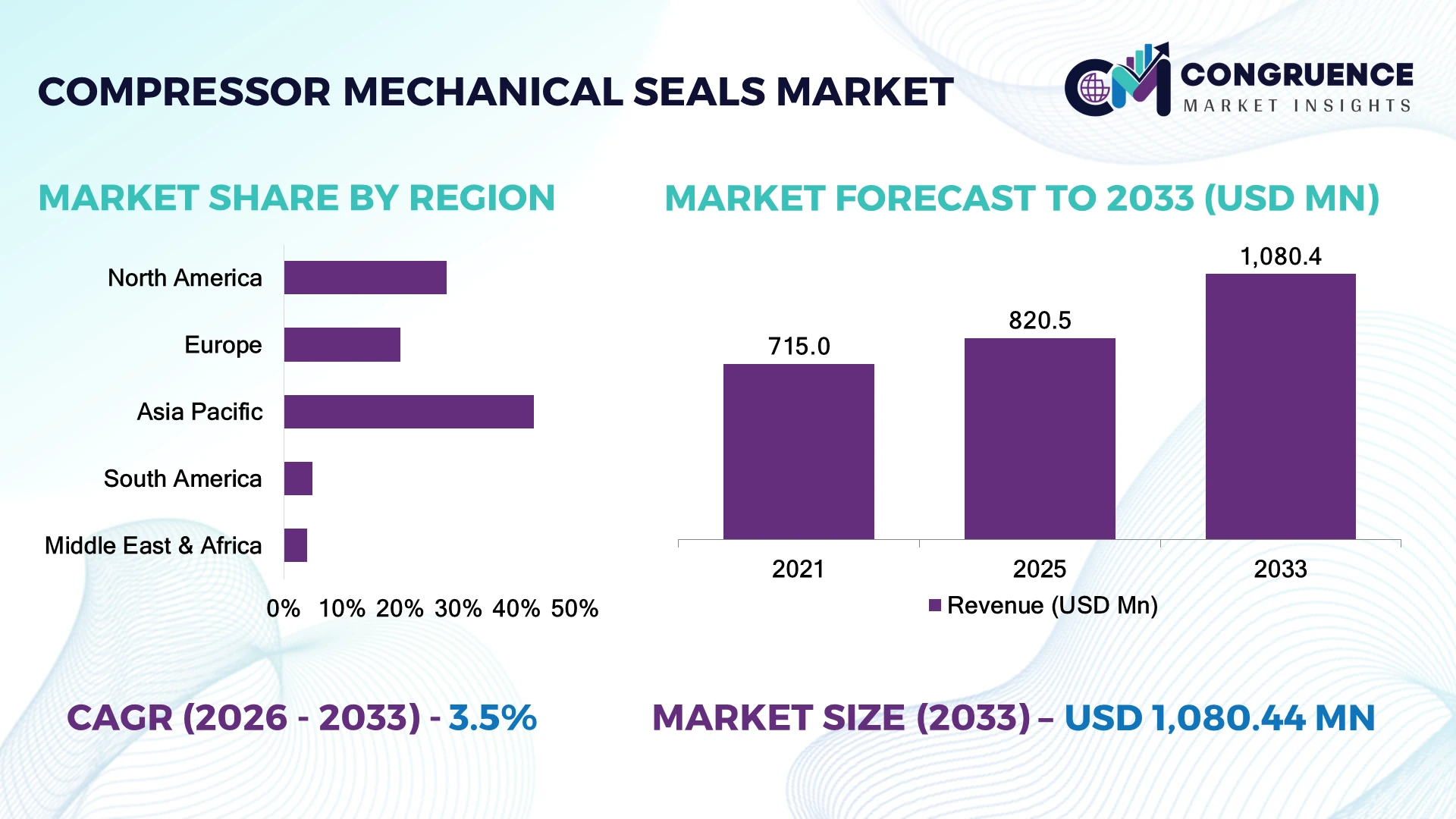
The Global Compressor Mechanical Seals Market was valued at USD 820.5 Million in 2025 and is anticipated to reach a value of USD 1,080.4 Million by 2033 expanding at a CAGR of 3.5% between 2026 and 2033. Growth is being driven by dry-gas sealing adoption, stricter methane-emission controls, LNG infrastructure expansion, and replacement of aging compressor sealing systems.
The United States remains the dominant country market, supported by oil and gas, LNG, petrochemical, and gas-processing infrastructure, with dry-gas sealing adoption exceeding 65% across newly installed high-pressure compressor systems. China follows with expanding petrochemical and industrial-compression capacity, while U.S. LNG expansion is strengthening demand for high-performance sealing technologies. Advanced carbon and silicon-carbide face materials are improving wear resistance by approximately 20–30%.
Strategically, suppliers should prioritize low-emission dry-gas seals, retrofit programs, and lifecycle service capabilities across compressor-intensive industrial hubs.
Market Size & Growth: USD 820.5 Million in 2025 to USD 1,080.4 Million by 2033 at 3.5% CAGR, driven by dry-gas sealing and compressor modernization.
Top Growth Drivers: Dry-gas sealing 32%, LNG infrastructure 24%, methane-control requirements 18%.
Short-Term Forecast: By 2028, advanced sealing systems can deliver 10–15% lower leakage-related losses and 8–12% longer maintenance intervals.
Emerging Technologies: Smart seal monitoring, silicon-carbide faces, carbon composites, and non-contacting architectures are gaining industrial deployment.
Regional Leaders: North America, Asia-Pacific, and Europe lead deployment, with advanced-seal adoption exceeding 60% in major gas-compression applications.
Consumer/End-User Trends: Oil and gas accounts for approximately 45% of demand, while chemical and petrochemical users increasingly prioritize low-emission configurations.
Pilot/Case Example: 2025 compressor modernization programs using dry-gas sealing reduced leakage exposure by approximately 30% while improving maintenance predictability.
Competitive Landscape: John Crane leads with approximately 16% share, competing with EagleBurgmann, Flowserve, AESSEAL, and Flexaseal through technology and aftermarket service.
Regulatory & ESG Impact: Methane-control initiatives are accelerating low-emission sealing adoption, with dry seals substantially reducing emissions versus conventional wet-seal arrangements.
Investment & Funding: More than USD 1 billion in recent LNG and gas-processing infrastructure investment is reinforcing demand for high-reliability compressor components.
Innovation & Future Outlook: 2026–2033 investment is shifting toward digitally monitored seals, advanced materials, predictive maintenance, and integrated compressor-condition monitoring.
Compressor mechanical seals are becoming strategically important because sealing performance directly influences gas containment, equipment availability, maintenance frequency, and environmental compliance across high-value compression assets. The transition from conventional wet seals toward dry-gas sealing is accelerating as operators address methane exposure and reduce auxiliary oil systems. Updated emissions requirements are reinforcing demand for standardized, high-reliability sealing designs.
Technology differentiation is increasingly measurable. Advanced dry-gas seals can reduce leakage by approximately 30% compared with conventional sealing configurations, while optimized silicon-carbide and carbon face combinations can extend wear resistance by roughly 20–25%. North America emphasizes LNG, gas transmission, and refinery applications, whereas China and India are expanding compressor deployment across petrochemical and industrial-processing facilities.
Over the next 2–3 years, predictive seal monitoring, digital condition diagnostics, and advanced face geometries will become more prominent in new compressor projects and retrofit programs. Operators are increasingly combining seal upgrades with planned compressor overhauls to avoid separate shutdowns. Companies integrating sealing technology, condition monitoring, engineering support, and aftermarket availability will secure stronger lifecycle value, making reliability and emissions performance decisive competitive differentiators.
Stricter methane-emission controls and expanding LNG compression capacity are shifting procurement toward dry-gas mechanical seals, particularly in the United States and Middle Eastern gas-processing hubs. Dry-gas configurations can reduce seal-related gas losses by approximately 25–35% versus conventional arrangements, while advanced face materials can extend operating life by 20–25%. The U.S. LNG build-out is reinforcing demand for high-reliability compressor sealing systems as operators prioritize continuous-duty performance. Approximately 60–65% of new high-pressure compressor installations in major gas applications increasingly specify advanced dry-sealing configurations. Manufacturers are responding through engineered retrofit packages, localized service centers, and investments in silicon-carbide faces and condition-monitoring capabilities. The strategic advantage is shifting from component supply toward lifecycle sealing performance.
High-performance compressor seals remain exposed to specialized material costs, precision machining requirements, and qualification constraints. Silicon carbide, tungsten carbide, and engineered carbon components can represent 20–30% of seal manufacturing cost, while precision finishing can account for roughly 15–20% of production expense. Supply disruptions affecting specialty ceramics and carbide powders can extend component lead times by 10–15%, particularly for customized compressor configurations. This limits price competitiveness in cost-sensitive industrial applications and complicates rapid replacement programs. U.S. and European suppliers are mitigating exposure through dual sourcing, regional machining capacity, longer-term material contracts, and standardized component platforms. The non-obvious pressure point is customization: excessive configuration increases inventory complexity and weakens economies of scale.
Digital condition monitoring is opening a higher-value aftermarket opportunity as compressor operators seek earlier detection of seal degradation, vibration anomalies, and leakage events. Sensor-enabled systems can improve maintenance forecasting by approximately 20–30% and reduce unplanned intervention requirements by 10–15% when integrated with compressor monitoring platforms. In India, China, and Southeast Asian petrochemical hubs, retrofit demand is particularly relevant because large installed compressor fleets require modernization without full equipment replacement. Emerging wireless sensors, edge diagnostics, and AI-assisted maintenance models are creating opportunities for seal manufacturers to bundle hardware, analytics, and service contracts. Companies are expanding R&D partnerships and retrofit portfolios around predictive sealing. The strongest opportunity lies in converting replacement sales into recurring condition-monitoring and lifecycle-service revenue.
Integrating intelligent mechanical seals into existing compressor control architectures remains a significant execution challenge. Legacy assets frequently operate with fragmented instrumentation, with approximately 25–35% of older compressor systems lacking the digital interfaces required for seamless condition-data integration. Sensor calibration, cybersecurity requirements, and inconsistent communication protocols can add 10–15% to retrofit engineering effort. Skilled technicians are also required to validate seal-face alignment, sensor positioning, and diagnostic thresholds during shutdowns. These constraints can slow deployment and reduce consistency across multinational compressor fleets. Manufacturers are responding through standardized communication modules, modular sensor packages, remote commissioning, and partnerships with automation specialists. The critical long-term issue is interoperability: seal intelligence creates value only when diagnostic outputs integrate reliably with plant-wide asset-management systems.
Dry-Gas Sealing Becomes Standard: New compressor projects increasingly favor dry-gas seals, with adoption in high-pressure gas applications approaching 60–65%. Methane-control requirements and LNG expansion are accelerating replacement of conventional wet systems. Manufacturers are expanding retrofit kits and local service capacity, while operators prioritize lower leakage, reduced auxiliary systems, and longer maintenance intervals.
Advanced Faces Extend Service Life: Silicon-carbide and engineered carbon combinations are gaining traction, delivering approximately 20–25% higher wear resistance and 10–15% longer operating intervals in demanding compressor environments. Specialty-material supply pressure is encouraging suppliers to qualify alternative formulations and localize machining. The shift is reducing lifecycle intervention frequency rather than simply improving initial seal performance.
Predictive Monitoring Enters Retrofits: Sensor-enabled seal monitoring is moving beyond new compressor installations, with retrofit programs targeting approximately 20–30% improvement in maintenance forecasting. Wireless vibration, temperature, pressure, and leakage monitoring are being integrated into plant asset-management platforms. Companies are responding with modular diagnostic packages that reduce installation complexity and create recurring service opportunities.
Low-Emission Designs Gain Priority: Methane-management initiatives are changing compressor procurement specifications, pushing operators toward sealing architectures capable of reducing fugitive emissions by roughly 25–35%. Gas-processing facilities are increasingly evaluating seal performance alongside compressor efficiency and environmental metrics. Manufacturers are responding through engineered low-emission designs, tighter face tolerances, and partnerships with compressor OEMs to embed sealing performance earlier in equipment selection.
Dry gas seals represent the leading type, accounting for approximately 63% of the Compressor Mechanical Seals Market, supported by lower leakage, reduced auxiliary-system requirements, and suitability for centrifugal compressors operating at elevated pressures. Their adoption is strongest across natural-gas transmission, LNG, refinery, and petrochemical assets where reliability and emissions performance directly affect operating economics. Oil seals remain relevant in legacy compressor fleets, but their share is gradually declining as operators modernize aging equipment. Clearance seals retain strategic importance in specialized compressor configurations where non-contacting operation and low maintenance requirements outweigh higher engineering complexity.
Dry gas seals are also the fastest-growing type, with adoption expanding as operators replace wet-seal architectures and specify low-emission equipment for new projects. Approximately 60% of newly specified high-pressure gas compressors increasingly favor advanced dry-sealing configurations, while smart-monitoring integration is approaching 35–40% in newer systems. Manufacturers are responding with engineered retrofit kits, advanced carbon and silicon-carbide faces, and compressor-OEM partnerships, shifting investment toward higher-value sealing platforms rather than conventional replacement components.
The U.S. Environmental Protection Agency states that dry seals have substantially lower emissions than wet seals in centrifugal natural-gas compressors, with wet-seal emissions typically ranging from 40–200 scfm compared with up to 6 scfm for dry seals, reinforcing the operational case for conversion.
Oil & gas is the leading application, accounting for approximately 44% of Compressor Mechanical Seals Market installations, reflecting the extensive use of centrifugal and reciprocating compressors across upstream production, gas processing, LNG, transmission, storage, and refining. High-pressure service and continuous-duty operation make seal integrity operationally critical, with roughly 55% of LNG compressor installations increasingly specifying dry-gas sealing configurations. Chemical and petrochemical applications follow, where aggressive media, temperature variation, and process-containment requirements support demand for engineered face materials and customized seal geometries.
Gas transmission and LNG-related applications represent the fastest-growing demand pocket as operators prioritize emissions control and equipment availability. Advanced sealing systems are increasingly integrated with condition-monitoring platforms, while retrofit programs target aging compressor fleets without requiring complete equipment replacement. Companies are expanding application-specific engineering capabilities and aftermarket service networks, particularly around U.S. LNG hubs and Asian refining centers. This is shifting procurement from lowest upfront cost toward leakage performance, maintenance intervals, and total compressor lifecycle economics.
A 2025 technical study examined spiral-groove dry-gas seals for pipeline compressors operating at 8–20 MPa, highlighting natural-gas composition and operating conditions as important factors in preventing phase-change-related seal failures.
Oil & gas companies represent the dominant end-user group, contributing approximately 44% of demand because compressor sealing directly affects gas containment, equipment reliability, and environmental performance across production and midstream infrastructure. Chemical industry users account for roughly 26%, supported by compressor-intensive processing and stringent containment requirements. Electricity-sector demand remains comparatively smaller but strategically relevant where compressors support power-generation gas systems and industrial utilities. Established buyers increasingly evaluate seals through lifecycle cost, leakage performance, and maintenance frequency rather than purchase price alone.
The fastest-growing end-user demand is emerging from gas-processing, LNG, and petrochemical operators modernizing installed compressor fleets. Approximately 35–40% of newer industrial sealing deployments increasingly incorporate monitoring or diagnostic capabilities, allowing operators to detect leakage, temperature deviations, and seal degradation earlier. Manufacturers are responding with application-specific configurations, service contracts, local technical support, and predictive-maintenance packages. The competitive opportunity is therefore shifting toward integrated sealing solutions that combine engineered components, retrofit expertise, digital monitoring, and rapid aftermarket availability.
Siemens Energy notes that thousands of centrifugal compressors worldwide still predate advanced dry-gas-seal technology, creating a substantial installed-base opportunity for wet-to-dry seal modernization and reliability upgrades.
Asia-Pacific accounted for the largest market share at 43% in 2025 however, North America is expected to register the fastest growth, expanding at a CAGR of 4.2% between 2026 and 2033.
Dry-gas sealing and LNG modernization reshape regional demand
North America represented approximately 28% of the global Compressor Mechanical Seals Market in 2025, supported by extensive natural-gas transmission, LNG, refinery, and petrochemical compressor infrastructure. The United States contributes nearly 82% of regional demand, reflecting concentrated compressor deployment across Texas, Louisiana, and Pennsylvania. More than 70% of major gas-compression installations increasingly specify dry-gas sealing configurations as operators prioritize methane containment and equipment availability. LNG export infrastructure is also increasing demand for tandem and double-sided sealing systems capable of continuous high-pressure operation. Manufacturers are responding by expanding regional service centers, developing retrofit packages, and integrating condition-monitoring capabilities into advanced seal assemblies. The strategic shift is toward lifecycle performance, where rapid replacement, leakage reduction, and predictive maintenance increasingly influence procurement decisions.
United States Market Outlook: The United States remains the principal North American market, supported by shale-gas processing, LNG terminals, interstate pipeline networks, and large refinery clusters. Approximately 47% of regional demand is associated with oil and gas applications, while advanced dry-gas seals are increasingly specified for high-pressure compressor stations. Ongoing LNG infrastructure expansion is strengthening demand for engineered sealing systems with tighter leakage control and extended maintenance intervals. U.S. operators are increasingly combining seal upgrades with planned compressor overhauls, improving asset availability while avoiding additional shutdown cycles.
Emissions control drives high-performance sealing upgrades
Europe maintains a strategically important position through mature oil and gas infrastructure, chemical processing, refining, and industrial-gas applications. Germany, Italy, France, and the United Kingdom represent key industrial demand centers, with stringent environmental requirements accelerating replacement of conventional sealing arrangements. Dry-gas configurations account for an estimated 55–60% of new high-pressure gas-compression applications, while advanced carbon and silicon-carbide faces are gaining adoption where temperature and pressure conditions are demanding. European operators increasingly prioritize leakage performance and maintenance predictability over lowest acquisition cost. Manufacturers are responding through localized engineering, retrofit programs, and partnerships with compressor OEMs. The region’s mature installed base creates an important aftermarket opportunity because modernization can improve sealing performance without replacing complete compressor systems.
Germany Market Outlook: Germany leads European industrial demand through its dense chemical, petrochemical, machinery, and process-manufacturing base. Compressor-intensive facilities increasingly require high-integrity sealing systems capable of operating under variable pressure and temperature conditions. Approximately 40% of new industrial sealing deployments increasingly incorporate enhanced monitoring or diagnostic features, supporting earlier identification of wear and leakage. German manufacturers are emphasizing precision-engineered seal faces, modular cartridge systems, and service agreements that reduce maintenance disruption. The country’s engineering ecosystem also supports collaboration between seal specialists, compressor manufacturers, and industrial automation providers.
Industrial scale and petrochemical expansion sustain deployment leadership
Asia-Pacific accounted for approximately 43% of the global market in 2025, making it the largest regional market, with China, India, Japan, and South Korea forming the principal demand centers. China represents roughly 36% of regional demand, while India contributes approximately 17%, supported by refinery expansion, LNG infrastructure, petrochemical manufacturing, and industrial gas processing. More than 70% of newly installed high-pressure industrial compressor systems increasingly incorporate advanced mechanical sealing technologies. Manufacturers are expanding localized production and technical support to address shorter lead-time requirements and price-sensitive procurement. The region is also becoming an important manufacturing base for sealing components, creating opportunities for suppliers to combine cost-efficient production with higher-performance materials and digital monitoring.
China Market Outlook: China represents the largest country-level demand center in Asia-Pacific, supported by extensive petrochemical, refining, LNG, industrial-gas, and manufacturing infrastructure. Approximately 46% of regional compressor-seal demand is linked to oil and gas applications, while chemical and industrial processing provide a substantial secondary base. Domestic manufacturers are increasing production of engineered seal components to reduce dependence on imported precision parts. International suppliers are responding through localized manufacturing, technical partnerships, and application-specific product portfolios. The strategic advantage lies in combining high-volume production with tighter tolerance control for increasingly demanding high-pressure compressor applications.
Energy infrastructure modernization expands aftermarket demand
South America is supported primarily by Brazil, Argentina, Colombia, and Chile, with oil and gas accounting for the largest share of compressor-seal consumption. Brazil represents the principal demand center because offshore production, gas processing, refining, and pipeline infrastructure require continuous compressor operation under demanding conditions. Approximately 45% of regional demand is linked to hydrocarbon processing and transportation applications. Aging compressor fleets are creating a measurable retrofit opportunity, particularly where operators seek dry-gas sealing and improved leakage control without replacing complete equipment. Manufacturers are strengthening distributor networks and technical-service partnerships to address geographic dispersion and longer component lead times. The key business opportunity is aftermarket localization, allowing suppliers to reduce downtime while maintaining access to engineered replacement components.
Brazil Market Outlook: Brazil dominates South American demand because of its offshore oil and gas infrastructure, expanding gas-processing capacity, and large industrial maintenance base. Compressor applications supporting offshore production require seals capable of handling pressure fluctuations, corrosive environments, and continuous-duty operation. Approximately 40% of major compressor refurbishment activity increasingly incorporates upgraded sealing components rather than direct like-for-like replacement. Suppliers are positioning through regional service partnerships, stocked replacement assemblies, and application engineering for offshore equipment. Brazil’s concentration of energy infrastructure makes rapid aftermarket response a decisive competitive advantage.
Gas-processing investment strengthens high-pressure seal demand
Middle East & Africa demand is concentrated around Saudi Arabia, the United Arab Emirates, Qatar, and major African oil and gas producers. Natural-gas processing, LNG, refining, petrochemical complexes, and pipeline infrastructure create sustained requirements for high-pressure mechanical seals. Oil and gas applications represent approximately 50% of regional demand, while petrochemical facilities increasingly specify advanced sealing configurations for continuous-duty compressors. Large-scale gas-processing investments are increasing demand for dry-gas seals, tandem arrangements, and high-temperature face materials. Suppliers are expanding local service capabilities and maintaining critical replacement inventories near industrial hubs to reduce compressor downtime. The region’s non-obvious advantage is the concentration of high-value compressor assets, making reliability and rapid aftermarket support more commercially important than initial component pricing.
Saudi Arabia Market Outlook: Saudi Arabia is the most strategically significant country in the region because of its integrated oil, gas-processing, refining, and petrochemical infrastructure. Compressor-intensive facilities increasingly require high-integrity seals capable of operating under elevated pressure and temperature conditions. Approximately 50% of regional demand is concentrated in hydrocarbon-related applications, creating a strong base for engineered dry-gas and high-performance mechanical seals. Suppliers are expanding local technical support, inventory availability, and refurbishment capabilities to serve major industrial clusters. The country’s large-scale energy infrastructure favors vendors capable of combining engineered products with rapid maintenance response and lifecycle support.
John Crane, EagleBurgmann, Flowserve, and AESSEAL compete as global technology leaders, while seal specialists and OEM-linked suppliers compete on customization and price. The top five players collectively hold approximately 55% of the market, indicating moderate concentration. Technology accounts for roughly 40% of purchasing decisions, while lifecycle service contributes 25% and price approximately 20%. John Crane and EagleBurgmann emphasize dry-gas sealing innovation, while Flowserve combines sealing with flow-control integration. AESSEAL competes through modular designs, rapid delivery, and aftermarket responsiveness. Manufacturers counter with localized production and 10–15% lower pricing, particularly across Asian markets. Competitive intensity is shifting toward low-emission separation seals, advanced face materials, and digital condition monitoring. Partnerships with compressor OEMs, service providers, and energy operators are important for specification wins. Entry barriers remain high because qualification, precision manufacturing, application engineering, and installed-base trust require substantial investment. Winning requires validated performance, service coverage, rapid retrofit capability, and measurable lifecycle savings.
John Crane
EagleBurgmann
Flowserve Corporation
AESSEAL
Meccanotecnica Umbra
Vulcan Seals
Flexaseal Engineered Seals and Systems
Chesterton
Garlock
KSB
Sulzer
Valmet
James Walker
Fluiten
Dry-gas sealing remains the core technology, with spiral-groove faces enabling non-contact operation, lower friction, and reduced wear. Compared with wet-oil seals, dry-gas systems can cut maintenance requirements by roughly 20–30% and reduce leakage. Adoption is strongest in high-pressure centrifugal compressors, LNG, gas transmission, and petrochemical plants. Silicon-carbide and carbon face materials add approximately 15–25% wear resistance, benefiting operators running higher pressures and temperatures.
Next-generation coaxial separation seals are gaining attention because they reduce nitrogen consumption while protecting dry-gas seals from bearing-oil contamination. John Crane’s 2025 Type 93AX demonstrated up to 80% lower nitrogen consumption than conventional radial separation seals, while EagleBurgmann’s CobaSeal technology reports up to 90% lower nitrogen consumption. These systems improve operating economics and emissions performance for energy-intensive compressor fleets. Digital condition monitoring is moving into retrofit programs, with sensor-enabled deployments improving maintenance forecasting by roughly 20%.
From 2026–2028, competitive advantage will depend on integrated seal systems combining advanced face geometry, smart diagnostics, and low-consumption separation technology. Leaders benefit from qualification databases and installed-base access, while regional manufacturers gain opportunities through localized retrofit engineering. Companies acting now can convert replacement cycles into higher-value lifecycle contracts, reduce shutdown exposure, and differentiate through leakage, nitrogen, maintenance, and reliability performance.
June 2025 John Crane launched the Type 93AX coaxial separation seal, cutting nitrogen consumption by up to 80% versus conventional radial designs. The launch strengthens low-emission compressor retrofits while improving operational resilience and reducing auxiliary-system energy costs significantly. Source: johncrane.com
January 2025 Flowserve secured an ADNOC contract to supply dry-gas seals for a carbon-capture project designed to capture 1.5 million tonnes of CO₂ annually. The project expands sealing technology into supercritical-CO₂ injection and strengthens decarbonization-focused compressor applications globally at scale. Source: flowserve.com
December 2024 EagleBurgmann and EthosEnergy signed an MOU covering compressor seal installation, upgrades, and emission-reduction projects. The partnership combines seal technology with maintenance expertise, creating a retrofit model that improves execution and strengthens aftermarket access for compressor operators. Source: ethosenergy.com
September 2025 Researchers at Zhejiang University of Technology published pipeline-compressor dry-gas-seal research covering operating pressures of 8–20 MPa. The study quantified phase-change effects in natural-gas mixtures, improving seal-design guidance for demanding transmission applications and reducing failure-related engineering uncertainty for operators.
The Compressor Mechanical Seals Market Report provides structured coverage of seal types, compressor configurations, applications, and end-user industries, with emphasis on dry gas, tandem, double, and specialized sealing architectures. Analysis evaluates oil and gas, LNG, petrochemical, chemical, power-generation, industrial-gas, and emerging hydrogen and carbon-capture applications. The report assesses material selection, seal-face engineering, separation systems, monitoring technologies, retrofit requirements, and aftermarket service models.
Regional analysis covers North America, Europe, Asia-Pacific, South America, and Middle East & Africa, highlighting country-level deployment, compressor infrastructure, technology adoption, manufacturing capabilities, and procurement patterns. The study evaluates leading companies, competitive positioning, supply-chain strategies, and technology differentiation, including advanced carbon and silicon-carbide materials and digitally monitored systems. Quantitative indicators covering segment shares, adoption levels, deployment patterns, and company participation support investment planning, expansion decisions, retrofit prioritization, and competitive strategy through 2026–2033.
| Report Attribute/Metric | Report Details |
|---|---|
|
Market Revenue in 2025 |
USD 820.5 Million |
|
Market Revenue in 2033 |
USD 1,080.4 Million |
|
CAGR (2026 - 2033) |
3.5% |
|
Base Year |
2025 |
|
Forecast Period |
2026 - 2033 |
|
Historic Period |
2021 - 2025 |
|
Segments Covered |
By Type
By Application
By End-User
|
|
Key Report Deliverable |
Revenue Forecast, Growth Trends, Market Dynamics, Segmental Overview, Regional and Country-wise Analysis, Competition Landscape |
|
Region Covered |
North America, Europe, Asia-Pacific, South America, Middle East, Africa |
|
Key Players Analyzed |
John Crane, EagleBurgmann, Flowserve Corporation, AESSEAL, Meccanotecnica Umbra, Vulcan Seals, Flexaseal Engineered Seals and Systems, Chesterton, Garlock, KSB, Sulzer, Valmet, James Walker, Fluiten |
|
Customization & Pricing |
Available on Request (10% Customization is Free) |




