
Reports
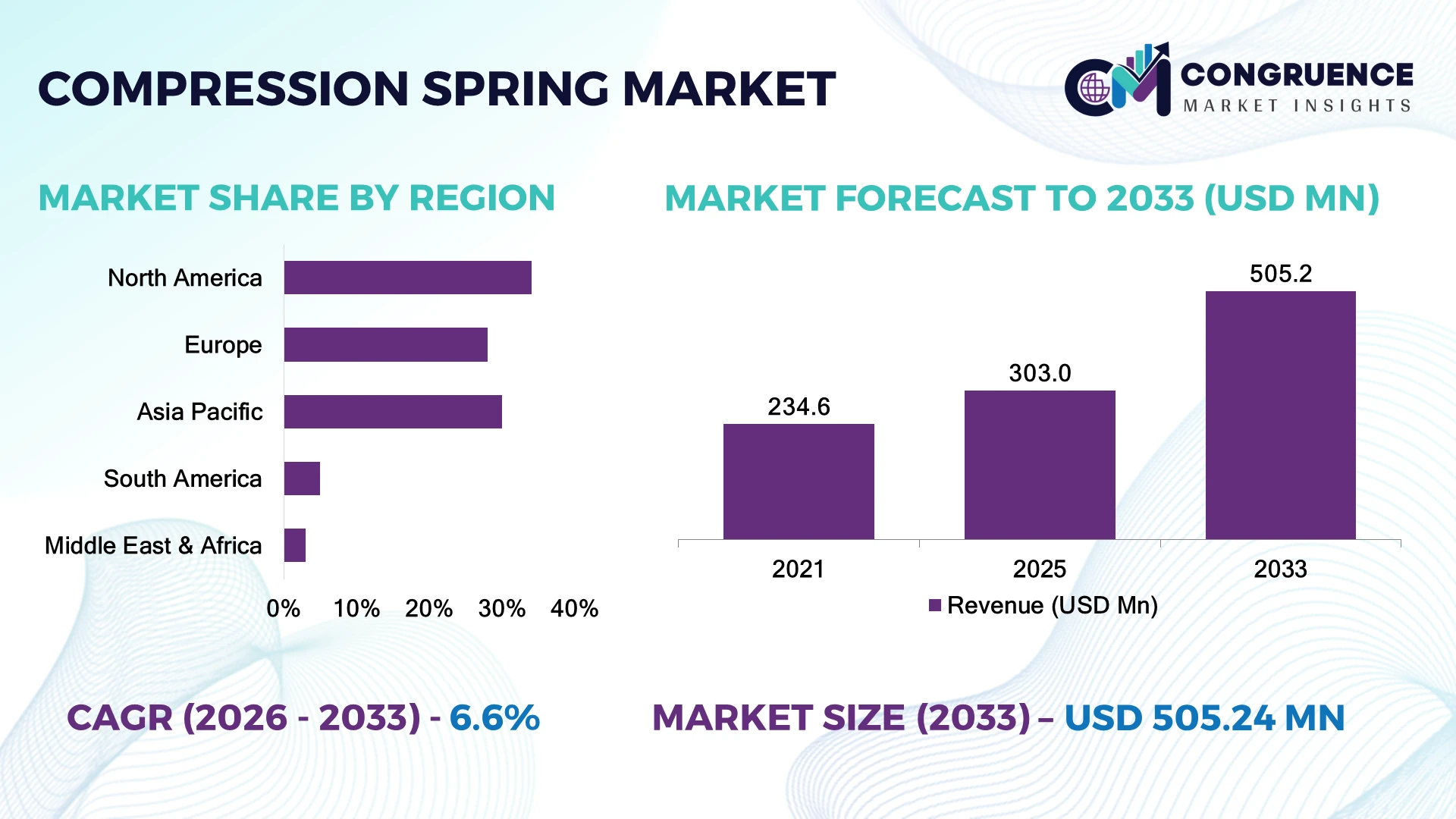
The Global Compression Spring Market was valued at USD 303.0 Million in 2025 and is anticipated to reach a value of USD 505.2 Million by 2033 expanding at a CAGR of 6.6% between 2026 and 2033. Growth is driven by lightweight automotive suspension systems, precision-engineered industrial springs, and rising adoption of automated manufacturing processes.
The United States leads the compression spring industry with nearly 32% market share, supported by automotive production, aerospace programs, and advanced manufacturing investments exceeding USD 100 billion annually. China follows with over 25% share, backed by large-scale EV manufacturing and machinery output. Japan’s precision spring ecosystem maintains 15%+ adoption in electronics and robotics applications. The U.S. focuses on high-value aerospace components, while China dominates volume manufacturing, creating a strategic supply-chain balancing opportunity for global producers.
Companies prioritizing localized production, advanced materials, and automation capabilities are positioned to strengthen competitiveness in the evolving compression spring landscape.
Market Size & Growth: Valued at USD 303.0 Million in 2025, reaching USD 505.2 Million by 2033 at 6.6% CAGR, driven by automotive electrification and industrial automation.
Top Growth Drivers: Automotive applications contribute 35%+ demand, industrial machinery 28%, and aerospace adoption 12%.
Short-Term Forecast: By 2028, automated spring manufacturing reduces production waste by 15% and improves precision efficiency by 20%.
Emerging Technologies: AI-based quality inspection, robotic coiling systems, and advanced alloy materials are transforming global spring production.
Regional Leaders: North America reaches USD 160 Million+ with aerospace adoption; Asia-Pacific exceeds USD 220 Million with EV manufacturing expansion; Europe approaches USD 100 Million through precision engineering demand.
Consumer/End-User Trends: More than 40% of automotive manufacturers are integrating lightweight spring components into next-generation vehicle platforms.
Pilot/Case Example: In 2024, automated spring production lines achieved nearly 25% cycle-time reduction through robotics and digital monitoring.
Competitive Landscape: Leading manufacturers hold approximately 35% combined share, including NHK Spring Co., Ltd., Sogefi S.p.A., Mubea, Gutekunst Federn, and KERN-LIEBERS.
Regulatory & ESG Impact: Lightweight vehicle regulations and energy-efficient manufacturing initiatives are reducing material consumption by 10–15% across component suppliers.
Investment & Funding: More than USD 500 Million in manufacturing modernization investments are supporting automation, regional expansion, and advanced material development.
Innovation & Future Outlook: Next-generation compression springs using smart materials, simulation software, and digital twins are shifting competition toward high-performance engineering solutions.
Compression spring demand is expanding beyond conventional mechanical applications as manufacturers prioritize durability, miniaturization, and energy efficiency. Recent product innovations include corrosion-resistant alloys, high-fatigue spring designs, and digitally monitored manufacturing systems. Approximately 30% of new industrial spring development programs now incorporate simulation-based optimization. Supply-chain restructuring following global manufacturing disruptions is encouraging localized production networks, creating stronger opportunities for advanced spring suppliers.
The compression spring market is becoming strategically important as automotive electrification, robotics, aerospace modernization, and precision machinery sectors demand components with higher durability and lower weight. Manufacturers are shifting from traditional steel spring production toward advanced alloys, simulation-driven designs, and automated inspection systems to improve reliability and production consistency.
Global supply-chain restructuring has accelerated investments in localized manufacturing hubs. Companies in the United States, Germany, Japan, and China are expanding domestic production capabilities to reduce dependency on concentrated suppliers. Advanced automated coiling systems deliver approximately 20% higher production efficiency compared with conventional manual processes while reducing material waste.
Regional differences remain significant, with China maintaining large-scale manufacturing advantages, while Japan and Germany lead precision engineering adoption. Automotive suppliers are deploying compression springs in EV suspension platforms, battery systems, and lightweight vehicle structures. Companies are strengthening partnerships with OEMs, investing in robotics, and expanding specialized production facilities.
Over the next 2–3 years, competitive advantage will depend on material innovation, digital manufacturing integration, and the ability to provide customized high-performance spring solutions across industrial sectors.
Automotive electrification and industrial automation are accelerating demand for high-performance compression springs. EV production growth has increased demand for lightweight suspension components, with electric vehicle platforms requiring approximately 15–20% more specialized mechanical optimization than conventional vehicles. Robotics adoption in manufacturing facilities has expanded precision component requirements by over 25% in major industrial hubs. Companies are responding through automated production investments, alloy development, and partnerships with automotive OEMs. Japan and Germany are advancing precision spring technologies, while China is scaling high-volume manufacturing capacity. The strategic advantage lies in combining material engineering with digital production controls to achieve longer service life and lower failure rates.
Steel alloy price fluctuations and specialized material dependency remain key limitations for compression spring manufacturers. Raw material costs account for nearly 50–60% of production expenses, creating margin pressure during commodity price instability. Global supply disruptions have increased lead-time variability by approximately 15% for specialty alloys and high-tensile wire materials. Manufacturers in Europe and North America are reducing exposure through supplier diversification, regional sourcing agreements, and recycled material integration. Companies are also increasing inventory buffers and adopting predictive procurement systems to stabilize operations. The primary operational challenge is maintaining cost competitiveness while meeting increasingly strict durability and performance requirements.
Emerging opportunities are developing through smart manufacturing, advanced alloys, and customized spring applications. Digital simulation tools reduce prototype development cycles by nearly 30%, enabling faster product optimization for automotive and aerospace customers. Demand for lightweight materials is increasing as manufacturers target 10–15% component weight reductions in mobility platforms. Companies are investing in AI-based inspection, additive manufacturing research, and connected production systems. India, Vietnam, and Mexico are gaining attention as alternative manufacturing locations due to expanding industrial ecosystems. The strongest opportunity lies in combining traditional spring engineering with digital design capabilities to deliver customized solutions for next-generation machinery and transportation systems.
Compression spring manufacturers face increasing complexity in designing components for high-load, compact, and temperature-sensitive applications. More than 20% of advanced spring projects require customized engineering validation, increasing development requirements. Aerospace and EV applications demand tighter tolerance levels, with some precision components requiring accuracy improvements below 5%. Skilled engineering shortages in countries such as Germany and Japan are affecting specialized manufacturing expansion. Companies must address these pressures through workforce training, automated quality systems, and collaborative engineering platforms. Long-term competitiveness depends on maintaining consistent production quality while managing increasingly complex customer specifications and evolving industrial standards.
Smart Manufacturing Adoption Surge: Compression spring producers are accelerating Industry 4.0 integration, with automated coiling, AI inspection, and digital monitoring systems improving production accuracy by 20–30%. Manufacturers in Japan and Germany are deploying connected workflows to reduce defect rates by nearly 15% and shorten quality-validation cycles. Supply-chain disruptions have pushed companies toward localized smart factories and predictive maintenance models.
Advanced Material Engineering Shift: High-strength alloys, corrosion-resistant coatings, and lightweight spring materials are gaining traction as automotive and aerospace customers demand improved fatigue performance. Approximately 25% of new spring development projects now prioritize material optimization, while manufacturers are reducing component weight by 10–15%. Companies are expanding R&D partnerships to deliver durable solutions for EV platforms and industrial machinery.
Automotive Platform Transformation: Electric vehicle expansion is changing compression spring specifications, with suppliers adapting designs for battery systems, suspension optimization, and compact vehicle architectures. EV-related spring applications are growing as manufacturers target 20% higher durability requirements and improved vibration control. Companies are restructuring product portfolios and collaborating with automakers to secure long-term component programs.
Regional Supply Chain Rebalancing: Global manufacturers are diversifying production beyond traditional hubs, with India, Mexico, and Southeast Asian markets receiving increased investment. Companies are shifting 15–20% of selected component sourcing activities closer to end markets to reduce logistics risks. This transition is creating opportunities for local spring manufacturers while encouraging multinational suppliers to establish flexible production networks.
Helical compression springs represent the dominant type segment, accounting for approximately 65% of the global compression spring market due to their broad adoption across automotive, industrial machinery, electronics, and consumer equipment applications. Their scalability, cost efficiency, and ability to withstand repeated loading cycles make them the preferred choice for high-volume manufacturing. Standard steel compression springs maintain strong demand, while specialty alloy variants capture growing interest in high-temperature and high-stress environments. The fastest-growing segment is advanced alloy compression springs, expanding as aerospace, EV, and precision equipment manufacturers require improved fatigue resistance and weight optimization. Adoption of engineered materials is increasing by nearly 20%, while customized spring solutions are gaining traction among premium industrial users. Companies are responding through material innovation, automated production capabilities, and application-specific product development. Investment priorities are shifting toward high-performance designs that deliver longer service intervals and reduced maintenance requirements.
Automotive applications lead the compression spring market with approximately 40% share, supported by extensive use in suspension systems, engine components, braking assemblies, and vehicle mechanisms. Vehicle manufacturers require durable springs capable of handling vibration, load variation, and long operating cycles. Industrial machinery follows with nearly 30% share, driven by automation equipment, manufacturing tools, and heavy-duty systems. The fastest-growing application area is electric vehicles and automated equipment, where customized compression springs are being integrated into lightweight platforms and precision assemblies. Demand for EV-related spring solutions is increasing by more than 20% as manufacturers optimize vehicle performance and reliability. Companies are expanding engineering partnerships with automotive OEMs, investing in simulation tools, and scaling flexible manufacturing lines. Remaining applications, including electronics and consumer products, continue supporting demand through miniaturized and specialized spring designs.
Automotive manufacturers represent the largest end-user group with approximately 45% market share due to extensive deployment across suspension systems, powertrain components, and vehicle assemblies. Large-scale vehicle production and increasing demand for durability-focused components create consistent procurement requirements. Industrial equipment manufacturers account for nearly 30% share, supported by machinery automation and manufacturing modernization initiatives. The fastest-growing end-user segment is electric vehicle and robotics manufacturers, with adoption increasing as companies redesign platforms for efficiency and compact engineering. These users are driving demand for precision springs capable of supporting higher performance requirements, with customized component adoption rising by approximately 25%. Traditional buyers are prioritizing cost efficiency, while emerging users emphasize material innovation and engineering collaboration. Compression spring suppliers are responding through dedicated OEM partnerships, customized product portfolios, and regional production expansion to capture evolving demand patterns.
North America accounted for the largest market share at 34% in 2025 however, Asia-Pacific is expected to register the fastest growth, expanding at a CAGR of 7.4% between 2026 and 2033.

North America holds a leading position in the compression spring market due to strong automotive, aerospace, defense, and industrial machinery production networks. The region contributes nearly 34% of global demand, supported by advanced manufacturing capabilities and high adoption of automated spring production systems. The United States represents the largest contributor, with significant demand from EV manufacturers, aerospace suppliers, and industrial automation companies. More than 40% of regional spring consumption is linked to automotive and transportation applications. Manufacturers are investing in robotic production lines, digital quality inspection, and localized supply chains to reduce dependency on overseas suppliers. Rising reshoring initiatives are encouraging domestic production expansion and improving supply reliability.
United States Market Outlook: The United States dominates regional demand through its automotive and aerospace manufacturing base, with over 15 million vehicle production capacity annually supporting large-scale spring requirements. Companies are increasing investments in precision engineering facilities and automated inspection technologies to meet higher durability standards for EV platforms and industrial equipment.
Europe maintains a strong position in compression spring production due to its established automotive, machinery, and industrial equipment ecosystem. The region accounts for approximately 28% of global demand, supported by Germany, Italy, and France’s precision manufacturing capabilities. European suppliers are focusing on lightweight designs, advanced alloys, and energy-efficient production methods to comply with stricter sustainability requirements. Automotive manufacturers are accelerating adoption of customized springs for electric and hybrid vehicles, increasing demand for high-performance components. Nearly 30% of European manufacturers have increased automation investments to improve production efficiency and reduce labor dependency. Companies are strengthening partnerships with OEMs and expanding digital manufacturing platforms to maintain competitiveness.
Germany Market Outlook: Germany remains the key European market due to its advanced automotive engineering sector and industrial machinery leadership. The country’s manufacturing base supports high demand for precision compression springs, with automotive suppliers increasingly adopting automated testing systems and simulation-based design processes to improve component reliability.
Asia-Pacific represents the fastest-growing compression spring market, driven by automotive production, electronics manufacturing, industrial automation, and infrastructure development. The region contributes nearly 30% of global demand and benefits from large-scale production capabilities in China, Japan, South Korea, and India. China’s manufacturing ecosystem supports high-volume spring production, while Japan focuses on precision components for robotics and advanced machinery. More than 50% of new manufacturing facilities in major Asian industrial hubs are integrating automated production technologies. Companies are expanding local capacity, improving export capabilities, and investing in advanced materials to meet rising demand from EV and industrial sectors.
China Market Outlook: China leads Asia-Pacific production through its extensive automotive and machinery manufacturing base. The country produces over 25 million vehicles annually, creating substantial demand for suspension and mechanical components. Manufacturers are scaling automated spring production facilities and strengthening domestic supply chains to support EV and industrial expansion.
South America represents an emerging compression spring market supported by automotive manufacturing, mining equipment, agricultural machinery, and industrial maintenance demand. Brazil accounts for the majority of regional consumption, supported by its vehicle manufacturing infrastructure and industrial equipment sector. The region contributes approximately 5% of global demand, with growth concentrated around manufacturing clusters and replacement component markets. Local producers are improving production capabilities through automation upgrades and supplier partnerships. Infrastructure limitations and imported material dependency remain operational challenges, encouraging companies to strengthen regional sourcing networks. Manufacturers are targeting automotive and heavy equipment applications where durable spring components remain essential.
Brazil Market Outlook: Brazil is the leading South American market due to its automotive production ecosystem and industrial machinery demand. The country manufactures more than 2 million vehicles annually, supporting consistent requirements for compression springs across transportation and equipment applications. Companies are investing in localized production to reduce import dependency and improve delivery efficiency.
The Middle East & Africa compression spring market is supported by infrastructure projects, energy-sector equipment, automotive assembly expansion, and industrial diversification programs. The region represents approximately 3% of global demand, with adoption concentrated in Saudi Arabia, the United Arab Emirates, and South Africa. Industrial modernization initiatives are increasing demand for reliable mechanical components used in machinery, construction equipment, and energy applications. More than 20% of regional manufacturing investments are directed toward industrial capability development and localization programs. Companies are forming regional partnerships and expanding distribution networks to improve availability of precision components. Growth is closely linked with manufacturing diversification strategies and infrastructure development plans.
Saudi Arabia Market Outlook: Saudi Arabia is emerging as a strategic market due to industrial diversification programs and increasing manufacturing investments. The country’s focus on automotive, machinery, and infrastructure development is creating new demand opportunities for compression spring suppliers. Companies are establishing local partnerships to support industrial supply-chain expansion and reduce reliance on imported components.
The compression spring market features global precision manufacturers competing with regional suppliers and specialized OEM partners. Leading players such as NHK Spring, Mubea, Sogefi, and KERN-LIEBERS compete against cost-focused Asian manufacturers through technology, customization, and supply reliability. The top five companies collectively account for approximately 35% of market share, creating a moderately consolidated structure. Competition is driven by automation adoption, with advanced production systems improving manufacturing efficiency by 20–30%, while customized spring solutions command premium positioning through enhanced performance. Companies are expanding through regional facilities, OEM partnerships, material innovation, and vertical integration of wire processing and testing capabilities. The competitive landscape is shifting toward digital manufacturing, lightweight materials, and localized supply chains as automotive and industrial customers demand faster delivery cycles. High tooling requirements, engineering expertise, and quality certification create significant entry barriers. Winning players must combine cost efficiency, engineering innovation, and global supply flexibility to outperform established competitors.
Mubea
Sogefi S.p.A.
KERN-LIEBERS
Gutekunst Federn
MW Industries, Inc.
Lee Spring
Associated Spring RAYMOND
Lesjöfors AB
Tohatsu Spring Co., Ltd.
Acxess Spring
Springmasters Ltd.
Betts Spring Manufacturing
Century Spring Corp.
Advanced manufacturing technologies are reshaping compression spring production through automation, digital monitoring, and precision engineering. AI-based inspection systems and robotic coiling equipment are improving defect detection accuracy by 20% and increasing production consistency. Compared with traditional manual inspection methods, automated quality systems reduce inspection time by nearly 30%, giving large suppliers a competitive advantage in automotive and aerospace applications.
Material innovation is becoming critical as manufacturers adopt high-strength alloys, corrosion-resistant coatings, and lightweight spring designs. These technologies improve fatigue resistance by 15–25% while supporting compact component requirements. Around 30% of new industrial spring development programs now incorporate simulation tools for performance optimization, helping companies reduce prototype cycles and accelerate product launches.
From 2026 to 2028, connected manufacturing platforms, digital twins, and predictive maintenance systems will influence competitive positioning. Companies investing in smart factories benefit from improved production visibility, lower waste, and faster customization capabilities. Global leaders gain advantage through technology integration, while regional suppliers are adopting flexible automation solutions to compete on speed, quality, and specialized applications.
February 2025 Lesjöfors Group announced the acquisition of International Industrial Springs (IIS) in India to expand its Asia-Pacific manufacturing footprint. The acquisition added six Mumbai production facilities and approximately 230 employees, strengthening supply capabilities across industrial and aerospace sectors. Source: www.lesjoforsab.com
January 2025 KERN-LIEBERS received the Best of Industry Award for its additive manufacturing project using high-performance steels. The innovation enables spring components to be produced within days instead of months for selected applications, improving flexibility and reducing supply-chain delays. Source: www.kern-liebers.com
December 2025 Lee Spring India achieved AS9100D aerospace quality certification to expand capabilities in aviation, defense, and high-reliability applications. The certification strengthens compliance systems and supports growth into aerospace supply chains requiring advanced spring precision and reliability standards. Source: www.leespring.com
June 2025 NHK Spring Co., Ltd. announced investment initiatives in India to expand electrification-related manufacturing capabilities. The company is developing production systems supporting automotive technology demand, strengthening regional supply capacity for next-generation vehicle components.
The Compression Spring Market Report covers comprehensive analysis across type, application, and end-user segments, including helical compression springs, specialty designs, automotive systems, industrial machinery, and emerging precision applications. The study evaluates demand patterns across North America, Europe, Asia-Pacific, South America, and Middle East & Africa, highlighting manufacturing concentration, technology adoption, and regional investment trends.
The report examines automation, advanced materials, digital manufacturing, and smart production technologies influencing market transformation. With analysis of major manufacturers, supplier strategies, competitive positioning, and niche application areas, the report supports investment planning, expansion decisions, partnership strategies, and long-term positioning. Coverage between 2026 and 2033 focuses on operational shifts, adoption patterns, and evolving opportunities across automotive, industrial, aerospace, and specialized engineering sectors.
| Report Attribute / Metric | Details |
|---|---|
| Market Revenue (2025) | USD 303.0 Million |
| Market Revenue (2033) | USD 505.2 Million |
| CAGR (2026–2033) | 6.6% |
| Base Year | 2025 |
| Forecast Period | 2026–2033 |
| Historic Period | 2021–2025 |
| Segments Covered |
By Type
By Application
By End-User
|
| Key Deliverables | Revenue Forecast; Market Trends; Growth Drivers & Restraints; Technology Insights; Segmentation Analysis; Regional Insights; Competitive Landscape; Regulatory & ESG Overview; Recent Developments |
| Regions Covered | North America; Europe; Asia-Pacific; South America; Middle East & Africa |
| Companies Profiled | NHK Spring Co., Ltd.; Mubea; Sogefi S.p.A.; KERN-LIEBERS; Gutekunst Federn; MW Industries, Inc.; Lee Spring; Associated Spring RAYMOND; Lesjöfors AB; Tohatsu Spring Co., Ltd.; Acxess Spring; Springmasters Ltd.; Betts Spring Manufacturing; Century Spring Corp. |
| Customization & Pricing | Available on Request (10% Customization Free) |




