
Reports
The Global Compound Semiconductor Materials Market was valued at USD 1138 Million in 2025 and is anticipated to reach a value of USD 1510.15 Million by 2033 expanding at a CAGR of 3.6% between 2026 and 2033. Growth is driven by expanding production of gallium nitride (GaN) and silicon carbide (SiC) materials for electric vehicles, high-frequency communications, advanced power electronics, and AI-enabled data infrastructure requiring higher power efficiency.
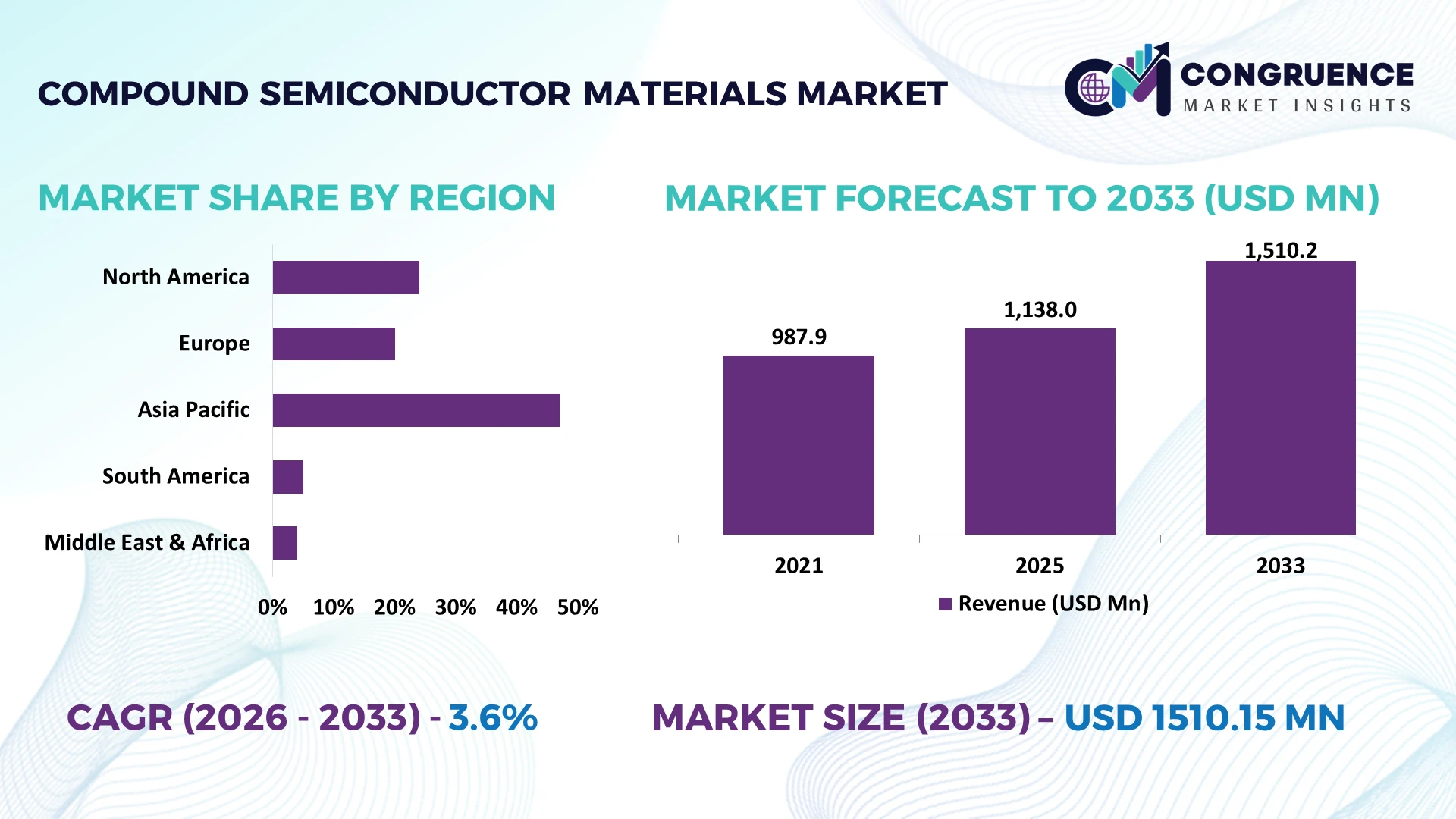
China remains the dominant manufacturing hub with approximately 45% of global compound semiconductor material processing capacity, supported by multi-billion-dollar investments in EV power electronics and 5G infrastructure, while Japan leads in premium substrate quality and process consistency with defect-density improvements exceeding 20%. Ongoing technology competition and export-control measures have accelerated regional supply-chain diversification across Asia, Europe, and North America, strengthening production resilience.
Manufacturers should prioritize geographically diversified sourcing, advanced substrate technologies, and long-term capacity partnerships to strengthen competitiveness in the evolving global compound semiconductor materials market.
Market Size & Growth: USD 1138 million in 2025 reaching USD 1510.15 million by 2033 at 3.6% CAGR, supported by accelerating GaN and SiC deployment in advanced power electronics.
Top Growth Drivers: EV power devices (+28%), AI data-center power systems (+22%), and 5G infrastructure (+18%) remain the strongest demand catalysts.
Short-Term Forecast: By 2028, wafer production efficiency improves by nearly 15% through automation and larger-diameter substrate adoption.
Emerging Technologies: AI-driven process control, advanced epitaxy, and 200 mm SiC wafer production increase manufacturing yield by over 12%.
Regional Leaders: Asia-Pacific exceeds USD 720 million, North America approaches USD 320 million, and Europe reaches nearly USD 250 million, driven by localized semiconductor expansion.
Consumer/End-User Trends: More than 60% of new high-voltage EV platforms increasingly integrate SiC-based power devices for higher energy efficiency.
Pilot/Case Example: During 2026, automated crystal-growth optimization improved usable wafer output by approximately 14% while reducing material waste.
Competitive Landscape: Leading suppliers collectively account for nearly 55% of global production, supported by Wolfspeed, Coherent, Sumitomo Electric, Resonac, and ROHM.
Regulatory & ESG Impact: Energy-efficient fabrication lowers production electricity intensity by around 10% while regional semiconductor policies accelerate domestic manufacturing.
Investment & Funding: More than USD 4 billion in manufacturing expansion supports regional supply-chain resilience through strategic partnerships and capacity additions.
Innovation & Future Outlook: Next-generation ultra-wide-bandgap materials, AI-assisted quality inspection, and localized substrate production strengthen long-term industry competitiveness.
Compound semiconductor materials are gaining stronger adoption across electric mobility, renewable energy systems, aerospace electronics, RF communication, and high-performance computing because of superior thermal conductivity and power efficiency. Process innovations have improved wafer yield by nearly 12%, while regional manufacturing expansion and evolving export-control policies continue reshaping material sourcing strategies, creating a stronger foundation for the strategic market assessment.
Compound semiconductor materials have become strategically important as governments and manufacturers prioritize resilient semiconductor ecosystems for electric mobility, AI infrastructure, defense electronics, and advanced telecommunications. Export-control measures, supply-chain restructuring, and domestic manufacturing incentives are accelerating investment in substrate production, epitaxial processing, and crystal growth capabilities. This transition is shifting competition from volume-based manufacturing toward material quality, yield optimization, and secure long-term supply agreements that strengthen industrial competitiveness.
Compared with conventional silicon devices, silicon carbide (SiC) power semiconductors reduce switching losses by nearly 50% while enabling approximately 10–15% higher energy efficiency in high-voltage applications, lowering cooling requirements and operating costs. China continues to lead in manufacturing scale through integrated production clusters, while Japan maintains leadership in high-purity substrate engineering and defect control. Over the next two to three years, automated wafer inspection and AI-assisted process control are expected to improve production yields by around 12%, supporting faster commercialization across automotive and industrial applications.
A practical example is the expansion of vertically integrated SiC wafer production, where manufacturers are combining substrate manufacturing with epitaxy and device fabrication to shorten lead times and improve supply reliability. Companies are strengthening strategic partnerships, expanding localized production, and increasing investment in advanced material processing to secure critical raw materials and improve manufacturing flexibility. Organizations that integrate technology leadership with diversified supply networks and high-yield production capabilities will establish stronger competitive positioning and long-term operational resilience.
The rapid transition toward electrified transportation and energy-efficient power systems is increasing demand for advanced compound semiconductor materials. More than 60% of next-generation electric vehicle platforms are integrating SiC-based power electronics, while GaN devices deliver approximately 20% higher power density in fast-charging infrastructure. Japan and the United States continue expanding domestic semiconductor manufacturing through targeted industrial programs, encouraging localized substrate production and process innovation. This structural shift improves supply security while raising quality standards across the value chain. In response, manufacturers are expanding crystal-growth capacity, forming long-term supply partnerships, and investing in automation to improve wafer consistency, reduce production defects, and strengthen competitive differentiation.
Limited availability of high-quality gallium, silicon carbide crystals, and specialized processing equipment continues to constrain manufacturing scalability. Premium substrate costs remain around 25% higher than conventional semiconductor materials, while wafer rejection rates of approximately 8–10% increase production expenses for advanced applications. Export restrictions on selected semiconductor technologies have added procurement complexity, particularly for manufacturers dependent on cross-border supply chains. These conditions directly affect production planning, inventory management, and operating margins. Companies are reducing exposure through localized sourcing strategies, multi-country supplier qualification, long-term procurement contracts, and process optimization initiatives that improve material utilization while reducing dependency on single-source suppliers.
Next-generation manufacturing technologies are creating new commercial opportunities beyond traditional power electronics. AI-enabled process monitoring improves wafer yield by nearly 12%, while automated defect inspection reduces quality-control cycles by approximately 18%. India is expanding semiconductor manufacturing initiatives, encouraging investment in compound semiconductor ecosystems and advanced packaging capabilities. Growing adoption of ultra-wide-bandgap materials for aerospace, renewable energy, and high-frequency communications is opening specialized high-value applications. Companies are increasing R&D expenditure, establishing technology partnerships with equipment providers, and building integrated production ecosystems that combine substrate development, epitaxy, and device manufacturing to achieve stronger operational efficiency and product differentiation.
Maintaining consistent quality while scaling production remains one of the industry's most significant execution challenges. Defect-density control requires precision manufacturing, and process variability can reduce usable wafer output by more than 10% if production parameters are not tightly controlled. The shortage of experienced semiconductor process engineers and advanced materials specialists continues to delay capacity expansion in several industrial hubs, including Europe and North America. At the same time, increasingly complex manufacturing equipment requires higher automation and predictive maintenance capabilities to sustain operational performance. Companies must strengthen workforce development, invest in digital manufacturing platforms, and expand collaboration with equipment suppliers and research institutions to achieve reliable large-scale production and long-term competitive advantage.
Advanced Wafer Size Transition Production is steadily shifting toward larger SiC wafers, with 200 mm manufacturing capacity expanding by nearly 30% and automated crystal-growth utilization improving around 15%. Equipment suppliers are redesigning production workflows to increase throughput, reduce substrate waste, and improve manufacturing consistency as semiconductor localization initiatives accelerate in the United States and Japan.
Localized Supply Chain Integration Export-control policies and procurement risks are encouraging vertically integrated manufacturing models. More than 40% of newly announced expansion projects now combine substrate, epitaxy, and wafer processing within a single production network, reducing lead times by approximately 20%. Companies are strengthening domestic partnerships and restructuring sourcing strategies to improve operational resilience and inventory stability.
AI-Driven Process Optimization Artificial intelligence is becoming a standard manufacturing tool, improving wafer inspection accuracy by nearly 18% while reducing manual quality-control time by approximately 25%. Manufacturers are integrating predictive process analytics and automated defect classification into fabrication facilities, allowing faster production decisions, improved yield consistency, and lower operating costs without expanding cleanroom footprints.
High-Efficiency Device Material Focus Demand is increasingly shifting toward premium GaN and SiC materials as next-generation power modules require higher thermal performance and switching efficiency. More than 55% of advanced power-device development programs now prioritize wide-bandgap materials. Companies are accelerating collaborative development with automotive and industrial OEMs while optimizing material engineering for longer component life and improved energy performance.
Silicon Carbide (SiC) remains the leading segment, accounting for approximately 38% of the compound semiconductor materials market due to its superior thermal conductivity, high-voltage capability, and strong suitability for electric vehicles, industrial drives, and renewable energy systems. Manufacturers continue expanding SiC substrate production and vertical integration to improve wafer quality and shorten production cycles. Gallium Arsenide (GaAs) maintains a significant position in RF devices and microwave electronics, while Indium Phosphide (InP) remains strategically important for high-speed optical communications and photonic integration.
Gallium Nitride (GaN) represents the fastest-growing segment, supported by nearly 25% higher deployment across fast chargers, 5G infrastructure, and compact power systems. Its higher switching frequency and improved energy efficiency are driving broader commercial adoption. Companies are expanding epitaxial wafer production, strengthening technology partnerships, and investing in larger wafer platforms to improve manufacturing economics. Investment priorities increasingly favor scalable GaN and SiC production while maintaining GaAs and InP for specialized, performance-critical applications.
Power Electronics accounts for approximately 42% of market demand, supported by large-scale deployment in electric vehicles, industrial automation, renewable energy converters, and charging infrastructure. Demand remains concentrated in applications requiring high efficiency, thermal stability, and high-voltage performance. RF Devices continue benefiting from expanding wireless communication infrastructure, while Optoelectronics maintains strategic relevance for optical networking and sensing applications.
Photovoltaics represents the fastest-growing application segment as higher-efficiency power conversion becomes increasingly important across energy systems. Deployment in advanced solar power systems has increased by nearly 18%, while wide-bandgap materials improve converter efficiency by approximately 10–12%. LED Lighting remains a mature segment emphasizing durability and energy savings. Companies are expanding manufacturing automation, strengthening device integration, and aligning production capacity with growing industrial and energy-sector requirements to improve operational flexibility and supply responsiveness.
Electronics remains the largest end-user segment with approximately 36% market share, supported by extensive deployment across consumer electronics, industrial equipment, computing systems, and advanced power management solutions. Continuous product miniaturization and higher energy-efficiency requirements sustain material demand. Telecommunications maintains stable adoption through expanding high-frequency communication infrastructure, while Aerospace & Defense continues investing in high-reliability semiconductor components for radar, satellite, and secure communication systems.
Automotive is the fastest-growing end-user segment as electric vehicle production and high-voltage architectures accelerate adoption of SiC and GaN technologies. Advanced semiconductor content per electric vehicle has increased by nearly 20%, while demand for efficient power modules continues rising across premium vehicle platforms. The Energy sector is strengthening procurement for grid modernization and renewable integration. Companies are responding through application-specific product development, long-term OEM partnerships, customized material solutions, and ecosystem collaboration to strengthen competitive positioning across high-value industrial segments.
Asia-Pacific accounted for the largest market share at 52% in 2025 however, North America is expected to register the fastest growth, expanding at a 4.3% CAGR between 2026 and 2033.
Integrated Manufacturing and Semiconductor Resilience
North America represents a strategically significant market supported by domestic semiconductor manufacturing expansion, advanced research capability, and increasing deployment of electric vehicles, AI infrastructure, and defense electronics. The region contributes approximately 24% of global market demand, with production concentrated around advanced wafer processing and power semiconductor ecosystems. Government-backed manufacturing incentives and private-sector investment continue strengthening localized supply chains, reducing dependency on imported materials. More than 20 new semiconductor manufacturing and expansion projects announced during recent investment cycles have accelerated capacity development for wide-bandgap materials. Companies are prioritizing vertically integrated production, advanced epitaxy, and collaborative research to improve production quality, shorten development timelines, and strengthen long-term supply security.
United States Market Outlook: The United States remains the operational center of the regional market through its strong semiconductor ecosystem, extensive R&D infrastructure, and leadership in AI computing, aerospace, and electric mobility. More than 70% of North America's advanced semiconductor manufacturing investments are concentrated within the country, supporting expansion of SiC and GaN production capabilities. Companies continue strengthening domestic partnerships, advanced packaging facilities, and manufacturing automation to improve supply resilience and accelerate commercialization of next-generation compound semiconductor technologies.
Industrial Electrification Driving Material Innovation
Europe accounts for nearly 21% of global market activity, supported by automotive electrification, industrial automation, renewable energy integration, and advanced research institutions. Demand remains concentrated around high-efficiency power electronics and industrial applications requiring reliable thermal performance. European manufacturers continue expanding collaboration across semiconductor value chains while modernizing fabrication facilities through digital manufacturing technologies. Automated process optimization has improved production efficiency by approximately 12%, supporting higher-quality substrate manufacturing. Sustainability objectives and semiconductor industrial policies are encouraging companies to strengthen localized manufacturing, improve energy efficiency, and diversify strategic material sourcing for long-term competitiveness.
Germany Market Outlook: Germany leads the European market through its strong automotive manufacturing base, industrial electronics sector, and engineering expertise. The country remains a key adopter of SiC-based power electronics for electric mobility and factory automation. More than one-third of Europe's automotive semiconductor development activity is linked to German industrial programs and enterprise investments. Manufacturers continue strengthening partnerships with equipment suppliers and research organizations to accelerate advanced semiconductor manufacturing and improve production quality.
Manufacturing Scale Strengthens Global Leadership
Asia-Pacific dominates the global compound semiconductor materials market with approximately 52% market share, supported by large-scale substrate production, integrated semiconductor manufacturing clusters, and expanding demand from consumer electronics, telecommunications, and electric vehicles. China, Japan, South Korea, and Taiwan collectively provide a significant share of global wafer manufacturing capacity. Automated fabrication lines and advanced crystal-growth technologies have improved production productivity by nearly 15%, strengthening export competitiveness. Companies continue expanding production facilities, securing long-term raw material supplies, and investing in higher-quality substrates to support increasing demand for advanced power devices and optical communication technologies.
China Market Outlook: China remains the region's largest manufacturing center through extensive semiconductor industrial capacity, vertically integrated production, and government-supported localization initiatives. The country accounts for roughly 45% of global compound semiconductor material processing capacity, supplying critical inputs for electric vehicles, industrial electronics, and communication infrastructure. Domestic enterprises continue expanding wafer fabrication, epitaxial growth, and material purification capabilities while strengthening strategic partnerships to improve manufacturing independence and long-term supply reliability.
Industrial Modernization Expands Demand Base
South America represents an emerging market where demand is supported by industrial modernization, renewable energy projects, expanding telecommunications infrastructure, and increasing adoption of advanced power electronics. The region contributes approximately 4% of global market activity, with deployment primarily focused on industrial equipment and energy conversion applications. Investment in digital infrastructure and manufacturing modernization is encouraging broader use of compound semiconductor materials despite limited domestic production capability. Companies increasingly depend on international technology partnerships while improving regional distribution networks and technical support services to strengthen market penetration and operational efficiency.
Brazil Market Outlook: Brazil remains the largest regional market due to its diversified industrial economy, expanding renewable energy sector, and growing electronics manufacturing capability. Industrial automation projects and electric mobility initiatives continue increasing demand for efficient semiconductor materials. Nearly half of South America's electronics manufacturing capacity is concentrated in Brazil, encouraging companies to strengthen local partnerships, technical service networks, and specialized component distribution to improve market accessibility and operational responsiveness.
Infrastructure Investment Supports Technology Adoption
The Middle East & Africa market is gradually strengthening through investments in digital infrastructure, renewable energy, industrial diversification, and advanced telecommunications. The region contributes approximately 3% of global demand, with deployment centered on power electronics, communication systems, and energy infrastructure modernization. Government-backed industrial diversification programs are encouraging technology transfer and advanced manufacturing partnerships. Infrastructure modernization projects have increased demand for energy-efficient semiconductor solutions by approximately 10%, particularly in power conversion and smart-grid applications. Companies are expanding regional partnerships, technical training, and engineering support to improve deployment capability and strengthen long-term market presence.
Saudi Arabia Market Outlook: Saudi Arabia leads regional adoption through large-scale infrastructure investment, industrial diversification strategies, and expanding digital transformation initiatives. The country continues integrating advanced semiconductor technologies into energy, telecommunications, and smart industrial projects while strengthening collaboration with international technology companies. Continued investment in high-value manufacturing ecosystems and advanced engineering capabilities is improving operational readiness and positioning Saudi Arabia as a strategic technology hub within the regional semiconductor landscape.
Competition is led by Wolfspeed, Coherent Corp., Sumitomo Electric Industries, Resonac Holdings, and SK Siltron, while regional substrate manufacturers compete through lower production costs and localized supply. Technology leaders challenge cost-focused producers by delivering higher crystal quality, lower defect density, and vertically integrated manufacturing. The top five players collectively control approximately 56% of global market activity, creating a moderately consolidated industry. Competition centers on substrate purity, production yield, delivery reliability, and manufacturing scale rather than pricing alone. AI-enabled wafer inspection improves yield by nearly 12%, while 200 mm wafer adoption enhances throughput by about 15%, giving integrated manufacturers a measurable operational advantage. Companies are expanding crystal-growth capacity, securing long-term raw material agreements, forming automotive partnerships, and integrating substrate, epitaxy, and wafer processing to strengthen supply control. Competitive pressure is shifting toward technology ownership and resilient supply chains as localization policies reshape procurement. High capital intensity and process expertise remain major entry barriers. Winning requires superior material quality, scalable manufacturing, dependable supply, and continuous process innovation.
Wolfspeed
Coherent Corp.
Sumitomo Electric Industries
Resonac Holdings Corporation
SK Siltron
II-VI Advanced Materials
IQE plc
Soitec
Wafer Works Corporation
AXT, Inc.
Freiberger Compound Materials GmbH
Qromis Inc.
Mitsubishi Chemical Corporation
Advanced wide-bandgap materials continue transforming compound semiconductor manufacturing as silicon carbide and gallium nitride replace conventional silicon in demanding power applications. Compared with legacy silicon devices, SiC solutions reduce switching losses by nearly 50% while improving energy efficiency by approximately 15% in high-voltage systems. More than 60% of newly designed premium electric vehicle power platforms now integrate wide-bandgap materials. Manufacturers adopting these technologies achieve lower thermal management costs, higher operating reliability, and improved system performance, creating a stronger competitive position in automotive, industrial automation, and renewable energy applications.
Artificial intelligence is reshaping fabrication through predictive process control, automated wafer inspection, and defect classification. AI-assisted manufacturing improves inspection accuracy by around 18% while reducing manual quality-control time by nearly 25%. Digital twins and advanced process analytics are increasingly integrated into fabrication facilities, enabling faster production adjustments and more consistent crystal growth. Vertically integrated manufacturers benefit most because they optimize substrate production, epitaxy, and wafer processing within unified manufacturing environments.
Between 2026 and 2028, 200 mm silicon carbide wafers, automated epitaxy platforms, and high-precision metrology will become mainstream manufacturing priorities. Larger wafer formats improve production throughput by approximately 15%, while advanced metrology reduces process variability by about 10%. Companies investing early in integrated digital manufacturing, automated materials engineering, and next-generation substrate technologies will secure stronger operational resilience, faster commercialization, and sustainable technological leadership.
September 2025 Wolfspeed commercially launched its 200 mm silicon carbide materials portfolio and qualification-ready epitaxy solutions, increasing usable wafer area by approximately 1.8× versus 150 mm platforms, enabling higher manufacturing scalability and improved device yields for automotive and industrial customers. Source: (https://www.wolfspeed.com)
September 2024 Coherent expanded production of 200 mm silicon carbide n-type epitaxial wafers, delivering approximately 1.8× greater usable wafer area than 150 mm formats. The expansion strengthened high-volume power semiconductor manufacturing for electric vehicles and energy infrastructure.
June 2026 GE Aerospace and Wolfspeed announced a collaboration to accelerate adoption of high-voltage silicon carbide technologies for aerospace power systems, targeting higher-voltage architectures that improve power density and operational efficiency in next-generation aircraft platforms. Source: (https://www.geaerospace.com)
January 2026 Wolfspeed achieved a 300 mm silicon carbide technology breakthrough, establishing the industry's largest demonstrated SiC wafer platform. The milestone supports future manufacturing scale, higher productivity, and next-generation AI infrastructure and power electronics development. Source: (https://compoundsemiconductor.net)
The report provides comprehensive analysis across Gallium Arsenide (GaAs), Gallium Nitride (GaN), Silicon Carbide (SiC), and Indium Phosphide (InP), covering applications including power electronics, RF devices, optoelectronics, LED lighting, and photovoltaics. It evaluates demand across electronics, automotive, telecommunications, aerospace & defense, and energy sectors while assessing deployment trends, manufacturing priorities, technology adoption, and competitive positioning across North America, Europe, Asia-Pacific, South America, and the Middle East & Africa.
The assessment combines operational benchmarking, technology evolution, regional manufacturing dynamics, and competitive intelligence covering more than 10 major industry participants. It highlights production localization, automation trends, supply-chain restructuring, and adoption patterns, including wide-bandgap semiconductor integration exceeding 60% in premium electric vehicle platforms. The report supports investment planning, product portfolio optimization, expansion strategy, partnership evaluation, risk assessment, and long-term competitive positioning by identifying high-priority applications, emerging technology opportunities, and strategic market shifts expected between 2026 and 2033.
| Report Attribute/Metric | Report Details |
|---|---|
Market Revenue in 2025 | USD 1138 Million |
Market Revenue in 2033 | USD 1510.15 Million |
CAGR (2026 - 2033) | 3.6% |
Base Year | 2025 |
Forecast Period | 2026 - 2033 |
Historic Period | 2021 - 2025 |
Segments Covered | By Type
By Application
By End-User
|
Key Report Deliverable | Revenue Forecast, Growth Trends, Market Dynamics, Segmental Overview, Regional and Country-wise Analysis, Competition Landscape |
Region Covered | North America, Europe, Asia-Pacific, South America, Middle East, Africa |
Key Players Analyzed | Wolfspeed, Coherent Corp., Sumitomo Electric Industries, Resonac Holdings Corporation, SK Siltron, II-VI Advanced Materials, IQE plc, Soitec, Wafer Works Corporation, AXT, Inc., Freiberger Compound Materials GmbH, Qromis Inc., Mitsubishi Chemical Corporation |
Customization & Pricing | Available on Request (10% Customization is Free) |




