
Reports
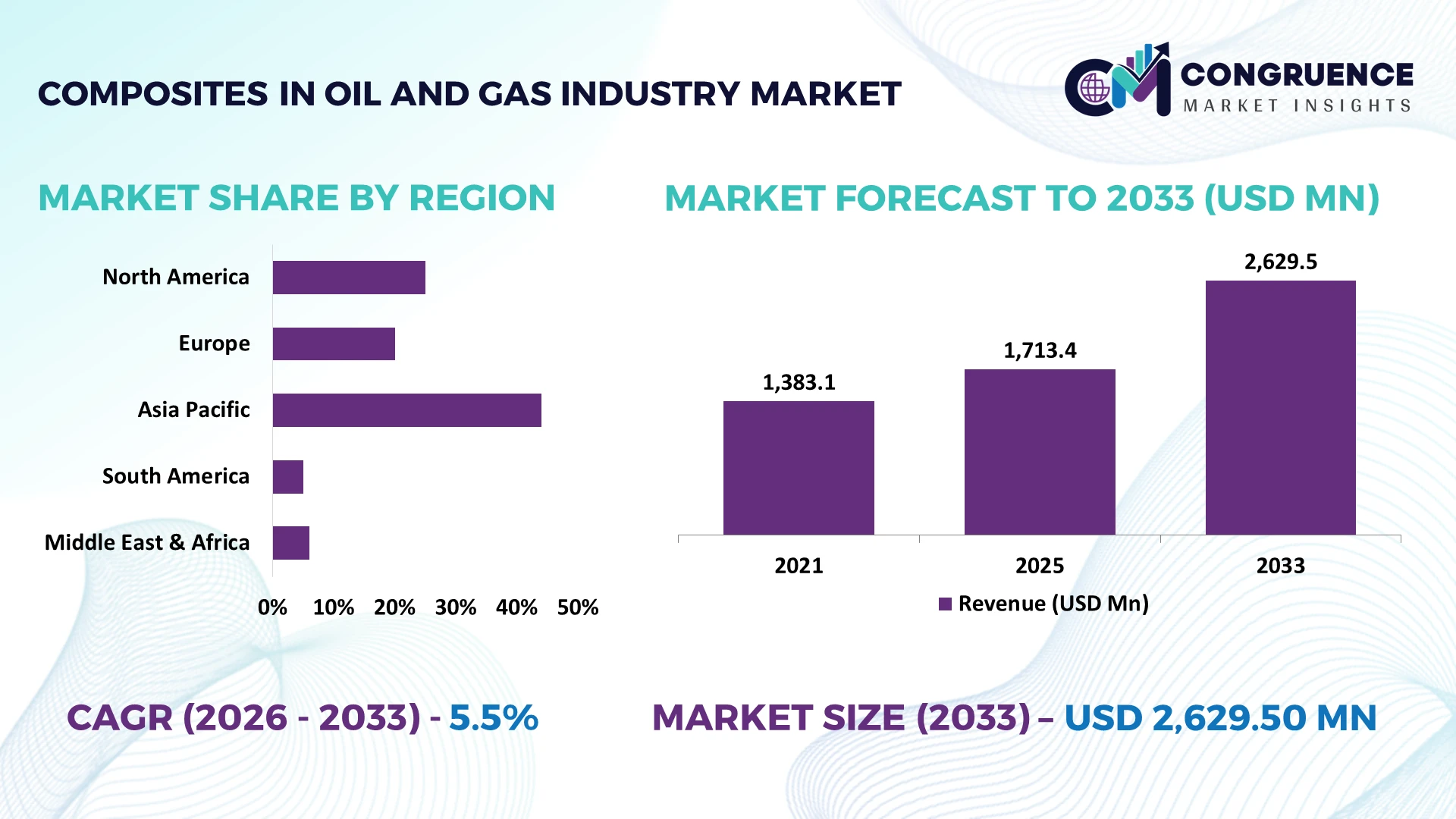
The Global Composites In Oil and Gas Industry Market was valued at USD 1713.4 Million in 2025 and is anticipated to reach a value of USD 2629.5 Million by 2033 expanding at a CAGR of 5.5% between 2026 and 2033. Growth is driven by corrosion-resistant composite pipe replacement, deepwater subsea developments, thermoplastic composite pipe qualification, and offshore operators seeking lower installation weight and reduced maintenance requirements.
The United States maintains a leading position in advanced oil and gas composite adoption, supported by offshore developments in the Gulf of Mexico, extensive shale infrastructure, and domestic composite manufacturing. US crude oil production averaged approximately 13.2 million barrels daily in 2024, compared with Saudi Arabia's approximately 9 million barrels daily. The US Gulf of Mexico contributes around 14% of domestic crude production, supporting demand for fiberglass reinforced piping, composite risers, and corrosion-resistant equipment. Offshore infrastructure modernization strengthens opportunities for automated fiber placement and thermoplastic composite technologies.
Strategically, manufacturers should prioritize the 14% offshore production base and high-pressure shale applications, combining certified composite materials with localized manufacturing to strengthen procurement competitiveness.
Market Size & Growth: USD 1,713.4 million in 2025, reaching USD 2,629.5 million by 2033 at 5.5% CAGR, supported by corrosion-resistant pipeline replacement.
Top Growth Drivers: US crude production increased 2% in 2024; the Permian Basin contributed 48% of national production; advanced composite pipelines demonstrate 40–50% lower lifecycle emissions.
Short-Term Forecast: By 2028, the market is projected to reach USD 2,012.2 million, with cumulative expansion of 17.4% from 2025.
Emerging Technologies: Carbon fiber reinforced thermoplastics, automated fiber placement, and smart composite sensors advance 3 priorities: structural integrity, installation efficiency, and corrosion monitoring.
Regional Leaders: Indicative 2033 estimates place North America at USD 946.6 million, Asia-Pacific at USD 736.3 million, and Middle East & Africa at USD 499.6 million, driven by shale, offshore, and nonmetallic pipeline adoption.
Consumer/End-User Trends: Aramco has deployed over 10,000 km of nonmetallic pipelines and used nonmetallic downhole products in more than 750 wells.
Pilot/Case Example: Aramco's 2015 Khurais project reduced reinforced thermoplastic pipeline installation from 70 days to under 2 days, exceeding 97% time savings.
Competitive Landscape: NOV, Future Pipe Industries, Shawcor, Strohm, and Baker Hughes compete in composite piping; a verified market leader share remains unavailable.
Regulatory & ESG Impact: Aramco's 2024 advanced composite pipeline technology demonstrated 40–50% lower lifecycle emissions, supporting lower-carbon infrastructure procurement.
Investment & Funding: Aramco's 2024 capital investment totaled USD 53.3 billion across its operations, reinforcing opportunities for qualified nonmetallic technologies.
Innovation & Future Outlook: Composite systems qualified for 1,500 psi and 200°F applications strengthen the shift toward corrosion-resistant hydrocarbon transportation.
The Global Composites In Oil and Gas Industry Market is shifting toward reinforced thermoplastic pipelines, fiberglass pressure vessels, carbon fiber risers, and corrosion-resistant downhole equipment. Operators increasingly prioritize lightweight materials that reduce welding requirements, offshore installation complexity, and maintenance exposure. Aramco's advanced composite pipeline development demonstrates 40–50% lower lifecycle emissions, highlighting measurable advantages over conventional metallic infrastructure. US shale operations and Saudi Arabian nonmetallic pipeline programs are strengthening demand for certified composite solutions. Growing emphasis on automated manufacturing, embedded structural health sensors, and high-pressure thermoplastic systems establishes important strategic priorities for manufacturers and energy infrastructure investors.
Composite materials are becoming strategically important as oil and gas operators replace corrosion-prone steel infrastructure with lightweight, chemically resistant alternatives. Saudi Aramco has deployed more than 10,000 kilometers of nonmetallic pipelines, demonstrating industrial-scale adoption. This transition is reshaping procurement strategies toward lifecycle reliability, localized manufacturing, and qualified thermoplastic technologies. Composite pipelines eliminate conventional steel corrosion mechanisms, reducing dependence on chemical inhibitors and frequent replacement. Manufacturers are consequently prioritizing reinforced thermoplastic pipe, fiberglass pressure systems, and automated composite fabrication.
Compared with conventional steel pipelines, reinforced thermoplastic systems offer substantial installation advantages. Aramco's Khurais deployment reduced pipeline installation from 70 days to fewer than 2 days, representing over 97% shorter installation time in that project. The United States emphasizes shale infrastructure and offshore risers, while Saudi Arabia prioritizes large-scale nonmetallic pipeline deployment. Through 2026–2028, suppliers are expected to expand high-pressure qualification, automated winding capacity, and digitally monitored composite systems.
Practical deployment involves replacing corrosion-sensitive gathering lines with spoolable composite pipelines, reducing field welding and installation complexity. Manufacturers are strengthening partnerships with energy operators and certification bodies to accelerate commercial qualification. Competitive advantage increasingly depends on verified pressure performance, dependable installation economics, and long-term material integrity.
Corrosion-related maintenance and pipeline replacement requirements are accelerating composite adoption across oil and gas infrastructure. Saudi Aramco's nonmetallic pipeline technologies demonstrate 40–50% lower lifecycle emissions than comparable conventional systems, while its Khurais installation achieved over 97% shorter installation time. In the United States, the Permian Basin contributes approximately 48% of domestic crude production, creating substantial demand for corrosion-resistant gathering infrastructure. Reinforced thermoplastic pipes eliminate internal steel corrosion and reduce field welding requirements, improving installation productivity. Manufacturers including Future Pipe Industries and NOV are expanding composite pipe technologies, qualification programs, and operator partnerships. Suppliers combining certified pressure performance with rapid installation capabilities gain procurement advantages in high-volume pipeline replacement projects.
Composite deployment faces structural limitations from specialized resin systems, carbon fiber supply concentration, and qualification requirements. Carbon fiber reinforced polymers can deliver weight reductions exceeding 50% compared with steel components, but their material costs and manufacturing complexity restrict adoption in price-sensitive applications. Glass fiber reinforced alternatives offer lower material costs but generally provide lower stiffness than carbon fiber systems. In the United States, offshore infrastructure operators require compliance with demanding pressure, temperature, and fatigue qualification standards, extending procurement cycles. Resin compatibility with hydrocarbons and sour-service environments adds testing requirements. Manufacturers are reducing supply exposure through regional resin sourcing, standardized pipe designs, and long-term material contracts. Commercial competitiveness increasingly depends on balancing performance specifications against installed lifecycle costs.
High-pressure thermoplastic composites create opportunities in subsea flowlines, offshore risers, and digitally monitored pipeline networks. Saudi Aramco's composite technologies have demonstrated 40–50% lower lifecycle emissions, while lightweight composite structures can reduce component weight by more than 50% compared with steel alternatives. In Brazil, offshore pre-salt production accounts for over 75% of national oil output, creating demanding applications for corrosion-resistant subsea equipment. Automated fiber placement, embedded optical sensors, and recyclable thermoplastic matrices are expanding technical possibilities. Manufacturers are investing in qualification programs and partnerships with offshore engineering contractors to commercialize advanced composite systems. Integrating structural monitoring with corrosion-free materials offers a differentiated opportunity to reduce inspection complexity and improve subsea asset management.
Long-term structural reliability remains a critical execution challenge for composites operating under cyclic pressure, elevated temperatures, and aggressive hydrocarbon exposure. Carbon fiber reinforced components can achieve weight reductions exceeding 50%, but sustained mechanical loading and thermal cycling require extensive fatigue and creep validation. Brazil's pre-salt fields contribute more than 75% of national oil production, exposing subsea equipment to demanding pressure and installation conditions. Offshore composite systems must maintain structural integrity across multilayer interfaces, mechanical connectors, and repeated operating cycles. Manufacturers face additional challenges in developing standardized inspection procedures and qualified repair techniques. Companies must invest in accelerated aging tests, digital structural monitoring, and operator-supported field qualification to demonstrate dependable performance and strengthen long-term procurement confidence.
Automated Composite Manufacturing Gains Industrial Traction: Automated filament winding and robotic fiber placement are improving manufacturing consistency across fiberglass pressure equipment and composite tubular products. Modern production lines support 24-hour manufacturing cycles, while automated systems control fiber orientation across multiple reinforcement layers. Manufacturers are integrating inline inspection and digital process monitoring to reduce material waste, improve dimensional accuracy, and strengthen production traceability for demanding oilfield applications.
Nonmetallic Material Standards Strengthen Procurement Discipline: ISO 14692 covers 4 principal parts governing glass-reinforced plastic piping systems, including qualification, manufacturing, system design, and installation. Operators increasingly require documented pressure testing, material traceability, and standardized joining procedures. Suppliers are restructuring quality assurance workflows around certified manufacturing processes, improving tender eligibility and reducing technical approval uncertainty for international oil and gas projects.
Composite Pressure Equipment Gains Application Diversity: Fiberglass reinforced pressure systems are expanding across separators, storage equipment, and chemical handling applications. ASME RTP-1 provides construction requirements for corrosion-resistant reinforced thermoset plastic vessels, while ASME Section X addresses fiber-reinforced plastic pressure vessels. Manufacturers are improving resin compatibility testing and automated winding control, enabling more consistent product qualification and reducing dependence on conventional metallic equipment.
Digital Manufacturing Traceability Becomes Procurement Priority: Composite manufacturers are linking 3 critical production datasets: resin batch identification, fiber placement parameters, and curing records. Digital quality systems connect manufacturing documentation with inspection results and installation records, supporting equipment lifecycle traceability. Suppliers adopting integrated production databases and automated inspection workflows improve audit readiness, reduce documentation delays, and strengthen customer confidence in high-consequence oilfield components.
Polymer Matrix Composites Lead Material Adoption
Polymer Matrix Composites dominate the Composites In Oil and Gas Industry Market, holding an indicative 38% share in 2025, supported by corrosion resistance, manufacturing scalability, and compatibility with diverse oilfield applications. This estimated allocation treats the five specified material categories as mutually exclusive for reporting purposes. Glass Fiber Composites represent approximately 29%, benefiting from comparatively economical reinforcement materials and established use in piping, storage, and chemical handling equipment. Their commercial maturity supports standardized manufacturing and broad deployment across oilfield infrastructure.
Carbon Fiber Composites are positioned as the fastest-growing type, with an indicative 19% share, supported by increasing requirements for lightweight, high-strength equipment in demanding operating environments. Metal Matrix Composites account for an estimated 9%, serving specialized wear-resistant and thermally demanding components, while Ceramic Matrix Composites represent approximately 5%, addressing extreme-temperature applications. Manufacturers are investing in automated fiber placement, improved resin formulations, and advanced composite qualification. Procurement decisions increasingly differentiate economical glass fiber solutions from high-performance carbon reinforcement, strengthening opportunities for suppliers offering application-specific material engineering and dependable certification.
Pipes and Tanks Dominate Commercial Deployment
Pipes and Tanks represent the largest application segment, with an indicative 43% market share in 2025, supported by widespread requirements for corrosion-resistant fluid transportation, chemical storage, and production infrastructure. Reinforced thermoplastic and fiberglass systems provide alternatives to conventional steel equipment in environments exposed to saline water and aggressive chemicals. Pressure Vessels account for an estimated 19%, reflecting established applications in fluid processing and storage operations. Manufacturers are expanding standardized pipe dimensions, improving jointing technologies, and strengthening material qualification to support efficient project execution.
Offshore Structures are positioned as the fastest-growing application, representing approximately 17% of demand, driven by requirements for lightweight structural components and corrosion-resistant offshore equipment. Downhole Tools contribute an indicative 12%, supported by specialized composite components used in drilling and well intervention. Oilfield Equipment accounts for approximately 9%, covering diverse operational components requiring chemical resistance and mechanical durability. Suppliers are investing in automated manufacturing, high-performance reinforcement systems, and operator-specific qualification programs. Competitive differentiation increasingly depends on verified operating limits, installation productivity, and dependable equipment lifecycle performance.
Upstream Operations Lead Composite Material Consumption
Upstream represents the leading end-user segment, with an indicative 37% market share in 2025, supported by extensive requirements for gathering systems, drilling equipment, production facilities, and chemically resistant components. Midstream accounts for approximately 28%, reflecting demand for corrosion-resistant transportation infrastructure and fluid handling systems. In the United States, the Permian Basin's substantial production concentration reinforces procurement requirements for durable gathering pipelines and associated equipment. Suppliers are emphasizing standardized composite piping, pressure qualification, and installation support to address operational reliability and procurement efficiency.
Offshore Oil and Gas Operators constitute the fastest-growing end-user segment, representing an estimated 23% share, driven by demanding marine environments, equipment weight constraints, and specialized infrastructure requirements. Downstream contributes approximately 12%, supported by refinery piping, chemical handling systems, and storage applications. Offshore buyers prioritize fatigue resistance and installation compatibility, while downstream operators emphasize chemical durability and maintenance efficiency. Manufacturers are strengthening partnerships with engineering contractors, expanding application-specific product portfolios, and improving technical certification. Competitive positioning increasingly reflects lifecycle performance, qualified installation networks, and customer-specific engineering capabilities.
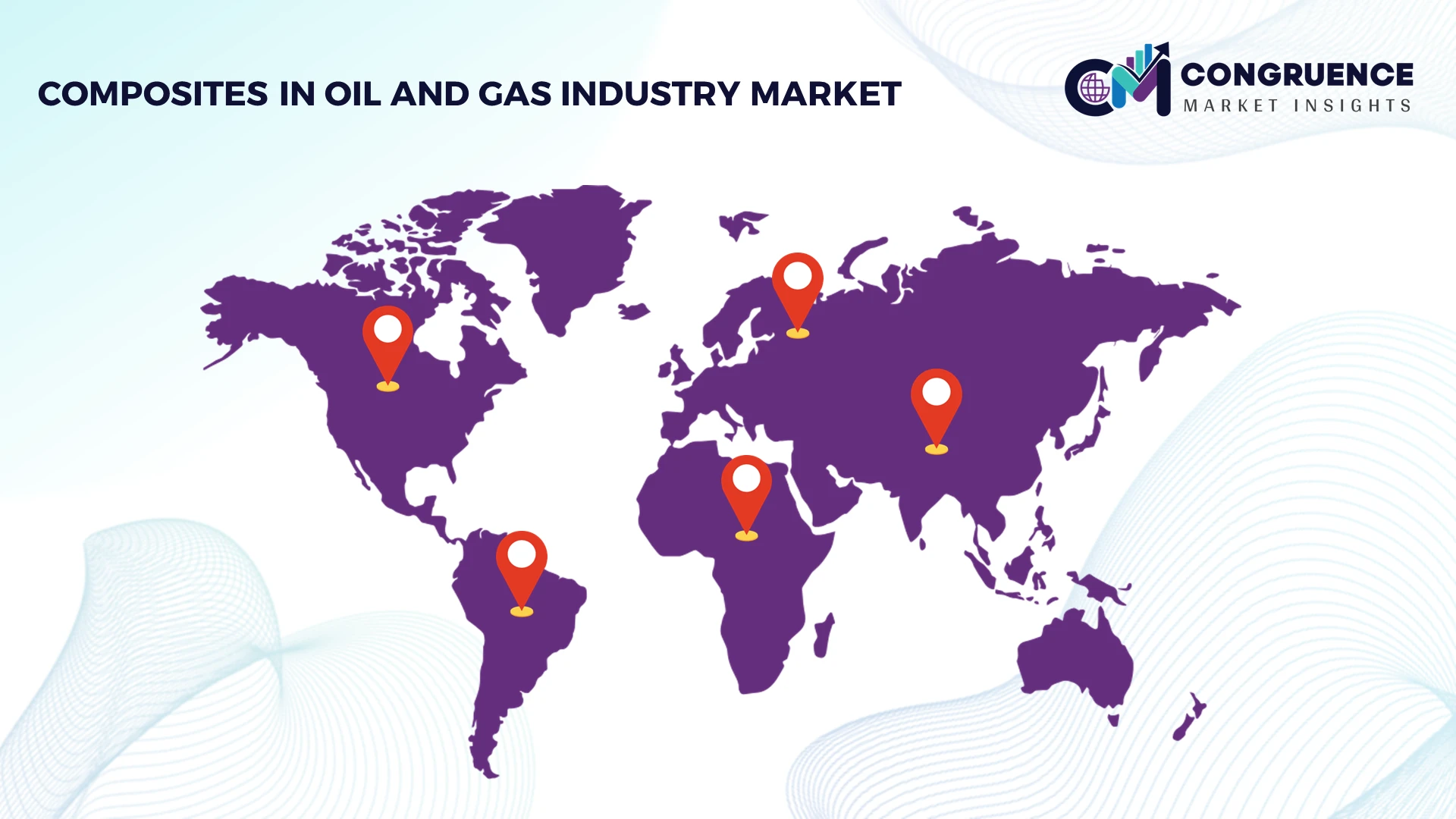
North America accounted for the largest market share at an estimated 36% in 2025 however, Asia-Pacific is expected to register the fastest growth, expanding at an estimated CAGR of 7.2% between 2026 and 2033.
Shale Infrastructure Modernization Strengthens Composite Material Adoption
North America represents an estimated 36% of global composite demand in oil and gas applications, supported by extensive shale production, offshore infrastructure, and established composite manufacturing capabilities. The United States dominates regional consumption through the Permian Basin, Eagle Ford, and Gulf of Mexico production systems. The Permian Basin accounts for approximately 48% of US crude oil production, supporting procurement of corrosion-resistant gathering pipelines, reinforced thermoplastic tubing, and fiberglass storage equipment. Canadian oil sands operations create additional demand for chemically resistant piping and industrial composite components. Manufacturers including NOV and Mattr are strengthening composite engineering, material qualification, and regional distribution capabilities. Increasing preference for spoolable pipeline systems supports installation efficiency in remote production environments. Suppliers with established pressure testing capabilities and reliable field installation networks maintain advantages in large-scale infrastructure replacement contracts.
United States Market Outlook: The United States benefits from extensive unconventional production infrastructure, advanced polymer engineering, and established oilfield equipment manufacturing. Domestic crude oil production averaged approximately 13.2 million barrels daily in 2024, creating substantial requirements for fluid transportation and equipment maintenance. Composite suppliers are prioritizing reinforced thermoplastic pipes, corrosion-resistant pressure equipment, and specialized downhole components. Gulf Coast manufacturing facilities provide logistical advantages for offshore and shale operators seeking shorter equipment delivery schedules.
Offshore Engineering Expertise Accelerates Advanced Composite Qualification
Europe accounts for an estimated 19% of global demand, supported by offshore engineering, specialized material manufacturing, and established composite qualification infrastructure. Norway, the United Kingdom, the Netherlands, and Germany maintain significant capabilities in subsea equipment development, advanced polymers, and composite manufacturing technologies. Norwegian Continental Shelf operations prioritize lightweight equipment, fatigue resistance, and corrosion protection across demanding offshore environments. The Netherlands hosts specialized thermoplastic composite pipe manufacturing and engineering capabilities, including Strohm's advanced pipeline technology. European manufacturers are strengthening automated production processes and qualification programs for offshore applications. The European Union's industrial decarbonization priorities encourage evaluation of materials offering lower installation emissions and reduced maintenance requirements. Technology partnerships between composite suppliers, certification organizations, and offshore contractors support commercialization of advanced pipe systems, particularly where conventional metallic infrastructure creates weight and corrosion limitations.
Norway Market Outlook: Norway maintains a strategic position through North Sea production infrastructure, subsea engineering expertise, and established offshore certification practices. Norwegian petroleum production exceeded 230 million standard cubic meters of oil equivalents in 2024, sustaining demand for specialized offshore equipment. Composite technology developers benefit from collaboration with operators, engineering contractors, and research institutions focused on material qualification, fatigue performance, and lightweight subsea components.
Manufacturing Scale Supports Cost-Competitive Composite Infrastructure
Asia-Pacific represents an estimated 23% of global demand, supported by expanding petrochemical infrastructure, domestic composite manufacturing, and offshore energy development. China leads regional production capabilities through established glass fiber manufacturing, polymer processing, and industrial equipment supply chains. India contributes demand through refinery modernization, pipeline development, and offshore exploration activities. China accounts for more than 60% of global fiberglass production capacity, strengthening regional access to reinforcement materials used in composite piping and storage equipment. Indonesia and Malaysia support additional demand through offshore production and corrosion-sensitive infrastructure. Manufacturers are expanding automated filament winding, resin formulation capabilities, and localized component manufacturing to improve cost competitiveness. Regional procurement increasingly favors suppliers combining standardized material specifications with domestic manufacturing capacity, particularly where imported specialty composites face delivery constraints and qualification requirements.
China Market Outlook: China benefits from extensive fiberglass manufacturing capacity, established petrochemical processing infrastructure, and integrated polymer supply chains. Its domestic oil production exceeded 210 million tonnes in 2024, sustaining requirements for corrosion-resistant production equipment and industrial piping. Manufacturers are strengthening automated composite fabrication, high-performance resin development, and pressure equipment qualification. Domestic material availability provides procurement advantages, while offshore developments increase requirements for specialized structural performance and long-term durability.
Brazilian Deepwater Production Expands Specialized Composite Applications
South America accounts for an estimated 10% of global composite demand, supported primarily by Brazil's offshore petroleum industry and expanding production infrastructure. Brazil's pre-salt fields contribute more than 75% of national oil output, creating demanding operating conditions for subsea equipment, corrosion-resistant piping, and lightweight structural components. Petrobras continues developing offshore production systems requiring advanced materials capable of withstanding high pressure, saltwater exposure, and complex installation environments. Argentina's Vaca Muerta formation contributes additional demand for composite gathering systems and oilfield equipment. Regional manufacturers face specialized material import dependencies and limited local qualification infrastructure for advanced offshore composites. Suppliers are strengthening partnerships with engineering contractors and domestic fabricators to improve technical support and equipment availability. Localized assembly and standardized component designs provide practical advantages in managing project delivery schedules.
Brazil Market Outlook: Brazil dominates regional opportunities through extensive deepwater reserves, offshore engineering capabilities, and established petroleum equipment procurement networks. National crude oil production exceeded 3.3 million barrels daily in 2024, supporting continued investment in production infrastructure. Petrobras procurement requirements emphasize qualified materials, operational reliability, and compatibility with subsea equipment. Composite suppliers are prioritizing high-performance pipe systems, structural components, and localized technical partnerships to access offshore development projects.
Nonmetallic Pipeline Programs Transform Material Procurement
Middle East & Africa represents an estimated 12% of global composite demand, supported by extensive hydrocarbon production infrastructure, corrosion-resistant pipeline initiatives, and industrial modernization. Saudi Arabia leads regional adoption through Saudi Aramco's established nonmetallic materials program, which has deployed more than 10,000 kilometers of nonmetallic pipelines. The United Arab Emirates supports demand through offshore production, gas processing, and petrochemical infrastructure. Oman and Qatar maintain applications for reinforced thermoplastic piping and corrosion-resistant industrial equipment. In Africa, Nigeria and Angola present opportunities for composite systems addressing corrosion exposure and maintenance challenges. Regional manufacturers and international suppliers are expanding technical partnerships, installation training, and material qualification capabilities. Procurement increasingly emphasizes certified operating performance, local technical support, and compatibility with established hydrocarbon transportation infrastructure.
Saudi Arabia Market Outlook: Saudi Arabia maintains a leading position in industrial nonmetallic technology adoption through Saudi Aramco's pipeline modernization and material engineering programs. The company's composite technology initiatives have demonstrated 40–50% lower lifecycle emissions for selected pipeline applications compared with conventional alternatives. Saudi industrial localization policies strengthen opportunities for domestic composite manufacturing, resin processing, and installation services. Suppliers offering certified materials and established operator relationships benefit from long-term infrastructure procurement requirements.
The Composites In Oil and Gas Industry Market features competition between integrated equipment suppliers NOV and Baker Hughes, specialist pipe manufacturers Future Pipe Industries and Strohm, and advanced materials providers Owens Corning and Hexcel. The leading five suppliers hold an indicative combined 38% market share, although independently verified concentration data remains unavailable. NOV competes through integrated oilfield equipment capabilities, while Future Pipe Industries emphasizes corrosion-resistant piping and regional manufacturing. Strohm differentiates through thermoplastic composite technology and offshore qualification. Glass fiber systems offer potential material cost advantages exceeding 30% against specialized carbon fiber alternatives, while advanced composites deliver component weight reductions exceeding 50% versus steel in selected applications. Manufacturers strengthen competitiveness through automated production, operator partnerships, and localized supply chains. Qualification requirements and material traceability remain significant entry barriers. Competitive leadership depends on certified performance, installation economics, reliable manufacturing capacity, and dependable technical support throughout demanding operating conditions.
NOV Inc.
Future Pipe Industries
Strohm B.V.
Mattr Corp.
Baker Hughes Company
Owens Corning
Hexcel Corporation
Toray Industries, Inc.
Teijin Limited
Jindal SAW Limited
National Oilwell Varco Fiberglass Systems (NOV)
Hengrun Group Co., Ltd.
HOBAS Pipe USA
Saudi Arabian Amiantit Company
Current composite technologies emphasize glass fiber reinforced polymers, epoxy resin systems, and reinforced thermoplastic pipes for corrosion-resistant oilfield infrastructure. Automated filament winding improves fiber alignment, manufacturing consistency, and pressure performance across pipelines and vessels. Saudi Aramco has deployed more than 10,000 kilometers of nonmetallic pipelines, demonstrating commercial adoption. Selected composite pipeline systems achieve 40–50% lower lifecycle emissions than conventional metallic alternatives. Manufacturers prioritize standardized qualification, automated production, and improved resin compatibility to reduce maintenance exposure and installation complexity.
Emerging technologies include carbon fiber reinforced thermoplastics, robotic fiber placement, and advanced multilayer pressure barriers. Carbon fiber components can achieve weight reductions exceeding 50% compared with equivalent steel structures, improving offshore handling and installation efficiency. Unlike conventional welded steel systems, spoolable composite pipelines reduce field joining requirements. Aramco's Khurais installation demonstrated over 97% shorter installation time under project-specific conditions. Strohm and specialized manufacturers benefit from lightweight pipe designs and high-pressure qualification capabilities.
Disruptive developments integrate embedded fiber optic sensors, digital manufacturing twins, and recyclable thermoplastic matrices. Between 2026 and 2028, suppliers are prioritizing automated defect inspection, continuous structural monitoring, and material traceability. These technologies strengthen qualification confidence, support condition-based maintenance, and differentiate manufacturers serving demanding offshore applications while improving procurement decisions through verified performance data.
December 2025: Aramco highlighted expanded nonmetallic pipeline deployment, confirming more than 10,000 kilometers of composite pipes installed within five years. The initiative strengthens corrosion resistance, reduces maintenance exposure, and demonstrates industrial-scale adoption across hydrocarbon infrastructure. Source: Aramco Europe
January 2025: Strohm secured a contract supplying 33 kilometers of thermoplastic composite pipe for Aramco's Fadhili gas plant. The project introduces electrofusion couplers, eliminating conventional metallic joints and improving corrosion resistance, installation efficiency, and infrastructure reliability. Source: World Pipelines
September 2026: Petrobras awarded Strohm a thermoplastic composite pipe contract for offshore Brazil, covering water injection and gas lift applications at depths reaching 1,500 meters. Field qualification supports lightweight subsea deployment and evaluates installation compatibility. Source: Oil & Gas Journal
March 2025: Composite Pipe Technology introduced MaxDR, a large-diameter fusible composite pipe, increasing pressure capability from 125 psi to 350 psi. Fiberglass reinforcement enables higher-pressure applications while retaining polymer piping advantages, expanding industrial deployment possibilities. Source: KTRE
The Composites In Oil and Gas Industry Market Report evaluates developments between 2026 and 2033, covering Polymer Matrix Composites, Metal Matrix Composites, Ceramic Matrix Composites, Carbon Fiber Composites, and Glass Fiber Composites. Application coverage includes Pipes and Tanks, Offshore Structures, Downhole Tools, Pressure Vessels, and Oilfield Equipment. End-user analysis examines Upstream, Midstream, Downstream, and Offshore Oil and Gas Operators, assessing material performance, installation economics, and procurement requirements.
Regional coverage spans North America, Europe, Asia-Pacific, South America, and Middle East & Africa, emphasizing manufacturing capacity, offshore deployment, and infrastructure modernization. With Aramco deploying more than 10,000 kilometers of nonmetallic pipelines, the report evaluates reinforced thermoplastics, automated manufacturing, and structural monitoring technologies. Competitive analysis supports investment planning, supplier selection, geographic expansion, and long-term material innovation strategies.
| Report Attribute/Metric | Report Details |
|---|---|
Market Revenue in 2025 | USD 1713.4 Million |
Market Revenue in 2033 | USD 2629.5 Million |
CAGR (2026 - 2033) | 5.5% |
Base Year | 2025 |
Forecast Period | 2026 - 2033 |
Historic Period | 2021 - 2025 |
Segments Covered | By Type
By Application
By End-User
|
Key Report Deliverable | Revenue Forecast, Growth Trends, Market Dynamics, Segmental Overview, Regional and Country-wise Analysis, Competition Landscape |
Region Covered | North America, Europe, Asia-Pacific, South America, Middle East, Africa |
Key Players Analyzed | NOV Inc., Future Pipe Industries, Strohm B.V., Mattr Corp., Baker Hughes Company, Owens Corning, Hexcel Corporation, Toray Industries, Inc., Teijin Limited, Jindal SAW Limited, National Oilwell Varco Fiberglass Systems (NOV), Hengrun Group Co., Ltd., HOBAS Pipe USA, Saudi Arabian Amiantit Company |
Customization & Pricing | Available on Request (10% Customization is Free) |




