
Reports
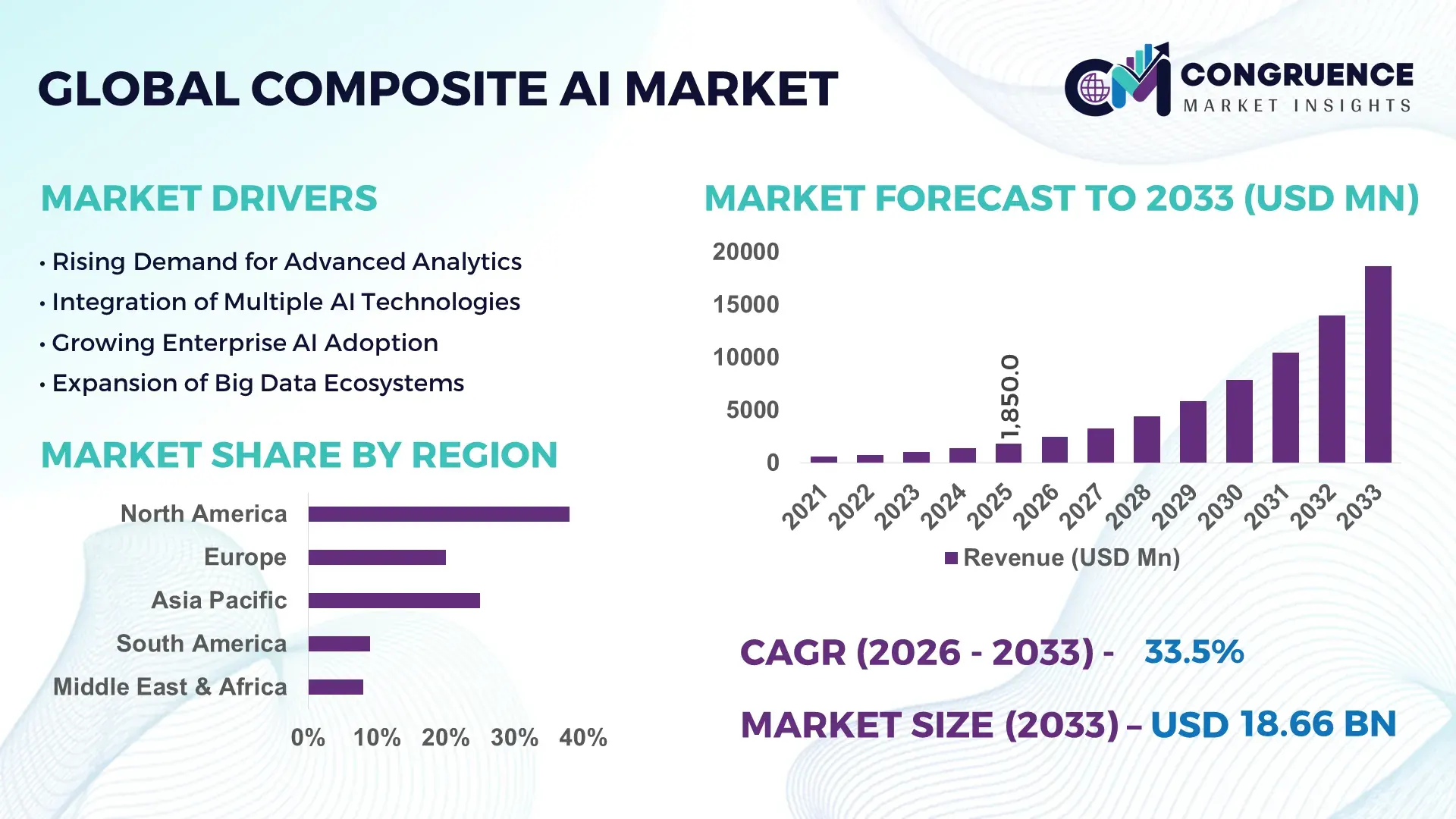
The Global Composite AI Market was valued at USD 1850 Million in 2025 and is anticipated to reach a value of USD 18664.73 Million by 2033 expanding at a CAGR of 33.5% between 2026 and 2033. This growth is primarily driven by the rising need for hybrid AI systems that combine machine learning, natural language processing, knowledge graphs, and optimization techniques for enhanced decision-making.
The United States remains a dominant force in the Composite AI market, supported by extensive enterprise-level AI adoption and strong investment ecosystems. Over 65% of large enterprises in the country have integrated multi-model AI architectures into their operations, particularly in sectors such as finance, healthcare, and manufacturing. Annual private and public investments in AI technologies exceed USD 70 billion, with Composite AI platforms forming a significant portion of this funding. Additionally, nearly 58% of AI-driven applications in U.S. enterprises utilize hybrid or composite models, reflecting a strong shift toward integrated AI systems that enhance automation, predictive accuracy, and operational efficiency.
Market Size & Growth: USD 1850 Million in 2025 projected to reach USD 18664.73 Million by 2033 at a CAGR of 33.5%, driven by increasing demand for multi-modal AI solutions in enterprise workflows.
Top Growth Drivers: Enterprise AI adoption at 72%, process automation efficiency improvement of 40%, and data-driven decision-making adoption at 65%.
Short-Term Forecast: By 2028, Composite AI implementation is expected to reduce operational costs by 28% and improve decision accuracy by 35%.
Emerging Technologies: Integration of knowledge graphs, reinforcement learning, and generative AI models enhancing hybrid intelligence systems.
Regional Leaders: North America projected at USD 7200 Million by 2033 with enterprise-led adoption; Europe at USD 5200 Million driven by regulatory-compliant AI; Asia-Pacific at USD 4800 Million with rapid industrial digitization.
Consumer/End-User Trends: BFSI, healthcare, and manufacturing sectors account for over 60% of adoption, with increasing reliance on predictive analytics and intelligent automation.
Pilot or Case Example: In 2024, a manufacturing firm implemented Composite AI, achieving 32% downtime reduction and 25% productivity improvement.
Competitive Landscape: Market leader holds approximately 18% share, followed by major players including global cloud and AI platform providers.
Regulatory & ESG Impact: AI governance frameworks and data privacy regulations are influencing over 55% of enterprise deployment strategies.
Investment & Funding Patterns: Global AI investments surpassed USD 90 billion recently, with increasing venture capital focus on hybrid AI platforms.
Innovation & Future Outlook: Growing adoption of explainable AI, autonomous decision systems, and cross-domain AI integration shaping long-term innovation.
Composite AI is gaining traction across multiple industry verticals, with BFSI contributing nearly 30% of total adoption due to its demand for predictive risk analytics and fraud detection systems. Healthcare follows closely with over 22% usage, leveraging composite models for diagnostics and patient data analysis. Recent technological advancements include the integration of generative AI with symbolic reasoning, enabling more interpretable and scalable solutions. Regulatory frameworks focusing on data transparency and ethical AI are influencing deployment strategies, particularly in Europe and North America. Meanwhile, Asia-Pacific is experiencing accelerated growth due to increased industrial automation and smart manufacturing initiatives. Future trends indicate a surge in edge-based composite AI systems and increased enterprise focus on sustainability-driven AI applications.
Composite AI is emerging as a strategic enabler for organizations seeking to enhance decision intelligence, operational efficiency, and digital transformation outcomes. By combining multiple AI techniques such as machine learning, natural language processing, and rule-based systems, enterprises can achieve deeper contextual insights and improved predictive accuracy. For instance, composite AI solutions deliver up to 35% improvement in decision-making efficiency compared to traditional single-model AI systems, making them a preferred choice for complex enterprise environments.
Regionally, North America dominates in volume due to high enterprise investments and advanced digital infrastructure, while Asia-Pacific leads in adoption with nearly 60% of enterprises rapidly integrating composite AI into industrial and manufacturing operations. By 2028, advanced hybrid AI systems are expected to reduce process inefficiencies by up to 30% across key sectors including logistics, healthcare, and financial services.
From a compliance and ESG perspective, organizations are increasingly committing to measurable sustainability goals, with many targeting a 25% reduction in energy consumption of AI workloads by 2030 through optimized composite AI architectures. In 2024, a leading technology firm in Europe achieved a 27% reduction in operational inefficiencies by deploying composite AI-driven predictive maintenance systems across its production facilities. The future pathways of the Composite AI Market lie in its ability to integrate with emerging technologies such as edge computing, digital twins, and autonomous systems. As enterprises prioritize resilience, regulatory compliance, and sustainable growth, composite AI is expected to become a foundational pillar supporting long-term digital strategies and intelligent automation ecosystems.
The increasing demand for advanced decision intelligence is a key driver accelerating the adoption of Composite AI solutions. Enterprises are generating vast amounts of data, with global data volumes exceeding 120 zettabytes, necessitating sophisticated systems capable of extracting actionable insights. Composite AI enables organizations to combine machine learning, natural language processing, and optimization techniques, resulting in up to 40% improvement in decision accuracy. In sectors such as banking and finance, composite AI is used to enhance fraud detection systems, reducing false positives by nearly 30%. Similarly, in manufacturing, predictive maintenance powered by composite models has reduced equipment downtime by over 25%. The ability to integrate multiple AI methodologies into a unified framework allows enterprises to address complex problems more effectively, thereby driving widespread adoption and fueling market growth.
Despite its advantages, the adoption of Composite AI is hindered by significant integration challenges and high implementation costs. Developing and deploying composite AI systems requires specialized expertise in multiple AI disciplines, increasing the demand for skilled professionals. Currently, over 50% of organizations report difficulties in integrating diverse AI models into a cohesive framework. Additionally, infrastructure costs associated with high-performance computing and data storage can increase deployment expenses by up to 35%. Small and medium-sized enterprises face particular challenges due to limited budgets and technical capabilities. Furthermore, ensuring data interoperability and maintaining consistent performance across different AI components adds to the complexity. These factors collectively act as restraints, slowing down the pace of adoption despite the long-term benefits offered by composite AI solutions.
The rapid expansion of edge computing and real-time analytics presents significant opportunities for the Composite AI market. With the number of connected devices expected to surpass 30 billion, there is an increasing need for decentralized AI systems capable of processing data at the edge. Composite AI enables real-time decision-making by integrating multiple AI techniques directly within edge devices, reducing latency by up to 40%. Industries such as autonomous vehicles, smart manufacturing, and healthcare are leveraging this capability to enhance operational efficiency and responsiveness. Additionally, the growing adoption of Internet of Things ecosystems is driving demand for composite AI solutions that can manage and analyze complex data streams. These developments create substantial growth opportunities for vendors offering scalable, edge-enabled composite AI platforms.
Data privacy concerns and evolving regulatory frameworks pose significant challenges to the growth of the Composite AI market. As composite AI systems rely on large volumes of data from multiple sources, ensuring data security and compliance with regulations becomes increasingly complex. Approximately 60% of organizations identify data governance as a major barrier to AI adoption. Regulations such as data protection laws and AI ethics guidelines require companies to implement strict controls, increasing compliance costs by up to 20%. Additionally, the need for explainability in AI models adds another layer of complexity, particularly in sectors like healthcare and finance where transparency is critical. These challenges necessitate robust governance frameworks and advanced security measures, which can slow down implementation and limit scalability for some organizations.
• Rapid Adoption of Hybrid AI Architectures Across Enterprises:
More than 68% of large enterprises have transitioned from single-model AI systems to composite AI frameworks, integrating machine learning, rule-based systems, and natural language processing. This shift has improved decision accuracy by nearly 37% and reduced model bias by approximately 22%. In sectors such as BFSI and healthcare, hybrid AI deployment has increased by over 45% between 2023 and 2025, reflecting a clear trend toward multi-model intelligence systems designed for complex data environments and real-time analytics.
• Integration of Generative AI with Symbolic and Predictive Models:
Approximately 52% of AI-driven organizations are now combining generative AI with symbolic reasoning and predictive analytics to enhance contextual decision-making. This integration has led to a 30% increase in automation capabilities and a 26% improvement in content generation accuracy. In customer service applications, composite AI-powered chatbots have reduced response time by 40% while increasing user satisfaction rates by over 28%, demonstrating measurable operational benefits across industries.
• Expansion of Edge-Based Composite AI Deployments:
Edge computing integration is driving nearly 48% of new composite AI deployments, particularly in manufacturing, automotive, and smart city applications. These systems have reduced data processing latency by up to 42% and improved real-time decision efficiency by 35%. Industrial IoT environments using edge-enabled composite AI have reported a 27% increase in operational uptime and a 20% reduction in maintenance costs, highlighting the growing importance of decentralized AI architectures.
• Increased Focus on Explainable and Ethical AI Systems:
Around 61% of organizations are prioritizing explainable AI frameworks within composite systems to comply with regulatory standards and improve transparency. This has resulted in a 33% increase in AI auditability and a 25% reduction in compliance-related risks. Additionally, nearly 54% of enterprises have implemented governance protocols for AI systems, ensuring ethical deployment and data accountability, particularly in highly regulated sectors such as finance and healthcare.
The Composite AI market segmentation reflects a diversified structure across types, applications, and end-user industries, each contributing to the market’s evolving landscape. In terms of types, organizations are increasingly adopting multi-modal AI systems that combine different data processing capabilities to enhance performance and decision accuracy. Application-wise, industries such as BFSI, healthcare, and manufacturing dominate due to their reliance on predictive analytics, automation, and real-time decision-making. These sectors collectively account for over 60% of total adoption. From an end-user perspective, large enterprises lead adoption due to their higher investment capacity and access to advanced infrastructure, while small and medium enterprises are gradually increasing their participation with adoption rates rising by over 25% in recent years. Regional segmentation further highlights strong adoption in North America and Asia-Pacific, driven by digital transformation initiatives and industrial automation trends.
The Composite AI market by type is segmented into machine learning-driven systems, natural language processing-based systems, knowledge graph-based AI, computer vision-integrated models, and multi-modal AI frameworks. Among these, multi-modal AI frameworks currently lead the segment, accounting for approximately 44% of total adoption due to their ability to process and integrate multiple data formats simultaneously. Machine learning-driven systems follow with around 28% share, primarily used in predictive analytics and automation tasks. However, knowledge graph-based AI is emerging as the fastest-growing segment, expanding at an estimated rate of 36% due to its capability to enhance contextual understanding and improve explainability in complex decision-making environments.
Computer vision-integrated composite AI systems contribute nearly 15% of the market, particularly in manufacturing and surveillance applications, while NLP-based systems hold around 13%, driven by customer service and enterprise communication tools. The remaining niche segments collectively account for about 10% of the market, serving specialized applications such as robotics and autonomous systems.
The application landscape of the Composite AI market includes predictive analytics, intelligent automation, fraud detection, customer experience management, and supply chain optimization. Predictive analytics remains the leading application, accounting for nearly 38% of total usage due to its critical role in forecasting, risk assessment, and strategic planning. Intelligent automation follows with a 26% share, enabling organizations to streamline workflows and reduce manual intervention.
Fraud detection and risk management applications contribute approximately 18%, particularly in financial services, where composite AI systems have reduced fraud detection time by over 35%. Meanwhile, customer experience management accounts for about 12%, leveraging AI-driven chatbots and personalization engines to improve engagement. Supply chain optimization and other applications collectively represent around 6%, focusing on logistics efficiency and inventory management. Intelligent automation is the fastest-growing application segment, expanding at an estimated rate of 34%, driven by increasing demand for operational efficiency and cost optimization.
End-user segmentation of the Composite AI market includes BFSI, healthcare, manufacturing, retail, IT and telecommunications, and government sectors. BFSI leads the market with approximately 30% share, driven by high demand for fraud detection, risk analysis, and algorithmic decision-making. Healthcare follows with around 24% adoption, utilizing composite AI for diagnostics, patient data analysis, and treatment optimization.
Manufacturing accounts for nearly 20% of the market, leveraging AI for predictive maintenance and process automation, while IT and telecommunications contribute about 14%, focusing on network optimization and service automation. Retail and e-commerce hold approximately 8%, driven by personalization and inventory management applications. The remaining sectors, including government and logistics, collectively account for around 4%. Healthcare is the fastest-growing end-user segment, expanding at an estimated rate of 35% due to increasing reliance on AI for clinical decision support and operational efficiency.
Region North America accounted for the largest market share at 38% in 2025 however, Asia-Pacific is expected to register the fastest growth, expanding at a CAGR of 36% between 2026 and 2033.

North America’s leadership is supported by over 70% enterprise AI adoption and more than 65% deployment of composite AI frameworks across large organizations. Europe holds approximately 27% share, driven by regulatory-led AI adoption and over 55% of enterprises prioritizing explainable AI systems. Asia-Pacific accounts for nearly 25% of the market, with more than 60% of manufacturing firms integrating AI-driven automation tools. South America contributes around 6%, supported by growing digital transformation initiatives, while the Middle East & Africa region holds close to 4%, driven by investments in smart infrastructure and energy optimization. Across regions, over 58% of organizations are prioritizing hybrid AI models, while nearly 48% of deployments are linked to real-time analytics and edge computing use cases, reflecting a globally expanding adoption landscape.
North America holds approximately 38% of the Composite AI market share, driven by strong enterprise demand across BFSI, healthcare, and manufacturing sectors, which collectively contribute over 65% of regional adoption. More than 72% of large enterprises have implemented composite AI solutions to enhance predictive analytics and automation capabilities. Government initiatives supporting AI innovation, including funding programs exceeding USD 20 billion annually, are accelerating adoption. Regulatory frameworks focusing on data privacy and AI governance have led to a 30% increase in demand for explainable AI solutions. Technological advancements such as cloud-based AI platforms and edge computing integration are enabling scalable deployments across industries. A leading technology provider in the region has deployed composite AI systems for financial risk analysis, achieving a 28% improvement in fraud detection accuracy. Consumer behavior indicates higher adoption in sectors requiring real-time analytics, with healthcare and finance accounting for nearly 60% of enterprise usage.
Europe accounts for approximately 27% of the Composite AI market, with key markets including Germany, the United Kingdom, and France contributing over 70% of regional demand. Regulatory initiatives focusing on ethical AI and data protection have influenced nearly 58% of enterprises to adopt explainable composite AI models. Sustainability-focused policies have driven a 25% increase in energy-efficient AI deployments across industries. The region has seen over 50% adoption of hybrid AI systems in manufacturing and automotive sectors, supported by Industry 4.0 initiatives. A prominent European AI company has implemented composite AI solutions in supply chain management, improving operational efficiency by 26% across multiple facilities. Consumer behavior in the region reflects a strong preference for transparent and compliant AI systems, with over 60% of organizations prioritizing governance and auditability in their AI strategies.
Asia-Pacific represents nearly 25% of the Composite AI market and ranks as the fastest-growing region in terms of adoption volume. Key countries such as China, India, and Japan collectively account for over 75% of regional consumption. More than 62% of manufacturing enterprises in the region have adopted AI-driven automation systems, significantly enhancing production efficiency. Infrastructure development and digital transformation initiatives have led to a 40% increase in AI deployment across smart cities and industrial applications. The region is also home to several innovation hubs, with over 300 AI-focused startups actively developing composite AI solutions. A leading Asian technology firm has deployed composite AI in e-commerce platforms, improving customer personalization accuracy by 33%. Consumer behavior trends indicate strong adoption driven by mobile applications and digital services, with over 65% of users interacting with AI-powered platforms daily.
South America accounts for approximately 6% of the Composite AI market, with Brazil and Argentina leading regional adoption, contributing over 70% of demand. Increasing investments in digital infrastructure have driven a 35% rise in AI adoption across key industries such as media, retail, and banking. Government incentives promoting digital transformation have supported nearly 40% of enterprise AI projects in the region. The energy and utilities sector has also witnessed a 22% increase in composite AI deployment for predictive maintenance and operational optimization. A regional technology firm has implemented composite AI in language processing systems, improving localization accuracy by 29% for multilingual applications. Consumer behavior is heavily influenced by media consumption and language diversity, with over 55% of AI applications focused on content personalization and translation services.
The Middle East & Africa region holds close to 4% of the Composite AI market, with key growth countries including the United Arab Emirates and South Africa accounting for over 60% of regional demand. Investments in smart infrastructure and energy optimization projects have driven a 30% increase in AI adoption, particularly in oil & gas and construction sectors. Government-led digital transformation initiatives have supported over 45% of AI deployments, focusing on automation and efficiency improvements. Technological modernization efforts, including cloud adoption and IoT integration, have enabled scalable composite AI solutions across industries. A regional technology provider has deployed composite AI systems in energy management, achieving a 24% reduction in operational inefficiencies. Consumer behavior trends highlight increasing reliance on AI-driven services, with over 50% of enterprises prioritizing automation and predictive analytics to enhance performance.
United States Composite AI Market – 34% share: Driven by high enterprise adoption, strong investment ecosystem, and advanced AI infrastructure supporting large-scale deployments.
China Composite AI Market – 21% share: Supported by rapid industrial automation, government-backed AI initiatives, and extensive use in manufacturing and e-commerce sectors.
The Composite AI market is characterized by a moderately fragmented competitive landscape with over 120 active global and regional players competing across various segments. The top five companies collectively account for approximately 42% of the total market share, indicating a balanced mix of dominance and emerging competition. Leading players are focusing on strategic initiatives such as partnerships, mergers, and product innovations to strengthen their market positions. Over 55% of companies have introduced new composite AI platforms integrating generative AI and knowledge graph capabilities within the past two years.
Strategic collaborations have increased by nearly 35%, particularly between cloud service providers and AI solution developers, enabling enhanced scalability and deployment capabilities. Additionally, more than 48% of market participants are investing heavily in research and development to improve explainability and reduce bias in AI models. Product differentiation is increasingly driven by advanced features such as real-time analytics, edge computing integration, and autonomous decision-making capabilities.
The competitive environment is further influenced by the entry of startups, which account for nearly 30% of the total players and are driving innovation through niche applications and specialized solutions. Larger enterprises are leveraging their technological expertise and global presence to maintain leadership, while smaller firms focus on agility and customization. This dynamic competition is fostering rapid technological advancements and expanding the overall market landscape.
IBM
Microsoft
Amazon Web Services
Oracle
SAP
SAS Institute
NVIDIA
Intel
Salesforce
DataRobot
H2O.ai
The Composite AI market is evolving through the integration of multiple advanced technologies that collectively enhance decision intelligence and operational efficiency. One of the most significant developments is the convergence of machine learning, natural language processing, and knowledge graphs, with over 62% of enterprise AI systems now utilizing at least two or more AI techniques simultaneously. Knowledge graphs, in particular, have improved contextual data interpretation by nearly 35%, enabling more accurate and explainable outcomes in sectors such as finance and healthcare.
Generative AI integration is another key technological advancement, with approximately 54% of organizations embedding generative models within composite AI frameworks to automate content creation and predictive simulations. This has resulted in a 28% increase in workflow automation and a 32% improvement in customer interaction efficiency. Additionally, reinforcement learning is gaining traction, especially in supply chain optimization and robotics, where it has enhanced operational adaptability by over 25%.
Edge AI technologies are also playing a crucial role, with nearly 48% of composite AI deployments now occurring at the edge. This shift has reduced data processing latency by up to 42% and improved real-time decision-making accuracy by 30%. Furthermore, explainable AI (XAI) tools are being integrated into composite systems, with around 59% of enterprises adopting transparency frameworks to comply with regulatory requirements and improve model trustworthiness.
Cloud-native AI platforms are enabling scalable deployment, with over 67% of organizations leveraging hybrid cloud environments for composite AI implementation. Emerging technologies such as digital twins and autonomous AI agents are further expanding the scope of composite AI, allowing organizations to simulate complex systems and achieve up to 27% efficiency gains in predictive maintenance and operational planning.
• In May 2025, Microsoft expanded its Azure AI portfolio by integrating advanced composite AI capabilities into Azure AI Studio, enabling enterprises to combine large language models with knowledge graphs and machine learning pipelines, improving enterprise workflow automation efficiency by over 30%. Source: www.microsoft.com
• In April 2025, Google introduced enhancements to its Vertex AI platform, allowing seamless integration of generative AI with structured data models, enabling organizations to build composite AI applications that improved predictive analytics accuracy by approximately 25%. Source: cloud.google.com
• In November 2024, IBM launched new composite AI features within its Watsonx platform, enabling enterprises to combine symbolic AI with machine learning for enhanced explainability, resulting in a 35% improvement in decision transparency for regulated industries. Source: www.ibm.com
• In September 2024, NVIDIA announced updates to its AI Enterprise software suite, supporting composite AI workflows that integrate deep learning, simulation, and data analytics, leading to a 28% increase in processing efficiency for large-scale industrial AI applications. Source: www.nvidia.com
The Composite AI Market Report provides a comprehensive analysis of the evolving landscape, covering a wide range of technologies, applications, and industry verticals. The report examines over 10 key technology categories, including machine learning, natural language processing, knowledge graphs, computer vision, and generative AI, highlighting their integration into composite frameworks. It also evaluates more than 15 application areas such as predictive analytics, intelligent automation, fraud detection, supply chain optimization, and customer experience management, which collectively account for over 70% of enterprise AI use cases.
Geographically, the report analyzes five major regions and more than 20 key countries, offering insights into regional adoption patterns, infrastructure development, and industry-specific demand. North America and Europe together contribute over 60% of enterprise-level deployments, while Asia-Pacific is emerging as a high-growth region with over 65% of manufacturing firms integrating AI-driven automation technologies.
The report further explores end-user industries including BFSI, healthcare, manufacturing, retail, IT and telecommunications, and government sectors, which together represent over 80% of total market demand. It includes analysis of over 120 active market participants, ranging from global technology leaders to emerging startups, providing insights into competitive positioning and innovation strategies.
Additionally, the scope encompasses emerging segments such as edge-based composite AI, autonomous decision systems, and sustainability-focused AI applications. With more than 50% of enterprises prioritizing explainable and ethical AI frameworks, the report also addresses regulatory compliance and governance trends, offering decision-makers a holistic view of market opportunities, risks, and future growth areas.
| Report Attribute/Metric | Report Details |
|---|---|
|
Market Revenue in 2025 |
USD V2025 Million |
|
Market Revenue in 2033 |
USD V2033 Million |
|
CAGR (2026 - 2033) |
33.5% |
|
Base Year |
2025 |
|
Forecast Period |
2026 - 2033 |
|
Historic Period |
2021 - 2025 |
|
Segments Covered |
By Types
By Application
By End-User
|
|
Key Report Deliverable |
Revenue Forecast, Growth Trends, Market Dynamics, Segmental Overview, Regional and Country-wise Analysis, Competition Landscape |
|
Region Covered |
North America, Europe, Asia-Pacific, South America, Middle East, Africa |
|
Key Players Analyzed |
IBM, Microsoft, Google, Amazon Web Services, Oracle, SAP, SAS Institute, NVIDIA, Intel, Salesforce, DataRobot, H2O.ai |
|
Customization & Pricing |
Available on Request (10% Customization is Free) |




