
Reports
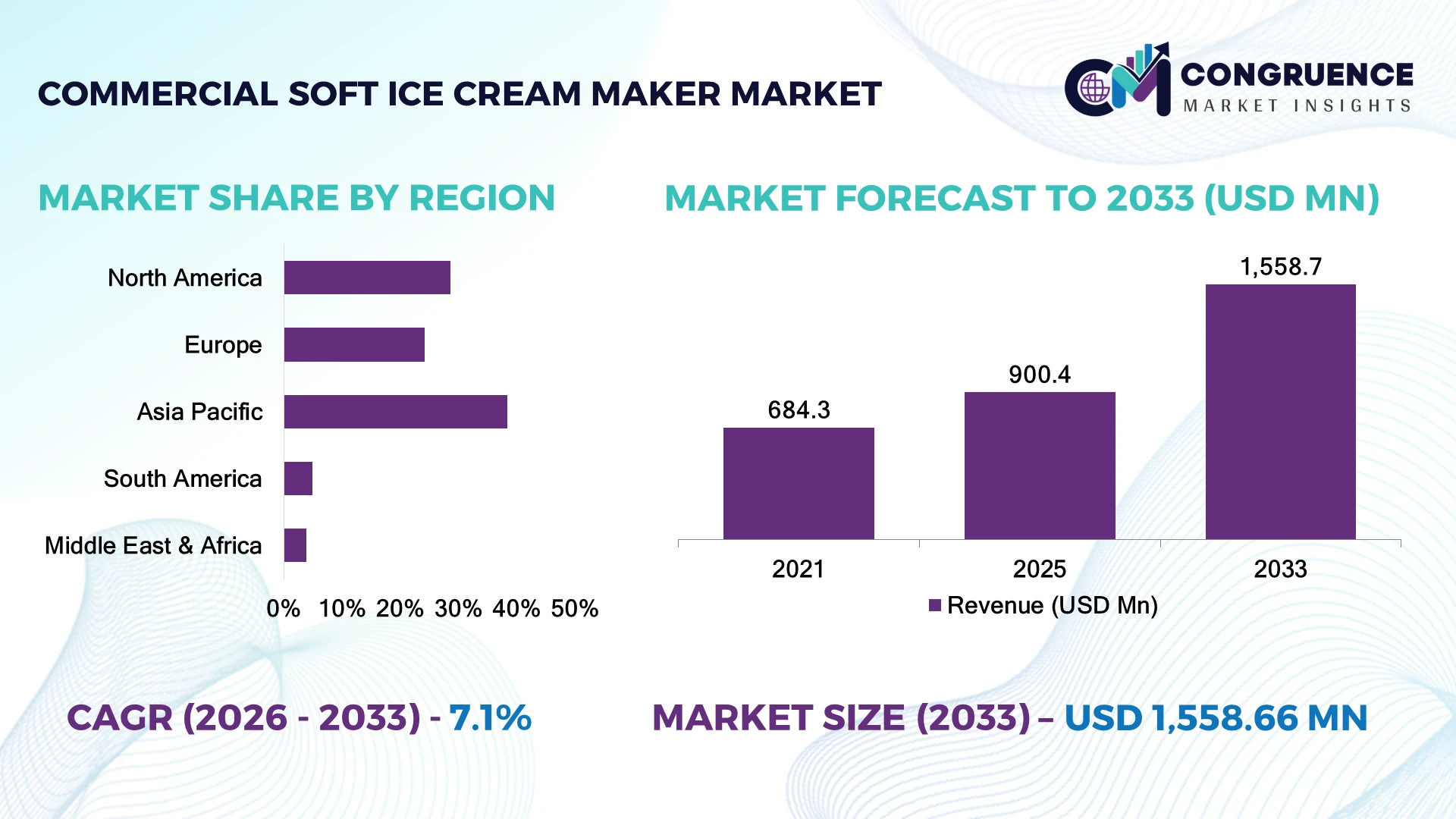
The Global Commercial Soft Ice Cream Maker Market was valued at USD 900.4 Million in 2025 and is anticipated to reach a value of USD 1,558.7 Million by 2033 expanding at a CAGR of 7.1% between 2026 and 2033. Growth is being driven by rapid expansion of quick-service restaurants, increasing demand for premium frozen desserts, and adoption of energy-efficient, IoT-enabled commercial dispensing equipment.
China leads the global market with an estimated 30% share, supported by large-scale foodservice expansion, strong domestic equipment manufacturing, and rising investments in automated restaurant operations. Compared with the United States, which emphasizes premium, high-output machines for franchise networks, China supplies nearly 46% of commercial soft ice cream equipment manufactured across Asia. Ongoing supply-chain diversification following Red Sea shipping disruptions has encouraged regional production and localized component sourcing, strengthening delivery reliability for commercial refrigeration equipment.
Manufacturers prioritizing intelligent automation, localized production, and energy-efficient systems are securing stronger positions in the rapidly evolving global foodservice equipment market.
Market Size & Growth: USD 900.4 million in 2025 to USD 1,558.7 million by 2033 at 7.1% CAGR, driven by QSR automation and premium dessert demand.
Top Growth Drivers: Quick-service restaurant expansion (+34%), café modernization (+28%), automated foodservice equipment adoption (+24%).
Short-Term Forecast: By 2028, machine energy consumption declines 16% while production efficiency improves 19%.
Emerging Technologies: IoT monitoring, predictive maintenance, and touchscreen automation improve operational reliability.
Regional Leaders: Asia-Pacific (~USD 690 million), North America (~USD 430 million), Europe (~USD 320 million), supported by franchise expansion.
Consumer/End-User Trends: Nearly 62% of new foodservice outlets prioritize compact, multifunction commercial machines.
Pilot/Case Example: A 2026 restaurant modernization programme increased dessert output by 21% through automated dispensing systems.
Competitive Landscape: Leading supplier controls approximately 20% share alongside Taylor, Carpigiani, Electro Freeze, and Stoelting.
Regulatory & ESG Impact: High-efficiency refrigeration systems reduce electricity consumption by approximately 18% in commercial kitchens.
Investment & Funding: More than USD 1.4 billion supports manufacturing expansion, smart equipment, and regional supply chains.
Innovation & Future Outlook: Connected diagnostics and self-cleaning technologies strengthen equipment uptime and service efficiency.
Commercial soft ice cream makers are experiencing stronger demand across quick-service restaurants, cafés, hotels, convenience stores, and entertainment venues where operational consistency and rapid dispensing are essential. Approximately 58% of newly purchased commercial machines now feature digital controls and automated cleaning functions. Increasing localization of refrigeration component manufacturing and stricter energy-efficiency requirements are accelerating product innovation, creating a strong foundation for the market's strategic evolution.
The Commercial Soft Ice Cream Maker Market has become strategically important as foodservice operators focus on productivity, menu differentiation, and labour efficiency while responding to evolving consumer demand for premium frozen desserts. Restaurant chains are modernizing kitchen equipment through digitalization and energy-efficient refrigeration technologies, while supply-chain regionalization is reducing dependence on imported refrigeration components and improving equipment availability for franchise expansion.
Modern inverter-driven compressors and automated dispensing systems improve energy efficiency by approximately 18% while reducing maintenance interventions by nearly 22% compared with conventional fixed-speed machines. North America leads deployment of premium connected equipment across franchise restaurant networks, whereas Asia-Pacific benefits from manufacturing scale and rapid expansion of quick-service dining formats. During the next two to three years, connected diagnostics, predictive maintenance, and automated sanitation technologies are expected to become standard purchasing criteria for high-volume commercial kitchens.
Manufacturers are expanding regional assembly facilities, strengthening refrigeration component partnerships, and investing in intelligent control systems to improve equipment reliability and lifecycle performance. Large restaurant operators increasingly standardize smart soft ice cream machines across franchise locations to improve product consistency and reduce operating costs. Companies combining energy-efficient engineering, digital service capabilities, and responsive after-sales support will secure stronger competitive positioning as commercial foodservice operations continue prioritizing automation, uptime, and sustainable equipment performance.
Expansion of quick-service restaurant chains, premium dessert outlets, and convenience food formats is increasing demand for automated commercial soft ice cream makers with higher throughput and lower operating costs. Nearly 64% of new restaurant equipment purchases now prioritise programmable dispensing and energy-efficient refrigeration, while automated portion control reduces product waste by approximately 17% and improves serving consistency by around 21%. China continues expanding organised foodservice infrastructure, encouraging franchise operators to standardise advanced dispensing equipment across multiple locations. This operational shift is increasing replacement demand beyond first-time installations. Manufacturers are responding through intelligent control systems, regional assembly expansion, and partnerships with foodservice distributors. A key competitive advantage increasingly comes from maximising machine uptime rather than simply increasing production capacity.
Commercial soft ice cream makers remain exposed to fluctuations in compressor, stainless steel, electronic controller, and refrigerant component costs. Refrigeration systems account for nearly 42% of total equipment manufacturing costs, while electronic component price variability has affected approximately 28% of procurement contracts. Continued adjustments in global refrigeration supply chains following Red Sea shipping disruptions have extended delivery schedules for specialised cooling components, increasing production planning complexity. These pressures compress manufacturer margins and delay customer deliveries, particularly for customised equipment. Companies are reducing exposure through dual-source procurement, regional component localisation, strategic supplier agreements, and modular equipment platforms that simplify manufacturing while maintaining consistent product specifications.
Integration of IoT connectivity, cloud diagnostics, predictive maintenance, and remote fleet management is creating new value beyond traditional machine sales. Connected monitoring reduces unexpected equipment downtime by approximately 24%, while predictive servicing lowers maintenance costs by nearly 18%. Japan's expanding smart foodservice sector is accelerating deployment of digitally connected commercial kitchen equipment that supports centralised operational management. Manufacturers are investing in software development, cloud service partnerships, and digital maintenance platforms alongside equipment production. A less obvious opportunity lies in subscription-based service contracts combining equipment monitoring, preventive maintenance, and operational analytics, creating recurring revenue while improving customer retention.
Long-term market expansion depends on maintaining qualified installation, calibration, and refrigeration service capabilities across increasingly digital equipment platforms. Approximately 31% of commercial equipment downtime results from delayed technical servicing, while insufficient preventive maintenance shortens machine operating life by nearly 20%. India continues experiencing shortages of specialised refrigeration technicians despite rapid foodservice expansion, limiting consistent after-sales support. This operational challenge directly affects equipment reliability, customer satisfaction, and franchise standardisation. Manufacturers are investing in technician certification programmes, remote diagnostics, digital training platforms, and expanded authorised service partnerships to strengthen lifecycle support and ensure consistent equipment performance across geographically dispersed restaurant networks.
Smart Controls Become Standard: Digital touchscreen interfaces and programmable dispensing systems are now specified in approximately 61% of new commercial installations, reducing operator errors by nearly 19% while improving portion consistency by around 22%. Restaurant labour shortages are accelerating investment in simplified machine operation, prompting manufacturers to expand software-enabled product portfolios and remote configuration capabilities.
Natural Refrigerants Gain Momentum: Adoption of low-global-warming-potential refrigerants has increased by approximately 27%, while modern cooling systems reduce electricity consumption by nearly 16%. Tightening refrigeration efficiency requirements are encouraging manufacturers to redesign compressor systems, strengthen component partnerships, and accelerate certification of environmentally compliant commercial equipment for global foodservice operators.
Compact Machines Expand Deployment: Countertop commercial machines now represent approximately 34% of new purchases as cafés, convenience stores, and small-format restaurants optimise limited kitchen space. Faster installation and reduced floor-space requirements improve operational flexibility, encouraging manufacturers to introduce modular equipment platforms supporting diverse foodservice formats without sacrificing production performance.
Remote Diagnostics Reshape Service: Connected service platforms reduce unplanned maintenance visits by approximately 23% while improving first-time repair success by nearly 18%. A notable operational shift is that franchise operators increasingly evaluate equipment based on lifecycle service analytics rather than initial purchase price. Manufacturers are expanding digital support centres, integrating predictive maintenance software, and strengthening regional service partnerships to maximise operational uptime.
Floor-Standing Commercial Soft Ice Cream Makers account for approximately 66% of the global market, driven by their high production capacity, continuous dispensing capability, and suitability for quick-service restaurants, amusement parks, and large foodservice chains. Their ability to support peak-hour demand with minimal downtime makes them the preferred choice for high-volume operations. Countertop Commercial Soft Ice Cream Makers remain strategically important for cafés, convenience stores, boutique dessert outlets, and food kiosks where space optimisation and lower capital expenditure are critical purchasing factors.
Countertop machines represent the fastest-growing segment as compact foodservice formats and premium café chains expand across urban markets. Nearly 37% of new independent dessert outlets now select countertop units due to installation flexibility, while compact systems reduce floor-space requirements by approximately 28%. Manufacturers are introducing modular designs, touchscreen controls, and energy-efficient refrigeration while strengthening distributor partnerships targeting small business operators. Investment priorities are steadily shifting towards intelligent compact equipment that balances production efficiency with lower operating costs and simplified maintenance.
According to a 2026 assessment by the National Restaurant Association, compact commercial kitchen equipment adoption continued accelerating among independent restaurants and café operators as space efficiency and labour productivity became primary purchasing considerations.
Quick-Service Restaurants (QSRs) hold approximately 48% of total market demand, reflecting extensive deployment across global franchise networks where high-volume dessert production, consistent product quality, and rapid service are operational priorities. Automated dispensing, programmable controls, and reliable refrigeration systems support standardised menu offerings and continuous operation. Cafés and Dessert Shops remain established demand centres, while Hotels & Restaurants and Entertainment Venues increasingly invest in premium soft-serve equipment to expand high-margin dessert offerings and improve customer experience.
Convenience Stores are emerging as the fastest-growing application segment as retailers diversify fresh food and ready-to-eat offerings. Soft-serve installations across convenience retail formats have increased by approximately 23%, while self-service dispensing improves transaction efficiency by nearly 17%. Equipment suppliers are responding through compact machine development, automated cleaning technologies, and integrated service agreements tailored for retail operators. Demand is increasingly shifting from seasonal deployment towards year-round frozen dessert programmes that improve store profitability and customer retention.
A 2025 enterprise foodservice equipment survey by the Foodservice Consultants Society International highlighted that automated frozen dessert equipment ranked among the fastest-growing investments for quick-service restaurant operators seeking labour efficiency and menu expansion.
Quick-Service Restaurant Chains represent approximately 44% of global commercial soft ice cream maker purchases due to standardised equipment specifications, large multi-site deployment, and recurring replacement cycles. National franchise operators prioritise machine consistency, remote diagnostics, and after-sales service to maintain operational uniformity across extensive restaurant networks. Independent Restaurants and Cafés continue contributing stable demand through premium dessert offerings, while Hotels, Resorts, and Institutional Foodservice providers increasingly invest in commercial soft-serve equipment to enhance customer engagement and menu differentiation.
Convenience Retail Chains are the fastest-growing end-user segment as retailers expand in-store foodservice operations and automated dessert offerings. Equipment deployment within organised convenience retail has increased by approximately 21%, while digital payment integration and self-service concepts improve customer throughput by nearly 18%. Manufacturers are targeting these buyers through flexible leasing models, customised equipment configurations, regional maintenance partnerships, and integrated service packages. Competitive positioning increasingly depends on lifecycle support, operational uptime, and scalable deployment across distributed retail networks.
According to a 2026 industry assessment published by the International Foodservice Manufacturers Association (IFMA), multi-unit restaurant operators continued prioritising connected commercial kitchen equipment that improves equipment uptime, maintenance planning, and operational standardisation across franchise networks.
Asia-Pacific accounted for the largest market share at 38.4% in 2025 however, Middle East & Africa is expected to register the fastest growth, expanding at a CAGR of 8.0% between 2026 and 2033.
Premium Foodservice Automation Drives Equipment Upgrades
North America accounts for approximately 28.6% of the global market, supported by an extensive quick-service restaurant ecosystem, mature franchise operations, and continuous investment in automated foodservice equipment. Restaurant operators increasingly replace legacy machines with digitally controlled models offering predictive maintenance, remote diagnostics, and lower energy consumption. Nearly 61% of newly installed commercial soft ice cream makers across large franchise networks include connected monitoring capabilities, improving equipment uptime and reducing service interruptions. Equipment manufacturers are strengthening regional assembly, expanding certified service networks, and collaborating with foodservice distributors to improve delivery speed and lifecycle support. Operational competitiveness is increasingly determined by machine reliability and after-sales performance rather than production capacity alone.
United States Market Outlook: The United States dominates regional demand through its large quick-service restaurant industry, nationwide franchise networks, and advanced commercial kitchen infrastructure. Major restaurant brands continue standardising intelligent soft ice cream machines across multiple outlets to improve operational consistency. Approximately 68% of large foodservice chains now prioritise connected equipment procurement, encouraging manufacturers to expand domestic technical support, predictive maintenance capabilities, and regional spare-parts distribution.
Energy-Efficient Equipment Shapes Modern Foodservice Operations
Europe contributes approximately 24.2% of global demand, driven by premium cafés, restaurant chains, hospitality operators, and strict energy-efficiency standards for commercial refrigeration equipment. Businesses increasingly invest in compact, low-energy machines that reduce operating costs while maintaining consistent dispensing performance. Nearly 46% of replacement purchases now prioritise environmentally efficient refrigeration technologies. Manufacturers are modernising production facilities, improving refrigeration efficiency, and strengthening partnerships with commercial kitchen equipment distributors to support replacement demand across hospitality and foodservice sectors.
Italy Market Outlook: Italy remains the region's strategic manufacturing and innovation hub for commercial gelato and soft-serve equipment. Strong engineering expertise, specialised refrigeration manufacturing, and premium foodservice equipment exports support sustained market leadership. Approximately 57% of equipment shipments from Italian manufacturers are supplied to international foodservice operators, encouraging continued investment in automated production technologies, product customisation, and export-oriented manufacturing capacity.
Manufacturing Scale Supports Global Equipment Supply
Asia-Pacific leads the global market with approximately 38.4% share, supported by extensive commercial equipment manufacturing, expanding restaurant chains, and increasing investment in organised foodservice infrastructure. China, Japan, and South Korea continue strengthening production capabilities for intelligent refrigeration systems and automated dispensing technologies. Nearly 52% of commercial soft ice cream equipment manufactured in the region is supplied to export markets, reflecting strong manufacturing competitiveness. Companies are expanding production capacity, integrating digital controls, and localising critical refrigeration components to improve supply resilience and delivery performance.
China Market Outlook: China serves as the world's largest manufacturing base for commercial soft ice cream makers through its integrated refrigeration supply chain, electronics production, and large domestic foodservice industry. Rapid expansion of café chains and quick-service restaurants continues supporting equipment demand. Around 65% of newly established chain restaurant outlets adopt digitally controlled commercial dessert equipment, encouraging manufacturers to accelerate intelligent product development and factory automation.
Restaurant Modernisation Expands Equipment Adoption
South America is steadily strengthening commercial equipment demand as restaurant chains, shopping centres, and convenience retail operators expand frozen dessert offerings. Brazil, Chile, and Colombia are investing in modern foodservice infrastructure, increasing deployment of automated dispensing equipment across organised retail and hospitality businesses. Approximately 41% of newly established franchise dessert outlets now install energy-efficient commercial soft ice cream machines as part of standard kitchen layouts. Manufacturers are expanding distributor partnerships and regional service capabilities while balancing currency fluctuations and imported component dependence through selective localisation strategies.
Brazil Market Outlook: Brazil represents the region's largest commercial foodservice equipment market, supported by an extensive restaurant industry, growing franchise sector, and expanding shopping mall infrastructure. National dessert chains continue investing in high-output commercial machines to improve service speed and menu diversification. Nearly 48% of organised frozen dessert outlets have upgraded to automated dispensing equipment, encouraging suppliers to strengthen technical service coverage and local inventory management.
Hospitality Investment Accelerates Premium Equipment Deployment
The Middle East & Africa market is gaining momentum through hospitality expansion, tourism development, and large-scale commercial infrastructure investments. International restaurant brands and hotel operators increasingly deploy advanced soft ice cream equipment within premium foodservice environments to enhance customer experience. Approximately 39% of newly opened hospitality projects across major Gulf markets include dedicated frozen dessert concepts supported by automated dispensing equipment. Manufacturers are strengthening regional partnerships, expanding technical support centres, and improving equipment availability to meet commercial hospitality requirements.
Saudi Arabia Market Outlook: Saudi Arabia leads regional demand through sustained investment in tourism, entertainment, mixed-use developments, and international restaurant expansion. Large hospitality projects continue integrating premium commercial kitchen equipment to support diversified foodservice offerings. Approximately 44% of newly commissioned branded hospitality facilities now incorporate automated dessert preparation systems, encouraging manufacturers to expand regional distribution networks, technical training programmes, and local after-sales support infrastructure.
Taylor Company, Carpigiani, Electro Freeze, Stoelting, and Nissei compete for multinational restaurant chains, while ICETRO, Spaceman, and Donper challenge through aggressive pricing and rapid regional expansion. Premium OEMs compete against cost-focused Asian manufacturers by combining intelligent controls, service capability, and refrigeration efficiency. The top five companies collectively control approximately 57% of the global market. Connected diagnostics improve equipment uptime by nearly 22%, inverter refrigeration reduces energy consumption by approximately 18%, and regional assembly shortens delivery lead times by around 20%. Leading brands strengthen market position through distributor expansion, franchise partnerships, digital monitoring platforms, and vertical integration across manufacturing and after-sales service. Competition is shifting from machine sales toward lifecycle service contracts and connected equipment ecosystems. High certification requirements, specialised refrigeration engineering, and nationwide service infrastructure create substantial entry barriers. Winning requires superior reliability, intelligent automation, responsive technical support, and long-term relationships with commercial foodservice operators.
Taylor Company
Carpigiani S.p.A.
Electro Freeze
Stoelting Foodservice Equipment
Nissei Co., Ltd.
ICETRO
Spaceman USA
Gel Matic Italia
Donper USA
Bravo S.p.A.
Oceanpower Soft Serve Freezers
Guangshen Electric Manufacture Co., Ltd.
Shanghai Lisong Food Machinery Co., Ltd.
Modern commercial soft ice cream makers increasingly integrate inverter compressors, touchscreen controls, IoT connectivity, and automated heat-treatment systems to maximise operational efficiency. Approximately 63% of newly installed premium machines now feature cloud-enabled diagnostics, while intelligent refrigeration lowers electricity consumption by nearly 18%. Automated viscosity management improves dispensing consistency by approximately 15%, allowing restaurant operators to reduce product waste and maintain uniform serving quality during peak operating hours.
Emerging technologies include AI-assisted predictive maintenance, remote fleet monitoring, natural refrigerant systems, and self-cleaning automation. Compared with conventional fixed-speed refrigeration platforms, inverter-driven systems improve cooling efficiency by approximately 21% while reducing maintenance interventions by nearly 19%. Global manufacturers with integrated software platforms and established service networks gain a competitive advantage, whereas regional suppliers compete through modular equipment, lower acquisition costs, and customised configurations for independent foodservice operators.
Between 2026 and 2028, connected kitchen ecosystems, digital maintenance platforms, and environmentally efficient refrigeration technologies will become core purchasing criteria for restaurant chains. Manufacturers investing in intelligent controls, cybersecurity-enabled remote access, and predictive service infrastructure will strengthen equipment uptime, reduce lifecycle costs, and improve customer retention. Companies acting now will secure stronger franchise partnerships and operational differentiation as commercial kitchens become increasingly data-driven and automation-focused.
May 2024 Taylor Company expanded digital monitoring capabilities across selected commercial frozen dessert machines to improve predictive maintenance for franchise operators, strengthening remote service management and reducing unplanned downtime. Business impact: improved lifecycle support.
May 2024 Carpigiani introduced upgraded energy-efficient soft serve systems using low-global-warming-potential refrigerants for professional foodservice applications, strengthening sustainability-focused product offerings and improving refrigeration efficiency. Business impact: accelerated adoption of environmentally compliant equipment.
February 2025 Spaceman USA announced expanded distributor partnerships across Southeast Asia to strengthen commercial equipment availability for cafés and convenience store operators. Business impact: faster regional market penetration and improved after-sales coverage.
2026 Electro Freeze introduced compact countertop soft serve machines with reduced power consumption targeting kiosks and small-format restaurants, strengthening deployment flexibility for space-constrained operators. Business impact: broader accessibility across independent foodservice businesses.
This report provides a comprehensive assessment of the Commercial Soft Ice Cream Maker market across floor-standing and countertop equipment, major foodservice applications, and key end-user categories including quick-service restaurants, cafés, hotels, convenience stores, and institutional foodservice. It evaluates deployment trends across North America, Europe, Asia-Pacific, South America, and the Middle East & Africa while analysing equipment standardisation, franchise procurement strategies, and manufacturing competitiveness. More than 60% of market demand is linked to organised foodservice operators adopting intelligent commercial kitchen equipment.
The study further examines IoT-enabled diagnostics, inverter refrigeration, automated cleaning systems, digital controls, and environmentally efficient refrigeration technologies shaping industry transformation between 2026 and 2033. It delivers strategic intelligence on competitive positioning, technology adoption, supply-chain localisation, investment priorities, and operational benchmarking, enabling manufacturers, distributors, investors, and restaurant operators to identify expansion opportunities, optimise procurement strategies, and strengthen long-term market competitiveness.
| Report Attribute/Metric | Report Details |
|---|---|
|
Market Revenue in 2025 |
USD 900.4 Million |
|
Market Revenue in 2033 |
USD 1,558.7 Million |
|
CAGR (2026 - 2033) |
7.1% |
|
Base Year |
2025 |
|
Forecast Period |
2026 - 2033 |
|
Historic Period |
2021 - 2025 |
|
Segments Covered |
By Type
By Application
By End-User
|
|
Key Report Deliverable |
Revenue Forecast, Growth Trends, Market Dynamics, Segmental Overview, Regional and Country-wise Analysis, Competition Landscape |
|
Region Covered |
North America, Europe, Asia-Pacific, South America, Middle East, Africa |
|
Key Players Analyzed |
Taylor Company, Carpigiani S.p.A., Electro Freeze, Stoelting Foodservice Equipment, Nissei Co., Ltd., ICETRO, Spaceman USA, Gel Matic Italia, Donper USA, Bravo S.p.A., Oceanpower Soft Serve Freezers, Guangshen Electric Manufacture Co., Ltd., Shanghai Lisong Food Machinery Co., Ltd. |
|
Customization & Pricing |
Available on Request (10% Customization is Free) |




