
Reports
The Global Commercial Power Generators Market was valued at USD 24,164.7 Million in 2025 and is anticipated to reach a value of USD 41,210.0 Million by 2033 expanding at a CAGR of 6.9% between 2026 and 2033. Rising investments in data centers, healthcare infrastructure, and resilient backup power systems are accelerating deployment of advanced commercial power generators across critical industries.
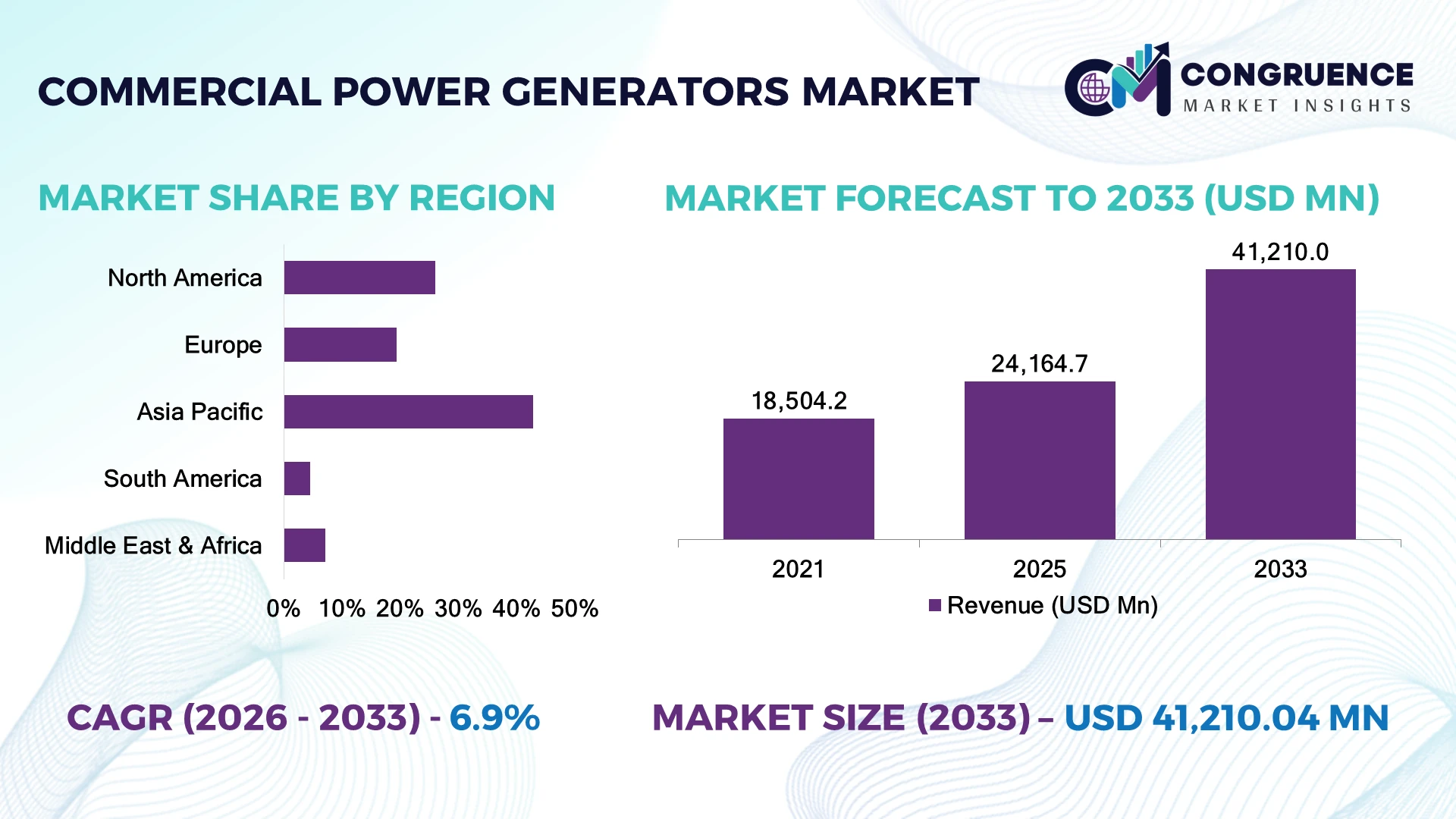
The United States leads the global market with approximately 29% of commercial generator demand, supported by expanding hyperscale data centers, healthcare facilities, and industrial infrastructure. More than 62% of newly commissioned hyperscale facilities integrate redundant onsite backup generation, while China continues expanding commercial installations through rapid infrastructure development and manufacturing growth. Ongoing geopolitical uncertainty surrounding global energy security has further strengthened demand for dependable standby power systems and diversified equipment supply chains.
Strategic investment increasingly favors intelligent, low-emission, digitally monitored generator platforms with resilient regional manufacturing networks.
Market Size & Growth: USD 24,164.7 million in 2025, reaching USD 41,210.0 million by 2033 at 6.9%, driven by critical infrastructure resilience.
Top Growth Drivers: Data centers +26%, healthcare infrastructure +18%, commercial construction +15%.
Short-Term Forecast: By 2028, remote monitoring adoption exceeds 58%, reducing downtime by 21%.
Emerging Technologies: IoT diagnostics, hybrid power systems, and AI predictive maintenance improve asset utilization.
Regional Leaders: North America exceeds USD 10,800 million; Asia-Pacific expands manufacturing; Europe strengthens low-emission installations.
Consumer/End-User Trends: Nearly 64% of enterprise buyers prioritize automated standby power capability.
Pilot/Case Example: 2025 hybrid commercial installation reduced fuel consumption by 17% through intelligent load management.
Competitive Landscape: Top five manufacturers control approximately 52% of global market activity.
Regulatory & ESG Impact: Advanced engines lower particulate emissions by nearly 20% while improving compliance.
Investment & Funding: More than USD 3.4 billion supports manufacturing expansion and service infrastructure.
Innovation & Future Outlook: Digital fleet management and hybrid generator systems strengthen operational resilience amid supply chain diversification.
Commercial power generators are becoming essential across data centers, hospitals, logistics hubs, telecommunications, and commercial real estate where uninterrupted electricity is operationally critical. Hybrid generator architectures and cloud-based monitoring platforms improve fleet availability by nearly 19%, while increasing localization of component manufacturing enhances supply resilience. These technology and procurement shifts establish a stronger foundation for long-term strategic investment.
Commercial power generators have become strategic infrastructure assets as businesses prioritize operational continuity against grid instability, extreme weather events, and expanding digital infrastructure. Modernization of commercial facilities, stricter resilience planning, and growing dependence on uninterrupted electrical supply are reshaping procurement priorities across healthcare, telecommunications, manufacturing, logistics, and hyperscale data center operations.
Advanced electronically controlled generator systems deliver approximately 15% higher fuel efficiency than conventional mechanical platforms while enabling predictive maintenance through continuous digital diagnostics. North America emphasizes intelligent backup systems integrated with critical infrastructure, whereas Asia-Pacific continues expanding manufacturing capacity and commercial deployment scale. During the next two to three years, more than 55% of newly installed commercial generators are expected to incorporate remote fleet monitoring and automated performance analytics, improving maintenance planning and reducing operational interruptions.
Commercial operators are increasingly deploying hybrid generator solutions paired with battery energy storage to optimize fuel usage and operational flexibility. Manufacturers are expanding regional production, strengthening supplier partnerships, and investing in low-emission engine technologies to improve market responsiveness. Competitive advantage will increasingly depend on intelligent power management, localized manufacturing capability, lifecycle service support, and digitally connected generator platforms that deliver reliable performance under demanding commercial operating conditions.
Expansion of hyperscale data centers, hospitals, logistics hubs, and commercial campuses is accelerating investment in dependable standby power infrastructure. More than 65% of new hyperscale data center developments include redundant generator systems, while demand for generators above 500 kVA has increased by nearly 18%. The United States continues strengthening critical infrastructure resilience through modernization initiatives and grid reliability investments, encouraging wider deployment of intelligent backup power systems. This shift improves operational continuity while reducing outage-related financial losses. Manufacturers are responding by expanding production capacity, introducing digitally connected generator platforms, and partnering with energy management providers. A strategic advantage increasingly comes from integrating remote diagnostics with predictive maintenance, enabling commercial operators to maximize equipment availability and lifecycle performance.
Stringent emission regulations and volatility in engine, alternator, and electronic controller costs continue to pressure commercial generator deployment. Advanced aftertreatment systems can increase equipment costs by approximately 12%, while electronic control components have experienced procurement lead-time fluctuations exceeding 20% during supply disruptions. Europe and North America require increasingly sophisticated emission-compliant generator platforms, raising engineering complexity and certification expenses. These factors reduce project flexibility for commercial buyers and increase ownership costs. Manufacturers are mitigating risk by localizing component sourcing, signing long-term supplier agreements, and expanding dual-fuel product portfolios. Competitive success increasingly depends on balancing regulatory compliance with cost-efficient production and dependable component availability.
Commercial facilities are increasingly adopting hybrid power architectures combining generators, battery energy storage, and intelligent energy management platforms. Hybrid systems reduce fuel consumption by approximately 18% while improving generator utilization by nearly 16% through optimized load distribution. India and Southeast Asia are expanding commercial infrastructure where distributed backup power complements evolving electricity networks. Manufacturers are investing in AI-driven power optimization, cloud-based fleet management, and modular generator platforms that simplify deployment across healthcare, telecommunications, and commercial buildings. A significant opportunity lies in offering integrated energy resilience solutions instead of standalone equipment, creating recurring service revenue through monitoring, maintenance, and lifecycle optimization.
Commercial generator fleets are becoming increasingly software-driven, making integration between generators, building management systems, energy storage, and remote monitoring platforms more complex. More than 46% of enterprise operators now manage multi-site power assets, while digital monitoring increases cybersecurity exposure and system integration requirements. In Japan and Germany, commercial facilities increasingly demand unified energy management platforms capable of coordinating multiple distributed assets. Companies must invest in secure communication protocols, technician training, software validation, and predictive diagnostics to maintain operational reliability. Long-term competitiveness depends not only on engine performance but also on seamless digital integration, service responsiveness, and resilient fleet management infrastructure.
Smart Fleet Monitoring Expands Cloud-connected generator management platforms now support nearly 57% of newly installed commercial systems, reducing unexpected downtime by approximately 22% and maintenance visits by 15%. Equipment suppliers are integrating predictive diagnostics and remote service capabilities to improve asset availability across hospitals, commercial campuses, and data centers.
Hybrid Backup Systems Accelerate Commercial facilities increasingly combine generators with battery storage and intelligent controllers, lowering fuel consumption by nearly 18% while improving power transition speed by 25%. Grid modernization initiatives and corporate resilience planning are driving manufacturers to expand hybrid product portfolios and strategic technology partnerships.
Localized Manufacturing Strengthens Supply Supply-chain diversification has increased regional component sourcing by approximately 20%, reducing logistics exposure and shortening delivery cycles by nearly 14%. Manufacturers are expanding assembly operations closer to major commercial markets while strengthening supplier qualification programs to improve production continuity and customer responsiveness.
Low-Emission Engines Advance Commercial buyers increasingly prioritize advanced engine platforms with improved combustion control and aftertreatment technologies, reducing particulate emissions by around 19%. Equipment manufacturers are accelerating investment in electronically controlled engines, alternative fuel compatibility, and automated compliance monitoring to satisfy stricter environmental standards while maintaining dependable standby performance.
Diesel generators remain the leading type in the Commercial Power Generators market, accounting for approximately 49% of total demand due to their high reliability, rapid startup capability, and superior performance during extended power interruptions. Their widespread deployment across hospitals, data centers, manufacturing facilities, and commercial complexes reflects proven operational scalability and readily available service networks. Gas generators follow as the fastest-growing segment as businesses prioritize lower-emission solutions and access to expanding natural gas infrastructure. Hybrid commercial generator systems combining conventional generators with battery storage are also gaining strategic relevance for load optimization, while portable commercial generators continue serving temporary operations and construction sites.
Gas-powered commercial generators are expected to record the strongest adoption shift as fuel flexibility and emission compliance become procurement priorities. Nearly 37% of newly specified commercial standby projects now evaluate gas-based alternatives alongside diesel systems. Manufacturers are expanding dual-fuel portfolios, strengthening engine partnerships, and integrating intelligent load management platforms to improve efficiency. Investment is increasingly directed toward cleaner, digitally managed generator platforms capable of supporting resilient commercial power infrastructure while balancing operational costs and regulatory requirements.
According to a 2025 survey released by the U.S. Data Center Energy Practitioner Network, more than 70% of newly commissioned hyperscale data centers continued specifying diesel or dual-fuel standby generators as primary emergency backup because of proven reliability during extended grid interruptions.
Standby power generation represents the largest application segment with an estimated 58% market share, supported by strict business continuity requirements across healthcare, financial institutions, retail complexes, and digital infrastructure. Commercial operators prioritize standby generators because uninterrupted electricity directly protects revenue, operational safety, and regulatory compliance. Peak shaving applications are expanding rapidly as commercial facilities seek to reduce electricity costs and manage grid demand charges through intelligent energy optimization. Prime power installations maintain strategic importance in remote industrial operations, while continuous power applications remain concentrated in critical off-grid commercial environments.
Peak shaving is emerging as the fastest-growing application as enterprises integrate generators with energy management platforms and battery storage. Approximately 34% of newly installed commercial generator systems now incorporate automated load optimization capabilities, while intelligent controller adoption exceeds 45% in premium installations. Manufacturers are responding through integrated control software, remote monitoring, and hybrid energy partnerships that improve operational flexibility. Commercial demand is steadily shifting from emergency backup alone toward multipurpose power management assets capable of delivering both resilience and measurable operating cost reductions.
A 2026 enterprise energy management assessment by the Electric Power Research Institute found that commercial facilities deploying intelligent generator controls reduced peak demand charges by up to 18% while improving standby asset utilization across multi-building operations.
Data centers account for the largest share of the Commercial Power Generators market at approximately 31%, driven by zero-tolerance outage requirements, expanding AI computing capacity, and continuous digital infrastructure investments. Hyperscale facilities typically deploy multiple redundant generator units, making them the highest-value commercial buyers. Healthcare facilities represent the fastest-growing end-user segment as hospitals expand critical care capacity and strengthen emergency preparedness. Telecommunications, commercial buildings, retail complexes, hospitality, and educational institutions continue investing in resilient backup systems to ensure uninterrupted operations under increasingly volatile grid conditions.
Healthcare operators are accelerating procurement through infrastructure modernization and stricter resilience requirements, while commercial campuses increasingly adopt digitally monitored generator fleets. Around 42% of enterprise buyers now prioritize predictive maintenance capabilities during procurement, and nearly 36% evaluate hybrid-ready systems for future energy integration. Manufacturers are responding through customized service agreements, sector-specific product configurations, and long-term maintenance partnerships that strengthen customer retention. Future demand is expected to shift toward intelligent, connected power solutions designed around operational reliability rather than equipment ownership alone.
According to a 2025 healthcare infrastructure assessment published by the American Society for Health Care Engineering, hospitals increasingly prioritized digitally monitored emergency power systems as facility resilience standards and uninterrupted patient care requirements became more stringent.
Asia-Pacific accounted for the largest market share at 42.8% in 2025 however, Middle East & Africa is expected to register the fastest growth, expanding at a CAGR of 7.8% between 2026 and 2033.
Commercial resilience investments strengthen distributed backup infrastructure
North America represents a mature commercial power generators market, supported by extensive deployment across hyperscale data centers, healthcare campuses, airports, financial institutions, and logistics facilities. The region contributes approximately 26% of global demand, with standby generator integration becoming standard for mission-critical infrastructure. Grid instability caused by extreme weather events continues accelerating generator modernization, while natural gas-powered units gain traction alongside conventional diesel systems. Nearly 48% of newly specified commercial installations now incorporate remote monitoring and predictive maintenance capabilities. Manufacturers are expanding service networks, digital fleet management platforms, and long-term maintenance agreements to improve lifecycle value. Growing investment in hybrid power systems integrating battery storage with generators further strengthens operational resilience while reducing fuel consumption during partial-load operation.
United States Market Outlook:
The United States dominates regional demand through its concentration of hyperscale data centers, healthcare infrastructure, advanced manufacturing, and commercial real estate. More than 60% of new Tier III and Tier IV data center developments specify redundant backup generation systems. Infrastructure modernization, utility resilience programs, and increasing enterprise investment in energy security continue supporting commercial generator procurement. Domestic manufacturers are expanding production capacity, strengthening dealer networks, and investing in intelligent controller technologies to support long-term commercial reliability requirements.
Energy transition drives intelligent backup power modernization
Europe is increasingly emphasizing cleaner commercial backup solutions through low-emission generator technologies, hybrid power architectures, and digital energy management platforms. Commercial operators are balancing energy security with sustainability objectives, encouraging greater deployment of gas-powered and HVO-compatible generators. Around 38% of recently installed premium commercial generator systems feature advanced emissions control and remote diagnostics. Manufacturers are investing in intelligent control platforms and fuel-flexible engines that support regulatory compliance while maintaining uninterrupted commercial operations across healthcare, telecommunications, and industrial facilities.
Germany Market Outlook:
Germany leads the European market through advanced manufacturing capability, industrial automation, and extensive commercial infrastructure. Growing investment in resilient energy systems across pharmaceutical manufacturing, logistics centers, and enterprise campuses continues strengthening demand. Nearly 45% of industrial facility modernization projects now evaluate integrated backup power alongside digital energy management systems, encouraging equipment suppliers to expand engineering partnerships and customized commercial power solutions.
Manufacturing expansion accelerates commercial backup deployment
Asia-Pacific remains the largest commercial power generators market due to extensive industrialization, commercial construction, expanding digital infrastructure, and rapid urbanization. Large-scale manufacturing facilities, technology parks, hospitals, and commercial complexes continue increasing investment in standby power infrastructure. The region accounts for approximately 43% of global commercial generator deployment, supported by strong domestic manufacturing capability and competitive production costs. Equipment suppliers are expanding localized assembly operations, strengthening distribution networks, and introducing digitally connected generator platforms that improve operational efficiency while supporting rapidly expanding commercial infrastructure.
China Market Outlook:
China dominates regional demand through its extensive industrial base, large commercial construction pipeline, and expanding cloud computing infrastructure. Data centers, semiconductor manufacturing, logistics hubs, and commercial real estate continue driving generator installations. More than half of newly commissioned hyperscale digital infrastructure projects incorporate redundant commercial backup generation. Domestic manufacturers are enhancing engine technology, automation capabilities, and export-oriented production to strengthen global competitiveness while serving growing domestic enterprise demand.
Infrastructure reliability sustains commercial equipment demand
South America is experiencing steady commercial generator adoption as enterprises strengthen protection against grid instability and operational interruptions. Mining operations, food processing facilities, retail chains, hospitals, and telecommunications infrastructure remain primary demand centers. Commercial investment increasingly targets intelligent standby systems capable of remote diagnostics and optimized fuel management. Approximately 30% of recent enterprise installations include digital monitoring platforms that improve maintenance planning and operational availability. Although transmission infrastructure limitations remain challenging in several markets, localized manufacturing partnerships and regional service expansion continue improving equipment accessibility.
Brazil Market Outlook:
Brazil leads regional commercial generator demand through its diversified industrial economy, expanding logistics infrastructure, healthcare investments, and agribusiness processing facilities. Commercial facilities increasingly deploy high-capacity standby generators to minimize operational disruption caused by transmission instability. Large distribution centers, manufacturing plants, and retail operators continue investing in automated backup power systems, encouraging suppliers to strengthen localized service capabilities and long-term maintenance support across major industrial corridors.
Critical infrastructure investment strengthens distributed power systems
Middle East & Africa is emerging as the fastest-expanding regional market as governments and private enterprises accelerate investment in commercial infrastructure, digital facilities, healthcare expansion, and tourism developments. Commercial generators remain essential for ensuring uninterrupted operations across business parks, airports, hospitality assets, and industrial zones where power reliability remains critical. Nearly 35% of recently commissioned commercial infrastructure projects integrate permanent standby generation during the construction phase. Manufacturers are increasing regional partnerships, localized engineering support, and fuel-flexible generator offerings aligned with long-term infrastructure modernization initiatives.
Saudi Arabia Market Outlook:
Saudi Arabia represents the region's strongest commercial market, supported by major infrastructure development, smart city initiatives, industrial diversification, and expanding data center investments. Commercial districts, healthcare facilities, hospitality projects, and logistics hubs continue specifying high-reliability standby generation systems. Large mixed-use developments increasingly deploy digitally monitored backup power integrated with centralized facility management systems, encouraging international suppliers to establish regional partnerships, technical support centers, and localized engineering capabilities.
Global manufacturers including Caterpillar, Cummins, Rolls-Royce Power Systems, Mitsubishi Heavy Industries, and Generac compete directly against regional engine assemblers and cost-focused OEMs for commercial infrastructure projects. The top five participants collectively control approximately 56% of market demand through broad product portfolios, global service coverage, and integrated engine technologies. Competition is driven by lifecycle cost, fuel efficiency, delivery speed, and digital capabilities, with remote monitoring influencing nearly 45% of premium commercial procurements and fuel-efficient platforms reducing operating costs by 12–18%. Leading companies are expanding manufacturing capacity, securing long-term engine supply agreements, developing gas-powered solutions, and integrating predictive maintenance software into generator fleets. The competitive landscape is shifting toward intelligent, hybrid-ready power systems as AI-driven data centers reshape procurement priorities. High certification requirements, extensive service infrastructure, and engine development costs remain significant entry barriers. Winning requires scalable production, advanced digital diagnostics, resilient supply chains, and application-specific power solutions.
Caterpillar Inc.
Cummins Inc.
Rolls-Royce Power Systems AG
Mitsubishi Heavy Industries Ltd.
Generac Power Systems Inc.
Kohler Energy
Atlas Copco AB
Wärtsilä Corporation
Himoinsa S.L.
Yanmar Holdings Co., Ltd.
Kirloskar Oil Engines Limited
FG Wilson
Briggs & Stratton Corporation
Commercial power generators are rapidly transitioning from conventional standby equipment into intelligent distributed energy assets. AI-enabled engine controllers, cloud-based fleet monitoring, and predictive diagnostics now support approximately 48% of newly commissioned premium commercial systems, reducing unplanned maintenance by nearly 25%. Low-emission gas generators, dual-fuel engines, and hybrid generator-battery architectures are improving fuel efficiency by 10–15% while enabling compliance with increasingly stringent environmental regulations. Remote firmware updates and digital twin technologies further enhance operational visibility across multi-site commercial installations.
Modern generator platforms outperform legacy mechanically controlled systems through integrated automation and intelligent load optimization. Advanced electronic control systems improve load response by roughly 20% while reducing fuel consumption by approximately 12% under variable operating conditions. Nearly 40% of enterprise customers now prioritize generators capable of seamless integration with building energy management systems and microgrids. Global manufacturers benefit from this transition by offering complete digital service ecosystems instead of equipment-only sales, strengthening customer retention and recurring maintenance revenue.
Between 2026 and 2028, commercial deployments will increasingly combine generators, battery storage, renewable energy, and advanced energy management software into resilient hybrid power ecosystems. Edge computing, hyperscale data centers, healthcare infrastructure, and industrial automation projects will accelerate demand for autonomous power management. Companies investing early in intelligent controls, cybersecurity, fuel-flexible engines, and scalable digital service platforms will secure stronger competitive positioning as commercial customers prioritize operational resilience, lower lifecycle costs, and continuous power availability.
April 2024 Cummins introduced new Centum Series generator sets delivering 2,750 kW and 3,000 kW outputs for mission-critical applications, improving space efficiency while strengthening backup power capabilities for data centers and healthcare facilities. Business impact: expanded high-capacity product portfolio. Source: Cummins (Cummins Inc.)
August 2025 Caterpillar launched a new 1.5 MW diesel generator with a reduced installation footprint, enabling commercial operators to optimize constrained equipment spaces while maintaining standby performance. Business impact: stronger competitiveness in urban commercial infrastructure. Source: Caterpillar (Cat)
March 2026 Caterpillar partnered with OnePWR Solutions and Vero3 to deliver integrated infrastructure for data centers, combining power generation with energy solutions for rapidly expanding AI facilities. Business impact: accelerated deployment of resilient commercial power ecosystems. Source: Caterpillar (Cat)
June 2026 Cummins signed an agreement to supply high-efficiency natural gas generator sets for a scalable behind-the-meter microgrid supporting a Texas high-performance computing data center. Business impact: strengthened commercial adoption of gas-powered prime power systems. Source: Cummins Newsroom (Cummins Inc.)
This report provides comprehensive analysis of the Commercial Power Generators market across generator types, applications, end-user industries, and major regional markets between 2026 and 2033. It evaluates diesel, gas, hybrid, and portable systems across standby, prime power, continuous power, and peak shaving applications serving data centers, healthcare, commercial buildings, telecommunications, manufacturing, retail, hospitality, and public infrastructure. The assessment covers deployment patterns, technology adoption, competitive positioning, and operational trends influencing procurement decisions.
The report further examines digital monitoring platforms, predictive maintenance, hybrid energy integration, intelligent control systems, and fuel-flexible engine technologies shaping commercial power infrastructure. It profiles leading manufacturers, analyzes regional investment activity, compares segment performance, and evaluates enterprise purchasing priorities. Strategic insights support capacity expansion planning, product development, partnership opportunities, supply chain optimization, competitive benchmarking, and long-term investment decisions by identifying evolving deployment trends, technology adoption rates, and high-potential commercial infrastructure opportunities worldwide.
| Report Attribute/Metric | Report Details |
|---|---|
|
Market Revenue in 2025 |
USD 24,164.7 Million |
|
Market Revenue in 2033 |
USD 41,210.0 Million |
|
CAGR (2026 - 2033) |
6.9% |
|
Base Year |
2025 |
|
Forecast Period |
2026 - 2033 |
|
Historic Period |
2021 - 2025 |
|
Segments Covered |
By Type
By Application
By End-User
|
|
Key Report Deliverable |
Revenue Forecast, Growth Trends, Market Dynamics, Segmental Overview, Regional and Country-wise Analysis, Competition Landscape |
|
Region Covered |
North America, Europe, Asia-Pacific, South America, Middle East, Africa |
|
Key Players Analyzed |
Caterpillar Inc., Cummins Inc., Rolls-Royce Power Systems AG, Mitsubishi Heavy Industries Ltd., Generac Power Systems Inc., Kohler Energy, Atlas Copco AB, Wärtsilä Corporation, Himoinsa S.L., Yanmar Holdings Co., Ltd., Kirloskar Oil Engines Limited, FG Wilson, Briggs & Stratton Corporation |
|
Customization & Pricing |
Available on Request (10% Customization is Free) |




