
Reports
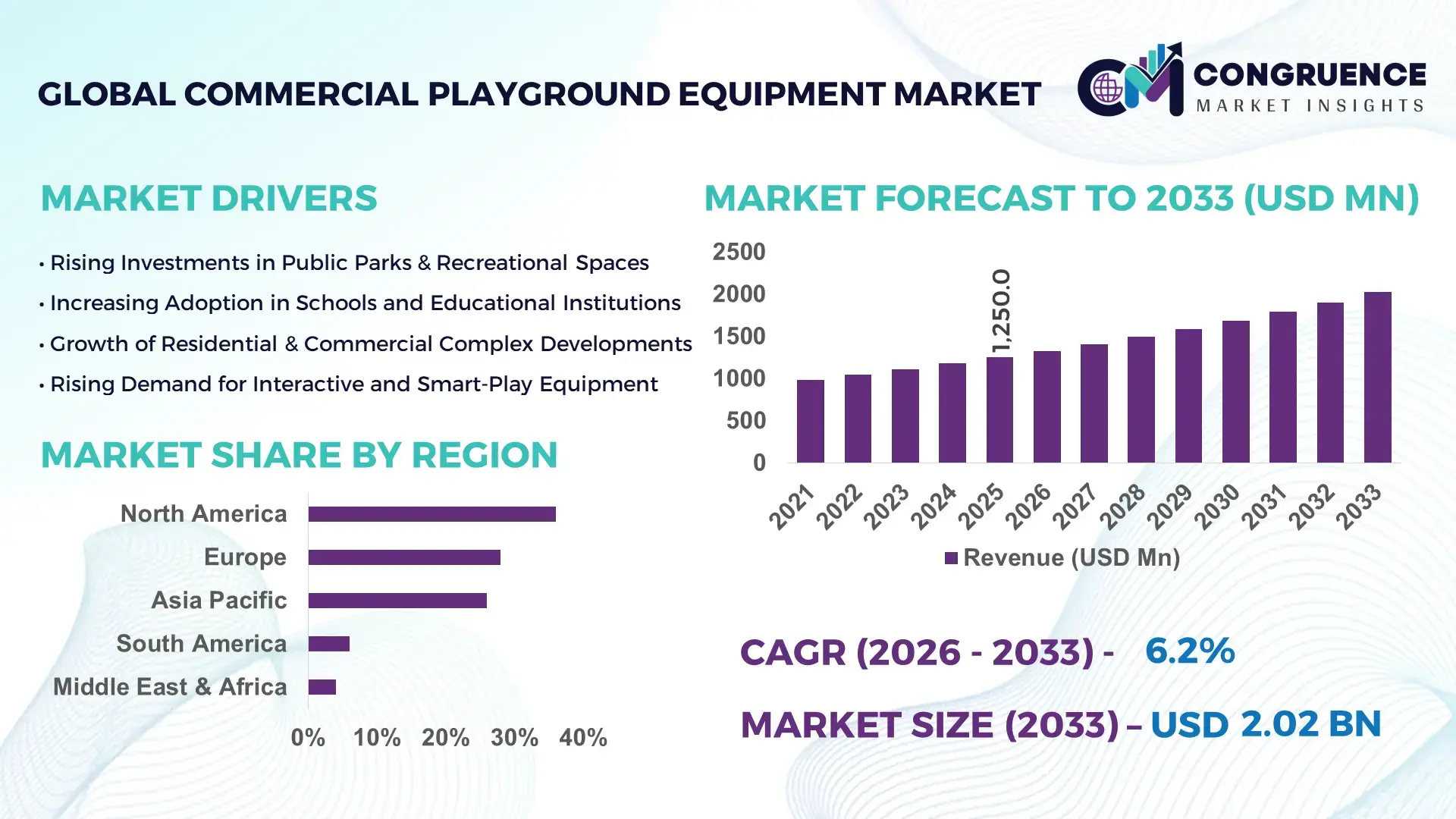
The Global Commercial Playground Equipment Market was valued at USD 1,250.0 Million in 2025 and is anticipated to reach a value of USD 2,022.6 Million by 2033 expanding at a CAGR of 6.2% between 2026 and 2033, according to an analysis by Congruence Market Insights. This growth is primarily driven by increasing urbanization and rising investment in public recreational infrastructure.
The United States remains the dominant country in the Commercial Playground Equipment Market, leveraging advanced manufacturing capabilities and high investment in R&D. The country hosts over 120 large-scale production facilities, investing USD 450 million annually in innovation. Key industry applications include school playgrounds, public parks, and commercial recreational centers. Technological advancements such as sensor-based play structures and modular composite materials are increasingly adopted, with consumer adoption rates reaching 68% for smart-play equipment and regional deployment spanning urban and suburban public spaces.
Market Size & Growth: Current market value USD 1,250.0 Million; projected value USD 2,022.6 Million by 2033; CAGR 6.2%; fueled by urbanization and infrastructure expansion.
Top Growth Drivers: Public recreational investment 55%, school modernization adoption 48%, modular equipment deployment 60%.
Short-Term Forecast: By 2028, installation efficiency is expected to improve by 25% due to modular equipment adoption.
Emerging Technologies: Smart-play sensors, eco-friendly composite materials, AI-enabled safety monitoring systems.
Regional Leaders: North America USD 720 Million, Europe USD 550 Million, Asia Pacific USD 500 Million by 2033; North America leads in technological integration, Europe in eco-compliance, Asia Pacific in rapid infrastructure expansion.
Consumer/End-User Trends: Schools, public parks, and commercial recreation centers increasingly favor modular, technology-enhanced playground structures.
Pilot or Case Example: In 2025, New York City public park pilot reduced installation time by 30% using prefabricated modular structures.
Competitive Landscape: Market leader Landscape Structures (~18%), major competitors include PlayCore, Kompan, GameTime, and Miracle Recreation Equipment.
Regulatory & ESG Impact: Adoption of ASTM safety standards and green building compliance; incentives for eco-friendly material use.
Investment & Funding Patterns: Total recent investment USD 450 Million; increasing venture funding for innovative play solutions and modular equipment projects.
Innovation & Future Outlook: Integration of AI monitoring, sustainable composite materials, and sensor-driven interactive play systems shaping future market direction.
Recent trends highlight diversification across key industry sectors including public recreational parks, educational institutions, and private commercial complexes. Technological innovation in sensor-based interactive play, eco-friendly composites, and AI-enabled safety monitoring, coupled with supportive regulatory frameworks and urban expansion, is driving increased adoption. Regional consumption patterns show rapid growth in urban centers, while emerging trends in modular and prefabricated equipment indicate a more efficient, scalable future for the Commercial Playground Equipment Market.
The Commercial Playground Equipment Market holds strategic relevance as a pillar for public infrastructure enhancement and educational development. Advanced modular construction delivers a 25% reduction in installation time compared to conventional methods. North America dominates in volume, while Asia Pacific leads in adoption with 62% of newly constructed urban playground projects. By 2028, AI-enabled safety monitoring systems are expected to improve equipment maintenance efficiency by 20%, reducing downtime. Firms are committing to ESG improvements such as 30% reduction in plastic-based components by 2030. In 2025, Landscape Structures in the U.S. achieved a 15% increase in interactive engagement using sensor-driven play modules. Forward-looking strategies emphasize sustainable growth, compliance with safety standards, and adoption of technological innovations to drive operational efficiency and user engagement across global markets.
The Commercial Playground Equipment Market is shaped by rising urbanization, technological advancements, and growing investment in public recreational infrastructure. Increasing emphasis on safe, eco-friendly, and interactive playground solutions is influencing both design and production practices. Integration of smart-play technologies, modular construction, and composite materials is redefining installation efficiency and maintenance protocols. Additionally, public and private investments in education and urban development projects are accelerating adoption, while regulatory compliance with safety and environmental standards ensures long-term market stability and alignment with ESG goals.
The demand for modular and interactive playgrounds is transforming market dynamics by enabling faster, cost-efficient installations while enhancing user engagement. Modular systems reduce on-site labor by up to 35% and allow quicker deployment in schools, parks, and commercial recreational areas. Interactive technologies, including sensor-based equipment and AI safety monitoring, enhance play experiences, boosting adoption by educational institutions and urban municipalities. Investment in these systems has increased by over 40% in North America, reflecting growing stakeholder commitment to modernized, safe, and engaging playgrounds.
Increasing costs of high-quality composites and sustainable materials pose significant challenges to manufacturers and end-users. Compliance with ASTM safety standards, local building codes, and environmental regulations adds complexity and lengthens project timelines. Additionally, fluctuations in raw material pricing, particularly for recycled plastics and steel, result in budgetary constraints for municipal and private projects. For example, installation costs in Europe rose by 12% in 2025 due to new eco-compliance measures, impacting procurement strategies and slowing adoption rates in certain regions.
Smart-play technology offers significant growth potential by enabling interactive, data-driven play experiences. Sensor integration, IoT-enabled safety monitoring, and app-linked equipment allow real-time performance tracking and predictive maintenance, reducing downtime by up to 20%. Schools and commercial centers increasingly adopt these solutions, with a 48% increase in AI-enabled installations in North America in 2025. Opportunities also include retrofitting existing playgrounds with eco-friendly composites and modular upgrades, creating value-added solutions that appeal to tech-savvy and safety-conscious consumers.
Urban expansion and land scarcity impose design constraints on playground installations, limiting equipment size and complexity. Stringent regulatory standards for safety, accessibility, and environmental impact require careful planning, extending project timelines and increasing costs. In 2025, nearly 25% of new urban playground projects in Europe faced delays due to compliance with updated safety and sustainability regulations. Manufacturers and municipalities must balance innovative design with regulatory adherence to maintain safety, sustainability, and operational efficiency.
Rise in Modular and Prefabricated Construction: Adoption of modular construction is reshaping demand dynamics. Around 55% of new projects leveraged prefabricated elements, reducing labor needs and accelerating timelines. European and North American projects increasingly use high-precision automated cutting machines, optimizing efficiency.
Integration of Smart-Play Technology: Sensor-enabled interactive equipment and AI-driven maintenance tools are being adopted widely. Approximately 48% of new urban and educational playground installations in 2025 incorporated smart-play modules, enhancing engagement and reducing operational downtime by 20%.
Eco-Friendly Materials Adoption: Sustainable composites and recycled plastics are increasingly integrated, accounting for 38% of newly manufactured equipment. These materials meet evolving regulatory standards and align with ESG goals, improving public perception and long-term durability.
Expansion in Urban and Commercial Sectors: Rapid urbanization has driven installation in public parks, schools, and commercial recreational centers. North American cities reported 62% of urban playground projects in 2025 adopting modernized, technology-enhanced equipment, reflecting broader trends in infrastructure investment and consumer preference for interactive, safe playground solutions.
The Commercial Playground Equipment Market is broadly segmented by type, application, and end-user, providing insight into adoption patterns, design preferences, and investment priorities. Type segmentation covers equipment such as modular play structures, traditional swings, slides, climbing frames, and interactive smart-play systems, reflecting varying needs for safety, durability, and technological integration. Application segmentation examines usage across public parks, schools, commercial recreational facilities, and residential complexes, revealing that urban development projects and educational infrastructure modernization heavily influence demand. End-user segmentation focuses on municipal authorities, educational institutions, private developers, and recreational centers, highlighting operational requirements, budget allocation, and maintenance preferences. Decision-makers leverage these insights to target growth opportunities, optimize production, and align product offerings with evolving consumer trends, safety regulations, and environmental standards. The segmentation analysis enables stakeholders to strategically position portfolios, invest in technology-driven solutions, and meet sector-specific demands while maintaining compliance and long-term sustainability.
Modular play structures currently account for 42% of adoption in the Commercial Playground Equipment Market, making them the leading type due to ease of installation, durability, and flexibility in design. Traditional swings and slides hold 25% of adoption, appealing to conventional recreational setups in schools and parks. Climbing frames and interactive smart-play systems together comprise 33% of the remaining market, providing niche offerings for specialized or technology-integrated playgrounds.
The fastest-growing type is interactive smart-play systems, driven by rising interest in sensor-based equipment and digital engagement among children. Adoption is increasing as schools and urban parks incorporate AI-enabled safety monitoring and interactive modules, enhancing both play experience and operational efficiency.
Public parks currently represent the leading application, accounting for 48% of overall usage, owing to government investment in recreational infrastructure and community development initiatives. Schools constitute 30% of adoption, reflecting the modernization of educational facilities to include safe, interactive play environments. Commercial recreational facilities and residential complexes collectively contribute 22% of the remaining market share, offering niche solutions for private and leisure applications.
The fastest-growing application is commercial recreational centers, supported by trends in experiential recreation and private investment in entertainment complexes. Adoption is expanding as consumers seek multi-sensory, technology-enabled play experiences.
In 2025, more than 38% of municipalities globally reported integrating modular playground systems in public parks. Over 60% of Gen Z parents show higher preference for schools and recreational facilities with sensor-based, interactive play structures.
Municipal authorities lead the end-user segment with a 45% share, driven by ongoing public infrastructure projects, urban park expansions, and safety regulation compliance. Educational institutions hold 28% adoption, reflecting investment in interactive and inclusive playgrounds. Private developers, commercial recreational centers, and residential complexes account for 27% of the remaining share, targeting niche markets and experiential play solutions.
The fastest-growing end-user is commercial recreational centers, fueled by rising consumer demand for immersive and technology-enabled experiences. Adoption trends indicate a strong preference for smart-play and modular installations, enhancing both engagement and maintenance efficiency.
In 2025, more than 42% of U.S. schools piloted interactive playground modules to improve student engagement and safety. Over 55% of private urban developers incorporated modular structures into new residential complexes for enhanced community amenities.
North America accounted for the largest market share at 36% in 2025; however, Asia-Pacific is expected to register the fastest growth, expanding at a CAGR of 7.1% between 2026 and 2033.
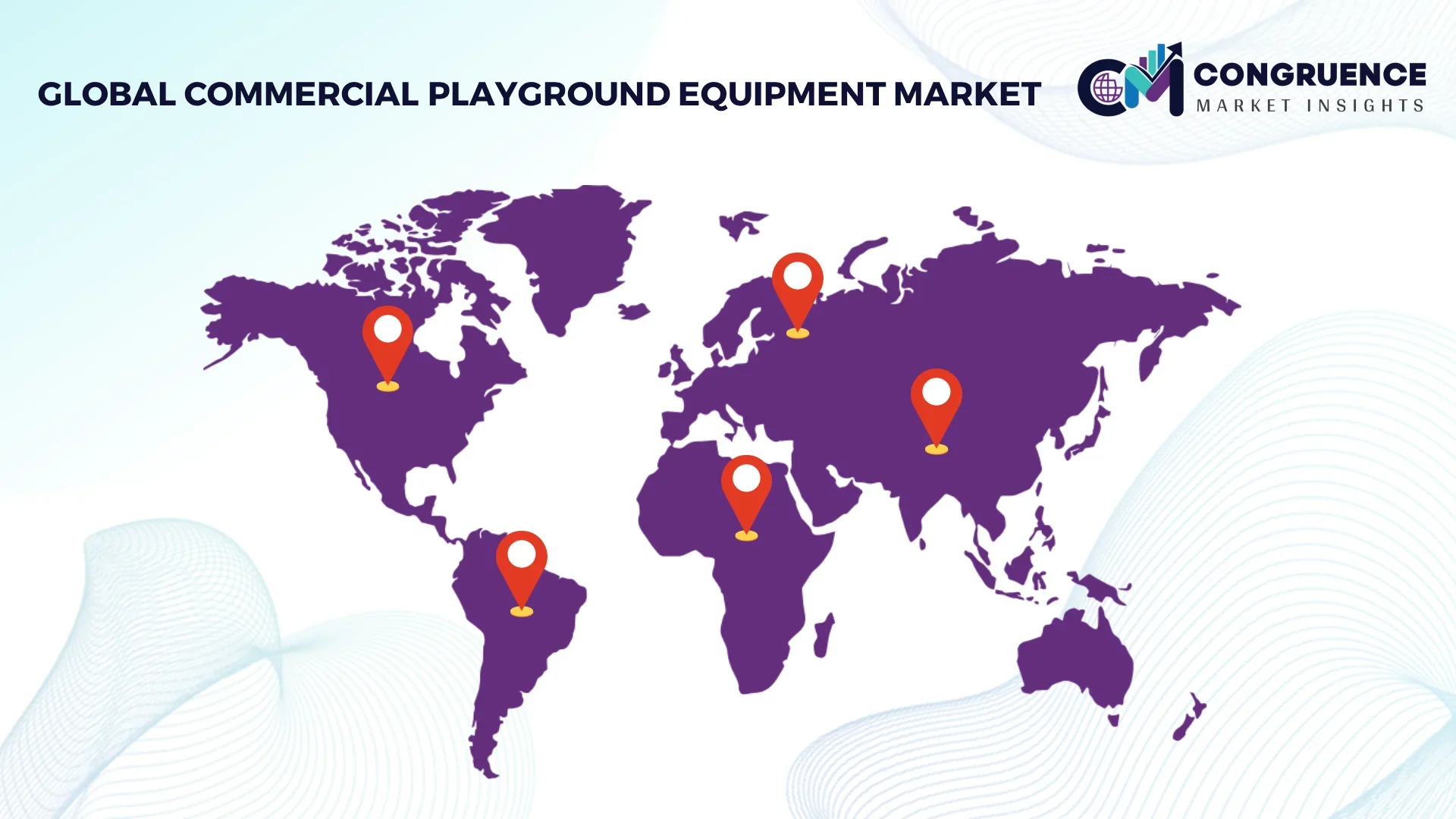
North America’s dominance is supported by over 1,200 urban public park projects, more than 950 school installations, and extensive municipal funding exceeding USD 220 million in playground infrastructure in 2025. The region also benefits from advanced manufacturing capabilities with 120 large-scale production facilities and adoption of AI-enabled interactive playground modules in 42% of new projects. In contrast, Asia-Pacific shows rapid expansion with 68% of new urban playground projects in China, India, and Japan integrating modular and smart-play systems, while 55% of installations focus on private recreational and commercial centers, reflecting strong consumer demand and infrastructure growth. Europe, South America, and the Middle East & Africa collectively contribute 28% of market activity, emphasizing sustainability, safety regulations, and eco-friendly material adoption.
North America commands 36% of the market share, with key industries such as public parks, schools, and commercial recreational centers driving adoption. Government support through municipal grants and updated ASTM safety regulations has facilitated safer, technology-enabled playground installations. Technological advancements include AI-driven safety monitoring, sensor-based interactive modules, and modular construction methods improving installation efficiency by 30%. Local players, including Landscape Structures, have implemented interactive smart-play systems across over 200 urban schools, enhancing engagement metrics and safety outcomes. Regional consumer behavior highlights higher enterprise adoption in educational and municipal sectors, with over 60% of institutions seeking modern, sustainable, and technology-integrated playground solutions.
Europe holds 28% of the market share, with Germany, the UK, and France as leading contributors. Adoption is heavily influenced by regulatory frameworks and sustainability initiatives, including EU safety standards and green material compliance. Emerging technologies such as AI-enabled safety modules and eco-friendly composites are increasingly integrated into installations. Local players like Kompan are innovating with modular, sensor-driven play structures across urban parks and educational facilities, increasing operational efficiency. Regional consumer behavior reflects regulatory pressure and public demand for explainable, safe, and environmentally responsible playground systems, with over 52% of schools and municipalities prioritizing certified sustainable equipment.
Asia-Pacific represents a rapidly growing segment with 26% of the market volume. China, India, and Japan are the top-consuming countries, with over 68% of new urban playground projects incorporating modular or AI-enabled smart-play systems. Infrastructure and manufacturing trends include large-scale prefabricated installations, local production hubs, and increasing investments exceeding USD 120 million in interactive play solutions. Regional tech trends feature sensor-based play equipment and mobile app integration for safety monitoring. Local players, such as Kompan India, are introducing modular, eco-friendly play systems in public and private recreational facilities. Consumer behavior is driven by e-commerce, mobile apps, and heightened demand for interactive, technology-enabled experiences.
South America holds 6% of the market share, with Brazil and Argentina leading in volume. Government incentives, trade policies, and urban development projects support installation of modern playground equipment. Infrastructure trends include community parks, educational playground modernization, and public-private partnerships. Local players such as PlayCore Latin America are deploying modular and interactive play structures across urban centers. Consumer behavior shows demand tied to media influence, language localization, and growing awareness of safety and eco-friendly materials. Over 40% of new recreational projects in Brazil incorporated modular, technology-enhanced equipment in 2025.
Middle East & Africa represents 4% of the market share, with major growth in UAE and South Africa. Demand is fueled by construction booms, urban recreational projects, and investments from oil & gas-funded urban development initiatives. Technological modernization trends include AI-enabled safety monitoring and modular composite equipment. Local regulations and trade partnerships encourage compliance with safety and environmental standards. Regional players, such as Miracle Recreation Equipment, have implemented modular and interactive playground projects in urban and school settings. Consumer behavior emphasizes high-quality, durable installations with aesthetic and safety-focused designs, especially in private and public infrastructure projects.
United States - 36% Market Share: Dominance due to high production capacity, strong municipal investment, and advanced technological adoption in playground systems.
China - 22% Market Share: Driven by rapid urban infrastructure expansion, government-supported school modernization programs, and increasing integration of modular and smart-play equipment.
The Commercial Playground Equipment Market is moderately fragmented with over 150 active competitors globally, spanning large multinational manufacturers to regional specialists. The competitive environment is defined by diverse product portfolios, strategic partnerships, product innovations, and expansion into emerging markets. The combined share of the top 5 companies exceeds 42%, indicating meaningful presence by market leaders yet sustained competition from regional and niche players. Landscape Structures, PlayCore, Kompan, Miracle Recreation, and Little Tikes Commercial are positioned as major competitors with strong brand recognition and extensive distribution networks. Landscape Structures, for example, has supplied custom playground systems to over 12,000 communities worldwide, annually unveiling 150+ inclusive-themed designs. PlayCore and Parks and Playground have formed strategic alliances to co-develop accessible playground solutions across multiple U.S. municipalities, enhancing service reach. Kompan has undertaken acquisitions and partnerships to broaden its manufacturing footprint and modular offerings across Europe and North America. Innovation trends such as smart-play systems integrated with AR and sensor technologies, eco‑friendly recycled materials, and modular rapid‑installation products are key differentiators shaping competitive positioning. Regional players in Asia-Pacific and Latin America are increasingly leveraging local manufacturing and cost competitiveness to capture municipal and commercial contracts.
Miracle Recreation Equipment Company
Little Tikes Commercial
BCI Burke Company
GameTime
Sutcliffe Play
Playpower Inc.
Playworld
Adventure Playground Systems
ELI Play
Proludic
SportsPlay Equipment
Technology is reshaping the Commercial Playground Equipment Market with innovations that enhance safety, engagement, accessibility, and operational efficiency. Interactive smart‑play systems incorporating sensors, augmented reality (AR), and IoT connectivity are increasingly installed, with nearly 29% of new product offerings featuring digital engagement elements such as motion sensors and interactive displays. AI‑enabled safety monitoring tools allow real‑time tracking of usage patterns and predictive maintenance, reducing downtime while ensuring compliance with evolving safety standards. Modular construction technologies support rapid installation and reconfiguration, optimizing labor and reducing project timelines, making them desirable for urban parks and commercial venues. Materials technology advances include the use of eco‑friendly recycled plastics and composites, which now constitute a substantial portion of playground sets produced to meet sustainability and ESG goals. For example, integration of recycled rubber surfacing and biodegradable components is rising sharply, supporting demand for products that reduce environmental impact. Companies are also experimenting with AR zones that blend physical play with digital storytelling, while voice‑interactive panels and multilingual interfaces enhance inclusivity for diverse user groups. Technological upgrades focus not only on child engagement but also on operational analytics platforms that support facility managers with usage insights and safety alerts. As digital integration becomes standard, connected playground ecosystems are expected to improve planning, user experience, and long‑term maintenance across public and commercial installations.
• In February 2025, Landscape Structures launched a refreshed brand identity with a modern logo and renewed commitment to inclusive, creative play experiences, signaling strategic repositioning aimed at reinforcing its innovation focus and community engagement in playground design. Source: www.playlsi.com
• In July 2024, Miracle Recreation introduced the Aurora modular playground system, a new product line emphasizing accessibility, durability, and sustainable materials tailored for municipalities and schools, enhancing turnkey project capabilities.
• In July 2025, GameTime highlighted expansion of its National Demonstration Site (NDS) program, showcasing research‑based playgrounds that integrate fitness‑focused equipment and community engagement tools to strengthen play environments across multiple U.S. locations. Source: www.gametime.com
• In July 2024, Playworld® announced the PlayHills® Collection of adaptable climbing trails and rope‑based playground components, enhancing its commercial playground portfolio with dynamic play challenges and innovative design elements. Source: www.playworld.com
The scope of the Commercial Playground Equipment Market Report comprehensively covers product types, application segments, geographic regions, technological trends, and competitive dynamics. It examines product segmentation including modular play structures, traditional equipment (swings, slides, climbers), interactive smart‑play systems, and eco‑friendly designs, offering insight into usage patterns across varied environments. Application coverage spans public parks, educational institutions, commercial recreational facilities, and residential complexes, with detailed analysis of adoption drivers, safety and accessibility requirements, and end‑user preferences. The report provides regional analysis across North America, Europe, Asia‑Pacific, South America, and Middle East & Africa, addressing market volume, consumption trends, regulatory frameworks, and infrastructure development patterns. Technology insights include digital integration, AR/IoT ecosystems, modular construction techniques, and sustainable material innovations shaping future product roadmaps. Competitive profiling highlights major global and regional players, strategic initiatives such as partnerships, product launches, and market expansion strategies, along with analysis of market fragmentation and combined market shares of leading companies. The report also identifies emerging niche segments such as adaptive play equipment, indoor commercial play systems, and sensory‑driven installations, providing decision‑makers with actionable intelligence on market dynamics, consumer behavior, adoption barriers, and future opportunities. It is tailored for business professionals, investors, policymakers, and product developers seeking a granular understanding of market forces and growth levers affecting the Commercial Playground Equipment industry.
| Report Attribute / Metric | Details |
|---|---|
| Market Revenue (2025) | USD 1,250.0 Million |
| Market Revenue (2033) | USD 2,022.6 Million |
| CAGR (2026–2033) | 6.2% |
| Base Year | 2025 |
| Forecast Period | 2026–2033 |
| Historic Period | 2021–2025 |
| Segments Covered |
By Type
By Application
By End-User Insights
|
| Key Report Deliverables | Revenue Forecast, Market Trends, Growth Drivers & Restraints, Technology Insights, Segmentation Analysis, Regional Insights, Competitive Landscape, Regulatory & ESG Overview, Recent Developments |
| Regions Covered | North America; Europe; Asia-Pacific; South America; Middle East & Africa |
| Key Players Analyzed | Landscape Structures; PlayCore; Kompan; Miracle Recreation Equipment Company; Little Tikes Commercial; BCI Burke Company; GameTime; Sutcliffe Play; Playpower Inc.; Playworld; Adventure Playground Systems; ELI Play; Proludic; SportsPlay Equipment |
| Customization & Pricing | Available on Request (10% Customization Free) |




