
Reports
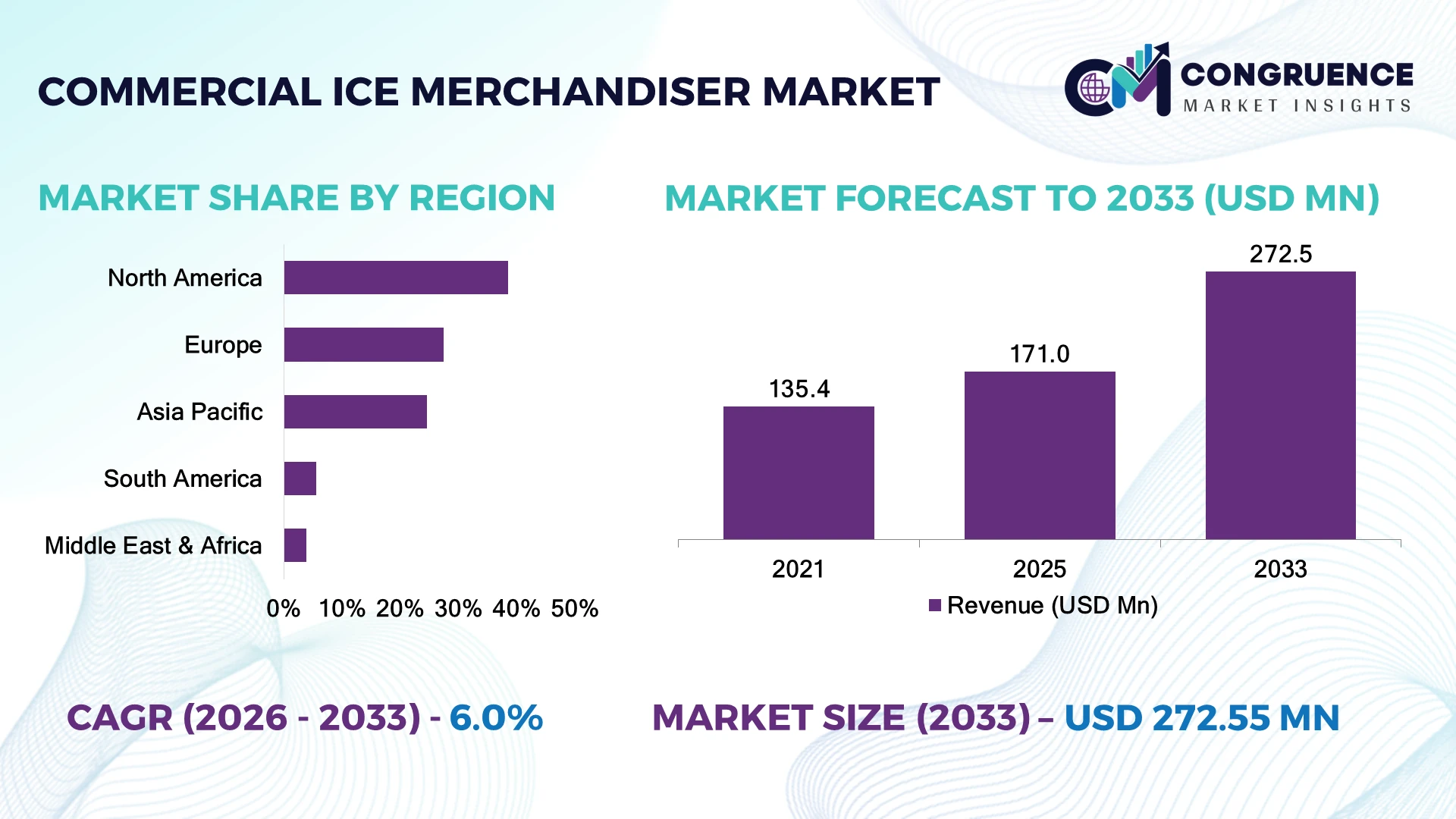
The Global Commercial Ice Merchandiser Market was valued at USD 171.0 Million in 2025 and is anticipated to reach a value of USD 272.5 Million by 2033 expanding at a CAGR of 6.0% between 2026 and 2033. Growth is driven by the rapid expansion of organized food retail, convenience stores, and energy-efficient refrigerated merchandising technologies that improve product visibility while reducing operating costs.
The United States leads the global market with approximately 34% share, supported by more than 150,000 convenience stores, extensive beverage distribution networks, and continuous investment in high-efficiency refrigeration systems. Canada records faster adoption of natural refrigerant technologies, while Mexico benefits from expanding cold-chain retail infrastructure, strengthening North America's leadership across commercial refrigeration applications.
Manufacturers are prioritizing advanced refrigeration efficiency, regional production capabilities, and retailer-focused product innovation to strengthen long-term competitive positioning.
Market Size & Growth: USD 171.0 Million in 2025, projected to reach USD 272.5 Million by 2033 at 6.0% CAGR, supported by energy-efficient refrigeration upgrades and expanding convenience retail networks.
Top Growth Drivers: Organized retail expansion (+18%), energy-efficient refrigeration adoption (+22%), and cold-chain infrastructure investment (+16%) are accelerating global demand.
Short-Term Forecast: By 2028, smart refrigeration monitoring is expected to improve energy efficiency by nearly 20% while reducing maintenance downtime by approximately 15%.
Emerging Technologies: IoT-enabled monitoring, natural refrigerants, and predictive maintenance platforms are improving operational performance across advanced commercial refrigeration fleets.
Regional Leaders: North America (USD 96 Million), Europe (USD 63 Million), and Asia Pacific (USD 58 Million) lead deployment through retail modernization, sustainability upgrades, and expanding convenience store chains.
Consumer/End-User Trends: Nearly 68% of organized retailers prioritize high-visibility, low-energy merchandisers to improve impulse purchases and operational efficiency.
Pilot/Case Example: In 2024, a large convenience retail deployment using connected refrigeration reduced service visits by 25% through predictive equipment monitoring.
Competitive Landscape: Carrier Global holds approximately 18% market share alongside Hussmann, Leer Inc., Arctic Industries, and Beverage-Air through innovation and regional expansion.
Regulatory & ESG Impact: Natural refrigerant adoption and stricter energy-efficiency standards reduce electricity consumption by up to 18% across newly installed commercial units.
Investment & Funding: More than USD 450 Million has been directed toward refrigeration manufacturing expansion, automation, and strategic partnerships supporting resilient global supply chains.
Innovation & Future Outlook: AI-enabled diagnostics, modular refrigeration platforms, and environmentally compliant cooling systems are reshaping next-generation commercial merchandising strategies.
Commercial Ice Merchandiser Market demand continues expanding across supermarkets, convenience stores, fuel stations, and event venues seeking reliable cold-storage merchandising with lower operating costs. Connected temperature monitoring, natural refrigerants, and modular cabinet designs are becoming standard, while over 40% of newly introduced commercial refrigeration platforms incorporate remote diagnostics. Ongoing supply-chain regionalization is encouraging localized manufacturing and faster product deployment, setting the stage for broader strategic market evolution.
Commercial ice merchandisers have become strategically important as retailers modernize cold-chain infrastructure, improve in-store merchandising, and reduce operating expenses. Competition increasingly centers on intelligent refrigeration systems, energy optimization, and environmentally compliant cooling technologies. Supply-chain diversification and localized manufacturing are enabling faster product availability while reducing procurement risks for commercial operators.
Modern IoT-enabled merchandisers typically lower maintenance requirements by around 25% compared with conventional manually monitored equipment through continuous performance tracking and predictive service alerts. North America remains the largest deployment region because of its mature convenience retail network, while Asia-Pacific is advancing rapidly through expanding supermarket chains, hospitality infrastructure, and urban commercial development. During the next two to three years, connected refrigeration deployment across newly installed commercial units is expected to exceed 45%, improving operational visibility and equipment reliability.
A practical example is the installation of remotely monitored ice merchandisers across multi-store retail networks, allowing operators to optimize servicing schedules and reduce equipment downtime. Manufacturers are strengthening partnerships with component suppliers, expanding regional production, and investing in digital monitoring capabilities to enhance product differentiation. Companies that combine operational efficiency, regulatory readiness, and intelligent refrigeration technologies will secure stronger competitive positioning in the evolving commercial refrigeration landscape.
The rapid modernization of food retail infrastructure and the transition toward energy-efficient refrigeration systems are strengthening demand for commercial ice merchandisers. More than 68% of newly opened convenience stores now prioritize high-efficiency refrigerated display equipment, while natural refrigerant adoption has increased by nearly 24% across new commercial installations. In the United States, stricter refrigerant regulations are accelerating replacement cycles for legacy equipment, encouraging retailers to deploy environmentally compliant solutions. This shift improves operating efficiency, lowers electricity consumption, and enhances product visibility, directly influencing purchasing behavior. Manufacturers are responding by expanding production of IoT-enabled merchandisers, investing in low-GWP refrigeration platforms, and partnering with supermarket chains to deliver customized equipment. The strategic focus has shifted from equipment sales toward lifecycle performance, predictive maintenance, and energy optimization services.
Commercial ice merchandiser manufacturers continue to face operational pressure from fluctuating compressor, insulation material, and refrigeration component costs. Compressor prices have experienced fluctuations exceeding 15% over recent procurement cycles, while specialized electronic control modules account for nearly 18% of total equipment manufacturing costs. Mexico and the United States remain highly dependent on imported refrigeration components, increasing exposure to logistics disruptions and extended lead times. These structural constraints reduce pricing flexibility, delay product deliveries, and compress manufacturer margins during large commercial projects. Companies are mitigating these risks through supplier diversification, localized component sourcing, long-term procurement contracts, and inventory optimization strategies. Strengthening regional manufacturing ecosystems has become an operational priority to improve supply resilience and stabilize production schedules.
The integration of intelligent monitoring platforms and environmentally advanced refrigeration technologies is creating significant opportunities for commercial ice merchandiser manufacturers. More than 45% of newly specified commercial refrigeration projects now require remote monitoring capabilities, while predictive maintenance can reduce unplanned equipment downtime by approximately 30%. Japan and Germany continue investing in smart retail automation and low-emission refrigeration technologies, accelerating deployment of digitally connected equipment. Manufacturers are expanding research into AI-enabled diagnostics, modular refrigeration architecture, and natural refrigerant systems that improve operational efficiency while simplifying maintenance. Strategic partnerships with software providers and facility management companies are creating service-based business models, enabling recurring value beyond equipment installation and strengthening long-term customer relationships.
Deploying advanced commercial ice merchandisers across large retail networks remains operationally complex due to system integration requirements and workforce capability gaps. Nearly 38% of multi-location retailers report interoperability challenges between refrigeration controls and existing building management systems, while technician shortages have increased maintenance response times by approximately 20% in several developed markets. The United States continues to experience increasing demand for skilled refrigeration technicians capable of servicing connected equipment and natural refrigerant systems. Without standardized digital infrastructure, operators face inconsistent equipment performance and higher lifecycle maintenance costs. Manufacturers are investing in technician certification programs, cloud-based diagnostics, standardized communication protocols, and strategic service partnerships to improve deployment consistency and support long-term operational competitiveness.
Smart Fleet Monitoring Expansion Commercial operators are rapidly deploying IoT-enabled monitoring across refrigerated merchandising fleets, with connected equipment penetration exceeding 42% among newly installed units. Remote diagnostics reduce service visits by nearly 25% while improving equipment uptime by approximately 18%. Labor shortages and rising maintenance costs are accelerating digital monitoring adoption, prompting manufacturers to integrate cloud connectivity, predictive maintenance software, and centralized fleet management capabilities into standard product offerings.
Natural Refrigerant Transition Accelerates Environmental compliance is reshaping refrigeration design as more than 38% of newly specified commercial ice merchandisers incorporate low-GWP refrigerants. Advanced compressor technology improves energy efficiency by nearly 20% compared with older systems while reducing operating expenses. Equipment suppliers are redesigning refrigeration platforms, expanding environmentally compliant product portfolios, and strengthening component partnerships to support retailers replacing conventional cooling infrastructure.
Localized Manufacturing Gains Momentum Supply-chain restructuring continues to influence procurement strategies as manufacturers increase regional production capacity and shorten delivery cycles by nearly 22%. Component localization reduces logistics exposure while improving inventory availability during seasonal demand peaks. Companies are expanding assembly facilities, qualifying multiple component suppliers, and investing in automated manufacturing processes to strengthen operational resilience and improve customer responsiveness.
Retail Format Optimization Continues Convenience retailers and supermarket operators are increasingly selecting modular commercial ice merchandisers that improve merchandising flexibility and reduce installation time by approximately 30%. Nearly 46% of new retail refrigeration projects prioritize configurable cabinet layouts that simplify store remodeling and product placement. Manufacturers are introducing scalable product platforms, standardized components, and customizable merchandising solutions to improve deployment efficiency across diverse retail environments.
Glass Door Ice Merchandisers represent the largest segment due to superior product visibility, stronger merchandising performance, and compatibility with modern retail layouts. Approximately 61% of commercial installations utilize glass door configurations because they encourage impulse purchases while maintaining efficient temperature control. Retail chains increasingly standardize these units across convenience stores and supermarkets to simplify maintenance and improve merchandising consistency. Manufacturers continue introducing LED illumination, smart temperature monitoring, and energy-efficient compressors to strengthen operational performance. Solid Door Ice Merchandisers are emerging as the fastest-growing segment, particularly in high-volume storage applications where thermal retention and durability take priority over display visibility. Their adoption has increased by nearly 19% across distribution centers and commercial backroom operations. Hybrid cabinet designs combining storage efficiency with operational flexibility are also gaining traction. Companies are expanding product portfolios, improving insulation technologies, and introducing modular cabinet configurations to address varying commercial requirements while aligning investment toward energy-efficient refrigeration platforms.
Convenience Stores remain the leading application segment, accounting for approximately 47% of commercial ice merchandiser deployments due to continuous consumer demand for packaged ice, beverages, and grab-and-go products. Extended operating hours and high customer traffic encourage retailers to invest in durable, low-maintenance refrigeration equipment. Supermarkets continue expanding refrigerated merchandising space by integrating energy-efficient units that improve inventory visibility and reduce operating costs. Gas Stations represent the fastest-growing application as fuel retailers diversify revenue through expanded foodservice and convenience offerings. Deployment across fuel retail sites has increased by nearly 21%, supported by store modernization initiatives and improved cold-chain merchandising. Hotels, restaurants, and entertainment venues continue strengthening demand through seasonal and event-driven consumption. Manufacturers are introducing compact, connected refrigeration systems, customized cabinet sizes, and simplified installation solutions to address varying operational requirements across each application segment.
Retail Chains constitute the largest end-user segment because of extensive store networks, standardized equipment specifications, and continuous refrigeration replacement programs. Nearly 58% of large retail procurement projects prioritize energy-efficient commercial ice merchandisers with digital monitoring capabilities to improve operational consistency. Enterprise buyers increasingly seek equipment that reduces maintenance frequency while supporting sustainability objectives and standardized fleet management. Independent Retailers represent the fastest-growing end-user group as affordable connected refrigeration technologies become more accessible. Adoption among independent operators has increased by approximately 17% through flexible financing options and simplified equipment maintenance programs. Hospitality operators, foodservice businesses, and commercial facility managers continue expanding procurement to support customer convenience and operational efficiency. Manufacturers are responding through customized financing, broader dealer partnerships, enhanced after-sales service, and modular product platforms that address diverse operational requirements while strengthening long-term customer retention.
Enterprise purchasing activity during 2025 reflects increasing preference for standardized refrigeration fleets equipped with remote monitoring capabilities, enabling centralized asset management and improved maintenance planning across multiple commercial locations.
North America accounted for the largest market share at 38.5% in 2025 however, Asia-Pacific is expected to register the fastest growth, expanding at a CAGR of 7.2% between 2026 and 2033.
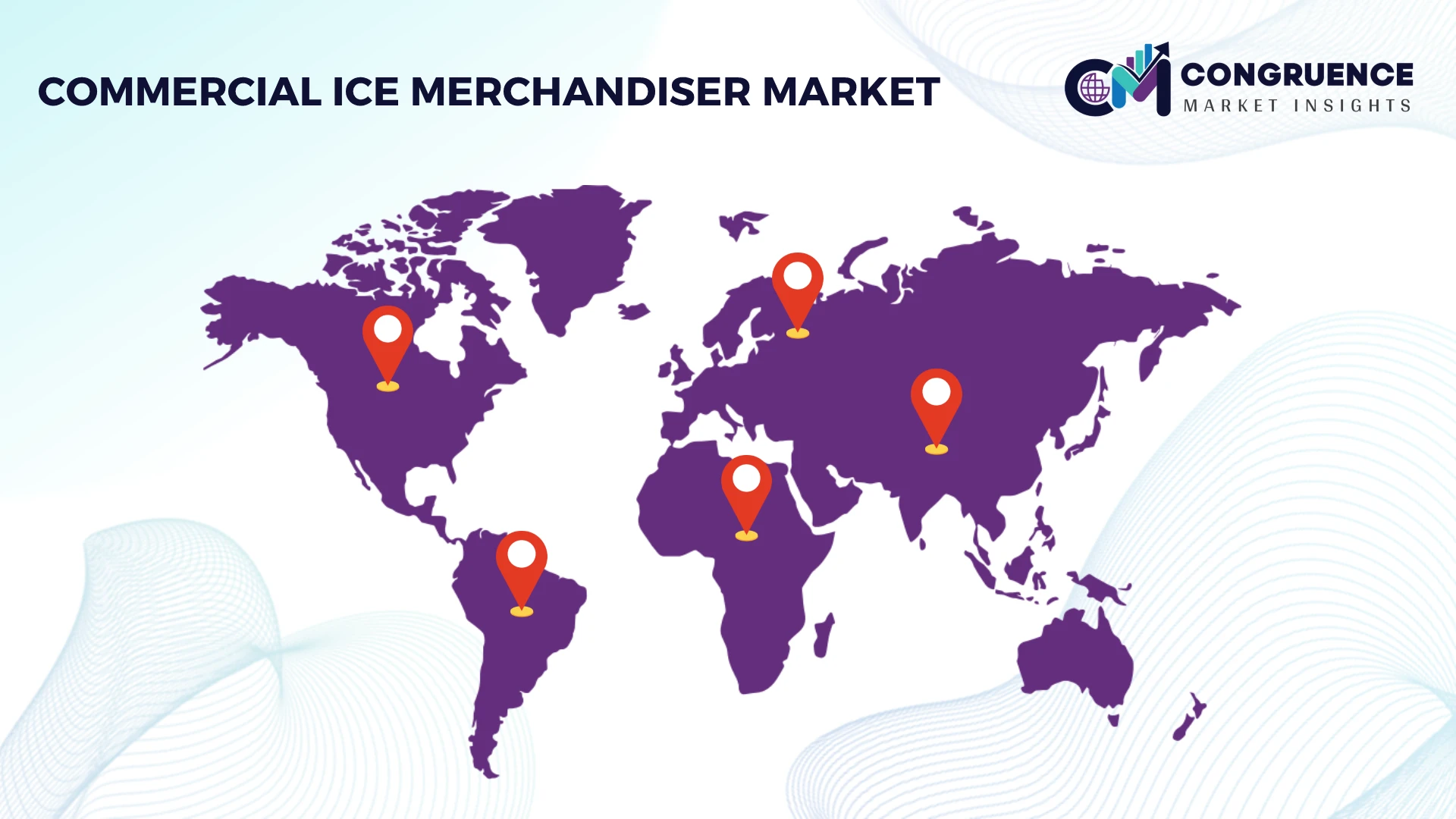
North America maintains the leading position in the Commercial Ice Merchandiser Market through its extensive convenience retail network, advanced cold-chain infrastructure, and widespread replacement of aging refrigeration equipment. The region contributes approximately 38.5% of global demand, supported by supermarket chains, fuel retailers, and foodservice operators investing in connected refrigeration technologies. More than 45% of newly installed commercial merchandisers incorporate remote monitoring capabilities, improving maintenance planning and reducing equipment downtime. Retailers continue upgrading stores with environmentally compliant refrigeration systems to improve operational efficiency and reduce energy consumption. Manufacturers are strengthening regional production, expanding dealer networks, and introducing modular refrigeration platforms to support faster deployment, simplified maintenance, and standardized fleet management across large commercial retail portfolios.
United States Market Outlook: The United States remains the largest national market because of its extensive network of convenience stores, supermarkets, and fuel retail locations requiring reliable commercial refrigeration. More than 150,000 convenience stores operate nationwide, creating continuous replacement demand for commercial ice merchandisers. Retail chains increasingly deploy connected refrigeration equipment with predictive maintenance capabilities, while manufacturers continue expanding domestic assembly operations and service partnerships to improve product availability, installation efficiency, and long-term equipment performance.
Europe continues strengthening its Commercial Ice Merchandiser Market through strict environmental regulations, widespread energy-efficiency initiatives, and modernization of retail refrigeration infrastructure. The region represents approximately 27.4% of global market demand, with supermarkets and food retailers accelerating replacement of legacy refrigeration systems using low-GWP refrigerants. Nearly 41% of newly specified commercial refrigeration equipment utilizes environmentally advanced cooling technologies that reduce operating costs while supporting sustainability objectives. Equipment suppliers are investing in high-efficiency compressors, digital monitoring systems, and environmentally compliant refrigeration platforms. Strategic collaborations between equipment manufacturers and food retailers are improving deployment consistency while supporting standardized refrigeration upgrades across large commercial retail networks.
Germany Market Outlook: Germany leads the European market through its strong refrigeration engineering capabilities, advanced manufacturing base, and strict environmental compliance standards. Large food retail groups continue investing in connected refrigeration infrastructure to improve equipment performance and energy efficiency. More than 48% of new commercial refrigeration installations incorporate digital monitoring functions, encouraging manufacturers to expand intelligent refrigeration solutions and environmentally compliant product development.
Asia-Pacific is becoming the fastest-expanding Commercial Ice Merchandiser Market as organized retail, foodservice, and cold-chain infrastructure continue expanding across major economies. The region accounts for approximately 24.6% of global demand while recording rapid deployment across supermarkets, convenience stores, and hospitality facilities. Commercial refrigeration manufacturing capacity has increased by nearly 23% over recent years, improving regional equipment availability and reducing delivery timelines. Companies are strengthening localized production, expanding distribution partnerships, and introducing cost-efficient refrigeration platforms suited to diverse commercial applications. Rising investment in smart retail infrastructure is further encouraging deployment of digitally connected merchandising equipment across expanding urban retail networks.
China Market Outlook: China represents the largest market within Asia-Pacific because of its large-scale commercial refrigeration manufacturing ecosystem and rapidly expanding convenience retail sector. Thousands of new convenience outlets are added annually, strengthening demand for energy-efficient refrigeration equipment. Domestic manufacturers continue investing in automated production, advanced compressor technologies, and intelligent refrigeration controls to improve export competitiveness and satisfy growing domestic commercial demand.
South America continues developing its Commercial Ice Merchandiser Market through expanding supermarket investments, food distribution modernization, and increasing convenience retail penetration. The region contributes approximately 5.6% of global demand, with commercial operators prioritizing durable refrigeration systems capable of supporting tropical operating conditions. Store modernization programs have increased deployment of energy-efficient refrigeration equipment by nearly 16%, improving operating reliability and reducing maintenance requirements. Manufacturers are strengthening distributor partnerships, regional warehousing, and localized after-sales service to improve equipment availability despite logistics and infrastructure limitations. Commercial replacement demand remains a significant contributor to market activity across major urban centers.
Brazil Market Outlook: Brazil leads the regional market through its extensive supermarket industry, growing convenience retail network, and expanding foodservice sector. Large retail operators continue replacing conventional refrigeration equipment with energy-efficient commercial merchandisers to reduce electricity consumption and improve merchandising performance. Manufacturers are increasing local distribution capabilities and technical support networks, strengthening equipment deployment across metropolitan commercial markets.
The Middle East & Africa Commercial Ice Merchandiser Market continues expanding through hospitality development, food retail modernization, and investment in commercial infrastructure. The region accounts for approximately 3.9% of global demand, supported by hotel developments, tourism projects, and expanding supermarket chains. More than 18% of newly commissioned retail developments include advanced commercial refrigeration systems designed to improve operational efficiency and support food safety requirements. Equipment suppliers are expanding regional distribution partnerships, strengthening technical service capabilities, and introducing refrigeration platforms optimized for high-temperature operating environments. Infrastructure modernization continues improving long-term deployment opportunities across commercial retail and hospitality facilities.
Saudi Arabia Market Outlook: Saudi Arabia represents the leading national market because of sustained investment in tourism, hospitality, and organized retail development. Large commercial projects continue incorporating modern refrigeration infrastructure to support foodservice expansion and premium retail experiences. Commercial operators increasingly specify energy-efficient merchandisers with digital monitoring capabilities, while manufacturers strengthen regional partnerships and localized service operations to support growing deployment across the Kingdom.
The Commercial Ice Merchandiser Market is characterized by competition between global refrigeration specialists including Leer Inc., Hussmann, True Manufacturing, Beverage-Air, and Polar Temp, and regional manufacturers emphasizing cost-efficient production and localized service. The top five participants collectively account for approximately 58% of global market share, while independent manufacturers compete aggressively in niche retail applications. Technology, energy efficiency, customization, and delivery speed define purchasing decisions, with over 46% of commercial buyers prioritizing connected monitoring capabilities and nearly 39% selecting environmentally compliant refrigeration systems. Premium manufacturers compete through product innovation, dealer networks, and lifecycle service offerings, whereas regional players emphasize shorter lead times and customized cabinet configurations. Companies continue expanding manufacturing capacity, strengthening distribution partnerships, and integrating digital diagnostics into refrigeration platforms. Competitive intensity is shifting toward intelligent, low-GWP refrigeration solutions and supply-chain resilience rather than price alone. High engineering requirements, regulatory compliance, and established dealer ecosystems remain major entry barriers. Winning requires differentiated technology, dependable supply execution, and superior after-sales support.
Hussmann Corporation
True Manufacturing Co., Inc.
Beverage-Air Corporation
Polar Temp
Fogel USA
Turbo Air Inc.
Master-Bilt Products
Amerikooler
Minus Forty Technologies
Excellence Industries
Thermal Manufacturing Inc.
Commercial ice merchandisers are rapidly transitioning from conventional refrigeration equipment to intelligent, connected refrigeration platforms. IoT-enabled controllers, cloud-based monitoring, and electronic temperature management are now deployed in approximately 44% of newly installed commercial units. Compared with conventional manually monitored systems, predictive diagnostics reduce service visits by nearly 25% while improving equipment uptime by approximately 18%. Retail chains benefit through lower maintenance costs and improved merchandising consistency across multiple locations.
Energy-efficient refrigeration technologies are becoming the primary competitive differentiator. Natural refrigerants, variable-speed compressors, microchannel condensers, and high-efficiency LED lighting improve electricity efficiency by 15–20% over legacy refrigeration platforms. More than 40% of new commercial installations now specify environmentally compliant cooling systems integrated with remote monitoring. Global manufacturers are embedding smart control software, automated defrost optimization, and modular refrigeration architectures to strengthen product differentiation and simplify large-scale fleet management.
Between 2026 and 2028, AI-assisted equipment diagnostics, digital twin maintenance platforms, and centralized refrigeration management are expected to become standard across enterprise retail operations. Manufacturers investing in software-enabled refrigeration ecosystems, predictive maintenance, and modular connected equipment will achieve stronger competitive positioning through faster servicing, lower lifecycle operating costs, and higher customer retention as commercial buyers increasingly prioritize intelligent asset management over standalone refrigeration equipment.
January 2024 – Leer Inc. completed the transition of all new ice merchandiser production to R290 refrigerant, replacing previous refrigerants across its product portfolio to achieve full regulatory compliance and improved environmental performance. Business impact: strengthened sustainability positioning. Source: www.leerinc.com
October 2024 – Hussmann introduced its Krack Monoblock refrigeration solution featuring R-290 technology, reducing refrigerant charge by up to 95% and lowering annual carbon emissions by approximately 6%. Business impact: accelerated adoption of energy-efficient commercial refrigeration. Source: www.hussmann.com
June 2025 – Hussmann announced deployment of Aperion Electronic Shelf Labels across nearly 300 H&S Energy Group retail locations following a successful pilot. Business impact: improved pricing accuracy, operational efficiency, and connected retail merchandising. Source: www.hussmann.com
July 2024 – Arctic Glacier expanded production capacity at selected facilities while strengthening commercial leadership to support increasing packaged ice demand and market share growth. Business impact: enhanced manufacturing scalability and distribution efficiency.
The report provides comprehensive coverage of the Commercial Ice Merchandiser Market across major product types, applications, end-user industries, and key geographic regions. It evaluates technology adoption, equipment deployment patterns, competitive positioning, product innovation, and evolving commercial refrigeration requirements between 2026 and 2033. The analysis examines operational trends across convenience retail, supermarkets, hospitality, foodservice, and other commercial environments while assessing the increasing adoption of connected refrigeration platforms, energy-efficient systems, and environmentally compliant cooling technologies. More than 40% of new commercial installations now incorporate intelligent monitoring capabilities, reflecting accelerating digital transformation across refrigeration infrastructure.
The report further delivers strategic assessment of manufacturing capabilities, regional deployment dynamics, competitive benchmarking, company profiles, investment priorities, and emerging technology developments. It supports business expansion planning, product portfolio optimization, partnership evaluation, procurement strategy, and competitive positioning by identifying high-potential market segments, evolving customer purchasing behavior, and innovation opportunities shaping the future commercial refrigeration ecosystem.
| Report Attribute / Metric | Details |
|---|---|
| Market Revenue (2025) | USD 171.0 Million |
| Market Revenue (2033) | USD 272.5 Million |
| CAGR (2026–2033) | 6.0% |
| Base Year | 2025 |
| Forecast Period | 2026–2033 |
| Historic Period | 2021–2025 |
| Segments Covered |
By Type
By Application
By End-User
|
| Key Deliverables | Revenue Forecast; Market Trends; Growth Drivers & Restraints; Technology Insights; Segmentation Analysis; Regional Insights; Competitive Landscape; Regulatory & ESG Overview; Recent Developments |
| Regions Covered | North America; Europe; Asia-Pacific; South America; Middle East & Africa |
| Companies Profiled | Leer Inc.; Hussmann Corporation; True Manufacturing Co., Inc.; Beverage-Air Corporation; Polar Temp; Fogel USA; Turbo Air Inc.; Master-Bilt Products; Amerikooler; Minus Forty Technologies; Excellence Industries; Thermal Manufacturing Inc. |
| Customization & Pricing | Available on Request (10% Customization Free) |




