
Reports
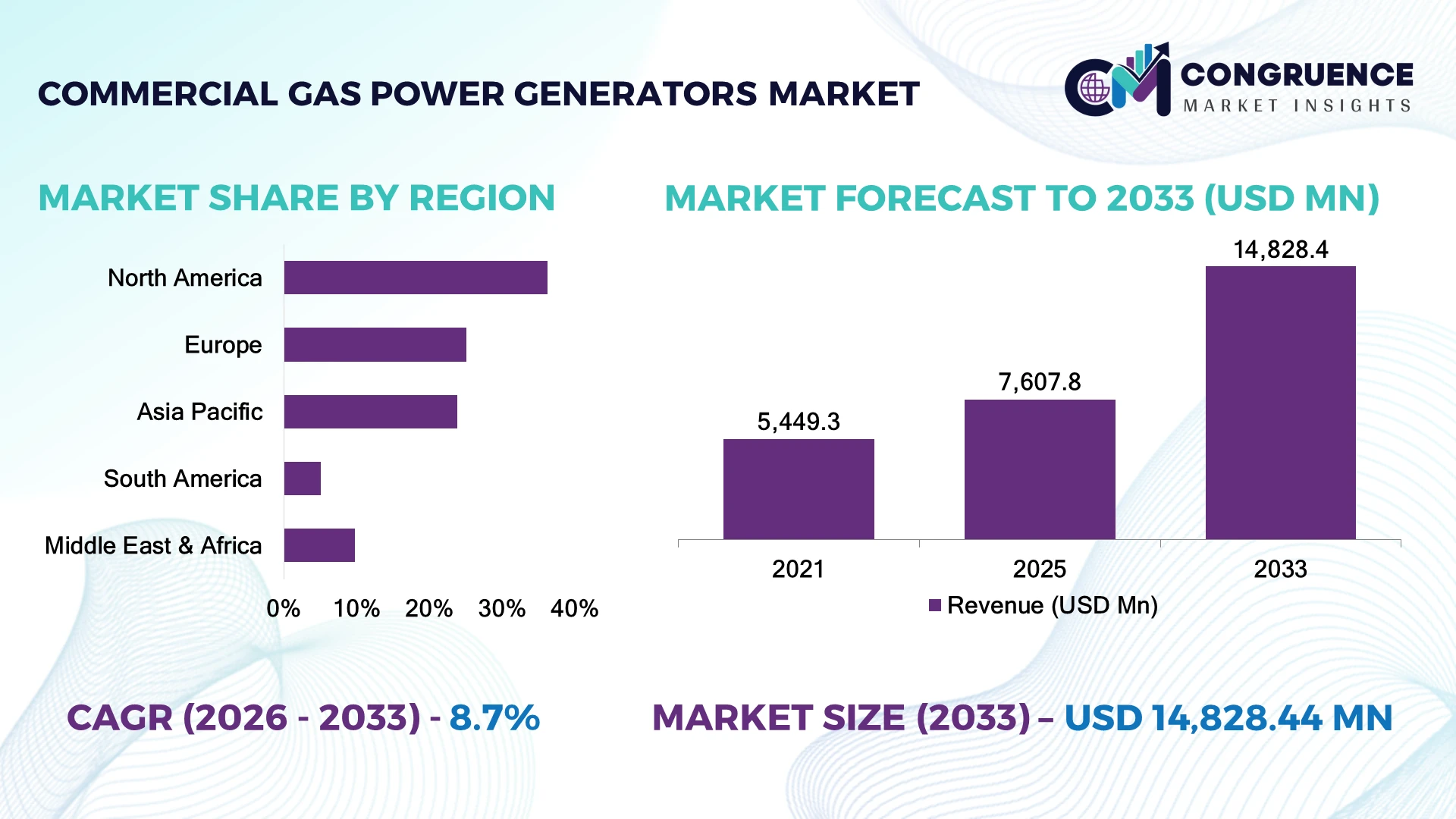
The Global Commercial Gas Power Generators Market was valued at USD 7,607.8 Million in 2025 and is anticipated to reach a value of USD 14,828.4 Million by 2033 expanding at a CAGR of 8.7% between 2026 and 2033. Commercial adoption is accelerating through expansion of natural gas infrastructure, rising data center investments, stricter emission standards, and enterprise demand for lower-carbon backup power systems.
The United States leads the commercial gas power generators market with approximately 29% global deployment share, supported by an extensive natural gas pipeline network, expanding hyperscale data centers, healthcare infrastructure, and industrial campuses. More than 70% of commercial facilities have direct access to pipeline gas, compared with less than 45% across several emerging economies. Continued energy security initiatives following global fuel supply disruptions have reinforced investment in resilient gas-based distributed generation.
Businesses investing in intelligent gas-powered backup infrastructure are strengthening operational resilience while reducing lifecycle emissions and fuel dependency risks.
Market Size & Growth: USD 7,607.8 million in 2025 reaching USD 14,828.4 million by 2033 at 8.7% CAGR, supported by expanding distributed energy infrastructure.
Top Growth Drivers: Natural gas infrastructure +34%, data center construction +28%, emission-compliant backup systems +24%.
Short-Term Forecast: By 2028, remote monitoring adoption exceeds 55% while maintenance costs decline by nearly 18%.
Emerging Technologies: AI diagnostics, hybrid gas-battery integration, and digital twin monitoring improve operational efficiency.
Regional Leaders: Asia-Pacific, North America, and Europe lead deployment through industrial expansion, resilient infrastructure, and cleaner energy adoption.
Consumer/End-User Trends: Nearly 48% of enterprise buyers prioritize low-emission standby power over conventional diesel alternatives.
Pilot/Case Example: 2026 commercial microgrid deployment reduced fuel consumption by approximately 16% using hybrid gas generation.
Competitive Landscape: Top five manufacturers control roughly 58% of market activity through technology leadership.
Regulatory & ESG Impact: Low-emission compliance programs reduce commercial carbon intensity by approximately 22%.
Investment & Funding: More than USD 4 billion supports distributed energy projects and gas infrastructure modernization.
Innovation & Future Outlook: Hydrogen-ready generators and predictive maintenance platforms define the next commercial power transition.
Commercial Gas Power Generators are increasingly deployed across healthcare facilities, cloud computing campuses, airports, and manufacturing plants where uninterrupted, lower-emission electricity is operationally critical. Approximately 44% of new premium installations now include intelligent remote diagnostics and automated load optimization. Expanding natural gas infrastructure and hybrid microgrid integration continue reshaping procurement strategies, setting the foundation for the broader strategic market outlook.
Commercial gas power generators have become strategically important as enterprises balance energy resilience with stricter environmental performance targets. Grid instability, expansion of digital infrastructure, and modernization of commercial facilities are accelerating investment in gas-based distributed generation. Supply-chain diversification following global energy disruptions has encouraged organizations to prioritize fuel-flexible backup systems capable of supporting uninterrupted operations with lower lifecycle emissions.
Modern gas generators equipped with intelligent engine controls operate approximately 14% more efficiently than conventional fixed-speed systems while reducing maintenance requirements through predictive diagnostics. North America continues leading deployment through mature gas infrastructure, whereas Asia-Pacific is expanding rapidly with industrial parks, commercial campuses, and digital infrastructure investments. Over the next two to three years, hybrid gas generators integrated with battery storage are expected to represent an increasingly important share of premium commercial installations.
Commercial data centers increasingly deploy gas generators alongside advanced energy management platforms to improve resilience and optimize operating costs. Manufacturers are expanding hydrogen-ready product lines, strengthening digital service partnerships, and investing in remote fleet management capabilities. Organizations adopting intelligent gas-powered generation today establish stronger operational continuity, regulatory compliance, and long-term competitive positioning as commercial power strategies continue evolving.
Commercial demand is increasingly shifting toward gas-powered generators as enterprises pursue lower-emission backup solutions without compromising operational reliability. Nearly 46% of newly commissioned commercial power projects now evaluate natural gas systems alongside conventional diesel alternatives, while fuel efficiency improvements of 12–15% strengthen long-term operating economics. The rapid expansion of hyperscale data centers and healthcare infrastructure in the United States has accelerated procurement of high-capacity gas generator systems. This structural transition improves energy resilience while supporting compliance with tighter environmental standards. Manufacturers are responding through hydrogen-ready engine development, expanded production facilities, strategic utility partnerships, and intelligent monitoring platforms. A notable strategic shift is the integration of commercial gas generators into distributed energy systems, transforming them from emergency assets into continuous operational infrastructure.
Commercial gas power generators remain constrained by uneven natural gas infrastructure and exposure to fuel price volatility. Approximately 32% of potential commercial installations in developing economies lack reliable pipeline connectivity, while pipeline expansion timelines frequently exceed commercial construction schedules. Seasonal gas price fluctuations of 15–20% also affect lifecycle operating costs, particularly for continuous-duty applications. Businesses operating in remote industrial zones often retain diesel systems due to easier fuel logistics. To reduce deployment risk, manufacturers are expanding dual-fuel generator portfolios, localizing component sourcing, and establishing long-term gas supply agreements with utility partners. The strongest operational challenge remains balancing emission advantages with dependable fuel availability across geographically diverse commercial projects.
The strongest growth opportunity lies in fuel-flexible commercial generators capable of operating on natural gas today while supporting hydrogen blending in future energy systems. More than 40% of enterprise buyers now evaluate hydrogen compatibility during procurement, and intelligent energy management platforms improve fuel utilization by approximately 14%. Japan and Germany continue encouraging commercial infrastructure modernization through cleaner distributed power technologies, creating favorable conditions for next-generation generator deployment. Manufacturers are increasing R&D investment in digital controls, hybrid gas-battery integration, and predictive maintenance ecosystems. A significant strategic opportunity is the emergence of commercial microgrids, where gas generators provide dispatchable power that complements renewable energy while maintaining uninterrupted business operations.
Commercial gas generators are evolving into digitally connected assets, increasing integration complexity across energy management systems, building automation platforms, and cybersecurity frameworks. Around 47% of enterprise customers now require remote diagnostics and cloud connectivity, yet interoperability challenges continue delaying deployment across mixed infrastructure environments. Skilled technicians capable of managing advanced generator software remain limited in several industrial markets, extending commissioning and maintenance timelines. Companies must invest in cybersecurity protection, standardized communication protocols, and workforce training to maintain reliable operations. Strategic partnerships with software providers and industrial automation specialists are becoming essential to ensure secure, scalable deployment while preserving operational continuity across mission-critical commercial facilities.
Hybrid Gas Power Integration Hybrid commercial power architectures combining gas generators with battery storage have expanded by nearly 30% in premium installations, reducing fuel consumption by approximately 16% during fluctuating loads. Commercial operators are optimizing energy dispatch through intelligent controllers, while manufacturers strengthen partnerships with battery suppliers and energy management software providers to improve resilience and operational efficiency.
Smart Fleet Monitoring Expansion Approximately 58% of newly deployed commercial gas generators now include cloud-based monitoring and predictive maintenance platforms. AI-enabled diagnostics reduce unexpected equipment downtime by nearly 22% while improving maintenance scheduling. Growing digital infrastructure investments are encouraging suppliers to expand software capabilities, subscription-based service models, and remote asset management solutions.
Hydrogen-Ready Engine Development Equipment manufacturers are accelerating hydrogen-compatible engine programs as commercial buyers prepare for cleaner fuel transitions. Hydrogen-ready product evaluations have increased by approximately 35% among enterprise customers. Regulatory pressure on industrial emissions is encouraging companies to redesign combustion systems and expand collaborative technology development with engine and utility partners.
Data Center Procurement Shift AI-driven computing infrastructure is reshaping commercial generator specifications, with nearly 45% of hyperscale projects prioritizing high-efficiency gas-powered backup systems over conventional alternatives. Operators increasingly require modular scalability, faster installation, and intelligent load-sharing capabilities. Manufacturers are responding through localized production, standardized modular designs, and expanded engineering support for large commercial campuses.
Medium-capacity gas generators (375–750 kVA) remain the leading type, accounting for approximately 41% of the Commercial Gas Power Generators market. Their dominance stems from broad deployment across hospitals, data centers, office campuses, retail complexes, and educational institutions where continuous standby capability, fuel efficiency, and manageable installation costs are essential. High-capacity generators above 750 kVA continue serving hyperscale data centers and industrial campuses, while units below 375 kVA retain strategic importance for small commercial facilities and distributed backup applications.
Large-capacity gas generators represent the fastest-growing type as AI-driven data centers and mission-critical infrastructure demand scalable backup systems with lower emissions. Nearly 36% of new enterprise procurements now specify generators capable of future hydrogen blending, while approximately 44% of premium installations include intelligent digital controls. Manufacturers are expanding modular product portfolios, investing in hydrogen-ready engines, and strengthening engineering partnerships for turnkey commercial deployments. Investment priorities increasingly favor scalable platforms that combine operational flexibility with long-term environmental compliance.
A 2025 assessment released by the Uptime Institute found that newly commissioned enterprise data center projects increasingly favored medium- and high-capacity gas generator systems capable of supporting modular expansion and redundant power architectures.
Standby power remains the largest application segment with an estimated 57% market share, reflecting its critical role in maintaining uninterrupted operations across healthcare facilities, data centers, financial institutions, airports, and commercial campuses. Businesses continue prioritizing standby gas generators because pipeline-based fuel supply, lower emissions, and rapid automatic startup strengthen operational continuity. Prime power applications remain strategically important in off-grid commercial developments, while peak shaving and continuous power applications continue expanding alongside distributed energy initiatives.
Peak shaving is the fastest-growing application as enterprises seek to reduce electricity demand charges and optimize energy consumption through intelligent power management. Around 39% of recently commissioned premium gas generator installations support automated load balancing, while nearly 34% integrate with building energy management systems. Manufacturers are responding through advanced controller development, remote monitoring platforms, and hybrid energy partnerships. Commercial demand is steadily shifting toward multipurpose power assets capable of supporting resilience, operational optimization, and lower lifecycle operating costs.
A 2026 enterprise energy assessment by the Electric Power Research Institute reported increasing adoption of commercial gas generators integrated with automated energy management systems for demand optimization and operational resilience.
Data centers account for approximately 33% of total Commercial Gas Power Generators demand, making them the dominant end-user because uninterrupted electricity remains essential for cloud computing, AI infrastructure, and digital service continuity. Their preference for gas-powered generators is supported by lower emissions, continuous fuel availability, and compatibility with intelligent energy management systems. Healthcare facilities represent the fastest-growing end-user segment as hospitals strengthen emergency preparedness and modernize resilient power infrastructure. Telecommunications, commercial real estate, manufacturing facilities, and educational campuses continue expanding investment in cleaner standby generation.
Commercial buyers increasingly prioritize digitally connected gas generator platforms that support predictive maintenance and remote asset management. Nearly 46% of enterprise customers now require cloud-enabled monitoring capabilities, while approximately 38% evaluate hydrogen-ready engines during procurement. Manufacturers are strengthening sector-specific service agreements, customized engineering solutions, and long-term maintenance partnerships to improve lifecycle performance. Future competition will increasingly center on delivering integrated commercial power ecosystems rather than standalone generator equipment.
A 2025 enterprise infrastructure survey by the Uptime Institute found that operators expanding AI-ready facilities increasingly specified low-emission gas-powered backup generation with advanced digital monitoring to strengthen operational resilience.
North America accounted for the largest market share at 36.2% in 2025 however, Middle East & Africa is expected to register the fastest growth, expanding at a CAGR of 9.6% between 2026 and 2033.
Commercial gas infrastructure accelerates resilient distributed power adoption
North America leads the Commercial Gas Power Generators market through extensive natural gas pipeline infrastructure, stringent emission standards, and continuous investment in mission-critical facilities. Data centers, healthcare campuses, financial institutions, and commercial office complexes increasingly favor gas-powered standby systems because of lower emissions and reliable fuel availability. The region contributes more than one-third of global commercial deployments, while approximately 52% of newly commissioned premium commercial generators include cloud-enabled monitoring and intelligent load management. Equipment manufacturers are expanding hydrogen-ready product lines, strengthening utility partnerships, and investing in regional service capabilities. Growing deployment of gas-powered microgrids further reinforces commercial energy resilience while supporting enterprise decarbonization strategies.
United States Market Outlook:
The United States dominates regional demand through its extensive gas transmission network, expanding AI-driven data center construction, and large commercial healthcare sector. More than 70% of commercial facilities have access to pipeline natural gas, enabling rapid adoption of low-emission standby systems. Commercial operators increasingly specify digitally connected gas generators integrated with building energy management platforms, encouraging manufacturers to expand engineering services, localized production, and predictive maintenance capabilities.
Low-emission infrastructure modernizes commercial backup power
Europe is steadily replacing conventional backup technologies with cleaner commercial gas power solutions that align with industrial decarbonization objectives. Commercial operators increasingly deploy gas generators supporting HVO compatibility, intelligent controls, and future hydrogen blending capabilities. Approximately 41% of recently specified commercial generator projects include advanced emission management features. Manufacturers continue expanding digital monitoring services and modular gas-powered systems designed for healthcare, telecommunications, logistics, and commercial real estate where operational continuity remains essential despite increasingly demanding environmental regulations.
Germany Market Outlook:
Germany remains the region's leading commercial gas generator market through advanced manufacturing, industrial automation, and energy modernization initiatives. Commercial facilities increasingly integrate gas generators into intelligent energy systems supporting factories, logistics hubs, and pharmaceutical campuses. Nearly 44% of industrial infrastructure upgrades now evaluate low-emission standby generation alongside digital energy management technologies, creating opportunities for engineering partnerships and customized commercial power solutions.
Industrial expansion strengthens gas-powered commercial infrastructure
Asia-Pacific represents a rapidly expanding commercial gas generator market as industrialization, commercial construction, and digital infrastructure continue accelerating. Countries with expanding LNG infrastructure increasingly deploy gas-powered standby systems across technology parks, hospitals, airports, and enterprise campuses. Approximately 39% of new commercial projects in major industrial economies evaluate gas generators as part of long-term energy transition strategies. Manufacturers are expanding localized assembly operations, strengthening regional distribution channels, and introducing modular gas-powered platforms that improve installation flexibility while supporting expanding commercial infrastructure.
China Market Outlook:
China leads regional deployment through extensive commercial construction, cloud computing investments, and expanding natural gas utilization. Large technology parks, industrial campuses, and commercial logistics centers increasingly adopt gas generators to strengthen operational resilience. Commercial equipment manufacturers continue expanding intelligent engine technologies, localized production, and integrated digital service platforms to meet rising enterprise demand for cleaner distributed generation systems.
Natural gas expansion supports commercial resilience
South America is witnessing growing commercial adoption of gas-powered generators as pipeline expansion and LNG investments improve fuel accessibility across industrial and commercial corridors. Commercial demand is concentrated in healthcare facilities, food processing plants, logistics centers, and telecommunications infrastructure seeking cleaner backup power alternatives. Around 28% of recent enterprise projects incorporate gas-based standby generation where pipeline connectivity is available. Although infrastructure gaps continue limiting wider deployment, suppliers are strengthening regional partnerships, engineering support, and fuel-flexible product offerings to improve market penetration and operational reliability.
Brazil Market Outlook:
Brazil leads regional demand through expanding gas infrastructure, diversified manufacturing activity, and modernization of commercial facilities. Industrial processing plants, hospitals, logistics operators, and commercial campuses increasingly deploy gas-powered standby generators to improve energy resilience. Equipment suppliers are strengthening local distribution networks, expanding technical service capabilities, and promoting hybrid gas generation solutions aligned with the country's evolving commercial energy landscape.
Gas infrastructure investment transforms commercial power systems
Middle East & Africa is emerging as the fastest-growing regional market as governments accelerate gas infrastructure development, commercial real estate expansion, and industrial diversification. Business districts, airports, hospitality developments, healthcare facilities, and digital infrastructure increasingly deploy gas-powered standby systems to improve energy security while reducing emissions. Nearly 37% of newly commissioned premium commercial developments evaluate permanent gas-based backup generation during project planning. Manufacturers are expanding regional engineering partnerships, localized technical support, and hydrogen-ready product portfolios aligned with infrastructure modernization initiatives.
Saudi Arabia Market Outlook:
Saudi Arabia remains the region's most influential market through extensive gas network expansion, industrial diversification, and large-scale commercial developments. Smart cities, hospitality projects, logistics zones, and data centers increasingly specify commercial gas generators integrated with digital facility management systems. International manufacturers continue investing in regional engineering centers, technical partnerships, and localized support capabilities to address growing enterprise demand for resilient low-emission commercial power infrastructure.
The Commercial Gas Power Generators market is led by Caterpillar, Cummins, Rolls-Royce Power Systems, INNIO Jenbacher, and Wärtsilä, competing against regional generator assemblers and low-cost OEMs for commercial infrastructure projects. The top five companies collectively command approximately 56% of global market share through integrated engine platforms, service networks, and fuel-flexible technologies. Competition centers on electrical efficiency, lifecycle cost, and delivery speed, with digitally monitored gas generators reducing maintenance requirements by nearly 25% and hydrogen-ready platforms improving future fuel compatibility by up to 20%. Global manufacturers are expanding localized assembly, forming EPC partnerships, and strengthening vertical integration across engines, alternators, and remote monitoring software. The competitive shift increasingly favors AI-ready data center power, modular gas generation, and hydrogen-compatible systems over conventional standby products. High certification costs, emissions compliance, and established after-sales infrastructure remain major entry barriers. Sustainable competitive advantage depends on scalable manufacturing, advanced digital services, rapid project execution, and fuel-flexible technologies.
Caterpillar Inc.
Cummins Inc.
Rolls-Royce Power Systems (mtu)
Wärtsilä Corporation
INNIO Group (Jenbacher)
Mitsubishi Heavy Industries Ltd.
MAN Energy Solutions
Siemens Energy AG
Kawasaki Heavy Industries Ltd.
Kohler Energy
Baudouin
FG Wilson
Generac Power Systems
Yanmar Holdings Co., Ltd.
Commercial gas power generators are rapidly transitioning toward intelligent, fuel-flexible, and digitally connected platforms. Lean-burn gas engines, advanced engine control units, and cloud-enabled monitoring improve fuel efficiency by 8–12% while reducing scheduled maintenance by approximately 20%. Around 48% of newly installed commercial gas generators now include remote diagnostics and predictive maintenance capabilities, enabling faster fault detection and higher operational availability for hospitals, data centers, and commercial campuses.
Hydrogen-ready combustion technology, AI-assisted performance optimization, and microgrid integration are reshaping generator design. Compared with conventional fixed-control systems, AI-enabled generator management improves load response by nearly 30% while lowering fuel consumption by approximately 10% under variable operating conditions. Manufacturers offering integrated digital platforms, battery storage compatibility, and hybrid energy controls gain a stronger competitive position because customers increasingly prioritize lifecycle performance over initial acquisition cost. Commercial deployments increasingly combine gas generators with renewable assets through intelligent energy management software.
Between 2026 and 2028, adoption of modular gas generator packages supporting hydrogen blending, biomethane, and advanced emissions monitoring is expected to accelerate across commercial infrastructure. Automated synchronization, cybersecurity-enabled remote operations, and digital twin technology will further optimize fleet management. Companies investing early in software-defined energy systems, fuel flexibility, and predictive service ecosystems will strengthen long-term competitiveness while reducing operational risk for commercial power users.
July 2024 Rolls-Royce Power Systems received TÜV Süd H2-ready certification for mtu Series 4000 gas engines supporting up to 25% hydrogen blending, strengthening commercial customers' transition toward hydrogen-compatible power generation. Source: Rolls-Royce. (Rolls-Royce)
July 2025 Rolls-Royce and Duisport commissioned the first commercial energy system using two 1 MW hydrogen-powered mtu CHP units, demonstrating carbon-neutral logistics infrastructure and validating commercial hydrogen-ready distributed generation. Source: Rolls-Royce News. (Rolls-Royce)
February 2026 Rolls-Royce launched modular mtu gas engine power plants delivering 5 MW to several hundred MW, with factory-tested modules enabling grid connection within 12–18 months, accelerating commercial distributed power deployment. Source: Rolls-Royce Media. (Rolls-Royce)
December 2025 Industry reporting highlighted Cummins and Caterpillar expanding generator manufacturing as data center demand surged, with Cummins forecasting 30–35% higher generator sales to hyperscale facilities, reinforcing commercial gas generator investment momentum. Source: Business Insider. (Business Insider)
The report delivers a comprehensive assessment of the Commercial Gas Power Generators market across generator capacities, applications, end-user industries, and major geographic regions. It evaluates adoption across commercial buildings, healthcare facilities, data centers, educational institutions, hospitality, telecommunications, and industrial campuses while examining fuel-flexible technologies, hydrogen-ready systems, digital monitoring, and hybrid microgrid integration. More than 55% of current commercial deployments emphasize intelligent control systems and remote asset management, reflecting the market's transition toward digitally connected power infrastructure.
The study provides strategic analysis of competitive positioning, technology evolution, regional investment patterns, procurement strategies, and deployment trends between 2026 and 2033. It assesses operational performance, supply chain developments, commercialization of advanced gas engine technologies, and emerging opportunities across established and developing markets. The report supports investment prioritization, product development, market expansion, partnership planning, and long-term competitive decision-making through detailed segmentation, regional benchmarking, technology assessment, and company-level strategic analysis.
| Report Attribute/Metric | Report Details |
|---|---|
|
Market Revenue in 2025 |
USD 7,607.8 Million |
|
Market Revenue in 2033 |
USD 14,828.4 Million |
|
CAGR (2026 - 2033) |
8.7% |
|
Base Year |
2025 |
|
Forecast Period |
2026 - 2033 |
|
Historic Period |
2021 - 2025 |
|
Segments Covered |
By Type
By Application
By End-User
|
|
Key Report Deliverable |
Revenue Forecast, Growth Trends, Market Dynamics, Segmental Overview, Regional and Country-wise Analysis, Competition Landscape |
|
Region Covered |
North America, Europe, Asia-Pacific, South America, Middle East, Africa |
|
Key Players Analyzed |
Caterpillar Inc., Cummins Inc., Rolls-Royce Power Systems (mtu), Wärtsilä Corporation, INNIO Group (Jenbacher), Mitsubishi Heavy Industries Ltd., MAN Energy Solutions, Siemens Energy AG, Kawasaki Heavy Industries Ltd., Kohler Energy, Baudouin, FG Wilson, Generac Power Systems, Yanmar Holdings Co., Ltd. |
|
Customization & Pricing |
Available on Request (10% Customization is Free) |




