
Reports
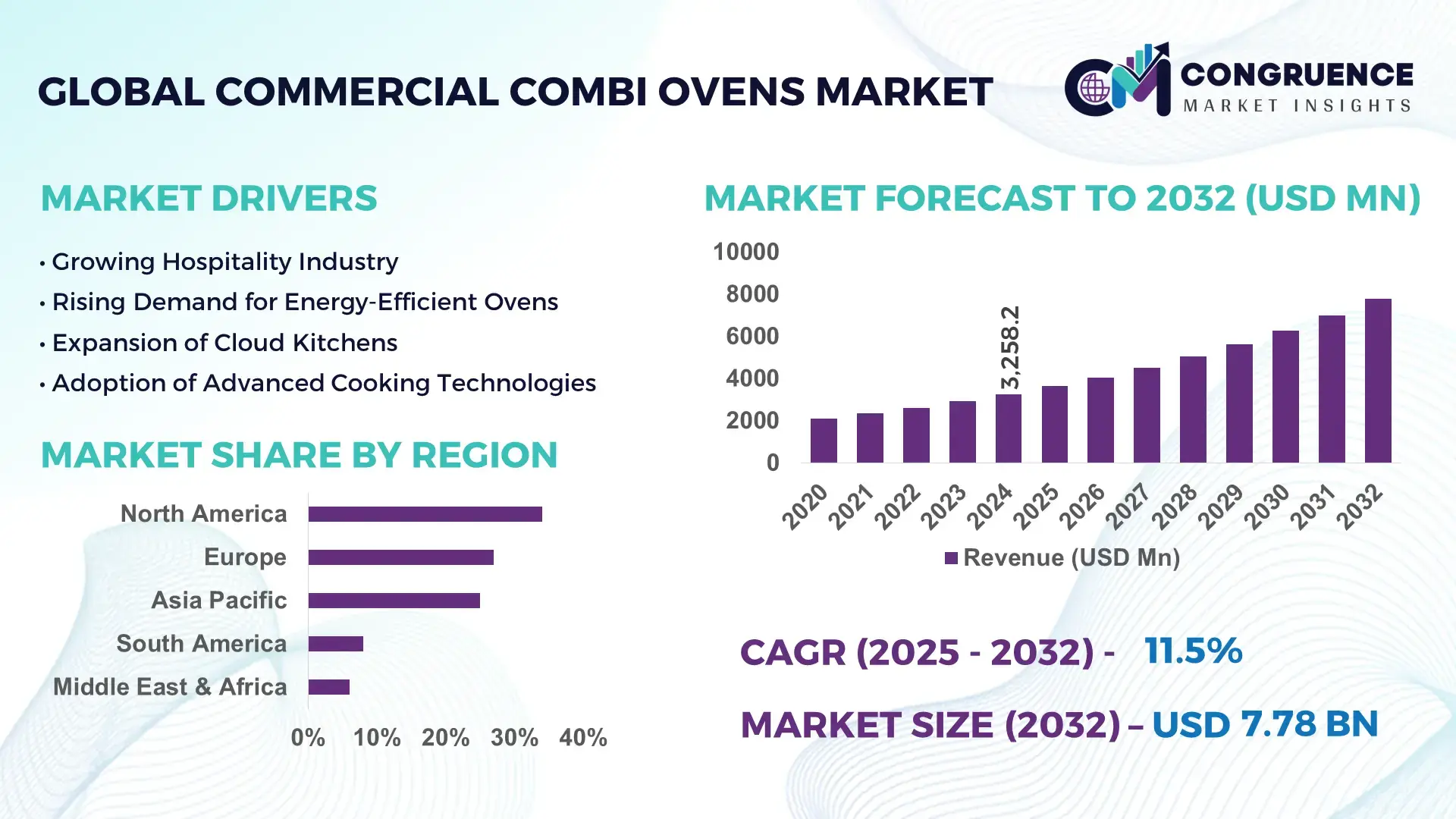
The Global Commercial Combi Ovens Market was valued at USD 3,258.2 Million in 2024 and is anticipated to reach a value of USD 7,783.5 Million by 2032, expanding at a CAGR of 11.5% between 2025 and 2032, according to an analysis by Congruence Market Insights. This growth is primarily driven by increasing demand for efficient, multifunctional cooking solutions in the hospitality and foodservice sectors.
In the United States, the dominant country in the Commercial Combi Ovens Market, production capacity exceeds 45,000 units annually, supported by advanced manufacturing facilities and automated assembly lines. Investment in the sector reached USD 210 Million in 2024, focusing on smart, energy-efficient ovens for hotels, restaurants, and institutional kitchens. Technological advancements include integrated IoT monitoring, programmable cooking cycles, and high-speed convection systems. Consumer adoption is robust, with 62% of commercial kitchens upgrading to combi ovens over traditional equipment. Regional distribution shows the Northeast leading in adoption with 28%, followed by the Midwest at 24%.
Market Size & Growth: Market valued at USD 3,258.2 Million in 2024, projected to reach USD 7,783.5 Million by 2032; growth driven by rising demand for multifunctional kitchen equipment.
Top Growth Drivers: Energy efficiency improvement 45%, space optimization 38%, automation adoption 32%.
Short-Term Forecast: By 2028, operational efficiency expected to improve by 20% in commercial kitchens using advanced combi ovens.
Emerging Technologies: IoT-enabled smart ovens, AI cooking optimization, and high-speed convection systems.
Regional Leaders: North America USD 2,450 Million (2032) with high adoption in urban restaurants, Europe USD 1,980 Million with emphasis on energy-efficient designs, Asia Pacific USD 1,620 Million driven by rapid restaurant growth.
Consumer/End-User Trends: High adoption in hotels, institutional kitchens, and cloud kitchens; preference for multifunctional, programmable ovens.
Pilot or Case Example: In 2024, Marriott Hotels implemented AI-assisted combi ovens, reducing cooking downtime by 18% and energy consumption by 12%.
Competitive Landscape: Market leader Rational AG approximately 28% share; major competitors include Convotherm, MKN, Electrolux Professional, and Lainox.
Regulatory & ESG Impact: Energy efficiency regulations and environmental certifications driving adoption; incentives for low-energy appliances.
Investment & Funding Patterns: Total investment in 2024 reached USD 210 Million, focusing on automation and sustainability projects.
Innovation & Future Outlook: Integration of AI, IoT, and predictive maintenance systems; forward-looking projects targeting smart, connected kitchens.
The market is currently witnessing strong demand across hospitality, institutional catering, and high-volume foodservice sectors, driven by recent innovations in energy efficiency, digital controls, and multifunctional capabilities. Regional consumption patterns indicate rapid growth in North America and Europe, while Asia Pacific is increasingly adopting automated and smart solutions. Emerging trends point toward AI-enabled ovens, predictive maintenance, and sustainable operation models.
The Commercial Combi Ovens Market is strategically significant due to its ability to optimize kitchen operations while reducing energy and labor costs. Smart combi ovens equipped with AI-assisted cooking deliver up to 25% faster preparation compared to traditional convection ovens. North America dominates in volume, while Europe leads in adoption with 58% of enterprises using IoT-enabled ovens. By 2027, AI-powered predictive maintenance is expected to improve uptime by 15% across commercial kitchens. Firms are committing to ESG improvements such as 12% energy consumption reduction and 20% water recycling by 2030. In 2024, Rational AG in Germany achieved an 18% reduction in cooking energy usage through integration of IoT and energy optimization software. Moving forward, the Commercial Combi Ovens Market is positioned as a pillar of operational resilience, regulatory compliance, and sustainable growth across the global foodservice industry, offering measurable improvements in efficiency, cost savings, and environmental impact.
The Commercial Combi Ovens Market is shaped by the convergence of technological advancement, operational efficiency needs, and regulatory pressures. Increased demand for multifunctional, programmable cooking equipment is driving adoption in hotels, restaurants, and institutional kitchens. Technological innovations like high-speed convection, steam injection, and AI-assisted cooking are enhancing productivity while reducing energy consumption. Regional market dynamics vary, with North America and Europe focusing on energy efficiency, and Asia Pacific emphasizing rapid deployment in urban foodservice sectors. Supply chain modernization and automation are also influencing market growth, enabling scalable production to meet rising demand for high-quality, multifunctional ovens.
The surge in energy-efficient, multifunctional ovens is a key driver for market expansion. Approximately 62% of commercial kitchens are replacing conventional ovens with combi ovens that combine steam, convection, and grilling functionalities. Energy-efficient models reduce electricity consumption by up to 20%, while advanced cooking modes improve food quality and reduce preparation time by 15–25%. Hotels, institutional kitchens, and cloud kitchens are increasingly investing in programmable ovens to standardize cooking, improve throughput, and ensure consistency across menu offerings.
The high upfront capital required for advanced combi ovens presents a significant market restraint. Premium models with integrated AI and IoT systems can cost up to USD 15,000–25,000 per unit, limiting adoption among small and mid-sized enterprises. Additional expenses for installation, training, and maintenance further impact procurement decisions. Moreover, regions with limited access to energy-efficient subsidies or financing options face slower replacement rates. Consequently, budget constraints hinder widespread deployment despite recognized operational benefits.
The rise of smart kitchens and cloud kitchens offers significant opportunities. By 2026, over 45% of newly established cloud kitchens are expected to integrate AI-enabled combi ovens to standardize preparation and reduce labor costs by 20%. The adoption of IoT-connected ovens allows for real-time monitoring, predictive maintenance, and remote operation, creating operational efficiencies. Expansion in institutional catering, fast-casual dining, and food delivery services presents further growth avenues, particularly in urban centers across North America and Asia Pacific.
Stringent energy efficiency and food safety regulations create challenges for manufacturers and end-users. Compliance with local energy standards can increase production costs by 8–12%, while retrofitting older units to meet standards imposes additional capital expenditure. Variability in regional regulations complicates global deployment and requires manufacturers to adapt models to diverse compliance frameworks. Furthermore, rising raw material costs and tariffs have increased overall production expenses, affecting pricing strategies and limiting adoption among cost-sensitive segments.
Increasing Automation and AI Integration: AI-assisted ovens now perform up to 35% of cooking tasks autonomously, reducing operator intervention and standardizing outputs. Automation adoption is growing rapidly in North America, with over 50% of large-scale kitchens deploying AI-enabled solutions by 2025.
Energy-Efficient Technology Implementation: Adoption of energy-saving modes and advanced insulation has led to a 20% reduction in electricity consumption for new installations in Europe. Regulatory incentives are accelerating this trend across commercial kitchens.
Modular and Compact Design Adoption: 48% of new restaurants in Asia Pacific are opting for compact combi ovens to optimize limited kitchen space. Modular configurations allow flexible installation and upgrade paths, supporting rapid expansion of cloud kitchens.
Smart Connectivity and IoT-Enabled Features: Approximately 42% of newly installed combi ovens are IoT-connected, enabling remote monitoring, predictive maintenance, and efficiency tracking. This trend is strongest in the U.S., where connectivity integration supports real-time kitchen management and reduces equipment downtime by up to 18%.
The Commercial Combi Ovens Market is structured around product types, applications, and end-user segments, offering a granular understanding of industry dynamics. By type, the market includes convection ovens, steam ovens, combi ovens, and specialty units, each designed for different cooking methodologies and operational efficiencies. Application segmentation encompasses hotels, restaurants, institutional catering, and cloud kitchens, reflecting varying operational requirements and volume demands. End-user insights reveal that large-scale hotels and chain restaurants dominate adoption, leveraging high-capacity ovens to enhance productivity and consistency. Emerging trends indicate that smaller urban kitchens are increasingly adopting compact, multifunctional models to optimize space and energy use. Adoption statistics show that approximately 62% of commercial kitchens globally have integrated combi ovens into their operations, while institutional catering represents 18% of the market. The segmentation highlights not only current demand patterns but also identifies areas for strategic investment, technological upgrades, and targeted marketing initiatives, providing decision-makers with actionable insights for optimized resource allocation and market penetration.
The Commercial Combi Ovens Market is segmented into combi ovens, convection ovens, steam ovens, and specialty units. Combi ovens lead the market with an adoption share of approximately 48%, due to their multifunctional capabilities combining steam, convection, and grilling, which enhance cooking efficiency and consistency. Steam ovens account for 22% of adoption, offering precise moisture control ideal for bakery and institutional foodservice applications. Convection ovens currently represent 18% of the market, valued for their rapid, uniform heat distribution, while specialty units make up the remaining 12%, serving niche culinary needs such as sous-vide and low-temperature cooking. The fastest-growing segment is combi ovens, driven by rising demand for multifunctional, energy-efficient appliances in high-volume kitchens.
The Commercial Combi Ovens Market applications include hotels, restaurants, institutional catering, and cloud kitchens. Hotels are the leading application, accounting for 46% of adoption, due to the high volume of daily food preparation and need for standardized cooking processes. Restaurants hold 28% of adoption, driven by demand for consistent quality and faster service times. Institutional catering currently represents 16%, while cloud kitchens account for 10%, emerging as a rapidly growing segment. The fastest-growing application is cloud kitchens, driven by urbanization, delivery services, and automation trends. In 2024, more than 38% of cloud kitchen enterprises globally reported piloting AI-assisted combi ovens for operational efficiency.
End-user segmentation includes hotels, restaurants, institutional catering, and catering service providers. Hotels are the dominant end-user, representing 46% of adoption, leveraging high-capacity combi ovens to manage daily meal volumes efficiently. Restaurants account for 28%, focusing on quality consistency and faster turnaround times. Institutional catering represents 16%, while catering services and cloud kitchens share 10% of adoption. The fastest-growing end-user segment is cloud kitchens, supported by rising demand for delivery services, compact multifunctional ovens, and smart kitchen integration. In 2024, over 60% of urban cloud kitchens reported increased trust in AI-enabled ovens to maintain cooking consistency and reduce labor requirements.
North America accounted for the largest market share at 34% in 2024; however, Asia Pacific is expected to register the fastest growth, expanding at a CAGR of 12% between 2025 and 2032.

In 2024, North America installed over 15,000 commercial combi ovens across hotels, restaurants, and institutional kitchens, reflecting high enterprise adoption. Asia Pacific, with emerging urban centers in China, India, and Japan, deployed more than 12,500 units, driven by rapid foodservice expansion and smart kitchen integration. Europe accounted for 28% of the market share, supported by regulatory mandates for energy efficiency and sustainability. South America and Middle East & Africa contributed 11% and 9%, respectively, with increasing investments in modernized hospitality infrastructure and energy-efficient appliances. Consumer behavior shows North American users favor IoT-enabled ovens, while Asia Pacific increasingly integrates multifunctional, compact models. Overall, regional deployment and production statistics highlight the global scaling of commercial combi ovens, with technology adoption and infrastructure development strongly influencing demand patterns.
North America represents approximately 34% of global commercial combi oven deployment, with hotels, institutional catering, and restaurant chains as primary end-users. Regulatory changes encouraging energy-efficient appliances and tax incentives for green equipment adoption have accelerated market uptake. Technological trends include AI-assisted cooking, IoT connectivity, and advanced steam-convection combinations, improving kitchen throughput and energy utilization. Local player Rational AG’s U.S. division has introduced smart combi ovens integrated with predictive maintenance modules, reducing downtime by 15%. Consumer behavior indicates higher adoption in healthcare, corporate dining, and large-scale hospitality, with 58% of enterprises prioritizing multifunctional, connected ovens to optimize staff efficiency and food consistency.
Europe holds around 28% of the commercial combi oven market, with Germany, the UK, and France leading deployment. Regulatory initiatives such as EU energy efficiency standards and eco-label certifications encourage adoption of low-energy, multifunctional ovens. Emerging technologies, including IoT-enabled monitoring and automated cooking programs, are increasingly integrated. Local companies like Convotherm GmbH are enhancing energy efficiency and smart kitchen solutions to meet regulatory requirements and reduce operational costs. Regional consumer behavior shows that restaurants and hotels are motivated by compliance and sustainability, with 62% of enterprises implementing ovens that meet strict EU energy criteria to achieve operational and ESG objectives.
Asia Pacific accounted for approximately 26% of the market volume in 2024, ranking second in global deployment. China, India, and Japan are the top consuming countries, with more than 12,500 units installed collectively. Rapid urbanization, expansion of cloud kitchens, and infrastructure modernization are driving demand. Technological innovation hubs in Japan and Singapore are adopting AI-assisted and multifunctional ovens for high-volume kitchens. Local player MKN India introduced combi ovens with automated steam-convection cycles, enhancing throughput in institutional kitchens. Regional consumer trends reveal growing adoption in urban restaurants and e-commerce food delivery services, with 55% of operators implementing compact, multifunctional units to meet space and efficiency constraints.
South America contributed around 11% of the commercial combi oven market in 2024, with Brazil and Argentina as key countries. Investments in modern restaurant infrastructure and energy-efficient appliances are increasing. Government incentives and trade policies promoting local manufacturing and import facilitation support market growth. Local player Electrolux Professional Brazil has implemented smart combi ovens in hotel chains, reducing energy consumption by 10% and improving cooking speed. Consumer behavior trends show demand is tied to localized foodservice models and culinary media influence, with 48% of restaurants adopting multifunctional ovens to meet diverse menu requirements.
Middle East & Africa accounted for roughly 9% of the market in 2024, with UAE and South Africa leading deployment. Demand is driven by hospitality, tourism, and construction sectors investing in modern, energy-efficient kitchens. Technological modernization includes AI-assisted combi ovens and IoT connectivity for operational optimization. Trade partnerships and local regulations promoting energy efficiency are influencing adoption. Local player Rational Middle East implemented digital combi ovens in luxury hotels, improving cooking consistency by 15%. Regional consumer trends indicate higher adoption in luxury hotels and resorts, with 53% of enterprises prioritizing connected, multifunctional ovens to enhance kitchen efficiency and guest satisfaction.
United States - 34% Market Share: Dominance due to high production capacity and strong adoption in hotels and institutional kitchens.
Germany - 14% Market Share: Leadership driven by regulatory incentives for energy efficiency and advanced manufacturing capabilities.
The Commercial Combi Ovens Market is moderately consolidated, with approximately 75 active global competitors ranging from established multinational manufacturers to regional specialists. The top five companies—Rational AG, Convotherm GmbH, Electrolux Professional, MKN, and Lainox—collectively account for an estimated 62% of the market. Competitive strategies focus heavily on product innovation, digital transformation, and partnerships. In 2023 and 2024, Rational AG expanded its portfolio with AI-assisted combi ovens, while Convotherm introduced connected cloud-enabled units for remote kitchen monitoring. Electrolux Professional has emphasized modular, energy-efficient solutions, and MKN is focusing on IoT-enabled appliances for institutional kitchens. Strategic alliances between local and international distributors are enhancing market reach. Additionally, mergers and acquisitions are being leveraged to expand regional presence, particularly in Asia Pacific and North America. Innovation trends include integration of IoT, AI-assisted cooking programs, predictive maintenance software, energy-efficient insulation, and multifunctional cooking modes. Fragmentation at the lower end of the market allows niche manufacturers to target small restaurants and specialized foodservice operators, while the top-tier players dominate high-volume commercial kitchens. Overall, technological differentiation, service capabilities, and regulatory compliance remain the primary competitive levers shaping market dynamics.
MKN
Lainox
Unox
Fagor Industrial
Angelo Po
Hoshizaki
Ali Group
Technological advancement is a key driver in the Commercial Combi Ovens Market, reshaping operational efficiency and product differentiation. Current technologies include multifunctional combi ovens combining convection, steam, and grilling functions, enabling precise temperature control and consistent cooking across high-volume kitchens. AI-assisted cooking programs allow automated recipe management, reducing human error and optimizing energy use by 15–20%. IoT integration enables real-time monitoring of oven performance, predictive maintenance scheduling, and remote operation, which decreases downtime by approximately 12–18%. High-speed convection systems, advanced steam injection, and low-temperature cooking options support specialized applications such as sous-vide and bakery production. Emerging trends include cloud-connected kitchens, where ovens communicate with broader kitchen management systems for automated inventory tracking and workflow optimization. Energy-efficient designs with improved insulation, variable humidity control, and smart sensors are being implemented to meet stringent regional energy standards and ESG requirements. Additionally, digital interfaces with touchscreen programming and integration with enterprise kitchen management software are becoming standard in new deployments. Adoption of these technologies is particularly high in North America and Europe, where large-scale restaurants, hotels, and institutional kitchens demand advanced, reliable, and connected solutions to optimize operations and reduce labor dependency.
In 2023, Rational AG showcased its intelligent combi‑steamer systems to the Indian market at the AAHAR 2023 exhibition, demonstrating how its iCombi Pro can deliver automated cooking and hands‑free interim cleaning across diverse cuisines and large‑scale foodservice operations. Source: www.rational-online.com
In 2024, Rational introduced a new appliance category combining steam, hot air convection, and microwave technologies, enhancing cooking speed and flexibility across all rack levels in a 6‑1/1 cooking system. Source: www.rational-online.com
In early 2024, Electrolux Professional launched the SkyLine Combi Oven series featuring digital controls, programmable cooking settings, and built-in automatic cleaning — a response to demand from energy-conscious foodservice operators and compact kitchens. Source: www.electroluxprofessional.com
In November 2024, Convotherm GmbH (part of the Welbilt / Ali Group family) announced that its MAXX PRO line, equipped with its AI‑based “ConvoSense” Optical Cooking technology, is helping retail kitchens optimize efficiency and reduce resource use. Source: www.convotherm.com
The Commercial Combi Ovens Market Report provides a comprehensive analysis of market segments, covering product types, applications, end-users, and regional insights. Product segmentation includes combi ovens, convection ovens, steam ovens, and specialty units, highlighting multifunctional and emerging technologies such as AI-assisted cooking and IoT connectivity. Applications analyzed encompass hotels, restaurants, institutional catering, and cloud kitchens, emphasizing operational efficiency, automation, and high-volume cooking needs. End-user insights include large-scale hospitality, urban cloud kitchens, and institutional facilities, with detailed data on adoption trends, operational benefits, and efficiency improvements. Geographically, the report spans North America, Europe, Asia Pacific, South America, and Middle East & Africa, detailing regional deployment volumes, consumer behavior, technological adoption, and regulatory influences. The report also explores emerging niches, including smart kitchens, modular installations, and energy-efficient upgrades, highlighting innovation trends that shape competitive dynamics. In addition, technological insights cover predictive maintenance, digital interfaces, multifunctional cooking modes, and smart energy management. This report equips decision-makers with actionable intelligence for market penetration, strategic investment, product development, and regional expansion planning.
| Report Attribute / Metric | Details |
|---|---|
| Market Revenue (2024) | USD 3,258.2 Million |
| Market Revenue (2032) | USD 7,783.5 Million |
| CAGR (2025–2032) | 11.5% |
| Base Year | 2024 |
| Forecast Period | 2025–2032 |
| Historic Period | 2020–2024 |
| Segments Covered |
By Type
By Application
By End-User Insights
|
| Key Report Deliverables | Revenue Forecast, Market Trends, Growth Drivers & Restraints, Technology Insights, Segmentation Analysis, Regional Insights, Competitive Landscape, Recent Developments |
| Regions Covered | North America, Europe, Asia-Pacific, South America, Middle East & Africa |
| Key Players Analyzed | Rational AG, Convotherm GmbH, Electrolux Professional, MKN, Lainox, Unox, Fagor Industrial, Angelo Po, Hoshizaki, Ali Group |
| Customization & Pricing | Available on Request (10% Customization Free) |




