
Reports
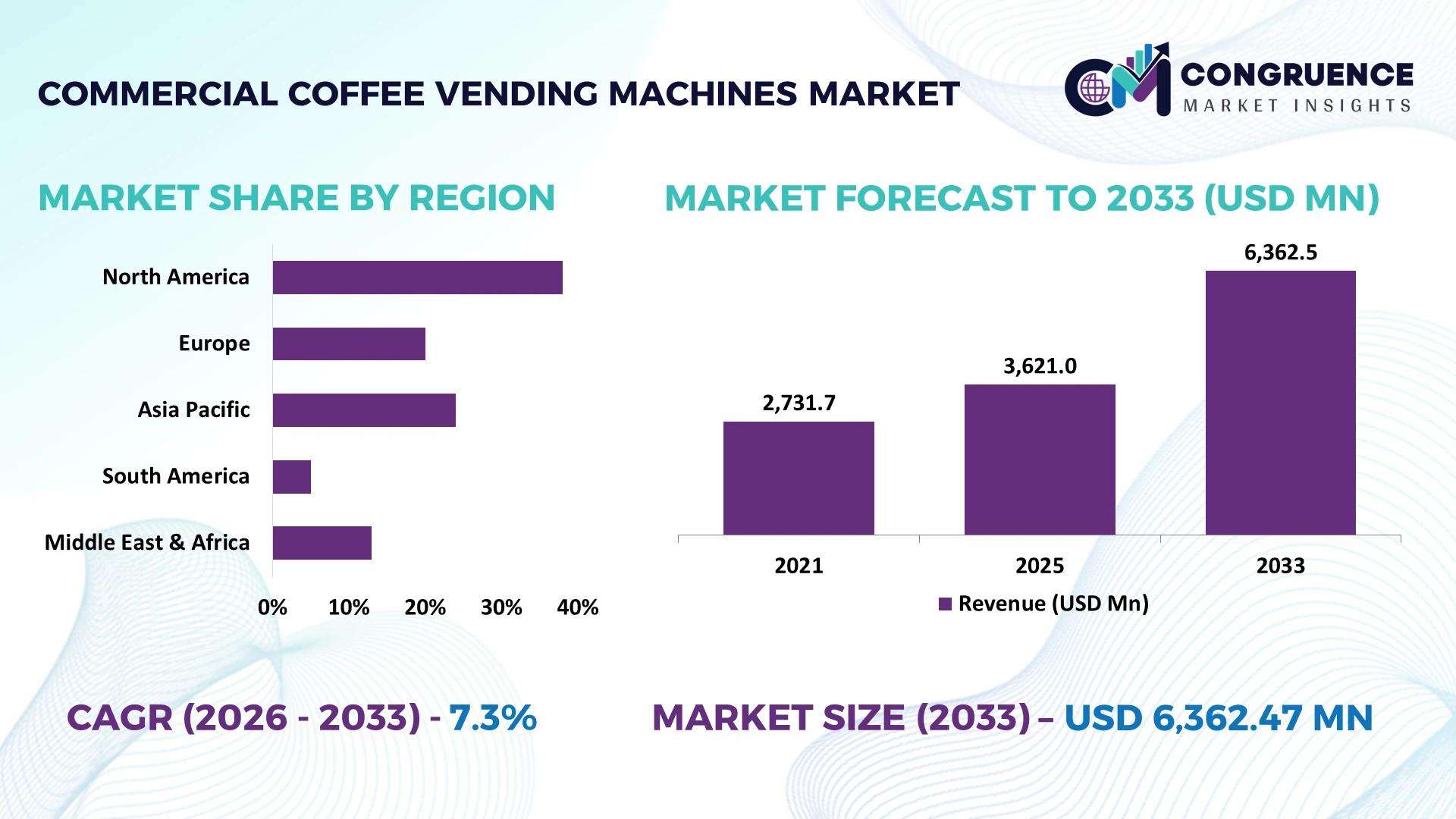
The Global Commercial Coffee Vending Machines Market was valued at USD 3621 Million in 2025 and is anticipated to reach a value of USD 6362.47 Million by 2033 expanding at a CAGR of 7.3% between 2026 and 2033. Growth is driven by cashless payment integration, bean-to-cup automation, labor-saving self-service formats, and rising workplace demand for premium coffee without full-service café infrastructure.
Japan represents a dominant commercial deployment market, supported by its mature vending ecosystem, high cashless-payment adoption, and extensive workplace and transportation infrastructure. Japan has more than 4 million vending machines across categories, providing a strong distribution base for automated beverage formats. Europe follows with strong office, hospitality, and convenience deployment, while the United States is accelerating smart-machine adoption through contactless payments and telemetry. Japan's dense vending infrastructure and automation culture give it a measurable scale advantage, while global operators increasingly prioritize connected machines, fresh-brew systems and remote inventory monitoring.
Suppliers combining bean-to-cup quality, cashless payments and remote machine intelligence are best positioned to capture premium commercial deployments.
Market Size & Growth: USD 3.62 billion in 2025 to USD 6.36 billion by 2033 at 7.3% CAGR, driven by automated beverage preparation and cashless vending.
Top Growth Drivers: Cashless payments 32%, bean-to-cup systems 27%, workplace automation 21%.
Short-Term Forecast: By 2028, connected machines can reduce servicing costs by 15% and increase equipment uptime by 10%.
Emerging Technologies: AI telemetry, IoT inventory monitoring and automated milk systems are transforming commercial coffee dispensing.
Regional Leaders: Asia-Pacific reaches approximately USD 2.25 billion, Europe USD 1.70 billion and North America USD 1.55 billion, supported by workplace and convenience deployment.
Consumer/End-User Trends: Cashless transactions exceed 70% across several advanced vending environments, accelerating demand for contactless coffee purchasing.
Pilot/Case Example: 2024 smart-vending deployments demonstrated inventory-monitoring improvements of approximately 20%, reducing refill-related operational inefficiencies.
Competitive Landscape: Selecta leads with approximately 10% share, competing with Crane Payment Innovations, Westomatic, Azkoyen and Necta-based commercial operators.
Regulatory & ESG Impact: Energy-efficient machines can reduce electricity consumption by approximately 10–20%, strengthening demand for low-power refrigeration and standby controls.
Investment & Funding: Commercial operators are directing approximately 15% of modernization budgets toward connected-payment, telemetry and remote-management upgrades.
Innovation & Future Outlook: AI demand forecasting, fresh-milk automation and personalized beverage interfaces are shifting competition toward higher-margin, data-enabled vending ecosystems.
The Commercial Coffee Vending Machines Market is shifting from conventional powdered-coffee dispensers toward bean-to-cup, fresh-milk and fully automated beverage platforms serving offices, factories, hospitals, universities, transport hubs and hospitality locations. Premium machines increasingly combine cashless payment, touchscreen ordering, telemetry and remote diagnostics, improving operational efficiency while reducing dependence on onsite attendants. Approximately 15–20% lower servicing requirements are achievable through remote inventory and fault monitoring. European workplaces are emphasizing premium self-service coffee as operators manage labor costs, while Japan's mature vending infrastructure supports rapid machine utilization. Supply-chain normalization for electronic payment modules and brewing components is further enabling connected-machine upgrades, creating stronger strategic opportunities for equipment manufacturers, vending operators and coffee suppliers.
Commercial coffee vending machines are becoming strategically important as employers, transport operators, healthcare facilities, universities, and hospitality venues seek beverage service with lower labor intensity and consistent output. Connected machines are shifting purchasing decisions from hardware price toward uptime, telemetry, payment integration, and consumables management. By 2028, remote monitoring and predictive servicing can reduce unnecessary service visits by around 15% and improve machine availability by 8–12%, strengthening the economics of distributed deployments.
A major market shift is the transition from powdered beverage systems toward bean-to-cup, fresh-milk, and automated grinding technologies. Modern platforms can prepare beverages 20–30% faster than labor-intensive counter service while reducing operator intervention. Japan remains highly automated and machine-dense, while Germany and the United States are placing greater emphasis on premium workplace coffee, cashless payments, and connected fleet management.
Practical deployment is expanding across corporate campuses, factories, hospitals, airports, and educational facilities, where centralized telemetry can track inventory and consumption across dozens of machines. Companies are increasing investment in IoT-enabled fleets, partnering with payment and coffee-ingredient providers, and prioritizing modular machines that support localized menus. Competitive advantage is increasingly tied to service efficiency, machine uptime, and data-driven fleet optimization rather than vending capacity alone.
The strongest driver is enterprise demand for automated beverage service as labor costs and service expectations rise. Cashless payment adoption can exceed 70% across advanced vending environments, while connected telemetry can reduce manual inventory checks by roughly 20–30%. In Japan, dense unattended retail infrastructure demonstrates how automation can support high transaction volumes with limited staffing. Bean-to-cup systems are also replacing conventional powdered dispensers where freshness and customization command higher utilization. Companies are responding by investing in IoT-enabled fleets, remote diagnostics, and integrated payment platforms. The non-obvious advantage is operational visibility: consumption data allows operators to optimize refill frequency, product mix, and technician scheduling simultaneously, improving machine economics beyond beverage preparation alone.
Equipment economics remain constrained by volatile prices for electronic controllers, payment modules, coffee ingredients, refrigeration components, and stainless-steel assemblies. Imported component exposure can increase procurement costs by 8–15% during supply disruptions, while coffee input volatility can compress operator margins by 3–6% when contracts cannot be adjusted quickly. European and Indian operators also face differing requirements for electrical safety, payment integration, and food-contact components, complicating standardized deployments. Companies are mitigating pressure through dual sourcing, longer-term procurement contracts, localized assembly, and modular component architectures. A key operational insight is that consumables represent a recurring margin lever, so machine suppliers increasingly prioritize integrated ingredient contracts and service agreements rather than relying solely on equipment sales.
The strongest opportunity is premium automated coffee positioned between traditional vending and staffed cafés. Fresh-milk systems, automated grinding, personalized beverage interfaces, and mobile ordering can increase premium beverage selection by 15–25% within suitable workplace and hospitality deployments. India, Poland, and parts of Southeast Asia offer attractive expansion opportunities as organized workplaces, hospitals, universities, and transport facilities modernize unattended food-service infrastructure. AI-based demand forecasting can further reduce ingredient waste by approximately 10–15% through consumption-based replenishment. Companies are expanding R&D around compact modular machines, partnering with payment platforms and coffee roasters, and developing subscription-based servicing. The non-obvious opportunity is converting machine telemetry into recurring revenue through predictive maintenance, consumables optimization, and location-specific beverage personalization.
Connected coffee vending fleets increasingly combine payment gateways, IoT sensors, telemetry software, refrigeration, brewing modules, and remote service platforms, creating integration complexity that can raise deployment-related troubleshooting by 10–15%. Cybersecurity is becoming more significant as machines transmit transaction and operational data through cloud platforms, while fragmented payment standards can complicate multinational fleet management. In the United States, Europe, and Japan, operators must maintain consistent food safety, electrical, payment, and data-management compliance across different deployment environments. Companies are addressing these pressures through standardized APIs, encrypted device communication, modular hardware, and partnerships with specialist technology providers. The strategic challenge is achieving interoperability without sacrificing machine simplicity, because excessive software complexity can increase downtime and undermine the labor-saving advantage of automation.
Premium Coffee Replaces Basic Dispensing: Bean-to-cup and specialty formats are gaining preference as workplace buyers prioritize quality over basic instant coffee. Premium coffee spending at surveyed office stations increased 59% year over year, while 65% of employees expected higher-quality workplace coffee. Operators are upgrading brewing systems and menus rather than simply adding machines.
Hybrid Work Reshapes Machine Deployment: Office demand is becoming more uneven as hybrid schedules create peak-day consumption patterns. Around 40% of U.S. jobs allow some remote work, encouraging operators to use modular equipment and consumption tracking instead of fixed-capacity installations. Companies are increasingly resizing fleets and using flexible service agreements to prevent underutilized machines.
Personalization Enters Coffee Operations: Customized flavors, milk alternatives, and beverage configurations are moving into mainstream workplace programs. Plant-based milk demand at surveyed office stations increased 62%, while 88% of coffee drinkers considered customization important. Operators are expanding ingredient partnerships and programmable interfaces to increase beverage choice without adding staffed service counters.
Flexible Contracts Gain Operational Value: Coffee operators are broadening machine agreements into pantry, water, and micro-market services as input costs fluctuate. Earlier industry data showed 28% adding pantry services and 19% adding micro markets to strengthen account economics. The non-obvious shift is that vending machines increasingly serve as entry points for wider workplace-service contracts.
Bean-to-Cup machines represent the leading type, accounting for an estimated 34% share, supported by automated grinding, brewing consistency, customizable recipes, and compatibility with cashless payment systems. Their ability to deliver café-style beverages without dedicated staff gives them a clear advantage over Instant Coffee and Filter Coffee formats in offices, hospitals, and transportation facilities. Capsule-Based systems retain strong relevance where portion control and simple maintenance are priorities, while Fresh Brew serves locations requiring higher perceived freshness. Hybrid Machines are gaining traction as operators combine brewing formats within one platform, improving menu flexibility by roughly 15–20%.
Hybrid Machines are also emerging as the fastest-growing type as operators seek to accommodate fluctuating demand and varied beverage preferences. Companies are increasing investment in modular brewing architecture, fresh-milk modules, and programmable dispensing. Instant Coffee remains attractive for low-cost, high-volume environments, but premiumization is gradually shifting investment toward automated fresh preparation. This creates a strategic divide between cost-led deployments and experience-led deployments.
Self-Service Coffee is the leading application, representing an estimated 32% share as offices, hospitals, transport facilities, and public venues prioritize unattended beverage access. Its advantage comes from rapid transaction cycles, reduced staffing requirements, and continuous availability. Employee Refreshment follows closely in workplace environments, while Customer Service and Hospitality Service increasingly use premium machines to complement staffed counters. Public Refreshment remains important in high-footfall locations where speed and accessibility outweigh extensive beverage customization.
Hospitality Service is emerging as one of the fastest-growing applications as hotels and service operators add automated coffee stations without expanding front-of-house staffing. Premium machines can reduce preparation intervention by approximately 20–30% compared with manual counter service, while digital payment integration can shorten transaction handling by 10–15%. Companies are responding through modular installations, centralized monitoring, and partnerships with coffee suppliers. The strategic implication is a shift from isolated vending points toward integrated beverage-service infrastructure.
Offices represent the leading end-user group, accounting for an estimated 36% share because corporate locations require recurring beverage access across concentrated employee populations. Their purchasing decisions increasingly emphasize premium quality, flexible capacity, telemetry, and employee experience rather than basic machine pricing. Hotels and Restaurants maintain strong demand for customer-facing service, while Cafes typically use vending-style systems selectively for overflow or unattended areas. Hospitals and Educational Institutions favor reliable, low-intervention systems that can serve users across extended operating hours.
Transportation Hubs are among the fastest-growing end-users as airports, railway facilities, and terminals require rapid beverage transactions across long operating periods. Demand in these locations can favor unattended formats with transaction throughput 15–25% higher than conventional staffed service points. Retail Stores are also expanding selective deployments where floor space is constrained. Companies are responding with compact machines, location-specific menus, remote monitoring, and tailored service contracts. The key shift is toward matching machine architecture with traffic intensity rather than applying one standardized format across every end-user.
North America accounted for the largest market share at 31% in 2025 however, Asia-Pacific is expected to register the fastest growth, expanding at a CAGR of 8.2% between 2026 and 2033.
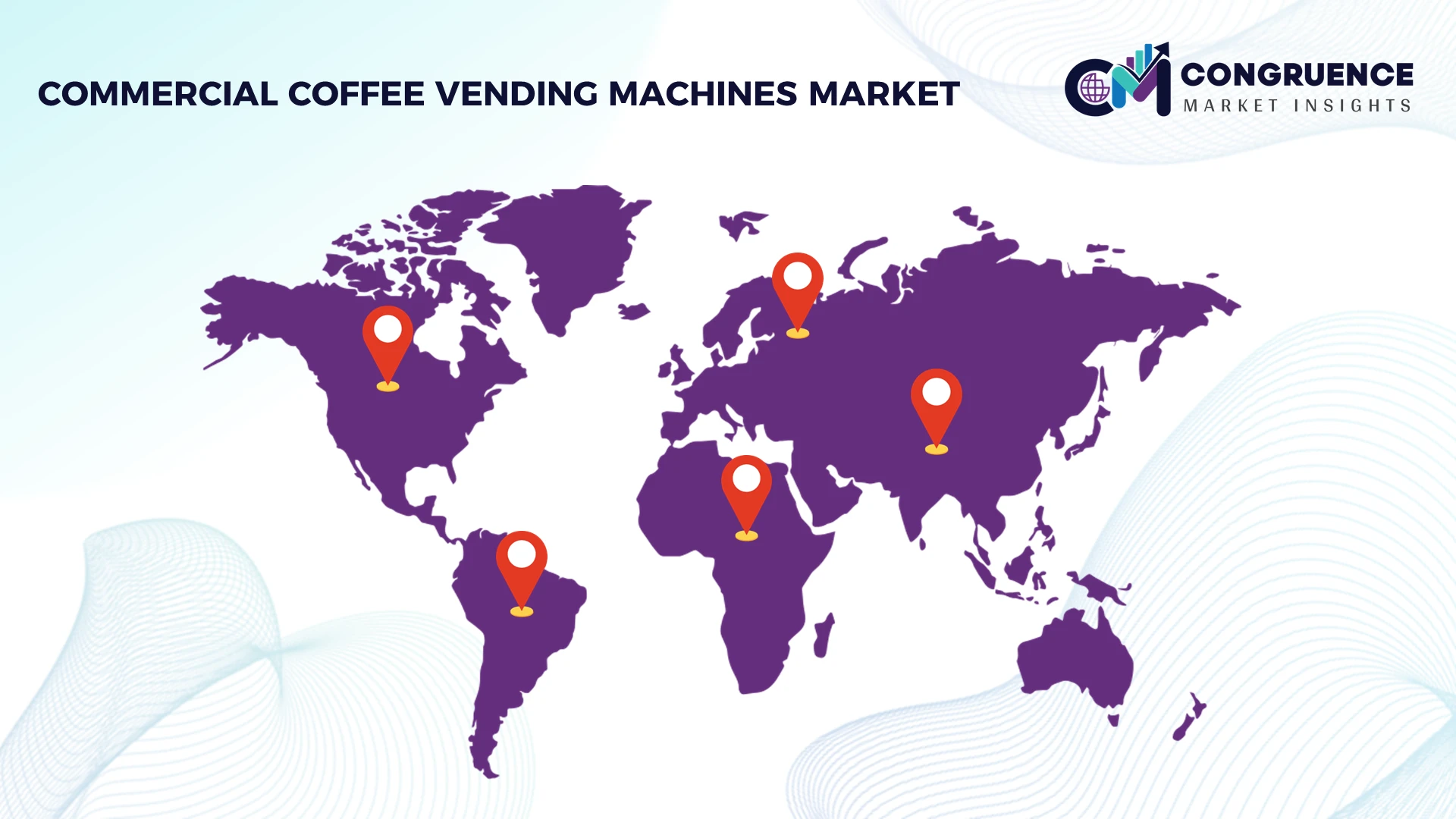
Workplace modernization shifts coffee vending toward connected premium service
North America holds approximately 31% of global commercial coffee vending machine demand, supported by extensive workplace, healthcare, education, hospitality, and transportation deployments. The United States represents the regional concentration point, with operators increasingly replacing basic dispensers with bean-to-cup and telemetry-enabled systems. Cashless functionality is present across more than 70% of advanced vending environments, strengthening transaction speed and machine-level data collection. Office-service providers are also integrating vending with micro markets, pantry programs, and water services, increasing account value without proportional staffing. Canada contributes through institutional and workplace installations, particularly where unattended service improves operating-hour coverage. Manufacturers are responding with modular brewing platforms, remote diagnostics, and integrated payment systems. The key regional shift is from equipment placement toward managed beverage infrastructure, making uptime, consumables optimization, and service responsiveness central purchasing criteria.
United States Market Outlook: The United States remains the region's most strategically significant market because of its large corporate workplace base, mature vending infrastructure, and established operator networks. High labor costs encourage unattended beverage formats, while demand for premium coffee is pushing operators toward fresh-brew and bean-to-cup equipment. Large enterprise accounts increasingly favor centralized fleet management, enabling operators to monitor inventory, machine performance, and consumption remotely across multiple locations.
Premiumization and efficiency reshape established vending infrastructure
Europe represents an estimated 26% market share, supported by mature vending networks across Germany, Italy, France, Spain, the United Kingdom, and the Netherlands. Demand is shifting from conventional instant systems toward bean-to-cup, fresh-brew, and energy-efficient equipment as employers modernize workplace amenities. Energy-efficient refrigeration, automated standby functions, and intelligent power management can reduce machine electricity consumption by roughly 10–20%. European operators are also adapting equipment portfolios to tighter sustainability expectations and growing preference for cashless transactions. Germany and Italy remain important equipment and deployment centers, while the United Kingdom shows strong workplace-service integration. Companies are prioritizing machines with lower maintenance requirements, recyclable components, and remote monitoring. The strategic differentiator is increasingly lifecycle cost rather than initial equipment price, encouraging suppliers to combine hardware, servicing, consumables, and digital management within longer-term contracts.
Germany Market Outlook: Germany provides a strong industrial base for commercial coffee vending through established vending operators, engineering capabilities, and high workplace automation standards. Demand is concentrated across offices, manufacturing facilities, hospitals, and public institutions. Buyers increasingly evaluate machines through energy consumption, maintenance intervals, payment interoperability, and beverage consistency. Suppliers offering efficient equipment with service contracts and localized technical support are positioned strongly in institutional deployments.
Automation scale and manufacturing depth accelerate deployment
Asia-Pacific accounts for approximately 29% of global demand and combines Japan's mature vending ecosystem with rapidly expanding workplace and hospitality adoption in China, India, South Korea, and Southeast Asia. Japan remains highly automated, while China provides substantial equipment manufacturing and electronics integration capabilities. India is seeing greater deployment across offices, hospitals, universities, malls, and transportation facilities as cashless payments and organized workplace services expand. Connected machines can reduce manual inventory checks by approximately 20–30%, improving fleet-level operating efficiency. Manufacturers are increasingly integrating payment terminals, IoT telemetry, touchscreen interfaces, and modular brewing systems during production rather than adding them as aftermarket features. The region's major advantage is the combination of manufacturing scale and high automation adoption, allowing suppliers to shorten product-development cycles and customize machines for different consumption environments.
Japan Market Outlook: Japan remains the most strategically mature country because vending is deeply integrated into everyday commercial infrastructure and consumers are accustomed to unattended purchasing. High machine density supports sophisticated payment, telemetry, and maintenance ecosystems. Suppliers benefit from demand for compact equipment, reliable uptime, and automated beverage preparation. Japanese operators are increasingly emphasizing digital monitoring and product personalization to extract greater value from established machine networks.
Workplace adoption expands alongside organized food-service infrastructure
South America represents an emerging commercial coffee vending market, with Brazil accounting for the largest demand concentration because of its extensive coffee culture, corporate workforce, retail infrastructure, and domestic coffee-processing ecosystem. Commercial operators are increasingly deploying machines in offices, hospitals, universities, shopping centers, and transportation locations where unattended service can extend operating coverage. Brazil's established coffee supply chain supports localized ingredient sourcing, while Argentina, Chile, and Colombia provide additional institutional demand. Cashless payment integration is expanding, although deployment remains more fragmented than in North America or Western Europe. Operators can achieve roughly 10–15% lower service requirements through remote monitoring and automated diagnostics. Companies are responding with compact machines, local distributor partnerships, and flexible service models. The principal opportunity lies in combining locally sourced coffee with reliable equipment rather than competing solely through low machine pricing.
Brazil Market Outlook: Brazil offers the strongest country-level opportunity because coffee production, consumption, equipment servicing, and enterprise demand intersect within one market. Its large corporate and hospitality base supports recurring machine utilization, while domestic coffee availability can reduce exposure to imported ingredient costs. Suppliers are increasingly emphasizing localized servicing, flexible financing, and machines capable of handling varied beverage formats.
Hospitality investment drives premium unattended beverage infrastructure
Middle East & Africa represents approximately 9% of global demand, with deployment concentrated in the Gulf states, South Africa, major airports, hotels, hospitals, corporate campuses, and high-footfall retail environments. The United Arab Emirates and Saudi Arabia are particularly important because large hospitality, tourism, commercial real-estate, and infrastructure projects require convenient beverage services across extended operating hours. Premium bean-to-cup machines are gaining preference where operators want café-style output without proportional staffing increases. Automated systems can reduce beverage preparation intervention by approximately 20–30% compared with conventional staffed service. Companies are forming distributor partnerships, integrating cashless payment systems, and supplying machines tailored to high-temperature operating conditions. The region's strategic opportunity is concentrated deployment within premium facilities rather than broad low-cost vending penetration, making reliability, service coverage, and premium beverage quality decisive purchasing factors.
United Arab Emirates Market Outlook: The UAE leads regional deployment sophistication through its concentration of airports, hotels, shopping destinations, offices, and large-scale commercial developments. High visitor traffic supports automated beverage service where transaction speed and continuous availability are important. Suppliers increasingly customize machines for premium hospitality environments, multilingual interfaces, cashless payments, and centralized fleet monitoring, creating opportunities for technology-led operators rather than commodity equipment providers.
The Commercial Coffee Vending Machines market pits Selecta, Westomatic, Azkoyen, Crane Payment Innovations, and Evoca against regional vending operators, specialist coffee-system suppliers, and technology-enabled service providers. The top five players are estimated to control roughly 30–35% of the market, leaving substantial space for localized operators. Competition centers on equipment economics, brewing technology, payment integration, service coverage, and consumables. Bean-to-cup systems can command 15–25% higher equipment value than basic instant machines, while connected telemetry can reduce servicing requirements by roughly 15–20%. Large players are expanding through service contracts, distributor partnerships, and integrated workplace solutions, while regional firms compete through customization and faster local support. The competitive shift is moving from machine sales toward recurring managed-service models combining equipment, ingredients, maintenance, and digital monitoring. Entry barriers include service networks, component sourcing, software integration, and enterprise contracts. Winning requires dependable hardware, premium beverage quality, data-enabled servicing, and scalable customer support.
Selecta Group
Westomatic Vending Services Ltd.
Azkoyen Group
Evoca Group
Crane Payment Innovations
JDE Peet's
N&W Global Vending
Bianchi Industry
Rhea Vendors Group
FAS International
Coffetek
SandenVendo
Bravilor Bonamat
Franke Coffee Systems
Current systems are shifting from basic instant dispensers toward bean-to-cup platforms with automated grinding, dosing, milk delivery, touchscreens, and cashless payment integration. Connected telemetry is increasingly deployed in fleets, enabling remote stock monitoring and fault alerts. These systems can improve beverage preparation efficiency by 10–15% and reduce manual service intervention by 8–12%, while digital payments shorten transaction handling by roughly 1–2%. Operators benefit from higher uptime, menu consistency, and precise replenishment.
Emerging technology centers on IoT-enabled predictive maintenance, AI-assisted demand forecasting, RFID inventory tracking, and modular fresh-milk systems. Predictive servicing can reduce avoidable technician visits by about 10–15%, while automated inventory workflows can improve replenishment accuracy by 5–10%. Compared with legacy powder-based machines, modern bean-to-cup platforms can deliver 15–25% faster preparation for beverages and support broader customization. Operators with integrated telemetry, payment, and service platforms gain an advantage through lower operating friction.
Disruptive development through 2026–2028 will come from machine-learning personalization, cloud fleet orchestration, computer-vision diagnostics, and energy-optimized refrigeration. Connected deployments already provide infrastructure for these capabilities. Companies combining brewing hardware, software, payments, and consumables stand to capture efficiency gains. The priority now is interoperability: modular APIs and standardized data flows allow operators to scale technology without replacing entire fleets.
April 2024 Lavazza announced a €185 million investment in IVS, raising its stake to 28.36% and strengthening its vending strategy. The transaction supports vertical integration between coffee production and automated distribution, expanding Lavazza’s control across European vending operations.
June 2024 Sodexo’s InReach acquired Capitol Vending and Coffee, adding about 250 clients across Texas. The expansion increased regional service density and strengthened integrated coffee, vending, and pantry capabilities, supporting broader workplace-service contracts and localized operating coverage.
May 2025 Aramark Refreshments introduced WorkScape Hub at the NAMA Show, targeting hybrid workplaces through integrated coffee and refreshment services. The launch responds to changing office utilization and supports bundled workplace solutions, improving account scalability and service personalization.
May 2025 Flavia debuted its AROMA Brewer and upgraded Creation systems at NAMA, targeting hybrid workplaces and premium beverage demand. The launch expands coffee choices while supporting flexible deployment, strengthening Flavia’s positioning in office refreshment markets.
The Commercial Coffee Vending Machines Market Report covers Bean-to-Cup, Instant Coffee, Capsule-Based, Filter Coffee, Fresh Brew, and Hybrid Machines across Self-Service Coffee, Employee Refreshment, Customer Service, Hospitality Service, Breakroom Service, and Public Refreshment applications. End-user analysis spans Offices, Hotels, Restaurants, Cafes, Hospitals, Educational Institutions, Retail Stores, and Transportation Hubs, with regional assessment across North America, Europe, Asia-Pacific, South America, and Middle East & Africa.
The report evaluates deployment intensity, automation adoption, cashless payment integration, IoT-enabled monitoring, brewing technologies, machine customization, and service-model evolution. Segment comparisons identify leading and fastest-shifting categories, while company analysis examines product positioning, partnerships, expansion priorities, and technology differentiation. Coverage supports investment planning, geographic expansion, portfolio decisions, procurement strategy, and competitive positioning from 2026 through 2033, with emphasis on premiumization, workplace modernization, unattended service, and connected fleet management.
| Report Attribute/Metric | Report Details |
|---|---|
Market Revenue in 2025 | USD 3621 Million |
Market Revenue in 2033 | USD 6362.47 Million |
CAGR (2026 - 2033) | 7.3% |
Base Year | 2025 |
Forecast Period | 2026 - 2033 |
Historic Period | 2021 - 2025 |
Segments Covered | By Type
By Application
By End-User
|
Key Report Deliverable | Revenue Forecast, Growth Trends, Market Dynamics, Segmental Overview, Regional and Country-wise Analysis, Competition Landscape |
Region Covered | North America, Europe, Asia-Pacific, South America, Middle East, Africa |
Key Players Analyzed | Selecta Group, Westomatic Vending Services Ltd., Azkoyen Group, Evoca Group, Crane Payment Innovations, JDE Peet's, N&W Global Vending, Bianchi Industry, Rhea Vendors Group, FAS International, Coffetek, SandenVendo, Bravilor Bonamat, Franke Coffee Systems |
Customization & Pricing | Available on Request (10% Customization is Free) |




