
Reports
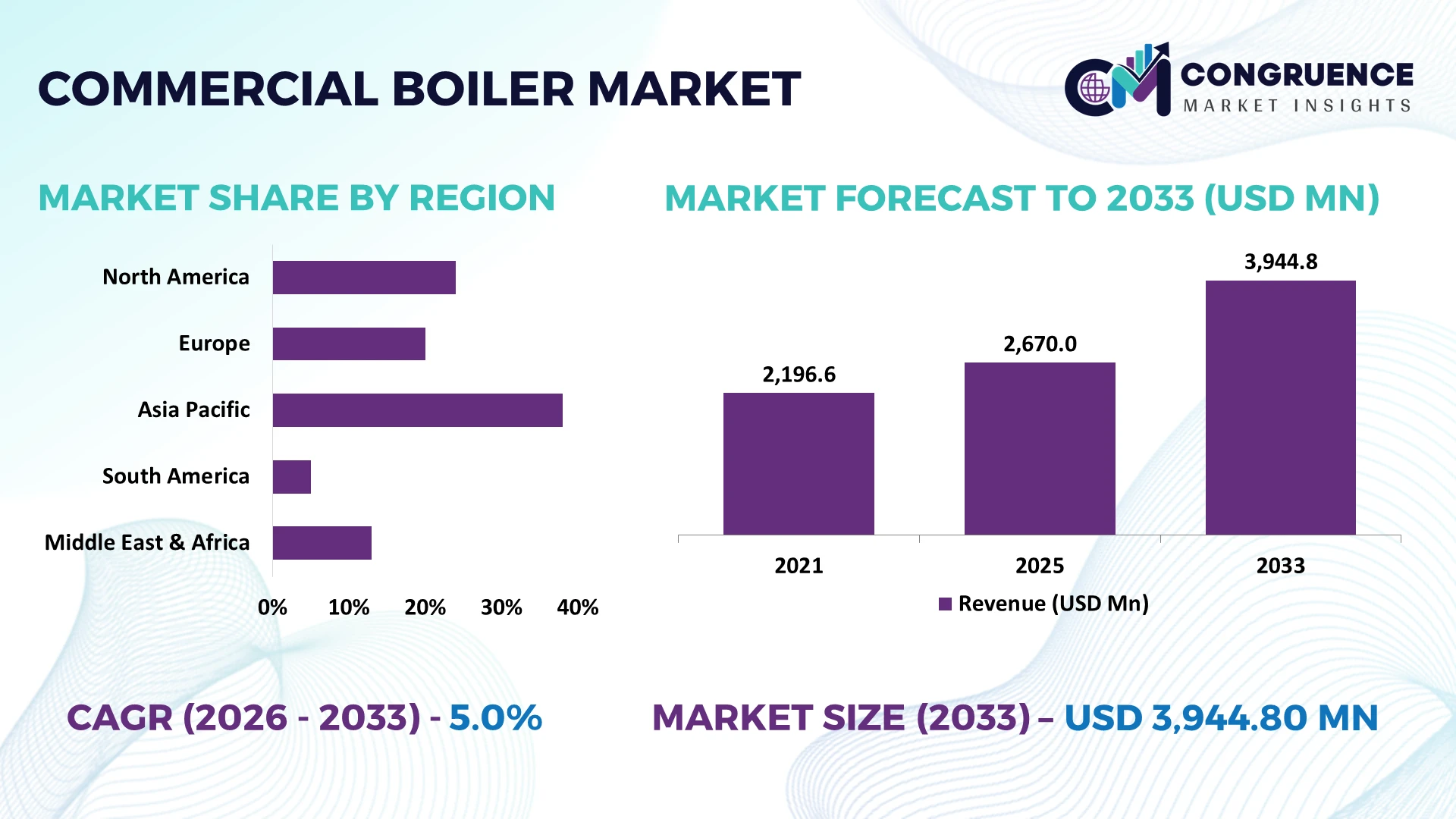
The Global Commercial Boiler Market was valued at USD 2670 Million in 2025 and is anticipated to reach a value of USD 3944.8 Million by 2033 expanding at a CAGR of 5% between 2026 and 2033. Growth is supported by stricter building-efficiency regulations, rapid replacement of aging heating infrastructure, and wider deployment of high-efficiency condensing and low-emission commercial boiler systems across institutional and industrial facilities.
China remains the dominant country, accounting for approximately 31% of global commercial boiler manufacturing capacity, supported by large-scale investments in district heating, commercial construction, and industrial modernization. More than 55% of newly installed commercial units integrate advanced combustion controls, compared with approximately 42% across Germany, where decarbonization policies accelerate premium system adoption. Ongoing global energy security initiatives following recent geopolitical supply-chain realignments continue to strengthen localized equipment production and component sourcing.
Manufacturers prioritizing high-efficiency, digitally monitored boiler platforms and regional production networks are positioned to secure stronger commercial contracts and long-term competitive advantage.
Market Size & Growth: USD 2670 Million (2025) to USD 3944.8 Million (2033) at 5% CAGR, driven by advanced condensing technology and commercial building modernization.
Top Growth Drivers: High-efficiency boiler adoption +18%, commercial retrofit activity +14%, low-emission heating installations +16%.
Short-Term Forecast: By 2028, intelligent boiler controls reduce operating costs by 12% while improving thermal efficiency by 10%.
Emerging Technologies: AI-based monitoring, IoT automation, and advanced heat exchanger materials improve maintenance efficiency by nearly 20%.
Regional Leaders: Asia Pacific exceeds USD 1500 Million, Europe approaches USD 980 Million, North America surpasses USD 860 Million, supported by district heating and clean-energy upgrades.
Consumer/End-User Trends: More than 48% of commercial facility upgrades prioritize connected, high-efficiency boiler systems for energy optimization.
Pilot/Case Example: In 2026, a commercial district heating upgrade improved fuel efficiency by 15% and reduced maintenance downtime by 18%.
Competitive Landscape: Bosch holds approximately 14% market share alongside Viessmann, Babcock Wanson, Miura, and Fulton.
Regulatory & ESG Impact: Low-emission compliance programs reduce fuel consumption by approximately 13% while supporting regional decarbonization initiatives.
Investment & Funding: Over USD 2 Billion supports manufacturing expansion, strategic partnerships, and regional supply-chain localization.
Innovation & Future Outlook: Hydrogen-ready boilers and predictive diagnostics accelerate the transition toward digitally connected, high-performance commercial heating systems.
Commercial Boiler Market demand is expanding across hospitals, educational institutions, manufacturing facilities, hospitality, and district heating networks as organizations prioritize energy-efficient heating infrastructure. Advanced condensing designs, smart combustion controls, and remote diagnostics improve operational performance, while nearly 40% of new commercial installations incorporate connected monitoring features. Regional manufacturing expansion and evolving emissions compliance continue to reshape procurement strategies, setting the foundation for broader strategic market developments.
Commercial boiler systems are becoming strategically important as governments, facility owners, and industrial operators prioritize energy resilience, emissions compliance, and operating-cost optimization. Infrastructure modernization programs and stricter building-efficiency regulations are accelerating replacement of aging heating assets with digitally managed, high-efficiency equipment. Simultaneously, supply-chain restructuring encourages localized manufacturing and component sourcing, strengthening procurement reliability while reducing delivery lead times for commercial projects.
Modern condensing commercial boilers deliver up to 18% higher thermal efficiency than conventional non-condensing systems while lowering fuel consumption by approximately 15%, creating measurable lifecycle savings. China leads large-scale manufacturing and commercial deployment, whereas Germany emphasizes premium low-emission systems integrated with smart building platforms. Over the next two to three years, connected monitoring is expected to exceed 50% of new commercial installations, enabling predictive maintenance, higher equipment availability, and improved asset utilization across healthcare, hospitality, and institutional facilities.
A recent district heating modernization project integrating IoT-enabled boiler controls reduced maintenance interventions by 20% and improved operational reliability across multiple commercial buildings. In response, manufacturers are expanding regional production, investing in hydrogen-ready platforms, and forming technology partnerships with building automation providers. Companies combining efficient combustion technologies with digital service capabilities will secure stronger competitive positioning through lower lifecycle costs, faster deployment, and differentiated service offerings.
Commercial building retrofits and industrial heating upgrades remain the primary market driver as organizations target lower energy intensity and higher operational reliability. High-efficiency condensing boiler installations improve fuel utilization by nearly 15%, while intelligent combustion controls reduce maintenance requirements by approximately 18%. In the United Kingdom, tightening building decarbonization policies continue to accelerate replacement of legacy heating equipment in public facilities and commercial complexes. This regulatory shift increases demand for integrated heating solutions with digital monitoring capabilities. Manufacturers are responding through localized production expansion, strategic technology partnerships, and investment in advanced control platforms. Companies delivering efficient, connected boiler systems gain stronger access to institutional procurement programs and long-term service agreements, creating recurring operational value beyond initial equipment sales.
Commercial boiler deployment continues to face pressure from fluctuating steel prices, electronic control component shortages, and skilled installation constraints. Advanced boiler systems typically require 20–30% higher upfront investment than conventional equipment, while project commissioning timelines can extend by nearly 15% because of specialized integration requirements. Germany and other manufacturing-intensive countries have experienced periodic supply disruptions affecting burner assemblies and automation components. These structural limitations compress contractor margins and delay commercial project execution. To reduce exposure, manufacturers are diversifying supplier networks, increasing regional component sourcing, and negotiating long-term procurement contracts. Standardized modular product designs also improve inventory flexibility and reduce installation complexity across commercial building portfolios.
The strongest opportunity lies in combining digital building management with next-generation low-emission heating technologies. More than 45% of large commercial facilities are prioritizing connected energy management solutions, while predictive maintenance platforms reduce unexpected equipment downtime by approximately 20%. Japan is advancing hydrogen-ready heating infrastructure, encouraging manufacturers to develop future-compatible commercial boiler systems with flexible fuel capability. Companies are increasing R&D investment in AI-enabled diagnostics, remote asset monitoring, and modular heat recovery technologies to strengthen lifecycle performance. Strategic partnerships between boiler manufacturers and building automation providers create integrated energy ecosystems that deliver measurable operational efficiency while expanding long-term service-based business models beyond equipment sales.
Long-term competitiveness depends on successfully integrating commercial boilers with increasingly complex digital building infrastructure. More than 35% of facility operators report shortages of technicians capable of commissioning advanced connected heating systems, while integrating legacy building management systems can increase implementation time by nearly 20%. In the United States, aging commercial infrastructure often requires extensive modernization before intelligent boiler platforms can operate at full capability. These execution challenges reduce deployment consistency and delay operational benefits despite strong technology availability. Companies must strengthen workforce training, expand certified service networks, invest in interoperable software architectures, and collaborate with automation specialists to ensure reliable implementation, scalable maintenance, and sustainable long-term operational performance.
Smart Boiler Control Expansion Connected commercial boiler platforms are becoming standard across large facilities, with over 52% of new installations integrating IoT monitoring and predictive diagnostics. AI-enabled combustion optimization improves fuel efficiency by nearly 14% while reducing unplanned maintenance by 18%. Labor shortages in the United Kingdom are accelerating remote service models, prompting manufacturers to expand software partnerships and digital maintenance platforms for faster operational response.
Hydrogen-Ready Product Development Boiler manufacturers are redesigning combustion systems to support low-carbon fuel flexibility as decarbonization policies accelerate. Hydrogen-ready commercial boilers now represent approximately 16% of newly launched premium product portfolios, while NOx emissions decline by nearly 20% compared with conventional systems. Companies in Germany are increasing engineering investments and certification programs to strengthen long-term competitiveness before broader hydrogen infrastructure deployment.
Localized Manufacturing Networks Supply-chain resilience has become a strategic operating priority following component disruptions and logistics volatility. More than 38% of major manufacturers have expanded regional sourcing, reducing average equipment lead times by approximately 15%. China continues strengthening localized production ecosystems, while global suppliers restructure procurement strategies through dual-source partnerships and modular manufacturing to improve delivery consistency and inventory flexibility.
Integrated Heat Recovery Systems Commercial projects increasingly combine boilers with advanced heat recovery technologies, delivering thermal efficiency improvements of nearly 17% and reducing overall fuel consumption by around 13%. Hospitals and institutional campuses are accelerating deployment to meet operational sustainability targets. Manufacturers respond through integrated equipment packages, engineering partnerships, and turnkey installation services that simplify implementation while improving long-term facility performance.
Condensing boilers lead the commercial boiler market with an estimated 43% share, supported by superior thermal efficiency, lower fuel consumption, and compliance with increasingly stringent emissions standards. Their ability to recover latent heat improves operating efficiency by up to 18% compared with conventional alternatives, making them the preferred choice for hospitals, commercial buildings, and educational institutions. Manufacturers continue expanding premium product portfolios with integrated digital controls and modular configurations to simplify installation and lifecycle management. Fire tube boilers remain widely deployed because of their lower installation cost and maintenance simplicity, particularly in small and medium commercial facilities requiring moderate steam or hot water output.
Water tube boilers represent the fastest-growing type as high-capacity industrial and institutional facilities require greater pressure capability and rapid steam generation. Adoption has increased by approximately 16% in large infrastructure projects where operational continuity is critical. Non-condensing boilers continue serving replacement demand in older facilities where complete system retrofits remain economically challenging. Manufacturers are prioritizing condensing technologies through product innovation while strengthening water tube offerings for specialized applications, reflecting a clear investment shift toward high-efficiency, digitally integrated commercial heating systems.
Space heating accounts for approximately 46% of commercial boiler installations, driven by widespread deployment across offices, hospitals, educational institutions, and public infrastructure. Consistent heating demand, energy optimization programs, and stricter building-efficiency standards reinforce its market leadership. Smart temperature controls improve energy utilization by nearly 12%, encouraging facility managers to replace aging equipment with digitally managed systems. Hot water applications remain essential in hospitality and healthcare, where uninterrupted supply and operational reliability directly influence service quality and regulatory compliance.
Process heating is the fastest-growing application as food processing, pharmaceuticals, and light manufacturing facilities modernize production infrastructure. Deployment has expanded by nearly 17% through automated process integration and higher thermal precision requirements. Steam generation continues supporting industrial laundries, healthcare sterilization, and institutional operations where stable pressure delivery remains essential. Manufacturers are expanding integrated heating solutions, combining remote monitoring, automation, and modular configurations to address application-specific requirements while strengthening long-term service relationships with commercial operators.
Commercial buildings hold approximately 41% of total demand because of extensive heating requirements across offices, retail complexes, mixed-use developments, and business parks. Large building portfolios increasingly replace legacy equipment with high-efficiency systems capable of reducing operating costs by nearly 15%. Integrated building management platforms improve equipment utilization by approximately 18%, encouraging property owners to prioritize connected commercial boiler installations. Government facilities maintain stable procurement through infrastructure modernization initiatives, while educational institutions continue upgrading campus heating systems to improve long-term operational efficiency.
Healthcare represents the fastest-growing end-user segment as hospitals expand capacity and require continuous, highly reliable heating, hot water, and sterilization support. Annual deployment of advanced boiler systems has increased by approximately 16% in newly developed healthcare infrastructure. Hospitality continues investing in energy-efficient equipment to improve guest comfort while reducing utility expenditure. Manufacturers respond through customized product configurations, long-term maintenance agreements, and strategic partnerships with engineering contractors, strengthening customer retention and expanding service-based business models across diverse institutional environments.
Asia-Pacific accounted for the largest market share at 41% in 2025 however, Middle East & Africa is expected to register the fastest growth, expanding at a 6.4% between 2026 and 2033.

Modernization Through Intelligent Heating Infrastructure
North America represents approximately 24% of the global commercial boiler market, supported by large-scale replacement of aging heating assets across healthcare, education, commercial buildings, and government facilities. Building decarbonization programs and stricter efficiency standards continue accelerating deployment of condensing boiler systems with integrated building management controls. More than 58% of new commercial projects specify digitally monitored heating equipment to improve lifecycle performance and maintenance planning. Institutional retrofits and district energy upgrades remain major procurement channels, while manufacturers strengthen regional service networks and engineering partnerships to reduce commissioning time. Growing adoption of predictive maintenance platforms and modular boiler configurations improves operational reliability and lowers facility operating costs across large commercial campuses.
United States Market Outlook: The United States leads regional demand through extensive commercial infrastructure, strong replacement activity, and widespread investment in high-efficiency building systems. Nearly 60% of large commercial retrofit projects now prioritize condensing boiler installations integrated with intelligent building automation. Federal energy-efficiency initiatives and expanding healthcare infrastructure continue supporting advanced boiler deployment, while domestic manufacturers increase localized production and digital service capabilities to strengthen aftermarket competitiveness.
Decarbonization Policies Reshape Commercial Heating
Europe accounts for nearly 27% of global commercial boiler deployment, driven by stringent emissions regulations, building renovation programs, and widespread adoption of low-emission heating technologies. Commercial facilities increasingly replace conventional equipment with condensing and hydrogen-ready systems to meet evolving environmental targets. More than 54% of newly installed premium commercial boilers incorporate smart energy management functions that improve operational efficiency and reduce maintenance requirements. Manufacturers continue investing in advanced combustion technologies, regional engineering centers, and strategic technology collaborations to strengthen compliance and product differentiation while supporting commercial infrastructure modernization.
Germany Market Outlook: Germany remains the region's technology leader through strong manufacturing capability, engineering expertise, and advanced heating equipment deployment. Approximately 45% of newly installed commercial boiler systems utilize high-efficiency condensing technology integrated with intelligent control platforms. Industrial modernization policies and expanding low-carbon heating initiatives encourage continuous investment in innovation, enabling domestic manufacturers to strengthen export competitiveness and premium commercial product portfolios.
Manufacturing Scale and Infrastructure Expansion
Asia-Pacific contributes approximately 41% of global market demand, supported by extensive commercial construction, industrial expansion, and district heating investments. Rapid deployment across hospitals, educational institutions, business parks, and manufacturing facilities sustains strong equipment utilization. More than 55% of newly commissioned commercial boiler systems incorporate advanced combustion controls and digital monitoring technologies. Local manufacturers continue expanding production capacity while strengthening component localization to improve supply-chain resilience and delivery performance. Large infrastructure projects and smart city developments reinforce long-term demand for efficient commercial heating solutions across both developed and emerging economies.
China Market Outlook: China dominates regional manufacturing and commercial deployment through extensive production capacity and integrated industrial supply chains. The country accounts for roughly 31% of global commercial boiler manufacturing output, supported by ongoing commercial construction and district heating modernization. Domestic companies continue expanding automated manufacturing facilities, investing in intelligent boiler technologies, and improving export capabilities to strengthen global market influence while meeting rising domestic demand.
Industrial Upgrades Support Market Expansion
South America represents approximately 5% of global commercial boiler demand, supported by infrastructure upgrades across healthcare, food processing, hospitality, and institutional facilities. Commercial replacement projects increasingly prioritize energy-efficient equipment capable of reducing operating costs while improving reliability. Nearly 22% of recent commercial installations include digital monitoring capabilities that simplify maintenance planning. Infrastructure limitations and financing constraints continue affecting deployment speed, encouraging manufacturers to introduce modular product offerings and localized engineering support. Strategic distributor partnerships improve market access while reducing project implementation complexity across developing commercial sectors.
Brazil Market Outlook: Brazil remains the largest commercial boiler market in South America because of its diversified industrial base and expanding commercial infrastructure. Approximately 48% of regional commercial boiler installations occur within the country, supported by investments in hospitals, hospitality facilities, and food manufacturing. Manufacturers strengthen local distribution, technical service capabilities, and installation partnerships to improve project execution while addressing increasing demand for energy-efficient heating equipment.
Infrastructure Investment Drives Advanced Heating Deployment
The Middle East & Africa market is supported by commercial infrastructure expansion, healthcare investments, hospitality developments, and industrial diversification programs. Large institutional projects increasingly deploy high-efficiency commercial boiler systems designed for long operating cycles and lower energy consumption. More than 28% of newly developed commercial facilities incorporate digitally controlled heating equipment as developers prioritize operational efficiency. Manufacturers expand regional partnerships, engineering support, and localized service capabilities to improve project delivery while addressing evolving sustainability requirements. Public infrastructure modernization and commercial real estate development continue strengthening procurement activity across key investment hubs.
Saudi Arabia Market Outlook: Saudi Arabia leads regional commercial boiler demand through major infrastructure development, healthcare expansion, and hospitality investments linked to national economic diversification initiatives. Commercial construction activity continues driving deployment of advanced heating systems, with approximately 30% of new institutional projects specifying high-efficiency boiler technologies. International manufacturers strengthen local partnerships and technical support operations to capture long-term opportunities created by expanding commercial infrastructure.
The market is led by Bosch Industrial Boilers, Viessmann, Miura, Babcock Wanson, Fulton, and Cleaver-Brooks, with global technology leaders competing against regional manufacturers focused on cost efficiency and localized service. The top five players collectively account for approximately 48% of the market. Competition centers on combustion efficiency, digital controls, delivery speed, lifecycle service, and product customization, with premium systems improving thermal efficiency by up to 18% and predictive maintenance reducing service costs by nearly 15%. Companies increasingly differentiate through regional manufacturing expansion, engineering partnerships, aftermarket service contracts, and hydrogen-ready product development rather than price alone. Vertical integration of critical components strengthens supply-chain resilience and shortens equipment lead times. The primary entry barrier is compliance with stringent commercial safety and emissions standards combined with advanced engineering capability. Winning requires superior energy performance, reliable service networks, digital integration expertise, and localized production supporting faster commercial project execution.
Bosch Industrial Boilers
Viessmann
Miura Co., Ltd.
Babcock Wanson
Cleaver-Brooks
Fulton
Cochran Ltd.
Hurst Boiler & Welding Co.
A.O. Smith
Ferroli S.p.A.
Parker Boiler Co.
ICI Caldaie
Lochinvar
Weil-McLain
Commercial boiler technology is rapidly shifting toward high-efficiency condensing systems, low-NOx burners, and intelligent combustion controls that optimize thermal performance while reducing fuel consumption. Nearly 58% of newly commissioned commercial boilers now integrate digital monitoring platforms, while advanced combustion optimization improves operating efficiency by approximately 14% and lowers maintenance costs by around 12%. Compared with conventional non-condensing boilers, modern condensing systems deliver up to 18% higher thermal efficiency, making them the preferred technology for hospitals, educational campuses, and commercial complexes seeking lower lifecycle operating costs.
Emerging technologies include AI-enabled predictive maintenance, IoT-connected boiler management, hydrogen-ready combustion systems, and modular heat recovery integration. Around 45% of premium commercial installations now incorporate cloud-based diagnostics that reduce unexpected downtime by nearly 20%. Digital twin technology is improving commissioning accuracy, while automated control algorithms continuously optimize fuel-air ratios. Large global manufacturers benefit through premium product differentiation, whereas regional suppliers strengthen competitiveness by integrating smart controls into mid-range boiler platforms without significantly increasing installation complexity.
Between 2026 and 2028, hybrid heating architectures combining commercial boilers with renewable heat sources and intelligent building management systems will accelerate deployment across institutional infrastructure. Connected fleet management is expected to exceed 55% of new commercial installations, improving asset utilization and service responsiveness. Companies investing now in hydrogen-compatible platforms, cybersecurity-enabled controls, and predictive analytics will secure stronger long-term contracts, higher aftermarket revenues, and greater competitive resilience as commercial heating standards continue advancing.
January 2025 Bosch Home Comfort launched the Buderus SSB Boiler Gen 2 for commercial applications, introducing upgraded stainless-steel heat exchangers and enhanced performance components across outputs up to 8,192 MBH, strengthening reliability and lifecycle efficiency for commercial facilities. Source: (Bosch Home Comfort)
March 2025 Miura showcased Miura Connect™ 2.0 and three advanced boiler technologies at the ABMA Boiler Technology Conference, expanding digital boiler-room management capabilities with enhanced operational visibility and predictive maintenance functions for industrial and commercial users. Source: (Miura Boiler)
August 2025 Bosch Home Comfort completed its acquisition of Johnson Controls and Hitachi's residential and light commercial HVAC business, significantly expanding its heating portfolio and strengthening global commercial heating market competitiveness. Source: (日本のボッシュ・グループ)
June 2026 Bosch Home Comfort Group and Hitachi announced collaboration on AI-enabled building connectivity and diagnostics through HMAX for Buildings, targeting mission-critical facilities to maximize equipment lifetime value and improve operational efficiency. Source: (Hitachi)
This report provides comprehensive analysis of the commercial boiler market across Fire Tube, Water Tube, Condensing, and Non-Condensing technologies, evaluating their operational positioning, deployment trends, and technology evolution. It assesses demand across Space Heating, Hot Water, Steam Generation, and Process Heating applications, together with detailed evaluation of Healthcare, Hospitality, Educational Institutions, Commercial Buildings, and Government Facilities. Regional assessments cover North America, Europe, Asia-Pacific, South America, and the Middle East & Africa, highlighting deployment concentration, technology adoption, and competitive dynamics.
The report evaluates adoption trends exceeding 50% for intelligent commercial heating systems in advanced markets, technology integration patterns, product innovation strategies, and competitive positioning across major manufacturers. It supports investment planning, product development, expansion strategies, partnership evaluation, and procurement decisions by identifying operational trends, emerging deployment opportunities, evolving customer priorities, and strategic market direction expected to shape commercial boiler adoption between 2026 and 2033.
| Report Attribute/Metric | Report Details |
|---|---|
Market Revenue in 2025 | USD 2670 Million |
Market Revenue in 2033 | USD 3944.8 Million |
CAGR (2026 - 2033) | 5% |
Base Year | 2025 |
Forecast Period | 2026 - 2033 |
Historic Period | 2021 - 2025 |
Segments Covered | By Type
By Application
By End-User
|
Key Report Deliverable | Revenue Forecast, Growth Trends, Market Dynamics, Segmental Overview, Regional and Country-wise Analysis, Competition Landscape |
Region Covered | North America, Europe, Asia-Pacific, South America, Middle East, Africa |
Key Players Analyzed | Bosch Industrial Boilers, Viessmann, Miura Co., Ltd., Babcock Wanson, Cleaver-Brooks, Fulton, Cochran Ltd., Hurst Boiler & Welding Co., A.O. Smith, Ferroli S.p.A., Parker Boiler Co., ICI Caldaie, Lochinvar, Weil-McLain |
Customization & Pricing | Available on Request (10% Customization is Free) |




