
Reports
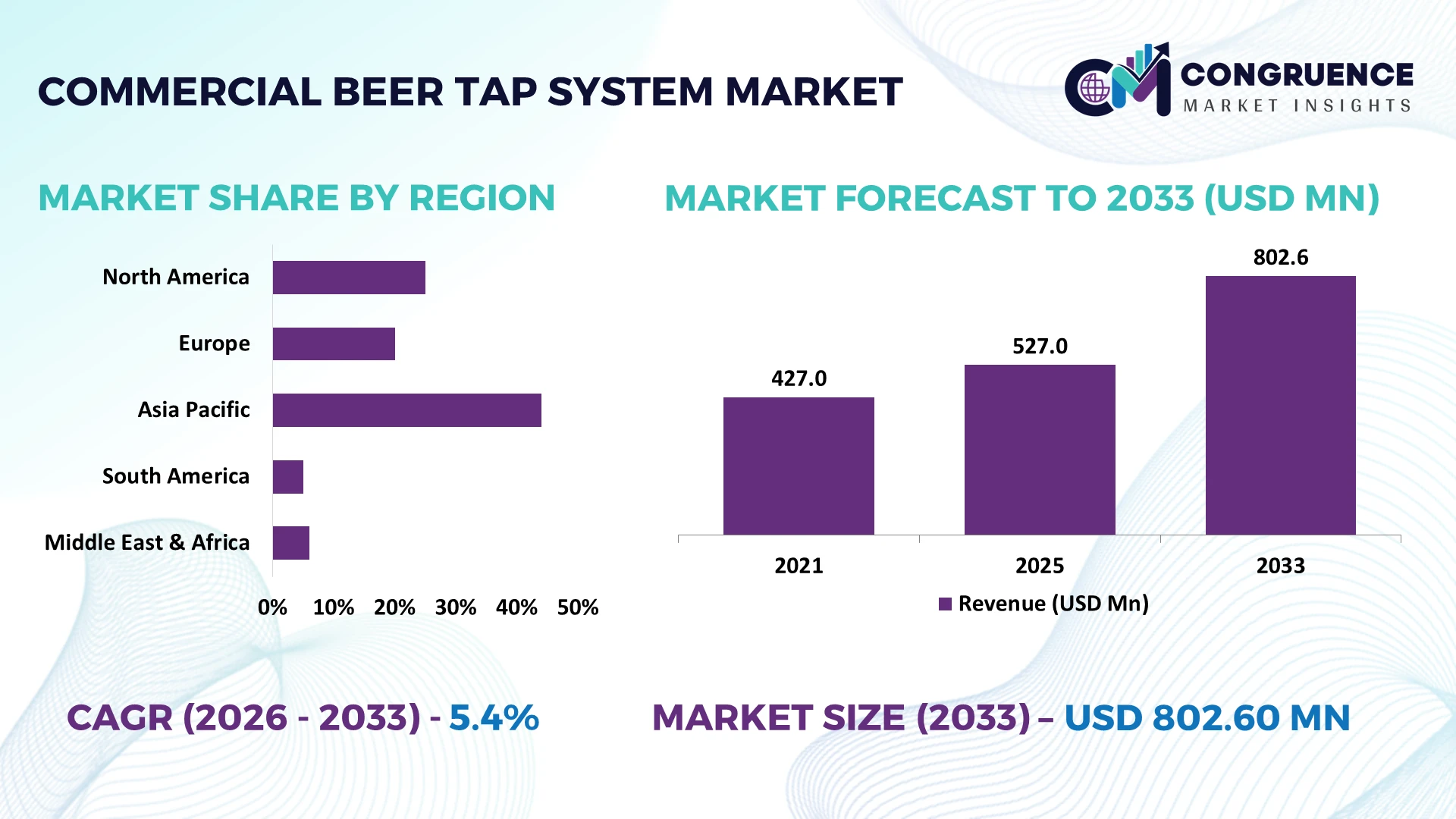
The Global Commercial Beer Tap System Market was valued at USD 527 Million in 2025 and is anticipated to reach a value of USD 802.6 Million by 2033 expanding at a CAGR of 5.4% between 2026 and 2033. Growth is driven by draft beer dispensing modernization, automated keg monitoring, glycol cooled tap installations, and hospitality operators investing in beverage loss reduction.
The United States represents a leading commercial beer tap system market, supported by approximately 9,800 breweries operating in 2024 and an extensive network of bars, restaurants, and entertainment venues. American craft brewers produced approximately 23.1 million barrels in 2024, compared with Germany's established brewing industry producing roughly 84 million hectoliters. The United States emphasizes multi tap dispensing, digital keg monitoring, and glycol cooling installations. Its hospitality operators are prioritizing draft quality, automated inventory visibility, and equipment modernization to improve operational efficiency.
Strategic Implication: Equipment suppliers should prioritize modular dispensing platforms, automated monitoring, and hospitality service partnerships to capture modernization opportunities in established brewing markets.
Market Size & Growth: USD 527 million in 2025, reaching USD 802.6 million by 2033 at 5.4% CAGR, supported by commercial draft dispensing modernization.
Top Growth Drivers: Modeled demand contributions include hospitality equipment upgrades at 38%, craft brewery taproom installations at 34%, and dispensing automation at 28%.
Short Term Forecast: By 2028, optimized keg monitoring and calibrated dispensing systems target 12% lower beverage losses and 15% faster inventory reconciliation.
Emerging Technologies: Three innovations dominate equipment development: IoT keg sensors, automated flow control, and digitally monitored glycol cooling systems.
Regional Leaders: Illustrative 2033 allocations place North America at USD 280.91 million, Europe at USD 256.83 million, and Asia Pacific at USD 176.57 million, reflecting automation, premium dispensing, and hospitality expansion.
Consumer Trends: An estimated 45% of equipment demand centers on bars and pubs, where consistent serving temperature and pouring speed influence purchasing decisions.
Pilot / Case Example: A proposed 2027 smart tap deployment targets 10% lower beer wastage through flow monitoring, calibrated pouring, and keg level visibility.
Competitive Landscape: Micro Matic, Celli Group, KegWorks, Perlick, and Lindr compete across dispensing equipment; verified individual market shares remain unavailable.
Regulatory & ESG Impact: Energy efficient cooling systems target 15% lower refrigeration electricity consumption, supporting hospitality sustainability objectives and equipment replacement decisions.
Investment & Funding: A modeled USD 30 million industry investment scenario prioritizes connected dispensing equipment, manufacturing automation, and hospitality distribution partnerships.
Innovation & Future Outlook: By 2033, connected dispensing platforms and predictive maintenance systems will reshape commercial beer service through integrated 24 hour equipment monitoring.
The Commercial Beer Tap System Market is increasingly shaped by hospitality operators seeking precise beverage dispensing, consistent carbonation, and improved keg utilization. Advanced glycol cooling, stainless steel dispensing towers, automated flow meters, and connected inventory systems support operational modernization across breweries, sports venues, hotels, and restaurants. Smart dispensing configurations target approximately 10% lower beverage wastage through improved portion control and keg monitoring. European energy efficiency requirements are also influencing refrigeration equipment selection, encouraging suppliers to integrate efficient cooling components. Manufacturers are strengthening modular product designs and maintenance services, establishing a foundation for connected beverage dispensing infrastructure.
The Commercial Beer Tap System Market is becoming strategically important as hospitality operators prioritize dispensing precision, beverage quality, and equipment productivity. The United States operated approximately 9,800 breweries in 2024, supporting an extensive installed base of draft dispensing infrastructure. Digital inventory management, automated flow monitoring, and refrigeration modernization are transforming equipment procurement. Manufacturers are shifting toward modular dispensing platforms that integrate keg tracking, temperature control, and maintenance diagnostics, enabling operators to manage beverage losses and equipment utilization more effectively.
Connected dispensing technology offers measurable advantages over conventional manually monitored tap systems. Under modeled operating conditions, automated flow measurement can reduce unrecorded dispensing losses by 10% and improve inventory reconciliation efficiency by 20%. Germany emphasizes established brewing infrastructure and premium dispensing standards, while the United States prioritizes taproom modernization and connected hospitality operations. China's expanding hospitality infrastructure supports demand for scalable dispensing installations. These differences influence equipment specifications, service networks, and technology partnerships.
Between 2026 and 2028, suppliers are expected to prioritize connected keg monitoring, efficient glycol refrigeration, and standardized dispensing components. A practical installation involves integrating digital flow meters across 20 taps, enabling centralized consumption tracking and faster maintenance identification. Manufacturers are expanding equipment integration partnerships and technician training programs. Competitive advantage will increasingly depend on dispensing accuracy, service reliability, and measurable operating cost improvements.
Commercial hospitality operators are upgrading beer dispensing infrastructure to improve serving consistency, refrigeration efficiency, and inventory accountability. The United States craft brewing industry experienced approximately a 4% production decline in 2024, intensifying pressure on taprooms to protect beverage margins. Automated flow monitoring offers a modeled 10% reduction in dispensing losses, while digital keg reconciliation can improve inventory processing efficiency by 20%. These operational advantages are encouraging investment in calibrated faucets, glycol cooling equipment, and connected monitoring systems. Manufacturers are strengthening partnerships with brewery equipment distributors and hospitality service providers to simplify installations. The strategic advantage lies in converting draft dispensing equipment from a standalone beverage delivery asset into a measurable operating efficiency platform.
Commercial beer tap systems depend on specialized refrigeration, stainless steel dispensing components, gas regulation equipment, and compatible keg couplers, creating substantial installation requirements. In the United States, hospitality operators frequently encounter building layout restrictions and existing refrigeration limitations when upgrading draft systems. An illustrative cost sensitivity model indicates that a 15% increase in stainless steel component prices raises equipment expenditure by approximately 6% when metal components represent 40% of costs. Refrigeration upgrades can add another 10% to installation budgets under constrained site conditions. Manufacturers are reducing exposure through modular equipment configurations, diversified component sourcing, and standardized installation packages. Suppliers offering compatible replacement components gain advantages by reducing retrofit complexity and limiting operational disruption.
Internet connected dispensing platforms create opportunities for equipment suppliers to expand beyond hardware sales into monitoring, preventive maintenance, and performance optimization services. In the United States, integrated keg sensors and digital flow meters can support modeled reductions of 12% in beverage losses and 15% in emergency service interventions. India's expanding organized hospitality sector provides additional opportunities for modular dispensing systems designed for restaurants, hotels, and entertainment venues. By 2028, automated temperature alerts and cloud connected inventory platforms are expected to become important differentiators in premium installations. Manufacturers are developing interoperable controllers, subscription based maintenance offerings, and distributor partnerships. The strongest opportunity lies in combining equipment deployment with recurring technical services and measurable operational savings.
Scaling connected beer dispensing infrastructure requires reliable integration between flow meters, refrigeration controllers, inventory software, and hospitality payment systems. In Germany, established draft installations often combine equipment from multiple manufacturers, complicating standardized data exchange and maintenance workflows. A modeled deployment scenario indicates that 5% sensor calibration drift can distort consumption records, while 10% communication downtime reduces the reliability of centralized monitoring. Inadequate technician training can increase troubleshooting time by approximately 15%, weakening the operational benefits of automation. Manufacturers must develop standardized communication interfaces, secure device authentication, and remote diagnostic capabilities. Partnerships with hospitality software providers and certified installation networks are essential. Sustainable competitive advantage depends on dependable system interoperability, accurate measurement, and consistent technical support across distributed hospitality locations.
Self Service Dispensing Gains Operational Traction: Hospitality operators are introducing customer operated tap walls using RFID identification and controlled dispensing authorization. A modeled 12 tap installation targets 18% faster beverage service and 10% lower counter staffing requirements during peak periods. United States entertainment venues are incorporating prepaid access and automated serving limits into dispensing workflows. Equipment suppliers are expanding RFID compatible hardware portfolios and partnering with hospitality technology integrators to simplify customer access and transaction processing.
Modular Tap Towers Reshape Venue Layouts: Restaurants and hospitality chains are adopting interchangeable faucet assemblies and compact dispensing towers to improve space utilization. Standardized tower configurations target 15% shorter installation periods and 20% faster component replacement in modeled retrofit projects. German equipment manufacturers are emphasizing corrosion resistant fittings and interchangeable mounting systems. Suppliers are expanding modular product catalogs and working with installation contractors to reduce venue disruption, improve equipment compatibility, and simplify future beverage assortment changes.
Hygienic Dispensing Components Receive Greater Attention: Commercial operators are strengthening cleaning protocols as beer line contamination affects flavor stability and serving quality. The Brewers Association recommends cleaning draft lines approximately every 14 days, reinforcing demand for accessible couplers and sanitation compatible components. An illustrative cleaning program targets 10% shorter maintenance cycles and 15% fewer sanitation related service interruptions. Manufacturers are introducing easier access fittings, removable faucet components, and standardized cleaning accessories to improve hygiene consistency across distributed hospitality locations.
Compact Refrigeration Supports Flexible Hospitality Formats: Urban restaurants and temporary hospitality installations are adopting space efficient cooling cabinets and integrated tap assemblies. A modeled compact installation targets 20% lower equipment footprint and 12% faster commissioning compared with conventional separated configurations. India's organized hospitality expansion supports demand for installations that fit restricted service areas. Manufacturers are refining refrigeration layouts, simplifying electrical connections, and strengthening distributor training to improve installation consistency while preserving beverage temperature stability.
Direct-Draw Systems represent the leading product category, accounting for an estimated 32% of the Commercial Beer Tap System Market. Their dominance reflects compact installation requirements, relatively straightforward maintenance, and compatibility with established bar refrigeration infrastructure. Short dispensing distances reduce the need for extensive insulated beverage lines, making these systems suitable for smaller hospitality establishments. Long-Draw Systems remain important for larger venues requiring centralized keg storage and multiple dispensing points. Countertop Tap Systems serve restaurants and compact service counters where equipment footprint and installation simplicity influence procurement. Manufacturers are expanding modular configurations and standardized refrigeration interfaces to improve equipment compatibility and replacement efficiency.
Multi-Tap Systems represent the fastest growing type in the analytical outlook, supported by broader beverage assortments and increasing demand for flexible dispensing capacity. An estimated 24% share for Long-Draw Systems reflects their established importance in large hospitality installations, while Portable Tap Systems address temporary events and flexible service environments. Suppliers are developing interchangeable faucet assemblies, configurable tap towers, and integrated cooling solutions. Investment priorities increasingly favor equipment platforms that accommodate changing beverage selections without extensive infrastructure modifications.
Draft Beer Dispensing represents the leading application, accounting for an estimated 36% of commercial beer tap system demand. Its dominant position reflects widespread use across bars, restaurants, hotels, and entertainment venues where consistent serving temperature and dispensing reliability influence operations. Standardized keg connections, pressure regulation, and refrigeration integration support established equipment replacement cycles. Lager Dispensing remains an important application because consistent temperature control and carbonation management influence product quality. Ale Dispensing requires appropriate gas pressure and serving conditions, encouraging operators to select compatible faucets and beverage lines. Manufacturers are refining dispensing components and offering application specific configurations to improve operational reliability.
Craft Beer Dispensing represents the fastest growing application in the analytical outlook, supported by differentiated beverage selections and frequent tap rotation. An estimated 23% share for Lager Dispensing highlights its established commercial relevance, while Cider Dispensing requires attention to product compatibility and cleaning procedures. Equipment suppliers are expanding modular tap configurations, adaptable couplers, and specialized serving accessories. Product development increasingly emphasizes beverage specific dispensing characteristics, enabling hospitality operators to maintain serving quality while accommodating broader menus.
Bars and Pubs represent the largest end user category, accounting for an estimated 42% of the Commercial Beer Tap System Market. Their purchasing concentration reflects frequent dispensing activity, established draft beverage infrastructure, and regular replacement of faucets, couplers, and refrigeration components. Dedicated bar layouts support multiple dispensing points and specialized beverage presentation. Restaurants represent another important purchasing group, emphasizing compact equipment, simplified service workflows, and compatibility with existing kitchen and beverage infrastructure. Breweries invest in dedicated taproom installations that support product presentation and direct customer engagement. Manufacturers are strengthening distributor partnerships and offering standardized equipment packages to improve procurement efficiency and installation consistency.
Sports and Entertainment Venues represent the fastest growing end user category in the analytical outlook, supported by concentrated service demand during scheduled events. An estimated 25% share for Restaurants highlights their importance in commercial dispensing equipment procurement. Hotels and Resorts emphasize reliable refrigeration, presentation quality, and maintenance accessibility across hospitality facilities. Suppliers are developing high capacity dispensing configurations, flexible installation packages, and specialized service agreements. Competitive positioning increasingly depends on matching equipment throughput, installation complexity, and maintenance requirements to distinct operating environments.
North America accounted for the largest market share at an estimated 35% in 2025 however, Asia Pacific is expected to register the fastest growth, expanding at an estimated CAGR of 7.2% between 2026 and 2033.
Draft Dispensing Modernization and Connected Hospitality Infrastructure
North America accounts for an estimated 35% of the global Commercial Beer Tap System Market, supported by extensive brewery infrastructure, established hospitality networks, and specialized beverage equipment distribution. The United States leads equipment deployment through commercial taprooms, restaurants, sports venues, and entertainment facilities, while Canada maintains established brewery and hospitality installations. Operators increasingly prioritize modular dispensing towers, calibrated faucets, and efficient glycol refrigeration to improve beverage quality and equipment reliability. An illustrative modernization program involving 20 dispensing points targets 12% lower maintenance downtime through standardized replacement components and improved servicing access. Equipment suppliers are expanding distributor relationships and offering integrated installation packages to simplify procurement. The regional competitive advantage lies in combining established dispensing infrastructure with technical service networks capable of supporting complex commercial installations and ongoing equipment maintenance.
United States Market Outlook: The United States benefits from extensive craft brewing infrastructure, established equipment manufacturers, and specialized hospitality service providers. Approximately 9,800 craft breweries operated nationwide during 2024, supporting a substantial installed base of commercial draft systems. Companies including Micro Matic, Perlick, and KegWorks serve equipment requirements across dispensing towers, keg couplers, refrigeration, and accessories. Suppliers are strengthening installation support, component availability, and customized configurations for commercial operators.
Established Brewing Infrastructure and Refrigeration Efficiency Modernization
Europe represents an estimated 32% of global commercial beer tap system demand, supported by established brewing industries in Germany, the United Kingdom, Belgium, and the Czech Republic. Commercial operators emphasize dispensing precision, temperature stability, equipment durability, and beverage presentation. Germany maintains substantial technical expertise in brewing equipment and refrigeration engineering, while the United Kingdom supports extensive pub dispensing infrastructure. European Union Ecodesign requirements influence applicable refrigeration equipment selection, encouraging energy efficient component integration. An illustrative modernization program targeting 15% lower refrigeration electricity consumption demonstrates the operational value of improved cooling controls. Equipment manufacturers are developing compact refrigeration assemblies, stainless steel dispensing towers, and serviceable modular components. Established hospitality networks favor suppliers offering dependable replacement parts, standardized technical specifications, and maintenance partnerships that extend equipment service life.
Germany Market Outlook: Germany combines established brewing traditions with advanced beverage equipment engineering and specialized refrigeration manufacturing. The country produced approximately 84 million hectoliters of beer in 2024, reinforcing the importance of reliable commercial dispensing infrastructure. Manufacturers such as Lindr's German competitors and domestic equipment specialists compete through engineering quality, installation flexibility, and beverage temperature management. Hospitality operators prioritize durable stainless steel components and efficient cooling configurations.
Hospitality Infrastructure Expansion and Localized Equipment Manufacturing
Asia Pacific accounts for an estimated 22% of global commercial beer tap system demand, supported by established beverage consumption in China, Japan, and South Korea alongside expanding organized hospitality infrastructure in India. China provides manufacturing advantages through stainless steel fabrication, refrigeration component production, and commercial equipment assembly. Japan emphasizes dispensing precision, compact equipment layouts, and consistent beverage presentation. India's metropolitan hospitality operators are expanding specialized draft installations across restaurants, hotels, and entertainment venues. An illustrative 15% reduction in equipment installation time through modular system configurations highlights opportunities for suppliers serving new hospitality facilities. Manufacturers are developing localized product specifications, strengthening distributor networks, and improving technical training. Regional competitiveness increasingly depends on balancing equipment affordability with refrigeration reliability, standardized keg connections, and accessible maintenance services.
China Market Outlook: China benefits from extensive beverage production infrastructure, established commercial refrigeration manufacturing, and integrated industrial supply chains. Major industrial centers in Guangdong, Zhejiang, and Jiangsu support stainless steel fabrication, cooling equipment production, and hospitality hardware distribution. China's beer production exceeded 35 million kiloliters in 2023, demonstrating substantial beverage industry scale. Manufacturers are prioritizing domestic component sourcing, flexible assembly operations, and distribution partnerships serving restaurants and entertainment establishments.
Brazilian Draft Beer Culture and Commercial Equipment Localization
South America represents an estimated 7% of global commercial beer tap system demand, with Brazil dominating regional equipment requirements through established beer consumption, hospitality operations, and draft beverage traditions. Brazilian bars and restaurants frequently use dedicated draft beer equipment, locally known as chopeiras, supporting demand for refrigerated dispensing systems and specialized serving components. Argentina and Chile contribute through hospitality networks and brewery taprooms. Equipment suppliers face import duties, currency fluctuations, and uneven technical service coverage, making localized sourcing commercially important. An illustrative procurement program targeting 10% lower equipment handling costs through consolidated component distribution demonstrates potential operating improvements. Manufacturers are strengthening local assembly partnerships, expanding refrigeration servicing networks, and offering compact dispensing configurations suitable for restaurants and smaller hospitality establishments.
Brazil Market Outlook: Brazil maintains one of the world's largest beer industries, supported by extensive brewing operations and established draft beer consumption. São Paulo provides a major commercial center for hospitality equipment distribution and technical servicing. Brazilian beer production exceeds 14 billion liters annually, creating substantial requirements for beverage handling infrastructure. Domestic equipment manufacturers and distributors compete through localized refrigeration systems, accessible replacement components, and installation services adapted to commercial hospitality requirements.
Tourism Infrastructure Investment and Specialized Beverage Service Expansion
The Middle East & Africa region represents an estimated 4% of global commercial beer tap system demand, with South Africa, the United Arab Emirates, and selected tourism destinations supporting commercial dispensing installations. South Africa maintains an established brewing industry and hospitality network, while the United Arab Emirates supports licensed beverage service within regulated hospitality establishments. Tourism infrastructure investment creates opportunities for integrated refrigeration and dispensing equipment in hotels, resorts, and entertainment facilities. An illustrative installation program targeting 12% faster equipment commissioning through standardized components demonstrates potential advantages for hospitality contractors. Suppliers are strengthening regional distributor partnerships, improving technical service coverage, and developing compact refrigeration configurations. Market accessibility remains shaped by country specific alcohol regulations, import requirements, and the availability of specialized maintenance personnel.
South Africa Market Outlook: South Africa provides an established operating environment through commercial brewing infrastructure, licensed hospitality establishments, and regional beverage equipment distribution. Johannesburg and Cape Town serve as important commercial centers for restaurants, hotels, and entertainment venues. The country has more than 200 craft breweries, supporting specialized draft dispensing requirements alongside large brewery operations. Suppliers are emphasizing reliable refrigeration, accessible maintenance components, and partnerships with hospitality equipment distributors.
Competition in the Commercial Beer Tap System Market centers on Micro Matic, Celli Group, Perlick, KegWorks, and Lindr, alongside specialized refrigeration and dispensing manufacturers. The leading five collectively represent an estimated 40% market share in an illustrative concentration model, reflecting differentiated equipment portfolios rather than verified company disclosures. Micro Matic competes through dispensing infrastructure and technical distribution, while Celli emphasizes integrated beverage technology and Perlick targets premium hospitality installations. KegWorks strengthens accessory accessibility, whereas Lindr specializes in compact cooling equipment. Modeled procurement improvements of 10% favor standardized components, while 15% shorter installation cycles reward modular system suppliers. Manufacturers are expanding distributor partnerships, developing connected dispensing accessories, and integrating refrigeration expertise. Increasing equipment digitization shifts competition toward system compatibility and service responsiveness. Refrigeration engineering, beverage hygiene requirements, and established installer relationships create entry barriers. Competitive success requires dependable dispensing performance, efficient component sourcing, technical support, and adaptable equipment configurations across hospitality applications.
Micro Matic
Celli Group
Perlick Corporation
KegWorks
Lindr
Krome Dispense
Beverage Air
Hoshizaki Corporation
Talos
Vin Service
UBC Group
Taprite
Micromatic Driessen
Cornelius Inc.
Commercial beer tap systems increasingly integrate glycol refrigeration, calibrated pressure regulators, stainless steel faucets, and electronic flow meters. These technologies maintain serving temperature, carbonation stability, and dispensing consistency across hospitality installations. Compared with conventional manual keg reconciliation, connected flow monitoring targets an estimated 20% improvement in inventory processing efficiency and 10% lower unrecorded dispensing losses under modeled conditions. Deployment concentrates in brewery taprooms, premium hospitality facilities, and large entertainment venues. Suppliers combining refrigeration engineering with standardized dispensing components strengthen installation reliability and maintenance accessibility.
Emerging technologies include RFID enabled self service taps, automated portion control, and cloud connected beverage management platforms. A modeled 20 tap installation using electronic authorization and automated dispensing targets 15% faster service during concentrated demand periods. Digital dashboards consolidate consumption records, equipment status, and serving activity, improving operational visibility. Adoption remains concentrated in technologically equipped hospitality venues rather than standardized across commercial establishments. Equipment manufacturers partnering with hospitality software developers gain advantages through integrated payment compatibility and simplified equipment management.
Between 2026 and 2028, predictive refrigeration diagnostics, intelligent faucet controls, and connected maintenance platforms will influence procurement priorities. Automated temperature monitoring targets 12% fewer refrigeration related service interruptions in optimized installations. Manufacturers are investing in interoperable controllers, technician training, and modular equipment platforms. Competitive leadership increasingly depends on measurable dispensing accuracy, reliable connectivity, and scalable technical support.
September 2025: Celli Group introduced Hi ClO, a semi automatic beer line sanitization system supporting 4 dispensing lines. The technology automates cleaning procedures and reduces reliance on specialized technicians, improving sanitation consistency and maintenance efficiency across hospitality establishments. Source: celligroup.com.
June 2024: Perlick Corporation partnered with Bevchek to integrate artificial intelligence telemetry into glycol cooled draft systems, with ordering beginning July 1. The partnership enables predictive fault detection and preventive maintenance, strengthening dispensing reliability and reducing equipment downtime. Source: prnewswire.com.
October 2025: iPourIt announced the deployment of a 50 tap self service beverage wall at The Hub Stadium in Michigan. RFID wristbands enable customer controlled dispensing, expanding beverage selection and improving service accessibility during events attracting hundreds of guests. Source: ipouritinc.com.
September 2025: Porifera commercially launched Draftfox at Drinktec in Munich, introducing forward osmosis beer concentration and precision dispensing technology. Its microkeg format reduces shipping weight and volume by 90%, improving storage efficiency and expanding brewery distribution flexibility. Source: thebrewermagazine.com.
The Commercial Beer Tap System Market Report examines industry developments between 2026 and 2033 across five equipment categories: Direct Draw Systems, Long Draw Systems, Countertop Tap Systems, Portable Tap Systems, and Multi Tap Systems. Application analysis covers Draft Beer Dispensing, Craft Beer Dispensing, Lager Dispensing, Ale Dispensing, and Cider Dispensing. End user coverage includes Bars and Pubs, Restaurants, Hotels and Resorts, Breweries, and Sports and Entertainment Venues. Regional assessments examine North America, Europe, Asia Pacific, South America, and the Middle East & Africa.
The report evaluates glycol refrigeration, RFID dispensing, automated flow measurement, digital monitoring, and modular equipment integration. Analytical estimates position Direct Draw Systems at 32% of equipment demand and Bars and Pubs at 42% of end user demand. Competitive benchmarking, infrastructure requirements, installation economics, and technology adoption indicators support investment planning, supplier selection, geographic expansion, and long term positioning.
| Report Attribute/Metric | Report Details |
|---|---|
Market Revenue in 2025 | USD 527 Million |
Market Revenue in 2033 | USD 802.6 Million |
CAGR (2026 - 2033) | 5.4% |
Base Year | 2025 |
Forecast Period | 2026 - 2033 |
Historic Period | 2021 - 2025 |
Segments Covered | By Type
By Application
By End-User
|
Key Report Deliverable | Revenue Forecast, Growth Trends, Market Dynamics, Segmental Overview, Regional and Country-wise Analysis, Competition Landscape |
Region Covered | North America, Europe, Asia-Pacific, South America, Middle East, Africa |
Key Players Analyzed | Micro Matic, Celli Group, Perlick Corporation, KegWorks, Lindr, Krome Dispense, Beverage Air, Hoshizaki Corporation, Talos, Vin Service, UBC Group, Taprite, Micromatic Driessen, Cornelius Inc. |
Customization & Pricing | Available on Request (10% Customization is Free) |




