
Reports
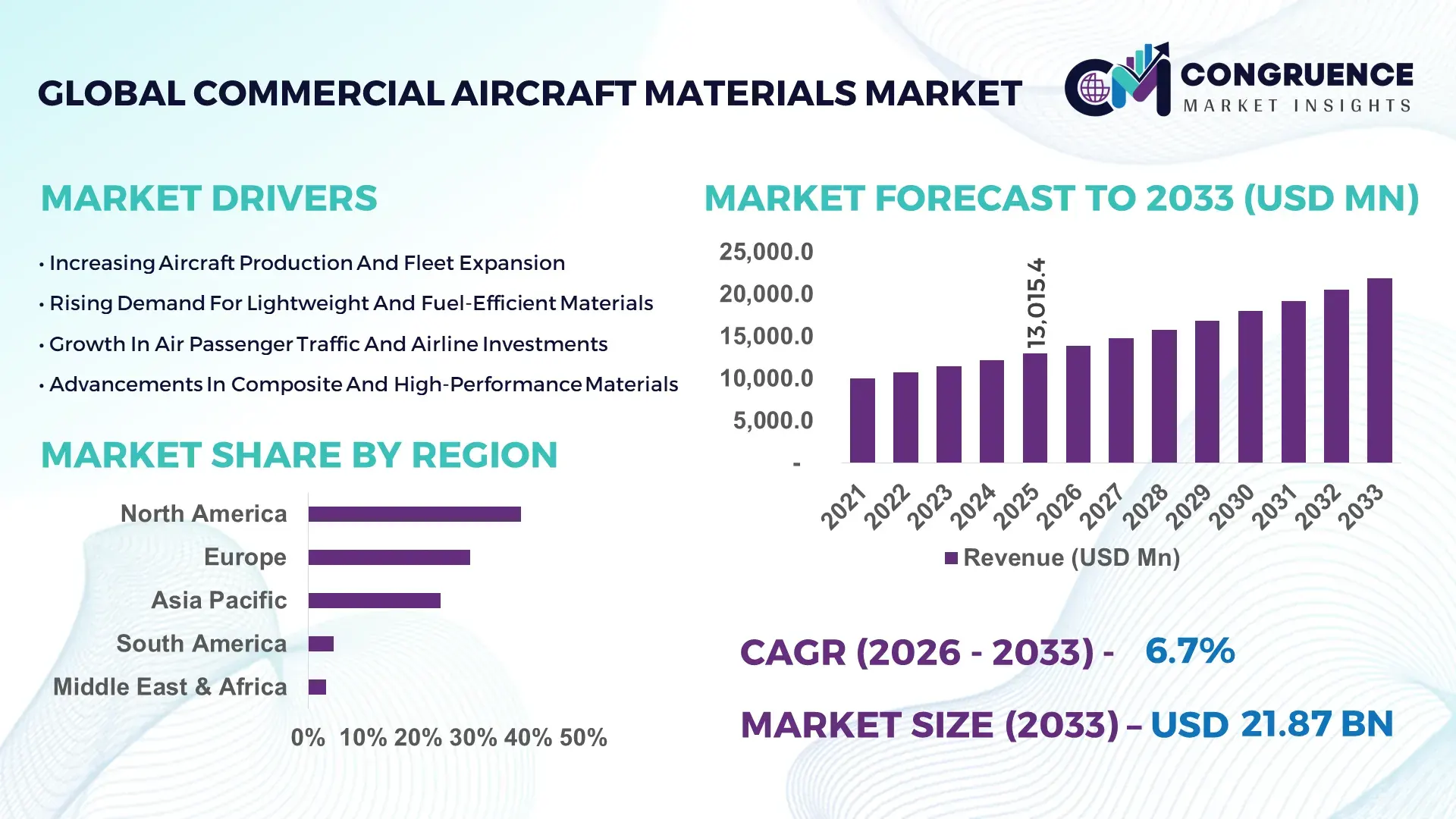
The Global Commercial Aircraft Materials Market was valued at USD 13,015.4 Million in 2025 and is anticipated to reach a value of USD 21,866.2 Million by 2033 expanding at a CAGR of 6.7% between 2026 and 2033, according to an analysis by Congruence Market Insights. Growth is driven by increasing aircraft production rates and demand for lightweight, fuel-efficient materials.
The United States leads the Commercial Aircraft Materials market with advanced aerospace manufacturing capabilities, strong R&D investment, and extensive supply chain networks. In 2025, the country accounted for over 41% of global aerospace material processing capacity, supported by more than 3,500 certified aerospace suppliers. Investments in advanced composites and lightweight alloys exceeded USD 2.8 billion during 2024–2025. Composite materials now represent nearly 53% of new aircraft structural components in domestic programs, while titanium and aluminum alloys continue to dominate engine and fuselage applications. Commercial aircraft production lines across major facilities processed over 1.2 million metric tons of aerospace-grade materials annually, with additive manufacturing adoption improving material utilization efficiency by 27%.
Market Size & Growth: Valued at USD 13,015.4 million in 2025, projected to reach USD 21,866.2 million by 2033, driven by lightweight material demand and fleet expansion.
Top Growth Drivers: Composite material adoption (46%), fuel efficiency improvement (38%), aircraft production increase (34%).
Short-Term Forecast: By 2028, advanced composites are expected to improve weight reduction efficiency by over 30%.
Emerging Technologies: Carbon fiber composites, additive manufacturing, advanced alloys.
Regional Leaders: North America projected at USD 8.2 billion by 2033; Europe at USD 6.5 billion driven by aerospace innovation; Asia-Pacific at USD 5.1 billion supported by fleet expansion.
Consumer/End-User Trends: Over 58% of aircraft manufacturers prioritize lightweight and durable materials for efficiency.
Pilot or Case Example: In 2024, a composite material pilot reduced aircraft weight by 25% and improved fuel efficiency by 18%.
Competitive Landscape: Hexcel leads with ~21% share, followed by Toray Industries, Solvay, Alcoa, and ATI.
Regulatory & ESG Impact: Emission reduction targets and sustainable aviation initiatives driving material innovation.
Investment & Funding Patterns: Over USD 3.6 billion invested globally in aerospace materials innovation between 2023–2025.
Innovation & Future Outlook: Integration of advanced composites and additive manufacturing shaping next-generation aircraft materials.
Composite materials account for approximately 52% of modern aircraft structures, followed by aluminum alloys (32%) and titanium alloys (16%). Innovations in lightweight materials and additive manufacturing are improving performance and efficiency. Regulatory focus on emissions reduction and sustainability is accelerating adoption, while regional demand is driven by fleet expansion and aerospace manufacturing growth.
The Commercial Aircraft Materials Market is strategically critical for improving aircraft performance, fuel efficiency, and sustainability. Advanced composite materials deliver up to 28% weight reduction compared to traditional aluminum structures, significantly enhancing fuel efficiency and operational performance. These materials are increasingly integrated into fuselage, wings, and interior components to meet stringent emission regulations.
North America dominates in volume due to established aerospace manufacturing infrastructure, while Europe leads in adoption with over 55% of aircraft programs incorporating advanced composite materials. By 2027, additive manufacturing technologies are expected to reduce material waste by 35%, improving production efficiency and cost optimization.
From an ESG perspective, manufacturers are committing to sustainability goals such as 30% reduction in carbon emissions and increased use of recyclable materials by 2030. In 2024, a leading aerospace company achieved a 24% reduction in material waste through advanced manufacturing techniques.
Strategically, integration of digital manufacturing, advanced materials, and supply chain optimization is shaping the future of the market. By 2028, next-generation composite materials are expected to improve aircraft durability by 22%. These advancements position the Commercial Aircraft Materials Market as a cornerstone of aerospace innovation, regulatory compliance, and sustainable aviation growth.
The Commercial Aircraft Materials market dynamics are influenced by increasing demand for fuel-efficient aircraft, advancements in material science, and evolving regulatory standards. Aerospace manufacturers are prioritizing lightweight and high-strength materials to enhance performance and reduce operational costs. The adoption of composite materials, advanced alloys, and additive manufacturing technologies is transforming production processes. Additionally, the expansion of global air travel and fleet modernization programs are driving demand for new aircraft materials. Supply chain optimization and digital manufacturing are further enhancing efficiency and scalability, reinforcing the market’s long-term growth trajectory.
The demand for lightweight materials is a key driver of the Commercial Aircraft Materials market. Advanced composites and alloys reduce aircraft weight by up to 30%, improving fuel efficiency and reducing emissions. In 2025, over 60% of new aircraft designs incorporated composite materials in primary structures. These materials enhance durability and reduce maintenance requirements, supporting long-term cost savings. The growing emphasis on sustainability and regulatory compliance further accelerates adoption, making lightweight materials essential for modern aircraft manufacturing.
High costs and manufacturing complexity are significant restraints for the Commercial Aircraft Materials market. Advanced composites and specialty alloys can cost 25–40% more than traditional materials, increasing production expenses. Additionally, manufacturing processes such as composite curing and additive manufacturing require specialized equipment and skilled labor. These factors increase production time and operational complexity, limiting adoption among smaller manufacturers and emerging markets.
Additive manufacturing offers significant opportunities for the Commercial Aircraft Materials market. This technology improves material utilization by up to 30% and reduces waste, supporting cost efficiency and sustainability. In 2025, over 45% of aerospace manufacturers integrated additive manufacturing into their production processes. The ability to produce complex components with high precision enhances performance and reduces assembly requirements, creating new growth opportunities for the market.
Supply chain disruptions and regulatory requirements present challenges for the Commercial Aircraft Materials market. Aerospace materials require strict certification and compliance, increasing approval timelines by up to 20%. Additionally, global supply chain disruptions can impact material availability and production schedules. These challenges require manufacturers to invest in supply chain resilience and regulatory compliance strategies, increasing operational costs.
Adoption of Advanced Composite Materials: Over 65% of new aircraft programs incorporate composite materials, improving weight efficiency by 30% and enhancing structural performance by 25%.
Growth in Additive Manufacturing Applications: Additive manufacturing adoption increased by 42% in 2024–2025, improving material utilization by 28% and reducing production waste significantly.
Integration of Sustainable Materials: Approximately 38% of aerospace manufacturers are developing recyclable materials, reducing environmental impact by 22% and supporting sustainability goals.
Expansion of High-Performance Alloys: Advanced alloys are used in over 47% of engine components, improving durability by 26% and enhancing performance under extreme conditions.
The Commercial Aircraft Materials market segmentation reflects diverse material types, applications, and end-user requirements across the aerospace industry. By type, the market includes composite materials, aluminum alloys, titanium alloys, and other specialty materials. Applications span structural components, interiors, engines, and landing gear systems. End-user insights highlight strong demand from aircraft manufacturers, MRO providers, and component suppliers. Segmentation trends demonstrate how material innovation and performance requirements influence market growth.
Composite materials account for approximately 52% of adoption, driven by their lightweight and high-strength properties, while aluminum alloys hold around 32%. However, titanium alloys are the fastest-growing segment, expected to expand at over 7.9% CAGR, supported by demand for high-performance engine components. Other materials, including specialty alloys and polymers, collectively contribute 16%.
In 2025, advanced composite materials were implemented in large-scale aircraft programs, improving structural efficiency and reducing overall weight significantly.
Structural components lead with a 49% share, driven by demand for lightweight and durable materials in aircraft design. Engine components are the fastest-growing application, projected above 7.2% CAGR, supported by demand for high-performance materials. Interiors and other applications collectively account for 51%. In 2025, over 57% of aircraft manufacturers prioritized advanced materials for structural optimization, while 43% focused on improving engine efficiency.
In 2025, advanced materials were deployed across multiple aircraft programs, improving performance and operational efficiency.
Aircraft manufacturers dominate with a 61% share, driven by increasing production rates and demand for advanced materials. MRO providers are the fastest-growing segment, expanding at over 6.9% CAGR, supported by maintenance and retrofit requirements. Component suppliers and other users collectively account for 39%. In 2025, 54% of aerospace companies integrated advanced materials into production, while 46% focused on maintenance and upgrades.
In 2025, over 500 aerospace companies adopted advanced material technologies to enhance production efficiency and performance.
North America accounted for the largest market share at 38.6% in 2025 however, Asia-Pacific is expected to register the fastest growth, expanding at a CAGR of 7.9% between 2026 and 2033.
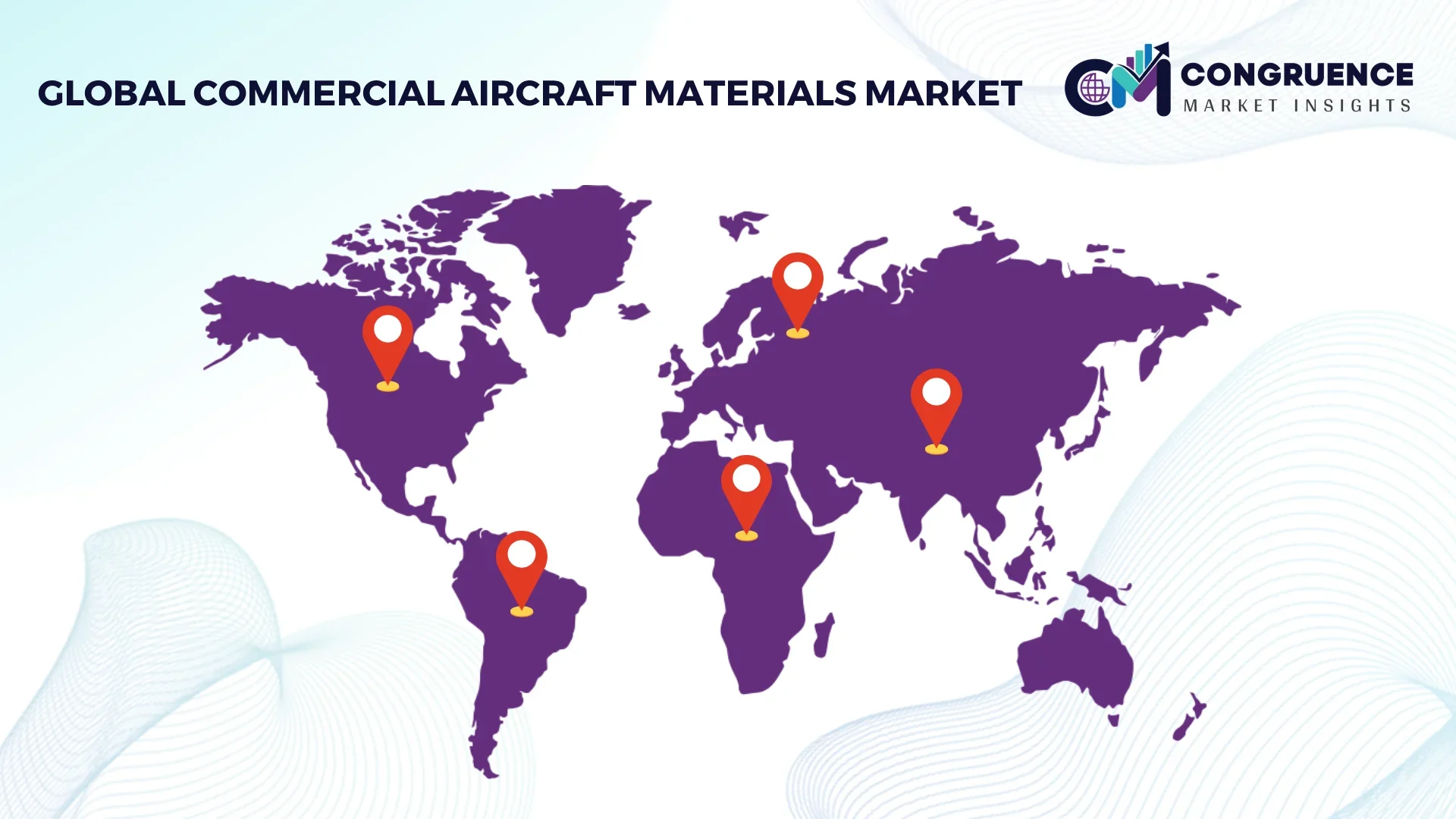
North America processed over 520,000 metric tons of aerospace-grade materials in 2025, supported by more than 2,800 active aerospace manufacturing units and over 65% integration of composite materials in new aircraft programs. Europe followed with a 29.4% share, driven by strong aircraft production pipelines in Germany, France, and the UK, where over 58% of aircraft structures incorporate advanced composites. Asia-Pacific accounted for 24.1%, with China and India expanding domestic aircraft production and material consumption exceeding 410,000 metric tons annually. South America and Middle East & Africa collectively held 7.9%, supported by growing MRO activities and regional fleet expansion programs.
How are advanced aerospace manufacturing ecosystems accelerating demand for lightweight high-performance materials?
This region held approximately 38.6% of the Commercial Aircraft Materials market in 2025, driven by strong demand across aircraft manufacturing, defense aviation, and MRO sectors. Over 67% of aircraft programs in the region utilize advanced composite materials for structural components. Regulatory support for sustainable aviation fuels and emission reduction standards has accelerated adoption of lightweight materials. Technological advancements include additive manufacturing, digital twin simulation, and AI-driven material optimization. A leading regional aerospace supplier increased composite production capacity by 22%, enhancing supply chain efficiency. Consumer behavior reflects high adoption of advanced materials among OEMs focused on performance optimization and sustainability compliance.
Why is sustainability-driven aerospace innovation transforming material adoption strategies?
Europe accounted for nearly 29.4% of the Commercial Aircraft Materials market in 2025, with Germany, France, and the UK contributing over 64% of regional demand. Strict environmental regulations have driven adoption of recyclable and lightweight materials, with over 55% of aircraft programs incorporating sustainable composites. Advanced manufacturing technologies improved material efficiency by 26%. A regional aerospace company developed next-generation composite materials with reduced carbon footprint. Regional behavior shows strong preference for sustainable and compliant materials, driven by regulatory pressure and environmental goals.
What is fueling rapid expansion of aerospace material demand across emerging aviation hubs?
Asia-Pacific accounted for 24.1% of the Commercial Aircraft Materials market in 2025, with China, India, and Japan leading growth. Aircraft production expansion and fleet modernization programs increased material demand by 32%. Investments in aerospace manufacturing infrastructure improved production capacity significantly. A regional manufacturer expanded composite material production facilities, supporting domestic aircraft programs. Consumer behavior reflects growing demand for cost-efficient and high-performance materials, particularly in emerging aviation markets.
How is regional aviation growth influencing demand for advanced aerospace materials?
South America held approximately 4.6% of the global Commercial Aircraft Materials market in 2025, led by Brazil and Argentina. Expansion of regional airlines and MRO activities increased demand for aerospace materials by 21%. Government incentives supporting aerospace manufacturing improved investment levels. A regional aerospace company enhanced material processing capabilities for aircraft components, improving production efficiency. Consumer behavior highlights demand for durable and cost-effective materials, particularly in maintenance and retrofit applications.
Why is aviation infrastructure development driving material demand in emerging markets?
The region accounted for around 3.3% of global Commercial Aircraft Materials demand in 2025, with UAE and South Africa leading growth. Investments in aviation infrastructure and airline expansion increased material consumption by 19%. Technological modernization initiatives improved adoption of advanced materials. A regional aerospace firm implemented composite material solutions for aircraft maintenance, improving efficiency. Consumer behavior reflects growing demand for high-performance materials, particularly in airline and MRO sectors.
United States Commercial Aircraft Materials Market – 34.9%: High aerospace production capacity, strong R&D investment, and extensive supplier network.
Germany Commercial Aircraft Materials Market – 16.3%: Advanced aerospace engineering capabilities, strong manufacturing base, and emphasis on sustainable materials.
The Commercial Aircraft Materials market is moderately consolidated, with over 85 active global players including material manufacturers, aerospace suppliers, and specialty chemical companies. The top five companies collectively account for approximately 58% of the market, reflecting strong competitive positioning and technological leadership.
Competition is driven by innovation in advanced composites, high-performance alloys, and additive manufacturing technologies. Strategic initiatives such as partnerships, mergers, and product innovations increased by 26% during 2024–2025. Companies are focusing on enhancing material performance, reducing weight, and improving sustainability. Product differentiation is increasingly based on durability, strength-to-weight ratio, and compliance with environmental regulations.
Investment in R&D has increased significantly, with leading companies allocating over 12% of their budgets to material innovation. Supply chain integration and digital manufacturing are improving efficiency and scalability. The market is evolving toward sustainable and high-performance materials, with increasing collaboration between material suppliers and aircraft manufacturers to develop next-generation solutions.
Alcoa Corporation
ATI (Allegheny Technologies Incorporated)
Teijin Limited
Mitsubishi Chemical Group
SGL Carbon
Arconic Corporation
Constellium
Norsk Hydro
Kobe Steel
Carpenter Technology Corporation
Materion Corporation
Technological advancements in the Commercial Aircraft Materials market are focused on improving strength-to-weight ratios, durability, and sustainability. Carbon fiber reinforced polymers (CFRP) have become a cornerstone technology, reducing aircraft weight by up to 25% while maintaining structural integrity. These materials are increasingly used in fuselage, wings, and tail structures, supporting fuel efficiency and performance improvements.
Additive manufacturing technologies are transforming material utilization, enabling production of complex components with up to 30% less material waste. Titanium and nickel-based superalloys are widely used in engine components, offering high resistance to extreme temperatures and mechanical stress. Advanced surface coatings and treatments improve corrosion resistance and extend component lifespan by 20%.
Digital manufacturing technologies, including simulation and digital twin systems, enable precise material design and performance optimization. Over 52% of aerospace manufacturers are integrating AI-driven material analysis to enhance product development. Sustainable materials, including recyclable composites and bio-based polymers, are gaining traction, reducing environmental impact by 18%.
Emerging innovations include nanomaterials, smart materials with self-healing properties, and hybrid composites combining multiple material types. These technologies enhance performance and reliability, positioning the market for continued innovation and growth.
In June 2025, Hexcel Corporation introduced advanced carbon fiber composites designed for next-generation aircraft structures, improving strength-to-weight ratio and enhancing fuel efficiency performance. Source: www.hexcel.com
In April 2025, Toray Industries expanded its aerospace composite production capacity, increasing output capabilities to meet rising demand from global aircraft manufacturers. Source: www.toray.com
In October 2024, Solvay launched high-performance thermoplastic composites for aerospace applications, improving manufacturing efficiency and reducing production cycle times. Source: www.solvay.com
In February 2024, ATI introduced advanced titanium alloys for aircraft engines, enhancing durability and performance under extreme operating conditions. Source: www.atimaterials.com
The Commercial Aircraft Materials Market Report provides a comprehensive analysis of material types, applications, and end-user industries across the global aerospace sector. The scope includes composite materials, aluminum alloys, titanium alloys, and specialty materials used in aircraft manufacturing and maintenance.
The report evaluates applications across structural components, engine systems, interiors, and landing gear, highlighting their role in improving aircraft performance and efficiency. Geographic coverage spans North America, Europe, Asia-Pacific, South America, and Middle East & Africa, with detailed insights into key aerospace markets such as the United States, Germany, China, and India.
Additionally, the report examines emerging segments such as additive manufacturing materials, sustainable composites, and advanced alloys. It highlights technological advancements, regulatory frameworks, and innovation strategies shaping the market. The scope also includes supply chain dynamics, material processing technologies, and industry adoption trends, providing actionable insights for stakeholders to optimize investment decisions and strategic planning.
| Report Attribute/Metric | Report Details |
|---|---|
|
Market Revenue in 2025 |
USD 13,015.4 Million |
|
Market Revenue in 2033 |
USD 21,866.2 Million |
|
CAGR (2026 - 2033) |
6.7% |
|
Base Year |
2025 |
|
Forecast Period |
2026 - 2033 |
|
Historic Period |
2021 - 2025 |
|
Segments Covered |
By Type
By Application
By End-User
|
|
Key Report Deliverable |
Revenue Forecast, Growth Trends, Market Dynamics, Segmental Overview, Regional and Country-wise Analysis, Competition Landscape |
|
Region Covered |
North America, Europe, Asia-Pacific, South America, Middle East, Africa |
|
Key Players Analyzed |
Hexcel Corporation, Toray Industries, Solvay, Alcoa Corporation, ATI (Allegheny Technologies Incorporated), Teijin Limited, Mitsubishi Chemical Group, SGL Carbon, Arconic Corporation, Constellium, Norsk Hydro, Kobe Steel, Carpenter Technology Corporation, Materion Corporation |
|
Customization & Pricing |
Available on Request (10% Customization is Free) |




