
Reports
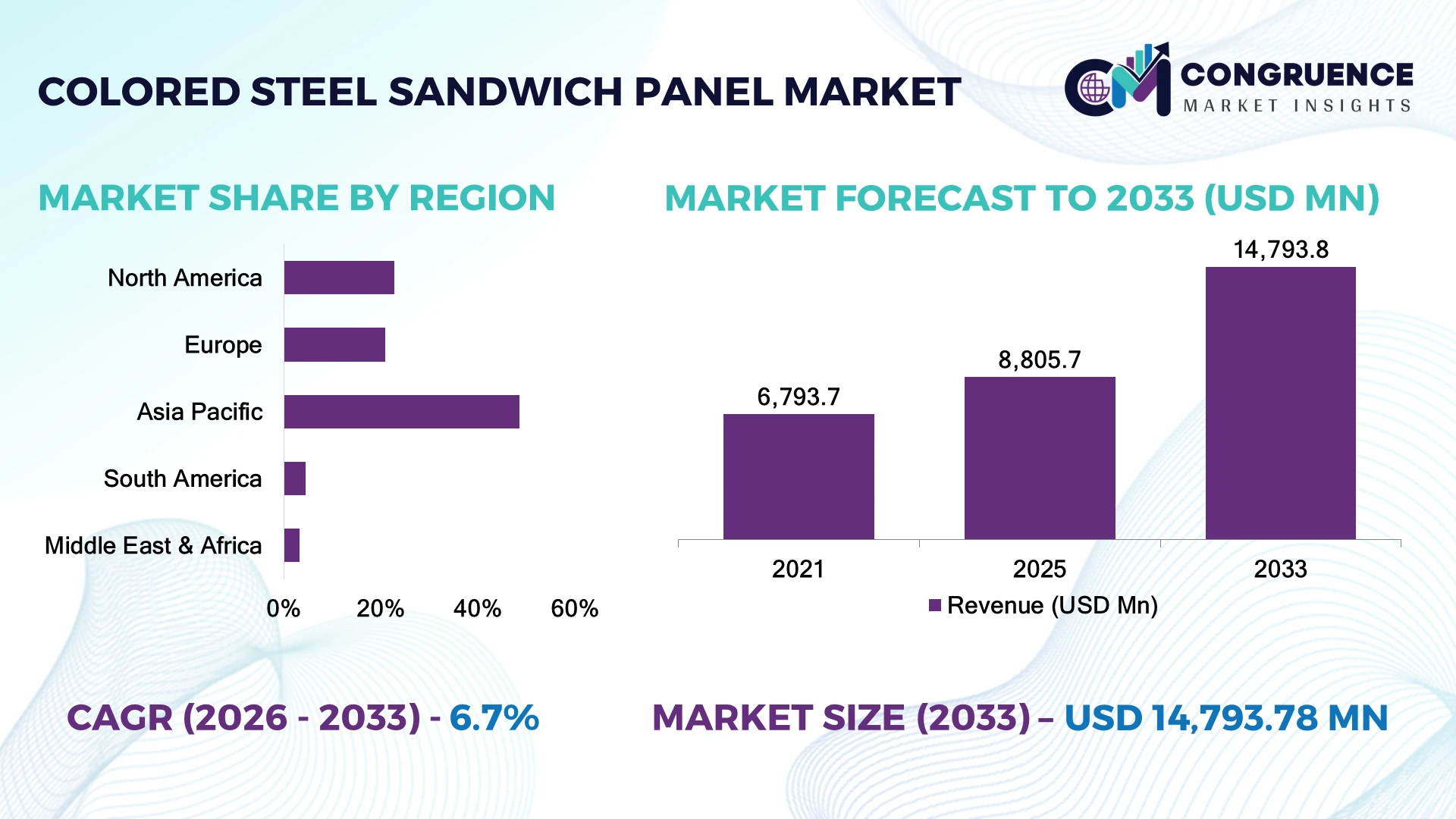
The Global Colored Steel Sandwich Panel Market was valued at USD 8,805.7 Million in 2025 and is anticipated to reach a value of USD 14,793.8 Million by 2033 expanding at a CAGR of 6.7% between 2026 and 2033. Growth is driven by accelerated prefabricated construction, cold-chain infrastructure expansion, and stricter energy-efficiency standards for industrial and commercial buildings.
China dominates the Colored Steel Sandwich Panel market with approximately 44% of global production capacity, supported by integrated steel manufacturing, large-scale prefabricated construction, and continuous investment in logistics parks, industrial facilities, and data centres. More than 61% of newly commissioned industrial buildings in China incorporate insulated sandwich panel systems, reflecting strong adoption of modular construction technologies. In comparison, Germany leads Europe in high-performance insulated panels with greater emphasis on fire-rated and energy-efficient building envelopes. Continued supply-chain diversification following global trade realignments in 2025–2026 has reinforced investment in regional manufacturing capacity and localized steel processing.
Manufacturers combining high-performance insulation, localized production, and advanced prefabrication capabilities will strengthen competitive positioning across industrial and commercial construction markets.
Market Size & Growth: USD 8,805.7 Million in 2025, reaching USD 14,793.8 Million by 2033 at a CAGR of 6.7%, driven by modular construction and energy-efficient building systems.
Top Growth Drivers: Prefabricated construction (+34%), cold-chain infrastructure (+29%), industrial facility expansion (+26%).
Short-Term Forecast: By 2028, automated panel production is expected to improve manufacturing efficiency by 19% and reduce installation time by 16%.
Emerging Technologies: AI-enabled production control, robotic panel fabrication, and advanced insulation materials improve product consistency.
Regional Leaders: Asia-Pacific exceeds USD 6.4 Billion, Europe approaches USD 3.5 Billion, North America surpasses USD 2.9 Billion with increasing green building adoption.
Consumer/End-User Trends: Nearly 64% of industrial developers prioritise insulated sandwich panels for faster project delivery and lower operating costs.
Pilot/Case Example: In 2026, automated panel production facilities reduced material waste by approximately 14% while improving dimensional accuracy by 18%.
Competitive Landscape: Top manufacturers control nearly 42% of global demand, led by Kingspan, Metecno, ArcelorMittal Construction, Isopan, and Nucor.
Regulatory & ESG Impact: High-performance insulated panels reduce operational building energy consumption by approximately 21%.
Investment & Funding: More than USD 2.3 Billion has been committed to production expansion, automated manufacturing, and cold-chain infrastructure projects.
Innovation & Future Outlook: Fire-resistant cores, recyclable insulation, and digital manufacturing platforms are redefining competitive differentiation.
Colored Steel Sandwich Panels have become integral to warehouses, manufacturing plants, logistics centres, cold-storage facilities, and commercial buildings where rapid construction and thermal efficiency are operational priorities. Advanced insulation cores and automated panel production have improved installation productivity by approximately 18%, while evolving energy-efficiency regulations and resilient industrial supply chains in 2026 are accelerating adoption of high-performance building envelope solutions, creating the foundation for long-term strategic investment.
The Colored Steel Sandwich Panel market has become strategically important as industrial developers, logistics operators, and commercial builders accelerate adoption of prefabricated construction to improve project delivery speed and operational efficiency. Tightened building energy regulations, modernization of manufacturing facilities, and restructuring of regional construction supply chains are increasing demand for advanced insulated panel systems with higher thermal performance and fire resistance. Competition increasingly centres on manufacturing capability, product certification, and integrated construction solutions.
Modern continuous production lines improve manufacturing productivity by approximately 22% while reducing material waste by nearly 15% compared with conventional batch fabrication methods. China leads large-scale production through integrated steel supply chains and manufacturing scale, whereas Germany focuses on premium fire-rated panels and energy-efficient construction systems. Over the next two to three years, automated production and digital quality inspection are expected to support more than 48% of newly commissioned high-capacity manufacturing facilities.
Industrial developers increasingly deploy polyurethane and mineral wool sandwich panels for logistics parks, pharmaceutical facilities, and cold-chain warehouses requiring fast installation and consistent insulation performance. Manufacturers are expanding regional production plants, strengthening steel procurement partnerships, and investing in recyclable insulation technologies. Companies capable of combining manufacturing scale, advanced insulation performance, and localized supply networks will secure stronger competitive positioning as industrial construction continues shifting toward high-efficiency modular building solutions.
Rapid expansion of prefabricated industrial buildings and logistics infrastructure is strengthening demand for colored steel sandwich panels across manufacturing, warehousing, and cold-chain projects. Approximately 63% of newly developed industrial facilities now incorporate insulated sandwich panel systems, while modular construction adoption has increased by nearly 31% in large-scale commercial developments. China's continued investment in industrial parks and India's accelerated factory construction under manufacturing initiatives are reinforcing demand for high-performance building envelopes. Faster installation shortens project schedules, reducing labour dependency and overall construction disruption. Manufacturers are expanding automated production lines, increasing mineral wool and polyurethane panel capacity, and partnering with engineering contractors to deliver integrated building systems. Competitive advantage increasingly depends on installation speed combined with certified thermal and fire performance.
Fluctuating prices of coated steel coils, insulation materials, and industrial adhesives continue creating structural cost pressure across the Colored Steel Sandwich Panel market. Raw materials represent approximately 68% of total production costs, while galvanized steel price fluctuations have exceeded 17% during recent procurement cycles. Continued supply-chain adjustments following geopolitical trade disruptions have increased procurement uncertainty for manufacturers dependent on imported specialty steel. These conditions reduce pricing flexibility, compress operating margins, and complicate long-term project quotations. Companies are mitigating risk through regional steel sourcing, long-term procurement contracts, alternative insulation formulations, and greater vertical integration. Operational resilience increasingly relies on diversified supply networks rather than aggressive pricing strategies.
The growing integration of intelligent industrial facilities creates significant opportunities for advanced colored steel sandwich panels designed for energy-efficient buildings. Approximately 38% of newly commissioned logistics centres now incorporate digitally monitored building envelopes, while insulated panel systems improve operational energy efficiency by nearly 24%. Japan and South Korea continue promoting smart factory programmes that prioritise thermally efficient construction materials with integrated performance monitoring. Manufacturers are investing in advanced coatings, recyclable insulation cores, and digital design collaboration with construction technology firms. A less obvious opportunity lies in developing sensor-compatible panel systems capable of supporting predictive building maintenance and long-term asset management for industrial operators.
Meeting increasingly complex fire safety, insulation, structural, and environmental standards across international construction markets remains a major execution challenge. Approximately 46% of industrial developers require project-specific certification, while compliance testing timelines have increased by nearly 20% because of evolving building regulations and higher fire-resistance expectations. Differences in national building codes complicate product standardisation and increase engineering costs for manufacturers serving multiple export markets. These complexities delay commercial deployment and reduce manufacturing flexibility. Companies must strengthen certified testing capabilities, invest in advanced product engineering, and collaborate with regulatory authorities and construction partners. Long-term competitiveness depends on delivering globally compliant panel systems without increasing production complexity or extending project delivery schedules.
Advanced Fire-Resistant Core Adoption: Demand for mineral wool and enhanced fire-rated insulation cores has increased by approximately 28%, driven by stricter industrial building regulations and higher safety expectations. Manufacturers are expanding certified product portfolios and upgrading production facilities, enabling broader deployment across pharmaceutical plants, logistics hubs, and high-value manufacturing complexes.
Digital Manufacturing Optimisation: Automated roll-forming, robotic handling, and AI-enabled production monitoring now support nearly 44% of high-capacity manufacturing lines, improving production efficiency by approximately 21% while reducing dimensional defects by around 16%. Companies are modernising factories to address labour shortages and deliver faster project execution with consistent product quality.
Low-Carbon Coating Technologies: High-durability coatings with improved corrosion resistance are gaining wider commercial acceptance, extending panel service life by approximately 18% while reducing maintenance requirements by nearly 15%. Steel producers and panel manufacturers are restructuring material partnerships to align with evolving environmental standards and growing demand for durable industrial building materials.
BIM-Integrated Panel Systems: Building Information Modeling integration has expanded by approximately 33% among large industrial construction projects, improving installation accuracy and reducing onsite material waste by nearly 14%. A notable shift is the development of factory-configured panel systems designed specifically for digital construction workflows, allowing manufacturers to strengthen partnerships with engineering firms and modular construction specialists.
Polyurethane (PU) colored steel sandwich panels account for approximately 48% of the global market due to their superior thermal insulation, lightweight structure, and ease of installation across industrial buildings, cold-storage facilities, and logistics centres. Their high insulation efficiency and lower lifecycle operating costs make them the preferred choice for temperature-controlled infrastructure. Expanded polystyrene (EPS) panels continue serving cost-sensitive commercial and temporary construction projects, while mineral wool panels strengthen adoption in facilities requiring enhanced fire resistance and acoustic performance.
Mineral wool panels represent the fastest-growing segment as stricter fire safety regulations accelerate deployment in data centres, pharmaceutical plants, and public infrastructure. Demand for fire-rated panels has increased by approximately 26%, while high-density insulation core adoption has expanded by nearly 19%. Manufacturers are investing in automated mineral wool production, developing hybrid insulation technologies, and expanding certified product portfolios. Investment priorities are steadily shifting from low-cost insulation toward high-performance building envelope solutions that satisfy evolving safety and energy-efficiency requirements.
A 2026 assessment by the International Energy Agency highlighted that high-performance insulated building envelopes remain one of the most effective technologies for reducing operational energy demand in industrial facilities.
Industrial buildings account for approximately 42% of Colored Steel Sandwich Panel demand as manufacturers increasingly adopt insulated panel systems for factories, warehouses, production plants, and logistics facilities. High installation speed, thermal efficiency, and structural durability continue supporting deployment across manufacturing-intensive economies including China, India, and Vietnam. Cold storage remains a mature application because of strict temperature-control requirements, while commercial buildings continue integrating insulated panels to improve construction productivity and operational efficiency.
Cold storage facilities represent the fastest-growing application segment as pharmaceutical logistics, food processing, and e-commerce distribution networks continue expanding globally. Deployment of insulated cold-chain infrastructure has increased by approximately 24%, while automated warehouse construction has risen by nearly 21%. Companies are expanding production capacity, integrating digital design platforms, and collaborating with engineering firms to deliver customised insulated building systems. Demand is becoming increasingly operationally critical where temperature stability, rapid construction, and long-term energy efficiency directly influence asset performance.
According to findings released during a 2025 Global Cold Chain Alliance industry assessment, investment in temperature-controlled logistics infrastructure continues to accelerate deployment of insulated construction materials across industrial facilities.
Manufacturing companies account for approximately 46% of total Colored Steel Sandwich Panel consumption owing to continuous investment in production facilities, industrial parks, and modern factory construction. High deployment intensity, large building footprints, and growing emphasis on energy-efficient industrial infrastructure reinforce purchasing concentration. Logistics operators continue expanding demand through warehouse development, while commercial real estate developers increasingly specify insulated panel systems for retail, office, and mixed-use industrial projects requiring faster project completion.
Cold-chain operators represent the fastest-growing end-user segment as pharmaceutical storage, food distribution, and e-commerce fulfilment networks expand. Procurement from this segment has increased by approximately 28%, while demand for fire-rated insulated panel systems has grown by nearly 18%. Manufacturers are strengthening partnerships with EPC contractors, offering project-specific engineering support, and expanding customised panel configurations for specialised industrial applications. Future demand is steadily shifting toward buyers seeking certified, high-performance, and digitally integrated construction systems rather than standardised commodity panels.
A 2026 enterprise survey conducted by the International Association for Cold Storage Construction found that high-performance insulated panels remain among the highest-priority building materials for new temperature-controlled warehouse developments.
Asia-Pacific accounted for the largest market share at 48.6% in 2025 however, Middle East & Africa is expected to register the fastest growth, expanding at a CAGR of 7.6% between 2026 and 2033.
Advanced Industrial Infrastructure Accelerates High-Performance Panel Adoption
North America accounts for approximately 22.8% of the global Colored Steel Sandwich Panel market, supported by sustained investment in logistics facilities, cold-chain infrastructure, advanced manufacturing plants, and data centres. Industrial developers increasingly specify insulated sandwich panels to reduce construction timelines while improving thermal efficiency and fire performance. More than 58% of newly constructed distribution facilities now incorporate insulated steel panel systems for walls and roofing. Automated manufacturing, prefabricated construction methods, and digital project planning continue improving installation accuracy and labour productivity. Building owners are also prioritising high-performance envelope systems to lower operating costs while meeting increasingly stringent energy performance requirements across commercial and industrial developments.
United States Market Outlook: The United States leads regional demand through large-scale warehouse construction, semiconductor manufacturing investments, and rapid expansion of hyperscale data centres. Domestic manufacturers continue expanding automated production capacity and introducing certified fire-resistant panel systems for industrial applications. Approximately 63% of insulated sandwich panels used in new industrial facilities are deployed within manufacturing, logistics, and cold-storage projects, reflecting the country's sustained infrastructure investment and industrial modernisation strategy.
Energy-Efficient Construction Reshapes Building Standards
Europe represents approximately 20.9% of the Colored Steel Sandwich Panel market, driven by stringent building efficiency regulations, industrial renovation programmes, and increasing adoption of sustainable construction materials. Manufacturers are introducing recyclable insulation cores and advanced coating technologies while expanding certified fire-rated panel production. Around 41% of industrial refurbishment projects now specify insulated steel sandwich panels to improve thermal performance and reduce long-term operating costs. Product innovation increasingly focuses on balancing structural durability, sustainability, and regulatory compliance across commercial and industrial construction.
Germany Market Outlook: Germany maintains regional leadership through its advanced manufacturing sector, strong prefabricated construction ecosystem, and high-performance building standards. Industrial developers continue prioritising mineral wool sandwich panels for factories, automotive facilities, and logistics centres requiring superior fire resistance. Nearly 54% of newly developed industrial buildings incorporate insulated building envelope systems designed to meet demanding operational and energy-efficiency requirements.
Manufacturing Scale Strengthens Global Leadership
Asia-Pacific remains the largest production and consumption hub for Colored Steel Sandwich Panels due to extensive industrialisation, integrated steel manufacturing, and rapid expansion of prefabricated construction. China, India, Vietnam, and Indonesia continue increasing deployment across logistics parks, manufacturing facilities, commercial buildings, and cold-chain infrastructure. Approximately 66% of regional production capacity is concentrated within integrated steel manufacturing clusters, enabling competitive production costs and reliable supply. Manufacturers are expanding automated panel fabrication facilities while strengthening export-oriented production to meet growing international demand.
China Market Outlook: China dominates the global market through integrated steel production, advanced roll-forming technology, and the world's largest prefabricated construction industry. Domestic producers continue investing in intelligent manufacturing systems, high-performance coatings, and automated quality inspection. More than 61% of newly constructed industrial buildings utilise insulated sandwich panels, reinforcing China's leadership in industrial-scale deployment and manufacturing efficiency.
Industrial Modernisation Expands Construction Demand
South America is witnessing increasing adoption of Colored Steel Sandwich Panels as industrial investments, food processing facilities, and cold-storage infrastructure continue expanding. Demand is concentrated in manufacturing plants, logistics facilities, and agricultural processing complexes seeking faster project completion and improved thermal performance. Approximately 27% of newly developed industrial warehouses now integrate insulated panel systems to reduce operating costs and construction timelines. Despite infrastructure investment, fluctuations in steel availability and logistics costs continue influencing project execution and procurement planning across several countries.
Brazil Market Outlook: Brazil leads regional demand owing to its large industrial base, expanding agribusiness processing facilities, and ongoing logistics infrastructure development. Manufacturers are increasing domestic panel production while supporting modular construction across warehousing and commercial buildings. Nearly 47% of insulated panel demand originates from industrial and food-processing developments requiring durable, energy-efficient building envelope solutions capable of operating in diverse climatic conditions.
Infrastructure Investment Accelerates Premium Panel Deployment
The Middle East & Africa market is benefiting from large-scale industrial diversification, logistics expansion, airport development, and commercial construction programmes. High ambient temperatures continue increasing demand for insulated building systems capable of reducing cooling loads while maintaining structural durability. Approximately 35% of new industrial construction projects now incorporate advanced insulated sandwich panels for improved operational efficiency. Manufacturers are strengthening regional distribution networks, establishing fabrication partnerships, and expanding local assembly operations to improve delivery capability and project responsiveness.
United Arab Emirates Market Outlook: The United Arab Emirates serves as the region's leading market through extensive investments in logistics parks, free economic zones, advanced manufacturing, and commercial real estate. Developers increasingly deploy high-performance insulated panels across airports, warehouses, and industrial facilities to improve energy performance and construction efficiency. Around 43% of large industrial developments specify prefabricated insulated building systems, reinforcing the country's position as a regional benchmark for modern industrial construction.
Kingspan, Metecno, Isopan, ArcelorMittal Construction, and Tata Steel compete directly in premium insulated building envelopes, while regional manufacturers challenge them on pricing and delivery speed. The top five players collectively command approximately 44% of the global market. Competition centres on thermal efficiency, fire certification, coating durability, manufacturing scale, and integrated supply chains rather than commodity pricing alone. Automated production improves manufacturing productivity by nearly 20%, advanced insulation cores reduce operational energy demand by approximately 22%, and vertically integrated steel sourcing lowers procurement risk by around 15%. Global leaders are expanding manufacturing plants, investing in digital production, launching lower-carbon product portfolios, and strengthening EPC partnerships, whereas regional suppliers compete through customised fabrication and shorter lead times. Competitive momentum is shifting toward sustainable, factory-engineered building systems with integrated services. Entry barriers remain high because of certification requirements, capital-intensive production, and steel procurement networks. Winning demands manufacturing scale, certified innovation, resilient supply chains, and rapid project execution.
Kingspan Group
Metecno Group
Isopan
ArcelorMittal Construction
Tata Steel
Assan Panel
Ruukki Construction
Italpannelli
Lattonedil
Zhongjie Group
Nucor Building Systems
Romakowski
Dana Group
Continuous automated production lines, advanced polyurethane and mineral wool insulation cores, and high-performance coil coating technologies define current manufacturing. Automated roll-forming improves production efficiency by approximately 21%, while precision lamination reduces material waste by nearly 14%. Around 58% of large manufacturing facilities now operate digitally monitored production systems, improving dimensional consistency and reducing quality deviations. These technologies deliver stronger thermal performance, faster installation, and lower lifecycle operating costs, giving manufacturers a measurable competitive advantage in industrial construction.
Emerging technologies include AI-enabled quality inspection, recyclable insulation cores, BIM-integrated panel engineering, and sensor-compatible building envelope systems. Compared with conventional batch manufacturing, intelligent continuous production improves throughput by approximately 24% while reducing production defects by nearly 18%. Large integrated manufacturers benefit most through greater operational efficiency, whereas engineering contractors gain from faster installation planning and improved project coordination. Digital integration is becoming a decisive procurement factor for complex industrial projects.
Between 2026 and 2028, low-carbon steel processing, robotic fabrication, and digital twin-enabled production management will reshape manufacturing competitiveness. Nearly 52% of newly commissioned production facilities are expected to incorporate intelligent automation and predictive maintenance platforms. Companies investing now in advanced manufacturing, sustainable insulation technologies, and digitally integrated product development will strengthen certification compliance, improve supply reliability, and secure long-term leadership across industrial, logistics, and cold-chain construction markets.
January 2025 Isopan and Marcegaglia Steel completed their industrial joint venture following regulatory approval, integrating Italian and Polish insulated panel production assets to strengthen European manufacturing capacity and operational synergies. Business impact: expanded production footprint.
March 2025 Kingspan launched the Therma TA41 high-performance PIR insulation panel featuring thermal conductivity of 0.022 W/mK, strengthening energy-efficient building envelope solutions for industrial and commercial construction. Business impact: enhanced premium insulation portfolio.
February 2026 Kingspan reported investment in insulated panel manufacturing plants across the United States, Germany, Paraguay, Australia, and New Zealand while expanding lower embodied carbon product portfolios. Business impact: strengthened global manufacturing capacity and sustainable product leadership. Source: Kingspan Annual Report
2025 Kingspan introduced 18 new lower embodied carbon building products and expanded product takeback programmes across multiple markets, reinforcing circular manufacturing strategies. Business impact: accelerated sustainable building material adoption. Source: Kingspan Annual Report. (Kingspan Annual Report 2025)
This report provides comprehensive analysis of the Colored Steel Sandwich Panel market across insulation core types, applications, end-user industries, and major geographic markets. It evaluates polyurethane, mineral wool, EPS, and other panel technologies across industrial buildings, cold storage, commercial facilities, logistics infrastructure, cleanrooms, and specialised construction. The study further assesses manufacturing trends, procurement strategies, certification requirements, and deployment patterns influencing product selection across mature and emerging construction markets.
The report examines advanced production technologies, intelligent manufacturing systems, recyclable insulation materials, and digital construction integration shaping industry development between 2026 and 2033. More than 60% of industrial construction projects increasingly prioritise insulated building envelope systems with higher thermal performance and operational efficiency. Strategic insights support investment planning, capacity expansion, supplier evaluation, competitive benchmarking, regional market entry, and technology adoption by identifying high-potential segments, evolving customer requirements, leading manufacturers, and long-term operational opportunities across the global construction materials value chain.
| Report Attribute/Metric | Report Details |
|---|---|
|
Market Revenue in 2025 |
USD 8,805.7 Million |
|
Market Revenue in 2033 |
USD 14,793.8 Million |
|
CAGR (2026 - 2033) |
6.7% |
|
Base Year |
2025 |
|
Forecast Period |
2026 - 2033 |
|
Historic Period |
2021 - 2025 |
|
Segments Covered |
By Type
By Application
By End-User
|
|
Key Report Deliverable |
Revenue Forecast, Growth Trends, Market Dynamics, Segmental Overview, Regional and Country-wise Analysis, Competition Landscape |
|
Region Covered |
North America, Europe, Asia-Pacific, South America, Middle East, Africa |
|
Key Players Analyzed |
Kingspan Group, Metecno Group, Isopan, ArcelorMittal Construction, Tata Steel, Assan Panel, Ruukki Construction, Italpannelli, Lattonedil, Zhongjie Group, Nucor Building Systems, Romakowski, Dana Group |
|
Customization & Pricing |
Available on Request (10% Customization is Free) |




