
Reports
The Global Color Masterbatch Market was valued at USD 4134 Million in 2025 and is anticipated to reach a value of USD 5528.41 Million by 2033 expanding at a CAGR of 3.7% between 2026 and 2033. Growth is driven by higher recycled-polymer usage, tighter color consistency requirements, and replacement of conventional liquid pigments with concentrated, automated masterbatch formulations that improve dispersion and processing control.
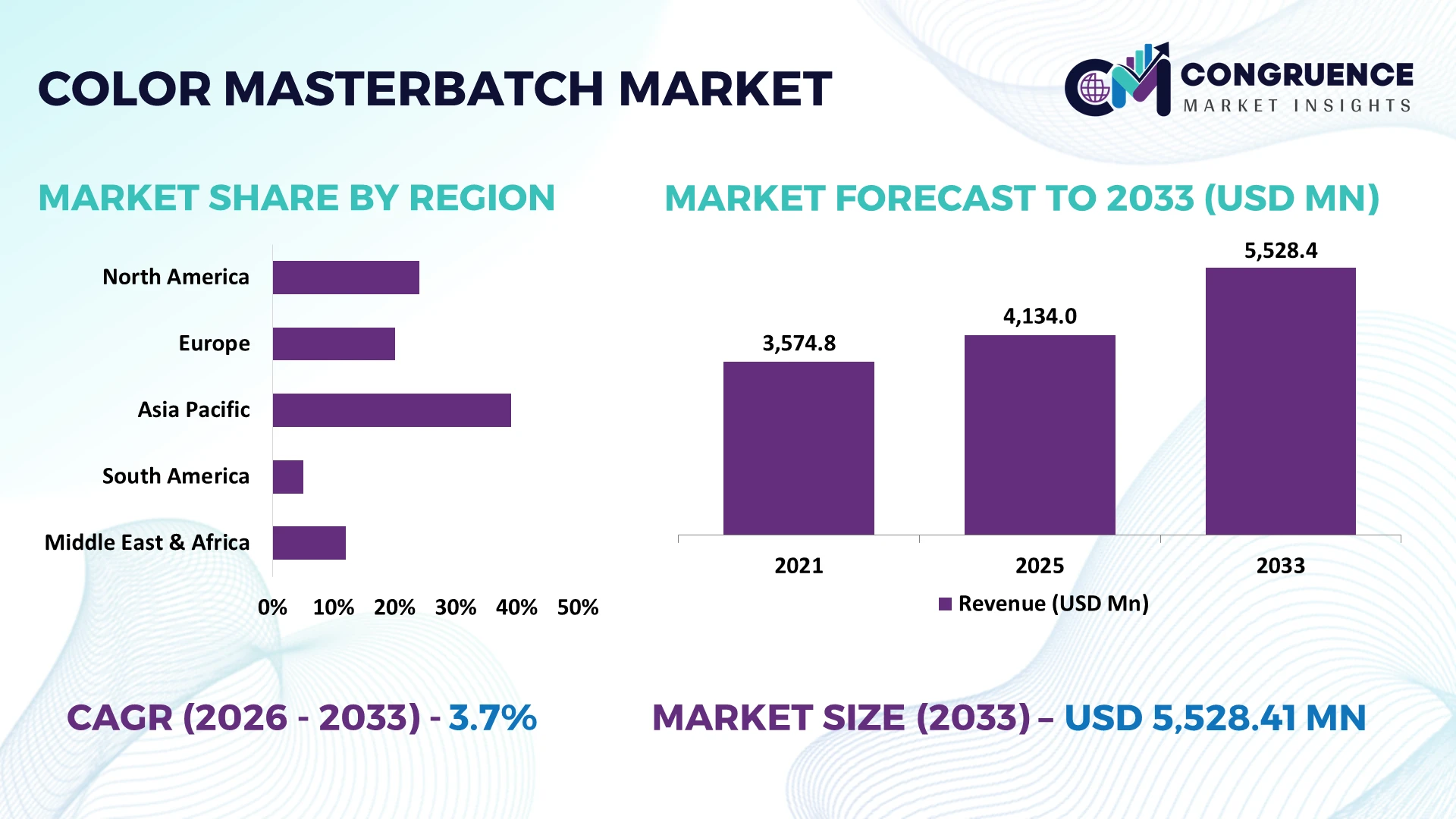
China remains the dominant production hub, accounting for approximately 45% of global color masterbatch capacity, supported by large plastics, packaging, automotive, and consumer-goods clusters. India holds roughly 7% of capacity but is expanding faster through packaging and infrastructure investments. Asia-Pacific represents more than 60% of global consumption, while advanced extrusion and automated dosing adoption continues increasing.
Strategic decisions should prioritize Asian capacity expansion, recycled-polymer compatibility, and high-performance formulations for automotive and sustainable packaging applications.
Market Size & Growth: USD 4,134 million in 2025 rising to USD 5,528.41 million by 2033, supported by recycled-polymer processing and advanced pigment dispersion.
Top Growth Drivers: Recycled plastics 38%, flexible packaging 31%, and automotive polymers 24% are leading demand drivers.
Short-Term Forecast: By 2028, automated dosing is expected to reduce colorant handling costs by 6% and improve batch consistency by 8%.
Emerging Technologies: AI-assisted formulation, automated gravimetric dosing, and advanced bio-based carrier systems are reshaping high-performance masterbatch production.
Regional Leaders: Asia-Pacific is projected above USD 3.3 billion, Europe near USD 1.1 billion, and North America above USD 850 million, with recycling-driven adoption strengthening.
Consumer/End-User Trends: More than 30% of packaging converters increasingly specify masterbatches compatible with recycled polymers and lower-carbon production requirements.
Pilot/Case Example: A 2025 automated extrusion initiative achieved approximately 9% lower pigment waste and 7% faster formulation changeovers.
Competitive Landscape: China leads with approximately 45% capacity share, while Avient, Ampacet, LyondellBasell, Plastika Kritis, and Tosaf strengthen global competition.
Regulatory & ESG Impact: Recyclability targets and extended producer responsibility programs are pushing formulations toward recycled-compatible carriers, improving material recovery efficiency by roughly 5%.
Investment & Funding: More than USD 1 billion in combined capacity expansion and technology investment is targeting specialty compounds, recycling compatibility, and Asian production hubs.
Innovation & Future Outlook: Next-generation color masterbatches will emphasize low-carbon carriers, AI formulation, nano-additives, and closed-loop production as supply chains diversify beyond China.
Color masterbatch demand is increasingly concentrated in flexible packaging, rigid packaging, automotive components, consumer products, and recycled plastics, where precise dispersion and processing stability are critical. Approximately 30% of converters are prioritizing recycled-polymer-compatible formulations, accelerating innovation in carrier systems and pigment efficiency. Supply-chain diversification following global logistics disruptions is also encouraging regional production investments, strengthening the strategic importance of localized advanced masterbatch capacity.
Color masterbatch is becoming strategically important because polymer converters increasingly compete on color consistency, recycled-content compatibility, processing efficiency, and regulatory readiness rather than pigment price alone. In packaging and automotive plastics, formulation precision directly affects scrap, throughput, and product appearance. Supply-chain restructuring is also shifting investment toward localized production and shorter pigment-to-converter supply routes.
Technology adoption is accelerating this transformation. Gravimetric dosing and automated dispersion systems deliver roughly 5–8% better material utilization and 6% lower color-change losses than legacy manual dosing. China remains the scale leader, while Germany and Japan emphasize high-performance formulations, process automation, and specialty polymers. Over the next 2–3 years, automated dosing penetration could rise by 8–12 percentage points among larger converters as recycled-polymer processing becomes more complex.
A practical deployment example is packaging extrusion, where closed-loop dosing adjusts masterbatch concentration against real-time color measurements, reducing pigment waste by approximately 7%. Companies are responding through localized compounding plants, strategic pigment partnerships, and R&D focused on recycled-polymer carriers. The strongest competitive position will belong to suppliers combining formulation expertise, automated processing, localized supply, and sustainability credentials.
Recycled-polymer adoption is reshaping color formulation requirements, with approximately 30% of packaging converters prioritizing compatible masterbatch systems and recycled-content processing increasingly influencing procurement. Recycled feedstock can introduce variable melt flow, contamination, and base-color inconsistency, increasing demand for high-dispersion formulations. India’s expanding packaging and plastics-processing base is accelerating investments in customized carrier systems. Suppliers are responding through formulation R&D, converter partnerships, and localized technical support. The non-obvious advantage is process stability: masterbatch suppliers that optimize formulations for variable recycled feedstock can reduce color correction and production interruptions while strengthening converter retention.
Raw-material volatility remains a structural constraint, particularly for specialty pigments, polymers, and additives. Pigment costs can fluctuate by approximately 8–15% during supply disruptions, while imported specialty inputs can add 5–10% to procurement exposure for manufacturers dependent on overseas suppliers. China’s concentration in chemical and pigment supply chains increases vulnerability to logistics interruptions and environmental production controls. Companies are responding through dual sourcing, regional inventories, longer-term procurement contracts, and alternative carrier development. The key operational pressure is margin protection: converters increasingly favor suppliers capable of maintaining color specifications without excessive formulation adjustments when input costs or feedstock characteristics change.
Digital formulation and automated dosing create a high-value opportunity as converters seek tighter quality control and lower material losses. Automated gravimetric systems can improve dosing accuracy by roughly 5–8%, while closed-loop color monitoring can reduce correction-related waste by 6–9%. Japan’s advanced plastics-processing ecosystem demonstrates how automation can support consistent output across complex polymer grades. Companies are expanding R&D partnerships around AI-assisted formulation, sensor-based color measurement, and recycled-compatible carriers. A particularly attractive opportunity lies in smaller specialty batches, where digital recipe management reduces changeover losses and enables suppliers to offer customized color solutions without proportionally increasing technical labor.
Integrating automated dosing, inline color measurement, recycled feedstock, and legacy extrusion equipment remains a major execution challenge. Approximately 20–30% of older converter lines require control-system upgrades before advanced masterbatch monitoring can operate effectively, while inconsistent recycled feedstock can increase formulation adjustments by 5–10%. Germany’s highly automated plastics sector highlights the capability gap between digitally integrated plants and aging production assets. Companies must invest in interoperable controls, workforce training, sensor calibration, and technical partnerships. The strategic issue extends beyond installation: maintaining consistent color across changing resin batches requires synchronized formulation data, equipment controls, and quality systems, making digital integration capability a critical competitive differentiator.
Recycled-Polymer Color Matching: Recycled-content processing is increasing demand for high-dispersion formulations, with circular plastics reaching 15.8% of European production in 2024. Companies are expanding carrier-system R&D and technical partnerships to manage variable feedstock color and melt characteristics.
Localized Production Networks: Supply-chain restructuring is pushing manufacturers toward regional compounding and pigment inventories. Europe’s plastics share fell to 12% of global output in 2024, while China accounted for 34.5%, intensifying localization pressure. Producers are adding regional capacity and dual-source procurement to reduce logistics exposure.
Closed-Loop Quality Control: Inline spectrophotometers, automated dosing, and digital recipe management are moving color control from batch correction toward continuous verification. Automated workflows can reduce adjustment losses by roughly 6–9% and improve dosing consistency by 5–8%. Larger converters are integrating sensors with extrusion controls.
Specialty Effects Expansion: Metallic, pearlescent, and fluorescent formulations are gaining attention in premium consumer packaging and automotive interiors, where visual differentiation supports higher-value applications. Companies are increasing specialty-product capacity and collaborating with converters on formulation stability. The non-obvious shift is greater emphasis on appearance consistency across recycled and virgin resin streams.
Standard Color remains the leading type, representing approximately 55% of demand because it offers broad resin compatibility, predictable dispersion, high-volume scalability, and lower formulation complexity. Its established position is strongest in packaging and general-purpose consumer plastics, where converters prioritize repeatability and cost control. Custom Color follows at roughly 22%, supported by shorter product cycles and brand-specific color requirements. Companies are increasingly using digital formulation tools to reduce development time and maintain tighter shade tolerances.
Fluorescent, Pearlescent, and Metallic remain smaller but strategically important categories, collectively accounting for about 23%. Metallic and Pearlescent formulations are gaining traction in automotive interiors and premium packaging, while Fluorescent serves specialized branding and safety applications. Metallic is the fastest-growing specialty type, with adoption expanding around 8–10% as manufacturers seek differentiated finishes without secondary coating processes. Suppliers are therefore increasing specialty pigment partnerships and customized production capabilities, shifting investment from commodity volume toward higher-margin engineered formulations.
Packaging is the leading application, capturing approximately 48% of color masterbatch demand because films, containers, closures, and flexible formats require high-volume shade consistency and rapid formulation changes. Automotive follows near 21%, with color specifications increasingly linked to lightweight polymer components and recycled-content requirements. Consumer Goods accounts for around 17%, supported by branded appearance and frequent product refreshes. Companies are prioritizing scalable formulations and automated dosing for high-throughput packaging lines.
Automotive is the fastest-growing application, expanding adoption by roughly 8–10% as manufacturers integrate recycled polymers, lightweight components, and tighter appearance standards. Construction represents about 9%, while Agriculture contributes approximately 5%, with both emphasizing UV stability and long service life. The strategic shift is toward application-specific masterbatch rather than universal formulations, prompting suppliers to develop resin-specific packages, technical partnerships, and localized application laboratories.
Plastics Manufacturers represent the dominant end-user group at approximately 42% share, reflecting their direct control over extrusion, injection molding, compounding, and color formulation workflows. Their purchasing decisions are strongly influenced by dosing accuracy, resin compatibility, and production throughput. Packaging Companies account for nearly 24%, while Automotive Manufacturers represent around 18%. Suppliers are responding with customized carrier systems, technical service agreements, and automated dosing packages that integrate directly into converter production lines.
Automotive Manufacturers are the fastest-growing end-user group, with adoption increasing approximately 9–11% as recycled-content requirements and lightweight polymer applications expand. Consumer Goods Manufacturers contribute about 10%, emphasizing appearance consistency and rapid SKU changes, while Construction Products Manufacturers hold roughly 6%, prioritizing weatherability and durability. Companies are increasingly segmenting pricing and technical support by application complexity rather than pigment volume. This creates a competitive advantage for suppliers capable of combining specialty formulations with process engineering and long-term converter partnerships.
Asia-Pacific accounted for the largest market share at 61% in 2025 however, Middle East & Africa is expected to register the fastest growth, expanding at a CAGR of 5.1% between 2026 and 2033.
Recycled-content compliance reshapes formulation economics
North America represents approximately 17% of global color masterbatch demand, supported by advanced packaging, automotive plastics, construction products, and consumer-goods manufacturing. The United States dominates regional consumption and specialty formulation activity, while Mexico is strengthening its position through nearshoring-oriented plastics production. More than 30% of large packaging converters are increasing requirements for recycled-polymer-compatible color systems, creating demand for improved dispersion and processing stability. Automated gravimetric dosing is gaining traction across larger extrusion operations, reducing formulation variability and supporting faster changeovers. Supply-chain restructuring is encouraging suppliers to hold more regional inventory and establish closer technical support networks. Competitive advantage increasingly depends on localized formulation capability, short lead times, and compatibility with recycled feedstocks rather than commodity pigment pricing alone.
United States Market Outlook: The United States remains the region’s principal manufacturing and technology hub, supported by sophisticated extrusion, injection molding, and automotive polymer ecosystems. More than 35% of major converters emphasize tighter color-control specifications, encouraging investment in automated dosing, specialty formulations, and recycled-content compatibility.
Circular plastics accelerate specialty formulation demand
Europe contributes approximately 15% of global color masterbatch demand, with Germany, Italy, France, and the United Kingdom providing concentrated plastics-processing capacity. Regulatory pressure around recycled content, recyclability, chemical safety, and product traceability is reshaping formulation priorities. Circular plastics represented about 15.8% of European plastics production in 2024, increasing the need for carriers and pigments that perform consistently in variable recycled feedstocks. German and Italian processors are prioritizing automated quality control and application-specific formulations, while producers are strengthening partnerships with recyclers and polymer compounders. Energy-intensive manufacturing remains a cost pressure, encouraging higher-value specialty products rather than volume-only expansion. Suppliers with documented material compatibility, consistent color performance, and flexible low-volume customization are gaining stronger purchasing consideration across sophisticated European converter networks.
Germany Market Outlook: Germany leads European industrial adoption through its dense automotive, engineering plastics, and advanced extrusion ecosystem. More than 40% of major plastics processors increasingly integrate automated process monitoring, creating demand for digitally controlled color dosing, tighter formulation tolerances, and specialized masterbatch solutions for recycled engineering polymers.
Manufacturing scale reinforces localized supply leadership
Asia-Pacific commands approximately 61% of global color masterbatch demand and production activity, anchored by China, India, Japan, South Korea, and Southeast Asian manufacturing hubs. China alone represents roughly 45% of global color masterbatch capacity, supported by extensive packaging, automotive, consumer-goods, and plastics-processing clusters. India is expanding converter capacity as packaging and infrastructure manufacturing scale up, while Japan emphasizes precision formulations and automated processing. More than 35% of large Asian converters are increasing use of recycled-compatible color systems, creating demand for improved dispersion and process stability. Regional producers are expanding localized pigment inventories, application laboratories, and customized formulations to reduce logistics exposure. The strategic advantage lies in proximity to polymer converters, rapid product customization, and integrated supply chains spanning pigments, carriers, compounding, and downstream plastics processing.
China Market Outlook: China remains the dominant production base because of its integrated pigment, polymer, compounding, and converter ecosystem. Its extensive export infrastructure supports rapid fulfillment, while concentrated automotive and packaging clusters sustain high-volume demand. Manufacturers increasingly invest in specialty formulations and automated dosing to move beyond commodity color competition.
Packaging modernization strengthens localized demand
South America accounts for approximately 6% of global color masterbatch consumption, with Brazil representing the principal manufacturing and conversion center. Flexible packaging, rigid containers, agricultural films, consumer products, and construction plastics form the strongest demand base. Brazil’s extensive food and beverage packaging industry supports sustained requirements for consistent coloration, while agricultural plastics create demand for UV-stable and weather-resistant formulations. Approximately 20% of regional converters are increasing recycled-polymer usage, intensifying requirements for compatible carrier systems and improved pigment dispersion. Currency volatility and imported specialty-pigment exposure remain operational constraints, encouraging suppliers to expand local inventories and establish longer procurement agreements. Companies with regional technical support and localized formulation capability can protect margins more effectively than suppliers relying heavily on imported finished masterbatch.
Brazil Market Outlook: Brazil combines the region’s largest plastics-processing base with strong packaging and agricultural-film demand. Domestic converters increasingly prioritize recycled-content compatibility and UV stability, while local production and distribution networks reduce exposure to imported formulation delays. Suppliers are strengthening technical partnerships with major processors to secure recurring application-specific orders.
Industrial diversification creates new polymer demand
Middle East & Africa is an emerging color masterbatch market, supported by plastics conversion, packaging expansion, construction materials, agriculture, and industrial diversification. Saudi Arabia and the United Arab Emirates are strengthening polymer-processing ecosystems through manufacturing investment and downstream diversification. Approximately 18% of regional demand is linked to construction-related plastic products, while packaging remains a major volume contributor. New conversion facilities are increasing demand for consistent, application-specific coloration rather than imported commodity blends alone. Producers are responding through regional warehouses, technical service centers, and partnerships with polymer manufacturers. Infrastructure investment and localization programs are improving supply responsiveness, although specialist formulation capabilities remain less developed than in mature markets. The non-obvious opportunity is integration with local polymer production, enabling shorter formulation cycles and reducing dependency on imported finished masterbatch.
Saudi Arabia Market Outlook: Saudi Arabia holds a strategically important position because its integrated petrochemical base provides direct access to polymer feedstocks and downstream manufacturing investment. Industrial diversification programs are encouraging plastics conversion capacity, while packaging and construction applications create demand for customized color systems and localized technical support.
The Color Masterbatch Market pits global specialists such as Avient, Ampacet, LyondellBasell, Plastika Kritis, and Tosaf against regional cost leaders and application-focused compounders. The top five players collectively command approximately 30% of the market, leaving meaningful space for specialized manufacturers. Competition centers on formulation precision, pricing, customization, supply reliability, and technical service. Advanced suppliers can achieve 5–8% better dosing efficiency and 6–9% lower color-correction waste through automated formulation and closed-loop monitoring. Global leaders are expanding application laboratories, while regional producers strengthen localized inventories and converter partnerships. Vertical integration across pigments, carriers, compounding, and distribution is becoming a stronger differentiator as supply-chain disruptions expose dependency risks. Entry barriers remain high for specialty automotive and regulated packaging grades because qualification cycles, color consistency, and technical validation require substantial expertise. Winning requires combining scale with fast customization, dependable supply, process engineering, and recycled-polymer compatibility.
Avient Corporation
Ampacet Corporation
LyondellBasell Industries
Plastika Kritis S.A.
Tosaf Group Ltd.
Gabriel-Chemie Gesellschaft m.b.H.
Cabot Corporation
Penn Color, Inc.
Hubron International
Kandui Industries
Astra Polymers
Constab Polyolefin Additives GmbH
Prayag Polytech Pvt. Ltd.
Americhem, Inc.
Current color masterbatch production is shifting toward automated gravimetric dosing, inline spectrophotometry, and digitally controlled pigment dispersion. Automated dosing improves material efficiency by 5–8%, while inline color monitoring can reduce correction-related waste by 6–9%. Adoption is strongest among large packaging and automotive converters, where tighter tolerances directly reduce rejects and changeover losses.
Emerging technologies include AI-assisted color formulation, recycled-polymer-compatible carriers, NIR-sortable pigments, and multifunctional color-additive concentrates. AI-supported formulation can shorten color-development cycles by 10–15%, while optimized dispersion improves processing consistency by 3–5%. Compared with manual dosing and offline color checks, integrated automated systems deliver approximately 7% better material utilization. Avient, Ampacet, and other global specialists benefit by combining formulation IP with digital process-control capabilities.
Through 2026–2028, integration will become the key differentiator as converters increase recycled-polymer usage and demand tighter traceability. Advanced systems are positioned to deliver another 3–5% efficiency improvement through closed-loop control, predictive color correction, and automated recipe management. Companies investing now gain faster qualification, lower pigment waste, and stronger compatibility with variable recycled feedstocks, creating measurable operational advantage over less-digitized competitors.
January 2025 Avient introduced a Color Simulation Tool using PCR spectral data to predict colors and calculate corrections, helping converters expand recycled-content use while reducing formulation work. It strengthens color consistency and supports broader PCR adoption at scale. Source: avient.com
September 2024 Tosaf showcased PPAX color masterbatch for PPA at Fakuma, enabling bright coloration at high processing temperatures while preserving heat resistance, strength, stiffness, and chemical resistance. The innovation targets automotive, electrical, and appliance components requiring durable coloration. Source: tosaf.com
February 2026 Ampacet demonstrated LIAD Smart color automation at Plastindia, including ColorSave 1000X gravimetric feeding with 10-second purges and output up to 100 kg/h. The system targets 50% masterbatch savings, reducing rejects and improving production control consistency. Source: ampacet.com
June 2026 Tosaf announced a 5,500-square-meter masterbatch facility in Olkusz, Poland, scheduled for second-quarter operation with initial capacity of 3,000 tons annually. The investment shortens Eastern European lead times, expands support, and supply resilience. Source: tosaf.com
The Color Masterbatch Market Report covers Standard Color, Custom Color, Fluorescent, Pearlescent, and Metallic types across Packaging, Automotive, Consumer Goods, Construction, and Agriculture applications. End-user analysis includes Plastics Manufacturers, Packaging Companies, Automotive Manufacturers, Consumer Goods Manufacturers, and Construction Products Manufacturers, enabling assessment of demand concentration and changing purchasing priorities.
Geographic coverage spans North America, Europe, Asia-Pacific, South America, and Middle East & Africa, with country-level analysis emphasizing China, the United States, Germany, India, Brazil, and Saudi Arabia. The report evaluates automation, advanced pigment dispersion, recycled-polymer compatibility, NIR-sortable colorants, and digital color management. More than 10 major competitive participants are assessed to support supplier benchmarking, capacity planning, partnership decisions, geographic expansion, technology investment, and positioning between 2026 and 2033. Emerging specialty-color applications and localized production strategies are also examined for actionable market direction.
| Report Attribute/Metric | Report Details |
|---|---|
Market Revenue in 2025 | USD 4134 Million |
Market Revenue in 2033 | USD 5528.41 Million |
CAGR (2026 - 2033) | 3.7% |
Base Year | 2025 |
Forecast Period | 2026 - 2033 |
Historic Period | 2021 - 2025 |
Segments Covered | By Type
By Application
By End-User
|
Key Report Deliverable | Revenue Forecast, Growth Trends, Market Dynamics, Segmental Overview, Regional and Country-wise Analysis, Competition Landscape |
Region Covered | North America, Europe, Asia-Pacific, South America, Middle East, Africa |
Key Players Analyzed | Avient Corporation, Ampacet Corporation, LyondellBasell Industries, Plastika Kritis S.A., Tosaf Group Ltd., Gabriel-Chemie Gesellschaft m.b.H., Cabot Corporation, Penn Color, Inc., Hubron International, Kandui Industries, Astra Polymers, Constab Polyolefin Additives GmbH, Prayag Polytech Pvt. Ltd., Americhem, Inc. |
Customization & Pricing | Available on Request (10% Customization is Free) |




