
Reports
The Global Color Cosmetics Market was valued at USD 60560 Million in 2025 and is anticipated to reach a value of USD 99476.13 Million by 2033 expanding at a CAGR of 6.4% between 2026 and 2033. Growth is driven by AI-enabled shade matching, social-commerce product launches, multifunctional makeup, and premiumization across emerging beauty markets.
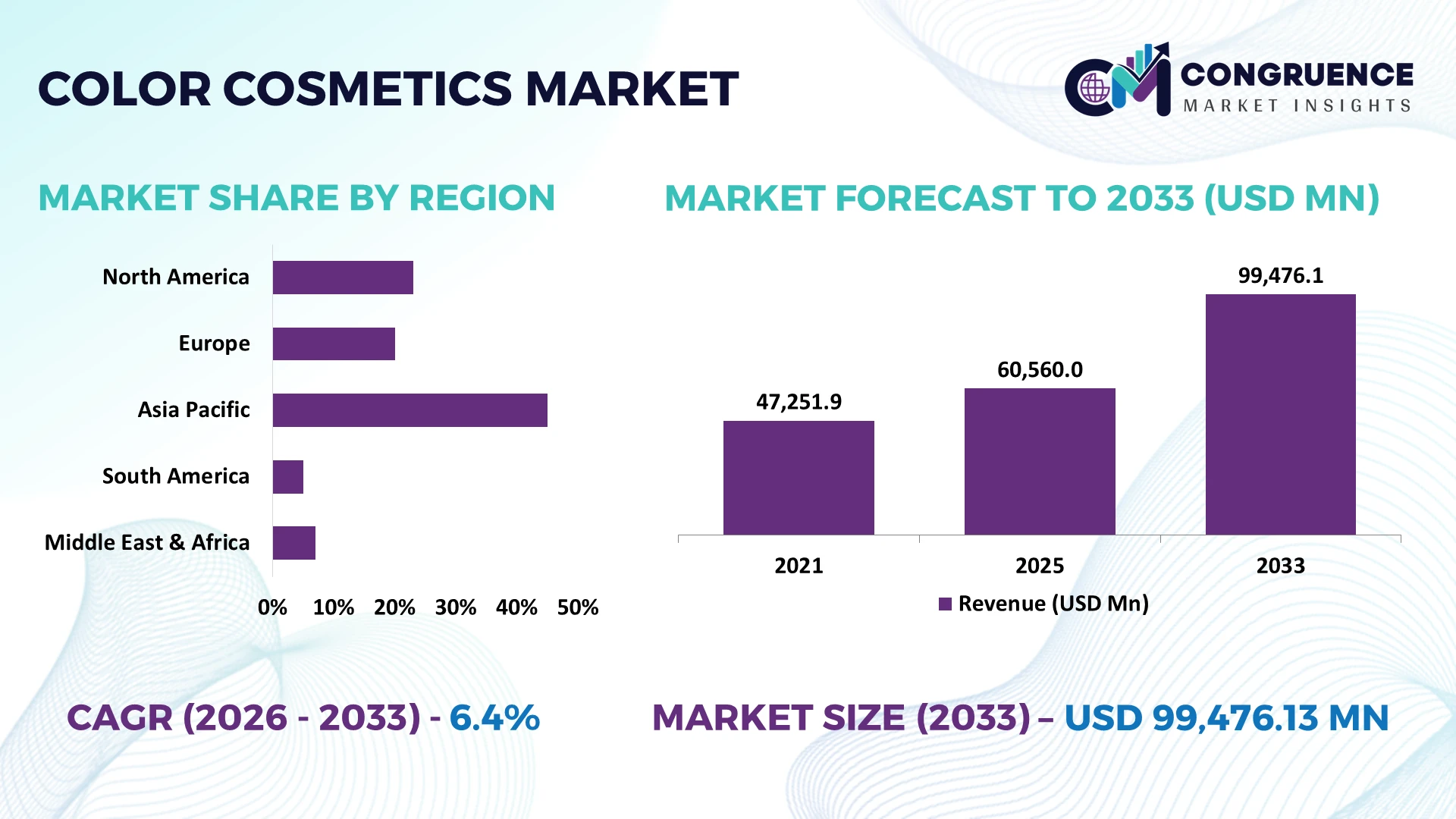
China holds a dominant position, accounting for about 41.7% of Asia Pacific color cosmetics demand and an estimated 14% of global consumption, supported by expanding domestic beauty brands, advanced formulation capacity, and digitally enabled retail. India is expanding faster from a smaller base, with urban beauty adoption and e-commerce accelerating category penetration. Across Asia, AI-assisted shade matching and virtual try-on are moving from pilot programs toward commercial deployment, while China+1 supply-chain strategies are encouraging manufacturers to diversify production across India and Southeast Asia.
Companies should prioritize China-scale product portfolios while building diversified India and Southeast Asia manufacturing and digital-commerce capacity.
Market Size & Growth: USD 60.56 billion in 2025 to USD 99.48 billion by 2033 at 6.4% CAGR, driven by AI personalization and digital beauty commerce.
Top Growth Drivers: AI personalization 28%, social commerce 24%, premiumization 19% accelerating global category expansion.
Short-Term Forecast: By 2028, AI-assisted product discovery can reduce shade-selection friction by 15% and improve conversion efficiency by 10%.
Emerging Technologies: GenAI, virtual try-on, AI shade matching, and biotech pigments are reshaping formulation and consumer engagement.
Regional Leaders: Asia Pacific reaches about USD 42.9 billion, North America USD 23.1 billion, and Europe USD 18.4 billion, with online beauty adoption accelerating.
Consumer Trends: Around 35% of younger beauty shoppers increasingly discover makeup through social platforms, supporting rapid trend-to-purchase cycles.
Pilot Example: 2026 AI makeup integration enables real-time virtual try-on through conversational commerce, reducing physical sampling dependence and improving digital product discovery.
Competitive Landscape: L’Oréal leads with an estimated 8% share, followed by Estée Lauder, Shiseido, Coty, and LVMH-backed beauty brands.
Regulatory & ESG Impact: EU microplastic restrictions create reformulation pressure, with makeup products receiving a transition period through 2035.
Investment & Funding: More than USD 1 billion in recent beauty-tech activity is shifting toward AI, biotechnology, digital diagnostics, and personalized product platforms.
Innovation & Future Outlook: Agentic AI, biotech-derived pigments, refillable packaging, and hyper-personalized formulations will shift competition toward technology-led product differentiation.
The Color Cosmetics Market is seeing strongest demand across lip, face, and eye products, particularly multifunctional foundations, long-wear lip formats, skin-enhancing makeup, and digitally personalized shade ranges. AI-driven virtual try-on and diagnostic technologies are becoming important conversion tools, with advanced platforms achieving up to 95% shade-matching accuracy. Asia Pacific remains the critical demand center as China, India, Japan, and South Korea expand beauty consumption and local-brand innovation. Meanwhile, EU microplastic restrictions are accelerating formulation and packaging changes, creating a strategic shift toward compliant pigments, cleaner formulations, and resilient regional supply chains.
The Color Cosmetics Market is becoming strategically important because competition is shifting from brand visibility toward faster product development, digital personalization, shade inclusivity, and omnichannel execution. China illustrates this transition clearly: domestic brands held 57.4% of cosmetics sales in 2025, while online channels represented 65.4%, forcing international players to accelerate localized innovation and digital distribution. India is following a different pathway, with online beauty sales expanding more than 10 times faster than offline channels.
Technology is also changing operating economics. AI-assisted virtual shade matching reduces dependence on physical sampling and can cut product-selection friction by roughly 15%, while legacy trial-led merchandising requires substantially more store-level inventory and staff intervention. Over the next 2–3 years, brands deploying AI diagnostics, virtual try-on, and demand analytics should target 10–15% faster digital conversion cycles and tighter inventory allocation.
Operationally, brands are redirecting investment toward localized formulations, creator-led commerce, and technology partnerships. EU microplastic restrictions, including a 2035 deadline for makeup and lip products, are accelerating reformulation planning. Companies combining compliant formulations with localized digital distribution will gain stronger competitive positioning, lower launch friction, and greater long-term relevance.
AI-powered shade matching and virtual try-on are becoming major demand accelerators as consumers expect personalized product selection across digital channels. In India, digitally influenced beauty purchasing has expanded sharply, while China generated 65.4% of cosmetics transaction volume online in 2025. These shifts reduce dependence on physical sampling and enable brands to test broader shade portfolios with lower merchandising friction. L’Oréal, Estée Lauder, and digitally native brands are increasing investments in personalization, social commerce, and data-led product development. The non-obvious advantage is faster demand sensing: brands can identify shade and format preferences before committing large production volumes, improving inventory turns and reducing obsolete SKU exposure.
Color cosmetics remain exposed to volatility in pigments, specialty polymers, packaging materials, and functional ingredients, creating direct pressure on formulation economics. Imported specialty ingredients can represent a significant portion of premium formulation inputs, while sudden logistics disruptions can increase procurement costs by 8–15% for selected components. EU microplastic restrictions add another compliance layer, with makeup and lip products facing requirements extending to 2035. Companies are responding through dual sourcing, regional formulation laboratories, longer supplier contracts, and alternative pigment systems. The strategic constraint is not consumer demand but formulation continuity: brands with concentrated supplier bases face greater risk of delayed launches and inconsistent shade performance.
India presents a high-value opportunity as digital beauty discovery moves beyond major metropolitan markets into smaller cities and digitally connected consumers. Online beauty sales are expanding more than 10 times faster than offline channels, while 53% of Indian beauty shoppers are digitally influenced, creating a substantial conversion gap between discovery and purchase. Brands can capture this gap through AI consultations, virtual shade trials, quick-commerce sampling, and localized complexion ranges. The strongest opportunity lies in combining digital recommendation engines with physical trial points rather than pursuing online-only models. Companies are expanding through retail partnerships, D2C platforms, and localized product development, turning fragmented demand data into faster regional assortment decisions.
Personalized color cosmetics create execution complexity because wider shade portfolios increase formulation, forecasting, packaging, and inventory requirements. Adding 20–30% more shades without accurate demand analytics can materially increase slow-moving SKUs, while AI recommendation systems require consistent product databases and high-quality consumer inputs. India’s fragmented omnichannel journey and China’s rapid online product turnover intensify this challenge. Companies must integrate formulation systems, demand forecasting, CRM data, and digital recommendation tools rather than deploying isolated AI applications. Over the next several years, competitive advantage will depend on achieving personalization without excessive SKU proliferation, making modular formulations, regional manufacturing, and predictive inventory systems critical to scalable operations.
Hybrid Makeup Gains Ground: Skinification is reshaping formulations, with more than 50% of U.S. consumers seeking makeup-skincare combinations and over 60% of Gen Z and Millennials favoring hybrid products. Brands are expanding serum foundations, tinted treatments, and multifunctional formats to improve perceived value and reduce routine complexity.
Lip Formats Accelerate Innovation: Lip products are shifting toward oils, balms, liners, and treatment-led formats, with U.S. prestige lip sales rising 3% in 2025 and lip liner among the fastest-growing subsegments. Companies are increasing launches, shade extensions, and social-commerce activation while reallocating shelf space toward higher-velocity formats.
Value Tiers Are Converging: Nearly 50% of global consumers now shop across multiple beauty price tiers, while mass and masstige makeup have gained about 5 percentage points of share over five years. Brands are widening entry-price portfolios and improving formulations, packaging, and distribution to capture selective premiumization without losing volume.
Regulation Reshapes Formulation Pipelines: EU microplastic restrictions are forcing reformulation and ingredient validation across affected cosmetic products, while supply-chain volatility encourages regional sourcing. Companies are increasing compliant pigment alternatives, supplier qualification, and formulation testing to protect launch schedules and reduce dependency on concentrated specialty-ingredient networks.
Face Makeup remains the leading type, representing approximately 38% of global color-cosmetics demand, supported by foundation, concealer, and complexion products that offer broad daily-use applications. Its scale advantage comes from high SKU turnover, repeat purchasing, and integration with skincare benefits. Eye Makeup follows at roughly 24%, while Lip Makeup accounts for about 21% and is gaining strategic importance through treatment-led formats. Nail Makeup, Cheek Makeup, and Body Makeup remain smaller but provide targeted expansion opportunities through specialized finishes and occasion-based consumption.
Lip Makeup is the fastest-moving type, with adoption accelerating through tinted oils, balms, liners, and hybrid treatment formats. U.S. prestige lip products grew 3% in 2025, while lip liner recorded substantially stronger momentum. Companies are increasing shade extensions, compact formats, and digital merchandising. Investment is therefore shifting from broad SKU expansion toward higher-velocity hybrid products that combine color, treatment, and convenience.
Foundation represents approximately 27% of application demand, making it the leading application because complexion coverage remains central to professional-looking makeup routines and supports broad shade architectures. Concealer contributes about 15%, Mascara 14%, Lipstick 13%, Eyeliner 10%, Blush 9%, and Nail Polish 12%. Foundation and concealer remain mature, high-volume applications, while mascara and eye products benefit from renewed consumer experimentation and compact application formats.
Lipstick is shifting toward multifunctional usage, with oils, balms, liners, and treatment-infused products expanding beyond conventional color delivery. In U.S. prestige makeup, lip remained a key contributor in 2025, while mascara supported renewed eye-makeup performance. Companies are therefore prioritizing hybrid lipstick formulations, precision applicators, and digitally promoted shade collections. The operational implication is stronger investment in flexible filling, rapid shade development, and smaller-format launches that allow brands to test demand before scaling production.
Individual Consumers represent approximately 72% of color cosmetics demand, reflecting the category's high purchase frequency, broad product accessibility, and direct-to-consumer availability. Beauty Salons account for about 9%, Professional Makeup Artists 7%, Cosmetic Studios 4%, Film & Television 3%, and the Fashion Industry 5%. Consumer purchasing remains the scale engine, but professional users generate higher product intensity because complex applications require broader shade libraries, specialized finishes, and dependable replenishment.
Professional Makeup Artists are among the faster-expanding high-value users as social content, bridal services, studio production, and creator-led beauty increase demand for performance-focused products. Companies are responding with pro kits, wholesale partnerships, larger-format packaging, and customized shade systems. India is particularly attractive because 58% of surveyed consumers associate beauty with confidence, strengthening the relevance of accessible and culturally localized product portfolios. The strategic shift is toward serving individual consumers for volume while using professional ecosystems to accelerate product credibility and trial.
Asia-Pacific accounted for the largest market share at 41.7% in 2025 however, South America is expected to register the fastest growth, expanding at a CAGR of 7.6% between 2026 and 2033.
Digital personalization and premium formulation are reshaping category economics
North America remains a high-value color cosmetics market, supported by mature prestige distribution, strong formulation capabilities, advanced retail infrastructure, and rapid adoption of AI-assisted beauty technologies. The region represents approximately 28% of global demand, with the U.S. generating the largest share of regional consumption. Digital platforms influence more than 60% of beauty-product discovery among younger consumers, increasing pressure for faster shade development, personalized recommendations, and shorter product-launch cycles. Major brands are expanding virtual try-on, creator-commerce partnerships, direct-to-consumer fulfillment, and data-led merchandising. Retailers are also reallocating shelf space toward hybrid complexion and lip formats with stronger turnover. The operational advantage increasingly comes from integrating consumer data with formulation, demand forecasting, and inventory systems, enabling faster product testing while reducing dependence on broad physical sampling networks.
United States Market Outlook: The U.S. remains North America’s technology, premiumization, and innovation center, supported by extensive prestige retail infrastructure and advanced beauty-commerce platforms. More than 60% of younger consumers engage with digital beauty discovery, strengthening investment in AI diagnostics, virtual try-on, creator partnerships, personalized shade portfolios, and rapid product testing. Large retailers are increasingly using consumer analytics to optimize assortment and promotional placement, giving technology-enabled brands an advantage in conversion and inventory efficiency.
Regulatory-led formulation modernization is redefining product development
Europe maintains approximately 22% of global color cosmetics demand, combining sophisticated premium markets with strong formulation, packaging, luxury, and specialty manufacturing capabilities. France, Germany, Italy, and the United Kingdom remain important commercial and production centers, while European sustainability requirements are accelerating reformulation and packaging redesign. Microplastic restrictions affecting cosmetic formulations are forcing manufacturers to validate alternative ingredients and reformulate affected products well ahead of regulatory deadlines. More than 50% of European consumers increasingly consider sustainability attributes during selected beauty purchases, strengthening demand for recyclable packaging, responsible formulations, and transparent ingredient positioning. Companies are responding through regional supplier qualification, cleaner pigment systems, refillable packaging, and laboratory investment. The key operational shift is that regulatory compliance is becoming embedded earlier in product-development workflows rather than treated as a final-stage certification activity.
France Market Outlook: France holds a strategically important position through its concentration of luxury beauty houses, formulation expertise, cosmetics laboratories, packaging specialists, and global distribution networks. Its established premium ecosystem supports rapid commercialization of advanced complexion, lip, and skincare-integrated makeup formats. French manufacturers are also strengthening sustainable packaging and formulation capabilities, allowing domestic brands to compete through premium positioning, innovation speed, and international brand recognition.
Scale, localized innovation, and digital commerce create the strongest operating advantage
Asia-Pacific commands approximately 41.7% of global color cosmetics demand, with China, Japan, South Korea, and India forming the region’s principal consumption and innovation centers. China combines large-scale manufacturing with highly developed livestream commerce and domestic beauty-brand ecosystems, while South Korea continues to influence formulation and packaging innovation. India is expanding its manufacturing and digital beauty infrastructure as domestic brands broaden shade ranges and omnichannel distribution. Online channels represent more than 65% of cosmetics transaction activity in China, demonstrating the region’s unusually strong digital purchasing infrastructure. Companies are responding through localized product development, influencer partnerships, rapid product iteration, and regional manufacturing diversification. China+1 supply-chain strategies are also encouraging investment across India and Southeast Asia, reducing concentration risk while improving access to growing consumer markets.
China Market Outlook: China remains the region’s most strategically significant market because of its manufacturing depth, sophisticated beauty-commerce infrastructure, large domestic-brand ecosystem, and rapid product-development cycles. Domestic brands accounted for more than half of cosmetics sales in 2025, reinforcing competitive pressure on international companies. AI-enabled recommendations, livestream commerce, and rapid SKU launches are strengthening China’s role as both a demand center and an innovation laboratory.
Digital retail expansion is unlocking fragmented consumer demand
South America is developing into an increasingly attractive color cosmetics market, led by Brazil’s large consumer base, established beauty industry, and strong direct-selling and retail infrastructure. The region accounts for approximately 7% of global demand, with Brazil representing the dominant commercial and manufacturing center. Digital beauty purchasing is expanding beyond major metropolitan areas, while social-commerce channels are increasing product discovery and accelerating trend adoption. Local manufacturers benefit from established formulation capabilities and access to regionally relevant shade and texture preferences. However, currency volatility, imported ingredient exposure, and logistics costs remain operational constraints for smaller brands. Companies are responding through domestic sourcing, localized manufacturing, distributor partnerships, and flexible product portfolios. The strongest strategic opportunity lies in combining Brazil’s manufacturing scale with digital distribution to reach underserved secondary cities.
Brazil Market Outlook: Brazil is the region’s primary strategic market, supported by a large beauty-consuming population, established cosmetics manufacturing, extensive retail networks, and strong professional beauty infrastructure. Local companies increasingly combine domestic formulation with digital commerce and influencer-led marketing. This ecosystem enables faster localization of shade ranges and product formats while reducing reliance on imported finished products and improving supply responsiveness.
Premiumization and modern retail infrastructure are accelerating market transformation
The Middle East & Africa market is being shaped by premium beauty consumption, tourism-linked retail, expanding shopping infrastructure, and rapid digital adoption. The region contributes approximately 6% of global color cosmetics demand, with the United Arab Emirates and Saudi Arabia serving as important premium retail and distribution hubs. Beauty e-commerce penetration has expanded rapidly, while luxury malls, specialty stores, and airport retail provide high-value consumer touchpoints. Saudi Arabia’s Vision 2030 investment cycle is strengthening modern retail and consumer infrastructure, creating additional opportunities for international and regional beauty brands. Companies are responding through local distributor partnerships, premium product launches, localized campaigns, and expanded omnichannel fulfillment. The operational challenge remains market fragmentation across countries, making regional distribution partnerships and localized inventory planning more effective than uniform market-entry strategies.
United Arab Emirates Market Outlook: The UAE functions as a regional commercial and re-export hub because of its premium retail infrastructure, international tourism, logistics connectivity, and concentration of luxury beauty consumers. Dubai’s airport and shopping ecosystem provides brands with access to international travelers as well as Gulf consumers. Companies are using the UAE as a launch platform for premium products before expanding into Saudi Arabia and neighboring markets.
The Color Cosmetics Market features global leaders such as L’Oréal, Estée Lauder, Shiseido, Coty, and LVMH competing with fast-growing regional and digitally native brands. The top five players collectively control approximately 25% of the market, leaving substantial space for localized challengers. Competition centers on formulation performance, brand positioning, speed-to-market, distribution reach, and personalization. AI-enabled product discovery can improve digital conversion by roughly 10%, while localized manufacturing can reduce selected logistics exposure by 8–15%. L’Oréal and Estée Lauder are strengthening technology and premium portfolios, while Asian brands compete through rapid launches, social commerce, and localized formulations. Vertical integration, supplier diversification, and creator partnerships are becoming increasingly important as ingredient regulation and supply-chain volatility reshape product development. The principal entry barrier is not formulation alone but the combination of brand equity, regulatory capability, retail access, data infrastructure, and scalable manufacturing. Winning requires faster innovation cycles, stronger consumer analytics, differentiated formulations, and resilient supply execution.
L’Oréal
Estée Lauder Companies
Shiseido Company
Coty Inc.
LVMH
Chanel
Revlon
Kao Corporation
Amorepacific Corporation
Natura &Co
KIKO MILANO
Intercos Group
Kryolan
Oriflame Cosmetics
AI-powered beauty diagnostics, virtual try-on, and shade matching are moving from experimental tools into mainstream consumer journeys. L’Oréal reports more than 120 million Beauty Tech uses across 66 countries, showing scaled deployment. Compared with physical sampling, virtual testing can reduce sampling-related operating effort by about 15% and improve digital conversion efficiency by 10%. Integration with CRM and recommendation engines gives brands faster demand signals, tighter assortment planning and personalization.
Emerging technologies are shifting formulation and content workflows. Generative AI accelerates campaign adaptation, while computational chemistry supports molecule screening and formulation discovery. AI-enabled development can improve formulation-cycle efficiency by roughly 10–15%, while automated content production can lower repetitive creative workload by about 10%. Adoption is strongest among enterprises with large SKU portfolios, where centralized platforms connect R&D, marketing, inventory, and ecommerce operations.
Advances will center on agentic AI, predictive formulation, biotech-derived pigments, and immersive commerce through 2026–2028. Makeup assistants and shopping interfaces will compress discovery-to-purchase steps, while predictive systems improve demand forecasting and reduce excess inventory by an estimated 5–8%. Leaders benefit first because they possess richer datasets, stronger R&D infrastructure, and technology partnerships. Companies delaying integration risk slower launches, weaker personalization, and higher operating costs.
June 2026 L’Oréal and OpenAI launched an AI collaboration bringing Maybelline virtual makeup try-on into ChatGPT. The deployment integrates ModiFace technology into conversational commerce, expanding real-time product discovery and strengthening L’Oréal’s competitive position in personalized digital beauty experiences across markets.
March 2025 The Estée Lauder Companies partnered with Adobe to integrate Firefly generative AI into Creative Cloud workflows. The program targets hundreds of thousands of digital assets annually, accelerating campaign production and releasing creative capacity for faster brand activation worldwide.
January 2025 Shiseido renewed its Perfect Cover color cosmetics line after 30 years, improving functionality and expanding shades for diverse global skin tones. Products launched internationally across retail and medical channels, strengthening inclusive makeup positioning and specialized coverage demand globally.
July 2026 Reuters reported L’Oréal using AI to repurpose skincare molecules for new products, cutting development cycles fourfold. Faster computational screening improves formulation productivity and supports quicker innovation, giving large beauty manufacturers a measurable speed advantage over conventional workflows today.
The Color Cosmetics Market Report covers the competitive structure, product segmentation, application patterns, end-user demand, technology adoption, and regional operating conditions shaping the industry through 2033. Coverage spans Face Makeup, Eye Makeup, Lip Makeup, Nail Makeup, Cheek Makeup, and Body Makeup, with application analysis across Foundation, Concealer, Mascara, Eyeliner, Lipstick, Blush, and Nail Polish. End-user assessment includes Individual Consumers, Professional Makeup Artists, Beauty Salons, Cosmetic Studios, Film & Television, and the Fashion Industry.
The report evaluates North America, Europe, Asia-Pacific, South America, and the Middle East & Africa, emphasizing country-level demand, manufacturing capabilities, digital commerce, formulation innovation, regulatory shifts, and supply-chain positioning. Technology coverage includes AI diagnostics, virtual try-on, generative AI, computational formulation, advanced pigments, and sustainable packaging. Segment shares, adoption indicators, competitive activity, and deployment patterns help decision-makers prioritize investment, expansion, partnerships, product development, and competitive positioning from 2026 through 2033.
| Report Attribute/Metric | Report Details |
|---|---|
Market Revenue in 2025 | USD 60560 Million |
Market Revenue in 2033 | USD 99476.13 Million |
CAGR (2026 - 2033) | 6.4% |
Base Year | 2025 |
Forecast Period | 2026 - 2033 |
Historic Period | 2021 - 2025 |
Segments Covered | By Type
By Application
By End-User
|
Key Report Deliverable | Revenue Forecast, Growth Trends, Market Dynamics, Segmental Overview, Regional and Country-wise Analysis, Competition Landscape |
Region Covered | North America, Europe, Asia-Pacific, South America, Middle East, Africa |
Key Players Analyzed | L’Oréal, Estée Lauder Companies, Shiseido Company, Coty Inc., LVMH, Chanel, Revlon, Kao Corporation, Amorepacific Corporation, Natura &Co, KIKO MILANO, Intercos Group, Kryolan, Oriflame Cosmetics |
Customization & Pricing | Available on Request (10% Customization is Free) |




