
Reports
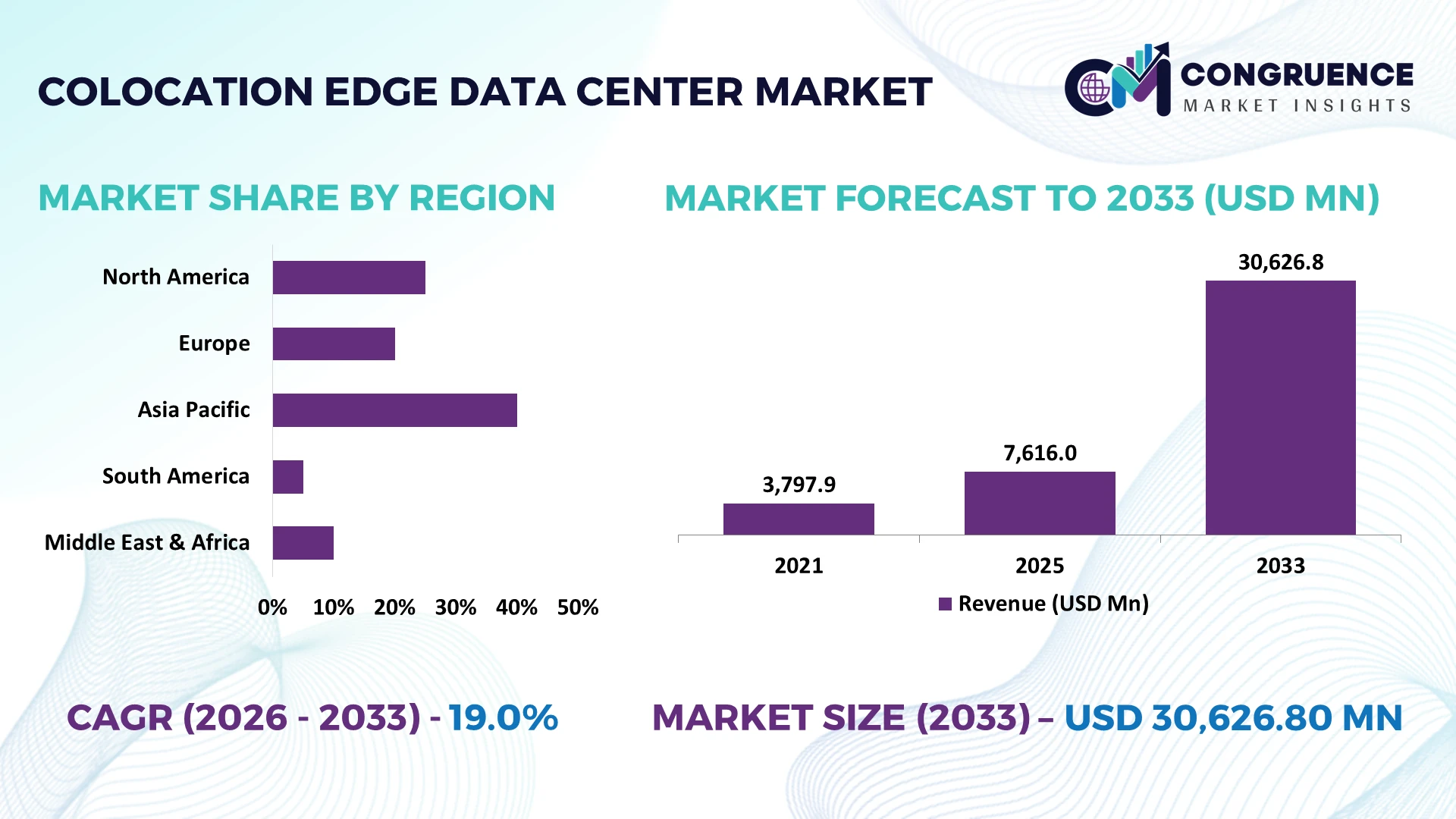
The Global Colocation Edge Data Center Market was valued at USD 7616 Million in 2025 and is anticipated to reach a value of USD 30626.8 Million by 2033 expanding at a CAGR of 19% between 2026 and 2033. Growth is driven by AI inference workloads, 5G traffic localization, cloud on-ramps, content delivery, and enterprise requirements to process latency-sensitive workloads closer to users.
The United States remains the dominant country, supported by more than 5,000 data centers and roughly 40% of global hyperscale capacity, with Northern Virginia, Dallas, Chicago, Silicon Valley, and Phoenix anchoring dense interconnection ecosystems. AI, financial services, streaming, cloud, and telecom workloads are pushing edge deployments toward higher rack densities and liquid-ready infrastructure. China operates a larger sovereign digital ecosystem but tighter cross-border data controls constrain international colocation patterns, while U.S. CHIPS Act investment strengthens domestic semiconductor and AI infrastructure supply chains.
The strongest strategic position belongs to operators combining metropolitan edge capacity, carrier-neutral connectivity, AI-ready power density, and rapid deployment near enterprise demand clusters.
Market Size & Growth: USD 7,616 million in 2025 reaches USD 30,626.8 million by 2033 at 19% CAGR as AI inference and distributed cloud workloads move closer to users.
Top Growth Drivers: AI workload expansion above 30%, 5G population coverage exceeding 50%, and cloud adoption above 70% are increasing distributed compute requirements.
Short-Term Forecast: By 2028, edge processing can reduce application latency by 30–50% for suitable workloads by eliminating repeated long-distance transfers to centralized cloud regions.
Emerging Technologies: AI inference accelerators, direct-to-chip liquid cooling, and software-defined infrastructure are supporting rack densities moving beyond 40–80 kW in advanced edge environments.
Regional Leaders: By 2033, North America approaches USD 12.0 billion, Asia-Pacific USD 10.0 billion, and Europe USD 6.5 billion as AI-ready metropolitan capacity expands.
End-User Trends: More than 70% of enterprises use multiple cloud environments, strengthening demand for colocation facilities providing direct cloud connectivity, distributed processing, and network choice.
Pilot/Case Example: In 2025, advanced liquid-cooled deployments supported AI racks exceeding 100 kW, multiplying compute density versus conventional 10–20 kW enterprise configurations.
Competitive Landscape: Equinix holds an estimated 10–15% position in addressable interconnected colocation, competing with Digital Realty, EdgeConneX, DataBank, and AtlasEdge across metropolitan deployments.
Regulatory & ESG Impact: Modern facilities targeting PUE below 1.3 can reduce infrastructure energy overhead by more than 20% versus legacy sites operating near 1.6.
Investment & Funding: Announced global data-center programs exceed USD 100 billion as operators secure power, land, fiber, and cooling capacity around AI-intensive metropolitan clusters.
Innovation & Future Outlook: Edge sites supporting 100+ kW racks, autonomous operations, and liquid cooling are shifting competitive advantage from floor space toward deliverable power, connectivity, and deployment speed.
The Colocation Edge Data Center Market is increasingly shaped by AI inference, telecom edge computing, content delivery, financial transactions, industrial IoT, and distributed cloud architectures. Operators are deploying GPU-ready racks, direct-to-chip liquid cooling, modular power systems, and automated infrastructure management as advanced deployments exceed 100 kW per rack. Power-grid congestion in established data-center hubs is simultaneously redirecting capacity toward secondary metropolitan locations with available substations and fiber routes. This decentralization is making power availability, interconnection density, and deployment speed decisive factors in the market’s strategic evolution.
Colocation edge infrastructure is becoming strategically important because AI inference, cloud interconnection, content delivery, and real-time enterprise applications increasingly require compute near users rather than centralized hyperscale campuses. Power scarcity in Northern Virginia, Dublin, Singapore, and other established hubs is redirecting deployment toward secondary metros where grid capacity and fiber converge. Operators securing energized land now gain a measurable time-to-market advantage as utility connection queues lengthen.
Modern edge facilities using liquid cooling and automated infrastructure controls can support 40–100+ kW racks, compared with roughly 10–20 kW for conventional air-cooled enterprise environments, delivering several times greater compute density. The United States leads interconnection scale, while Singapore emphasizes capacity efficiency under stricter sustainability requirements. Through 2028, direct-to-chip cooling and AI-ready power distribution will become increasingly embedded in premium deployments.
A practical model places GPU-enabled colocation nodes near telecom aggregation points, allowing inference traffic to remain metropolitan instead of repeatedly traversing distant cloud regions. Equinix, Digital Realty, EdgeConneX, and DataBank are consequently prioritizing power procurement, modular capacity, carrier partnerships, and liquid-ready infrastructure. Long-term advantage will belong to operators controlling power, connectivity, deployment speed, and high-density thermal capability simultaneously.
AI inference is moving compute requirements from centralized training campuses toward metropolitan facilities positioned close to enterprises and users. Advanced AI racks increasingly exceed 40 kW, compared with approximately 10–20 kW for conventional enterprise configurations, while 5G networks now cover more than 50% of the global population. The operational shift matters because inference workloads require rapid response and sustained accelerator availability rather than bulk storage alone. U.S. data-center operators are consequently securing utility capacity near Atlanta, Dallas, Phoenix, and emerging secondary hubs as Northern Virginia power availability tightens. Providers are investing in GPU-ready power distribution, liquid cooling, cloud on-ramps, and carrier-dense campuses. A critical strategic shift is occurring: usable megawatts, rather than available floor area, increasingly determine competitive edge capacity.
Power availability has become the principal structural constraint on edge colocation expansion. AI-ready racks can demand 2–5 times the power density of traditional enterprise installations, while utility interconnection processes in constrained hubs can extend beyond 24 months. Ireland has imposed tighter conditions on new Dublin data-center connections, and Singapore’s controlled capacity allocation demonstrates how electricity and sustainability limits directly influence development. Higher-density computing also raises cooling infrastructure requirements, increasing facility retrofit costs by 15–30% in unsuitable legacy environments. Operators are responding by diversifying into secondary metros, contracting renewable power, securing substations earlier, and retrofitting selected campuses with liquid cooling. The commercial bottleneck is no longer obtaining servers; operators unable to secure firm electricity capacity cannot monetize customer demand regardless of available building space or fiber connectivity.
High-density AI infrastructure creates an opportunity to extract substantially more computing capacity from constrained metropolitan footprints. Direct-to-chip liquid cooling can remove more than 70% of server heat directly at the component level, while advanced deployments support racks above 100 kW and reduce dependence on energy-intensive air movement. Japan and Singapore provide attractive environments for compact, high-efficiency infrastructure because land and power constraints reward greater compute density. Through 2028, modular liquid-cooling distribution units, rear-door heat exchangers, and automated thermal management will move deeper into edge colocation portfolios. Operators are partnering with chip vendors, cooling specialists, and cloud platforms while redesigning power trains for accelerator clusters. The non-obvious opportunity is brownfield densification: upgrading thermal infrastructure can unlock additional sellable compute without acquiring another metropolitan site.
Scaling hundreds of smaller edge locations creates operational complexity that centralized campuses avoid. Remote sites require consistent cybersecurity, firmware management, physical security, network orchestration, and thermal performance despite limited on-site staffing. Data-center workforce shortages remain material, while advanced racks operating above 40–80 kW demand specialized electrical and liquid-cooling expertise. European data-sovereignty requirements and sector-specific localization rules further complicate workload placement across interconnected facilities. A single poorly managed software or cooling failure can disrupt latency-sensitive applications across an entire metropolitan service zone. Operators must therefore invest in zero-touch provisioning, AI-assisted infrastructure management, standardized modular designs, remote-hands ecosystems, and cybersecurity automation. The strategic challenge is maintaining hyperscale-grade reliability across distributed footprints; expansion without operational standardization increases service inconsistency faster than it expands commercially usable edge capacity.
Secondary Metros Absorb New Capacity: Operators are shifting deployments from power-constrained primary hubs toward Atlanta, Columbus, Madrid, Johor, and Osaka, where utility access improves expansion timelines. New interconnections in constrained markets can exceed 24 months, while secondary locations can offer 15–25% lower occupancy costs. Providers are securing substations, fiber routes, and land earlier, making power-reservation strategy increasingly decisive for capacity delivery.
Private Interconnection Density Accelerates: Enterprises increasingly bypass public internet routes for cloud and partner connectivity, with direct connections reducing network latency by 20–40% for suitable architectures. Multi-cloud usage exceeds 70% among large enterprises, increasing demand for dense exchange ecosystems. Equinix and Digital Realty are expanding software-defined interconnection and virtual network services, converting edge facilities from server-hosting locations into distributed digital exchange points.
Prefabrication Compresses Deployment Timelines: Modular electrical rooms, cooling systems, and prefabricated data halls are replacing sequential on-site construction, shortening selected deployment schedules by approximately 20–30% and reducing site labor requirements by 15–25%. Skilled construction shortages reinforce adoption in the United States. Operators are standardizing repeatable designs and supplier frameworks, allowing identical edge capacity blocks to be deployed across multiple metropolitan markets with lower commissioning complexity.
Inference Changes Capacity Contracting Models: AI customers increasingly request smaller distributed accelerator clusters instead of concentrating every workload within training campuses. Edge inference can reduce round-trip latency by 30–50%, while deployments increasingly require 40+ kW racks. Operators are introducing power-based reservations, dedicated AI suites, and shorter expansion increments. The non-obvious shift is commercial: sellable kilowatts and network proximity increasingly determine contract value more than physical cabinet counts.
Retail Colocation represents the leading type with an estimated 31% share, supported by enterprises purchasing cabinets, cages, cross-connects, cloud access, and managed infrastructure without committing to entire data halls. Its advantage lies in scalable increments and dense connectivity, particularly for financial, cloud, media, and distributed IT workloads. Carrier-Neutral and Network-Dense facilities command strategic premiums where customers require multiple carriers and exchanges. Wholesale Colocation remains important for larger deployments requiring dedicated power blocks and predictable capacity economics.
Micro Data Centers are the fastest-growing type as latency-sensitive processing moves closer to industrial, telecom, retail, and metropolitan endpoints. Compact deployments can reduce application latency by approximately 30–50% versus distant centralized processing in suitable architectures, while Modular Facilities can shorten capacity delivery by 20–30%. Operators are consequently expanding prefabricated infrastructure, remote-management platforms, and carrier partnerships. Investment priorities are moving toward smaller repeatable capacity blocks that preserve interconnection density while reducing dependence on lengthy conventional construction cycles.
Cloud Computing leads applications with an estimated 32% share because enterprises require distributed cloud access, private interconnection, hybrid infrastructure, and localized processing without building dedicated facilities. Content Delivery and Video Streaming remain mature workloads because proximity reduces transit distance and improves user experience. 5G Services increasingly place network functions near metropolitan aggregation points, while IoT Processing and Real-Time Analytics require local execution where sending every event to centralized clouds introduces unnecessary latency and bandwidth consumption.
AI Workloads are the fastest-growing application as inference moves closer to enterprise datasets and end users. Advanced accelerator deployments increasingly require 40–100+ kW racks, compared with roughly 10–20 kW for conventional enterprise computing. Operators are adapting through dedicated AI suites, high-capacity power distribution, accelerator connectivity, and automated workload orchestration. Content and network workloads continue supplying baseline utilization, but AI is changing facility engineering requirements. Competitive investment is consequently concentrating on infrastructure capable of supporting both conventional edge traffic and high-density inference without extensive reconstruction.
Cloud Providers represent the leading end-user group with an estimated 35% share, reflecting their requirement for distributed capacity, direct interconnection, availability zones, and localized enterprise access beyond hyperscale campuses. Telecom Operators form another infrastructure-intensive buyer group as network functions migrate toward virtualized architectures. IT Enterprises increasingly use colocation to connect hybrid environments, while Financial Services prioritize low-latency pathways and resilient redundancy. Media & Entertainment demand proximity for content distribution, whereas Government and Healthcare emphasize controlled data placement and security.
Telecom Operators are the fastest-growing end-user segment as 5G network densification increases distributed processing requirements. Global 5G population coverage has moved beyond 50%, strengthening demand for network-adjacent compute and localized service delivery. Retail is also expanding edge adoption for analytics and digitally connected stores. Colocation providers are responding with telecom partnerships, dedicated cloud connectivity, compliance-focused suites, flexible power blocks, and distributed metropolitan footprints. Future demand therefore favors operators capable of serving cloud-scale customers while maintaining specialized environments for regulated and latency-sensitive enterprises.
North America accounted for the largest market share at 38.6% in 2025 however, Asia-Pacific is expected to register the fastest growth, expanding at a CAGR of 21.7% between 2026 and 2033.
AI Capacity Moves Beyond Core Hubs
North America represented approximately 38.6% of global demand in 2025, supported by dense cloud ecosystems, extensive fiber infrastructure, mature colocation adoption, and accelerating AI inference requirements. Northern Virginia remains the principal interconnection hub, but constrained grid connections are redirecting incremental deployments toward Dallas, Phoenix, Atlanta, Columbus, and Salt Lake City. Advanced facilities increasingly accommodate 40–100+ kW racks, requiring liquid-ready cooling and higher-capacity electrical distribution. Operators are also positioning smaller edge nodes near telecom aggregation points to serve financial transactions, streaming, cloud access, and enterprise AI. The United States has more than 5,000 data-center facilities across categories, creating substantial interconnection depth. Equinix, Digital Realty, DataBank, and specialized providers are therefore securing power and fiber earlier while standardizing modular designs that accelerate metropolitan capacity additions.
United States Market Outlook: The United States combines hyperscale cloud concentration, dense carrier ecosystems, semiconductor investment, and enterprise AI adoption. Northern Virginia alone operates data-center capacity measured in multiple gigawatts, while secondary markets increasingly absorb deployments constrained by power availability. Operators are prioritizing direct cloud connections, GPU-capable electrical systems, liquid cooling, and utility partnerships, strengthening the country’s position as the principal commercialization environment for advanced edge colocation architectures.
Sovereignty Redirects Distributed Infrastructure Investment
Europe accounted for approximately 24.1% of market activity in 2025, with London, Frankfurt, Paris, Amsterdam, and Dublin forming the established interconnection core. Capacity expansion is increasingly shaped by energy availability, data-sovereignty requirements, and environmental regulation rather than connectivity alone. Dublin’s grid restrictions and Amsterdam’s development controls have encouraged operators to diversify into Madrid, Milan, Warsaw, Berlin, and Nordic locations. EU data localization requirements strengthen demand for in-region processing, while AI deployment is increasing requirements for high-density power and advanced thermal management. Operators are targeting PUE levels near 1.2–1.3 in efficient new facilities and integrating renewable electricity procurement with heat-reuse systems. Carrier-neutral architectures remain particularly valuable because enterprises require compliant connectivity between multiple cloud platforms without transferring sensitive workloads unnecessarily across jurisdictions.
Germany Market Outlook: Germany combines Frankfurt’s dense internet exchange ecosystem with major financial, industrial, cloud, and manufacturing workloads. DE-CIX Frankfurt handles peak traffic exceeding 20 Tbps, demonstrating exceptional network concentration for latency-sensitive deployments. Operators are expanding beyond central Frankfurt toward surrounding municipalities where power and land are more accessible, while enterprise customers increasingly require sovereign cloud connectivity, resilient infrastructure, and localized AI processing.
Digital Scale Accelerates Distributed Capacity
Asia-Pacific represented approximately 26.9% of global demand in 2025, with Singapore, Japan, Australia, India, China, Indonesia, and Malaysia supporting distinct deployment models. Singapore remains a premium interconnection hub but controlled capacity allocation has redirected large developments toward Johor, where operators can secure larger power blocks and land parcels. Japan combines established carrier infrastructure with enterprise cloud demand, while India’s rapid digitalization supports edge deployments around Mumbai, Chennai, Hyderabad, Bengaluru, and Delhi NCR. 5G coverage and growing AI inference requirements are strengthening metropolitan compute demand. Operators increasingly combine modular construction, renewable-power procurement, liquid-ready cooling, and submarine-cable connectivity. The emerging competitive pattern is cross-border clustering: Singapore provides connectivity and enterprise concentration while neighboring Johor supplies scalable physical capacity, creating complementary rather than purely competing infrastructure ecosystems.
India Market Outlook: India offers a powerful edge deployment case because more than 900 million internet users, nationwide 5G expansion, digital payments, streaming, cloud migration, and data-localization requirements generate geographically distributed workloads. Mumbai remains the principal connectivity gateway, while Chennai benefits from submarine cables. Operators are expanding into secondary cities as latency-sensitive applications require compute closer to consumption centers rather than exclusive concentration in primary campuses.
Connectivity Expansion Extends Beyond São Paulo
South America represented approximately 5.1% of global market activity in 2025, with Brazil accounting for the majority of regional colocation and interconnection infrastructure. São Paulo remains the principal cloud and enterprise concentration, while Santiago, Bogotá, Buenos Aires, and secondary Brazilian metros are developing distributed capacity. Financial technology, streaming, gaming, cloud services, and digital commerce support latency-sensitive demand. Brazil’s PIX ecosystem processes billions of transactions monthly, reinforcing requirements for resilient, low-latency infrastructure supporting financial applications. Operators are extending fiber-connected capacity beyond established campuses while adopting modular designs where demand remains less predictable. Execution is constrained by electricity quality, equipment import exposure, permitting differences, and limited network density outside major metros, making site selection and carrier access more important than simply obtaining inexpensive land.
Brazil Market Outlook: Brazil combines the region’s largest digital consumer base with dense cloud, financial-services, telecom, and content ecosystems. São Paulo’s network concentration supports carrier-neutral facilities, while Fortaleza provides strategic submarine-cable connectivity between South America, North America, Europe, and Africa. Operators increasingly evaluate Rio de Janeiro and secondary cities for distributed capacity, balancing lower latency against power availability and sufficient enterprise demand.
Sovereign Digital Infrastructure Attracts Capacity
Middle East & Africa represented approximately 5.3% of global demand in 2025, with the UAE, Saudi Arabia, South Africa, Kenya, and Nigeria providing major deployment concentrations. Government digitalization, cloud-region development, financial technology, and data-residency requirements are accelerating localized infrastructure. Saudi Arabia is building domestic cloud and AI capacity under Vision 2030, while the UAE combines international connectivity with expanding hyperscale ecosystems. South Africa remains the principal sub-Saharan interconnection center, particularly around Johannesburg and Cape Town. Operators are deploying modular capacity and increasingly designing for high ambient temperatures through efficient cooling architectures. Submarine-cable expansion along African coastlines is also creating new edge opportunities, but inconsistent power reliability in selected markets requires greater investment in redundancy, storage, and distributed energy systems before facilities can deliver enterprise-grade availability.
Saudi Arabia Market Outlook: Saudi Arabia is emerging as a strategic colocation location through sovereign cloud requirements, hyperscaler investment, smart-city development, and AI infrastructure programs. Internet penetration exceeds 98%, providing a highly digital customer base. Riyadh and Jeddah are attracting carrier-neutral and cloud-connected capacity as operators align new facilities with local data requirements, renewable-energy development, and enterprise modernization under Vision 2030.
Equinix and Digital Realty compete through global interconnection scale, while EdgeConneX, DataBank, AtlasEdge, and regional specialists challenge them through localized capacity, deployment speed, and edge-focused footprints. The top five providers hold an estimated 35–40% combined share, leaving substantial metropolitan demand fragmented across local operators. Competition increasingly centers on power availability, network density, AI readiness, and commissioning speed. Liquid-ready facilities supporting 40–100+ kW racks command stronger positioning, while modular construction can shorten deployment schedules by 20–30% and direct cloud connectivity can reduce latency by 20–40% for suitable workloads. Operators are securing substations, acquiring regional platforms, expanding carrier partnerships, and standardizing prefabricated designs. The competitive shift is from selling cabinets toward delivering guaranteed power, connectivity, cooling, and distributed cloud access. Grid access, fiber density, permitting, capital intensity, and operational expertise remain formidable entry barriers. Winning requires pre-secured megawatts, dense ecosystems, rapid deployment, and infrastructure engineered for AI-intensive workloads at metropolitan scale.
Equinix, Inc.
Digital Realty Trust, Inc.
EdgeConneX Inc.
DataBank Holdings, Ltd.
AtlasEdge Data Centres
Colt Data Centre Services
NTT DATA Group Corporation
CyrusOne
STACK Infrastructure
Vantage Data Centers
Iron Mountain Incorporated
QTS Data Centers
Flexential
NEXTDC Limited
Current colocation edge infrastructure combines software-defined interconnection, DCIM automation, high-density power distribution and direct-to-chip liquid cooling. Liquid cooling can remove over 70% of server heat at component level, while automated infrastructure controls can reduce cooling-energy consumption by 10–20%. Adoption is accelerating as AI deployments move beyond 40 kW per rack, enabling operators to accommodate denser inference clusters without proportionally expanding metropolitan floor space.
Emerging architectures integrate prefabricated power modules, intelligent workload orchestration, battery energy storage and digital twins. Modular construction can shorten selected deployment schedules by 20–30%, while predictive controls can improve infrastructure utilization by approximately 10–15%. Compared with legacy air-cooled facilities supporting roughly 10–20 kW racks, liquid-ready designs supporting 40–100+ kW deliver several-fold higher compute density. Operators with secured power and standardized modular designs gain faster capacity monetization.
Disruptive development through 2026–2028 centers on autonomous edge operations, distributed AI inference and grid-interactive facilities. AI-assisted fault detection can reduce incident-response time by 20–30%, while software-defined connectivity increasingly enables workloads to shift dynamically between metros. Adoption will favor carrier-neutral operators integrating compute, power, cooling and network orchestration. Companies acting now secure operational data, vendor ecosystems and engineering capability before high-density infrastructure at scale becomes a baseline requirement for premium edge capacity.
December 2024 EdgeConneX acquired 45,000 square meters beside its Jakarta campus, enabling expansion beyond 200 MW. The land purchase strengthened Indonesian hyperscale and edge capacity, giving customers additional scalable infrastructure near Jakarta’s rapidly expanding digital economy.
August 2025 Digital Realty broke ground on ROM1 in Rome, designed with more than 3 MW of installed IT capacity. The carrier-neutral facility strengthens Mediterranean interconnection and creates an AI-ready gateway connecting European, African, Middle Eastern and Asian networks.
October 2025 AtlasEdge secured €253 million green financing for its Lisbon campus, targeting 30 MW across three phases. Sustainability-linked funding supports renewable-powered capacity expansion while strengthening Lisbon’s position as an interconnected edge gateway between Europe and international subsea-cable routes.
February 2026 Digital Realty reported 769 MW of projects underway globally, with 64% already pre-leased. The deployment pipeline demonstrates contracted capacity absorption before completion, strengthening expansion visibility as cloud, colocation, interconnection and AI customers compete for infrastructure.
The Colocation Edge Data Center Market Report evaluates Retail Colocation, Wholesale Colocation, Carrier-Neutral, Network-Dense, Modular Facilities, and Micro Data Centers across Content Delivery, Cloud Computing, IoT Processing, AI Workloads, Video Streaming, 5G Services, and Real-Time Analytics. Retail Colocation represents approximately 31% of type demand, while Cloud Computing accounts for about 32% of applications, providing benchmarks for capacity allocation and deployment planning.
End-user coverage includes Cloud Providers, Telecom Operators, IT Enterprises, Financial Services, Healthcare, Media & Entertainment, Government, and Retail across North America, Europe, Asia-Pacific, South America, and Middle East & Africa. Technology analysis addresses liquid cooling, DCIM automation, digital twins, modular infrastructure, software-defined interconnection, and distributed AI inference. The 2026–2033 framework evaluates metropolitan expansion, power availability, carrier ecosystems, niche micro-data-center deployment, competitive positioning, and investment priorities supporting site selection, partnerships, infrastructure modernization, and portfolio strategy.
| Report Attribute/Metric | Report Details |
|---|---|
Market Revenue in 2025 | USD 7616 Million |
Market Revenue in 2033 | USD 30626.8 Million |
CAGR (2026 - 2033) | 19% |
Base Year | 2025 |
Forecast Period | 2026 - 2033 |
Historic Period | 2021 - 2025 |
Segments Covered | By Type
By Application
By End-User
|
Key Report Deliverable | Revenue Forecast, Growth Trends, Market Dynamics, Segmental Overview, Regional and Country-wise Analysis, Competition Landscape |
Region Covered | North America, Europe, Asia-Pacific, South America, Middle East, Africa |
Key Players Analyzed | Equinix, Inc., Digital Realty Trust, Inc., EdgeConneX Inc., DataBank Holdings, Ltd., AtlasEdge Data Centres, Colt Data Centre Services, NTT DATA Group Corporation, CyrusOne, STACK Infrastructure, Vantage Data Centers, Iron Mountain Incorporated, QTS Data Centers, Flexential, NEXTDC Limited |
Customization & Pricing | Available on Request (10% Customization is Free) |




