
Reports
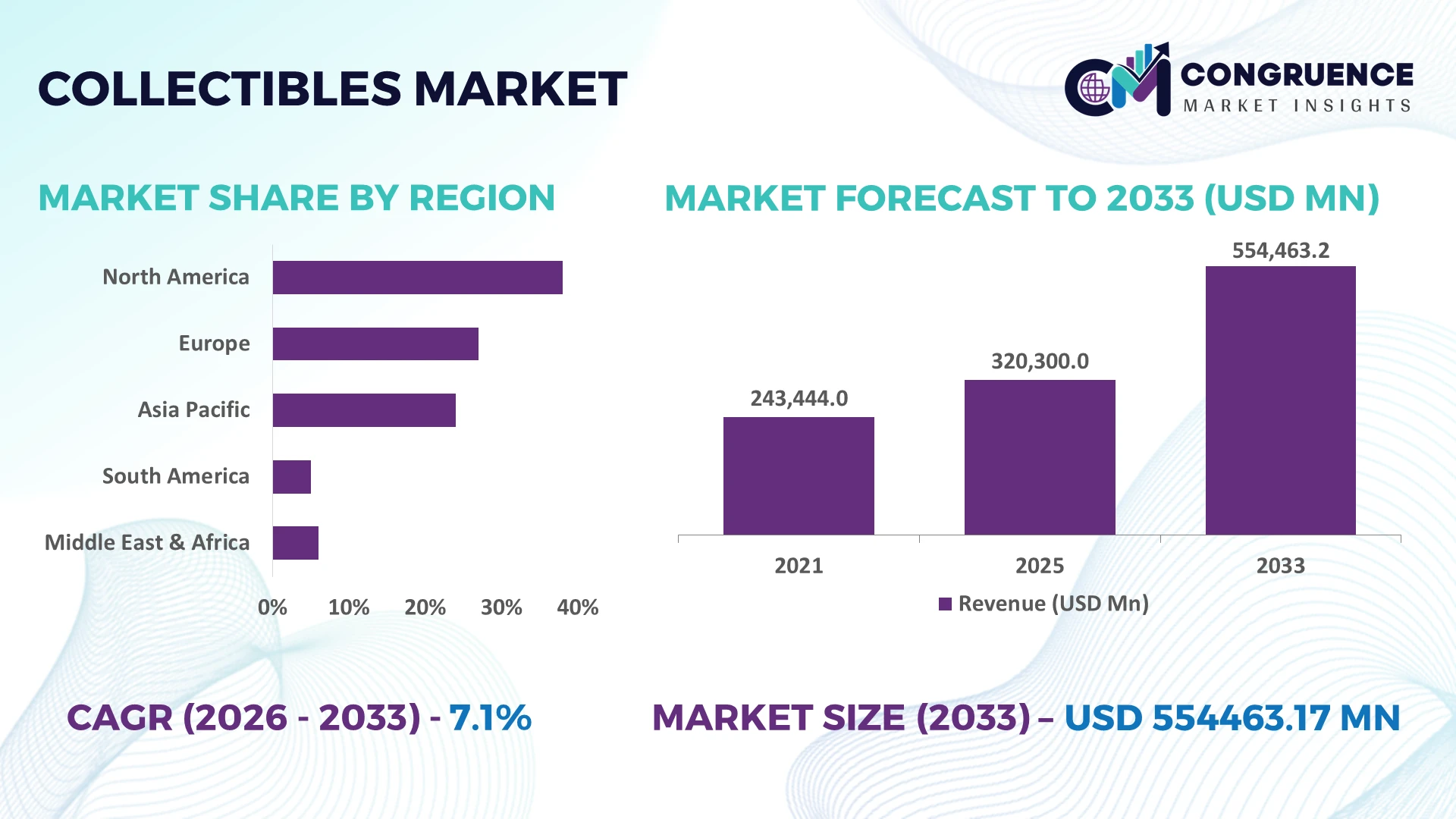
The Global Collectibles Market was valued at USD 320300 Million in 2025 and is anticipated to reach a value of USD 554463.17 Million by 2033 expanding at a CAGR of 7.1% between 2026 and 2033. Growth is driven by authenticated digital trading platforms, AI-enabled valuation systems, premium licensed merchandise, and expanding cross-border collectible commerce supported by secure verification technologies.
The United States remains the dominant collectibles market, accounting for approximately 38% of global transaction activity, supported by established auction ecosystems, grading services, and over 85% adoption of online collectible trading among major marketplace participants. Japan follows with strong leadership in anime, trading cards, and vintage collectibles, while China's expanding luxury collectibles ecosystem benefits from continued digital marketplace investments despite evolving cross-border trade policies shaped by global tariff adjustments during 2026.
Market leadership is concentrated in digitally integrated economies where authentication, provenance tracking, and premium collector engagement create scalable competitive advantages for investors and marketplace operators.
Market Size & Growth: USD 320300 Million in 2025, reaching USD 554463.17 Million by 2033 at 7.1% CAGR, supported by AI-enabled authentication and expanding premium collectibles marketplaces.
Top Growth Drivers: Digital marketplace transactions (+24%), graded collectibles (+19%), and licensed entertainment merchandise (+17%) continue strengthening global demand.
Short-Term Forecast: By 2027, AI-based pricing accuracy improves nearly 30%, while authentication processing time declines by approximately 25%.
Emerging Technologies: AI image recognition, blockchain provenance tracking, and automated grading platforms increase transaction transparency and operational efficiency.
Regional Leaders: North America exceeds USD 215 Billion, Asia-Pacific approaches USD 170 Billion, and Europe surpasses USD 110 Billion, driven by expanding digital collector communities and premium auctions.
Consumer Trends: More than 68% of active collectors purchase through digital platforms, while premium authenticated products record stronger repeat buying behavior.
Pilot Example: A 2025 AI-enabled grading deployment reduced manual verification time by 35%, improving marketplace throughput and buyer confidence.
Competitive Landscape: Leading marketplace operators collectively control approximately 32% of premium transactions alongside major auction houses, grading companies, licensed merchandise providers, and specialty retailers.
Regulatory & ESG Impact: Digital compliance frameworks improve marketplace transparency by 28%, while sustainable packaging adoption exceeds 40% across premium collectibles distribution.
Investment & Funding: More than USD 2.4 Billion supports marketplace expansion, authentication technologies, strategic acquisitions, and cross-border platform partnerships amid supply-chain diversification.
Innovation & Future Outlook: Next-generation AI valuation, digital provenance systems, and immersive collector experiences strengthen long-term platform differentiation and global expansion strategies.
Growing demand for authenticated trading cards, luxury memorabilia, vintage collectibles, and limited-edition entertainment merchandise continues reshaping purchasing behavior across digital and physical marketplaces. AI-powered authentication and blockchain-based ownership verification now support over 40% of premium online listings, while diversified global sourcing strategies improve inventory resilience amid evolving cross-border compliance requirements, setting the stage for broader strategic market expansion.
The Collectibles Market has become strategically important as authenticated assets increasingly function as alternative stores of value, brand engagement tools, and digitally tradable products. Competition is shifting toward integrated ecosystems combining authentication, grading, logistics, and online marketplaces. Digital adoption and stricter cross-border compliance requirements are encouraging companies to modernize fulfillment networks while improving provenance verification to strengthen buyer confidence and reduce counterfeit circulation.
AI-assisted grading platforms now process collectible image analysis approximately 45% faster than conventional manual assessment while reducing verification costs by nearly 30% through automated defect recognition and standardized quality scoring. The United States maintains leadership through mature auction infrastructure and established grading providers, whereas Japan continues driving innovation in trading cards, anime collectibles, and limited-edition merchandise supported by highly organized collector communities. During the next two to three years, digital authentication is expected to exceed 70% of premium online listings, while automated inventory management expands across leading marketplace operators.
A practical example is the deployment of blockchain-backed ownership certificates for premium collectibles, enabling faster transaction validation and improved resale transparency. Companies are expanding strategic partnerships with grading specialists, payment providers, and logistics firms while investing in AI-enabled valuation tools and localized fulfillment capabilities. Organizations that combine trusted authentication, operational efficiency, and scalable digital ecosystems will establish stronger competitive positioning and long-term marketplace resilience.
AI-driven authentication, certified grading, and expanding licensed merchandise ecosystems are fundamentally reshaping the collectibles industry. More than 68% of premium transactions now originate through digital marketplaces, while authenticated collectibles achieve selling prices approximately 25% higher than unverified alternatives. Japan and the United States continue strengthening grading capacity as tighter anti-counterfeit standards encourage investment in digital verification technologies. This structural shift increases buyer confidence, accelerates transaction speed, and supports international trading activity. Companies are responding through acquisitions of authentication specialists, investments in AI-powered valuation systems, and partnerships with logistics providers to create secure end-to-end trading ecosystems. The strongest competitive advantage increasingly belongs to businesses integrating authentication, fulfillment, and marketplace services within a unified digital platform.
Market expansion remains constrained by inconsistent authentication standards and counterfeit circulation across secondary marketplaces. Industry estimates indicate counterfeit collectibles account for nearly 12% of online listings in certain categories, while manual verification can increase transaction processing time by over 35%. Cross-border customs inspections and documentation requirements further complicate international fulfillment, particularly for high-value memorabilia shipped from China and other manufacturing hubs. These structural constraints reduce transaction confidence and increase operating costs for marketplace operators. Companies are mitigating exposure through localized authentication centers, long-term logistics agreements, diversified sourcing strategies, and blockchain-enabled provenance records. Standardizing verification frameworks remains a critical operational priority for improving scalability and marketplace trust.
Digital collectibles infrastructure is creating new commercial opportunities beyond traditional auctions and retail channels. AI-assisted pricing engines improve valuation consistency by approximately 28%, while blockchain ownership records reduce ownership verification time by nearly 40%. South Korea and Singapore continue expanding digital asset infrastructure, supporting premium collectible trading through secure online ecosystems and advanced payment technologies. Companies are investing in R&D, strategic licensing agreements, and integrated collector platforms that combine authentication, insurance, and digital ownership management. A notable strategic opportunity lies in subscription-based collector services, enabling recurring customer engagement while improving inventory liquidity and long-term customer retention through personalized portfolio management.
Maintaining consistent authentication quality across rapidly expanding international marketplaces remains a major execution challenge. Premium collectibles often require multiple verification stages, increasing operational complexity by nearly 30%, while cybersecurity incidents targeting digital trading platforms have prompted over 40% of leading operators to strengthen identity verification and transaction security. The United States continues investing heavily in secure marketplace infrastructure, but many international markets still face fragmented digital standards and limited grading capacity. Companies must expand skilled authentication workforces, deploy AI-assisted verification, strengthen cybersecurity architecture, and establish interoperable digital certification systems. Successfully scaling trusted global trading networks will determine long-term competitiveness, operational resilience, and customer confidence.
AI-Enabled Authentication Expansion AI-powered grading and image verification are becoming standard across premium collectibles, reducing authentication time by nearly 45% and lowering manual processing requirements by around 30%. Increased counterfeit enforcement in the United States is accelerating deployment, prompting companies to integrate automated verification, expand digital certification partnerships, and standardize quality assessment workflows across international marketplaces.
Cross-Border Inventory Localization Supply-chain restructuring is encouraging marketplace operators to establish regional fulfillment and authentication hubs closer to buyers. Average international delivery times have declined by approximately 22%, while logistics-related transaction costs have fallen by nearly 15% through localized inventory strategies. Companies are expanding warehouse partnerships and optimizing inventory placement to improve premium collectible availability and transaction reliability.
Digital Trading Ecosystem Integration Online collectible platforms are integrating payment services, insurance, grading, and ownership records into unified transaction environments. More than 70% of premium listings now include authenticated digital documentation, while transaction completion rates have improved by roughly 18%. Enterprise operators are scaling ecosystem partnerships to simplify collector workflows and strengthen customer retention across competitive digital marketplaces.
Licensed Limited-Edition Growth Entertainment franchises, sports organizations, and luxury brands are increasing production of authenticated limited-edition collectibles supported by serialized manufacturing and digital ownership records. Limited releases generate approximately 35% higher sell-through rates than standard editions, while pre-order participation has increased by nearly 20%. Companies are restructuring licensing strategies and expanding exclusive collaborations to improve inventory control and long-term brand value.
Trading Cards represent the leading segment because of their high transaction frequency, standardized grading ecosystem, and strong digital marketplace integration. Approximately 42% of premium collectible transactions involve graded trading cards, supported by expanding authentication infrastructure and strong collector liquidity. Art Collectibles are emerging as the fastest-growing category as digital provenance verification, curated online galleries, and institutional participation improve transaction transparency. Companies continue investing in AI-assisted grading, premium licensing agreements, and collector engagement platforms to strengthen market competitiveness.
Coins & Currency maintain stable demand through historical value preservation and established dealer networks, while Sports Memorabilia benefits from athlete licensing and event-driven releases. Antique Collectibles continue attracting specialist buyers despite longer sales cycles and complex authentication requirements. Businesses are expanding partnerships with grading providers, auction platforms, and authentication companies while prioritizing premium certified inventory to improve buyer confidence and operational efficiency. Investment is increasingly shifting toward digitally verifiable collectibles with stronger resale liquidity and scalable marketplace integration.
Online Trading has become the dominant application as secure digital marketplaces improve accessibility, price transparency, and international participation. More than 68% of active collectors complete purchases through online channels, while AI-supported pricing tools improve valuation consistency by approximately 28%. Investment is the fastest-growing application, supported by increasing portfolio diversification strategies and stronger demand for authenticated alternative assets. Marketplace operators continue expanding automated verification, digital payment integration, and international fulfillment capabilities.
Personal Collection remains the largest foundation of recurring demand, particularly for licensed entertainment products and historical collectibles. Auctions continue serving premium and rare assets where competitive bidding maximizes value, while Museums increasingly adopt digital cataloging to enhance collection management and public engagement. Companies are integrating authentication, insurance, and logistics into unified trading ecosystems, allowing faster transactions and greater operational scalability across multiple application channels.
Individual Collectors remain the dominant end-user group, representing nearly 60% of marketplace activity due to consistent purchasing behavior, expanding online participation, and growing interest in authenticated collectibles. Investors are the fastest-growing end-user segment as certified assets gain recognition within diversified portfolios. Approximately 40% of premium buyers now prioritize independently authenticated products before purchase, encouraging marketplaces to strengthen grading and verification infrastructure. Companies are introducing membership programs, personalized recommendations, and AI-supported pricing services to improve long-term customer retention.
Dealers continue serving as critical intermediaries through inventory sourcing and international distribution, while Auction Houses retain leadership in premium and rare collectible transactions requiring trusted valuation expertise. Museums remain strategically important through preservation, exhibition, and institutional acquisitions that reinforce historical significance. Businesses are tailoring pricing strategies, exclusive product launches, and strategic partnerships to address the distinct purchasing patterns of collectors, investors, and professional intermediaries, creating more specialized and resilient commercial ecosystems.
North America accounted for the largest market share at 39.2% in 2025 however, Asia-Pacific is expected to register the fastest growth, expanding at a 9.2% CAGR between 2026 and 2033.

Strategic Leadership Through Digital Authentication and Premium Trading
North America remains the largest collectibles marketplace, supported by advanced authentication infrastructure, established auction networks, and highly developed digital trading ecosystems. The region represents approximately 39.2% of global market activity, with certified collectibles accounting for more than 65% of premium transactions. AI-assisted grading, blockchain ownership verification, and integrated logistics platforms continue improving transaction speed and reducing verification complexity. Marketplace operators are expanding regional fulfillment centers and strategic partnerships with grading companies, while premium licensing agreements strengthen product exclusivity. Continued investment in secure digital marketplaces and standardized authentication frameworks enables faster cross-border transactions, reinforcing North America's position as the industry's operational benchmark.
United States Market Outlook: The United States dominates regional activity through its extensive network of grading providers, auction houses, licensed entertainment brands, and specialized online marketplaces. More than 70% of premium certified collectibles sold within North America originate from U.S.-based platforms, supported by high digital adoption and advanced payment infrastructure. Companies continue investing in AI-driven valuation systems, automated fulfillment, and enterprise partnerships that improve transaction transparency and customer retention across both domestic and international markets.
Heritage Assets Meet Digital Modernization
Europe continues strengthening its position through historical collectibles, fine art, antiques, and regulated auction markets supported by robust authentication standards. The region contributes nearly 27% of global collectible transactions, while digital cataloging and AI-assisted provenance verification improve operational efficiency across museums and commercial marketplaces. Approximately 55% of leading European auction operators now integrate digital bidding and authentication workflows. Companies are expanding cross-border logistics partnerships and adopting digital inventory management systems to improve operational consistency while preserving the value of heritage assets across international collector networks.
United Kingdom Market Outlook: The United Kingdom serves as Europe's primary hub for premium auctions, historical collectibles, and international trading activity. London continues attracting institutional collectors, investors, and global auction participants through established legal frameworks and specialist expertise. More than 60% of Europe's high-value collectible auctions are facilitated through UK-based enterprises, encouraging continued investment in digital bidding platforms, authentication technologies, and secure international logistics capabilities.
Rapid Digital Marketplace Expansion and Consumer Scale
Asia-Pacific is experiencing the strongest market momentum through expanding digital commerce, licensed entertainment products, and growing participation from younger collectors. The region accounts for approximately 24% of global market activity while recording the fastest expansion in online collectible transactions. Digital marketplace participation has increased by more than 35% over the past three years, supported by mobile commerce, integrated payment platforms, and AI-based recommendation systems. Companies continue establishing authentication centers, expanding regional distribution infrastructure, and strengthening partnerships with entertainment franchises to improve premium product availability and transaction efficiency.
Japan Market Outlook: Japan leads the regional market through its globally recognized anime, gaming, trading card, and collectible toy industries. Certified trading cards represent one of the country's strongest collectible categories, supported by mature grading services and highly engaged collector communities. More than 75% of premium domestic trading card transactions involve authenticated products, encouraging companies to expand digital marketplaces, exclusive licensing partnerships, and collector-focused retail ecosystems.
Growing Collector Communities Drive Digital Demand
South America is witnessing increasing participation in sports memorabilia, historical collectibles, and digital trading platforms as online commerce infrastructure continues improving. The region contributes approximately 5% of global market activity, while authenticated online transactions have increased by nearly 22% over recent years. Marketplace operators are expanding localized payment solutions and logistics partnerships to improve accessibility despite infrastructure limitations affecting cross-border fulfillment. Businesses are prioritizing regional warehouse networks and authentication collaborations to reduce delivery times and strengthen consumer confidence in premium collectibles.
Brazil Market Outlook: Brazil represents the region's largest collectibles ecosystem through its strong sports culture, expanding e-commerce infrastructure, and growing collector participation. Football memorabilia and licensed entertainment products remain major demand drivers. Digital collectible purchases have increased by more than 25% among younger consumers, encouraging marketplace operators to invest in localized fulfillment, secure payment technologies, and partnerships with authentication providers serving domestic and international buyers.
Investment-Led Premium Marketplace Development
The Middle East & Africa market is gradually expanding through luxury collectibles, cultural heritage assets, and digitally enabled premium trading platforms. The region represents approximately 4.8% of global market activity, with investment concentrated in high-value auctions and digital marketplace modernization. Premium auction participation has increased by around 18% as luxury collectors increasingly adopt authenticated online purchasing channels. Companies are investing in secure payment systems, specialized logistics, and authentication partnerships to support higher-value transactions while improving operational transparency across emerging collector communities.
United Arab Emirates Market Outlook: The United Arab Emirates serves as the region's primary collectibles hub through luxury retail infrastructure, international exhibitions, and premium auction activity. Dubai continues attracting global collectors with advanced logistics connectivity and business-friendly investment policies. Cross-border premium collectible transactions have increased by nearly 20%, encouraging enterprises to establish regional distribution centers, authentication services, and exclusive partnerships with international brands and auction operators.
Global marketplace operators including eBay, Heritage Auctions, Goldin, Collectors Holdings, and PWCC compete directly for premium authenticated transactions, while regional auction houses challenge them through localized expertise and niche categories. The top five participants collectively control approximately 34% of organized premium collectible trading, leaving substantial room for specialized platforms. Competition centers on authentication accuracy, digital transaction speed, fulfillment reliability, and exclusive licensing rather than price alone. AI-assisted grading reduces verification time by nearly 45%, integrated fulfillment lowers delivery costs by around 15%, and digital ownership records improve buyer confidence by approximately 30%. Companies are expanding authentication centers, acquiring specialist grading capabilities, forming logistics partnerships, and integrating payment, insurance, and valuation services into unified ecosystems. The competitive landscape is shifting toward technology-enabled consolidation as trusted authentication becomes the primary differentiator. New entrants face high barriers from brand credibility, grading infrastructure, and network effects. Winning requires scalable authentication, seamless digital commerce, premium partnerships, and trusted collector ecosystems.
eBay Inc.
Heritage Auctions
Goldin
Collectors Holdings
PWCC Marketplace
Sotheby's
Christie's
Fanatics Collectibles
Panini S.p.A.
Topps Company
Stack's Bowers Galleries
ComicConnect
Beckett Collectibles
Catawiki
Authentication technology is becoming the operational foundation of the collectibles market. AI-powered image recognition, automated grading, and computer vision substantially improve consistency while reducing manual inspection time by approximately 45%. More than 60% of premium digital marketplaces now integrate automated verification into transaction workflows. Compared with conventional grading, AI-supported assessment lowers operating costs by nearly 30% while enabling faster listing approvals and standardized quality scoring. Marketplace operators, grading companies, and premium auction platforms gain the greatest competitive advantage through higher throughput and improved buyer confidence.
Emerging technologies are extending beyond authentication into blockchain provenance, digital ownership certificates, predictive pricing engines, and cloud-based collection management. Blockchain-backed ownership verification reduces documentation processing time by around 40%, while AI pricing models improve valuation accuracy by approximately 28%. Nearly half of enterprise-grade collectible platforms have begun integrating multiple digital verification tools to streamline transactions, reduce disputes, and strengthen cross-border marketplace operations through interoperable digital records.
Between 2026 and 2028, integration of AI, blockchain, and advanced analytics will transform end-to-end marketplace infrastructure. Automated fraud detection, digital inventory optimization, and personalized recommendation engines will accelerate operational efficiency while strengthening customer retention. Companies investing early in scalable authentication platforms, interoperable digital ecosystems, and intelligent valuation capabilities will secure stronger market positioning, improve international trading efficiency, and establish durable competitive differentiation as technology becomes the primary driver of trust and marketplace performance.
April 2026 Fanatics Collectibles signed a multi-year licensing agreement with the NFL and NFLPA, returning the Topps brand to officially licensed NFL trading cards for the first time since 2016, with global distribution beginning April 15, strengthening premium sports collectibles worldwide.
February 2026 Heritage Auctions reported a record USD 2.158 billion in 2025 total sales, surpassing the previous year's performance and demonstrating sustained demand across comics, rare coins, sports memorabilia, and historical collectibles, reinforcing its leadership in premium auction markets.
October 2025 Fanatics Collectibles, the NBA, and NBPA launched a multi-year exclusive licensing partnership, introducing officially licensed Topps NBA trading cards covering all 30 teams and expanding premium basketball collectibles through exclusive athlete content and enhanced collector engagement.
May 2026 FIFA selected Fanatics-owned Topps as the exclusive producer of FIFA trading cards and stickers from 2031, ending a partnership spanning more than 60 years and significantly expanding Fanatics' global football collectibles portfolio through long-term licensing rights.
This report delivers a comprehensive assessment of the global collectibles market by evaluating major product categories including Coins & Currency, Sports Memorabilia, Trading Cards, Art Collectibles, and Antique Collectibles across Personal Collection, Investment, Auctions, Museums, and Online Trading applications. It further analyzes demand among Individual Collectors, Dealers, Auction Houses, Museums, and Investors while providing detailed regional coverage across North America, Europe, Asia-Pacific, South America, and the Middle East & Africa. More than 10 leading industry participants and multiple technology adoption trends are examined to support competitive benchmarking.
The report evaluates authentication technologies, AI-enabled grading, blockchain-based provenance, digital marketplaces, and integrated fulfillment models that are reshaping industry operations between 2026 and 2033. It highlights evolving deployment patterns, expanding digital transaction adoption, enterprise partnerships, and premium licensing strategies while identifying high-potential investment areas, competitive positioning opportunities, emerging niche segments, and operational priorities supporting long-term expansion, portfolio optimization, and strategic business decision-making.
| Report Attribute/Metric | Report Details |
|---|---|
Market Revenue in 2025 | USD 320300 Million |
Market Revenue in 2033 | USD 554463.17 Million |
CAGR (2026 - 2033) | 7.1% |
Base Year | 2025 |
Forecast Period | 2026 - 2033 |
Historic Period | 2021 - 2025 |
Segments Covered | By Type
By Application
By End-User
|
Key Report Deliverable | Revenue Forecast, Growth Trends, Market Dynamics, Segmental Overview, Regional and Country-wise Analysis, Competition Landscape |
Region Covered | North America, Europe, Asia-Pacific, South America, Middle East, Africa |
Key Players Analyzed | eBay Inc., Heritage Auctions, Goldin, Collectors Holdings, PWCC Marketplace, Sotheby's, Christie's, Fanatics Collectibles, Panini S.p.A., Topps Company, Stack's Bowers Galleries, ComicConnect, Beckett Collectibles, Catawiki |
Customization & Pricing | Available on Request (10% Customization is Free) |




