
Reports
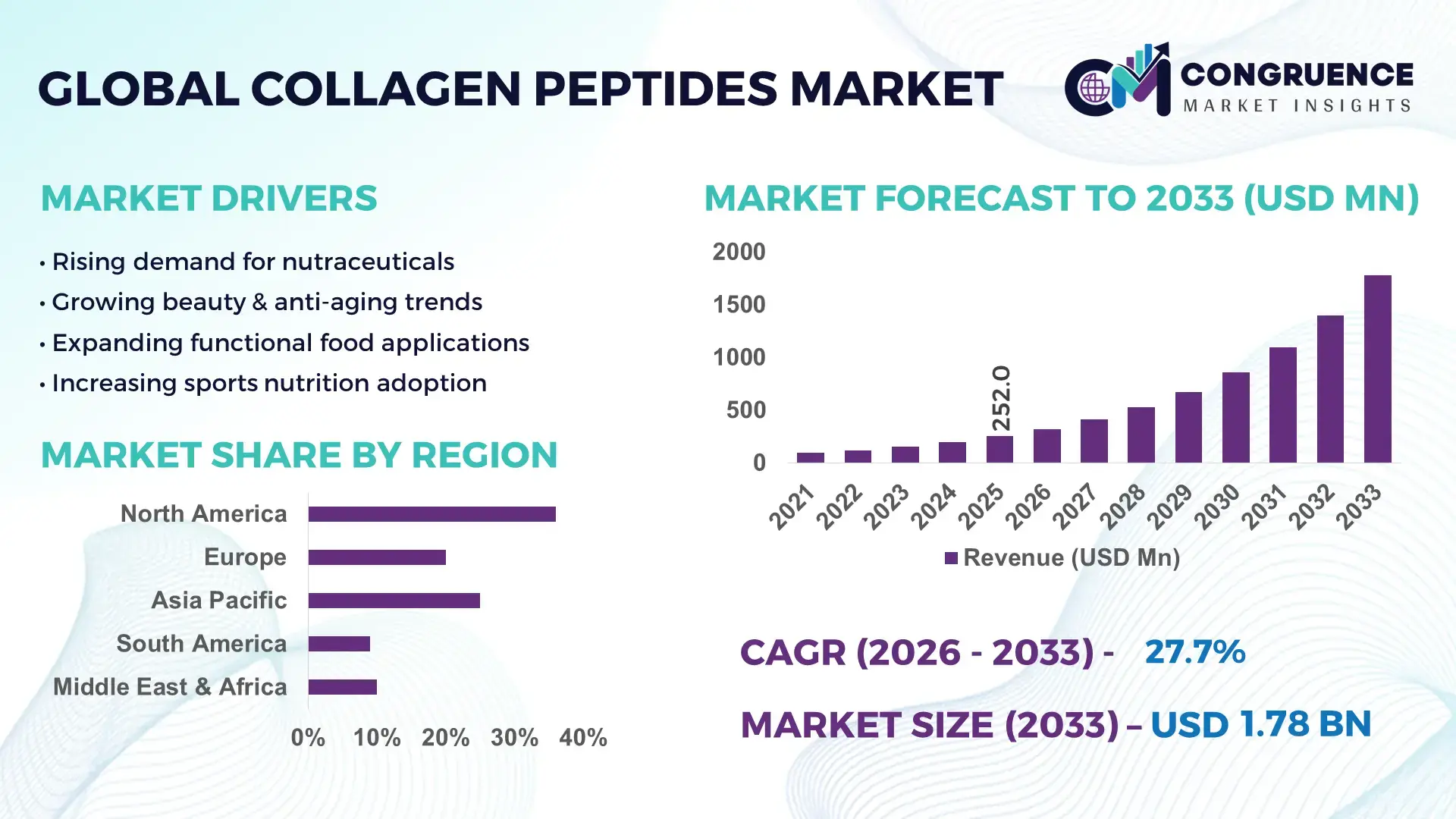
The Global Collagen Peptides Market was valued at USD 252 Million in 2025 and is anticipated to reach a value of USD 1782.08 Million by 2033 expanding at a CAGR of 27.7% between 2026 and 2033. This rapid expansion is primarily driven by rising demand for functional nutrition and bioactive protein supplements across health, wellness, and clinical applications.
The United States continues to demonstrate strong industrial and technological capabilities in the collagen peptides market, supported by advanced bioprocessing infrastructure and high consumer penetration in nutraceutical products. The country produces over 35% of global gelatin and collagen derivatives, with more than 60% of dietary supplement users consuming protein-based formulations. Investment in peptide hydrolysis technologies has improved yield efficiency by nearly 25%, enabling scalable production for sports nutrition, cosmetics, and medical nutrition. Additionally, over 40% of collagen-based product innovations launched annually originate from North American companies, reflecting high R&D intensity and product diversification across ingestible and topical applications.
Market Size & Growth: Valued at USD 252 Million in 2025, projected to reach USD 1782.08 Million by 2033 at 27.7% CAGR, driven by expanding applications in functional foods and anti-aging formulations.
Top Growth Drivers: Functional food adoption increased by 48%, sports nutrition demand rose by 35%, and beauty-from-within product usage grew by 42%.
Short-Term Forecast: By 2028, manufacturing optimization is expected to reduce production costs by 18% and improve product bioavailability by 22%.
Emerging Technologies: Enzymatic hydrolysis advancements, nano-encapsulation techniques, and peptide purification innovations are reshaping product quality and absorption efficiency.
Regional Leaders: North America projected at USD 620 Million by 2033 with strong supplement demand; Europe at USD 480 Million driven by clean-label trends; Asia-Pacific at USD 520 Million due to rapid nutraceutical expansion.
Consumer/End-User Trends: Increasing adoption among aging populations, athletes, and preventive healthcare consumers, with over 55% preference for ingestible collagen formats.
Pilot or Case Example: In 2024, a European nutraceutical firm achieved a 30% improvement in peptide absorption efficiency through advanced enzymatic processing.
Competitive Landscape: Market leader holds approximately 18% share, followed by key players including Gelita, Rousselot, Nitta Gelatin, and Weishardt Group.
Regulatory & ESG Impact: Rising emphasis on sustainable sourcing and traceability, with firms targeting 25% reduction in carbon footprint by 2030.
Investment & Funding Patterns: Over USD 900 Million invested globally in protein innovation and peptide processing facilities between 2023 and 2025.
Innovation & Future Outlook: Growth in marine collagen, plant-based alternatives, and personalized nutrition platforms is shaping long-term market evolution.
The collagen peptides market demonstrates strong cross-sector integration, with healthcare and nutraceutical applications contributing over 50% of total demand, followed by cosmetics and food processing industries. Technological advancements in hydrolyzed collagen production have enhanced solubility and absorption rates, improving product efficacy. Regulatory frameworks promoting clean-label and sustainable sourcing are influencing procurement strategies, while Asia-Pacific markets are witnessing rapid growth due to increasing disposable income and health awareness. Emerging trends include marine collagen adoption, peptide-based functional beverages, and personalized nutrition solutions, positioning the market for diversified application growth and innovation-driven expansion.
The collagen peptides market holds strategic importance as a convergence point between nutrition science, biotechnology, and preventive healthcare. Its relevance is reinforced by measurable improvements in product performance and consumer outcomes, particularly in joint health, skin elasticity, and muscle recovery. Advanced enzymatic hydrolysis technology delivers 28% higher peptide bioavailability compared to conventional thermal processing methods, significantly enhancing product effectiveness and consumer satisfaction.
Regionally, North America dominates in production volume due to established protein processing infrastructure, while Asia-Pacific leads in adoption with over 45% of consumers integrating collagen supplements into daily wellness routines. This dual dynamic reflects a global value chain where manufacturing efficiency and consumer demand are geographically distributed. By 2028, AI-driven formulation and precision nutrition platforms are expected to improve product personalization accuracy by 35%, enabling targeted health benefits based on genetic and lifestyle data. Sustainability and compliance are becoming central to strategic planning. Firms are committing to environmental targets such as 30% reduction in water usage and 20% increase in recyclable packaging materials by 2030. Ethical sourcing of raw materials, particularly bovine and marine collagen, is also gaining regulatory attention, pushing companies toward transparent supply chains.
In 2024, a Japanese manufacturer achieved a 26% increase in production efficiency through automation and AI-based quality control systems, reducing waste and enhancing output consistency. Such advancements highlight the integration of digital technologies into traditional protein processing industries. The collagen peptides market is evolving into a critical pillar of resilient, compliant, and sustainable growth, driven by innovation, regulatory alignment, and expanding global health consciousness.
The surge in functional nutrition demand is significantly propelling the collagen peptides market, particularly as consumers increasingly prioritize preventive healthcare and performance optimization. Over 60% of global consumers now actively seek functional food ingredients that offer health benefits beyond basic nutrition. Collagen peptides are widely incorporated into dietary supplements, protein powders, and fortified beverages due to their proven benefits in improving skin elasticity by up to 20% and reducing joint discomfort by nearly 30% in regular users. The sports nutrition sector alone has witnessed a 35% increase in collagen-based product launches, reflecting its growing role in muscle recovery and injury prevention. Additionally, the aging global population is contributing to demand, with individuals aged 50 and above accounting for over 40% of collagen supplement consumption. These trends collectively reinforce collagen peptides as a core ingredient in next-generation functional nutrition products.
Raw material sourcing variability remains a critical restraint in the collagen peptides market, primarily due to dependency on animal-based inputs such as bovine, porcine, and marine sources. Fluctuations in livestock availability, disease outbreaks, and regulatory restrictions on animal by-products can disrupt supply chains and impact production stability. For instance, stringent import regulations and traceability requirements have increased compliance costs by approximately 18% for manufacturers. Additionally, consumer concerns regarding ethical sourcing and religious dietary restrictions limit the acceptance of certain collagen types in specific regions. Marine collagen, while gaining popularity, faces challenges related to seasonal availability and higher extraction costs, often 25% above traditional sources. These factors create inconsistencies in supply, pricing volatility, and operational complexity, ultimately affecting scalability and market expansion.
Emerging innovations in marine collagen and plant-based alternatives present substantial growth opportunities for the collagen peptides market. Marine collagen, derived from fish skin and scales, offers superior absorption rates, nearly 1.5 times higher than bovine collagen, making it highly attractive for premium nutraceutical and cosmetic applications. The global shift toward sustainable and eco-friendly products is driving adoption, with marine collagen demand increasing by over 40% in recent years. Simultaneously, advancements in biotechnology are enabling the development of plant-based collagen analogs using fermentation and synthetic biology, addressing vegan and ethical consumption preferences. These alternatives are gaining traction, particularly among younger consumers, where plant-based product adoption exceeds 50% in certain markets. Such innovations expand the addressable market, diversify product portfolios, and align with evolving consumer values, creating long-term growth avenues.
Regulatory complexity and the lack of uniform quality standards pose significant challenges to the collagen peptides market. Different regions enforce varying regulations regarding labeling, health claims, and permissible sources, creating compliance burdens for global manufacturers. For example, approval timelines for new collagen-based ingredients can extend beyond 18 months in certain jurisdictions, delaying product launches. Quality inconsistency across suppliers further complicates market dynamics, as peptide purity, molecular weight distribution, and bioavailability can vary significantly. Testing and certification processes increase operational costs by up to 20%, particularly for exporters targeting multiple regions. Additionally, the absence of standardized testing protocols limits transparency and consumer trust, making it difficult for companies to differentiate high-quality products. Addressing these challenges requires harmonized regulations, improved quality assurance frameworks, and greater industry collaboration.
• Rapid Expansion of Functional Beverages with 38% Product Launch Growth
The integration of collagen peptides into functional beverages has surged significantly, with over 38% increase in product launches across ready-to-drink protein shakes, infused waters, and wellness drinks. Approximately 47% of consumers now prefer liquid collagen formats due to faster absorption rates and convenience. Beverage manufacturers report a 22% improvement in product shelf stability through advanced peptide formulations, while Asia-Pacific markets have witnessed a 35% rise in collagen-infused drink consumption. This trend is reshaping product innovation pipelines, particularly in urban markets where on-the-go nutrition demand is accelerating.
• Increasing Adoption of Marine Collagen with 44% Demand Growth
Marine collagen peptides are gaining traction, recording a 44% increase in demand due to superior bioavailability and sustainability benefits. Studies indicate marine-derived peptides offer up to 1.5x higher absorption efficiency compared to bovine sources, influencing consumer preference shifts. Approximately 52% of premium skincare supplement brands have transitioned to marine collagen formulations. In Europe, marine collagen accounts for nearly 33% of new product development in the collagen segment, driven by clean-label and eco-conscious consumer behavior. This trend is also supported by improved extraction technologies reducing processing waste by 18%.
• Personalization in Nutrition Driving 41% Consumer Engagement वृद्धि
Personalized nutrition solutions incorporating collagen peptides have increased consumer engagement by 41%, particularly through AI-based health platforms. Around 36% of supplement users now prefer customized formulations tailored to age, lifestyle, and health conditions. Digital health tools integrating biomarker analysis have improved product recommendation accuracy by 28%, enhancing user retention rates. North America leads this trend, with over 45% of nutraceutical companies offering personalized collagen-based solutions. This shift is encouraging targeted product development, including blends for joint health, skin repair, and sports recovery.
• Sustainable Production Practices Achieving 26% Resource Efficiency Gains
Sustainability initiatives in collagen peptide manufacturing have resulted in a 26% improvement in resource efficiency, particularly in water usage and waste reduction. Approximately 48% of manufacturers have adopted circular economy practices, utilizing by-products from the meat and seafood industries. Carbon footprint reduction initiatives have led to a 19% decrease in emissions across large-scale facilities. Additionally, 31% of companies are investing in biodegradable packaging solutions, aligning with global environmental standards. This trend is influencing procurement strategies and strengthening brand positioning in environmentally conscious markets.
The collagen peptides market segmentation reflects a diversified structure driven by product types, application areas, and end-user industries. Product-wise segmentation includes bovine, marine, porcine, and other specialty collagen peptides, each catering to distinct performance and regulatory requirements. Application segmentation is heavily dominated by nutraceuticals and functional foods, followed by cosmetics and pharmaceutical uses, highlighting the ingredient’s versatility across health and wellness domains. End-user segmentation spans food manufacturers, cosmetic companies, healthcare providers, and dietary supplement producers, with adoption rates exceeding 50% in nutraceutical-focused enterprises. Increasing demand for clean-label products, sustainable sourcing, and bioavailable protein solutions is influencing segmentation dynamics, while technological advancements in hydrolysis and peptide purification are enabling tailored product offerings across regions.
Bovine collagen peptides currently dominate the market, accounting for approximately 46% of total adoption due to their cost-effectiveness, widespread availability, and high protein yield. Marine collagen peptides hold around 32% share, driven by their superior absorption rates and increasing demand for sustainable and pescatarian-friendly products. However, marine collagen is the fastest-growing segment, expanding at an estimated CAGR of 9.8%, supported by rising consumer preference for clean-label and environmentally responsible ingredients. Porcine collagen peptides contribute nearly 14% of the market, primarily used in specialized food and pharmaceutical applications where regulatory acceptance permits. Other niche types, including poultry-based and recombinant collagen, collectively account for about 8%, catering to emerging innovation-driven segments. Technological improvements in enzymatic hydrolysis have enhanced peptide purity and solubility across all types, increasing their application efficiency.
Nutraceuticals and dietary supplements represent the leading application segment, accounting for approximately 52% of total market usage due to increasing health awareness and preventive healthcare adoption. Functional food and beverages follow with a 27% share, reflecting strong demand for fortified products such as protein bars, drinks, and dairy alternatives. Cosmetics and personal care applications hold around 15%, driven by the “beauty-from-within” trend and growing consumer interest in anti-aging solutions. Pharmaceutical applications, including wound healing and tissue regeneration, contribute the remaining 6%, showcasing specialized but high-value use cases. Among these, functional beverages are the fastest-growing application segment, expanding at a CAGR of 10.5%, fueled by convenience-driven consumption and innovation in ready-to-drink formats. Increasing urbanization and lifestyle changes are further accelerating this growth.
Dietary supplement manufacturers dominate the end-user landscape, accounting for approximately 49% of total demand due to their extensive product portfolios and strong distribution networks. Food and beverage companies follow with a 28% share, leveraging collagen peptides in functional and fortified product lines. Cosmetic and personal care companies represent about 17% of the market, utilizing collagen in ingestible beauty supplements and topical formulations. Healthcare providers and pharmaceutical firms contribute the remaining 6%, focusing on clinical and therapeutic applications. The fastest-growing end-user segment is functional food and beverage companies, expanding at a CAGR of 11.2%, driven by rising consumer demand for convenient and health-enhancing products. Adoption rates in this segment have increased by over 34% in the past three years, particularly in Asia-Pacific and North America. Meanwhile, over 60% of nutraceutical companies have integrated collagen peptides into at least one flagship product line, reflecting strong market penetration.
Region North America accounted for the largest market share at 38% in 2025 however, Asia-Pacific is expected to register the fastest growth, expanding at a CAGR of 29.4% between 2026 and 2033.

North America’s dominance is supported by high consumption of dietary supplements, with over 65% of adults regularly using protein-based health products. Europe follows with a 27% share, driven by strong demand for clean-label and sustainably sourced collagen products, particularly in Germany, France, and the UK. Asia-Pacific holds approximately 25% share, but leads in volume expansion, with collagen product consumption increasing by over 42% across China, Japan, and India. South America accounts for around 6%, supported by growing nutraceutical adoption in Brazil and Argentina, while the Middle East & Africa contributes nearly 4%, with rising demand in UAE and South Africa. Regional disparities are influenced by consumer awareness, regulatory frameworks, and production infrastructure, with over 55% of global collagen peptide manufacturing facilities concentrated in North America and Europe.
How is advanced nutraceutical adoption accelerating protein-based ingredient demand?
North America holds approximately 38% of the collagen peptides market share, driven by strong demand from dietary supplements, functional foods, and personal care industries. The region benefits from advanced healthcare infrastructure, with over 70% of supplement manufacturers incorporating collagen peptides into product lines. Regulatory support from food safety authorities has streamlined product approvals, improving time-to-market efficiency by nearly 20%. Technological advancements such as precision hydrolysis and AI-driven formulation systems have enhanced product bioavailability by 25%. A key industry participant in the region has expanded its production capacity by 30% through automation, enabling higher output and improved quality control. Consumer behavior reflects high awareness, with over 62% of adults prioritizing preventive health solutions, leading to increased adoption of collagen-based products in sports nutrition and anti-aging segments.
What role do sustainability regulations play in shaping protein ingredient innovation?
Europe accounts for approximately 27% of the collagen peptides market, with key contributions from Germany, the UK, and France. The region’s growth is strongly influenced by stringent sustainability and traceability regulations, with over 58% of manufacturers adopting eco-friendly sourcing practices. Regulatory bodies have introduced labeling requirements that have increased transparency and boosted consumer confidence by 18%. Technological adoption, including enzymatic hydrolysis and clean-label processing, has improved product purity levels by 22%. A leading European collagen producer has invested in marine collagen extraction facilities, increasing production efficiency by 26%. Consumer preferences in the region are highly aligned with ethical sourcing, with nearly 49% of buyers opting for sustainably produced collagen products, reinforcing demand for environmentally responsible solutions.
Why is rapid urbanization driving demand for bioactive protein solutions?
Asia-Pacific ranks as the fastest-growing region in the collagen peptides market, accounting for nearly 25% of global consumption volume. China, Japan, and India are the leading markets, collectively contributing over 70% of regional demand. Rapid urbanization and rising disposable income have led to a 45% increase in nutraceutical product adoption. The region has over 50 large-scale collagen production facilities, supported by cost-efficient manufacturing and abundant raw material availability. Technological innovation hubs in Japan and South Korea are advancing peptide extraction techniques, improving yield efficiency by 28%. A regional manufacturer has introduced marine collagen products targeting beauty and wellness consumers, achieving a 32% increase in product uptake. Consumer behavior is heavily influenced by e-commerce, with over 60% of collagen products purchased online, highlighting digital transformation in distribution channels.
How are evolving health trends influencing protein supplement adoption patterns?
South America accounts for approximately 6% of the collagen peptides market, with Brazil and Argentina as key contributors. The region is experiencing steady growth due to increasing awareness of preventive healthcare, with collagen supplement usage rising by 34% in urban populations. Infrastructure improvements in food processing and nutraceutical manufacturing have enhanced production capabilities by 18%. Government initiatives promoting local manufacturing and import substitution have reduced dependency on external suppliers by 12%. A regional company has expanded its collagen-based product portfolio, increasing market penetration by 21%. Consumer behavior shows a preference for affordable and multifunctional health products, with over 48% of users opting for collagen supplements targeting joint and skin health simultaneously.
What factors are driving adoption of functional nutrition in emerging economies?
The Middle East & Africa region holds approximately 4% of the collagen peptides market, with notable growth in UAE and South Africa. Demand is driven by increasing health awareness and rising disposable incomes, with collagen supplement usage increasing by 29% over recent years. The region is witnessing modernization in food processing infrastructure, with investments improving production efficiency by 17%. Trade partnerships and import policies have facilitated easier access to high-quality collagen products, increasing availability by 23%. A regional distributor has expanded its supply chain network, improving product reach by 26%. Consumer behavior is shifting toward premium wellness products, with over 41% of buyers preferring collagen-based solutions for beauty and anti-aging benefits.
United States – 34% market share: Collagen peptides market leadership driven by high production capacity, advanced nutraceutical industry, and strong consumer adoption of protein supplements.
China – 22% market share: Collagen peptides market growth supported by large-scale manufacturing, rising health awareness, and expanding functional food consumption.
The collagen peptides market exhibits a moderately fragmented competitive landscape, with over 45 active global and regional players competing across nutraceutical, food, and cosmetic segments. The top five companies collectively account for approximately 52% of the market, indicating a balance between consolidation and competitive diversity. Leading players are focusing on product innovation, with over 60% of companies launching new collagen formulations tailored for specific health benefits such as joint support, skin health, and sports recovery.
Strategic initiatives including mergers, partnerships, and capacity expansions are shaping the competitive environment. Nearly 28% of key players have entered into cross-industry collaborations with food and beverage manufacturers to integrate collagen into functional products. Technological advancements in enzymatic hydrolysis and peptide purification have improved production efficiency by up to 25%, enabling companies to scale operations and reduce costs. Additionally, over 35% of manufacturers are investing in marine collagen and sustainable sourcing solutions to align with evolving consumer preferences. Digital transformation is also influencing competition, with approximately 40% of companies adopting e-commerce and direct-to-consumer models to expand market reach. Product differentiation through clean-label certifications, traceability, and bioavailability enhancements is becoming a critical competitive factor, positioning innovation and sustainability as key drivers of long-term market leadership.
Gelita AG
Rousselot
Nitta Gelatin Inc.
Weishardt Group
Darling Ingredients Inc.
Tessenderlo Group
Gelnex
Collagen Solutions plc
Italgelatine S.p.A.
Lapi Gelatine S.p.A.
Technological advancements are playing a transformative role in the collagen peptides market, particularly in enhancing extraction efficiency, product purity, and bioavailability. Enzymatic hydrolysis remains the dominant processing technology, with modern systems achieving up to 92% protein recovery efficiency while reducing processing time by nearly 30%. Advanced multi-stage filtration and membrane separation techniques are improving peptide uniformity, enabling manufacturers to produce low molecular weight peptides below 5 kDa, which demonstrate up to 40% higher absorption rates in human metabolism.
Emerging technologies such as nano-encapsulation are gaining traction, allowing collagen peptides to be protected from degradation and improving stability in functional beverages and nutraceutical formulations. This technology has shown to extend shelf life by approximately 18% while enhancing bioavailability by over 25%. Additionally, precision fermentation and recombinant collagen production are being explored as alternatives to traditional animal-based sources, offering scalability and consistent quality output with up to 35% reduction in raw material dependency.
Automation and digitalization are also reshaping production processes. Smart manufacturing systems integrated with AI-driven quality control have reduced defect rates by 22% and improved batch consistency by 27%. Real-time monitoring systems using IoT sensors are enabling manufacturers to track temperature, pH levels, and enzymatic activity with over 95% accuracy, ensuring optimal production conditions.
Furthermore, sustainability-focused technologies are becoming integral, with water recycling systems reducing consumption by 28% and energy-efficient drying techniques lowering operational energy usage by 20%. These innovations collectively support cost optimization, regulatory compliance, and product differentiation, positioning technology as a key enabler of competitive advantage in the collagen peptides market.
• In March 2025, Gelita AG expanded its collagen peptide production facility in Germany, increasing capacity by 20% to meet rising demand in nutraceutical and functional food sectors. The expansion integrates advanced enzymatic processing systems to improve peptide yield and product consistency. Source: www.gelita.com
• In September 2024, Rousselot launched a new range of marine collagen peptides under its Peptan brand, designed for enhanced bioavailability and targeted skin health applications. Clinical studies demonstrated up to 25% improvement in skin elasticity after 12 weeks of use. Source: www.rousselot.com
• In January 2025, Nitta Gelatin Inc. introduced a next-generation low-molecular-weight collagen peptide product optimized for sports nutrition, achieving 30% faster absorption rates compared to conventional formulations. The product targets muscle recovery and joint health segments. Source: www.nitta-gelatin.com
• In November 2024, Darling Ingredients Inc. invested in expanding its sustainable collagen production capabilities, incorporating circular economy practices that utilize animal by-products, reducing waste by 18% and improving overall resource efficiency across its processing facilities. Source: www.darlingii.com
The collagen peptides market report provides a comprehensive analysis of industry dynamics across multiple dimensions, including product types, applications, technologies, and regional markets. The report covers key product segments such as bovine, marine, porcine, and specialty collagen peptides, which collectively represent over 90% of global production. It further evaluates application areas including nutraceuticals, functional foods and beverages, cosmetics, and pharmaceutical uses, with nutraceuticals accounting for more than 50% of total demand.
Geographically, the report encompasses five major regions: North America, Europe, Asia-Pacific, South America, and the Middle East & Africa, analyzing regional consumption patterns, production capacities, and trade flows. Over 55% of global manufacturing facilities are concentrated in North America and Europe, while Asia-Pacific is emerging as a high-growth consumption hub with increasing urbanization and health awareness. The report also highlights technological advancements such as enzymatic hydrolysis, nano-encapsulation, and precision fermentation, which are improving product quality and expanding application potential. It examines supply chain dynamics, including raw material sourcing, processing efficiency, and distribution channels, with e-commerce contributing to over 35% of global collagen product sales.
Additionally, the scope includes emerging segments such as marine collagen, plant-based alternatives, and personalized nutrition solutions, reflecting evolving consumer preferences. Industry focus areas extend to regulatory compliance, sustainability initiatives, and innovation strategies, providing decision-makers with actionable insights into market positioning, competitive dynamics, and future growth opportunities.
| Report Attribute/Metric | Report Details |
|---|---|
|
Market Revenue in 2025 |
USD V2025 Million |
|
Market Revenue in 2033 |
USD V2033 Million |
|
CAGR (2026 - 2033) |
27.7% |
|
Base Year |
2025 |
|
Forecast Period |
2026 - 2033 |
|
Historic Period |
2021 - 2025 |
|
Segments Covered |
By Types
By Application
By End-User
|
|
Key Report Deliverable |
Revenue Forecast, Growth Trends, Market Dynamics, Segmental Overview, Regional and Country-wise Analysis, Competition Landscape |
|
Region Covered |
North America, Europe, Asia-Pacific, South America, Middle East, Africa |
|
Key Players Analyzed |
Gelita AG, Rousselot, Nitta Gelatin Inc., Weishardt Group, Darling Ingredients Inc., Tessenderlo Group, Gelnex, Collagen Solutions plc, Italgelatine S.p.A., Lapi Gelatine S.p.A. |
|
Customization & Pricing |
Available on Request (10% Customization is Free) |




