
Reports
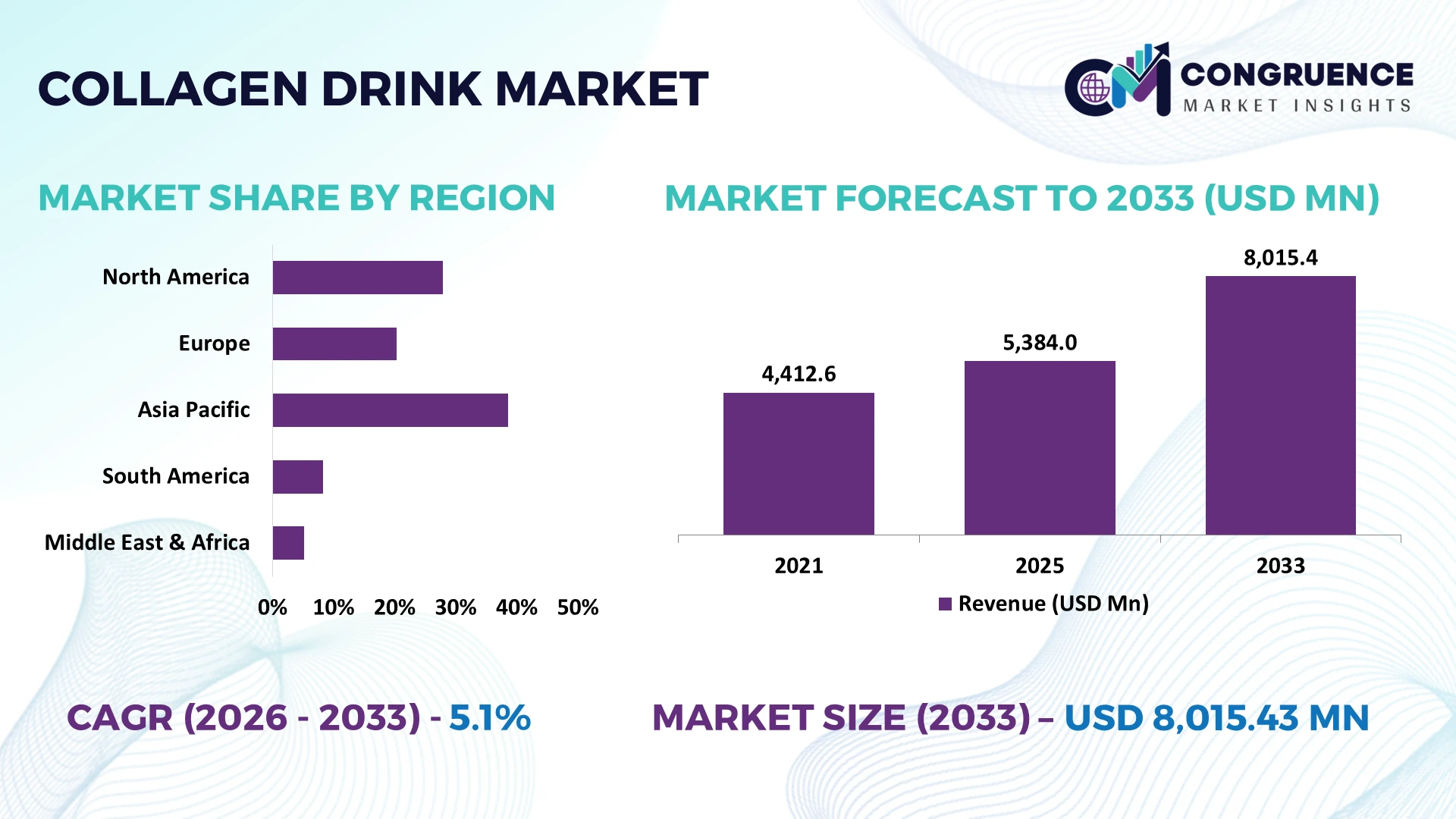
The Global Collagen Drink Market was valued at USD 5,384.0 Million in 2025 and is anticipated to reach a value of USD 8,015.4 Million by 2033 expanding at a CAGR of 5.10% between 2026 and 2033. Growth is driven by low-molecular-weight collagen peptides, marine-collagen formulations, ready-to-drink innovation, and beauty-from-within product development.
Japan remains a major innovation hub, supported by established functional-food manufacturing and strong beauty-from-within consumption. Asia Pacific accounted for 38.5% of the collagen beverages market in 2025, with Japan and China leading product commercialization. Japan's 2025 Meiji launch combined 5,000 mg fish collagen peptides with 250 mg NMN per serving, while China's expanding digital commerce ecosystem is accelerating localized functional-beverage adoption. The U.S. market emphasizes premium wellness and sports-nutrition applications.
Strategically, manufacturers should prioritize clinically differentiated formulations, traceable marine sourcing, localized products, and digital distribution partnerships.
Market Size & Growth: The market is projected to reach USD 8,015.4 Million by 2033 from USD 5,384.0 Million in 2025, with peptide innovation and RTD product development strengthening category expansion.
Top Growth Drivers: Marine collagen is advancing at 10.4%, online retail at 10.5%, while Asia Pacific represents 38.5% of collagen beverage demand.
Short-Term Forecast: By 2028, manufacturers are targeting more than 10% growth in digital replenishment channels through subscriptions, direct-to-consumer platforms, and convenient RTD formats.
Emerging Technologies: Enzymatic hydrolysis, low-molecular-weight peptide processing, AI-assisted formulation screening, and advanced shelf-stability technologies are improving product differentiation.
Regional Leaders: Asia Pacific represents 38.5% of demand, North America is expanding premium wellness applications, and Europe is strengthening evidence-based and traceable collagen formulations.
Consumer/End-User Trends: Supermarkets and hypermarkets accounted for 42.1% of distribution, while online retail is advancing at 10.5%, increasing digital replenishment and subscription purchasing.
Pilot/Case Example: An 8-week collagen-drink study reported 17.8% higher skin hydration and 22.3% higher collagen content, supporting clinically positioned product development.
Competitive Landscape: Vital Proteins held more than 14% of the collagen-infused beverage segment, alongside Meiji, Rousselot, Glanbia Nutritionals, and Bulletproof.
Regulatory & ESG Impact: Traceable sourcing and compliant health claims are becoming increasingly important, with marine-origin ingredients supporting diversification from livestock-based collagen supply chains.
Investment & Funding: Companies are increasing investment in marine-collagen processing, RTD manufacturing, formulation R&D, e-commerce partnerships, and regional expansion across Asian wellness markets.
Innovation & Future Outlook: Combination products incorporating collagen with NMN, vitamin C, minerals, and functional botanicals are shifting the category toward multifunctional healthy-aging beverages.
The Collagen Drink Market is increasingly driven by beauty-from-within, healthy aging, sports recovery, and convenient functional nutrition. Low-molecular-weight peptides are gaining importance as manufacturers pursue stronger functional differentiation, while marine formulations support premium positioning. Japan's product-development pipeline and China's expanding e-commerce ecosystem are accelerating localized innovation. Traceability, clinically supported formulations, and supply-chain diversification are becoming central to competitive positioning.
The Collagen Drink Market is becoming strategically important as beverage manufacturers transform collagen from a supplement ingredient into a recurring functional beverage category. Competition is shifting toward peptide quality, clinically supported benefits, marine sourcing, formulation complexity, and digital distribution rather than collagen concentration alone. Japan demonstrates advanced product-development capabilities, while China combines manufacturing scale with rapid e-commerce commercialization.
Technology is improving formulation performance compared with conventional collagen products. Low-molecular-weight collagen peptides have demonstrated measurable improvements in skin hydration and elasticity in controlled studies, while advanced RTD processing improves shelf stability and reduces dependence on refrigerated distribution. This enables broader retail coverage and more efficient logistics.
During the next 2–3 years, companies will prioritize marine peptide capacity, e-commerce replenishment, and multifunctional formulations. Meiji's 2025 product combined 5,000 mg fish collagen peptides with 250 mg NMN, demonstrating the shift toward healthy-aging combinations. Companies are adjusting investments toward R&D, ingredient partnerships, localized manufacturing, and regulatory validation to strengthen operational efficiency and long-term competitive positioning.
Low-molecular-weight peptide technology is strengthening product differentiation as consumers increasingly prioritize measurable functional outcomes. Clinical research has reported 17.8% improvement in skin hydration and 22.3% improvement in collagen content after eight weeks of collagen-drink consumption. Japan's Meiji launched a formulation in 2025 containing 5,000 mg collagen peptides and 250 mg NMN per serving. These developments are pushing manufacturers toward advanced hydrolysis, absorption-oriented formulations, and multifunctional products. Companies are increasing R&D investment in peptide molecular weight, flavor masking, and ingredient combinations. The strategic advantage is that clinically differentiated formulations support premium positioning and reduce direct competition with conventional beauty beverages.
Collagen drinks remain exposed to ingredient sourcing, quality-control, and regulatory constraints. Animal-based collagen represented 89.4% of collagen drinks in 2025, maintaining significant dependence on livestock-derived supply chains, while marine alternatives require stronger traceability and sourcing controls. China is also strengthening technical requirements surrounding collagen ingredients and hydrolysates, increasing testing and documentation requirements. These pressures affect manufacturing costs, gross margins, supplier qualification, and product launch timelines. Companies are reducing exposure through multi-source procurement, long-term ingredient contracts, regional production, and standardized hydrolysates. A key operational issue is maintaining identical peptide specifications across suppliers because small variations can affect taste, solubility, stability, and formulation consistency.
Marine collagen and multifunctional formulations are creating high-value opportunities across premium wellness markets. Marine collagen is advancing at 10.4%, while online retail is growing at 10.5%, creating a strong combination of premium ingredients and digital distribution. Japan, South Korea, India, and Southeast Asia provide opportunities for localized flavors, smaller formats, and subscription-based replenishment. The non-obvious opportunity is combining collagen with healthy-aging ingredients rather than positioning collagen as a single-benefit product. Meiji's combination of fish collagen and NMN illustrates this transition. Companies are responding through formulation partnerships, localized R&D, marine ingredient sourcing, direct-to-consumer platforms, and premium packaging innovation.
Scalable commercialization requires consistent peptide quality and evidence-backed product claims across different regulatory markets. Clinical outcomes vary according to dosage, formulation, study duration, and consumer population, with studies reporting 17.8% hydration improvement after eight weeks and 13.8% improvement after 12 weeks. This variability makes standardized clinical substantiation increasingly important. European markets are emphasizing evidence-supported health communication, while Asian markets are strengthening ingredient documentation and testing requirements. Companies must invest in clinical validation, batch traceability, formulation standardization, and regulatory expertise. The critical operational challenge is scaling successful formulations without introducing ingredient variability or unsupported claims that could weaken consumer trust, retailer acceptance, and international market access.
Marine Peptide Premiumization Accelerates: Marine collagen is gaining traction at a projected 10.4% growth rate, while animal-based collagen still represented 89.4% of 2025 sales. Manufacturers are shifting procurement toward traceable marine inputs and premium peptide grades as consumers increasingly associate marine sourcing with purity and beauty applications. This supply-chain restructuring is encouraging longer supplier contracts and vertically integrated processing.
Digital Replenishment Reshapes Purchasing: Online retail is advancing at 10.5%, while supermarkets and hypermarkets retained 42.1% of distribution in 2025. Brands are integrating subscription ordering, personalized product recommendations, and direct-to-consumer fulfillment to increase repeat purchases. The non-obvious shift is that digital channels are becoming demand-planning tools, giving manufacturers faster consumption data and enabling smaller, more frequent production runs.
Compact Formats Improve Logistics: Pouches and sachets are projected to expand at 10.1%, compared with 37.9% share for PET and glass bottles in 2025. Manufacturers are introducing concentrated formats to reduce packaging volume, improve portability, and simplify e-commerce fulfillment. This shift is particularly relevant for cross-border shipments, where lighter packaging can reduce logistics intensity while supporting single-dose consumption.
Claims Compliance Changes Formulation: Regulatory scrutiny is increasingly influencing formulation workflows, particularly in Europe, where manufacturers are adjusting collagen products toward vitamin C and other permitted functional ingredients. Companies are strengthening clinical substantiation, ingredient documentation, and label-review processes rather than relying solely on collagen-based claims. This creates a competitive advantage for manufacturers with integrated R&D and regulatory teams and increases the value of evidence-backed product architectures.
Female Collagen Drink is the leading type, supported by the strong concentration of beauty-from-within purchasing and products positioned around skin hydration, elasticity, hair, and nail care. Women accounted for approximately 68.4% of collagen beverage end-use demand in a 2024 industry assessment, demonstrating the scale of female-oriented consumption. Male Collagen Drink remains smaller but is expanding as manufacturers reposition collagen around joint support, active lifestyles, recovery, and broader wellness rather than exclusively cosmetic benefits.
The strategic gap between the two types is narrowing as male-targeted formulations diversify. Female products retain established retail penetration, while male products benefit from sports-nutrition positioning and broader wellness messaging. Companies are responding with gender-specific flavors, packaging, dosage positioning, and functional ingredient combinations. The key investment shift is toward segment-specific formulation rather than one universal collagen beverage, allowing manufacturers to improve consumer relevance while expanding consumption occasions.
Cosmetic applications represent the leading segment, accounting for approximately 36.5% of the collagen drinks market in 2025. Demand is concentrated around skin hydration, elasticity, anti-aging positioning, and beauty-from-within routines. Healthcare applications remain strategically important because collagen beverages are increasingly positioned around joint, bone, and general wellness benefits, creating a broader functional-use pathway beyond cosmetic consumption.
Cosmetic applications remain mature because they benefit from established consumer awareness and extensive beauty-channel integration, whereas healthcare applications are gaining relevance as manufacturers develop more function-specific formulations. Companies are responding through vitamin-enriched formulas, clinically supported positioning, and partnerships across wellness and healthcare-oriented retail. The operational implication is a gradual shift from beauty-only SKUs toward multifunctional beverages capable of addressing multiple consumption occasions without abandoning the category's strongest cosmetic demand base.
Women represent the dominant end-user group, accounting for approximately 68.4% of collagen beverage demand in an industry assessment. Their purchasing concentration reflects established beauty-from-within routines and high usage of products positioned around skin, hair, and nail benefits. Men represent the faster-expanding opportunity as brands increasingly connect collagen with sports recovery, mobility, and general wellness. This shift broadens the category beyond traditional beauty-oriented purchasing behavior.
The established female consumer base provides manufacturers with predictable demand and strong product-line extensions, while male consumers create opportunities for differentiated formulations and new retail positioning. Companies are adapting through gender-specific communication, functional combinations, sports-oriented formats, and broader wellness partnerships. The strategic implication is a two-track portfolio: maintain premium beauty-led products for women while developing performance and mobility propositions for men. This approach expands consumption occasions and reduces dependence on a single demographic without diluting collagen's core functional identity.
Asia Pacific accounted for the largest market share at 38.5% in 2025 however, Asia Pacific is expected to register the fastest growth, expanding at a CAGR of 10.3% between 2026 and 2033.

North America represented 27.8% of the global collagen drink market in 2025, supported by mature wellness retail, established nutraceutical distribution, and strong consumer acceptance of functional beverages. The United States remains the principal demand center, with collagen drinks increasingly moving from specialty nutrition stores into supermarkets, warehouse clubs, pharmacies, and direct-to-consumer channels. Product development is shifting toward low-sugar RTD formats, flavored shots, and formulations combining collagen with vitamins, electrolytes, and botanical ingredients. Regulatory infrastructure is also influencing formulation strategies, particularly where brands use collagen ingredients in food and beverage applications. U.S. FDA-recognized collagen ingredients have expanded formulation flexibility, while established compliance capabilities favor larger manufacturers. Broader retail rollout by major collagen brands across mass retailers is reinforcing repeat-purchase behavior and improving category visibility.
United States Market Outlook: The United States benefits from the region's strongest combination of functional-beverage manufacturing, e-commerce penetration, specialty nutrition retail, and formulation expertise. The country contributed the majority of North American collagen-infused beverage demand in 2025, with approximately USD 857 million reported across the broader category. Large-scale retailers such as Walmart and Costco are increasingly important for converting collagen beverages from specialist wellness products into routine consumer purchases.
Europe accounted for 20.3% of the global collagen drink market in 2025, with Germany, the United Kingdom, France, and Italy forming important consumption and distribution centers. The region's market structure is increasingly shaped by regulatory discipline around food claims, ingredient traceability, and product presentation. Manufacturers are therefore emphasizing formulation transparency, quantified nutrient content, and compliant beauty and wellness positioning rather than unsupported therapeutic messaging. The European supply chain also requires careful management of animal-derived collagen because establishments handling collagen or gelatin for EU markets can be subject to approved-establishment listing requirements. Premium marine collagen and compact drinkable formats are gaining attention in specialist beauty and wellness channels, while established supermarkets provide broader reach. This environment favors manufacturers with documented sourcing, regulatory expertise, and flexible packaging capabilities.
Germany Market Outlook: Germany provides Europe with a strong combination of advanced food manufacturing, organized retail infrastructure, stringent quality controls, and established consumer demand for functional nutrition. Its strategic importance is reinforced by its position among Europe's major collagen beverage markets. Manufacturers targeting Germany increasingly need robust ingredient documentation and compliant consumer communication, particularly as European authorities require scientific substantiation before health claims can be used commercially.
Asia Pacific held the largest 38.5% share of the global collagen drink market in 2025, supported by deep consumer familiarity with collagen supplementation, advanced RTD manufacturing, and dense convenience-store, pharmacy, and e-commerce networks. Japan, South Korea, China, and Taiwan remain important production, innovation, and consumption centers, with manufacturers combining collagen peptides with vitamins, antioxidants, functional botanicals, and beauty-oriented ingredients. Japan's mature functional-food ecosystem supports frequent product launches and compact daily-serving formats, while South Korea benefits from the international influence of K-beauty. China's expanding urban wellness market is strengthening online discovery and premium functional beverage adoption. Regional manufacturers are also increasing marine-collagen utilization and developing more convenient single-serve formats. Asia Pacific's established collagen culture provides manufacturers with shorter commercialization cycles and greater opportunities to extend collagen into coffee, sparkling drinks, shots, and other everyday beverages.
Japan Market Outlook: Japan represents the region's most established collagen beverage ecosystem, supported by sophisticated functional-food manufacturing, convenience-store distribution, vending infrastructure, and longstanding consumer familiarity with beauty-oriented nutrition. Domestic companies have developed collagen products across drinks, powders, and food formats, creating a highly competitive innovation environment. The country's mature retail network enables frequent single-serve launches and supports collagen beverages as routine daily-consumption products rather than occasional supplements.
South America represented 8.2% of the global collagen drink market in 2025, with Brazil serving as the region's principal demand and commercialization center. The country's established beauty, wellness, pharmacy, and nutraceutical ecosystem provides a practical route for collagen drinks to reach consumers beyond specialist supplementation channels. Product formats are broadening toward flavored RTD beverages, sparkling drinks, concentrated shots, and convenient single-serve packaging. Online retail is particularly relevant for premium products because it enables smaller brands to reach consumers without extensive physical distribution networks. Brazil's large urban population also supports pharmacy-led and modern-trade distribution, although regional logistics and income differences can make nationwide expansion uneven. Manufacturers are increasingly adapting flavor profiles and pack sizes to local purchasing behavior while using digital channels to test demand before committing to wider retail deployment.
Brazil Market Outlook: Brazil is the strategically significant South American market because of its large consumer base, strong beauty and personal-care culture, and developed nutraceutical retail infrastructure. The country accounted for approximately USD 62 million of the broader collagen-infused beverage market in 2025, indicating meaningful commercial activity relative to neighboring markets. Its established pharmacy and specialty-health channels provide manufacturers with distribution points for premium collagen formulations before expansion into mass retail.
Middle East & Africa accounted for 5.2% of the global collagen drink market in 2025, with the Gulf Cooperation Council providing the strongest commercial base. The UAE and Saudi Arabia are particularly important because premium wellness retail, luxury hospitality, aesthetic clinics, pharmacies, and modern supermarkets create multiple consumption occasions for functional beauty beverages. Dubai has also seen collagen drinks enter cafés and restaurant settings, demonstrating movement beyond conventional supplement channels. Product localization increasingly emphasizes halal-certified collagen, clean formulations, low sugar, and convenient drinkable formats. Import-dependent markets require reliable cold-chain and distribution partnerships, making established regional distributors strategically valuable. Manufacturers are also using premium packaging and smaller serving formats to align collagen drinks with beauty and wellness positioning. In Africa, South Africa provides the most developed specialist retail and online environment, while GCC markets offer stronger premiumization opportunities.
United Arab Emirates Market Outlook: The UAE offers the region's strongest combination of premium retail, hospitality infrastructure, aesthetic-wellness services, and digitally connected consumers. Dubai has become an important testing ground for collagen beverages in cafés, restaurants, wellness venues, and specialty retail. Halal-certified collagen products are particularly relevant to regional commercialization, with products using halal bovine collagen already available through major UAE retail channels. This combination gives manufacturers a practical platform for premium product launches and broader GCC expansion.
Global brands such as Vital Proteins, Meiji, Rousselot, Glanbia Nutritionals, and regional functional-beverage specialists compete across premium RTD, beauty, sports, and ingredient-led formulations. Vital Proteins competes with Meiji in branded beverages, while Rousselot and Glanbia supply peptide differentiation. The top five players command 39% combined share, leaving substantial room for regional and channel specialists. Competition centers on formulation performance, sourcing, retail reach, and format innovation: marine collagen grows 10.4%, online retail 10.5%, and sachets 10.1%. Companies pursue premiumization and convenience simultaneously. Vital Proteins expanded into RTD shakes, Meiji combined collagen with NMN, and Thai Union invested in marine-collagen processing. The competitive shift is toward supply control and multifunctional formats. Entry barriers include validated formulations, compliant claims, stable peptide sourcing, and retail access. Winning requires differentiated peptides, reliable supply, rapid commercialization, strong omnichannel distribution, and continuous evidence-backed innovation across regional consumer segments without sacrificing taste, stability, regulatory compliance, or everyday convenience.
Vital Proteins
Meiji Holdings Co., Ltd.
Rohto Pharmaceutical Co., Ltd.
Rousselot
Glanbia Nutritionals
Shiseido Company, Limited
Amorepacific Corporation
Kinohimitsu
Sappe Public Company Limited
Nitta Gelatin Inc.
GELITA AG
Thai Union Ingredients
Low-molecular-weight peptide hydrolysis is the core current technology, replacing conventional higher-molecular-weight collagen with absorption-oriented fractions. Meiji’s drink uses 5,000 mg low-molecular-weight fish collagen and reports about 1.5x higher absorption than porcine collagen. This 50% absorption advantage strengthens dose efficiency and supports premium positioning. Enzymatic hydrolysis also significantly increases absorption rate and bioavailability of collagen-rich amino acids, making hydrolysis central to formulation design.
RTD aseptic processing, compact sachets, and low-impact packaging are emerging technologies reshaping distribution. Nature’s Farm’s 35 ml collagen sachets contain 2.2 g sugar versus approximately 4 g in some competing products, representing about 45% lower sugar and improving clean-label positioning. Vital Proteins’ paperboard technology cuts plastic use by more than 90%, showing how packaging innovation can reduce material intensity while preserving product convenience. Adoption is expanding as brands optimize e-commerce portability and sustainability.
Time-controlled delivery and multifunctional formulation are disruptive directions. Rohto’s MOCOLA combines a collagen drink with granules designed for different dissolution timing, creating differentiated delivery architecture. By 2026–2028, premium innovators using hydrolyzed peptides, compact formats, and controlled-release combinations can improve formulation precision, reduce material intensity, and differentiate beyond collagen dosage alone. Acting now matters because technology-led formats are moving collagen from supplement routines toward functional beverages.
March 2025 Meiji launched Meiji W Skin Care Yogurt nationwide, a drinkable yogurt containing collagen peptides, SC-2 lactic bacteria, and sphingomyelin. The product carried two reported functions for skin protection and hydration, broadening collagen beverages into functional dairy and beauty nutrition. Source: meiji.co.jp
August 2025 Vital Proteins introduced its first ready-to-drink Collagen & Protein Shake, delivering 30 g protein and 10 g collagen peptides per serving. The launch extends collagen into convenient sports-nutrition occasions and expands retail-ready beverage competition and supports broader trial. Source: vitalproteins.com
June 2025 Thai Union Ingredients launched tuna-skin marine collagen and invested US$30 million in a dedicated processing factory. The vertically integrated expansion strengthens marine peptide supply control, supports premium applications, and increases manufacturing capacity near its tuna processing operations globally. Source: nutraingredients.com
May 2025 Rohto Pharmaceutical launched MOCOLA Double Impact Shot, combining a collagen drink with vitamin-C-containing granules in one package. Its 7-piece format introduces time-controlled delivery and broadens collagen drinks toward multifunctional beauty supplementation and differentiated daily routines for daily consumers. Source: rohto.co.jp
The Collagen Drink Market Report covers product types including Female Collagen Drink and Male Collagen Drink, applications spanning cosmetic and healthcare uses, and end-users segmented by women and men. Coverage evaluates RTD beverages, concentrated shots, sachets, sparkling formats, marine-collagen products, multifunctional formulations, and emerging healthy-aging combinations across North America, Europe, Asia Pacific, South America, and Middle East & Africa.
The report assesses peptide hydrolysis, low-molecular-weight processing, formulation technology, time-controlled delivery, packaging innovation, and digital distribution integration. It highlights regional adoption patterns, premiumization, supply-chain localization, regulatory requirements, and niche opportunities in sports recovery, mobility, beauty-from-within, and multifunctional wellness. These insights support investment planning, market-entry decisions, regional expansion, portfolio positioning, partnership selection, and competitive strategy while identifying technology and consumer shifts likely to influence market direction from 2026 through 2033.
| Report Attribute / Metric | Details |
|---|---|
| Market Revenue (2025) | USD 5,384.0 Million |
| Market Revenue (2033) | USD 8,015.4 Million |
| CAGR (2026–2033) | 5.10% |
| Base Year | 2025 |
| Forecast Period | 2026–2033 |
| Historic Period | 2021–2025 |
| Segments Covered |
By Type
By Application
By End-User
|
| Key Deliverables | Revenue Forecast; Market Trends; Growth Drivers & Restraints; Technology Insights; Segmentation Analysis; Regional Insights; Competitive Landscape; Regulatory & ESG Overview; Recent Developments |
| Regions Covered | North America; Europe; Asia Pacific; South America; Middle East & Africa |
| Companies Profiled | Vital Proteins; Meiji Holdings Co., Ltd.; Rohto Pharmaceutical Co., Ltd.; Rousselot; Glanbia Nutritionals; Shiseido Company, Limited; Amorepacific Corporation; Kinohimitsu; Sappe Public Company Limited; Nitta Gelatin Inc.; GELITA AG; Thai Union Ingredients |
| Customization & Pricing | Available on Request (10% Customization Free) |




