
Reports
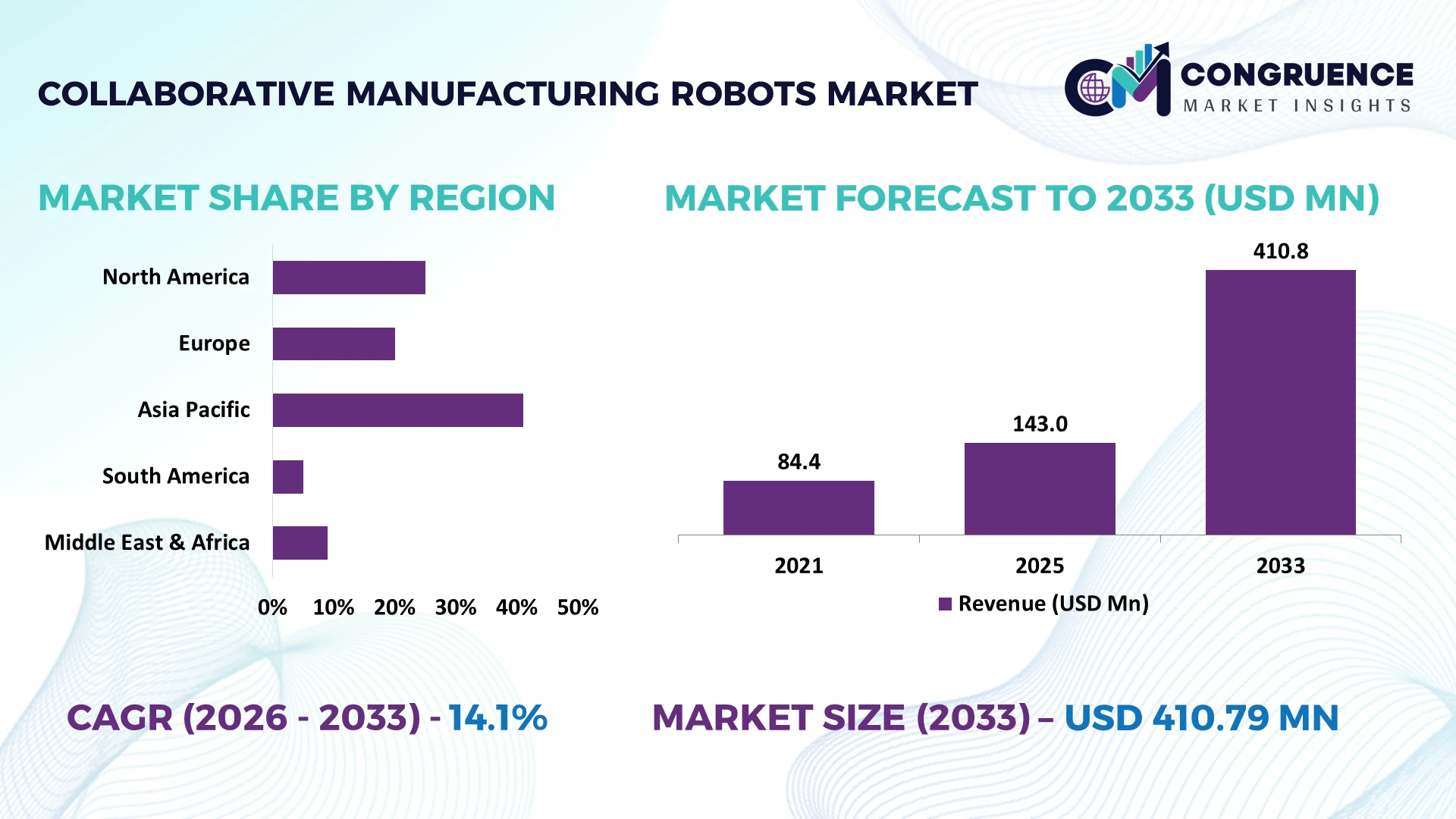
The Global Collaborative Manufacturing Robots Market was valued at USD 143 Million in 2025 and is anticipated to reach a value of USD 410.79 Million by 2033 expanding at a CAGR of 14.1% between 2026 and 2033. Growth is driven by labor shortages in precision manufacturing, deployment of AI-enabled collaborative robots, simplified robotic programming, and flexible automation across small-batch production environments.
China dominates the global industrial robotics manufacturing and deployment landscape, accounting for approximately 54% of worldwide industrial robot installations in 2024, with 295,000 units deployed. Its manufacturing ecosystem spans automotive assembly, electronics, metalworking, and machinery production, supported by government-led industrial automation initiatives. China's operational robot stock exceeded 2 million units, substantially surpassing Japan's installed base. Domestic manufacturers including JAKA and AUBO are expanding collaborative robot capabilities through force sensing, machine vision, and automated handling applications. China's industrial modernization policies strengthen localized robotics component manufacturing.
Collaborative robot suppliers prioritizing Chinese manufacturing partnerships, affordable automation packages, and rapid application deployment can strengthen competitive positioning across high-volume industrial production networks.
Market Size & Growth: USD 143 million in 2025, reaching USD 410.79 million by 2033 at 14.1% CAGR, driven by flexible factory automation.
Top Growth Drivers: Industrial robot installations increased 7% in China, 7% in India, and 5% across Asia in 2024.
Short-Term Forecast: By 2028, targeted cobot deployments will prioritize productivity improvements, with OTV Plast demonstrating a 35% increase through automated finishing.
Emerging Technologies: AI-powered vision, force-sensitive robotic arms, and no-code programming support 3 advanced capabilities for flexible manufacturing automation.
Regional Leaders: Asia-Pacific captured 74% of 2024 industrial robot installations, Europe 16%, and the Americas 9%, indicating distinct deployment priorities.
Consumer/End-User Trends: Collaborative robots represented approximately 11% of new industrial robot installations in 2024, reflecting growing adoption of human-robot production workflows.
Pilot/Case Example: Universal Robots' UR5 deployment at OTV Plast delivered 35% higher productivity in repetitive plastic component finishing operations.
Competitive Landscape: Universal Robots competes with FANUC, ABB, Techman Robot, and JAKA across 4 major differentiation areas: payload, programming, safety, and integration.
Regulatory & ESG Impact: ISO/TS 15066 defines 4 collaborative operating methods, guiding risk assessment, human-robot interaction, and safety-focused workstation engineering.
Investment & Funding: China's 57% domestic industrial robot supplier share in 2024 signals investment momentum toward localized production and robotics supply chains.
Innovation & Future Outlook: AI-assisted programming, digital twins, and mobile manipulation represent 3 technology priorities reshaping high-mix manufacturing automation.
The Collaborative Manufacturing Robots Market is transforming factory operations through flexible human-robot collaboration, automated machine tending, precision assembly, and intelligent material handling. Automotive component manufacturers, electronics producers, and metal fabrication facilities are adopting compact cobots to address repetitive processes without extensive production-line reconstruction. Collaborative robots represented approximately 11% of global industrial robot installations in 2024, demonstrating their growing importance within factory automation. Advances in AI-based vision, adaptive gripping, and simplified programming are enabling faster product changeovers. China's industrial localization strategy and expanding domestic robotics supply chain are intensifying competition, establishing new priorities for automation investment and manufacturing efficiency.
Collaborative manufacturing robots are becoming strategically important as manufacturers restructure production around flexible automation, workforce augmentation, and shorter product changeover cycles. Global industrial robot installations reached approximately 542,000 units in 2024, demonstrating substantial industrial automation activity. Collaborative robots accounted for approximately 11% of installations, establishing their role in human-machine production environments. China's manufacturing localization policies are accelerating domestic robotics development, while manufacturers increasingly prioritize compact automation systems that operate within existing production layouts.
Compared with conventional fixed robotic cells, collaborative robots reduce installation complexity through integrated safety functions, simplified programming, and smaller workstation footprints. Universal Robots' deployment at OTV Plast demonstrated a 35% productivity improvement in automated component finishing. China leads in installation scale, Germany emphasizes precision engineering and safety validation, while India recorded 7% industrial robot installation growth in 2024. These differences influence supplier strategies for pricing, integration support, and application-specific automation.
Between 2026 and 2028, manufacturers will increasingly deploy vision-guided cobots, adaptive gripping systems, and offline programming for high-mix production. Robotics suppliers are expanding integrator partnerships, application libraries, and workforce training programs to shorten deployment cycles. Competitive differentiation will depend on repeatable productivity gains, reliable human-robot interaction, and scalable automation solutions across manufacturing facilities.
Persistent manufacturing labor shortages and rising production complexity are accelerating collaborative robot adoption in assembly, machine tending, and precision handling operations. Collaborative robots represented approximately 11% of global industrial robot installations in 2024, while China's installations increased 7% and India's expanded by approximately 7%. These developments reflect manufacturers' growing emphasis on automation that complements existing production workforces. China's industrial modernization initiatives are encouraging deployment of programmable robotic systems across automotive components and electronics manufacturing. Universal Robots, FANUC, and JAKA are responding through simplified programming interfaces, application-specific automation packages, and local integration partnerships. The strategic advantage lies in automating repetitive operations without redesigning entire production lines, improving equipment utilization and workforce allocation.
Collaborative robot deployment remains constrained by peripheral equipment costs, application engineering requirements, and differences in manufacturing automation readiness. Asia accounted for approximately 74% of global industrial robot installations in 2024, compared with 16% in Europe and 9% in the Americas, illustrating substantial geographic concentration. China's domestic suppliers captured approximately 57% of its industrial robot market, intensifying pricing pressure on imported automation systems. Manufacturers must also purchase grippers, vision systems, safety equipment, and programming services beyond the robotic arm itself. Smaller Indian and Southeast Asian manufacturers face additional constraints from limited automation engineering resources. Suppliers are responding through bundled workcells, standardized end-effectors, leasing arrangements, and regional service partnerships to improve affordability and deployment economics.
Artificial intelligence and modular automation architectures are creating opportunities for collaborative robots in variable production environments. India's industrial robot installations increased approximately 7% in 2024, while China's domestic manufacturers achieved 57% market penetration, demonstrating expanding opportunities for localized automation solutions. Collaborative robots accounted for approximately 11% of global installations, leaving substantial scope for adoption beyond conventional robotic applications. Between 2026 and 2028, AI-assisted programming, machine vision, and adaptive force control will support automated inspection, precision assembly, and mixed-product handling. ABB, Techman Robot, and Universal Robots are advancing intelligent robotics platforms and application development ecosystems. Suppliers combining robotic hardware with reusable software workflows can reduce integration effort and capture recurring service opportunities.
Scaling collaborative robots across manufacturing facilities introduces challenges involving application-specific risk assessment, workforce training, cybersecurity, and consistent process performance. Collaborative robots represented approximately 11% of industrial robot installations in 2024, while Asia accounted for 74% of global installations, concentrating deployment expertise within established manufacturing ecosystems. India's robot installations expanded 7%, increasing demand for qualified automation engineers and safety specialists. ISO 10218 and ISO/TS 15066 require careful evaluation of human-robot interaction, protective separation, and power-and-force-limited operation. Integrating vision systems, industrial networks, and variable payload tooling further complicates deployment standardization. Manufacturers must invest in simulation, operator certification, cybersecurity controls, and reusable safety validation procedures. Reliable scaling depends on maintaining production consistency without increasing operational hazards or engineering overhead.
• Higher Payload Cobots Enter Production: Manufacturers are introducing collaborative robots with greater lifting capacity for palletizing and heavy component handling. Universal Robots' UR30 supports 30 kg payloads, while FANUC's CRX-30iA handles 30 kg with 1,756 mm reach. These specifications extend collaborative automation into operations previously requiring larger industrial robotic cells. Suppliers are expanding heavy-duty gripper compatibility and application engineering services to improve production flexibility.
• Robotic Welding Workflows Become Standardized: Metal fabrication companies are adopting preconfigured collaborative welding cells to reduce repetitive programming and improve weld consistency. Universal Robots' UR20 provides 20 kg payload capacity and 1,750 mm reach, supporting extended work envelopes. Lincoln Electric and robotics integrators are developing coordinated welding packages with reusable process parameters, helping manufacturers reduce setup complexity and maintain consistent production quality across changing component batches.
• Robotic Fleet Monitoring Gains Traction: Manufacturing operators are connecting collaborative workcells to centralized production dashboards for cycle monitoring, fault diagnosis, and maintenance planning. Industrial Ethernet supports 100 Mbps communication, while modern robotic controllers provide millisecond-level process feedback. ABB and FANUC are strengthening connected automation platforms, allowing factory operators to identify recurring stoppages, coordinate maintenance activities, and improve equipment availability without increasing production supervision requirements.
• Compact Automation Cells Support Retrofitting: Manufacturers are integrating cobots into existing workstations instead of constructing dedicated automation lines. Universal Robots' UR3e supports 3 kg payloads and 500 mm reach, while FANUC's CRX-5iA provides 5 kg capacity and 994 mm reach. These configurations allow electronics and precision component producers to automate constrained workspaces. Suppliers are expanding modular mounting systems and standardized tooling packages to accelerate equipment integration.
Payload-Based Cobots represent the established segment of collaborative manufacturing automation, particularly in machine loading, component transfer, packaging, and precision handling. Standard configurations accommodate payloads ranging from 3 kg to 30 kg, allowing manufacturers to match robotic capacity with component weight and production cycle requirements. Universal Robots' UR30 supports 30 kg payloads, while FANUC's CRX-30iA combines equivalent lifting capacity with extended operational reach. These platforms benefit from standardized tooling, established integration practices, and compatibility with existing manufacturing equipment. Suppliers are expanding application-specific gripping solutions and configurable robot controllers to improve deployment economics.
Collaborative Mobile Robots represent an emerging growth category as manufacturers connect robotic manipulation with autonomous material movement. Reach-Based Cobots remain important for welding, inspection, and machine access, with newer platforms offering approximately 1,750 mm working reach. Dual-Arm Collaborative Robots serve complex handling and coordinated assembly operations requiring synchronized manipulation. Manufacturers are prioritizing modular software, adaptable end-effectors, and integrated mobility solutions, shifting investment toward systems capable of performing multiple production tasks.
Material Handling represents a leading application for collaborative manufacturing robots because repetitive component transfers, palletizing, and production-line replenishment offer standardized automation opportunities. Manufacturers use robotic arms equipped with vacuum grippers, mechanical end-effectors, and programmable motion sequences to automate physically repetitive tasks. Collaborative robot platforms now support payloads reaching 30 kg, extending deployment into heavier industrial handling operations. China's industrial robot installations reached 295,000 units in 2024, demonstrating the manufacturing scale supporting robotic handling applications. Universal Robots, FANUC, and ABB are expanding integrated handling packages to simplify deployment and improve equipment utilization.
Quality Inspection represents an emerging application as manufacturers combine robotic positioning with machine vision and automated defect detection. Machine Tending benefits from consistent loading cycles, while Assembly requires precise positioning and controlled contact forces. Welding applications increasingly use extended-reach robotic arms, including systems offering approximately 1,750 mm reach. Pick and Place remains important for high-frequency component movement and packaging operations. Suppliers are developing reusable application software, sensor integration, and specialized tooling to reduce engineering complexity across manufacturing environments.
Automotive manufacturers represent an established end-user group for collaborative manufacturing robots, supported by complex assembly processes, precision component handling, and extensive production automation infrastructure. India's automotive industry accounted for approximately 45% of national industrial robot installations in 2024, demonstrating substantial automation concentration. Automotive suppliers deploy collaborative robots for machine tending, component assembly, welding support, and repetitive handling tasks. Germany's industrial robot installations reached approximately 26,982 units, reflecting its established manufacturing automation capabilities. Universal Robots, ABB, and FANUC are targeting automotive manufacturers through integrated robotic workcells, application-specific tooling, and production engineering partnerships.
Electronics and Semiconductors represent a particularly attractive adoption segment because precision handling, inspection accuracy, and frequent product changes favor flexible robotic systems. Food and Beverage manufacturers increasingly evaluate robotic packaging and hygienic handling applications, while Metal and Machinery producers emphasize welding, machine loading, and component finishing. Pharmaceuticals and Healthcare require controlled material handling and repeatable production processes. Suppliers are developing specialized grippers, contamination-resistant components, and configurable automation packages to address distinct operational requirements.
Asia-Pacific accounted for the largest market share at approximately 48% in 2025 however, Asia-Pacific is expected to register the fastest growth, expanding at a CAGR of approximately 16.2% between 2026 and 2033.

Advanced Factory Automation and Human-Robot Production Integration
North America represents an established collaborative manufacturing robotics market, supported by automotive production, aerospace engineering, medical device manufacturing, and industrial automation investments. The United States, Canada, and Mexico maintain interconnected manufacturing networks that support robotic assembly, machine tending, and precision handling applications. The United States installed approximately 34,200 industrial robots in 2024, demonstrating sustained automation investment across manufacturing facilities. Automotive manufacturers accounted for a substantial proportion of deployments, while electronics and metal fabrication companies increasingly prioritize flexible robotic workstations. Universal Robots, FANUC, and ABB are expanding application-specific robotic solutions through system integrator partnerships and standardized automation packages. Manufacturing reshoring initiatives and persistent skilled labor shortages are strengthening demand for compact collaborative systems. Suppliers increasingly emphasize rapid commissioning, operator-friendly programming, and compatibility with existing industrial equipment.
United States Market Outlook: The United States remains the region's primary collaborative robotics deployment and innovation center, supported by automotive manufacturing clusters in Michigan, Tennessee, and South Carolina. Domestic automotive manufacturers are integrating robotic machine tending, assembly assistance, and component inspection into production workflows. Federal manufacturing modernization initiatives and industrial automation training programs support broader deployment, while established robotics integrators strengthen technical service availability.
Precision Manufacturing and Safety-Certified Automation Expansion
Europe's collaborative manufacturing robotics market is shaped by advanced engineering capabilities, industrial workforce constraints, and strict machinery safety requirements. Germany, Italy, France, and Spain maintain extensive automation ecosystems supporting automotive components, industrial machinery, electronics, and precision metalworking. European industrial robot installations reached approximately 85,000 units in 2024, reflecting substantial deployment across established manufacturing economies. Germany remains a major industrial automation center, while Italy supports robotics applications across machinery manufacturing and specialized production facilities. European suppliers emphasize force-limited operation, integrated safety monitoring, and reliable human-machine interaction. Universal Robots, ABB, and KUKA are expanding collaborative automation solutions through industrial partnerships, application development, and engineering support networks. The EU Machinery Regulation, applicable from January 2027, is strengthening attention to risk assessment, software integrity, and compliant robotic workstation design.
Germany Market Outlook: Germany represents a leading European collaborative robotics manufacturing and deployment center, with approximately 27,000 industrial robots installed in 2024. Automotive manufacturers, machinery producers, and precision engineering companies use robotic automation for component assembly, machine loading, and inspection. Established engineering infrastructure and specialized automation integrators support deployment of safety-certified collaborative systems across industrial production facilities.
Large-Scale Industrial Automation and Domestic Robotics Manufacturing
Asia-Pacific dominates collaborative manufacturing robotics through concentrated industrial production, expanding domestic robotics capabilities, and extensive electronics manufacturing infrastructure. China, Japan, South Korea, and India represent important markets for robotic assembly, automated inspection, machine tending, and material handling. Asia accounted for approximately 74% of global industrial robot installations in 2024, demonstrating its substantial manufacturing automation concentration. China leads deployment volumes, while Japan maintains strong industrial robot engineering capabilities and South Korea benefits from advanced semiconductor and automotive manufacturing infrastructure. Domestic suppliers including JAKA, AUBO, and Techman Robot are advancing compact robotic platforms with integrated vision, force sensing, and simplified programming. India's expanding automotive and electronics production is creating opportunities for cost-efficient automation. Manufacturers are prioritizing localized component procurement, application-specific robotic systems, and expanded engineering service networks.
China Market Outlook: China represents the largest industrial robotics deployment center globally, with approximately 295,000 industrial robots installed in 2024. Domestic manufacturers captured around 57% of national robot installations, strengthening competition in robotic hardware and integrated automation systems. Industrial clusters in Guangdong, Jiangsu, and Zhejiang support collaborative robot manufacturing, electronics integration, and production-scale automation deployment.
Automotive Production Modernization and Flexible Automation Adoption
South America's collaborative manufacturing robotics market is concentrated around Brazil and Argentina, where automotive assembly, metal fabrication, food processing, and industrial machinery production support automation investment. Brazil represents the region's principal industrial robotics deployment center, benefiting from established automotive manufacturing clusters and expanding production modernization initiatives. The country manufactured approximately 2.64 million vehicles in 2025, providing a substantial industrial base for robotic assembly, welding assistance, and machine tending applications. Manufacturers increasingly evaluate collaborative robots for repetitive production processes that require limited floor space and flexible equipment positioning. However, imported robotics components, currency fluctuations, and shortages of specialized automation engineers constrain deployment economics. Suppliers are responding through regional distributor partnerships, standardized robotic workcells, and localized technical training programs. These strategies improve equipment accessibility while reducing integration complexity for medium-sized manufacturers.
Brazil Market Outlook: Brazil leads regional collaborative robot adoption through industrial clusters in São Paulo, Minas Gerais, and Paraná. Automotive manufacturers including Volkswagen, Stellantis, and General Motors maintain extensive production operations supporting robotics integration. Industrial modernization programs and growing demand for automated component handling are encouraging suppliers to expand service partnerships, operator training, and application-specific robotic automation packages.
Industrial Diversification and Smart Manufacturing Infrastructure Development
The Middle East & Africa collaborative manufacturing robotics market is developing through industrial diversification, automotive manufacturing investments, and modernization of production infrastructure. Saudi Arabia and the United Arab Emirates are expanding advanced manufacturing capabilities, while South Africa and Morocco maintain established automotive assembly operations. Saudi Arabia's Vision 2030 industrial transformation agenda supports investment in digitally connected factories, robotics integration, and advanced manufacturing technologies. Morocco manufactured approximately 559,000 vehicles in 2024, reinforcing opportunities for automated assembly and precision handling equipment. South Africa's automotive production networks support robotic welding, component transfer, and industrial inspection applications. Limited domestic robotics manufacturing and specialized integration capacity increase dependence on imported systems. Suppliers are strengthening distributor relationships, engineering partnerships, and industrial workforce training to improve deployment reliability and long-term equipment support.
Saudi Arabia Market Outlook: Saudi Arabia is emerging as a strategic manufacturing automation destination through industrial investment programs and automotive production initiatives. The kingdom targets approximately 300,000 vehicles annually by 2030 under its automotive industrial development ambitions. Manufacturing projects associated with Ceer and Lucid are creating opportunities for robotic assembly, intelligent material handling, and integrated production monitoring technologies.
The Collaborative Manufacturing Robots Market features competition between Universal Robots, FANUC, ABB, Techman Robot, and JAKA, with established automation suppliers challenging cost-focused Asian manufacturers. The five leading suppliers collectively represent approximately 55% of collaborative robot deployments, indicating concentrated technological competition. Universal Robots emphasizes intuitive programming and application ecosystems, while FANUC and ABB leverage established industrial automation infrastructure. Chinese manufacturers compete through localized production, flexible pricing, and integrated hardware development. Collaborative robots represented approximately 11% of global industrial robot installations in 2024, while Chinese domestic suppliers captured 57% of national industrial robot deployments. Competition increasingly centers on payload capacity, commissioning speed, vision integration, and lifecycle support. Manufacturers are expanding integrator partnerships, developing AI-assisted programming tools, and standardizing application packages. Functional safety certification and dependable service networks remain significant entry barriers. Winning suppliers combine competitive hardware economics, adaptable software, reliable integration, and measurable manufacturing productivity improvements across diverse industrial applications.
Universal Robots A/S
FANUC Corporation
ABB Ltd.
KUKA AG
Techman Robot Inc.
JAKA Robotics
AUBO Robotics
Doosan Robotics Inc.
Yaskawa Electric Corporation
Kawasaki Heavy Industries Ltd.
Franka Robotics GmbH
DENSO Corporation
Elite Robots
Hanwha Robotics Co., Ltd.
Current collaborative manufacturing robots integrate torque sensing, force-limited motion control, and programmable safety functions for assembly, machine tending, and component handling. Collaborative robots represented approximately 11% of global industrial robot installations in 2024, demonstrating established factory adoption. Universal Robots' UR30 supports 30 kg payloads, extending automation into heavier handling applications. Compared with conventional fixed robotic cells, collaborative systems reduce workstation reconstruction requirements, while demonstrated finishing deployments have delivered 35% productivity improvements. Manufacturers benefit from flexible equipment placement and reduced operator intervention.
Emerging technologies combine AI-assisted programming, three-dimensional machine vision, and adaptive gripping for variable manufacturing processes. Vision-guided systems identify component orientation, while force feedback adjusts robotic movements during precision assembly. Modern collaborative platforms support repeatability approaching ±0.03 mm, improving positioning consistency in electronics production. Digital twins and offline simulation reduce physical programming requirements, supporting faster production changeovers. Suppliers including ABB, FANUC, and Techman Robot are integrating intelligent perception capabilities, allowing manufacturers to automate operations previously dependent on manual positioning.
Between 2026 and 2028, multimodal AI, mobile manipulation, and interoperable robotic software will influence deployment strategies. Manufacturers integrating robotic arms with autonomous transport and centralized monitoring gain operational flexibility. Suppliers offering validated safety architectures, reusable applications, and scalable engineering support will strengthen competitive positioning across industrial production networks.
October 2026: Doosan Robotics secured participation in two South Korean government-funded physical AI projects, developing three collaborative robot models with 5 kg, 10 kg, and 20 kg payloads. The initiative advances autonomous industrial manipulation and intelligent welding capabilities. Source: doosan.com
May 2025: Universal Robots introduced its UR15 collaborative robot, delivering 5 m/s maximum tool speed and up to 30% shorter pick-and-place cycles. The launch strengthens high-speed manufacturing automation and expands productivity opportunities for existing robotic workcells. Source: universal-robots.com
June 2025: JAKA Robotics established an assembly and inspection facility in Toyohashi, Japan, strengthening localized technical services. Its collaborative robots already support more than 10 automotive manufacturing processes, improving customer access to regional engineering and deployment capabilities. Source: jetro.go.jp
September 2024: ABB launched Ultra Accuracy for its GoFa collaborative robot family, achieving 0.03 mm path accuracy and tenfold greater precision than competing cobots. The innovation supports precision welding, electronics assembly, and industrial inspection applications requiring tighter manufacturing tolerances. Source: abb.com
The Collaborative Manufacturing Robots Market Report examines industrial automation deployment, technology development, and competitive positioning between 2026 and 2033. Type segmentation covers Payload-Based Cobots, Reach-Based Cobots, Collaborative Mobile Robots, and Dual-Arm Collaborative Robots. Application analysis includes Material Handling, Machine Tending, Assembly, Welding, Quality Inspection, and Pick and Place. End-user coverage evaluates Automotive, Electronics and Semiconductors, Food and Beverage, Metal and Machinery, and Pharmaceuticals and Healthcare manufacturing. Technology assessment addresses force sensing, AI-assisted programming, machine vision, and integrated robotic safety.
Regional analysis covers North America, Europe, Asia-Pacific, South America, and the Middle East & Africa, examining manufacturing concentration, localization, and deployment readiness. Collaborative robots represented approximately 11% of global industrial robot installations in 2025, highlighting expanding automation penetration. The report supports capital allocation, supplier benchmarking, automation investment planning, regional expansion, and identification of high-value industrial applications.
| Report Attribute/Metric | Report Details |
|---|---|
Market Revenue in 2025 | USD 143 Million |
Market Revenue in 2033 | USD 410.79 Million |
CAGR (2026 - 2033) | 14.1% |
Base Year | 2025 |
Forecast Period | 2026 - 2033 |
Historic Period | 2021 - 2025 |
Segments Covered | By Type
By Application
By End-User
|
Key Report Deliverable | Revenue Forecast, Growth Trends, Market Dynamics, Segmental Overview, Regional and Country-wise Analysis, Competition Landscape |
Region Covered | North America, Europe, Asia-Pacific, South America, Middle East, Africa |
Key Players Analyzed | Universal Robots A/S, FANUC Corporation, ABB Ltd., KUKA AG, Techman Robot Inc., JAKA Robotics, AUBO Robotics, Doosan Robotics Inc., Yaskawa Electric Corporation, Kawasaki Heavy Industries Ltd., Franka Robotics GmbH, DENSO Corporation, Elite Robots, Hanwha Robotics Co., Ltd. |
Customization & Pricing | Available on Request (10% Customization is Free) |




