
Reports
The Global Collaborative Combat Aircraft Mission Autonomy Software Market was valued at USD 237 Million in 2025 and is anticipated to reach a value of USD 927.73 Million by 2033 expanding at a CAGR of 18.6% between 2026 and 2033. Growth is driven by military aviation modernization, expanding collaborative aircraft procurement programs, and increasing investment in autonomous aviation software development and certification.
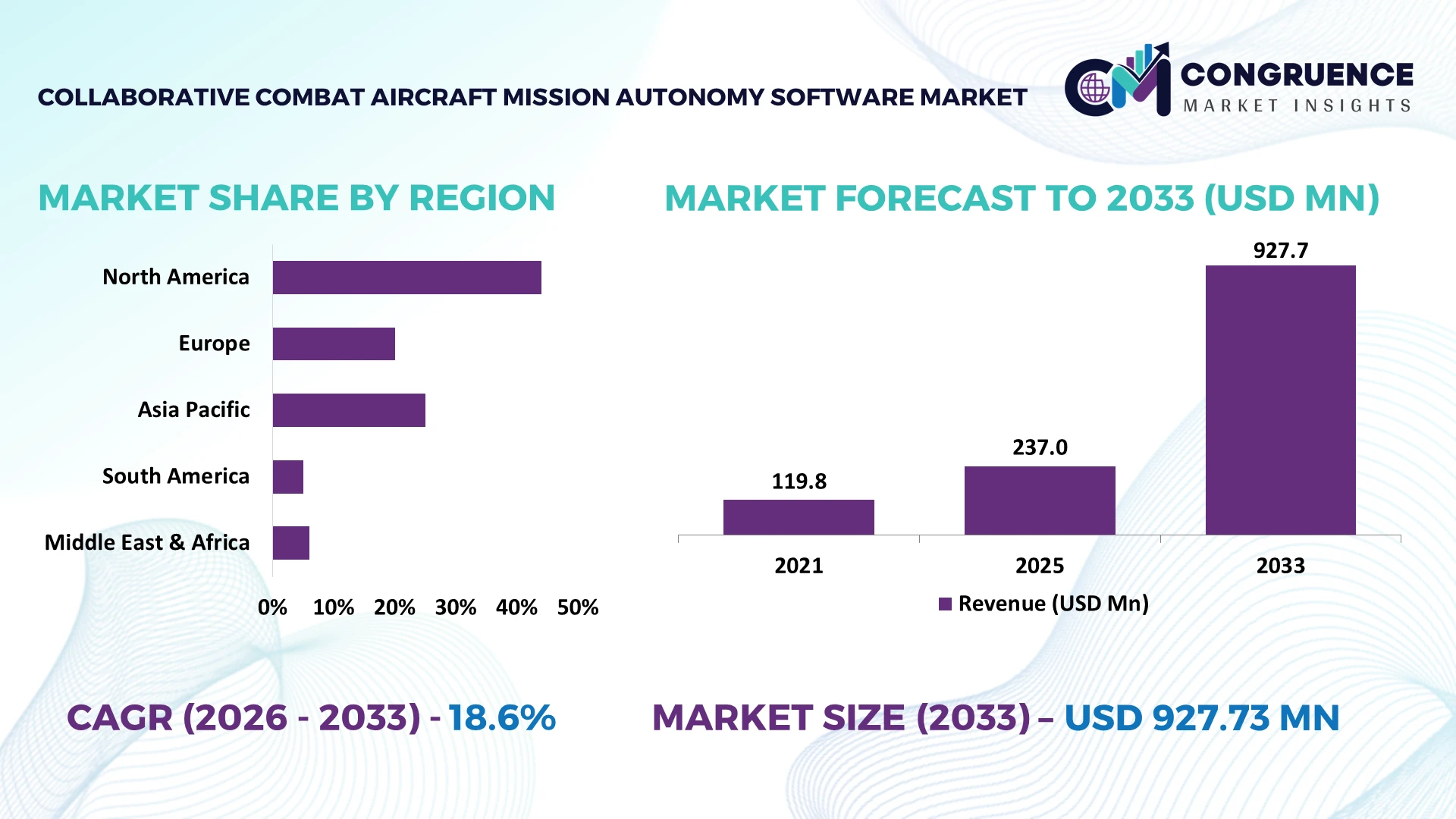
The United States dominates the global market with an estimated 58% share in 2025, supported by established aerospace contractors, defense software developers, and military modernization investments. The US Air Force requested approximately USD 557 million for its Collaborative Combat Aircraft program in fiscal 2025, with 2 manufacturers selected for initial aircraft development. Compared with Australia's MQ 28 Ghost Bat initiative, the United States demonstrates broader procurement ambitions and supplier participation, supported by strategic competition across the Indo Pacific and expanding aerospace technology partnerships.
Strategic investment in software interoperability, independent safety validation, and standardized certification frameworks will strengthen competitive positioning across emerging collaborative aircraft procurement programs.
Market Size & Growth: USD 237 million in 2025, reaching USD 927.73 million by 2033 at 18.6% CAGR, supported by aviation modernization.
Top Growth Drivers: Estimated contributions include aircraft modernization (45%), autonomous software investment (35%), and procurement expansion (20%).
Short Term Forecast: By 2028, standardized software architectures target 20% lower integration expenditure.
Emerging Technologies: Three prominent technologies include digital twins, virtual certification environments, and automated software assurance.
Regional Leaders: Estimated 2033 values include North America (USD 556.64 million, procurement), Europe (USD 185.55 million, modernization), and Asia Pacific (USD 139.16 million, development).
Consumer/End User Trends: Government defense organizations represent an estimated 85% of purchasing demand.
Pilot/Case Example: Australia's 2024 Ghost Bat program expansion included 3 additional aircraft, supporting software validation activities.
Competitive Landscape: Anduril holds an indicative 18% share estimate, alongside Shield AI, Boeing, General Atomics, and Lockheed Martin.
Regulatory & ESG Impact: US DoD Directive 3000.09 establishes human judgment and rigorous verification requirements for autonomous weapons systems.
Investment & Funding: Anduril secured USD 1.5 billion in 2024, supporting broader defense technology development and manufacturing expansion.
Innovation & Future Outlook: By 2028, an estimated 30% of new software procurement programs will prioritize modular architectures.
The Collaborative Combat Aircraft Mission Autonomy Software Market is experiencing concentrated demand across military aviation modernization, aerospace research programs, and autonomous aircraft software certification. Recent technology innovations encompass digital simulation environments, modular software architectures, automated verification, and secure software lifecycle management. Virtual certification is emerging as an important investment area, targeting an estimated 25% reduction in preliminary physical testing expenditure. Expanding international aerospace partnerships and government requirements for responsible autonomy are influencing procurement specifications, establishing software assurance, interoperability, and sustainable lifecycle management as central considerations in strategic market development.
The Collaborative Combat Aircraft Mission Autonomy Software Market is becoming strategically important as aerospace procurement shifts toward software defined aircraft architectures, increasing the commercial influence of independent software developers. Modular software procurement is restructuring traditional aerospace supply chains by separating aircraft manufacturing from software lifecycle management. Virtual verification environments target an estimated 25% reduction in preliminary testing expenditure compared with conventional physical testing processes, improving development economics.
The United States leads procurement scale through its Collaborative Combat Aircraft initiative, while Australia emphasizes focused aircraft development through the MQ 28 Ghost Bat program. Australia's 2024 commitment to three additional Ghost Bat aircraft demonstrates sustained investment in development and validation infrastructure. Between 2026 and 2028, an estimated 30% of new procurement initiatives will prioritize independently assessed software assurance frameworks, strengthening demand for specialized certification services.
Companies including Boeing, Anduril, and General Atomics are expanding aerospace software partnerships, engineering capabilities, and development infrastructure. Investment priorities increasingly encompass regulatory compliance, configuration management, and independently documented software reliability. Suppliers demonstrating transparent development processes and credible safety assurance will strengthen procurement eligibility. Long term competitive positioning depends on establishing trusted relationships with government customers while maintaining commercially sustainable software lifecycle support capabilities.
Government investment in collaborative aircraft development is creating dedicated procurement opportunities for specialized aerospace software suppliers. The United States Air Force selected two aircraft manufacturers in April 2024 for its initial Collaborative Combat Aircraft development phase, establishing a competitive industrial framework. Government defense organizations account for an estimated 85% of purchasing demand, while aircraft modernization represents approximately 45% of modeled growth drivers. This procurement concentration encourages suppliers to establish direct relationships with government agencies and established aerospace contractors. Anduril and General Atomics are expanding engineering infrastructure and program participation. Separating software procurement from aircraft manufacturing creates additional commercial entry points for independent developers with established compliance and assurance credentials.
Specialized aerospace engineering requirements, restricted technology transfers, and concentrated government procurement limit commercial scalability. Software assurance and regulatory documentation can represent an estimated 25% to 35% of development expenditure, while specialized engineering personnel account for approximately 40% under complex program cost scenarios. United States International Traffic in Arms Regulations restrict international distribution of designated defense technologies, complicating cross border commercial expansion. These restrictions increase administrative expenditure and limit opportunities to distribute development costs across international customers. Aerospace companies are addressing structural limitations through domestic engineering partnerships, localized compliance teams, and multiyear development contracts. Suppliers lacking established government contracting credentials face disproportionately high market entry costs despite possessing relevant software development expertise.
Independent software assurance represents an emerging commercial opportunity as government customers place greater emphasis on documented reliability, accountability, and regulatory compliance. Digital documentation platforms and automated compliance reporting target an estimated 25% reduction in administrative workloads and 20% lower recurring audit preparation expenditure. Australia's expanding aerospace development ecosystem provides opportunities for domestic certification specialists, research institutions, and independent verification providers. Increasing separation between aircraft manufacturing and software procurement creates additional demand for impartial assessment services throughout program lifecycles. Aerospace suppliers are positioning through research partnerships, dedicated assurance teams, and standardized documentation services. Recurring certification and compliance contracts offer commercial diversification beyond initial development awards, reducing dependence on individual aircraft procurement decisions.
Maintaining transparent accountability throughout extended aerospace software lifecycles presents a substantial execution challenge. Changing regulatory expectations, personnel turnover, and fragmented documentation ownership complicate consistent oversight across successive development phases. Lifecycle governance activities can represent an estimated 20% to 30% of ongoing software support expenditure, while centralized documentation systems target a 25% reduction in administrative duplication. United States Department of Defense Directive 3000.09 establishes requirements for appropriate human judgment and rigorous review of autonomous weapons systems. Companies must invest in independent oversight, personnel training, traceable documentation, and durable institutional governance arrangements. Long term competitiveness increasingly depends on demonstrating continued regulatory compliance and accountability rather than relying exclusively on initial program approval.
Software Procurement Becomes Increasingly Independent: Aerospace procurement is separating aircraft manufacturing contracts from software acquisition. The United States Air Force selected 2 aircraft manufacturers for its initial development phase in 2024. Independent software contracting targets an estimated 15% reduction in duplicated procurement expenditure, encouraging suppliers to establish dedicated commercial partnerships.
Digital Engineering Restructures Development Workflows: Aerospace contractors are expanding digital engineering environments to consolidate documentation, design records, and development approvals. Integrated documentation targets an estimated 25% reduction in administrative duplication and 20% shorter review cycles. Boeing and Lockheed Martin are expanding digital engineering capabilities to improve program coordination and contractual accountability.
Domestic Supplier Ecosystems Gain Priority: Australia committed AUD 399 million in 2024 toward continued Ghost Bat development, including 3 additional aircraft. Domestic industrial participation is becoming increasingly important in procurement decisions. Aerospace companies are expanding local research partnerships and engineering recruitment, strengthening supply continuity while addressing technology transfer restrictions.
Intellectual Property Shapes Contract Negotiations: Government customers increasingly emphasize software ownership, licensing transparency, and long term support rights. Flexible licensing structures target estimated administrative savings of 15% and contract renegotiation savings of 10%. Suppliers are restructuring commercial agreements to balance proprietary technology protection with customer requirements for sustainable lifecycle access.
Flight Autonomy Software represents the leading type, with an estimated 32% market share in 2025, reflecting its central position within aircraft development contracts and associated regulatory approval requirements. Its commercial dominance stems from substantial development expenditure, specialized engineering requirements, and continuing lifecycle support obligations. Mission Planning Software accounts for an estimated 23% share, supported by established procurement relationships and recurring licensing arrangements. Sensor Fusion Software constitutes another specialized procurement category, characterized by substantial intellectual property requirements and concentrated supplier participation.
Teaming Software represents the projected fastest growing commercial category as dedicated collaborative aircraft programs expand their software procurement portfolios. Combat Decision Software remains subject to particularly stringent oversight, accountability, and regulatory review requirements. Across these categories, standardized commercial licensing arrangements target an estimated 15% reduction in contract administration expenditure. Boeing, Anduril, and General Atomics are expanding dedicated software business portfolios and industrial partnerships, with investment priorities increasingly emphasizing contractual transparency, intellectual property management, regulatory compliance, and sustainable customer support arrangements.
Air-to-Air Combat represents the leading application with an estimated 36% market share in 2025, reflecting the procurement priorities of established collaborative aircraft development programs. Demand concentration is particularly evident within United States military aviation modernization initiatives, where dedicated development contracts support specialized software acquisition. ISR Missions account for an estimated 24% share, supported by established aerospace procurement categories and recurring software support requirements. Strike Missions represent another significant application segment, with purchasing decisions subject to extensive regulatory oversight and government authorization requirements.
Electronic Warfare represents the projected fastest growing application category in commercial procurement terms, reflecting increased government expenditure across specialized aerospace electronics programs. Suppression of Air Defenses remains a highly regulated application with concentrated institutional purchasing. Across these categories, consolidated licensing arrangements target an estimated 15% reduction in procurement administration costs. Aerospace contractors are differentiating their commercial offerings through dedicated program support, transparent licensing structures, and regulatory documentation, while prioritizing established government relationships and sustainable contractual arrangements.
Air Force organizations dominate the end user segment with an estimated 62% market share in 2025, supported by dedicated collaborative aircraft acquisition programs, established aerospace infrastructure, and substantial software development budgets. The United States Air Force and Royal Australian Air Force represent prominent institutional customers, creating concentrated procurement opportunities for established aerospace contractors and independent software suppliers. Defense Agencies account for an estimated 21% share, emphasizing program administration, regulatory oversight, contractual evaluation, and independent technology assessment across national procurement frameworks.
Navy organizations represent the projected fastest growing buyer category as maritime aviation modernization expands institutional interest in collaborative aircraft programs. Military Research Organizations concentrate on experimental development, academic partnerships, and independent software evaluation. Shared procurement administration targets an estimated 15% reduction in duplicated contractual workloads. Boeing, Lockheed Martin, and General Atomics are strengthening institutional partnerships and dedicated customer support arrangements. Commercial differentiation increasingly depends on procurement eligibility, domestic industrial participation, intellectual property agreements, and the ability to maintain accountable software support throughout extended government contract periods.
North America accounted for the largest market share at an estimated 60% in 2025; however, Asia-Pacific is expected to register the fastest growth, expanding at an estimated CAGR of 22.4% between 2026 and 2033.
Dedicated Aerospace Software Procurement Strengthens Market Leadership
North America maintains market leadership through established aerospace manufacturing capabilities, specialized software engineering ecosystems, and dedicated government acquisition programs. The United States represents an estimated 96% of regional demand, reflecting its extensive defense industrial infrastructure and institutional purchasing capacity. The US Air Force requested approximately USD 557 million for its Collaborative Combat Aircraft program in fiscal 2025, establishing substantial development opportunities for aerospace contractors and software suppliers. Canada contributes through aerospace research, engineering services, and industrial partnerships, although domestic procurement remains comparatively limited. Regional companies benefit from established government contracting relationships, dedicated research facilities, and mature aerospace regulatory frameworks. Commercial competition increasingly emphasizes intellectual property ownership, contractual accountability, and software lifecycle support. Established suppliers are expanding engineering employment and domestic industrial partnerships to meet government procurement requirements.
United States Market Outlook: The United States maintains a significant industrial advantage through its network of established aerospace manufacturers and independent software developers. In March 2025, the US Air Force assigned official designations to two collaborative aircraft prototypes. This development demonstrates institutional commitment to dedicated aircraft programs, supporting commercial demand for software licensing, engineering services, regulatory documentation, and lifecycle management.
Multinational Aerospace Partnerships Reshape Industrial Participation
Europe accounted for an estimated 20% of global market demand in 2025, supported by multinational aerospace development programs, domestic technology investment, and government procurement modernization. The United Kingdom, France, Germany, and Italy represent prominent industrial centers, with established aerospace manufacturers and specialized software engineering organizations. The Global Combat Air Programme brings together three participating countries, including the United Kingdom, Italy, and Japan, creating a multinational framework for future aerospace development. European procurement emphasizes technological sovereignty, intellectual property protection, and domestic industrial participation. Regulatory differences between participating countries increase contractual coordination requirements, particularly for internationally developed software products. Companies are responding through collaborative research arrangements, shared engineering infrastructure, and dedicated program management organizations. Commercial opportunities remain closely linked to government funding commitments, multinational procurement agreements, and independently documented compliance capabilities.
United Kingdom Market Outlook: The United Kingdom benefits from established aerospace engineering capabilities centered on BAE Systems, Rolls Royce, and specialized technology suppliers. In December 2024, BAE Systems, Leonardo, and Japan Aircraft Industrial Enhancement announced an agreement to establish a joint venture with equal ownership. This industrial structure strengthens multinational development coordination and creates commercial opportunities for qualified software and engineering suppliers.
Domestic Aerospace Development Expands Software Procurement
Asia Pacific represented an estimated 14% of global market demand in 2025, reflecting expanding aerospace development initiatives across Australia, Japan, South Korea, India, and China. Australia maintains a prominent position through its collaborative aircraft development program and established industrial partnership with Boeing. Japan emphasizes multinational aerospace development, while South Korea and India are expanding domestic aerospace research and manufacturing capabilities. Australia's government announced an AUD 399 million commitment in February 2024 to continue MQ 28 Ghost Bat development, demonstrating sustained institutional investment. Regional procurement increasingly incorporates domestic industrial participation, technology ownership, and specialized workforce development requirements. International aerospace companies are establishing local engineering partnerships and research arrangements to address these procurement conditions. Differences in regulatory frameworks and technology transfer restrictions continue to influence commercial participation across individual national markets.
Australia Market Outlook: Australia benefits from established government and industry collaboration through Boeing Australia's aerospace development activities. Its 2024 Ghost Bat funding announcement included three additional aircraft, strengthening domestic engineering and manufacturing participation. Queensland's aerospace industrial ecosystem supports specialized employment, research partnerships, and associated software development services, reinforcing Australia's position within internationally connected aerospace procurement programs.
Established Aerospace Manufacturing Supports Emerging Participation
South America accounted for an estimated 2.5% of global market demand in 2025, with commercial activity concentrated around established aerospace manufacturers, government research organizations, and specialized engineering suppliers. Brazil maintains the strongest industrial foundation through Embraer's aerospace manufacturing capabilities and established international partnerships. The Brazilian Air Force's original Gripen acquisition agreement covered 36 aircraft, demonstrating the country's experience with multinational aerospace procurement and industrial participation arrangements. However, this established aviation activity does not represent direct collaborative aircraft software deployment. Limited dedicated procurement programs, constrained public expenditure, and dependence on internationally sourced technology restrict immediate market expansion. Regional companies are emphasizing research collaboration, workforce development, and participation in established aerospace supply chains. Commercial activity remains concentrated in associated engineering services, software documentation, and government funded research rather than large scale dedicated procurement.
Brazil Market Outlook: Brazil's aerospace industry benefits from established manufacturing infrastructure and international industrial cooperation. The Gripen production line inaugurated in Brazil in 2023 represents the program's first final assembly facility outside Sweden. This development demonstrates domestic aerospace industrial capabilities, although dedicated collaborative aircraft software demand remains dependent on future government procurement decisions and authorized research programs.
Industrial Localization Shapes Aerospace Investment Priorities
The Middle East and Africa represented an estimated 3.5% of global market demand in 2025, with commercial participation concentrated across government aerospace procurement, domestic industrial development, and specialized research organizations. Saudi Arabia and the United Arab Emirates are expanding domestic aerospace industrial ecosystems through government investment and international technology partnerships. Saudi Arabia's Vision 2030 establishes a target to localize more than 50% of military expenditure, influencing procurement structures and domestic supplier participation requirements. South Africa contributes through established aerospace engineering capabilities, although dedicated collaborative aircraft procurement remains limited. International contractors face differing technology transfer restrictions, regulatory requirements, and local ownership expectations across national markets. Commercial activity increasingly emphasizes industrial participation agreements, workforce development, and authorized engineering services. Market development remains closely dependent on transparent government procurement commitments and sustainable domestic research infrastructure.
Saudi Arabia Market Outlook: Saudi Arabia is strengthening domestic aerospace manufacturing and engineering participation through government industrial development initiatives. Saudi Arabian Military Industries was established in 2017 to support national defense industrial localization. Its aerospace activities and international industrial partnerships provide an institutional foundation for associated software procurement, specialized employment, and research collaboration, subject to applicable technology transfer and regulatory requirements.
Anduril, Shield AI, Boeing, General Atomics, and Lockheed Martin compete across dedicated aerospace software development, government contracting, and aircraft program participation. The top five players collectively represent an estimated 62% market share, indicating concentrated procurement relationships. Established aerospace manufacturers leverage institutional contracting experience, while independent developers differentiate through specialized intellectual property and software licensing arrangements. Standardized documentation processes target estimated administrative savings of 20%, while consolidated licensing arrangements target 15% lower contract management expenditure. Companies are expanding engineering operations, establishing industrial partnerships, and restructuring software ownership agreements. Competition is shifting from bundled aircraft procurement toward separately negotiated software contracts, increasing the commercial significance of independent developers. Entry barriers include government procurement eligibility, export restrictions, specialized workforce requirements, and regulatory compliance obligations. Sustainable competitive positioning requires credible institutional relationships, transparent intellectual property arrangements, independently documented accountability, and financially sustainable lifecycle support commitments across extended government procurement programs and multinational aerospace development partnerships.
Anduril Industries
Shield AI
Boeing
General Atomics
Lockheed Martin Corporation
Northrop Grumman Corporation
RTX Corporation
BAE Systems plc
Leonardo S.p.A.
Airbus SE
Saab AB
Kratos Defense & Security Solutions
Dassault Aviation
Current technologies encompass digital engineering environments, software configuration management, and automated regulatory documentation. Digital engineering targets an estimated 25% reduction in documentation duplication compared with conventional fragmented engineering workflows. Configuration management platforms target 20% lower administrative workloads, while automated documentation offers potential audit preparation savings of 30%. Adoption remains concentrated across major aerospace development programs, supporting contractual transparency, development accountability, and consistent regulatory reporting.
Emerging technologies include digital compliance platforms, software provenance tracking, and centralized intellectual property management. Digital compliance platforms target estimated administrative savings of 20%, while provenance tracking targets 25% shorter documentation reviews. Centralized intellectual property management offers potential contract administration savings of 15%. Independent software suppliers and established aerospace manufacturers benefit through clearer ownership arrangements, improved contractual coordination, and reduced administrative duplication across multinational development partnerships.
Disruptive technologies include automated governance reporting and standardized digital assurance records, currently concentrated within specialized development environments. Automated governance reporting targets an estimated 30% reduction in manual reporting workloads, while standardized assurance records target 20% lower documentation maintenance expenditure. Between 2026 and 2028, adoption will increasingly reflect government accountability requirements. Suppliers maintaining transparent software ownership, independently documented compliance, and sustainable lifecycle governance will strengthen institutional credibility and long term contractual relationships.
August 2025: General Atomics completed its inaugural Collaborative Combat Aircraft prototype flight within two years of program initiation, marking a significant development milestone. The achievement advances contractual evaluation and provides documented evidence of progress toward subsequent procurement decisions. Source: af.mil
June 2025: BAE Systems, Leonardo, and Japan Aircraft Industrial Enhancement officially launched Edgewing, a multinational joint venture involving three industrial partners. The organization establishes centralized development responsibility, supporting shared aerospace engineering investment and coordinated international program management. Source: jaiec.com
March 2025: Anduril Industries and General Atomics received official aircraft designations for two Collaborative Combat Aircraft prototypes. The announcement formalized their participation within the dedicated acquisition program, establishing identifiable development platforms for subsequent government evaluation and contracting. Source: af.mil
February 2024: Boeing Defence Australia received additional government backing through an AUD 399 million commitment to continued Ghost Bat development. The investment supports domestic aerospace engineering, continued program development, and industrial participation across Australia's established technology ecosystem. Source: australiandefence.com.au
The report examines the global Collaborative Combat Aircraft Mission Autonomy Software Market across five software types, five application categories, and four institutional end user groups. Coverage encompasses mission planning software, flight autonomy software, sensor fusion software, teaming software, and combat decision software from a commercial and regulatory perspective. Application analysis evaluates procurement distribution, institutional purchasing behavior, development expenditure priorities, and government program participation.
Regional coverage includes North America, Europe, Asia Pacific, South America, and the Middle East and Africa, assessing aerospace industrial infrastructure, procurement frameworks, and technology investment patterns. The report profiles 13 prominent companies, examining commercial partnerships, intellectual property arrangements, regulatory compliance, and contractual positioning. Emerging research areas include digital engineering governance, independent software assurance, and lifecycle documentation, supporting informed investment planning and market assessment between 2026 and 2033.
| Report Attribute/Metric | Report Details |
|---|---|
Market Revenue in 2025 | USD 237 Million |
Market Revenue in 2033 | USD 927.73 Million |
CAGR (2026 - 2033) | 18.6% |
Base Year | 2025 |
Forecast Period | 2026 - 2033 |
Historic Period | 2021 - 2025 |
Segments Covered | By Type
By Application
By End-User
|
Key Report Deliverable | Revenue Forecast, Growth Trends, Market Dynamics, Segmental Overview, Regional and Country-wise Analysis, Competition Landscape |
Region Covered | North America, Europe, Asia-Pacific, South America, Middle East, Africa |
Key Players Analyzed | Anduril Industries, Shield AI, Boeing, General Atomics, Lockheed Martin Corporation, Northrop Grumman Corporation, RTX Corporation, BAE Systems plc, Leonardo S.p.A., Airbus SE, Saab AB, Kratos Defense & Security Solutions, Dassault Aviation |
Customization & Pricing | Available on Request (10% Customization is Free) |




