
Reports
The Global Cold Rolled Steel Coil Market was valued at USD 143.0 Million in 2025 and is anticipated to reach a value of USD 179.7 Million by 2033 expanding at a CAGR of 2.9% between 2026 and 2033. Growth is driven by automotive lightweighting, advanced high-strength steel adoption, appliance gauge reduction, and expansion of precision cold-rolling capacity for higher-value applications.
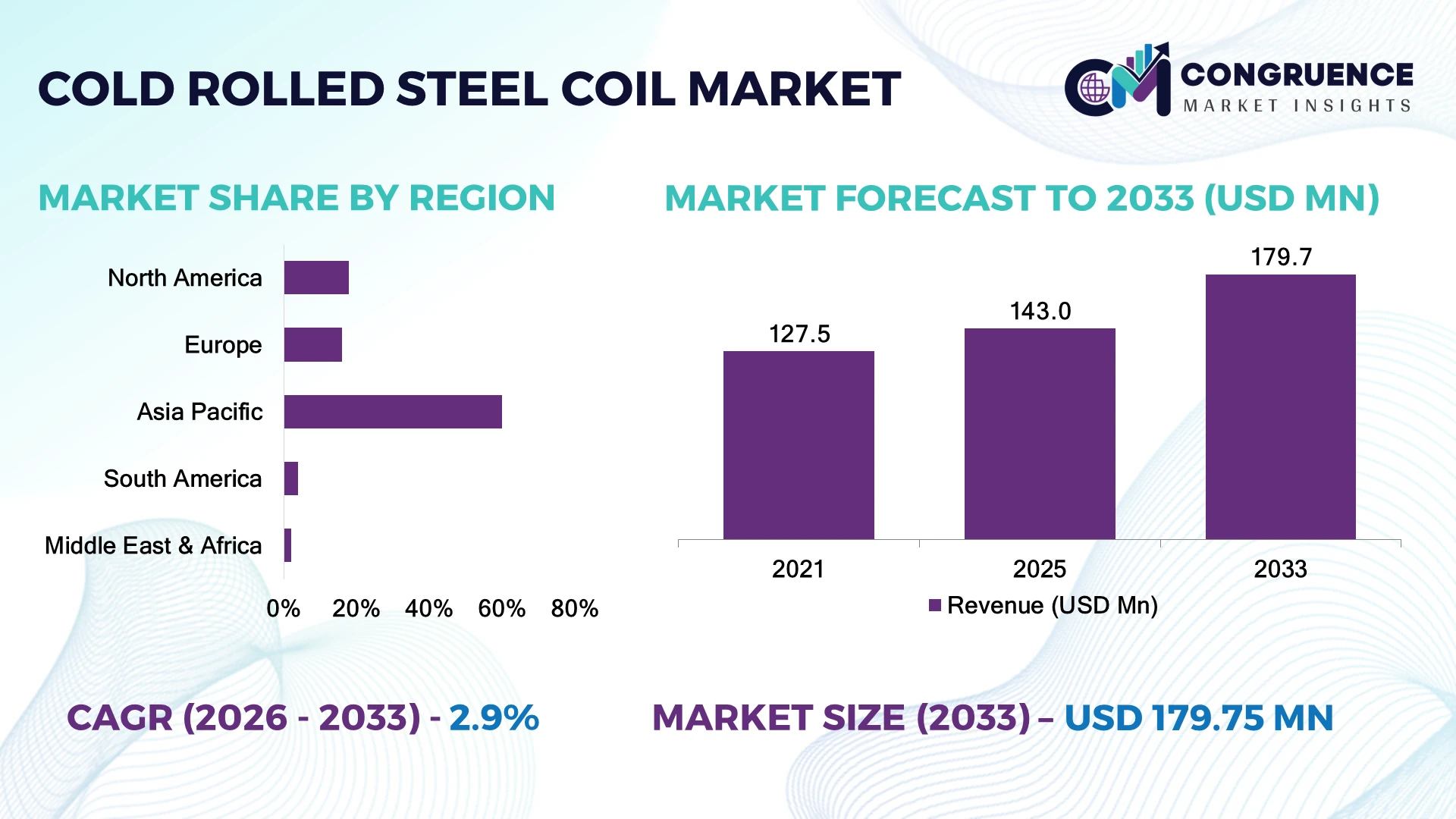
China dominates the global cold rolled steel coil landscape, accounting for about 52% of global crude-steel output and more than 60% of its cold-rolling capacity concentrated across eastern and northern industrial hubs. India, by comparison, produced about 165 million tonnes of crude steel in 2025, up 10.4%, strengthening its automotive and appliance manufacturing base.
Strategically, buyers should prioritize suppliers with high-strength grades, localized capacity, tight-gauge control, and low-carbon production capabilities.
Market Size & Growth: USD 143.0 million in 2025 to USD 179.7 million by 2033 at 2.9% CAGR, supported by automotive lightweighting and higher-grade steel adoption.
Top Growth Drivers: Automotive lightweighting 15–20%; appliance material savings up to 12%; advanced steel applications expanding through higher-strength grades.
Short-Term Forecast: By 2028, thinner-gauge adoption is positioned to improve material efficiency by 10–15% in selected automotive applications.
Emerging Technologies: AI-enabled rolling control, automated inspection, and AHSS grades above 1,500 MPa are reshaping precision manufacturing.
Regional Leaders: Asia-Pacific represents about 59.94% of market volume; Europe is accelerating low-carbon steel deployment; North America is expanding advanced electrical and automotive steel capacity.
Consumer/End-User Trends: Automotive applications represented about 42.23% of 2025 demand, while appliance producers increasingly adopt 0.4–0.5 mm gauges.
Pilot/Case Example: In 2025, EV-oriented AHSS development enabled potential gauge reductions of 10–15% while maintaining structural performance.
Competitive Landscape: China holds the dominant production position, with Baosteel, POSCO, Nippon Steel, ArcelorMittal, and Tata Steel competing through grade development and processing capacity.
Regulatory & ESG Impact: EU CBAM entered its operational phase in 2026, increasing pressure for lower-carbon steel and emissions traceability across international supply chains.
Investment & Funding: China commissioned about 8.39 million tonnes of new cold-rolling and coated-steel capacity in 2024, emphasizing higher-value downstream processing.
Innovation & Future Outlook: The market is shifting toward AHSS, digital quality control, thinner gauges, recycled inputs, and localized supply chains as manufacturers pursue productivity and carbon-efficiency gains.
Cold Rolled Steel Coil Market demand is concentrated in automotive body structures, appliances, electrical equipment, precision components, and engineered construction products. Advanced high-strength grades are gaining traction as manufacturers target 10–15% gauge reductions without compromising structural performance. Supply-chain restructuring and EU carbon requirements are also pushing mills toward traceable, lower-emission production, creating a natural transition toward strategic grade and capacity decisions.
Cold rolled steel coil is becoming strategically important because manufacturers increasingly require tighter dimensional tolerances, superior surface quality, and stronger lightweight materials rather than commodity steel alone. Automotive electrification is reinforcing this shift: battery-electric vehicles can use 15–20% more advanced high-strength steel than comparable internal-combustion platforms, while thinner gauges reduce material intensity.
Technology investment is separating high-performance mills from conventional producers. AI-enabled process control and automated surface inspection improve consistency and reduce quality losses compared with manual inspection, while AHSS grades above 1,500 MPa enable 10–15% gauge reductions in selected vehicle components. China retains the largest industrial scale, whereas India is expanding faster in steel output, with production rising 10.4% in 2025.
Over the next 2–3 years, mills with precision rolling, advanced annealing, coating, and digital inspection capabilities will gain stronger positioning. European producers are simultaneously adapting to CBAM-driven carbon accounting, while Asian manufacturers are localizing supply chains around automotive and appliance hubs. Companies are responding through capacity upgrades, technology partnerships, and higher-value product portfolios, making operational precision and low-carbon credentials decisive competitive advantages.
Automotive lightweighting is the strongest structural driver, with battery-electric vehicles using roughly 15–20% more AHSS than conventional platforms to offset battery mass and meet crash-performance requirements. Advanced grades exceeding 1,500 MPa also enable 10–15% gauge reductions in selected components. China produced 16.52 million new-energy vehicles in 2025, up 25.1%, reinforcing demand for higher-strength sheet. This shift is moving purchasing decisions from volume toward tensile strength, surface quality, and gauge precision. Steelmakers are responding by upgrading annealing, rolling, inspection, and coating lines. The strategic advantage increasingly sits with mills capable of supplying thinner, stronger coil consistently rather than producers competing primarily on commodity pricing.
Cold rolled steel producers remain exposed to raw-material, energy, and international trade volatility. China imported about 125.9 million tonnes of iron ore in 2025, while its rolled-steel imports declined 11.1%, illustrating the scale and sensitivity of cross-border steel flows. European producers face additional cost pressure as carbon-accounting requirements become embedded in procurement decisions. These conditions can compress margins when mills cannot rapidly pass input costs through contracts. Producers are reducing exposure through longer-term raw-material agreements, diversified sourcing, localized finishing operations, and greater production of premium grades. The non-obvious constraint is not simply steel availability but the ability to maintain consistent chemistry, surface quality, and delivery schedules amid shifting trade flows.
The strongest opportunity lies in premium cold rolled grades for electric vehicles, appliances, electrical equipment, and precision engineering. AHSS adoption supports potential 10–15% material reductions, while appliance manufacturers using 0.4–0.5 mm gauges can achieve material savings of up to 12% compared with thicker conventional sheet. India is particularly attractive as crude-steel output increased 10.4% in 2025 and automotive manufacturing continues expanding. Mills can capture this opportunity by developing localized grade portfolios, partnering with automakers, and investing in automated gauge and surface-control systems. A distinctive opportunity is the westward and inland localization of processing capacity, reducing transportation dependence while positioning suppliers closer to emerging manufacturing clusters.
The long-term challenge is simultaneously scaling precision production and lowering embedded emissions without disrupting yield. China’s cold-rolling capacity has increased about 60% over the past decade, while eastern and northern areas still account for more than 60% of national capacity, creating geographic concentration. Meanwhile, EU CBAM requirements increase the importance of emissions data and production-route transparency. Mills must integrate automated inspection, digital process monitoring, energy optimization, and traceable carbon accounting across increasingly complex production networks. Companies that fail to synchronize these systems face inconsistent quality, higher conversion losses, and weaker access to premium export contracts. Investment therefore needs to combine equipment modernization with workforce capability, supplier integration, and measurable decarbonization infrastructure.
Thin-Gauge Production Intensifies: Indian and Chinese mills are increasing sub-0.5 mm and below-3 mm coil production as appliance and automotive fabricators seek 10–15% material savings. Automated gauge control and continuous annealing are improving thickness consistency while reducing conversion losses. The operational shift is moving procurement toward tighter tolerances rather than simply lower per-tonne prices, encouraging mills to upgrade rolling and inspection systems.
Automotive Grade Upgrading Accelerates: AHSS and higher-strength grades are gaining traction as vehicle manufacturers target lightweight structures without sacrificing crash performance. India recorded 7.9% passenger-vehicle sales growth in FY2025–26, while electric passenger-vehicle registrations increased by more than 80%, strengthening demand for precision sheet. Steelmakers are expanding advanced-grade qualification programs and collaborating more closely with automakers to shorten approval cycles and stabilize grade supply.
Digital Quality Control Expands: AI-assisted surface inspection, automated flatness monitoring, and predictive process control are moving from pilot lines toward production-scale deployment. Digital inspection can identify defects across 100% of coil surfaces, while automated parameter adjustment targets 5–10% lower process variability. Labor shortages and tighter customer specifications are accelerating this transition, particularly at large integrated mills. Companies are integrating inspection data with production-management platforms to reduce rework and improve coil traceability.
Low-Carbon Coil Procurement Rises: European buyers are increasingly linking steel procurement with embedded-carbon reporting as CBAM enters its definitive phase, while Asian producers expand lower-emission production routes. Green-steel programs increasingly target 20–30% reductions in production-related emissions through renewable electricity, higher scrap use, and process optimization. The non-obvious shift is that carbon traceability is becoming a commercial specification alongside tensile strength and surface finish, prompting mills to restructure contracts and invest in emissions-monitoring systems.
Full Hard Cold Rolled Coils remain the leading type, accounting for approximately 27% of market share, supported by high strength, dimensional stability, and suitability for applications requiring limited forming. Their established position reflects broad use in industrial components, construction-related products, and downstream processing where strength retention is prioritized over maximum ductility. Half-hard and quarter-hard coils serve applications requiring greater formability, while other hardness grades remain important for specialized fabrication. Full-hard production also benefits from established mill configurations, keeping conversion economics competitive.
Half-hard coils represent the faster-shifting segment as manufacturers seek a balance between strength and forming performance. Demand is strengthening in automotive components, appliances, and precision fabrication where deeper forming requirements make fully hard material less suitable. Companies are expanding temper-rolling and annealing capabilities, with hardness-controlled products increasingly differentiated through surface quality and dimensional tolerance. The strategic implication is a gradual shift from standardized coil procurement toward application-specific hardness specifications, allowing producers to defend margins through technical customization rather than commodity pricing alone.
Automotive applications lead the market with approximately 42.23% share, reflecting extensive cold rolled coil consumption in body panels, structural parts, closures, and precision components. High surface quality, formability, and tight dimensional tolerances keep automotive demand structurally concentrated. Construction remains a major mature application, while machinery and industrial fabrication provide diversified demand across equipment housings and precision components. Companies supplying automotive customers increasingly prioritize grade qualification, surface consistency, and just-in-time delivery over standardized commodity volumes.
Home appliances represent the fastest-changing application as Indian and Chinese manufacturers shift toward thinner gauges, improved surface finishes, and higher forming precision. Appliance production benefits from 0.4–0.5 mm material ranges, while automated stamping and forming can reduce material losses by roughly 5–10%. Machinery applications remain comparatively specification-driven, whereas construction demand is more project-dependent. Producers are therefore expanding slitting, finishing, and customized coil-processing services to serve shorter production runs. This creates a strategic opportunity to diversify away from automotive concentration while capturing higher-value appliance demand.
Automotive is the leading end-user, representing approximately 37% of market share, driven by high-volume body-panel, structural, closure, and component requirements. Its purchasing model emphasizes consistent gauge, surface quality, formability, and scheduled delivery because coil defects can disrupt stamping and assembly lines. Construction provides a substantial established customer base, while oil and gas and aerospace purchase more specification-intensive grades in smaller volumes. Companies are responding by creating dedicated automotive-grade production routes, technical-service teams, and long-term supply arrangements.
Construction is positioned as the fastest-expanding buyer group within the specified end-user structure as modular construction, light-gauge framing, and prefabricated components increase demand for accurately processed sheet. Its procurement behavior differs from automotive: project schedules and price competitiveness carry greater weight, while aerospace prioritizes certification and material consistency. Oil and gas remains comparatively specialized, with demand tied to equipment and infrastructure requirements. Suppliers are consequently segmenting commercial strategies, combining high-volume automotive contracts with customized construction packages and premium specification-driven sales.
Asia-Pacific accounted for the largest market share at 60% in 2025 however, Middle East & Africa is expected to register the fastest growth, expanding at a CAGR of 3.8% between 2026 and 2033.
North America holds approximately 18% of the global cold rolled steel coil market, with demand concentrated in the United States and Mexico automotive corridors. U.S. automotive manufacturing remains the principal consumption base, while Mexico continues attracting vehicle and component production toward integrated manufacturing clusters. Advanced high-strength steel, galvanized substrates, and tighter surface specifications are increasing the value of domestic processing. The U.S. steel industry produced approximately 79.5 million metric tons of crude steel in 2025, supporting extensive downstream conversion capacity. Automotive localization and trade-policy pressures are also encouraging mills and service centers to secure regional coil availability rather than relying heavily on distant imports. Investments increasingly prioritize continuous annealing, automated inspection, and specialized finishing lines, strengthening supply reliability for high-volume automotive and appliance customers.
United States Market Outlook: The United States remains the region's strategic manufacturing center because of its large automotive, appliance, construction, and machinery base. Integrated producers are increasingly emphasizing advanced grades and domestic processing capabilities. The country's established service-center network enables rapid slitting, leveling, and distribution, while domestic-content policies strengthen the commercial case for locally processed cold rolled coil.
Europe represents approximately 16% of global cold rolled steel coil demand, with Germany, Italy, France, and Spain forming important automotive and industrial consumption hubs. Automotive manufacturing remains central, but procurement is increasingly shaped by embedded-carbon disclosure, energy costs, and product traceability. EU CBAM entered its definitive regime in 2026, increasing pressure on importers and producers to document carbon intensity across steel supply chains. European mills are therefore combining electric-arc-furnace capacity, renewable electricity procurement, higher scrap utilization, and digital process controls. Premium automotive sheet increasingly requires consistent surface finish and tight gauge tolerances alongside lower embodied emissions. Producers are redirecting capital toward modernization rather than simple volume expansion, creating stronger differentiation between conventional commodity coil and certified lower-carbon grades.
Germany Market Outlook: Germany remains Europe's most strategically significant market because of its concentrated automotive manufacturing ecosystem and sophisticated steel-processing infrastructure. Major vehicle and component producers require high-strength, highly formable sheet with stringent dimensional and surface specifications. German mills and downstream processors are strengthening digital quality monitoring and lower-carbon production pathways, positioning domestic suppliers for increasingly demanding automotive procurement standards.
Asia-Pacific commands approximately 60% of the global cold rolled steel coil market, supported by China's massive steel-processing ecosystem, Japan's advanced automotive grades, South Korea's integrated mills, and India's expanding manufacturing base. China produced approximately 961 million tonnes of crude steel in 2025, maintaining an overwhelming regional production advantage. India is simultaneously strengthening its position through automotive, appliance, infrastructure, and engineering expansion. Japanese and South Korean producers remain differentiated by high-strength grades, precision processing, and export-oriented automotive relationships. Regional supply chains increasingly integrate cold rolling with annealing, coating, inspection, and slitting to shorten lead times. Producers are investing in automated quality control and application-specific grades as downstream manufacturers demand higher consistency and thinner gauges.
China Market Outlook: China remains the dominant country because of its enormous steelmaking capacity, dense downstream processing network, and extensive automotive and appliance manufacturing base. Its 2025 crude-steel output remained above 950 million tonnes, providing unmatched feedstock availability for cold rolling. Producers are increasingly prioritizing higher-value automotive sheet, precision grades, and integrated processing to offset weaker commodity economics.
South America accounts for approximately 4% of global cold rolled steel coil demand, with Brazil representing the principal industrial and consumption center. Automotive manufacturing, white goods, machinery, construction equipment, and fabricated metal products generate the majority of downstream requirements. Brazil's crude-steel production reached approximately 33.3 million tonnes in 2025, providing a substantial domestic feedstock base for flat-steel processing. Local producers are focusing on higher-value grades and service-center capabilities as manufacturers seek shorter supply chains and reduced exposure to imported coil volatility. Automotive investments are reinforcing demand for surface-critical sheet, while infrastructure limitations and logistics costs continue to influence distribution economics. Companies are responding through localized processing, customer-specific inventories, and closer supply agreements rather than pursuing broad capacity expansion without downstream commitments.
Brazil Market Outlook: Brazil offers the strongest operational platform in South America because of its integrated steelmaking base, large automotive manufacturing footprint, and diversified industrial demand. The country produced more than 33 million tonnes of crude steel in 2025, supporting domestic flat-steel conversion. Growing vehicle and appliance production is encouraging suppliers to strengthen local finishing, inventory management, and application-specific grade availability.
Middle East & Africa represents approximately 2% of global cold rolled steel coil consumption, but industrial diversification is creating new downstream opportunities. Saudi Arabia, the United Arab Emirates, Egypt, and South Africa are strengthening manufacturing, construction, infrastructure, and fabricated-metal ecosystems. Saudi Arabia's National Industrial Development and Logistics Program targets more than 100 billion Saudi riyals in additional industrial investment by 2025, supporting steel-intensive manufacturing development. Demand is increasingly shifting from basic construction use toward appliances, automotive components, electrical equipment, and engineered products. Local production remains uneven, making imported coil and regional service centers important to supply continuity. Producers and distributors are responding through localized warehousing, processing partnerships, and investments in slitting and finishing capabilities, improving delivery flexibility while reducing dependence on distant supply routes.
Saudi Arabia Market Outlook: Saudi Arabia is the region's strongest strategic market because industrial diversification is expanding demand beyond traditional construction applications. Investments in manufacturing, logistics, automotive supply chains, and downstream metal fabrication are strengthening the addressable customer base. The country's industrial-development programs also encourage localized value addition, creating opportunities for cold rolled coil processors to establish finishing, distribution, and customized service capabilities.
ArcelorMittal, Baosteel, POSCO, Nippon Steel, and Tata Steel compete as global scale and technology leaders, while regional mills compete through pricing, localized supply, and faster customization. The top five players collectively account for approximately 32% of global market value, indicating a fragmented structure. Competition increasingly centers on high-strength grades, where premium products command 10–20% higher value, while automated inspection can reduce quality-related losses by 5–10%. Players are expanding downstream capacity, integrating rolling with annealing and coating, and forming regional partnerships to secure automotive customers. ArcelorMittal’s India expansion combines a 2 Mtpa pickling-and-tandem-cold-mill complex with additional galvanizing capacity, while POSCO is strengthening Indian integration through a 50:50 partnership with JSW Steel. The competitive shift is toward localized, digitally controlled, lower-carbon production. High capital requirements, qualification cycles, and technology expertise remain major entry barriers. Winning requires scale plus specialized grades, reliable delivery, and measurable quality performance.
ArcelorMittal
China Baowu Steel Group
POSCO Holdings
Nippon Steel Corporation
Tata Steel
JFE Steel Corporation
Hyundai Steel
thyssenkrupp Steel
United States Steel Corporation
JSW Steel
Nucor Corporation
Cleveland-Cliffs
Steel Authority of India Limited
China Steel Corporation
Cold rolling technology is shifting from conventional mechanical control toward digitally coordinated production. AI-assisted surface inspection, automated gauge control, and predictive process monitoring are being integrated across modern mills, with automated inspection targeting 5–10% lower defect-related losses. Baosteel already integrates automatic gauge control and shape detection within automotive cold-rolling operations, demonstrating how digital control is becoming embedded in premium-grade production.
Advanced continuous annealing and high-strength steel processing are emerging as major differentiators. Modern AHSS processing enables selected automotive components to achieve 10–15% gauge reductions while maintaining structural performance. Compared with legacy inspection workflows, automated optical systems provide 100% surface coverage instead of sampling-based inspection, improving defect detection consistency and reducing manual intervention. High-volume automotive suppliers benefit most because quality deviations can rapidly disrupt stamping operations.
From 2026–2028, integrated digital twins, AI-based rolling optimization, robotic material handling, and lower-emission annealing systems will increasingly connect production, quality, and energy-management workflows. Mills with vertically integrated data systems will gain faster grade qualification and tighter process control. The competitive advantage will shift toward producers combining advanced metallurgy with automation, traceability, and energy efficiency rather than relying solely on installed rolling capacity.
June 2025 — ArcelorMittal received two Manufacturing Leadership Council awards for its AI-driven investment-assessment approach applied to the Vega expansion in Brazil, strengthening digital decision-making for cold rolling, annealing, and galvanizing operations. The development supports more data-driven capacity deployment and process modernization. Source: corporate.arcelormittal.com
April 2025 — ArcelorMittal reported that its AM/NS India downstream expansion remained on track, including a 2 Mtpa pickling-and-tandem-cold-mill complex and 1 Mtpa continuous galvanizing and annealing line. The investment strengthens high-value automotive-grade production and expands localized supply capabilities. Source: corporate.arcelormittal.com
July 2025 — POSCO and JSW Steel advanced their Indian integrated-steel joint venture into full-scale execution, with each company holding a 50% stake. The planned facility integrates ironmaking, steelmaking, hot rolling, cold rolling, and galvanizing, strengthening premium domestic supply-chain integration. Source: newsroom.posco.com
September 2025 — The European Commission initiated an anti-dumping investigation covering cold-rolled flat steel products from India, Japan, Taiwan, Türkiye, and Vietnam. The measure increases trade-compliance pressure on imported coil and reinforces the strategic importance of localized European supply. Source: corporate.arcelormittal.com
The report covers the global cold rolled steel coil market across hardness types, including full hard, half hard, quarter hard, and other grades; applications spanning automotive, construction, machinery, and home appliances; and end-users including automotive, construction, oil and gas, and aerospace. It evaluates demand concentration, product specifications, processing requirements, procurement behavior, and emerging application areas.
Geographic coverage encompasses North America, Europe, Asia-Pacific, South America, and the Middle East & Africa, with country-level analysis of major production and consumption hubs. The study assesses advanced high-strength steel, continuous annealing, automated inspection, precision gauge control, low-carbon processing, and digital manufacturing. Competitive profiling covers 14 major participants, supporting supplier evaluation, capacity planning, localization decisions, partnership strategy, investment prioritization, and competitive positioning through 2026–2033.
| Report Attribute / Metric Details | Details |
|---|---|
| Market Revenue (2025) | USD 143.0 Million |
| Market Revenue (2033) | USD 179.7 Million |
| CAGR (2026–2033) | 2.90% |
| Base Year | 2025 |
| Forecast Period | 2026–2033 |
| Historic Period | 2021–2025 |
| Segments Covered |
By Type
By Application
By End-User
|
| Key Deliverables | Revenue Forecast; Market Trends; Growth Drivers & Restraints; Technology Insights; Segmentation Analysis; Regional Insights; Competitive Landscape; Regulatory & ESG Overview; Recent Developments |
| Regions Covered | North America; Europe; Asia-Pacific; South America; Middle East & Africa |
| Companies Profiled | ArcelorMittal; China Baowu Steel Group; POSCO Holdings; Nippon Steel Corporation; Tata Steel; JFE Steel Corporation; Hyundai Steel; thyssenkrupp Steel; United States Steel Corporation; JSW Steel; Nucor Corporation; Cleveland-Cliffs; Steel Authority of India Limited; China Steel Corporation |
| Customization & Pricing | Available on Request (10% Customization Free) |




