Global Cold Planers Market Report Overview
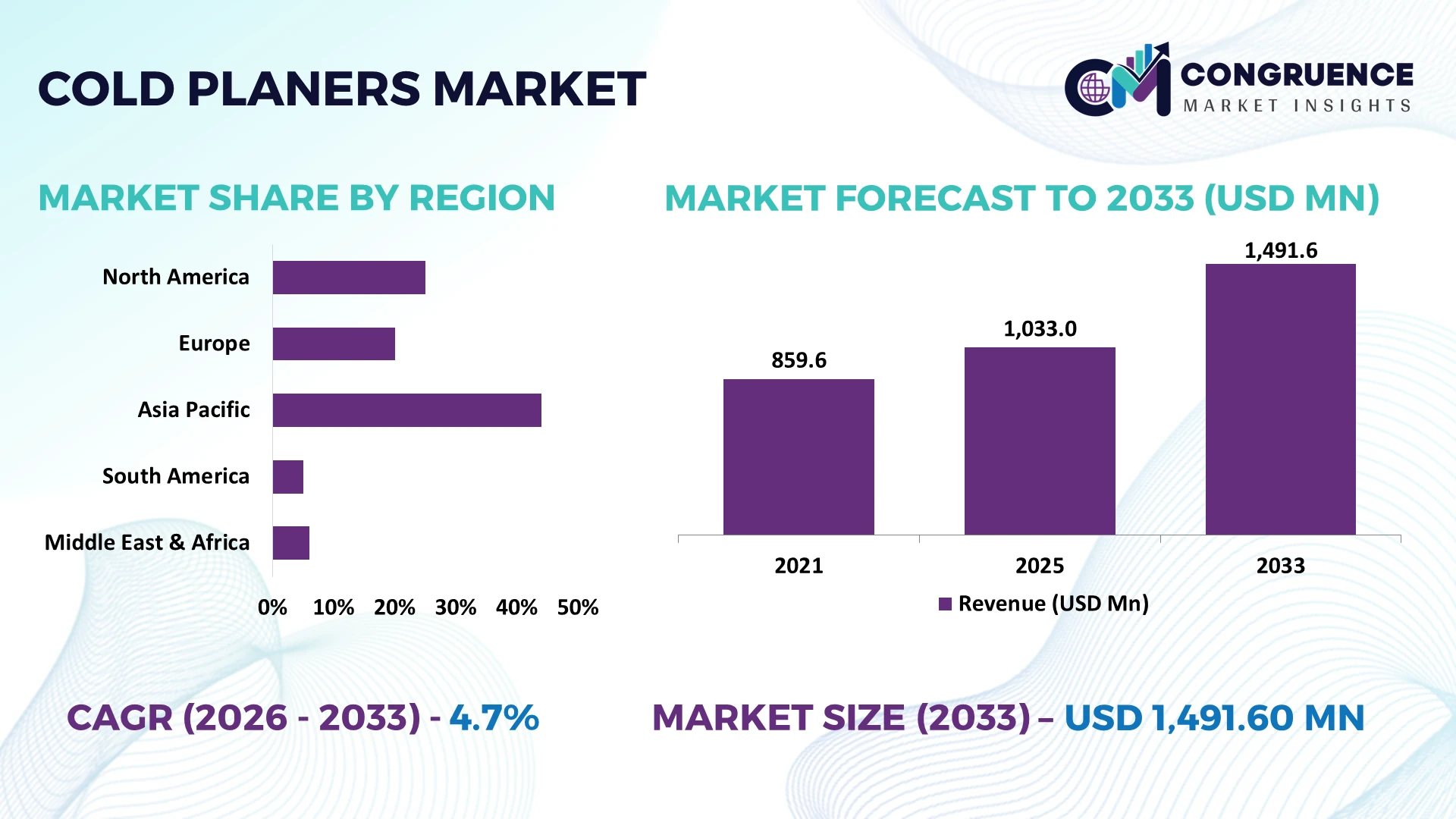
The Global Cold Planers Market was valued at USD 1033 Million in 2025 and is anticipated to reach a value of USD 1491.6 Million by 2033 expanding at a CAGR of 4.7% between 2026 and 2033. Growth is driven by asphalt pavement rehabilitation, infrastructure modernization, precision milling technology, and increased adoption of automated road resurfacing equipment.
The United States remains a leading national market for cold planers, supported by the USD 1.2 trillion Infrastructure Investment and Jobs Act and approximately USD 350 billion in federal highway program funding authorized over five fiscal years. Highway reconstruction, interstate rehabilitation, and airport runway resurfacing sustain equipment utilization. Compared with India, where the Bharatmala program targets approximately 34,800 kilometers of highway development, the United States emphasizes rehabilitation of mature road networks. Advanced milling machines integrating 3D grade control, automated depth adjustment, and telematics support precision pavement removal and improved contractor productivity.
Strategically, equipment manufacturers should prioritize the United States' multiyear highway funding pipeline and India's 34,800-kilometer infrastructure development program while expanding automated milling capabilities and lifecycle service offerings.
Key Highlights of the Global Cold Planers Market
-
Market Size & Growth: USD 1,033 million in 2025, reaching USD 1,491.6 million by 2033 at 4.7% CAGR, supported by highway rehabilitation and automated asphalt milling.
-
Top Growth Drivers: Illustrative demand sensitivities include 15% higher resurfacing activity, 10% increased equipment utilization, and 20% greater recycled asphalt processing.
-
Short-Term Forecast: By 2028, advanced milling fleets target 10% lower operating costs through automated depth control and predictive maintenance, an illustrative performance benchmark.
-
Emerging Technologies: AI-assisted milling optimization, 3D grade control, and automated drum-speed adjustment improve precision across multiple pavement layers.
-
Regional Leaders: Illustrative 2033 allocations place North America at USD 522 million, Europe at USD 418 million, and Asia-Pacific at USD 373 million, emphasizing automation, recycling, and highway expansion, respectively.
-
Consumer/End-User Trends: Contractors increasingly prioritize machines supporting up to 100% reclaimed asphalt material recovery and reuse in suitable applications.
-
Pilot/Case Example: Wirtgen's 2025 W 210 XF deployment introduced advanced automatic milling controls; its performance advantage requires project-specific measurement.
-
Competitive Landscape: Wirtgen leads technologically, alongside Caterpillar, BOMAG, Dynapac, and XCMG; a verified percentage market share is not established.
-
Regulatory & ESG Impact: US Tier 4 Final emission requirements encourage cleaner engines, while reclaimed asphalt utilization supports material circularity.
-
Investment & Funding: USD 350 billion in US federal highway program authorizations during fiscal years 2022–2026 supports infrastructure rehabilitation opportunities.
-
Innovation & Future Outlook: Next-generation cold planers integrate 3D positioning, automated milling strategies, and digital job documentation to strengthen fleet productivity.
The global Cold Planers Market is increasingly shaped by precision pavement rehabilitation, reclaimed asphalt processing, and digitally controlled construction equipment. Highway contractors are adopting automated leveling systems, intelligent cutting drums, and telematics-enabled fleet management to improve milling consistency and equipment utilization. Modern machines support recovery and potential reuse of up to 100% of milled asphalt material, strengthening circular construction practices. US Tier 4 Final emission standards and infrastructure modernization programs reinforce demand for efficient equipment. These developments position automation, recycling capability, and aftermarket support as critical strategic differentiators for manufacturers and contractors.
What Is the Strategic Relevance and Future Pathways of the Cold Planers Market?
Cold planers are becoming strategically important as highway agencies prioritize pavement preservation, material recovery, and digitally controlled rehabilitation over complete road reconstruction. The United States' Infrastructure Investment and Jobs Act authorized approximately USD 350 billion for federal highway programs across fiscal years 2022–2026, strengthening procurement visibility for milling contractors. Increasing use of reclaimed asphalt pavement also changes equipment selection, favoring machines capable of consistent cutting depth, selective layer removal, and efficient material loading.
Technology differentiation increasingly determines contractor productivity. Automated grade control reduces manual adjustments compared with conventional milling systems, while telematics improves machine utilization monitoring. A modeled 10% reduction in milling rework translates into approximately 11% more productive operating time when rework represents one-tenth of scheduled hours. Germany emphasizes precision rehabilitation and material circularity, whereas India combines highway expansion with pavement strengthening. During 2027–2029, digital machine documentation and automated cutting controls will become increasingly important procurement criteria.
Operationally, contractors deploying Wirtgen milling machines with LEVEL PRO ACTIVE control can coordinate cutting depth and machine functions during highway resurfacing. Manufacturers are expanding digital service capabilities, operator training, and dealer-supported maintenance programs. Competitive advantage increasingly depends on integrating equipment reliability, reclaimed material quality, and measurable project productivity into comprehensive fleet solutions.
Cold Planers Market Dynamics
DRIVER:
Highway Rehabilitation and Pavement Recycling
Highway pavement rehabilitation is the primary structural driver for cold planer adoption, particularly where governments prioritize resurfacing existing transport corridors. The United States authorized approximately USD 350 billion for federal highway programs during fiscal years 2022–2026, supporting sustained equipment procurement. Cold milling enables recovery of up to 100% of removed asphalt material, although actual reuse depends on mixture specifications and processing. For contractors, a modeled 10% improvement in equipment utilization increases productive milling hours without expanding fleet size. Wirtgen, Caterpillar, and BOMAG are responding through automated grade control, high-capacity milling drums, and telematics integration. The strategic advantage lies in increasing pavement rehabilitation throughput while reducing material handling and reconstruction requirements.
RESTRAINT:
Equipment Capital Intensity and Component Dependencies
Cold planer deployment faces substantial capital requirements, specialized maintenance costs, and exposure to imported hydraulic and electronic components. Machines depend on cutting tools, conveyor systems, diesel engines, and precision control electronics, creating multiple procurement vulnerabilities. A hypothetical 15% increase in replacement-part expenditure raises maintenance budgets materially, while 10% additional equipment downtime reduces available operating hours. In India, imported control components and specialized milling assemblies complicate servicing outside established construction equipment hubs. Contractors also face tighter financial conditions when purchasing high-capacity machines for intermittent projects. Manufacturers are responding through localized spare-parts inventories, dealer service agreements, and component standardization. Fleet leasing and equipment rental provide alternatives to outright ownership, improving capital flexibility.
OPPORTUNITY:
Intelligent Milling and Circular Pavement Solutions
Digital milling systems and reclaimed asphalt processing create opportunities for equipment manufacturers to expand beyond conventional machinery sales. In the United States, reclaimed asphalt represented 22.9% of asphalt mixture composition in 2024, compared with 15.6% in 2009. This shift strengthens demand for selective milling, accurate depth control, and consistent material recovery. Manufacturers can target an illustrative 12% reduction in milling rework through integrated 3D guidance and automated cutting adjustments. India's expanding highway network offers additional opportunities for compact milling machines, rental fleets, and localized servicing. Wirtgen, Caterpillar, and Dynapac can strengthen positioning through sensor development, contractor partnerships, and digital fleet platforms. Integrated material tracking also creates opportunities for performance-based equipment services.
CHALLENGE:
Skilled Workforce and Digital Integration Complexity
Advanced cold planers require operators capable of managing automated leveling, machine diagnostics, and digital project specifications. Wirtgen's LEVEL PRO ACTIVE integrates sensor feedback, 3D interfaces, and automated machine functions, increasing the importance of technical training. For a hypothetical contractor operating 20 machines, a 15% operator competency gap affects three fleet assignments, while 8% calibration-related rework reduces productive operating capacity. Germany's digitally coordinated road rehabilitation projects illustrate the importance of accurate survey data and machine control integration. Manufacturers must improve interface standardization, operator certification, and remote diagnostic support. Partnerships with construction training institutes and equipment dealers can strengthen workforce readiness. Long-term competitiveness depends on translating automation capabilities into consistent field performance across different contractors and project conditions.
Cold Planers Market Latest Trends
-
High-Precision Milling Control Integration: Contractors increasingly deploy sensor-based grade control and automated cutting-depth adjustment for complex pavement profiles. Modern systems integrate 2D leveling, 3D positioning, and continuous machine feedback, reducing reliance on manual surveying. An illustrative 10–15% reduction in grade correction time improves operational consistency. Wirtgen and Caterpillar are strengthening integrated control platforms to support tighter project tolerances and faster equipment setup.
-
Connected Fleet Maintenance Gains Momentum: Equipment owners are integrating telematics, diagnostic alerts, and machine utilization dashboards into maintenance workflows. A modeled 8–12% reduction in unplanned downtime improves fleet availability, while 5–10% shorter service intervals for diagnostic response accelerate repair decisions. Caterpillar and BOMAG are expanding connected equipment capabilities, helping contractors schedule maintenance around operating hours rather than fixed inspection cycles.
-
Specialized Milling Attachments Gain Adoption: Urban rehabilitation projects increasingly require narrow cutting widths, interchangeable milling drums, and improved maneuverability around underground utilities. Compact equipment configurations support working widths below 1 meter, while specialized cutting assemblies enable localized surface correction. Contractors targeting 10–15% faster site preparation are adopting application-specific configurations. Manufacturers are refining modular cutting systems to reduce equipment changeovers and transport requirements.
-
Low-Emission Equipment Procurement Expands: European Stage V requirements and urban construction restrictions are influencing engine selection and equipment replacement decisions. Stage V particulate limits reach 0.015 g/kWh for applicable nonroad engine categories, while diesel particulate filters support emissions compliance. Manufacturers are integrating efficient powertrains and engine load management, targeting illustrative 5–8% fuel savings under comparable operating conditions and strengthening eligibility for environmentally restricted infrastructure projects.
Segmentation Analysis
By Type
Medium Cold Planers Lead Commercial Deployment
Medium Cold Planers represent the leading equipment category, with an indicative 38% market share, reflecting their versatility across urban highways, arterial roads, and resurfacing contracts. Their balanced cutting capacity, transportation flexibility, and compatibility with automated leveling systems support high fleet utilization. Large Cold Planers account for an estimated 30%, serving extensive highway reconstruction and continuous milling operations where cutting width and material discharge capacity determine project economics. Manufacturers such as Wirtgen and Caterpillar prioritize advanced cutting drums, automated grade control, and high-output conveyor systems to strengthen these categories.
Compact Cold Planers represent the fastest-expanding category, supported by restricted urban worksites, localized pavement repairs, and smaller municipal contracts. An indicative 18% market allocation reflects their relevance in confined operating environments, while Small Cold Planers account for approximately 14%, addressing targeted surface removal and maintenance applications. Compact equipment reduces transportation complexity and supports flexible deployment between multiple worksites. BOMAG, Dynapac, and Wirtgen are strengthening compact equipment portfolios through maneuverability improvements and simplified operator controls. Investment priorities increasingly favor machines delivering high utilization across diverse contract sizes.
- The National Asphalt Pavement Association reported in March 2026 that American producers reused more than 101 million tons of reclaimed asphalt pavement during 2024, reinforcing demand for milling equipment capable of controlled material recovery across different machine sizes.
By Application
Road Milling and Resurfacing Dominates Demand
Road Milling and Resurfacing represents the largest application, with an indicative 44% market share, supported by recurring pavement renewal across interstate highways, arterial roads, and urban transport networks. Contractors deploy cold planers to remove deteriorated asphalt layers while preserving underlying pavement structures. Pavement Rehabilitation accounts for an estimated 27%, benefiting from selective depth milling and surface preparation techniques that extend road service life. Equipment manufacturers prioritize precise cutting systems and reliable material transfer capabilities to improve productivity across these established applications. Wirtgen and Caterpillar emphasize high-capacity equipment for continuous resurfacing operations.
Airport Runway Maintenance represents approximately 11% of application demand, requiring precise surface profiles, controlled milling depths, and coordinated equipment deployment within restricted operational windows. Bridge and Highway Rehabilitation, estimated at 18%, presents the fastest-growing application opportunity as aging structures require localized pavement removal and accurate surface preparation. Specialized milling configurations improve access around expansion joints and constrained bridge approaches. Manufacturers are developing application-specific cutting assemblies and advanced leveling interfaces. Investment is shifting toward versatile machines capable of handling complex rehabilitation requirements without extensive equipment changes.
- The Federal Aviation Administration's 2025–2029 National Plan of Integrated Airport Systems identifies rehabilitation as 33.3% of airport development needs. This reinforces specialized pavement maintenance demand, particularly where precise surface removal and limited operational closures influence equipment selection.
By End-User
Road Construction Contractors Maintain Procurement Leadership
Road Construction Contractors dominate cold planer purchasing and deployment, representing an indicative 46% market share. Their leadership reflects recurring resurfacing contracts, extensive equipment fleets, and the need to maintain high machine utilization across multiple projects. Highway Authorities account for an estimated 22%, influencing procurement through pavement maintenance specifications, infrastructure funding, and contractor qualification requirements. Contractors increasingly favor machines combining automated grade control, fleet monitoring, and interchangeable cutting configurations. Wirtgen, Caterpillar, and BOMAG strengthen relationships through equipment financing, dealer networks, and maintenance packages tailored to high-utilization fleets.
Municipal Public Works Departments represent approximately 13% of demand, emphasizing compact equipment for street repairs and localized rehabilitation. Airport Authorities account for an estimated 7%, prioritizing precise milling capabilities and dependable project scheduling. Infrastructure Development Companies, representing approximately 12%, offer the fastest-growing procurement opportunity as integrated infrastructure contracts expand equipment requirements. These buyers increasingly evaluate machinery through lifecycle operating costs and project productivity rather than initial purchase prices. Manufacturers are responding with flexible leasing, operator training, and integrated equipment support programs, strengthening long-term customer retention and fleet modernization.
- The National Asphalt Pavement Association's 2025 Annual Report emphasizes highway investment continuity and construction work zone safety as industry priorities. These requirements strengthen contractors' focus on dependable equipment, coordinated fleet deployment, and efficient pavement rehabilitation scheduling.
Region-Wise Market Insights
North America accounted for the largest market share at an estimated 35% in 2025 however, Asia-Pacific is expected to register the fastest growth, expanding at a projected CAGR of 6.2% between 2026 and 2033.

North America Cold Planers Market
Highway Preservation Programs Strengthen Advanced Milling Deployment
North America represents an estimated 35% of global cold planer demand, supported by extensive highway rehabilitation programs, established construction equipment fleets, and recurring pavement maintenance contracts. The United States dominates regional deployment, while Canada contributes through provincial highway renewal and municipal infrastructure rehabilitation. Contractors increasingly prioritize high-capacity milling machines with automated grade control, integrated conveyors, and remote equipment diagnostics. The Infrastructure Investment and Jobs Act authorized approximately USD 350 billion for federal highway programs during fiscal years 2022–2026, supporting multiyear construction equipment planning. Caterpillar and Wirtgen maintain strong competitive positioning through specialized milling technologies and established dealer support networks. Equipment rental companies also influence procurement by supplying machines for seasonal resurfacing contracts. Fleet productivity, replacement-part availability, and operator training remain decisive purchasing considerations, particularly for contractors managing simultaneous interstate rehabilitation projects.
United States Market Outlook: The United States benefits from approximately 4.2 million miles of public roads, creating substantial recurring pavement preservation requirements. State transportation departments increasingly specify precise milling depths and surface preparation standards for asphalt overlays. Domestic dealer networks, established equipment financing, and automated machine control capabilities strengthen contractor purchasing flexibility. California, Texas, and Florida remain important highway maintenance and equipment deployment markets.
Europe Cold Planers Market
Precision Rehabilitation and Emission Compliance Reshape Equipment Selection
Europe accounts for an indicative 27% of global cold planer demand, reflecting established road networks, advanced pavement maintenance practices, and stringent equipment emission requirements. Germany, France, Italy, and the United Kingdom represent important deployment markets for automated milling machinery. European Stage V emission standards influence engine selection, while pavement recycling practices encourage controlled asphalt removal and material segregation. Wirtgen, BOMAG, and Dynapac compete through precision cutting technology, specialized machine configurations, and integrated operator assistance systems. The European Union's revised Trans-European Transport Network framework establishes infrastructure completion milestones for 2030, 2040, and 2050, reinforcing long-term corridor modernization requirements. Contractors increasingly integrate digital survey information with machine control systems to improve surface accuracy and project documentation. High labor costs and restricted urban construction windows favor machines that reduce manual adjustments and accelerate equipment repositioning.
Germany Market Outlook: Germany combines advanced road construction equipment manufacturing with extensive highway rehabilitation requirements. Its Autobahn network extends approximately 13,000 kilometers, supporting continuous pavement maintenance and reconstruction activity. Wirtgen and BOMAG contribute specialized milling expertise, while established engineering capabilities support automated grade control and cutting technology development. Strict environmental requirements encourage efficient powertrains, precise material recovery, and digitally documented construction processes.
Asia-Pacific Cold Planers Market
Highway Expansion and Local Manufacturing Accelerate Equipment Deployment
Asia-Pacific holds an indicative 25% share of global cold planer demand, with China, India, Japan, and Australia contributing distinct infrastructure and equipment requirements. China combines extensive expressway networks with domestic construction machinery manufacturing, supporting both equipment production and local deployment. India is increasing pavement rehabilitation activity alongside national highway expansion, creating demand for medium and large milling machines. Japan emphasizes precision maintenance, while Australia prioritizes reliable equipment for geographically dispersed road projects. China's expressway network exceeded 190,000 kilometers in 2024, establishing a substantial installed infrastructure base requiring periodic resurfacing. XCMG and SANY compete through domestic manufacturing, equipment customization, and dealer expansion. International manufacturers differentiate through advanced leveling systems and service support. Local component sourcing and rental availability increasingly influence procurement decisions, particularly where contractors require rapid equipment deployment across multiple highway packages.
China Market Outlook: China benefits from extensive construction machinery manufacturing capacity and integrated domestic supply chains. XCMG and SANY support equipment localization through hydraulic systems, milling assemblies, and digital control integration. The country's large expressway network generates recurring demand for surface rehabilitation and pavement recycling. Government infrastructure modernization programs and established construction equipment distribution channels strengthen domestic manufacturers' ability to serve contractors across provincial highway networks.
South America Cold Planers Market
Road Concessions Drive Mechanized Pavement Rehabilitation
South America represents an indicative 7% of global cold planer demand, concentrated in Brazil, Chile, Colombia, and Argentina. Highway concession programs, freight corridor maintenance, and urban road rehabilitation underpin equipment deployment. Brazil remains the principal market because of its extensive road network and private infrastructure concession framework. The country has more than 1.7 million kilometers of roads, creating substantial pavement preservation requirements despite uneven surfacing quality. Contractors increasingly deploy medium cold planers for asphalt removal along heavily trafficked logistics corridors. Imported equipment, currency fluctuations, and specialized spare-parts availability influence procurement economics. Wirtgen, Caterpillar, and regional equipment distributors compete through dealer servicing, rental agreements, and machine availability. Infrastructure operators favor equipment capable of maintaining consistent cutting performance under demanding tropical conditions, while limited maintenance budgets encourage refurbishment and extended machine service life.
Brazil Market Outlook: Brazil's highway concession framework supports recurring resurfacing contracts across commercially important freight corridors. São Paulo has a particularly developed toll-road network, creating concentrated demand for mechanized pavement rehabilitation. The country's agricultural export logistics depend on reliable road connectivity, strengthening maintenance requirements. Equipment distributors increasingly emphasize service coverage, replacement cutting tools, and flexible financing to address contractor operating constraints.
Middle East & Africa Cold Planers Market
Transport Corridor Modernization Supports Specialized Milling Demand
The Middle East & Africa accounts for an indicative 6% of global cold planer demand, supported by highway modernization, airport infrastructure upgrades, and urban transportation projects. Saudi Arabia and the United Arab Emirates lead technologically advanced equipment deployment, while South Africa contributes through national road maintenance and rehabilitation programs. Saudi Arabia's Vision 2030 infrastructure transformation encourages modern construction equipment procurement across major transport developments. High ambient temperatures, abrasive pavement conditions, and extended operating schedules increase requirements for durable milling drums and dependable cooling systems. International manufacturers compete through distributor partnerships, operator training, and specialized service arrangements. Contractors increasingly prioritize machines capable of precise asphalt removal without damaging underlying pavement layers. Import dependency and uneven technical servicing capacity remain operational constraints, encouraging investment in local maintenance facilities and regional equipment rental networks.
Saudi Arabia Market Outlook: Saudi Arabia's infrastructure modernization initiatives support specialized road construction equipment demand across Riyadh, Jeddah, and major transport corridors. Vision 2030 projects encourage advanced construction methods and contractor fleet modernization. Extreme summer temperatures influence hydraulic cooling, cutting tool durability, and maintenance scheduling. Equipment suppliers are strengthening distributor partnerships and technical support capabilities to improve machine availability during intensive construction programs.
Market Competition Landscape
The global cold planers market features concentrated competition between Wirtgen, Caterpillar, Astec Industries, XCMG, and BOMAG, with the leading five accounting for an indicative 62% combined share. Wirtgen emphasizes precision milling technology, while Caterpillar competes through integrated equipment systems and extensive dealer coverage. XCMG challenges established manufacturers through competitive pricing and localized production, particularly in China and emerging infrastructure markets. Astec and BOMAG differentiate through specialized milling configurations and equipment reliability. An illustrative 10–15% improvement in operating efficiency strengthens automation-focused suppliers, while 8–12% lower maintenance downtime improves contractor retention. Manufacturers are expanding digital diagnostics, dealer partnerships, and cutting-tool integration to protect aftermarket relationships. Competition increasingly shifts toward connected fleet management and lifecycle operating economics rather than initial equipment pricing. High engineering requirements, specialized components, and established service networks restrict market entry. Winning requires measurable productivity advantages, dependable parts availability, responsive servicing, and competitive ownership costs across demanding applications.
Companies Profiled in the Cold Planers Market Report
-
Wirtgen GmbH
-
Caterpillar Inc.
-
BOMAG GmbH
-
Astec Industries, Inc.
-
Dynapac
-
XCMG Group
-
SANY Group
-
Guangxi LiuGong Machinery Co., Ltd.
-
Shantui Construction Machinery Co., Ltd.
-
SAKAI HEAVY INDUSTRIES, LTD.
-
CMI Roadbuilding Limited
-
Zoomlion Heavy Industry Science & Technology Co., Ltd.
-
Simex S.r.l.
-
Keestrack N.V.
Technology Insights for the Cold Planers Market
Automated grade control, intelligent milling drums, and telematics are transforming cold planer productivity. Wirtgen's LEVEL PRO ACTIVE and Caterpillar's integrated machine controls coordinate cutting depth, engine load, and material discharge. Compared with conventional manually adjusted milling systems, automated configurations target an illustrative 10–15% reduction in grade correction time and 5–8% improvement in productive machine utilization. Two-dimensional leveling remains established, while three-dimensional positioning is gaining deployment on precision highway rehabilitation projects. Contractors benefit from consistent pavement profiles, fewer operator interventions, and improved scheduling reliability across complex resurfacing contracts.
Emerging technologies include predictive maintenance algorithms, connected cutting tools, and automated milling parameter optimization. Telematics platforms monitor engine performance, operating hours, and fault diagnostics, supporting modeled downtime reductions of 8–12%. Sensor-assisted cutting systems target 5–10% lower tool replacement costs through improved wear monitoring. Large contractors gain competitive advantages through centralized fleet visibility, while smaller operators benefit from simplified diagnostic interfaces and dealer-supported maintenance services.
Between 2026 and 2028, integrated digital surveying, machine guidance, and automated project documentation will strengthen equipment differentiation. Manufacturers prioritizing interoperable controls and remote diagnostics can capture replacement demand. Digital workflows also support selective asphalt recovery, improving material traceability and operational accountability across infrastructure projects.
Recent Developments in the Global Cold Planers Market
-
March 2024: Caterpillar upgraded its PM310, PM312, and PM313 cold planers with a 343-horsepower C9.3B engine, improved conveyor sealing, and operator controls. These enhancements strengthen milling performance, simplify maintenance, and improve material containment during road rehabilitation projects. Source: cat.com
-
January 2025: Wirtgen introduced the W 210 XF cold milling machine into commercial operation, featuring three automated milling strategies and interchangeable cutting assemblies. The platform improves operational flexibility, supporting highway resurfacing, airport rehabilitation, and precise pavement removal. Source: wirtgen-group.com
-
February 2025: Blue Diamond Attachments launched eight Extreme Duty Series 2 cold planer models, offering milling widths from 14 to 48 inches. Self-leveling technology improves cutting consistency and expands compact equipment applications across municipal road maintenance operations. Source: bluediamondattachments.com
-
June 2025: Hamilton Civil and Asphalt deployed a BOMAG BM1300/35-2 cold planer through Porter Equipment in New Zealand. The investment supports its fleet modernization strategy, strengthens road rehabilitation capabilities, and reinforces distributor-led equipment servicing relationships locally. Source: porterce.com
Scope of the Cold Planers Market Report
The Cold Planers Market Report evaluates equipment technologies, competitive positioning, deployment patterns, and infrastructure investment priorities across 2026–2033. Type segmentation covers Small, Medium, Large, and Compact Cold Planers, while applications include Road Milling and Resurfacing, Pavement Rehabilitation, Airport Runway Maintenance, and Bridge and Highway Rehabilitation. End-user analysis examines Road Construction Contractors, Highway Authorities, Municipal Public Works Departments, Airport Authorities, and Infrastructure Development Companies, identifying procurement requirements and fleet utilization priorities.
Regional coverage includes North America, Europe, Asia-Pacific, South America, and the Middle East & Africa, with country-level assessments of manufacturing capabilities, infrastructure modernization, and equipment adoption. Technology evaluation addresses automated grade control, 3D milling guidance, telematics, and intelligent cutting systems. Competitive benchmarking examines equipment differentiation, distribution partnerships, aftermarket services, and localized production strategies, supporting investment planning, market entry decisions, and long-term competitive positioning.
Cold Planers Market Report Summary
| Report Attribute/Metric | Report Details |
|---|
Market Revenue in 2025 | USD 1033 Million |
Market Revenue in 2033 | USD 1491.6 Million |
CAGR (2026 - 2033) | 4.7% |
Base Year | 2025 |
Forecast Period | 2026 - 2033 |
Historic Period | 2021 - 2025 |
Segments Covered | By TypeBy ApplicationRoad Milling and Resurfacing Airport Runway Maintenance Bridge and Highway Rehabilitation
By End-UserRoad Construction Contractors Municipal Public Works Departments Infrastructure Development Companies
|
Key Report Deliverable | Revenue Forecast, Growth Trends, Market Dynamics, Segmental Overview, Regional and Country-wise Analysis, Competition Landscape |
Region Covered | North America, Europe, Asia-Pacific, South America, Middle East, Africa |
Key Players Analyzed | Wirtgen GmbH, Caterpillar Inc., BOMAG GmbH, Astec Industries, Inc., Dynapac, XCMG Group, SANY Group, Guangxi LiuGong Machinery Co., Ltd., Shantui Construction Machinery Co., Ltd., SAKAI HEAVY INDUSTRIES, LTD., CMI Roadbuilding Limited, Zoomlion Heavy Industry Science & Technology Co., Ltd., Simex S.r.l., Keestrack N.V. |
Customization & Pricing | Available on Request (10% Customization is Free) |





