
Reports
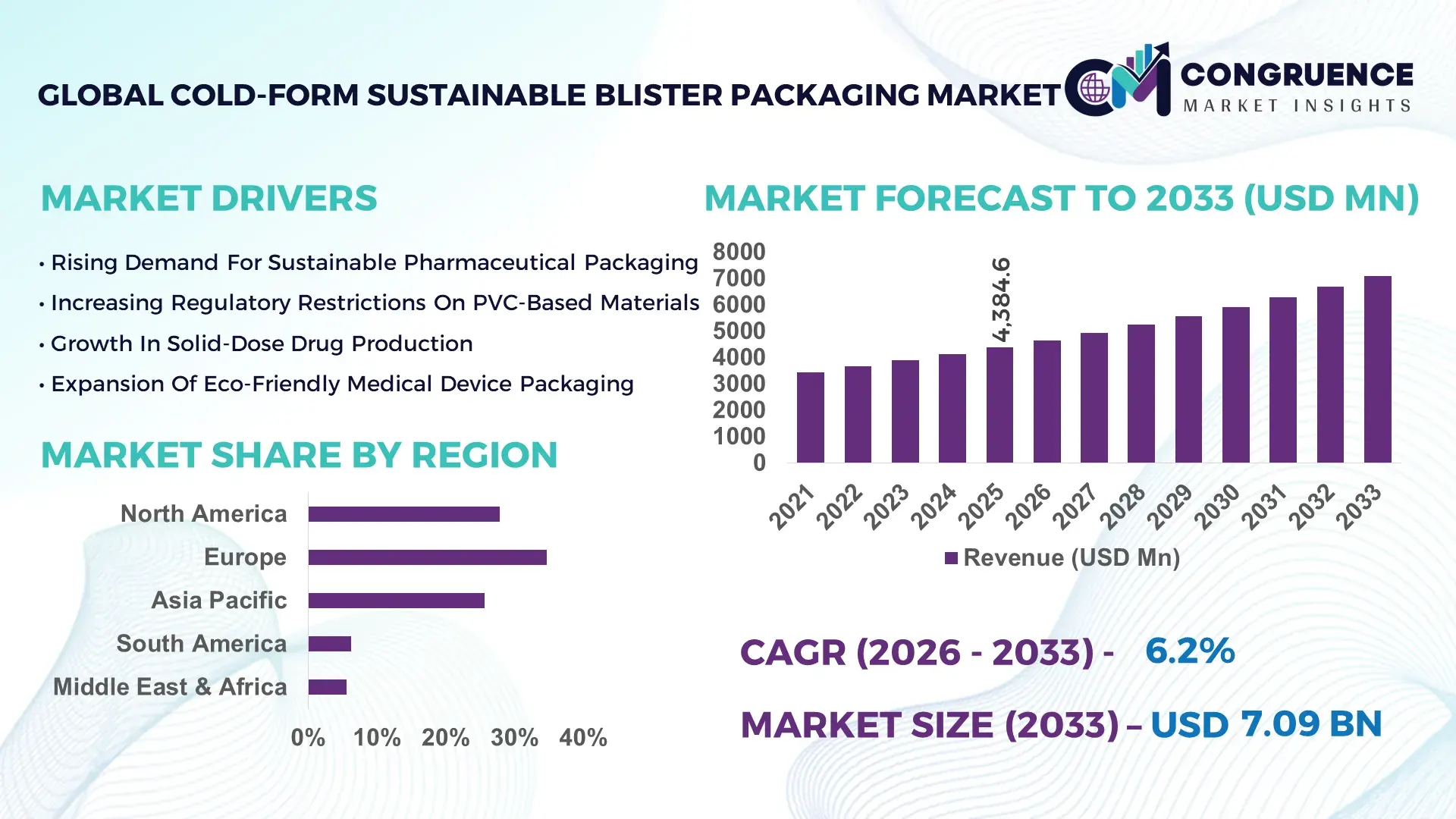
The Global Cold-Form Sustainable Blister Packaging Market was valued at USD 4,384.6 Million in 2025 and is anticipated to reach a value of USD 7,094.6 Million by 2033 expanding at a CAGR of 6.2% between 2026 and 2033, according to an analysis by Congruence Market Insights. Growth is supported by rising demand for eco-friendly pharmaceutical packaging solutions that ensure superior barrier protection and regulatory compliance.
Germany stands out as a dominant manufacturing hub in the Cold-Form Sustainable Blister Packaging market, driven by advanced pharmaceutical production infrastructure and strong sustainability mandates. In 2025, Germany operated over 140 pharmaceutical manufacturing facilities utilizing high-barrier aluminum-based cold-form blister lines. Nearly 48% of pharmaceutical solid-dose exports incorporated recyclable or reduced-material blister formats. Investment exceeding USD 620 million between 2023 and 2025 was directed toward recyclable laminate innovation and solvent-free coating technologies. Automated cold-form forming lines improved material utilization efficiency by 17%, while over 52% of domestic pharma companies adopted low-carbon aluminum foils and PVC-free alternatives, reinforcing technical leadership in sustainable barrier packaging innovation.
Market Size & Growth: Valued at USD 4,384.6 million in 2025, projected to reach USD 7,094.6 million by 2033, driven by sustainable pharma packaging demand.
Top Growth Drivers: Sustainable material adoption 41%, pharmaceutical output growth 36%, regulatory compliance upgrades 29%.
Short-Term Forecast: By 2028, material optimization initiatives are expected to reduce aluminum usage per pack by 14%.
Emerging Technologies: Recyclable mono-material laminates, solvent-free adhesive coatings, digitalized forming-line automation.
Regional Leaders: Europe projected at USD 2.6 billion by 2033 with regulatory-driven demand; North America at USD 1.8 billion via OTC drug packaging; Asia-Pacific at USD 1.9 billion supported by generic drug expansion.
Consumer/End-User Trends: Over 57% of pharmaceutical buyers prioritize recyclable blister substrates in procurement decisions.
Pilot or Case Example: In 2024, a pharmaceutical plant achieved 19% waste reduction through optimized cold-form die-cutting systems.
Competitive Landscape: Amcor leads with approximately 16% share, followed by Constantia Flexibles, Sonoco, Huhtamaki, and UFlex.
Regulatory & ESG Impact: Packaging waste directives and carbon neutrality targets accelerating material innovation.
Investment & Funding Patterns: More than USD 1.2 billion invested globally in sustainable blister laminate R&D between 2023–2025.
Innovation & Future Outlook: Shift toward PVC-free cold-form structures and digital quality inspection technologies.
Pharmaceutical applications represent nearly 72% of Cold-Form Sustainable Blister Packaging demand, followed by nutraceuticals at 18% and medical devices at 10%. Recent advancements in recyclable aluminum laminates and barrier-enhanced bio-based polymers are reshaping compliance strategies. Stricter environmental packaging regulations and rising demand for tamper-evident solutions are accelerating sustainable material transitions across Europe and North America, while Asia-Pacific benefits from expanding generic drug manufacturing capacity.
The Cold-Form Sustainable Blister Packaging Market plays a strategic role in balancing high-barrier pharmaceutical protection with environmental sustainability mandates. Cold-form aluminum laminates provide nearly 100% moisture and oxygen barrier performance, ensuring extended shelf life for temperature-sensitive drugs. Advanced recyclable laminate technology delivers up to 22% material weight reduction compared to conventional multi-layer PVC structures.
Europe dominates in production volume due to strong pharmaceutical manufacturing clusters, while North America leads in sustainable adoption with over 54% of pharmaceutical companies implementing recyclable blister formats. By 2027, AI-driven forming-line automation is expected to improve material yield efficiency by 18%, reducing scrap generation significantly.
Firms are committing to ESG-driven packaging goals, including 30% reduction in virgin plastic use and 25% improvement in aluminum recycling rates by 2030. In 2024, a German pharmaceutical manufacturer achieved 16% carbon emission reduction through solvent-free cold-form coating integration.
Short-term pathways focus on PVC-free structures, mono-material laminates, and digital defect detection systems capable of identifying micro-perforations with 94% accuracy. The Cold-Form Sustainable Blister Packaging Market is positioned as a pillar of resilience, regulatory compliance, and environmentally responsible pharmaceutical packaging innovation.
The Cold-Form Sustainable Blister Packaging market is shaped by pharmaceutical expansion, sustainability mandates, and barrier performance requirements. Increasing regulatory scrutiny on plastic waste has accelerated adoption of recyclable laminates and aluminum-intensive barrier formats. Growing generic drug production, particularly in Asia-Pacific, supports demand for cost-efficient and high-integrity packaging. Technological advancements in precision forming equipment reduce material waste while maintaining high moisture protection levels. Competitive differentiation centers on eco-design certification, lightweight laminate engineering, and automated quality inspection systems, reinforcing sustainable pharmaceutical supply chain optimization.
Global solid-dose pharmaceutical output increased by over 9% in 2025, directly boosting demand for high-barrier cold-form blister packs. Approximately 72% of moisture-sensitive drugs rely on aluminum-based cold-form packaging for extended shelf life. In 2025, more than 58% of newly approved oral drug formulations required enhanced oxygen barrier protection. Automation upgrades improved forming-line speeds by 13%, supporting higher packaging throughput. As regulatory frameworks mandate traceability and tamper resistance, pharmaceutical manufacturers increasingly favor sustainable cold-form blister packaging to ensure product safety and environmental compliance.
Aluminum foil prices increased by approximately 18% between 2023 and 2025, elevating production costs. Sustainable laminate alternatives often require advanced coating technologies, adding 11–15% to manufacturing expenses. Smaller pharmaceutical firms face capital constraints when upgrading forming lines. Limited recycling infrastructure in emerging markets reduces closed-loop aluminum recovery efficiency, constraining widespread sustainable packaging adoption.
Mono-material laminate structures reduce composite waste complexity and improve recyclability rates by up to 24%. In 2025, nearly 37% of pharmaceutical procurement tenders specified PVC-free cold-form structures. Digital embossing technologies enhance anti-counterfeit protection while maintaining sustainable design. Expansion of biodegradable coatings provides new avenues for eco-certified pharmaceutical packaging.
Cold-form packaging modifications require extensive validation testing for barrier integrity and stability compliance. Stability trials can extend up to 24 months, delaying commercialization timelines. Over 46% of manufacturers reported regulatory documentation complexity as a key operational challenge. Meeting evolving sustainability certifications adds additional audit and testing requirements, increasing compliance costs.
Shift Toward PVC-Free Laminate Structures: In 2025, nearly 39% of new blister line installations incorporated PVC-free sustainable laminates, reducing plastic content by up to 28% while maintaining equivalent barrier performance.
Automation in Forming and Sealing Lines: Over 44% of pharmaceutical packaging facilities adopted digital inspection systems capable of detecting micro-defects with 94% precision, reducing rejected blister packs by 21%.
Recyclable Aluminum Foil Integration: Approximately 36% of cold-form blister packs introduced in 2024 utilized high-recycled-content aluminum, cutting carbon intensity per unit by 17%.
Rise in Modular and Prefabricated Construction: The adoption of modular construction is reshaping demand dynamics in the Cold-Form Sustainable Blister Packaging market. Around 55% of new pharmaceutical plant projects reported cost efficiencies through modular forming-line installations, reducing commissioning timelines by 31% and improving operational scalability in Europe and North America.
The Cold-Form Sustainable Blister Packaging market is segmented by material type, application, and end-user, reflecting diversified pharmaceutical and healthcare requirements. Aluminum-based laminates dominate due to superior moisture and oxygen barrier properties. Applications primarily focus on solid-dose pharmaceuticals, nutraceuticals, and specialty medical devices. End-user demand is concentrated among pharmaceutical manufacturers, contract packaging organizations, and medical device producers. Segmentation insights highlight how sustainability standards and regulatory compliance influence procurement strategies.
Aluminum-aluminum cold-form laminates account for approximately 58% of adoption due to near-total barrier protection and extended drug stability. Aluminum-polymer sustainable laminates represent 27%, offering lighter weight and improved recyclability. Biodegradable-coated laminates and PVC-free structures collectively contribute 15%, serving eco-certified pharmaceutical segments.
Aluminum-polymer laminates are the fastest-growing segment, expanding at a CAGR of 7.1% driven by reduced material weight and lower environmental impact. Improved adhesive bonding technologies enhance laminate durability by 19%.
In 2025, a national pharmaceutical regulatory review indicated that over 1.3 billion oral solid-dose units were packaged using aluminum-based cold-form sustainable blister formats for enhanced stability compliance.
Pharmaceutical packaging leads with a 72% share, supported by prescription and OTC drug expansion. Nutraceutical applications represent 18%, driven by consumer health supplement growth. Medical device packaging accounts for 10%, requiring sterile and moisture-resistant protection.
Nutraceutical packaging is the fastest-growing segment, projected at a CAGR of 6.8%, fueled by global wellness product consumption. In 2025, 42% of supplement brands reported transitioning to recyclable blister formats. Additionally, 63% of pharmaceutical buyers emphasized tamper-evident packaging as a procurement priority.
In 2025, regulatory audits across 150 pharmaceutical plants confirmed adoption of high-barrier cold-form blister packaging for moisture-sensitive formulations, improving shelf-life stability metrics by 15%.
Pharmaceutical manufacturers account for approximately 64% of Cold-Form Sustainable Blister Packaging demand, followed by contract packaging organizations at 24% and medical device companies at 12%. Contract packaging organizations represent the fastest-growing segment, expanding at a CAGR of 6.9% due to outsourcing trends and flexible production requirements.
In 2025, over 48% of pharmaceutical firms integrated recyclable laminate procurement guidelines into sustainability frameworks. Approximately 37% of contract packagers upgraded forming lines to accommodate PVC-free structures.
In 2025, an international healthcare compliance initiative reported that 22% more SMEs in pharmaceutical manufacturing adopted sustainable blister packaging systems to align with environmental certification requirements.
Europe accounted for the largest market share at 34.7% in 2025 however, Asia-Pacific is expected to register the fastest growth, expanding at a CAGR of 7.4% between 2026 and 2033.
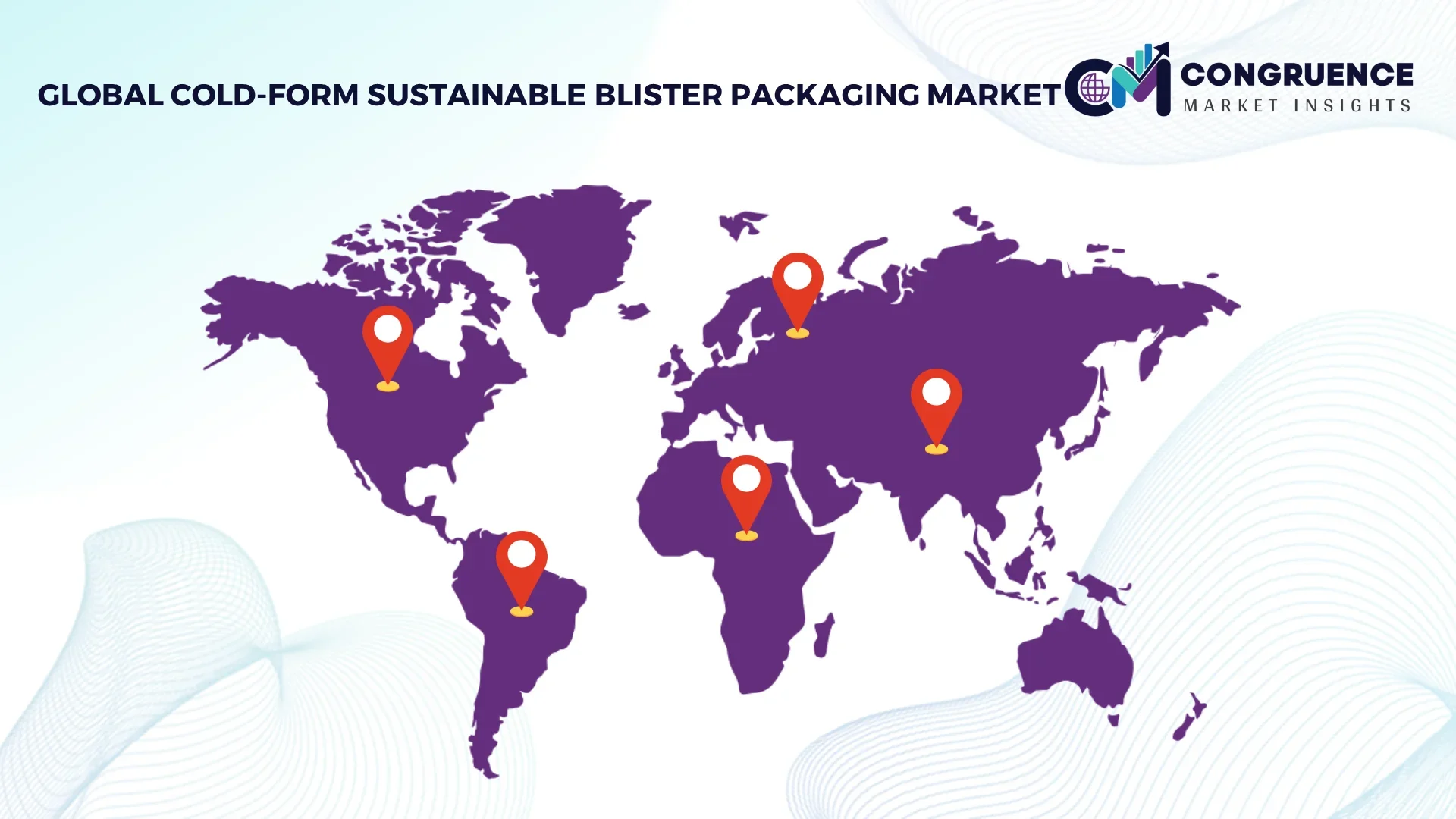
Europe generated over 1.9 million metric tons of pharmaceutical-grade blister laminate output in 2025, supported by more than 3,200 solid-dose drug manufacturing facilities across Germany, France, Italy, and the UK. North America represented 27.8% of global Cold-Form Sustainable Blister Packaging demand, with over 68 billion oral solid-dose units packaged in aluminum-based cold-form formats during the year. Asia-Pacific accounted for 25.6%, driven by rapid expansion in generic drug production in China and India, where pharmaceutical tablet output exceeded 1.4 trillion units. South America held 6.3%, while Middle East & Africa contributed 5.6%, with localized pharmaceutical manufacturing capacity expanding by 12% year-over-year to reduce import dependency.
How are pharmaceutical compliance standards accelerating high-barrier packaging upgrades?
North America accounted for approximately 27.8% of global Cold-Form Sustainable Blister Packaging consumption in 2025, representing more than 68 billion solid-dose units packaged in aluminum-intensive formats. Demand is led by prescription pharmaceuticals, OTC drugs, and specialty biologics requiring moisture-sensitive protection. Updated pharmaceutical serialization and traceability mandates increased investment in advanced blister forming and inspection lines by 18%. Digital inspection technologies capable of detecting pinhole defects with 93% accuracy were deployed across 44% of packaging plants. A leading regional packaging converter expanded PVC-free cold-form laminate capacity by 15% to meet sustainability procurement guidelines. Consumer behavior reflects higher enterprise adoption in healthcare and nutraceutical sectors, where over 51% of procurement contracts prioritize recyclable or reduced-plastic blister formats.
Why are eco-design regulations reshaping advanced pharmaceutical blister formats?
Europe represented 34.7% of total Cold-Form Sustainable Blister Packaging output in 2025, driven by Germany, France, Italy, and the UK. More than 1.9 million metric tons of high-barrier aluminum laminate were processed across regional packaging hubs. Sustainability directives targeting packaging waste reduction encouraged 46% of pharmaceutical manufacturers to transition toward PVC-free cold-form structures. Automated forming lines equipped with real-time defect detection improved yield rates by 16%. A prominent European converter introduced recyclable aluminum-polymer laminates that reduced plastic content by 22% without compromising barrier integrity. Regional buyers increasingly demand documented lifecycle transparency, with 53% of pharmaceutical tenders incorporating sustainability performance metrics into supplier evaluation.
What fuels high-volume generic drug packaging expansion across emerging manufacturing corridors?
Asia-Pacific accounted for 25.6% of global Cold-Form Sustainable Blister Packaging volume in 2025, supported by large-scale generic drug production in China and India. Tablet and capsule output in the region surpassed 1.4 trillion units, requiring moisture-resistant and tamper-evident blister solutions. Infrastructure investments in automated forming equipment improved line efficiency by 14%. Japan and South Korea advanced precision cold-form die technologies to enhance aluminum utilization by 12%. A regional packaging manufacturer deployed AI-enabled quality inspection across 28 production lines, reducing rejection rates by 19%. Procurement trends show increased demand from export-oriented pharmaceutical companies, where nearly 49% of shipments require high-barrier cold-form blister compliance for international markets.
How is local pharmaceutical manufacturing modernization driving sustainable blister demand?
South America accounted for 6.3% of global Cold-Form Sustainable Blister Packaging demand in 2025, with Brazil contributing nearly 61% of regional consumption. Local pharmaceutical output expanded by 9%, increasing reliance on moisture-protective aluminum-based blister packs. Government-backed incentives reduced import tariffs on recyclable laminate materials by 10%, encouraging technology upgrades. Automated die-cutting installations increased by 13% across Brazilian and Argentine facilities. A regional converter introduced high-barrier recyclable laminates optimized for tropical climate stability, improving shelf-life protection by 18%. Demand patterns reflect language localization and regulatory compliance requirements for multi-country pharmaceutical exports within the region.
Why is domestic drug manufacturing expansion strengthening barrier packaging adoption?
Middle East & Africa represented 5.6% of global Cold-Form Sustainable Blister Packaging usage in 2025. UAE and South Africa emerged as leading pharmaceutical packaging centers, with local solid-dose production capacity increasing by 12% year-over-year. Infrastructure modernization in industrial zones improved packaging line automation rates by 15%. Regulatory reforms promoting local drug manufacturing stimulated demand for high-integrity cold-form laminates. A regional pharmaceutical packaging firm implemented recyclable aluminum foil integration across 11 production facilities, reducing plastic laminate usage by 17%. Buyer preferences show premium hospital and government procurement programs prioritizing certified sustainable blister formats.
Germany Cold-Form Sustainable Blister Packaging Market – 14.9%: Advanced pharmaceutical production infrastructure and strong sustainability mandates supporting high-volume aluminum laminate utilization.
United States Cold-Form Sustainable Blister Packaging Market – 13.6%: Large-scale prescription drug output and stringent packaging compliance standards driving high-barrier sustainable blister demand.
The Cold-Form Sustainable Blister Packaging market is moderately consolidated, with approximately 40 global converters and more than 70 regional laminate producers competing across pharmaceutical and healthcare segments. The top five companies collectively account for nearly 55% of global market presence, reflecting strong manufacturing capabilities and advanced material engineering expertise. Competitive differentiation centers on recyclable laminate innovation, lightweight aluminum engineering, and digitalized forming-line automation. Between 2023 and 2025, over 38% of leading firms invested in PVC-free laminate R&D programs. Strategic initiatives include cross-border mergers, long-term pharmaceutical supply agreements, and capacity expansion projects adding over 250,000 metric tons of sustainable laminate output globally. Automation adoption increased operational efficiency by 14%, while integrated defect detection systems reduced scrap rates by up to 20%, reinforcing quality-driven competitive positioning.
Huhtamaki Oyj
UFlex Limited
Winpak Ltd.
Tekni-Plex
Bilcare Limited
Aluflexpack AG
Essentra plc
WestRock Company
Clondalkin Group
ACG Worldwide
Liveo Research
The Cold-Form Sustainable Blister Packaging market is undergoing rapid technological transformation centered on material optimization, digital inspection, and recyclable laminate engineering. Modern aluminum-based cold-form laminates provide near-zero moisture vapor transmission rates, ensuring extended stability for hygroscopic pharmaceuticals. Advanced roll-to-roll coating technologies have improved laminate bonding strength by 18% while reducing solvent usage by 23%.
Emerging mono-material solutions combine high-barrier aluminum layers with recyclable polymer substrates, improving recyclability rates by up to 24%. Precision die-forming equipment equipped with servo-driven controls enhances forming accuracy, reducing material thinning variability by 15%. Digital optical inspection systems now identify micro-perforations and sealing inconsistencies with up to 94% detection accuracy.
Automation integration across forming and sealing operations increases throughput by 12% while lowering waste generation. Sustainable adhesive technologies eliminate volatile organic compound emissions during lamination. Additionally, data-driven process monitoring allows real-time optimization of forming pressure and sealing temperatures, enhancing blister cavity integrity by 16%. These innovations collectively strengthen compliance, sustainability performance, and operational efficiency for pharmaceutical packaging stakeholders.
• In February 2025, Amcor launched a recyclable high-barrier blister laminate designed to reduce PVC content while maintaining pharmaceutical-grade moisture protection, supporting sustainability commitments across European drug manufacturers. Source: www.amcor.com
• In September 2024, Constantia Flexibles expanded its sustainable pharma packaging capacity with a new production line in Europe, increasing recyclable cold-form laminate output by approximately 15% to meet rising pharmaceutical demand. Source: www.cflex.com
• In May 2024, Sonoco announced advancements in its sustainable flexible packaging portfolio, enhancing high-barrier laminate performance for healthcare applications and improving material efficiency by double-digit percentages. Source: www.sonoco.com
• In March 2025, Huhtamaki introduced upgraded recyclable flexible packaging solutions aimed at reducing plastic intensity in pharmaceutical blister formats while improving lifecycle performance metrics. Source: www.huhtamaki.com
The Cold-Form Sustainable Blister Packaging Market Report provides comprehensive coverage of material innovations, pharmaceutical applications, and regional production patterns. The scope includes aluminum-aluminum laminates, aluminum-polymer sustainable structures, and PVC-free mono-material alternatives. Applications analyzed encompass prescription pharmaceuticals, OTC medications, nutraceuticals, and moisture-sensitive medical devices.
Geographic coverage spans Europe, North America, Asia-Pacific, South America, and Middle East & Africa, with country-level insights into Germany, the United States, China, India, Brazil, and UAE. The report evaluates technological developments in servo-driven forming systems, recyclable laminate engineering, digital optical inspection, and solvent-free adhesive bonding.
Industry focus areas include pharmaceutical compliance requirements, sustainability-driven procurement strategies, carbon footprint reduction targets, and packaging waste directives. Quantitative insights examine unit volumes, laminate tonnage, recycling integration rates, automation penetration, and defect detection efficiency improvements. Emerging niches such as biodegradable coatings and lightweight aluminum structures are assessed. The report supports strategic planning for packaging converters, pharmaceutical manufacturers, contract packagers, and regulatory stakeholders seeking resilient, sustainable blister packaging solutions aligned with evolving environmental and performance standards.
| Report Attribute/Metric | Report Details |
|---|---|
|
Market Revenue in 2025 |
USD 4,384.6 Million |
|
Market Revenue in 2033 |
USD 7,094.6 Million |
|
CAGR (2026 - 2033) |
6.2% |
|
Base Year |
2025 |
|
Forecast Period |
2026 - 2033 |
|
Historic Period |
2021 - 2025 |
|
Segments Covered |
By Material Type
By Application
By End-User
|
|
Key Report Deliverable |
Revenue Forecast, Growth Trends, Market Dynamics, Segmental Overview, Regional and Country-wise Analysis, Competition Landscape |
|
Region Covered |
North America, Europe, Asia-Pacific, South America, Middle East, Africa |
|
Key Players Analyzed |
Amcor plc, Constantia Flexibles, Sonoco Products Company, Huhtamaki Oyj, UFlex Limited, Winpak Ltd., Tekni-Plex, Bilcare Limited, Aluflexpack AG, Essentra plc, WestRock Company, Clondalkin Group, ACG Worldwide, Liveo Research |
|
Customization & Pricing |
Available on Request (10% Customization is Free) |




