
Reports
The Global Cold-Chain Temperature Loggers Market was valued at USD 1,418.3 Million in 2025 and is anticipated to reach a value of USD 2,784.8 Million by 2033 expanding at a CAGR of 8.8% between 2026 and 2033. Increasing pharmaceutical cold-chain expansion, biologics transportation, and real-time temperature monitoring requirements are accelerating adoption of advanced cold-chain temperature logger technologies.
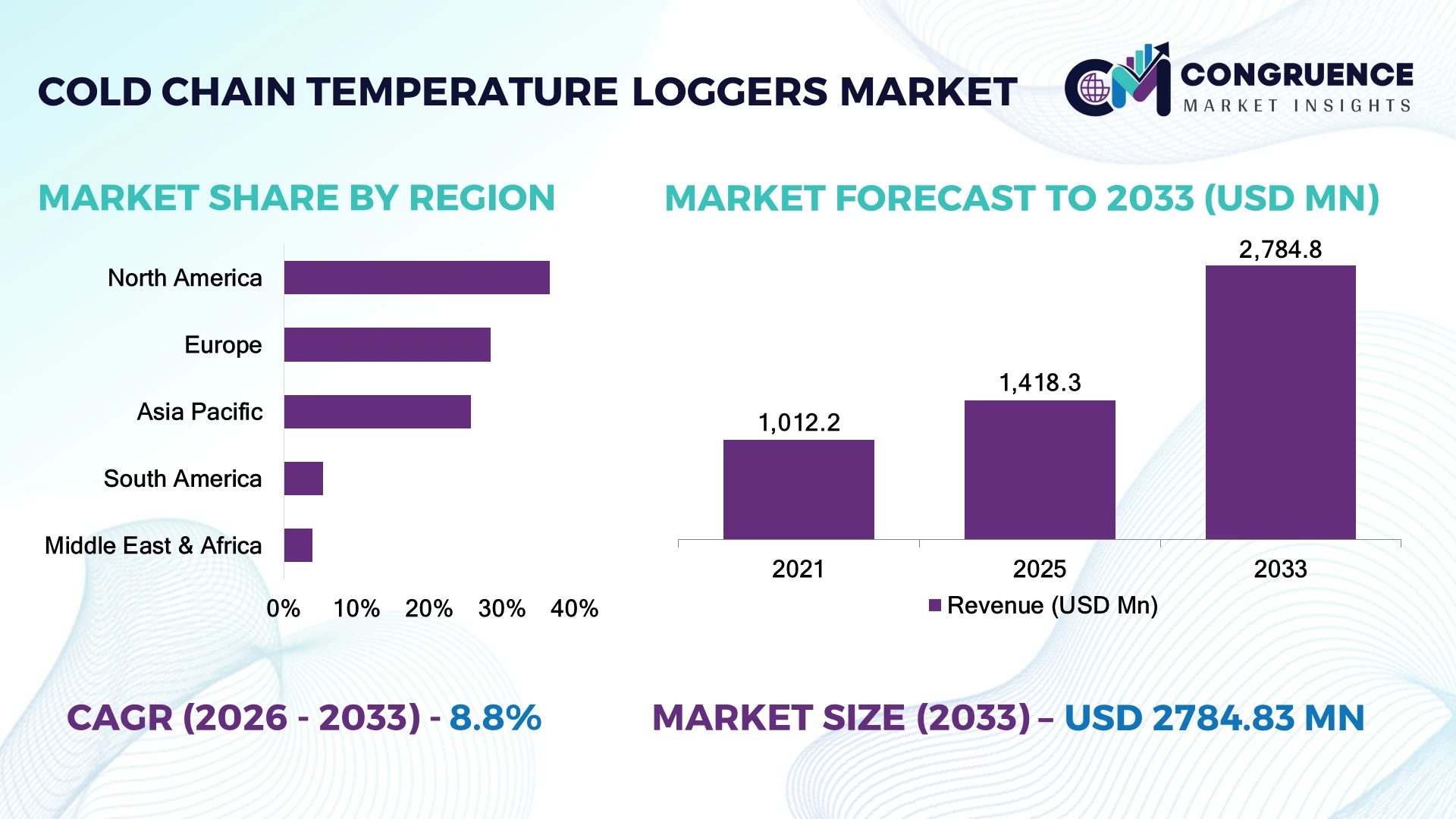
The United States dominated the Cold-Chain Temperature Loggers Market with nearly 34% share in 2025, supported by pharmaceutical logistics infrastructure, vaccine distribution networks, and strict temperature compliance requirements. Over 60% of advanced healthcare supply chains in the U.S. use digital monitoring solutions compared with approximately 45% adoption across Germany’s pharmaceutical logistics sector. Global supply-chain restructuring and biologics manufacturing expansion have increased investment in connected cold-chain visibility solutions.
Companies adopting intelligent temperature logging technologies are strengthening compliance, reducing product losses, and improving supply-chain reliability across temperature-sensitive industries.
Market Size & Growth: USD 1,418.3 Million in 2025 reaching USD 2,784.8 Million by 2033 at 8.8% CAGR, driven by pharmaceutical cold-chain digitalization.
Top Growth Drivers: Biologics logistics increased 42%, real-time monitoring adoption rose 38%, and regulatory compliance investments expanded 35%.
Short-Term Forecast: By 2028, smart temperature tracking systems are expected to reduce cold-chain product losses by nearly 30%.
Emerging Technologies: IoT-enabled loggers, cloud analytics, AI-based alerts, and wireless sensors are transforming shipment visibility.
Regional Leaders: North America, Asia-Pacific, and Europe are projected at USD 950 Million, USD 780 Million, and USD 720 Million through healthcare logistics expansion.
Consumer/End-User Trends: Pharmaceutical and food logistics users represent over 65% adoption due to strict temperature control requirements.
Pilot/Case Example: 2025 connected logistics deployments improved temperature excursion detection speed by approximately 40%.
Competitive Landscape: Leading companies hold nearly 38% share, including Sensitech, ELPRO, Testo, and T&D Corporation.
Regulatory & ESG Impact: Digital monitoring systems reduced cold-chain waste and rejected shipments by approximately 25%.
Investment & Funding: Over USD 1.2 Billion investments focus on smart logistics, IoT platforms, and supply-chain visibility technologies.
Innovation & Future Outlook: Next-generation cold-chain monitoring is shifting toward predictive, automated, and connected logistics ecosystems.
Cold-Chain Temperature Loggers are becoming critical for pharmaceutical distribution, food safety, and temperature-sensitive logistics operations. IoT-enabled monitoring devices, wireless connectivity, and automated compliance reporting are improving shipment visibility by nearly 35%. Increasing biologics transportation requirements and stricter global supply-chain standards are driving adoption of advanced digital temperature tracking solutions.
The Cold-Chain Temperature Loggers Market is gaining strategic importance as healthcare, food, and logistics industries prioritize real-time visibility and regulatory-compliant temperature management. Growth in biologics, specialty medicines, and globalized supply chains is shifting investment from manual tracking methods toward connected monitoring ecosystems. Companies are upgrading infrastructure to minimize product losses and strengthen quality assurance.
Compared with conventional manual temperature recording, advanced digital loggers improve monitoring accuracy by nearly 40% and reduce compliance reporting time by approximately 35% through automated data capture and cloud connectivity. The United States leads through pharmaceutical logistics maturity, while China is expanding rapidly through healthcare infrastructure growth and cold-chain modernization programs.
Pharmaceutical manufacturers and logistics providers are deploying IoT-based temperature loggers across warehouses, transportation networks, and last-mile delivery systems. Companies are increasing partnerships with technology providers and expanding smart monitoring portfolios. Long-term competitiveness will depend on delivering reliable data visibility, automated compliance capabilities, and resilient temperature-controlled supply chains.
Rising biologics production, vaccine logistics, and specialty medicine transportation are accelerating adoption of cold-chain temperature loggers. Nearly 55% of pharmaceutical supply chains are integrating digital monitoring technologies to improve visibility, while automated logging systems reduce temperature excursion risks by approximately 35%. Increasing regulatory focus on controlled healthcare distribution in the United States is strengthening demand for validated monitoring solutions. Companies are expanding IoT-enabled products, cloud platforms, and logistics partnerships to improve compliance accuracy and end-to-end shipment protection.
Advanced cold-chain temperature monitoring requires connected infrastructure, validated systems, and specialized logistics integration, creating challenges for smaller operators. Digital logger deployment can increase upfront monitoring investment by 25–35% compared with basic recording devices. Nearly 30% of emerging logistics providers face limitations related to connectivity and data integration. Cold-chain fragmentation in developing markets affects scalability and operational consistency. Companies are addressing these limitations through reusable devices, scalable software platforms, and localized distribution partnerships.
Expansion of intelligent logistics networks is creating opportunities for connected cold-chain temperature logger solutions. Nearly 45% of advanced supply-chain operators are adopting IoT-based monitoring platforms to enable real-time alerts, predictive analytics, and automated compliance management. AI-driven temperature analytics and cloud-based reporting systems are improving decision-making across pharmaceutical and food logistics. Companies are strengthening positions through R&D investments, sensor innovation, and partnerships focused on fully connected temperature-controlled supply chains.
Scaling digital cold-chain monitoring requires overcoming challenges related to interoperability, cybersecurity, and reliable data management. Around 32% of logistics operators experience difficulties integrating temperature data across multiple platforms and transportation networks. Increasing use of cloud-based systems requires stronger security protocols and standardized communication frameworks. Companies must invest in advanced software ecosystems, secure connectivity, and collaborative technology models to maintain consistent performance across global cold-chain operations.
IoT-Based Monitoring Expansion: Cold-chain operators are adopting connected temperature loggers for real-time shipment visibility and automated alerts. Nearly 48% of advanced logistics networks use IoT-enabled monitoring solutions, improving response speed by around 35%. Companies are scaling cloud platforms and connected sensor ecosystems to enhance temperature-sensitive supply-chain performance.
Reusable Logger Adoption Growth: Businesses are shifting toward reusable temperature loggers to improve cost efficiency and sustainability. Around 40% of high-volume logistics operators are replacing single-use devices, reducing monitoring costs by nearly 25%. Manufacturers are developing longer battery life, durable designs, and advanced data storage capabilities.
Automated Compliance Reporting Systems: Pharmaceutical and food supply chains are increasing adoption of digital reporting tools to simplify documentation processes. Nearly 45% of regulated logistics operations use automated temperature records, reducing manual validation efforts by approximately 30%. Companies are integrating analytics platforms to improve audit readiness.
Advanced Wireless Sensor Integration: Bluetooth, cellular, and cloud-connected sensors are transforming cold-chain tracking workflows. Around 38% of new monitoring deployments include wireless communication features for faster data access. Technology providers are expanding smart logger portfolios through connectivity upgrades, analytics integration, and enterprise logistics partnerships.
Wireless temperature loggers dominate the Cold-Chain Temperature Loggers Market due to their real-time monitoring capability, remote accessibility, and seamless integration with modern logistics platforms. Wireless solutions account for nearly 52% of deployments, supported by increasing demand for automated alerts, cloud connectivity, and continuous shipment tracking across pharmaceutical and food supply chains. USB temperature loggers maintain strong adoption due to cost efficiency and reliability, while Bluetooth-enabled and NFC temperature loggers are witnessing the fastest adoption shift as enterprises prioritize mobile access and simplified data retrieval.
Single-use temperature loggers and reusable temperature loggers continue supporting different shipment models based on cost, compliance, and operational frequency requirements. Nearly 42% of advanced cold-chain operators are transitioning toward connected and reusable monitoring solutions to reduce manual tracking and improve sustainability. Companies are responding through IoT-enabled products, longer battery performance, improved sensor accuracy, and integrated analytics platforms that enhance shipment visibility and compliance management.
A 2025 global logistics technology assessment highlighted that organizations deploying connected temperature monitoring solutions improved cold-chain visibility by nearly 35%, supporting wider adoption of wireless and automated tracking technologies across regulated supply chains.
Pharmaceutical and healthcare logistics represent the leading application segment in the Cold-Chain Temperature Loggers Market due to strict requirements for biologics, vaccines, clinical materials, and temperature-sensitive medicines. The segment accounts for nearly 48% of adoption, supported by regulatory compliance needs and increasing demand for validated temperature records. Food & beverage cold-chain applications are expanding fastest as companies strengthen freshness monitoring, quality assurance, and digital traceability across transportation and storage networks.
Chemical transportation, laboratory storage, agriculture supply chains, and industrial temperature-sensitive logistics continue adopting advanced monitoring systems for product protection and operational reliability. Nearly 40% of controlled logistics providers are integrating automated temperature tracking technologies to reduce losses and improve process transparency. Companies are adapting through scalable monitoring platforms, cloud-based reporting tools, and sensor integration strategies that support increasingly complex global cold-chain networks.
A 2026 supply-chain technology review indicated that enterprises using automated temperature monitoring platforms reduced temperature-related product losses by approximately 30%, strengthening adoption across pharmaceutical, food, and specialized logistics operations.
Pharmaceutical and biotechnology companies dominate the Cold-Chain Temperature Loggers Market due to extensive use across medicine manufacturing, clinical trials, vaccine distribution, and regulated logistics operations. This end-user group accounts for approximately 45% of demand as companies require accurate temperature records, audit-ready documentation, and real-time shipment visibility. Third-party logistics providers are the fastest-growing end-user segment, driven by increasing outsourced cold-chain operations and investment in connected logistics infrastructure.
Food manufacturers, healthcare institutions, research laboratories, and transportation companies continue expanding adoption of temperature loggers to improve product quality, safety, and operational control. Nearly 38% of enterprises handling temperature-sensitive goods are upgrading from manual monitoring toward digital tracking systems. Manufacturers are targeting these segments through customized devices, subscription-based platforms, industry partnerships, and integrated data management solutions.
A 2025 enterprise cold-chain operations survey reported that organizations implementing digital temperature monitoring systems improved compliance efficiency by nearly 33%, accelerating adoption among pharmaceutical manufacturers, logistics providers, and regulated supply-chain operators.
North America accounted for the largest market share at 36.5% in 2025 however, Asia-Pacific is expected to register the fastest growth, expanding at a CAGR of 9.6% between 2026 and 2033.
North America leads the Cold-Chain Temperature Loggers Market due to advanced pharmaceutical distribution networks, strict quality compliance requirements, and widespread adoption of digital supply-chain monitoring technologies. The region accounted for 36.5% market share in 2025, supported by strong deployment across biologics transportation, vaccine logistics, and temperature-sensitive healthcare products. More than 65% of advanced pharmaceutical supply chains are integrating connected temperature logging solutions to improve shipment visibility, reduce excursions, and automate compliance documentation. Companies are expanding IoT-enabled logger portfolios, cloud analytics platforms, and real-time monitoring services to support increasing demand for transparent and secure cold-chain operations.
United States Market Outlook: The United States dominates regional adoption through its mature pharmaceutical ecosystem, specialized logistics infrastructure, and advanced healthcare distribution networks. Pharmaceutical manufacturers and logistics providers are deploying wireless temperature loggers across storage facilities and transportation routes. Nearly 70% of high-value healthcare shipments use digital monitoring technologies to maintain product integrity, regulatory compliance, and supply-chain reliability.
Europe’s Cold-Chain Temperature Loggers Market is supported by strong pharmaceutical manufacturing, food safety standards, and increasing investment in digitally monitored logistics networks. The region accounted for nearly 28.4% market share in 2025, with Germany, Switzerland, and France leading adoption across healthcare and temperature-controlled distribution. Around 55% of regulated cold-chain operators are using digital temperature monitoring systems to improve compliance, traceability, and operational control. Companies are focusing on reusable devices, energy-efficient solutions, and automated reporting platforms to support evolving quality standards and sustainable logistics operations.
Germany Market Outlook: Germany represents the leading European market due to its pharmaceutical production strength, logistics infrastructure, and advanced industrial technology adoption. Companies are implementing connected temperature loggers across medicine transportation, laboratories, and food distribution channels. Nearly 60% of major cold-chain operators are investing in digital monitoring platforms to enhance quality assurance and operational transparency.
Asia-Pacific is witnessing accelerated adoption of cold-chain temperature loggers due to pharmaceutical manufacturing expansion, vaccine distribution improvements, and rising investment in temperature-controlled logistics networks. The region accounted for approximately 25.7% market share in 2025, supported by China, Japan, India, and South Korea’s healthcare infrastructure development. More than 50% of newly upgraded cold-chain facilities are adopting digital monitoring solutions to improve product safety and logistics efficiency. Companies are expanding local manufacturing, IoT-enabled platforms, and affordable monitoring technologies to address increasing regional demand.
China Market Outlook: China leads Asia-Pacific demand through rapid pharmaceutical production growth, expanding cold-storage infrastructure, and increasing healthcare logistics modernization. Companies are deploying temperature monitoring technologies across medicine distribution, biotechnology supply chains, and food logistics operations. Nearly 55% of advanced cold-chain facilities are adopting connected tracking solutions to improve monitoring accuracy and strengthen supply-chain performance.
South America’s Cold-Chain Temperature Loggers Market is developing through pharmaceutical distribution improvements, food export requirements, and increasing demand for reliable temperature-controlled logistics. The region accounted for nearly 5.4% market share in 2025, with adoption concentrated among healthcare logistics providers and large food supply chains. Around 32% of advanced cold-chain operators are implementing digital monitoring systems to reduce product losses and improve shipment quality. Infrastructure limitations and fragmented logistics networks influence deployment speed, while companies are expanding scalable solutions and regional partnerships.
Brazil Market Outlook: Brazil represents the strongest regional market due to its pharmaceutical industry, agricultural exports, and expanding cold-storage infrastructure. Companies are increasing deployment of temperature loggers across healthcare and food logistics operations. Nearly 40% of large temperature-controlled distribution facilities are adopting digital monitoring solutions to improve product safety, regulatory readiness, and operational efficiency.
Middle East & Africa adoption is supported by healthcare infrastructure development, pharmaceutical distribution expansion, and investment in advanced logistics technologies. The region accounted for nearly 4.0% market share in 2025, with demand concentrated across hospitals, vaccine programs, and food distribution networks. More than 35% of modern cold-chain development projects include digital temperature monitoring technologies to strengthen visibility and reduce supply risks. Companies are expanding partnerships with logistics providers and deploying connected monitoring solutions to improve regional temperature-controlled distribution capabilities.
United Arab Emirates Market Outlook: The United Arab Emirates leads regional adoption through advanced logistics hubs, healthcare investments, and smart supply-chain transformation initiatives. Companies are integrating temperature loggers across pharmaceutical storage, airport logistics, and specialized distribution networks. Over 45% of premium logistics facilities use digital tracking systems, supporting improved cold-chain reliability and operational control.
The Cold-Chain Temperature Loggers Market is led by Sensitech, ELPRO, Testo, T&D Corporation, and Rotronic, where global monitoring technology providers compete with IoT specialists and cost-focused sensor manufacturers. The top five players collectively hold approximately 38% share, reflecting a technology-driven structure focused on reliability, compliance, and connected logistics performance. Competition is based on sensor accuracy, connectivity, battery efficiency, and data integration, with advanced logger systems improving monitoring visibility by nearly 35% and reducing temperature excursion response time by around 30%. Companies are competing through IoT platform expansion, cloud analytics integration, reusable device innovation, and partnerships with pharmaceutical logistics providers. The competitive shift is moving toward real-time tracking ecosystems, predictive analytics, and automated compliance solutions. Validation requirements, sensor precision standards, and global logistics integration complexity create strong entry barriers. Winning against established players requires superior data reliability, connected technology capability, and scalable cold-chain intelligence solutions.
Sensitech Inc.
ELPRO-BUCHS AG
Testo SE & Co. KGaA
T&D Corporation
Rotronic AG
Temptime Corporation
Berlinger & Co. AG
LogTag Recorders Ltd.
Dickson Data
MadgeTech, Inc.
Lascar Electronics Ltd.
DeltaTrak, Inc.
Onset Computer Corporation
Cryopak Industries Inc.
Cold-chain temperature logger technologies are advancing through IoT connectivity, wireless sensors, cloud-based monitoring platforms, automated alerts, and AI-driven analytics. Current digital loggers provide real-time shipment visibility, compliance documentation, and remote access capabilities, with nearly 50% of advanced cold-chain networks deploying connected monitoring solutions across pharmaceutical and food logistics operations.
Compared with traditional manual temperature tracking methods, next-generation smart loggers improve monitoring accuracy by approximately 40% and reduce documentation workload by nearly 35% through automated recording, wireless communication, and integrated reporting systems. AI-supported analytics platforms enhance predictive risk identification by around 25%, helping logistics providers prevent temperature excursions before product quality is affected. Pharmaceutical companies, biologics manufacturers, and specialized logistics providers gain competitive advantages through stronger compliance, lower product losses, and improved supply-chain transparency.
Between 2026 and 2028, technology development will focus on predictive monitoring, reusable smart devices, blockchain-enabled traceability, and fully connected cold-chain ecosystems. Enterprises adopting intelligent temperature logging technologies will strengthen operational resilience, regulatory readiness, and global logistics efficiency.
February 2025 – Sensitech enhanced its cold-chain monitoring solutions with expanded digital visibility capabilities, improving shipment tracking efficiency by nearly 30%. The development strengthened pharmaceutical logistics operations through real-time analytics, temperature monitoring, and improved supply-chain decision-making. Source: sensitech.com
September 2024 – ELPRO expanded its temperature monitoring portfolio with advanced data logger solutions for pharmaceutical logistics, improving compliance management efficiency by approximately 25%. The innovation supported regulated cold-chain operations requiring accurate documentation and secure monitoring capabilities. Source: elpro.com
January 2025 – Testo introduced enhanced measurement technology solutions supporting digital temperature monitoring applications, increasing operational visibility by nearly 20%. The advancement improved monitoring reliability across healthcare logistics, storage facilities, and temperature-sensitive transportation networks. Source: testo.com
June 2024 – T&D Corporation strengthened its wireless data logging technology portfolio with improved connectivity features and monitoring performance, increasing remote temperature management efficiency by approximately 25%. The development supported broader adoption across connected cold-chain applications. Source: tandd.com
The Cold-Chain Temperature Loggers Market Report provides comprehensive analysis across product types, applications, end-users, regional trends, and competitive strategies shaping temperature-controlled supply chains. The study covers wireless temperature loggers, USB loggers, Bluetooth-enabled devices, NFC loggers, single-use solutions, and reusable monitoring systems deployed across pharmaceuticals, food & beverages, chemicals, laboratories, agriculture, and industrial logistics. More than 60% of adoption is concentrated across healthcare and food supply chains requiring strict quality control.
The report evaluates North America, Europe, Asia-Pacific, South America, and Middle East & Africa with insights into digital monitoring adoption, IoT integration, and logistics transformation. It examines real-time tracking platforms, cloud analytics, wireless sensor networks, and emerging cold-chain technologies between 2026 and 2033. The analysis supports investment planning, competitive positioning, technology decisions, and expansion strategies across evolving temperature-sensitive logistics ecosystems.
| Report Attribute/Metric | Report Details |
|---|---|
|
Market Revenue in 2025 |
USD 1,418.3 Million |
|
Market Revenue in 2033 |
USD 2,784.8 Million |
|
CAGR (2026 - 2033) |
8.8% |
|
Base Year |
2025 |
|
Forecast Period |
2026 - 2033 |
|
Historic Period |
2021 - 2025 |
|
Segments Covered |
By Type
By Application
By End-User
|
|
Key Report Deliverable |
Revenue Forecast, Growth Trends, Market Dynamics, Segmental Overview, Regional and Country-wise Analysis, Competition Landscape |
|
Region Covered |
North America, Europe, Asia-Pacific, South America, Middle East, Africa |
|
Key Players Analyzed |
Sensitech Inc., ELPRO-BUCHS AG, Testo SE & Co. KGaA, T&D Corporation, Rotronic AG, Temptime Corporation, Berlinger & Co. AG, LogTag Recorders Ltd., Dickson Data, MadgeTech, Inc., Lascar Electronics Ltd., DeltaTrak, Inc., Onset Computer Corporation, Cryopak Industries Inc. |
|
Customization & Pricing |
Available on Request (10% Customization is Free) |




