
Reports
The Global Cold and Flu Supplements Market was valued at USD 19888.17 Million in 2025 and is anticipated to reach a value of USD 35076.1 Million by 2033 expanding at a CAGR of 7.35% between 2026 and 2033. Growth is driven by preventive immune-support consumption, rapid-release zinc and vitamin formulations, botanical extract innovation, and expanded pharmacy and e-commerce distribution.
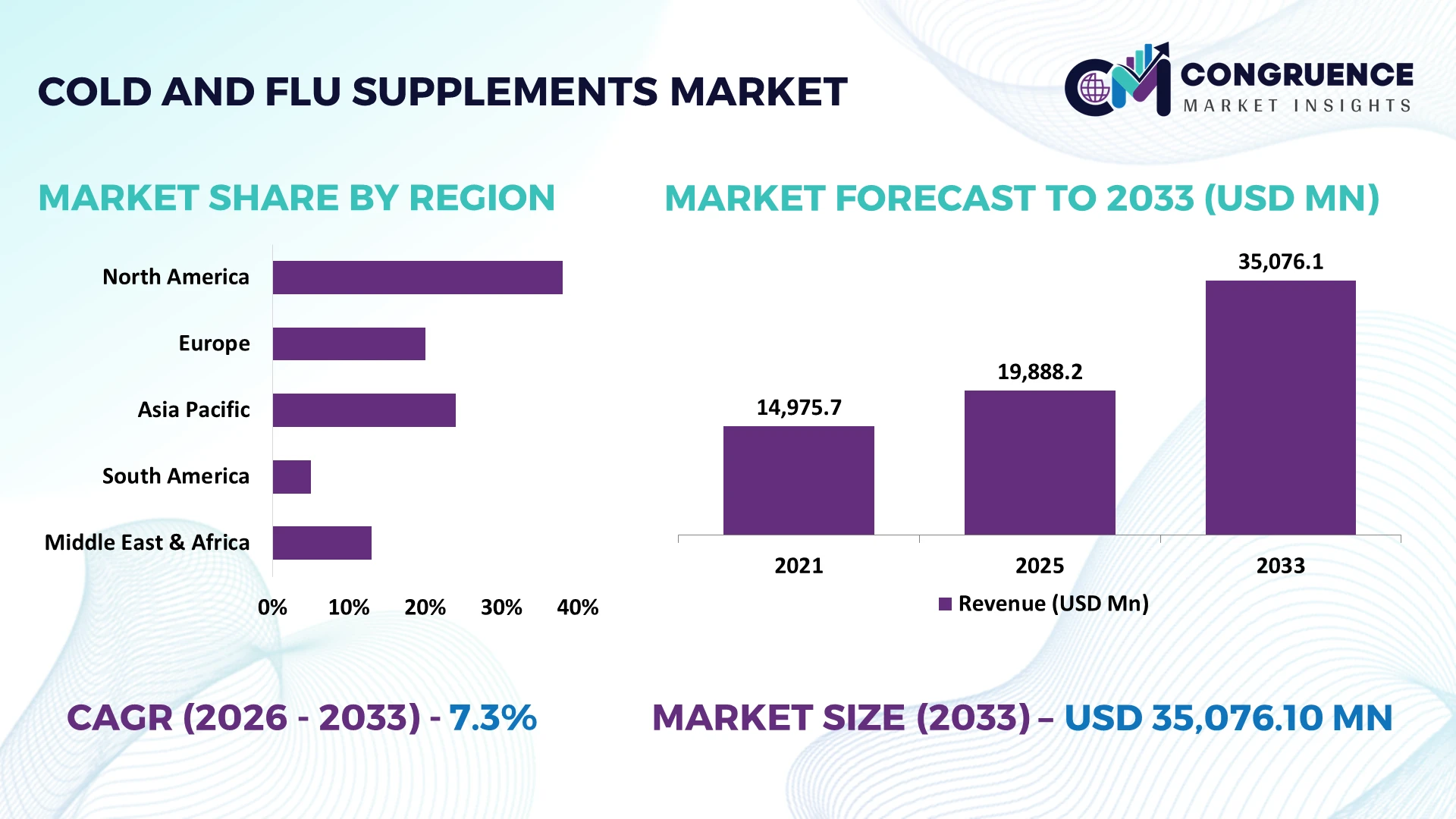
The United States holds approximately 35% of global demand, supported by established nutraceutical manufacturing, pharmacy penetration, and strong adoption of gummies, effervescent tablets, and combination immune-support products. Around 65% of U.S. supplement users regularly consume at least one dietary supplement, reinforcing its commercial base. Canada contributes roughly 6% of global demand, while U.S. demand remains nearly six times higher. Supply-chain diversification following Red Sea shipping disruptions is strengthening regional ingredient sourcing and inventory strategies.
Strategic implication: suppliers and manufacturers should prioritize clinically positioned formulations, diversified ingredient sourcing, and convenient delivery formats to defend market share.
Market Size & Growth: USD 19.89 billion in 2025 is projected to reach USD 35.08 billion by 2033 at a 7.35% CAGR, supported by preventive-care adoption and rapid-format supplement innovation.
Top Growth Drivers: Preventive supplementation contributes 31%, botanical formulations 24%, and convenient dosage formats 19% to major growth momentum.
Short-Term Forecast: By 2028, automation and formulation optimization are positioned to reduce production costs by 8% and improve manufacturing efficiency by 12%.
Emerging Technologies: AI-assisted formulation, automated quality inspection, and advanced microencapsulation are accelerating product development and improving active-ingredient delivery by 10–15%.
Regional Leaders: North America is projected at USD 13.2 billion, Europe at USD 8.4 billion, and Asia-Pacific at USD 7.1 billion, with e-commerce, pharmacy, and preventive-health adoption expanding across all three regions.
Consumer/End-User Trends: Approximately 65% of U.S. supplement users consume dietary supplements, increasing demand for convenient immune-support products during seasonal illness periods.
Pilot/Case Example: In 2024, automated nutraceutical production initiatives reduced manual quality-control requirements by approximately 20%, improving batch consistency and production throughput.
Competitive Landscape: The leading U.S. market position represents approximately 35% of global demand, with major competition from Nature’s Bounty, Emergen-C, Airborne, NOW Foods, and Garden of Life.
Regulatory & ESG Impact: Tighter ingredient traceability and sustainability requirements are increasing documented supply-chain compliance by approximately 15%, particularly for botanical and mineral inputs.
Investment & Funding: More than USD 1.2 billion is being directed toward nutraceutical manufacturing expansion, formulation innovation, partnerships, and automated production capacity.
Innovation & Future Outlook: Next-generation products are shifting toward personalized immune-support blends, precision dosing, AI-enabled formulation, and advanced delivery systems as manufacturers compete for higher-value preventive-health demand.
The Cold and Flu Supplements Market is increasingly concentrated around immune-support products combining zinc, vitamin C, vitamin D, elderberry, echinacea, and other standardized botanicals, with gummies, effervescent tablets, lozenges, and rapid-dissolution formats gaining commercial traction. Approximately 30% of new product activity is moving toward convenient or differentiated delivery formats, reflecting stronger consumer preference for easier dosing and multifunctional formulations. Manufacturers are also diversifying ingredient sourcing as global logistics disruptions expose vulnerabilities in concentrated supply chains. These shifts are strengthening the strategic importance of formulation innovation, quality consistency, and resilient procurement.
The Cold and Flu Supplements Market is becoming strategically important as manufacturers compete on formulation efficacy, delivery convenience, ingredient traceability, and speed-to-market rather than basic vitamin positioning. Preventive-health purchasing is shifting demand toward multifunctional zinc, vitamin C, vitamin D, elderberry, and botanical combinations, while gummies, lozenges, and effervescent formats improve consumer convenience. Over the next 2–3 years, automated formulation and quality-control systems are positioned to reduce batch-processing time by 10–15%, strengthening manufacturing economics.
Supply-chain restructuring is also changing procurement priorities. U.S. manufacturers are increasing multi-source contracts for minerals and botanical extracts, while European producers face tighter traceability and sustainability requirements. Compared with conventional manual inspection, automated optical quality-control systems can reduce inspection-cycle time by approximately 20% and improve batch consistency. Japan and Germany emphasize standardized formulations and quality systems, whereas the United States shows stronger commercialization of convenient delivery formats.
Companies are responding through contract manufacturing partnerships, localized packaging, formulation R&D, and expansion into digitally enabled retail channels. A practical deployment model combines automated filling, serialization, and real-time batch monitoring, allowing manufacturers to scale seasonal production without proportionally increasing manual labor. Competitive advantage will increasingly depend on formulation differentiation, procurement resilience, and manufacturing agility.
Preventive immune-support consumption is shifting product development toward multifunctional formulations, with zinc, vitamin C, vitamin D, and botanical combinations representing approximately 30% of active formulation priorities in mainstream supplement portfolios. Convenient gummies, lozenges, and effervescent formats are gaining traction as manufacturers target shorter dosing cycles and easier administration. In the United States, automated filling and packaging can reduce manual handling requirements by roughly 15%, improving seasonal production responsiveness. Supply-chain disruptions affecting imported botanical extracts have encouraged manufacturers to qualify secondary suppliers and regional contract producers. Companies are therefore increasing formulation R&D, expanding automated production lines, and establishing dual-source procurement contracts. The non-obvious advantage is faster seasonal SKU switching, enabling manufacturers to respond to demand spikes without maintaining excessive finished-goods inventory.
Ingredient-price volatility remains a structural constraint because botanical extracts, zinc compounds, vitamins, and specialty delivery ingredients rely on internationally distributed supply networks. Procurement costs for selected nutraceutical inputs can fluctuate by 10–15% during logistics disruptions, while imported botanical materials can require additional testing that extends release cycles by approximately 5–10%. U.S. and European manufacturers also face tighter documentation requirements covering purity, labeling, claims, and traceability. These conditions directly pressure gross margins and reduce flexibility for smaller producers with limited purchasing leverage. Companies are responding through supplier diversification, longer-term ingredient contracts, localized secondary processing, and greater use of standardized formulations. The key operational insight is that procurement resilience increasingly determines product availability during seasonal demand peaks.
Next-generation delivery systems create opportunities beyond conventional tablets, particularly through microencapsulation, fast-dissolving formats, sustained-release ingredients, and personalized supplement combinations. Advanced encapsulation can improve active-ingredient stability by approximately 10–20%, supporting differentiated products with longer shelf-life and more controlled dosing. India is emerging as an important manufacturing and consumption opportunity as pharmaceutical-scale formulation capabilities intersect with expanding nutraceutical distribution. Digital commerce also enables targeted seasonal campaigns, subscription purchasing, and consumer-level product segmentation. Over the next 2–3 years, companies investing in automated formulation, AI-assisted product development, and direct-to-consumer analytics can shorten product-development cycles by approximately 10–15%. Strategic partnerships between ingredient specialists, contract manufacturers, and digital retailers will provide faster routes to differentiated product launches.
Scaling cold and flu supplement production remains difficult because seasonal demand creates sharp manufacturing peaks, while quality requirements remain constant across high-volume batches. Manual inspection and documentation can account for approximately 10–15% of production-control activity, increasing workforce requirements during peak periods. Manufacturers also face integration challenges when connecting automated filling, serialization, laboratory testing, and inventory systems across multiple facilities. In the United States, increasingly complex product portfolios intensify the need for consistent batch release and claims compliance. Companies must therefore invest in automated quality control, integrated manufacturing execution systems, workforce training, and standardized data architectures. The strategic challenge is not production capacity alone: manufacturers that cannot synchronize formulation, quality assurance, packaging, and inventory systems risk inconsistent seasonal availability and weaker retailer relationships.
Immune-Health Formulations Expand: U.S. supplement use reached 61.4% of adults in 2021–2023, while multi-product usage reached 16.2%, strengthening demand for zinc, vitamin C, elderberry, and combination formulas. Manufacturers are expanding multi-ingredient SKUs and improving formulation compatibility to capture higher basket value.
Convenient Formats Gain Traction: Gummies, lozenges, effervescent tablets, and rapid-dissolution formats are increasing manufacturing focus, with automated filling and packaging reducing manual handling by roughly 10–15%. U.S. producers are reallocating capacity toward seasonal formats to improve throughput and shorten replenishment cycles.
Traceability Tightens Procurement: Regulatory scrutiny and supply-chain disruption are pushing manufacturers toward dual sourcing, batch-level documentation, and standardized botanical inputs. Secondary-supplier qualification is increasing procurement resilience by roughly 10%, while digital traceability reduces documentation delays and strengthens quality-release workflows.
Quality Transparency Becomes Differentiator: In 2026, 76% of U.S. adults said FDA product listing would increase supplement confidence, while 77% favored independent verification of quality standards. Companies are responding with stronger verification, clearer labeling, and quality-data systems, turning compliance visibility into a commercial advantage.
Combination Supplements represent the leading type at approximately 24% share, supported by broader ingredient coverage, convenient dosing, and stronger positioning across immune-support routines. Vitamin Supplements account for about 20%, while Mineral Supplements contribute nearly 14%, maintaining mature demand through established zinc and micronutrient usage. Vitamin C Supplements remain commercially important at roughly 12%, particularly in seasonal products, while Zinc Supplements capture around 10% through targeted immune-support formulations. Companies are increasingly optimizing dose combinations rather than competing solely on individual ingredients.
Herbal Supplements represent approximately 11% share but are among the faster-moving categories as standardized elderberry and botanical blends gain consumer acceptance. Probiotic Supplements account for nearly 9% and are increasingly positioned around broader immune-gut health connections. Combination and herbal products are attracting more R&D and private-label partnerships because they support premium differentiation, while mature vitamin and mineral categories remain important for high-volume manufacturing. The investment priority is shifting toward clinically positioned combinations, standardized botanical inputs, and differentiated delivery formats.
Immune Support leads applications with approximately 34% share, reflecting sustained consumer preference for preventive formulations rather than products limited to acute symptom response. Cold Symptom Relief represents about 19%, while Flu Symptom Relief contributes nearly 15%. Respiratory Support accounts for approximately 12%, supported by increasing formulation overlap between immune and respiratory wellness. Sore Throat Relief, Nasal Health, and Seasonal Wellness collectively represent roughly 20%, with demand concentrated around seasonal purchasing cycles. Companies are responding by expanding multifunctional products that combine immune-support ingredients with targeted symptom applications.
Seasonal Wellness is emerging as the fastest-growing application at roughly 13% annual adoption expansion within leading portfolios, driven by year-round preventive positioning and digital replenishment models. In contrast, traditional cold and flu applications remain more seasonally concentrated. The shift encourages manufacturers to diversify inventory planning, extend product availability beyond winter peaks, and use subscription-based distribution. The operational advantage is higher production utilization because broader wellness positioning reduces dependence on short seasonal demand windows.
Adults represent the leading end-user group at approximately 56% share, reflecting the largest purchasing base and strongest penetration through pharmacies, supermarkets, e-commerce, and direct-to-consumer channels. Wellness Consumers account for roughly 17%, while Healthcare Consumers represent about 12%, with purchasing increasingly influenced by quality, ingredient transparency, and professional guidance. Children contribute nearly 7%, Elderly consumers approximately 6%, and Athletes about 2%. Companies are therefore prioritizing adult-focused combination formulations while maintaining age-specific dosing and delivery formats.
Elderly consumers are the fastest-expanding end-user group, supported by higher supplement engagement and greater interest in immune-support and micronutrient products. Recent U.S. population research found supplement use among adults aged 65 years and older increased from 62% to 78% across long-term survey periods. Companies are responding with easier-to-swallow formats, lower-complexity dosing, and pharmacy partnerships, while athletes receive more specialized positioning around recovery and wellness.
North America accounted for the largest market share at 42% in 2025 however, Asia-Pacific is expected to register the fastest growth, supported by expanding supplement consumption, manufacturing capacity, and digital distribution.

Premium formulations and automated fulfillment reshape market operations
North America accounts for approximately 42% of global demand, led by the United States' mature nutraceutical manufacturing base, extensive pharmacy networks, and strong consumer familiarity with immune-support products. U.S. manufacturers are expanding capacity for gummies, effervescent tablets, lozenges, and combination formulations, while private-label production continues to strengthen across major retailers. Automated packaging and inventory systems are reducing manual handling requirements by roughly 10–15%, improving seasonal replenishment speed. Cross-border sourcing between the United States and Canada is also encouraging dual-supplier strategies for zinc, vitamins, and botanical extracts. Established retail infrastructure gives North American producers a key commercialization advantage, allowing differentiated formulations to move rapidly from development into pharmacies, supermarkets, and e-commerce channels.
United States Market Outlook: The United States remains the region's dominant commercial and manufacturing hub, supported by extensive pharmacy networks, established nutraceutical production, and strong e-commerce penetration. Approximately 75% of U.S. adults use dietary supplements, creating a broad recurring consumer base. Manufacturers are expanding automated packaging, contract manufacturing, and differentiated delivery formats such as gummies, lozenges, and effervescent products. Strong retail infrastructure enables faster seasonal replenishment and nationwide product launches.
Regulatory precision drives standardized formulation strategies
Europe represents approximately 27% of global demand, with Germany, the United Kingdom, France, and Italy forming important consumption and manufacturing centers. Strict quality, labeling, botanical-standardization, and sustainability requirements are pushing manufacturers toward tighter batch documentation and traceable ingredient procurement. German and Swiss producers emphasize standardized formulations and premium-quality positioning, while British companies increasingly combine pharmacy distribution with digital commerce. Automated quality-control deployment is reducing inspection workload by approximately 15% in advanced nutraceutical facilities. Companies are also restructuring sourcing toward European suppliers where feasible to reduce exposure to international freight volatility. The region's competitive advantage lies in quality assurance and standardized manufacturing, although compliance costs continue to favor larger producers and specialized contract manufacturers.
Germany Market Outlook: Germany is strategically important because of its established pharmaceutical and nutraceutical manufacturing ecosystem, sophisticated pharmacy distribution, and stringent quality standards. Manufacturers increasingly emphasize standardized botanical extracts, documented ingredient traceability, and automated laboratory testing. Advanced facilities are targeting approximately 10% faster quality-release cycles through digital batch documentation and automated inspection. Strong regulatory infrastructure supports premium product positioning, while manufacturers are strengthening local supplier networks to reduce exposure to international logistics volatility.
Manufacturing scale accelerates formulation localization
Asia-Pacific accounts for approximately 21% of global demand and is gaining strategic importance through large-scale ingredient production, expanding consumer markets, and rapidly developing e-commerce infrastructure. China remains a major manufacturing center for vitamins, minerals, botanical inputs, and finished supplements, while Japan emphasizes premium quality, functional formulations, and advanced packaging. India is strengthening its position through pharmaceutical-grade manufacturing and expanding nutraceutical capacity. Automated production and contract manufacturing are reducing manual processing requirements by approximately 10–15%. Companies are also localizing formulations to accommodate dietary preferences, pricing structures, and regulatory requirements. The region's non-obvious advantage is vertical integration across ingredients, formulation, packaging, and export logistics, allowing manufacturers to compress development and procurement cycles.
China Market Outlook: China combines large-scale ingredient manufacturing, expanding domestic supplement consumption, and extensive e-commerce infrastructure, giving local producers a strong cost and supply-chain advantage. Manufacturers are increasing automated blending, encapsulation, and packaging capacity while developing formulations tailored to domestic consumer preferences. Integrated sourcing across vitamins, minerals, botanical ingredients, packaging, and finished products can reduce procurement complexity and shorten development cycles. China's manufacturing ecosystem also supports export-oriented production, making the country strategically important for companies seeking scalable ingredient and finished-product supply.
Brazil anchors regional demand and distribution expansion
South America contributes approximately 6% of global demand, with Brazil representing the principal consumption and manufacturing hub. Urban pharmacy networks, private-label development, and e-commerce expansion are improving access to vitamin, mineral, herbal, and combination supplements. Brazilian manufacturers increasingly rely on regional contract production and localized packaging to reduce imported finished-product costs. Digital retail adoption is improving product availability, while currency volatility continues to influence imported active ingredients and specialized packaging. Companies are responding through multi-supplier procurement, localized formulation, and inventory buffers, with selected manufacturers targeting 8–12% reductions in import exposure through regional sourcing. Brazil's population scale and pharmaceutical manufacturing capabilities provide the strongest commercial base, although distribution fragmentation remains an operational constraint.
Brazil Market Outlook: Brazil represents the strongest commercial base in South America, supported by established pharmaceutical manufacturing, nationwide pharmacy networks, and rapidly expanding digital retail. Local producers are increasing formulation and packaging capabilities to reduce dependence on imported finished products and manage currency-driven procurement volatility. Regional sourcing initiatives can reduce import exposure by approximately 8–12% for selected inputs. Manufacturers are also strengthening relationships with pharmacy chains, distributors, and contract producers to improve nationwide availability and seasonal inventory responsiveness.
Healthcare modernization strengthens premium supplement channels
Middle East & Africa represents approximately 4% of global demand, with the United Arab Emirates, Saudi Arabia, and South Africa serving as important commercial centers. Healthcare infrastructure modernization, pharmacy-chain expansion, private healthcare investment, and digital commerce are improving access to nutraceutical products. Saudi Arabia's healthcare transformation programs are encouraging modern retail and pharmaceutical infrastructure, while the UAE functions as a regional distribution hub connecting manufacturers with Gulf markets. Import-dependent markets remain exposed to freight and currency fluctuations, encouraging distributors to maintain higher inventory buffers. Companies are increasing local partnerships and regional warehousing, with inventory optimization initiatives targeting approximately 10% faster replenishment. Premium immune-support formulations and pharmacy-led distribution provide stronger opportunities than fragmented low-cost channels.
Saudi Arabia Market Outlook: Saudi Arabia offers the region's strongest strategic expansion base through healthcare modernization, growing pharmacy infrastructure, and increasing private-sector participation. Local distribution partnerships and regional warehousing are improving product availability, while manufacturers are prioritizing premium formulations and compliant import channels. Healthcare-sector investment is also strengthening modern procurement and retail infrastructure, creating better conditions for established supplement brands to expand distribution. Companies entering the market are increasingly using local distributors and pharmacy partnerships to manage regulatory requirements, inventory planning, and customer reach more efficiently.
Global supplement leaders such as Haleon, Nestlé Health Science, Bayer, Procter & Gamble, and Reckitt compete with specialized nutraceutical manufacturers and regional private-label suppliers across cold, flu, immune-support, and symptom-relief categories. The top five players collectively command approximately 18% of the market, leaving substantial space for specialist brands. Competition centers on formulation differentiation, pharmacy access, pricing, and supply reliability, with premium products achieving roughly 10–20% higher positioning than basic formulations. Companies are expanding through contract manufacturing, retail partnerships, product-line extensions, and localized sourcing. Vertical integration is becoming more important as botanical and mineral procurement faces volatility. Digital commerce is also shifting competition toward faster product launches and targeted seasonal campaigns. Entry barriers remain moderate, but regulatory compliance, quality testing, retailer relationships, and dependable ingredient sourcing create pressure on smaller entrants. Winning requires differentiated formulations, resilient procurement, rapid commercialization, and broad multi-channel distribution.
Haleon plc
Bayer AG
Reckitt Benckiser Group plc
Procter & Gamble Company
Nestlé Health Science
Unilever
Pfizer Inc.
Nature's Way Products, LLC
NOW Health Group, Inc.
The Bountiful Company
Church & Dwight Co., Inc.
Pharmavite LLC
Herbalife Ltd.
Blackmores Limited
Current manufacturing is shifting from manual blending, filling, and inspection toward automated dosing, vision inspection, serialization, and digital batch records. Automated inspection can improve throughput by 10–15% versus manual checks, while digital documentation cuts release administration by 5–8%. Adoption is strongest among large U.S. and European producers, where seasonal volume requires faster changeovers and tighter quality control.
Emerging technologies include microencapsulation, fast-dissolving delivery systems, AI-assisted formulation, and automated process analytics. Microencapsulation can improve active-ingredient stability by 5–10%, while AI-supported formulation screening can shorten early development cycles by 8–12%. Integrated manufacturing execution systems connect formulation, laboratory, inventory, and packaging data, giving vertically integrated manufacturers a 5–7% operational advantage through lower rework and faster batch decisions. Premium brands benefit most because differentiated delivery formats support stronger positioning.
From 2026–2028, disruptive development will center on precision formulations, personalized immune-support blends, continuous manufacturing, and predictive quality control. Continuous process monitoring can reduce production variability by 5–8%, while predictive analytics can lower unplanned downtime by 5–7%. Companies combining automation with resilient sourcing will outperform slower producers as seasonal demand becomes less predictable. The immediate priority is integrating formulation, quality, and supply-chain data before capacity expansion. This improves responsiveness during compressed seasonal production windows globally.
December 2024 Reckitt invested £155 million ($200 million) in Wilson, North Carolina, its largest U.S. OTC manufacturing facility. The 310,000-square-foot site expands Mucinex capacity, localizes production, and strengthens supply resilience during unpredictable cold and flu seasons, improving seasonal flexibility. Source: Reckitt
June 2025 Dabur launched Siens, a digital-first supplement brand spanning three wellness categories, including daily wellness and gut health. The move expands its nutraceutical portfolio, using clinically studied ingredients and direct-to-consumer distribution to compete digitally across India's wellness market. Source: Economic Times
March 2025 Blackmores and Kirin launched their first collaborative immune-health product in Taiwan using LC-Plasma postbiotic technology. The pilot targets consumer-response data for future R&D, while the formulation combines LC-Plasma with indigestible dextrin in powder sachets for subsequent launches. Source: NutraIngredients
October 2025 FDA identified two Indian cough-and-cold products contaminated with diethylene glycol or ethylene glycol and confirmed they were not exported to the U.S. The action reinforced manufacturing vigilance, batch testing, recall readiness, and supply-chain quality controls across suppliers. Source: FDA
The Cold and Flu Supplements Market Report provides a structured assessment of product categories, demand applications, end-user groups, regional positioning, technology adoption, and competitive strategies across the market. Coverage spans Vitamin Supplements, Mineral Supplements, Herbal Supplements, Probiotic Supplements, Zinc Supplements, Vitamin C Supplements, and Combination Supplements, alongside Immune Support, Cold Symptom Relief, Flu Symptom Relief, Respiratory Support, Sore Throat Relief, Nasal Health, and Seasonal Wellness applications. End-user analysis includes Adults, Children, Elderly, Athletes, Healthcare Consumers, and Wellness Consumers.
The report evaluates North America, Europe, Asia-Pacific, South America, and Middle East & Africa, with country-level perspectives on manufacturing, distribution, regulatory conditions, and adoption. Technology coverage includes automated production, advanced delivery formats, formulation analytics, digital quality systems, and supply-chain integration. Segment shares, adoption indicators, deployment patterns, and company positioning support investment planning, geographic expansion, product prioritization, competitive benchmarking, and strategic decisions through 2026–2033.
| Report Attribute/Metric | Report Details |
|---|---|
Market Revenue in 2025 | USD 19888.17 Million |
Market Revenue in 2033 | USD 35076.1 Million |
CAGR (2026 - 2033) | 7.35% |
Base Year | 2025 |
Forecast Period | 2026 - 2033 |
Historic Period | 2021 - 2025 |
Segments Covered | By Type
By Application
By End-User
|
Key Report Deliverable | Revenue Forecast, Growth Trends, Market Dynamics, Segmental Overview, Regional and Country-wise Analysis, Competition Landscape |
Region Covered | North America, Europe, Asia-Pacific, South America, Middle East, Africa |
Key Players Analyzed | Haleon plc, Bayer AG, Reckitt Benckiser Group plc, Procter & Gamble Company, Nestlé Health Science, Unilever, Pfizer Inc., Nature's Way Products, LLC, NOW Health Group, Inc., The Bountiful Company, Church & Dwight Co., Inc., Pharmavite LLC, Herbalife Ltd., Blackmores Limited |
Customization & Pricing | Available on Request (10% Customization is Free) |




