
Reports
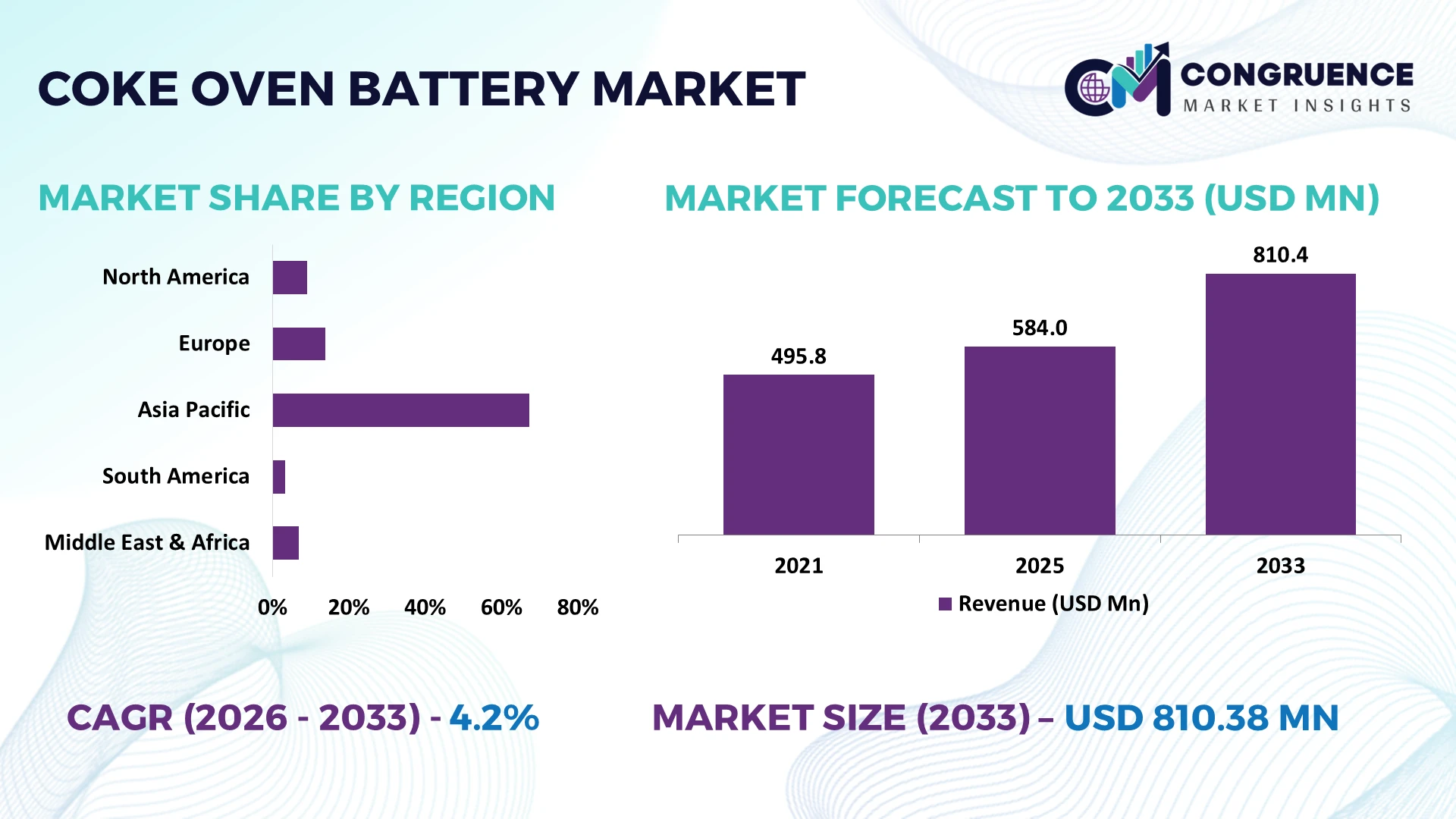
The Global Coke Oven Battery Market was valued at USD 584.0 Million in 2025 and is anticipated to reach a value of USD 810.4 Million by 2033 expanding at a CAGR of 4.18% between 2026 and 2033. Growth is driven by the modernization of aging coke oven batteries, adoption of heat-recovery technologies, stricter emissions controls, and increasing investment in high-efficiency coke production systems supporting integrated steelmaking.
India is an important expansion market, supported by integrated steelmaking investments in Odisha, Karnataka, and Jharkhand. JSW Steel is advancing a 0.75 MTPA coke oven battery at Vijayanagar, while Tata Steel has commissioned Battery 3A at Kalinganagar. China's stricter emissions framework, effective for existing plants from January 2027, is accelerating the replacement of inefficient equipment and investment in cleaner coke production.
Strategically, suppliers should prioritize battery rebuilding, emissions-control integration, and waste-heat recovery solutions to capture modernization contracts and strengthen long-term relationships with integrated steel producers.
Market Size & Growth: The market increases from USD 584.0 million in 2025 to USD 810.4 million by 2033, at 4.18%, supported by battery modernization and emissions-compliant capacity expansion.
Top Growth Drivers: Industrial modernization, stricter environmental compliance, and energy-recovery investments are the three principal demand drivers; China's new standards target 50% lower particulate emissions, 40% lower sulfur dioxide, and 70% lower nitrogen oxides.
Short-Term Forecast: By 2028, demand for automated battery controls, predictive maintenance, and emissions-monitoring systems strengthens as steelmakers prioritize equipment reliability and compliance.
Emerging Technologies: AI-assisted oven-temperature optimization, automated charging and pushing, coke dry quenching, and advanced refractory materials improve process consistency and energy recovery.
Regional Leaders: China leads installed production scale, India represents a major modernization and capacity-expansion market, and Europe emphasizes emissions retrofits and energy efficiency. Verified regional market-value forecasts are not separately established.
Consumer/End-User Trends: Integrated steel producers increasingly prioritize high-availability batteries, automated operations, and waste-heat recovery rather than standalone capacity additions.
Pilot/Case Example: In 2025, JSW Steel advanced its Vijayanagar coke oven expansion, including a 0.75 MTPA battery, alongside dry-quenching and automated equipment initiatives.
Competitive Landscape: Technology competition involves thyssenkrupp Uhde, Paul Wurth, Danieli, Nippon Steel Engineering, and regional engineering contractors. A verified combined top-five market share is not publicly established.
Regulatory & ESG Impact: China's emissions framework targets reductions of 50% in particulate matter, 40% in sulfur dioxide, and 70% in nitrogen oxides, creating a substantial retrofit requirement.
Investment & Funding: Investment is concentrated in integrated steel plant expansion, battery reconstruction, refractory upgrades, environmental equipment, and energy-recovery infrastructure; no reliable consolidated global investment total is available.
Innovation & Future Outlook: Next-generation batteries combine digital process monitoring, coke dry quenching, advanced combustion controls, and lower-emission operation, shifting competition toward lifecycle efficiency and technological integration.
The global coke oven battery industry is also experiencing a shift toward environmentally compliant reconstruction rather than conventional capacity installation. China produced approximately 490 million tonnes of coke in 2023, representing more than 70% of global output, establishing its dominance in production scale. India's expanding integrated steel facilities offer a complementary investment opportunity, particularly for advanced battery engineering, refractory systems, and pollution-control equipment.
Coke oven batteries are becoming strategically important because they determine coke quality, blast furnace reliability, energy utilization, and emissions performance across integrated steelmaking operations. As steel producers modernize aging infrastructure, battery reconstruction and advanced process controls are becoming essential capital-allocation priorities. China's transition toward stricter ultra-low-emission standards is accelerating investment in upgraded combustion systems, pollution-control equipment, and more efficient coke production.
Technology differentiation is increasingly visible in waste-heat utilization. Conventional coke quenching releases substantial thermal energy, whereas coke dry quenching captures heat for steam and electricity generation. JSW Steel's dry-quenching initiatives demonstrate how Indian producers are integrating energy recovery into broader modernization programs. China's large-scale coke production creates substantial retrofit opportunities, while India's investment priorities combine new battery installations with brownfield expansion.
Over the next 2–3 years, suppliers will benefit from demand for automated oven controls, predictive maintenance, refractory improvements, and emissions-monitoring systems. Steelmakers are prioritizing integrated engineering partnerships and phased reconstruction to reduce shutdown exposure. Competitive advantage will increasingly depend on delivering reliable battery performance, measurable energy savings, and regulatory compliance throughout the equipment lifecycle.
Expansion of integrated steelmaking facilities is strengthening demand for coke oven batteries, particularly where blast furnace operations require dependable metallurgical coke supplies. India's capacity-development programs and JSW Steel's 0.75 MTPA Vijayanagar battery illustrate this investment pattern. China, responsible for more than 70% of global coke production, continues to modernize large-scale facilities under stricter environmental requirements. The shift toward larger batteries, automated oven operations, and improved coal-blending systems increases demand for specialized engineering and refractory solutions. Manufacturers are responding through turnkey construction, reconstruction contracts, and integrated process-control offerings. A critical commercial advantage lies in matching battery capacity with blast furnace requirements to avoid underutilized assets and unnecessary operating expenditure.
Coke oven battery projects require substantial capital expenditure for refractory construction, gas-handling systems, pollution controls, and supporting infrastructure. Dependence on imported metallurgical coal also exposes producers to international price fluctuations and supply disruptions. India's steel industry is particularly exposed to coking-coal sourcing requirements, encouraging domestic coal washing and alternative coal-blending strategies. Extended construction schedules and the need to maintain continuous coke supply during battery reconstruction further increase project costs. These conditions constrain investment among smaller steel producers and pressure project profitability. Equipment suppliers are mitigating exposure through modular engineering, long-term procurement agreements, localized sourcing, and phased reconstruction plans. The non-obvious constraint is that lower initial construction costs can translate into higher lifetime expenditure through refractory deterioration and inefficient heat utilization.
Coke dry quenching, automated combustion management, and AI-enabled temperature monitoring create opportunities to improve energy utilization and reduce production losses. An industrial energy assessment identified approximately 6.91% of coke oven energy input as recoverable through flue-gas heat recovery into combustion air. India's expanding steel infrastructure provides opportunities for equipment manufacturers to integrate energy-recovery systems into new and reconstructed batteries. China's environmental modernization requirements further strengthen demand for advanced gas treatment and automated emissions monitoring. Suppliers are positioning through technology partnerships, refractory innovation, and integrated engineering packages. An important opportunity lies in retrofitting existing batteries with energy-recovery equipment rather than waiting for complete battery replacement, allowing steelmakers to improve operational efficiency while extending asset life.
Maintaining consistent emissions performance across aging coke oven installations remains a significant execution challenge. China's 2023 industry assessment found that only 47.7% of coke plants had achieved ultra-low-emission standards, highlighting substantial modernization requirements. Existing batteries require coordinated upgrades across charging, pushing, quenching, combustion, and gas-treatment operations. Integrating digital monitoring with legacy control infrastructure also introduces instrumentation, cybersecurity, and operational continuity requirements. In India, reconstruction projects must coordinate refractory installation, mechanical equipment, and production scheduling without disrupting downstream blast furnace operations. Companies must strengthen engineering capabilities, invest in continuous emissions monitoring, and develop specialized maintenance partnerships. Long-term competitiveness will depend on delivering consistently compliant operations across the entire battery lifecycle rather than achieving isolated equipment-level improvements.
Stricter Emissions Monitoring Reshapes Operations: Environmental compliance is increasingly influencing battery operating practices. The U.S. EPA's 2025 regulatory actions reinforced requirements covering coke oven leaks, benzene fenceline monitoring, and hazardous air pollutants. China's ultra-low-emission transition is also accelerating equipment modifications. Steelmakers are investing in improved door sealing, pressure monitoring, automated leak detection, and continuous emissions reporting to reduce compliance exposure and operational interruptions.
Digital Automation Improves Process Control: Coke oven operators are adopting PLC-controlled hydraulic systems, automated reversing mechanisms, gas analyzers, and computerized temperature monitoring. India's Ministry of Steel documented indigenous coke oven technologies incorporating automated hydraulic controls and continuous multi-component gas analysis in its 2025–26 annual report. These systems improve process consistency, reduce manual intervention, and support more predictable maintenance scheduling.
Dry Quenching Gains Industrial Traction: Energy recovery is becoming a prominent purchasing consideration as steelmakers modernize coke handling. In March 2026, SAIL's IISCO Steel Plant contracted two 130-ton-per-hour coke dry-quenching units for its expansion program targeting 4.8 million tonnes of coke production annually. The installation combines energy recovery, automation, and improved coke handling, strengthening demand for integrated engineering packages.
Coal Blending Supports Supply Resilience: Indian steelmakers are strengthening domestic coal preparation and blending capabilities to reduce dependence on imported coking coal. The Ministry of Steel identified coal washing and stamp-charged batteries as important measures for increasing indigenous coal utilization. This shift improves feedstock flexibility, while encouraging equipment suppliers to develop adaptable charging, crushing, blending, and carbonization systems.
By-product recovery coke oven batteries held the leading position with approximately 62.3% market share in 2025, supported by their ability to extract valuable coal tar, benzene, ammonia, and other chemical derivatives alongside coke oven gas. These recovered materials strengthen plant economics, with by-product monetization estimated to offset 15–25% of battery operating costs. Integrated steel producers favor these systems because they combine coke production with additional chemical feedstock streams. Companies such as ArcelorMittal, POSCO, and JFE Steel continue prioritizing gas-cleaning infrastructure and recovery-process improvements.
Heat recovery batteries accounted for approximately 37.7% but represent the faster-growing technology segment. Their lower infrastructure complexity, internal combustion of coke oven gas, and steam-generation capabilities attract independent coke producers and operators facing stricter emissions requirements. Manufacturers are expanding heat-recovery engineering, waste-heat boilers, and environmental-control configurations. Investment priorities increasingly depend on whether operators prioritize chemical monetization or simplified energy recovery.
Steel production represented the dominant application with approximately 70.0% market share in 2025, reflecting the essential role of metallurgical coke in blast furnace ironmaking. Conventional blast furnaces require approximately 350–450 kg of coke per metric ton of hot metal, creating a direct relationship between steel production volumes and coke oven battery utilization. Integrated producers such as China Baowu, Tata Steel, Nippon Steel, and POSCO prioritize captive coke production to secure consistent feedstock quality and operational continuity. Steel production remains the principal investment destination, while foundry coke production accounts for 18.5% of demand, supported by automotive castings, machinery, and industrial equipment manufacturing.
Non-recovery coke production represents the fastest-growing application, accounting for approximately 11.5% of the market. Its adoption is strengthening as producers prioritize simpler operating configurations and reduced emissions from coke oven gas combustion. Foundry applications also offer diversification beyond conventional blast furnace demand. Equipment manufacturers are responding with specialized battery designs, automated handling systems, and application-specific thermal configurations.
The steel industry dominated the end-user segment with approximately 75.0% market share in 2025, reflecting its dependence on metallurgical coke for blast furnace operations. Integrated steel manufacturers invest in captive coke oven batteries to secure reliable raw material supplies, maintain coke quality, and reduce exposure to merchant coke procurement. China Baowu, ArcelorMittal, Tata Steel, Nippon Steel, and POSCO represent important industrial buyers. Chemical industry users accounted for 18.0%, while other end-users represented 7.0%, including power producers and independent foundry operators.
The chemical industry represents the faster-growing end-user group as demand strengthens for coal tar pitch, benzene, and other recovered chemical intermediates. These materials support carbon products, aluminum smelting, and specialty chemical manufacturing. Unlike steel producers, chemical buyers prioritize by-product purity, feedstock consistency, and long-term supply arrangements. Battery operators are strengthening partnerships with downstream chemical processors, while equipment suppliers are improving gas purification and recovery configurations. This creates an increasingly diversified investment opportunity beyond conventional steelmaking customers.
Asia-Pacific accounted for the largest market share at 67.2% in 2025 however, Asia-Pacific is expected to register the fastest growth, expanding at an estimated CAGR of 5.1% between 2026 and 2033.
North America accounted for approximately 9.0% of the global coke oven battery market in 2025, with demand concentrated in established integrated steelmaking facilities in the United States and Canada. Investment is increasingly directed toward extending existing battery life, improving refractory integrity, upgrading gas-handling equipment, and meeting stringent air-quality requirements. The United States produced approximately 10.0 million tonnes of coke in 2024, while Canada's production reached approximately 1.9 million tonnes, demonstrating the region's comparatively smaller production base. Environmental compliance and competition from electric arc furnace steelmaking are influencing capital allocation. Suppliers are emphasizing specialized rebuilding, emissions-control engineering, and maintenance contracts rather than large-scale greenfield battery construction.
United States Market Outlook: The United States represents the region's principal coke oven battery market, supported by integrated steel facilities and established industrial infrastructure. Its approximately 10 million tonnes of 2024 coke production provides a substantial operating base for battery maintenance, reconstruction, and pollution-control upgrades. Producers are prioritizing reliability improvements, leak monitoring, and equipment modernization to maintain operational continuity under federal environmental requirements.
Europe represented approximately 13.7% of the global coke oven battery market in 2025, supported by established integrated steelmaking operations in Germany, Poland, and Italy. The market is increasingly shaped by industrial decarbonization, aging battery replacement, and tighter emissions requirements. Germany produced approximately 8.5 million tonnes of coke in 2024, while Poland contributed approximately 7.6 million tonnes, establishing important demand centers for refractory upgrades, gas-cleaning systems, and battery reconstruction. European steelmakers are balancing conventional blast furnace maintenance with investments in hydrogen-based direct reduction and electric arc furnace technologies. Equipment suppliers are consequently emphasizing flexible modernization packages, emissions monitoring, and longer equipment lifecycles rather than exclusively pursuing new battery installations.
Germany Market Outlook: Germany maintains a strategically important position through its integrated steel complexes, established engineering ecosystem, and specialized industrial equipment manufacturers. Its 8.5 million tonnes of coke production in 2024 supports demand for advanced oven maintenance, refractory materials, and gas-recovery infrastructure. German steel producers are also aligning modernization decisions with industrial decarbonization programs, creating opportunities for engineering companies offering integrated emissions-management and process-efficiency solutions.
Asia-Pacific dominated the global coke oven battery market with approximately 67.2% share in 2025, driven by China's extensive coke production infrastructure and India's expanding integrated steel capacity. China produced approximately 489.3 million tonnes of coke in 2024, while India produced approximately 55.1 million tonnes, demonstrating the region's exceptional industrial concentration. Japan and South Korea contribute through technologically advanced battery reconstruction, automated charging, and emissions-control installations. Recent investments include JFE Steel's 420,000-tonne-per-year stamp-charging battery at Fukuyama, commissioned in August 2026. Suppliers are prioritizing large-capacity installations, advanced combustion systems, and integrated dry-quenching equipment to serve both new steelmaking facilities and replacement projects.
China Market Outlook: China represents the region's largest individual country market because of its extensive metallurgical coke manufacturing ecosystem, integrated steel complexes, and established coke oven engineering supply chain. Its approximately 489.3 million tonnes of 2024 coke production provides substantial demand for battery maintenance, reconstruction, and environmental equipment. Stricter industrial emissions requirements are encouraging operators to replace outdated installations with advanced gas treatment, automated monitoring, and improved combustion technologies.
South America accounted for approximately 3.2% of the global coke oven battery market in 2025, with Brazil representing the principal demand center. The regional market is supported by integrated steelmaking facilities, metallurgical coke requirements, and selective investment in production modernization. Brazil produced approximately 9.5 million tonnes of coke in 2024, making it the region's most significant established production base. Demand is concentrated around major steelmaking operations, where battery reliability, refractory maintenance, and coke quality influence blast furnace productivity. However, currency volatility, capital constraints, and imported equipment costs affect project implementation. Suppliers are focusing on refurbishment contracts, localized maintenance capabilities, and partnerships with steel producers to reduce project costs and shorten equipment replacement cycles.
Brazil Market Outlook: Brazil holds the strongest strategic position in South America through its integrated steel manufacturing infrastructure and established metallurgical coke production. Its approximately 9.5 million tonnes of coke output in 2024 provides a substantial foundation for battery maintenance and equipment modernization. Steelmakers are prioritizing operating reliability, refractory replacement, and improved gas-handling systems. Domestic engineering partnerships and targeted brownfield investments provide equipment suppliers with opportunities to serve established industrial facilities without relying exclusively on expensive greenfield construction.
Middle East & Africa represented approximately 6.9% of the global coke oven battery market in 2025, with demand concentrated in South Africa, Iran, and selected industrial steelmaking centers. The region has a comparatively smaller coke production base, with South Africa producing approximately 1.8 million tonnes in 2024 and Iran approximately 1.8 million tonnes. Investment opportunities are associated with integrated steel infrastructure, industrial localization, and modernization of existing coke production facilities. Saudi Arabia's industrial diversification and regional steel capacity development provide additional long-term opportunities, although direct coke oven investment remains selective. Equipment suppliers are emphasizing plant rehabilitation, refractory systems, and gas-treatment technologies. Limited specialized engineering infrastructure and financing constraints make local partnerships particularly important for successful project execution.
South Africa Market Outlook: South Africa represents an important established coke oven battery market within the African steel industry, supported by its integrated steelmaking infrastructure and metallurgical processing capabilities. Its approximately 1.8 million tonnes of coke production in 2024 demonstrates an existing industrial requirement for reliable coke manufacturing equipment. Steel producers face opportunities to improve battery availability, modernize refractory structures, and strengthen emissions management. Suppliers offering localized technical support, maintenance partnerships, and cost-effective reconstruction solutions are positioned to address the requirements of existing industrial facilities.
The global coke oven battery market features technology-led competition between thyssenkrupp Uhde, SMS group, GIPROKOKS, Graycor International, and Heavy Engineering Corporation. European engineering specialists compete through advanced battery design and emissions-control systems, while Indian and regional contractors compete on project costs, localization, and execution capabilities. The top-five suppliers' combined market share is not independently disclosed; the market remains fragmented across engineering contractors, technology licensors, and integrated project suppliers. Competition centers on refractory durability, automation, emissions performance, and construction schedules. Advanced pressure-control technology already operates across more than 30 batteries and 2,100 ovens, strengthening technology differentiation. SMS group and MECON compete through turnkey stamp-charging installations, while thyssenkrupp Uhde targets premium low-emission reconstruction contracts. Players strengthen positions through engineering partnerships, proprietary controls, and lifecycle maintenance. The competitive shift favors integrated, compliance-ready solutions over basic equipment supply. High capital requirements, technical expertise, and commissioning complexity restrict entry. Winning requires proven execution, reliable technology, localized service, and measurable lifecycle efficiency.
thyssenkrupp Uhde
SMS group
GIPROKOKS
Graycor International
Koppers Inc.
Larsen & Toubro Limited
MECON Limited
Heavy Engineering Corporation Limited
Nippon Steel Engineering Co., Ltd.
Danieli & C. Officine Meccaniche S.p.A.
Tata Steel Limited
JSW Steel Limited
Coke oven battery technology is shifting from conventional wet-quenching installations toward stamp charging, coke dry quenching (CDQ), intelligent pressure control, and automated heating. CDQ recovers approximately 80% of hot coke’s sensible heat, while wet quenching dissipates most of it. Typical installations generate 0.4–0.5 tonnes of steam per tonne of coke, turning cooling into an energy-recovery process and lowers external energy dependence.
Digital controls are another differentiator. Single-chamber pressure regulation, automated charging and pushing, gas analysis, and temperature optimization improve process consistency and limit fugitive emissions. thyssenkrupp Uhde reports EnviBAT operation in more than 30 batteries and 2,100 ovens, demonstrating commercial deployment when integrated with plant-wide controls. Stamp charging densifies coal blends, helping operators use broader coal mixes while maintaining coke quality. Results depend on feedstock and operating discipline.
During 2026–2028, investment will focus on retrofits combining pressure control, emissions monitoring, refractory upgrades, and heat recovery. Large steelmakers benefit from scale and the ability to use recovered steam across plant utilities; smaller operators face higher integration costs. Suppliers with proven commissioning and interoperable controls gain advantage. Technology selection increasingly balances coke strength, energy recovery, emissions compliance, and lifecycle maintenance rather than initial capacity alone across aging assets in coal-intensive steelmaking regions.
April 2026 thyssenkrupp Uhde secured a POSCO E&C contract to rebuild Pohang Battery 3A with EnviBAT pressure control and upgraded gas treatment. The project advances low-emission modernization and strengthens its Korean engineering partnership. It includes engineering and commissioning support services. Source: thyssenkrupp-uhde.com.
June 2025 SMS group and MECON won SAIL IISCO’s stamp-charging battery contract. The 60-oven, 6.25-meter installation includes automated heating control, positioning the suppliers for a major public-sector modernization and improved coke-making consistency. It also includes two automated charging-pushing machines sets. Source: sms-group.com.
January 2025 Tata Steel announced decommissioning of Jamshedpur Battery 7 after 36 years and more than 12 million tonnes of coke. The retirement marks replacement-cycle demand and transition from legacy stamp-charging assets. The company recognized the battery’s long service contribution. Source: tatasteel.com.
October 2026 SAIL’s rebuilt Bhilai Battery 8 completed its first coke pushing, incorporating zero-leakage doors, improved gas mixing, and pneumatically sealed caps. The restart restores production while targeting lower emissions, energy use, and water consumption. It marks successful rebuilt-battery restart. Source: pib.gov.in.
The report evaluates the global coke oven battery industry across by-product recovery and non-recovery configurations, with coverage of steel production, foundry coke, and other coke-making applications. End-user analysis distinguishes integrated steel producers, chemical manufacturers, and other industrial buyers. Regional assessment covers North America, Europe, Asia-Pacific, South America, and the Middle East & Africa, comparing production concentration, installed infrastructure, modernization priorities, and country-level investment conditions.
Technology coverage includes top-charging and stamp-charging systems, refractory design, coke dry quenching, by-product recovery, pressure control, automation, gas treatment, and emissions monitoring. The analysis examines established suppliers and steelmaker-led projects, including engineering partnerships and brownfield battery reconstruction. It supports investment screening, market-entry decisions, supplier benchmarking, capacity planning, and competitive positioning by identifying where replacement demand, compliance upgrades, and energy-recovery deployments are reshaping purchasing priorities through 2033.
| Report Attribute / Metric | Details |
|---|---|
| Market Revenue (2025) | USD 584.0 Million |
| Market Revenue (2033) | USD 810.4 Million |
| CAGR (2026–2033) | 4.18% |
| Base Year | 2025 |
| Forecast Period | 2026–2033 |
| Historic Period | 2021–2025 |
| Segments Covered |
By Type
By Application
By End-User
|
| Key Report Deliverables | Revenue Forecast; Market Trends; Growth Drivers & Restraints; Technology Insights; Segmentation Analysis; Regional Insights; Competitive Landscape; Regulatory & ESG Overview; Recent Developments |
| Regions Covered | North America; Europe; Asia-Pacific; South America; Middle East & Africa |
| Key Players Analyzed | thyssenkrupp Uhde; SMS group; GIPROKOKS; Graycor International; Koppers Inc.; Larsen & Toubro Limited; MECON Limited; Heavy Engineering Corporation Limited; Nippon Steel Engineering Co., Ltd.; Danieli & C. Officine Meccaniche S.p.A.; Tata Steel Limited; JSW Steel Limited |
| Customization & Pricing | Available on Request (10% Customization Free) |




