
Reports
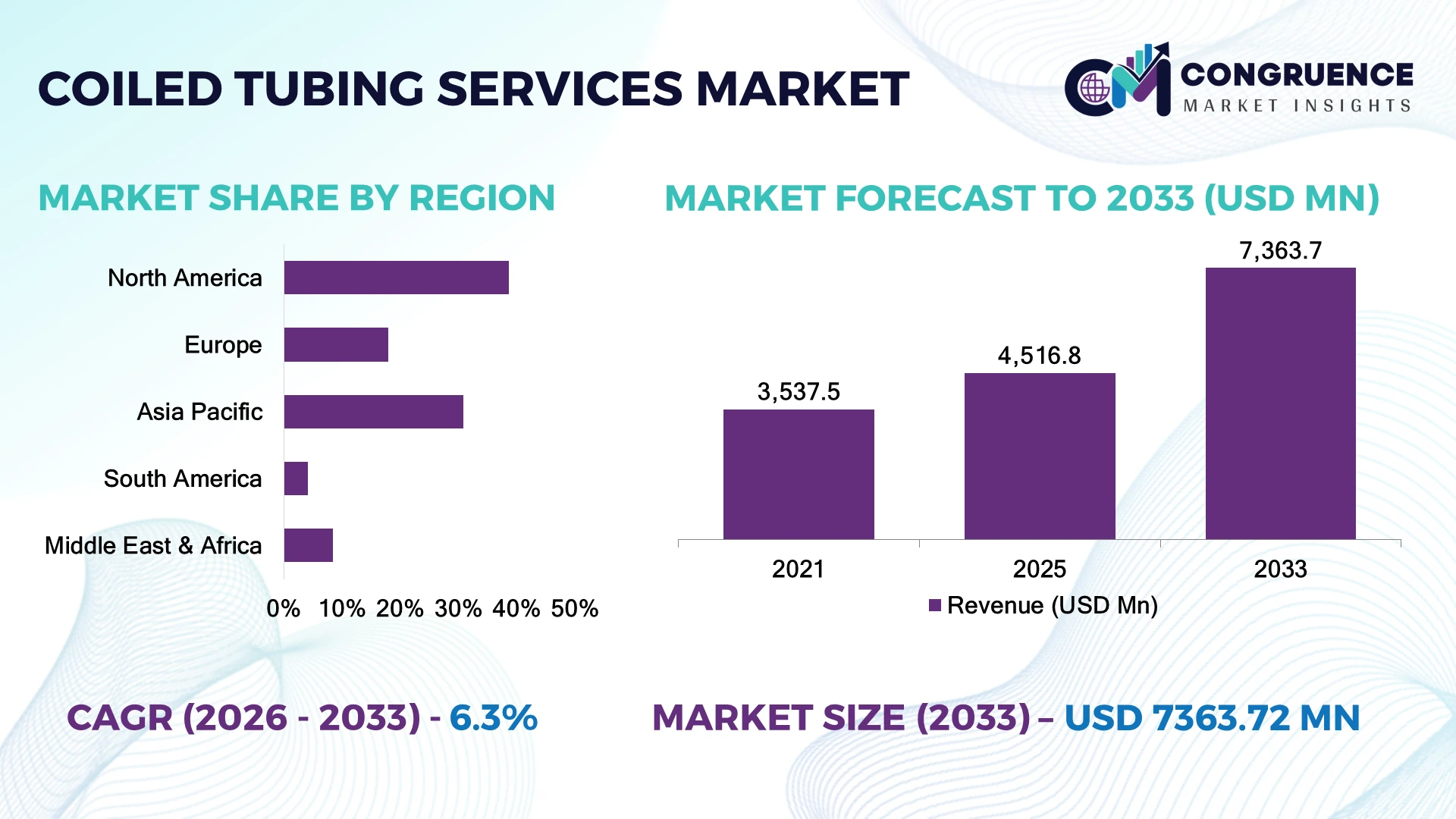
The Global Coiled Tubing Services Market was valued at USD 4,516.8 Million in 2025 and is anticipated to reach a value of USD 7,363.7 Million by 2033 expanding at a CAGR of 6.3% between 2026 and 2033. Growth is driven by increasing well intervention activities, aging oilfield infrastructure, horizontal well completions, and greater adoption of digitally monitored coiled tubing operations to maximize hydrocarbon recovery.
The United States dominates the global coiled tubing services market with approximately 36% market share, supported by extensive shale production, mature oilfield assets, and continuous investments in unconventional resource development. Compared with Saudi Arabia, which prioritizes large-scale conventional reservoir optimization, the United States deploys coiled tubing across a broader range of shale intervention operations. More than 68% of unconventional well interventions utilize coiled tubing technologies, while continued geopolitical efforts to strengthen domestic energy security have accelerated investment in advanced oilfield service capabilities and localized supply chains.
Service providers investing in digital well intervention technologies, high-capacity tubing fleets, and integrated field solutions are strengthening competitive positioning across conventional and unconventional oil and gas operations.
Market Size & Growth: USD 4,516.8 million (2025) to USD 7,363.7 million (2033) at 6.3% CAGR, supported by expanding well intervention and shale production.
Top Growth Drivers: Horizontal drilling (+31%), mature well intervention (+28%), digital oilfield adoption (+22%).
Short-Term Forecast: By 2028, intervention efficiency improves 24% while operational downtime declines 18%.
Emerging Technologies: AI-assisted diagnostics, real-time downhole telemetry, and automated injector control improve operational performance.
Regional Leaders: North America (~USD 2.6 billion), Middle East (~USD 1.5 billion), Asia-Pacific (~USD 1.2 billion), driven by upstream investments.
Consumer/End-User Trends: More than 64% of shale operators prioritize coiled tubing for cost-efficient well maintenance.
Pilot/Case Example: A 2026 digitally monitored intervention program reduced non-productive time by 21%.
Competitive Landscape: Top five providers hold approximately 44% market share, led by SLB, Halliburton, Baker Hughes, Weatherford, and NexTier.
Regulatory & ESG Impact: Closed-loop fluid management lowers operational waste generation by approximately 17%.
Investment & Funding: More than USD 8.5 billion supports upstream modernization, fleet expansion, and digital oilfield technologies.
Innovation & Future Outlook: Intelligent intervention systems and automated well diagnostics redefine advanced oilfield service strategies.
Coiled tubing services remain essential for well intervention, drilling support, cleanout operations, stimulation, and production optimization across conventional and unconventional reservoirs. Digital monitoring systems, predictive maintenance platforms, and high-strength tubing designs have improved operational efficiency by approximately 23%, while stricter environmental compliance is encouraging lower-impact intervention techniques. Continued fleet modernization and integrated digital oilfield operations are reshaping competitive strategy, setting the stage for the market's evolving strategic direction.
Coiled tubing services have become strategically important as operators prioritize maximizing production from existing wells instead of relying solely on new drilling programs. Rising well intervention activity, infrastructure modernization, and digital oilfield integration are reshaping service delivery models across upstream operations. Energy security initiatives, supply-chain localization, and increasing investment in unconventional resource development are encouraging operators to deploy advanced intervention technologies that improve asset productivity while reducing operational downtime.
Modern digitally monitored coiled tubing systems complete intervention programs approximately 26% faster than conventional workover methods while reducing overall operating costs by nearly 19% through continuous downhole monitoring and automated pressure control. The United States leads large-scale shale intervention activity, whereas Saudi Arabia focuses on maximizing production efficiency from mature conventional reservoirs. Over the next two to three years, more than 58% of major well intervention campaigns are expected to incorporate real-time analytics, automated control systems, and predictive maintenance technologies.
Service providers are expanding high-capacity tubing fleets, strengthening partnerships with digital oilfield technology companies, and investing in integrated intervention platforms supporting drilling, stimulation, and production enhancement. Operators increasingly deploy coiled tubing for multistage shale operations, acidizing, and well cleanout, reducing rig dependency and improving asset utilization. Companies capable of combining advanced intervention technologies, digital workflows, and operational reliability will secure stronger competitive positioning across the evolving global upstream energy sector.
Increasing intervention activity across aging oilfields is strengthening demand for coiled tubing services as operators prioritize production optimization over new drilling. More than 65% of producing wells in the United States have entered mature production phases, while coiled tubing reduces intervention time by approximately 27% and improves production restoration by nearly 18%. National initiatives to enhance domestic energy security continue encouraging redevelopment of existing assets rather than greenfield expansion. This operational shift enables operators to extend well life while lowering rig dependence. Service companies are expanding high-capacity tubing fleets, investing in digital well intervention technologies, and forming technology partnerships to deliver faster, safer, and more efficient intervention programs across conventional and unconventional reservoirs.
High capital requirements for advanced coiled tubing units, injector heads, and pressure control equipment continue limiting service expansion, particularly in cost-sensitive upstream markets. Premium steel tubing prices remain approximately 16% above historical averages, while specialized equipment maintenance costs have increased by nearly 14%. Supply constraints for high-pressure components and extended delivery schedules affect fleet availability during peak drilling seasons in the United States. These pressures reduce operational flexibility, delay project execution, and compress service margins. Companies are responding through long-term procurement agreements, localized maintenance facilities, fleet refurbishment programs, and multi-year customer contracts that improve equipment utilization while reducing exposure to supply-chain disruptions.
Digital transformation is creating new opportunities by integrating real-time downhole telemetry, predictive analytics, and automated intervention planning into coiled tubing operations. Intelligent monitoring systems improve operational efficiency by approximately 24%, while predictive maintenance reduces unplanned equipment downtime by nearly 21%. Saudi Arabia continues expanding digital oilfield initiatives that accelerate deployment of integrated well intervention technologies across mature fields. Service providers are investing in AI-assisted operational platforms, collaborating with energy technology firms, and developing remote intervention capabilities that optimize field execution. A significant strategic opportunity lies in combining coiled tubing services with production analytics, enabling operators to maximize recovery while reducing intervention frequency and overall operating expenditure.
Executing advanced coiled tubing operations requires experienced personnel capable of managing high-pressure wells, digital monitoring systems, and increasingly complex intervention programs. Workforce shortages have increased specialized crew demand by approximately 19%, while digital system integration has expanded technical training requirements by nearly 23%. Canada's unconventional resource sector continues facing operational pressure from limited availability of highly qualified intervention specialists. Companies must strengthen workforce development, digital training platforms, and standardized operating procedures to ensure safe and consistent execution. Sustained competitiveness will depend on combining skilled personnel, automated workflows, and advanced operational intelligence capable of supporting increasingly sophisticated well intervention environments.
Digital Well Monitoring Expands: Real-time downhole monitoring is becoming standard across advanced intervention programs, improving operational visibility by approximately 29% and reducing non-productive time by nearly 20%. Increasing digital oilfield adoption and tighter operational efficiency targets are driving deployment. Service providers are integrating cloud-based analytics, automated reporting, and remote operational support into field workflows.
Electric Intervention Equipment Adoption: Electrically powered coiled tubing units are gaining traction as operators seek lower emissions and improved fuel efficiency. Energy consumption has declined by approximately 18%, while equipment noise levels have fallen by nearly 15%. Stricter environmental compliance and field sustainability initiatives are accelerating fleet modernization. Companies are expanding electric equipment portfolios and upgrading existing intervention fleets.
Integrated Multi-Service Operations: Operators increasingly combine coiled tubing, wireline, stimulation, and well diagnostics into unified intervention campaigns, reducing project mobilization time by approximately 25% and improving asset utilization by nearly 22%. This integrated operating model minimizes logistical complexity. Service providers are restructuring operational teams and expanding strategic partnerships to deliver bundled well intervention solutions.
Predictive Fleet Maintenance Gains: Advanced equipment health monitoring is reducing unexpected fleet failures by approximately 21% while improving equipment availability by nearly 17%. Labor shortages and higher utilization rates are encouraging predictive maintenance rather than reactive servicing. Companies are deploying AI-assisted maintenance platforms, digital inspection systems, and centralized fleet management to strengthen operational reliability and maximize field productivity.
Well intervention services account for approximately 47% of the global coiled tubing services market, driven by extensive deployment across mature oilfields for cleanout, nitrogen lifting, milling, and production enhancement. Their dominance stems from lower operational costs than conventional workover rigs, rapid mobilization, and compatibility with live well operations. Drilling services remain strategically important for underbalanced drilling and specialized well construction, while completion services continue supporting hydraulic fracturing and horizontal well development across unconventional reservoirs.
Drilling services represent the fastest-growing segment as complex shale developments and extended-reach wells require continuous tubing deployment and precise downhole control. Operational efficiency has improved by approximately 25%, while intervention cycle times have declined by nearly 20% through integrated digital monitoring. Service providers are expanding automated coiled tubing fleets, investing in high-strength tubing technologies, and partnering with digital oilfield solution providers. Investment priorities are shifting toward multifunctional service platforms capable of delivering drilling, completion, and intervention operations from a single integrated fleet.
According to 2026 operational findings released by the International Association of Drilling Contractors (IADC), integrated coiled tubing technologies continue gaining adoption across complex well intervention programs as operators prioritize lower rig dependency and higher operational efficiency.
Well cleanout represents the largest application segment with approximately 35% market share, supported by continuous demand for debris removal, scale management, and production restoration across aging oilfields. The application remains operationally critical because it extends well productivity while minimizing expensive workover interventions. Well stimulation continues serving mature reservoirs through acidizing and chemical treatments, whereas logging and perforation applications support production diagnostics and reservoir evaluation across increasingly complex field environments.
Hydraulic fracturing support is the fastest-growing application as unconventional resource development increasingly integrates coiled tubing into multistage completion programs. Digital pressure monitoring has improved treatment precision by approximately 27%, while automated intervention workflows reduce operational downtime by nearly 22%. Companies are expanding integrated stimulation capabilities, automating field operations, and deploying real-time analytics platforms to optimize treatment effectiveness. Demand is steadily shifting toward high-efficiency intervention programs combining cleanout, stimulation, and production optimization within a single operational campaign.
Industry assessments published during 2025 by the Society of Petroleum Engineers highlighted increasing deployment of integrated coiled tubing operations to improve intervention efficiency, reservoir productivity, and well lifecycle management across unconventional developments.
Oil and gas exploration and production companies account for approximately 74% of total market demand due to their continuous investment in well intervention, production optimization, and reservoir management. Large upstream operators maintain extensive infrastructure requiring routine coiled tubing services across conventional and unconventional assets. Oilfield service contractors remain essential intermediaries, providing specialized intervention equipment and technical expertise, while independent operators increasingly outsource complex field operations to improve efficiency and reduce capital expenditure.
National oil companies represent the fastest-growing end-user group as governments prioritize domestic production, mature field redevelopment, and energy security initiatives. Digital intervention planning has improved operational utilization by approximately 24%, while integrated service contracts have reduced project mobilization time by nearly 19%. Service providers are developing customized intervention packages, expanding long-term strategic partnerships, and strengthening regional operational hubs to support large-scale production campaigns. Competitive differentiation increasingly depends on delivering integrated, technology-enabled well intervention solutions tailored to diverse reservoir conditions.
According to a 2026 enterprise survey conducted by the International Energy Forum, national oil companies continue expanding investment in integrated well intervention technologies to improve production efficiency, asset longevity, and operational resilience.
North America accounted for the largest market share at 38.6% in 2025 however, Asia-Pacific is expected to register the fastest growth, expanding at a CAGR of 7.2% between 2026 and 2033.
Shale Well Intervention Sustains Operational Leadership
North America contributes approximately 38.6% of the global coiled tubing services market, supported by extensive shale production, mature well intervention programs, and advanced oilfield service infrastructure. The region maintains the world's highest concentration of coiled tubing fleets, enabling continuous production enhancement across unconventional reservoirs. More than 67% of horizontal well intervention operations utilize coiled tubing technologies due to their operational efficiency and reduced rig dependency. Digital well diagnostics, automated pressure control systems, and integrated intervention platforms continue improving field productivity. Service providers are expanding intelligent fleet capabilities, strengthening technology partnerships, and modernizing equipment to support increasingly complex multi-stage intervention campaigns across upstream operations.
United States Market Outlook: The United States leads the regional market through large-scale shale production across the Permian Basin, Eagle Ford, and Bakken formations. Mature unconventional assets require continuous intervention, stimulation, and production optimization, supporting sustained demand for advanced coiled tubing services. More than 70% of unconventional well maintenance programs integrate digitally monitored coiled tubing operations, while service companies continue investing in automated equipment, predictive analytics, and high-capacity intervention fleets to improve operational efficiency and well productivity.
Mature Field Optimization Drives Service Demand
Europe accounts for approximately 18% of the global market, driven by mature offshore assets, production optimization strategies, and increasing investment in extending field life. Operators across the North Sea are prioritizing intervention-based recovery rather than large-scale exploration, increasing demand for efficient well servicing technologies. Approximately 53% of offshore intervention campaigns now utilize advanced coiled tubing systems integrated with digital well monitoring. Service companies are upgrading offshore intervention capabilities, strengthening asset management solutions, and adopting lower-emission operating practices to improve operational performance.
Norway Market Outlook: Norway remains the region's leading market due to its technologically advanced offshore petroleum sector and continued investment in maximizing recovery from mature North Sea reservoirs. Operators increasingly deploy coiled tubing for well cleanout, stimulation, and production enhancement while integrating digital reservoir management systems. Expansion of offshore intervention programs and automated field operations continues supporting demand for high-performance coiled tubing services.
Expanding Upstream Investment Accelerates Deployment
Asia-Pacific is emerging as the fastest-growing regional market, supported by rising upstream investment, expanding natural gas production, and increasing redevelopment of mature oilfields. China, India, Indonesia, and Australia continue strengthening domestic energy production through enhanced recovery and well intervention programs. Nearly 46% of newly approved field redevelopment projects incorporate coiled tubing technologies for production optimization and operational efficiency. Service providers are expanding regional fleets, investing in digital intervention platforms, and establishing localized service hubs to support growing exploration and production activity.
China Market Outlook: China leads regional demand through continued investment in shale gas development, mature field redevelopment, and national energy security initiatives. Large state-owned operators increasingly utilize coiled tubing for acidizing, nitrogen lifting, and production enhancement across conventional and unconventional assets. Digital oilfield deployment and expanding domestic equipment manufacturing continue improving intervention efficiency while supporting greater operational independence.
Production Recovery Strengthens Intervention Activity
South America continues expanding coiled tubing deployment as operators focus on increasing recovery from mature oilfields while supporting new offshore developments. Brazil and Argentina are investing in intervention technologies that improve production efficiency without extensive drilling campaigns. Approximately 24% of intervention activity has shifted toward integrated coiled tubing programs combining stimulation, cleanout, and production optimization. Infrastructure expansion and improved service availability are supporting long-term market development despite logistical and equipment availability constraints in selected producing areas.
Brazil Market Outlook: Brazil dominates the regional market through large offshore oil production, pre-salt developments, and sustained investment in production optimization technologies. National operators continue deploying coiled tubing for offshore well intervention, scale removal, and production enhancement. Expansion of deepwater infrastructure and digital offshore operations supports increasing utilization of advanced intervention services across high-value petroleum assets.
Energy Infrastructure Modernization Expands Intervention Services
The Middle East & Africa market remains strategically important due to extensive conventional hydrocarbon reserves, mature field redevelopment, and sustained investment in production optimization. National operators increasingly integrate advanced coiled tubing technologies into reservoir management programs to maximize recovery and reduce production interruptions. Nearly 58% of major mature-field intervention campaigns incorporate digitally monitored coiled tubing operations. Service providers are expanding regional maintenance facilities, strengthening technology partnerships, and introducing intelligent intervention solutions to improve operational reliability across complex production environments.
Saudi Arabia Market Outlook: Saudi Arabia represents the largest market in the region through continuous investment in conventional field optimization, enhanced oil recovery, and digital oilfield transformation. National production strategies emphasize extending reservoir performance while minimizing operational downtime through advanced intervention techniques. Large-scale deployment of automated well monitoring systems and integrated coiled tubing services continues strengthening operational efficiency across some of the world's most productive hydrocarbon fields.
Global oilfield service leaders including SLB, Halliburton, Baker Hughes, Weatherford, and Trican Well Service compete aggressively with regional intervention specialists for long-term well service contracts. The top five providers collectively control approximately 49% of the global market. Competition is driven by fleet availability, digital well intervention, execution speed, and integrated service delivery rather than pricing alone. Digitally enabled intervention reduces non-productive time by nearly 22%, automated planning improves fleet utilization by approximately 18%, and integrated contracts lower mobilization costs by around 15%. Major providers are expanding regional fleets, forming technology partnerships, integrating digital oilfield platforms, and strengthening maintenance infrastructure through vertical service integration. The competitive landscape is shifting toward bundled intervention solutions combining coiled tubing, stimulation, and diagnostics under unified contracts. High fleet capital requirements, experienced workforce availability, and advanced pressure-control capabilities remain significant entry barriers. Market leadership depends on operational reliability, digital execution, integrated service capability, and rapid field deployment.
SLB
Halliburton
Baker Hughes
Weatherford International
Trican Well Service Ltd.
STEP Energy Services Ltd.
Calfrac Well Services Ltd.
Archer Limited
Expro Group
NexTier Oilfield Solutions
Cudd Energy Services
Superior Energy Services
Digital well intervention is transforming coiled tubing operations through real-time downhole telemetry, fiber-optic monitoring, automated injector controls, and predictive analytics. Intelligent intervention platforms improve operational efficiency by approximately 24%, while continuous pressure monitoring reduces non-productive time by nearly 20%. Around 61% of large unconventional well intervention projects now incorporate digital monitoring systems, enabling operators to optimize treatment execution, reduce safety risks, and improve asset productivity across complex reservoirs.
Emerging technologies include AI-assisted intervention planning, digital twins, electric coiled tubing units, and predictive equipment maintenance integrated with cloud-based field management platforms. Compared with conventional intervention workflows, digitally integrated operations reduce planning time by approximately 31% while increasing job execution accuracy by nearly 26%. More than 46% of newly deployed premium intervention fleets now feature automated diagnostics and remote operational support. Large integrated service providers benefit through higher fleet utilization, whereas independent contractors strengthen competitiveness by adopting modular digital technologies and specialized intervention solutions.
Between 2026 and 2028, autonomous intervention workflows, intelligent pressure control, and advanced composite tubing materials will redefine operational performance across mature and unconventional fields. Companies investing early in integrated digital ecosystems, automation, and predictive maintenance technologies will improve service consistency, lower operating costs, and secure stronger competitive positions as operators increasingly prioritize efficiency-driven well intervention strategies.
December 2024 – SLB secured a three-year Petrobras offshore integrated services contract covering more than 100 deepwater wells, strengthening its intervention capabilities in Brazil and expanding long-term offshore service deployment. Source: SLB News
January 2025 – Halliburton received an integrated drilling services contract from Petrobras for offshore development and exploration projects, reinforcing its Brazil operations and supporting future well intervention demand across strategic offshore assets. Source: Industry market intelligence.
October 2025 – Baker Hughes signed a multi-year agreement with Aramco to expand its underbalanced coiled tubing drilling fleet from 4 to 10 units across Saudi Arabia, significantly increasing operational capacity for natural gas projects. Source: Baker Hughes Newsroom
February 2026 – STEP Energy Services introduced its UDx ultra-deep reel trailer, capable of carrying 35,000 feet of 2-5/8-inch coiled tubing, enabling extended-reach intervention operations and improving efficiency for ultra-deep North American wells.
This report provides a comprehensive evaluation of the global coiled tubing services market across service types, applications, end-user categories, and major regional markets. It examines well intervention, drilling, completion, and specialized operational services supporting conventional, unconventional, onshore, and offshore oil and gas production. The analysis covers North America, Europe, Asia-Pacific, South America, and the Middle East & Africa while assessing deployment intensity, digital intervention adoption, fleet utilization, and competitive operating strategies.
The report further evaluates intelligent well intervention technologies, automated monitoring platforms, predictive maintenance, fiber-optic telemetry, and integrated digital oilfield solutions influencing industry transformation between 2026 and 2033. More than 60% of advanced intervention programs now utilize digitally enabled operational workflows, highlighting the industry's transition toward efficiency-driven service delivery. The analysis supports investment planning, fleet expansion, competitive benchmarking, partnership strategies, and long-term business positioning by identifying high-value application areas, technology priorities, evolving procurement trends, and emerging opportunities across the global upstream energy value chain.
| Report Attribute/Metric | Report Details |
|---|---|
|
Market Revenue in 2025 |
USD 4,516.8 Million |
|
Market Revenue in 2033 |
USD 7,363.7 Million |
|
CAGR (2026 - 2033) |
6.3% |
|
Base Year |
2025 |
|
Forecast Period |
2026 - 2033 |
|
Historic Period |
2021 - 2025 |
|
Segments Covered |
By Type
By Application
By End-User
|
|
Key Report Deliverable |
Revenue Forecast, Growth Trends, Market Dynamics, Segmental Overview, Regional and Country-wise Analysis, Competition Landscape |
|
Region Covered |
North America, Europe, Asia-Pacific, South America, Middle East, Africa |
|
Key Players Analyzed |
SLB, Halliburton, Baker Hughes, Weatherford International, Trican Well Service Ltd., STEP Energy Services Ltd., Calfrac Well Services Ltd., Archer Limited, Expro Group, NexTier Oilfield Solutions, Cudd Energy Services, Superior Energy Services |
|
Customization & Pricing |
Available on Request (10% Customization is Free) |




