
Reports
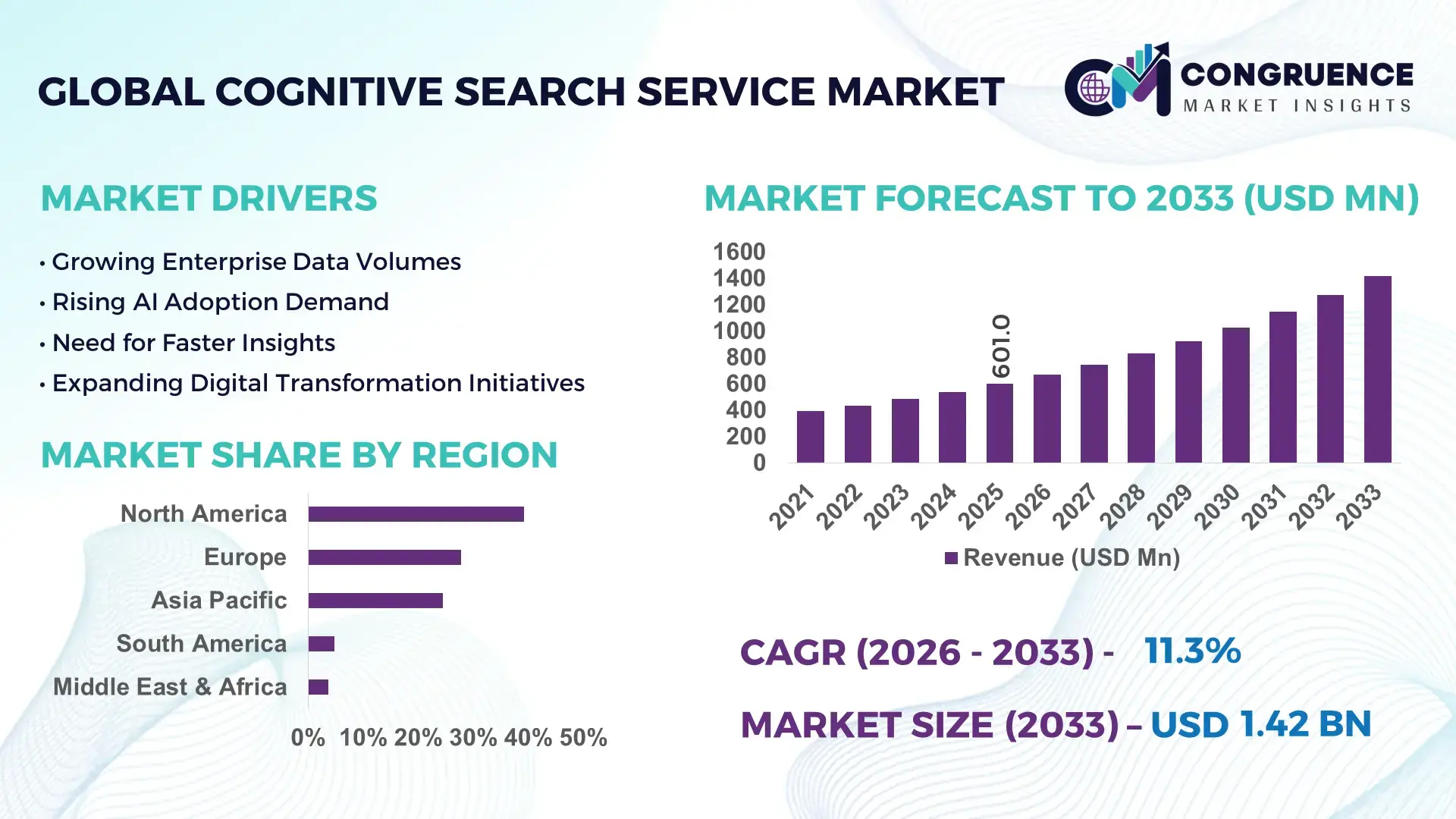
The Global Cognitive Search Service Market was valued at USD 601.0 Million in 2025 and is anticipated to reach a value of USD 1,419.3 Million by 2033 expanding at a CAGR of 11.34% between 2026 and 2033. Growth is being accelerated by enterprise-scale generative AI integration, expanding unstructured data volumes, and rising adoption of intelligent knowledge discovery platforms across financial services, healthcare, and government sectors.
The United States dominates the market with approximately 38% share, supported by over USD 70 billion in annual enterprise AI investments and strong deployment across banking, defense, and cloud ecosystems. Compared with Germany, where industrial search deployments are concentrated in manufacturing and engineering, U.S. adoption rates exceed 60% among large enterprises implementing AI-driven knowledge management. The CHIPS and Science Act further strengthens digital infrastructure modernization, reinforcing leadership in advanced cognitive search implementations.
Strategically, vendors that combine domain-specific AI models, governance frameworks, and real-time enterprise search capabilities are securing stronger competitive differentiation and long-term enterprise contracts.
Market Size & Growth: USD 601.0 million in 2025, reaching USD 1,419.3 million by 2033, driven by rapid enterprise deployment of generative AI-powered search and knowledge automation platforms.
Top Growth Drivers: Enterprise AI adoption (+42%), unstructured data expansion (+55%), and cloud-native search implementation (+37%) are accelerating market momentum.
Short-Term Forecast: By 2028, intelligent search platforms are expected to reduce information retrieval time by 45% and improve workforce productivity by 30%.
Emerging Technologies: Vector databases, retrieval-augmented generation (RAG), and multimodal AI search are improving search accuracy by over 35%.
Regional Leaders: North America (~USD 520 million), Europe (~USD 360 million), and Asia-Pacific (~USD 310 million) lead through cloud modernization and AI deployment initiatives.
Consumer/End-User Trends: Nearly 64% of enterprises prioritize AI-driven knowledge management to improve employee access to business-critical information.
Pilot/Case Example: In 2024, a global banking deployment reduced document search times by 50% and improved compliance retrieval efficiency by 28%.
Competitive Landscape: Microsoft holds approximately 16% market influence, alongside IBM, Elastic, Google Cloud, and Amazon Web Services.
Regulatory & ESG Impact: Data-governance regulations increased enterprise investment in explainable AI search frameworks by 29%.
Investment & Funding: Global enterprise AI and search ecosystem investments exceeded USD 20 billion, supported by strategic cloud partnerships and platform expansion.
Innovation & Future Outlook: Agentic AI, semantic reasoning engines, and enterprise copilots are reshaping high-growth cognitive search deployment strategies worldwide.
Cognitive Search Service platforms are becoming essential for extracting actionable intelligence from rapidly expanding enterprise data ecosystems. Demand is particularly strong across financial services, healthcare, legal operations, and industrial manufacturing, where intelligent retrieval and contextual analysis improve decision quality. Recent advances in retrieval-augmented generation and vector search have enhanced search relevance by more than 35%, while stricter data-governance requirements are encouraging organizations to deploy secure, enterprise-grade knowledge discovery architectures, setting the stage for broader strategic adoption.
Cognitive search services are becoming strategically important as organizations compete on speed of decision-making, knowledge accessibility, and AI-enabled productivity. The market is benefiting from enterprise-wide digital transformation initiatives, increasing regulatory scrutiny around information governance, and modernization of legacy content management environments. As businesses manage petabytes of structured and unstructured information, intelligent retrieval capabilities have become a critical operational requirement rather than a supplementary technology.
Modern cognitive search platforms deliver measurable performance improvements compared with traditional keyword-based systems. AI-powered semantic search environments can improve search relevance by 30–40% while reducing information retrieval times by nearly 50%. The United States leads large-scale enterprise deployments across finance and healthcare, whereas Japan and Germany demonstrate strong adoption within manufacturing, engineering, and industrial knowledge management environments. Over the next two to three years, enterprise deployments integrating retrieval-augmented generation and vector search architectures are expected to become standard components of digital workplace strategies.
A practical example is the deployment of AI-driven knowledge hubs within multinational financial institutions, enabling faster compliance verification and document discovery across thousands of employees. Vendors are increasing investments in cloud partnerships, vertical-specific AI models, and secure enterprise deployment frameworks. Organizations that successfully integrate cognitive search into operational workflows will strengthen competitive positioning through improved productivity, faster decision cycles, and enhanced enterprise intelligence capabilities.
The accelerating adoption of enterprise AI and knowledge automation platforms remains the primary market driver. More than 80% of enterprise data remains unstructured, creating significant demand for advanced semantic search and contextual discovery tools. Organizations deploying AI-driven search solutions report up to 40% improvement in knowledge retrieval accuracy and nearly 50% reduction in employee search time. The widespread deployment of generative AI applications following major investments by U.S. technology providers has intensified demand for retrieval-augmented enterprise search environments. In response, vendors are expanding cloud-native architectures, developing industry-specific language models, and forming strategic partnerships with hyperscale cloud providers. A notable operational insight is that productivity gains increasingly outweigh software acquisition costs, making cognitive search a board-level digital transformation priority.
Complex enterprise data environments continue to constrain large-scale implementation. Approximately 45% of organizations operate across multiple disconnected repositories, while nearly 35% report challenges integrating legacy content systems with modern AI search platforms. Regulatory requirements surrounding data sovereignty, privacy protection, and cross-border information access add further implementation complexity. Germany and France have introduced stricter governance expectations for enterprise AI deployments, increasing compliance workloads. These factors can lengthen deployment cycles and elevate operational expenditures. To mitigate risks, companies are investing in localized data architectures, hybrid-cloud environments, and governance-focused search frameworks. A critical strategic insight is that integration readiness increasingly determines deployment success more than search algorithm performance itself.
The emergence of domain-specialized cognitive search platforms presents a significant growth opportunity. Healthcare organizations report up to 32% faster clinical information retrieval, while legal services firms achieve document review efficiency gains exceeding 25% through AI-assisted search. India's digital public infrastructure expansion and enterprise digitization initiatives are creating new opportunities for localized knowledge discovery solutions. The increasing adoption of vector databases, multimodal search, and agentic AI frameworks is enabling higher-value enterprise use cases beyond traditional information retrieval. Vendors are expanding R&D investments, forming ecosystem partnerships, and developing sector-specific AI models optimized for compliance-intensive industries. A non-obvious opportunity lies in operational intelligence applications that transform search platforms into real-time decision-support systems.
Long-term market expansion depends on overcoming scalability and operational execution challenges. Nearly 52% of enterprises identify cybersecurity concerns as a key barrier to broader AI deployment, while 38% report shortages of skilled AI and data engineering professionals. As organizations integrate cognitive search across thousands of applications and repositories, maintaining performance consistency and governance controls becomes increasingly difficult. Large enterprises managing global information networks face rising pressure to balance accessibility, security, and compliance requirements. Companies are responding through infrastructure modernization, AI governance programs, and strategic technology partnerships. A critical operational insight is that future competitiveness will depend not only on search accuracy but also on the ability to securely scale enterprise-wide knowledge ecosystems without compromising trust or regulatory compliance.
Generative AI Search Integration Enterprise deployments are rapidly shifting from keyword retrieval to retrieval-augmented generation (RAG) architectures. More than 55% of large organizations have expanded AI-assisted search workflows, while semantic query accuracy has improved by nearly 35%. The widespread adoption of enterprise copilots and large language models is reducing document discovery time by up to 45%. Companies are responding through AI platform partnerships, vector database deployment, and integration of domain-specific knowledge engines to improve decision velocity and employee productivity.
Governance-Driven Search Modernization Tightening data governance requirements are accelerating investments in explainable and auditable search environments. Nearly 48% of enterprises have increased spending on secure knowledge management frameworks, while compliance-focused deployments have grown by approximately 30%. Regulatory developments surrounding data privacy and AI transparency are reshaping procurement priorities. Organizations are restructuring information architectures, implementing role-based access controls, and deploying governance-focused search layers that support compliance without reducing search performance or accessibility.
Cloud-Native Knowledge Platforms Cloud-first deployment models now account for more than 60% of new cognitive search implementations as enterprises consolidate fragmented repositories. Organizations report infrastructure management cost reductions of 25–30% after migrating search workloads to cloud-native environments. The shift is being driven by hybrid workforce requirements and expanding volumes of unstructured content. Vendors are scaling multi-cloud capabilities, expanding API ecosystems, and introducing automated indexing technologies to accelerate deployment across distributed enterprise environments.
Industry-Specific Intelligence Engines Sector-focused cognitive search solutions are gaining traction across healthcare, financial services, and manufacturing. Specialized deployments have improved information retrieval precision by nearly 40%, while workflow automation rates have increased by over 25% in document-intensive operations. A notable shift is the growing use of proprietary enterprise data rather than public datasets to train search models. Companies are investing in vertical AI models, strategic ecosystem partnerships, and customized deployment frameworks to create defensible competitive advantages and higher-value enterprise outcomes.
Cloud-Based Cognitive Search Services represent the largest segment, accounting for approximately 58% of market adoption due to scalability, faster deployment cycles, and seamless integration with enterprise cloud ecosystems. Organizations increasingly prefer cloud-native architectures because they support real-time indexing, AI model updates, and distributed workforce accessibility without significant infrastructure investments. Large enterprises deploying cloud-based search platforms report implementation timelines nearly 35% shorter than traditional on-premise environments. Vendors continue expanding cloud partnerships and managed service offerings to strengthen customer retention and platform interoperability. Hybrid Cognitive Search Services are emerging as the fastest-growing segment, supported by growing demand for regulatory compliance and data localization. Hybrid deployments are expanding by nearly 28% annually in highly regulated sectors such as banking and healthcare where organizations balance cloud scalability with local data control. On-Premise solutions maintain relevance among defense, government, and critical infrastructure operators requiring strict security protocols. Investment priorities are increasingly shifting toward hybrid orchestration capabilities, AI governance tools, and multi-environment deployment frameworks that enable organizations to manage sensitive and non-sensitive workloads through a unified search architecture.
Enterprise Search remains the leading application segment, contributing approximately 40% of total deployment activity as organizations seek faster access to business-critical information across fragmented repositories. Demand is concentrated among large enterprises managing complex document ecosystems, compliance records, and operational knowledge assets. AI-enhanced enterprise search solutions have reduced employee search time by nearly 45% while improving content discoverability by more than 30%. Vendors are expanding semantic search, multilingual indexing, and contextual retrieval capabilities to support increasingly complex enterprise workflows. Knowledge Management is the fastest-growing application segment as organizations formalize institutional knowledge and support AI-powered workplace productivity initiatives. Adoption has increased by approximately 32% among multinational corporations implementing digital workplace modernization programs. Customer Support and Risk & Compliance applications continue gaining strategic importance through automated document retrieval, case management, and regulatory reporting. Organizations are integrating cognitive search directly into workflow systems, customer engagement platforms, and compliance infrastructures, making intelligent retrieval capabilities operationally critical rather than standalone functionality.
BFSI represents the largest end-user segment, accounting for approximately 27% of market demand due to extensive documentation requirements, regulatory obligations, and high-volume information workflows. Financial institutions increasingly deploy cognitive search platforms to accelerate compliance reviews, fraud investigations, and customer intelligence initiatives. Search-enabled automation has improved document retrieval efficiency by nearly 40% across major banking operations. Vendors are responding with industry-specific AI models, enhanced governance features, and secure deployment architectures tailored to financial services environments. Healthcare is the fastest-growing end-user segment, supported by expanding digital health records, clinical documentation requirements, and medical research workloads. Adoption rates have increased by approximately 30% as healthcare organizations seek faster access to patient information and treatment knowledge. IT & Telecom, Government, Retail & E-commerce, and Manufacturing continue expanding deployments to improve operational intelligence and workforce productivity. Companies are targeting these sectors through customized pricing structures, ecosystem partnerships, and workflow-specific search capabilities. Future demand is increasingly concentrated among industries managing large volumes of unstructured information where retrieval speed directly influences operational outcomes and service quality.
North America accounted for the largest market share at 39.2% in 2025 however, Asia-Pacific is expected to register the fastest growth, expanding at a CAGR of 13.1% between 2026 and 2033.
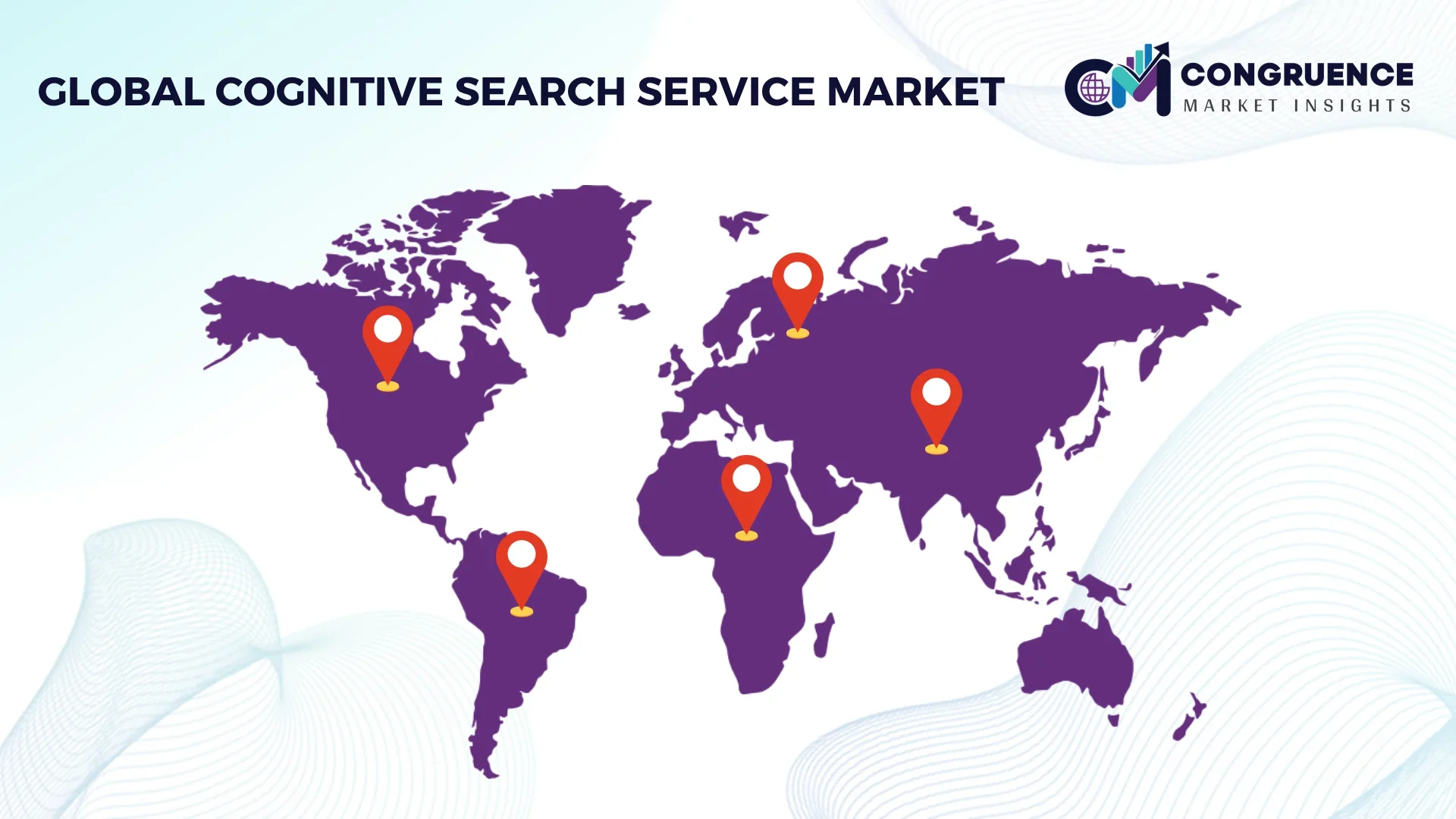
North America maintains its leadership position through extensive enterprise AI adoption, mature cloud infrastructure, and strong concentration of technology providers. The region accounts for approximately 39.2% of global market activity, supported by widespread deployment across financial services, healthcare, government, and technology sectors. More than 65% of large enterprises have integrated AI-powered knowledge discovery tools into operational workflows, driving demand for advanced semantic search capabilities. Enterprise modernization initiatives continue to accelerate as organizations seek to manage growing volumes of unstructured data. Strategic partnerships between cloud providers and enterprise software vendors are expanding deployment capacity, while increasing investments in generative AI ecosystems strengthen the region’s operational advantage in intelligent information retrieval.
United States Market Outlook: The United States serves as the primary growth engine for the regional market, supported by advanced cloud ecosystems, substantial enterprise AI spending, and strong digital transformation activity. Large organizations continue deploying cognitive search solutions to improve compliance management, employee productivity, and customer intelligence operations. More than 60% of Fortune 500 companies have implemented AI-enhanced knowledge management platforms, creating significant demand for scalable search architectures. Federal investments in AI innovation and enterprise technology modernization further strengthen deployment activity across regulated industries and large-scale corporate environments.
Europe represents a significant market driven by digital sovereignty priorities, enterprise modernization initiatives, and stringent data governance frameworks. The region accounts for approximately 27.8% of global market demand, with adoption concentrated across manufacturing, banking, healthcare, and public-sector organizations. Regulatory requirements surrounding AI transparency and information governance are accelerating investment in explainable search architectures and secure knowledge management platforms. Organizations are increasingly deploying hybrid search environments to balance compliance obligations with operational flexibility. Enterprise adoption has expanded steadily as businesses seek to improve document accessibility and knowledge utilization while maintaining strict control over sensitive information assets.
Germany Market Outlook: Germany remains the most strategically important market in Europe due to its industrial strength, advanced manufacturing ecosystem, and extensive enterprise digitization efforts. Large engineering, automotive, and industrial organizations are integrating cognitive search solutions to streamline technical documentation, research workflows, and operational knowledge management. Approximately 45% of large German enterprises have accelerated AI deployment initiatives focused on productivity and information management. The country's emphasis on industrial digitalization and enterprise software innovation continues to support long-term adoption across complex knowledge-intensive environments.
Asia-Pacific is emerging as the fastest-expanding market due to rapid enterprise digitization, growing cloud adoption, and large-scale investments in AI infrastructure. The region accounts for nearly 24.5% of global market activity, with deployment accelerating across financial services, telecommunications, e-commerce, and manufacturing industries. Organizations are increasingly implementing AI-driven search solutions to manage rising data volumes and support multilingual information environments. Enterprise cloud adoption rates have surpassed 55% in several major economies, creating favorable conditions for cognitive search deployment. Technology vendors are expanding regional partnerships, data center capacity, and localized AI capabilities to capitalize on accelerating digital transformation programs.
China Market Outlook: China represents the largest market within Asia-Pacific, supported by substantial investments in artificial intelligence, cloud computing, and enterprise software modernization. Large enterprises are deploying cognitive search platforms to improve operational intelligence, industrial knowledge management, and customer engagement capabilities. The country accounts for a significant share of regional AI infrastructure spending, while enterprise digitization initiatives continue expanding across manufacturing, finance, and telecommunications sectors. Strong domestic technology ecosystems and increasing adoption of intelligent automation platforms position China as a critical center for future deployment activity.
South America is experiencing steady adoption as enterprises modernize information management systems and expand cloud-based operations. The region contributes approximately 4.8% of global market demand, with implementation activity concentrated in banking, telecommunications, retail, and public-sector organizations. Digital transformation initiatives are driving increased deployment of intelligent search platforms capable of improving knowledge accessibility and operational efficiency. Cloud migration programs have accelerated across major economies, enabling organizations to adopt scalable cognitive search environments. Infrastructure limitations and uneven technology investment remain challenges, yet ongoing modernization efforts continue to strengthen long-term deployment prospects across the region.
Brazil Market Outlook: Brazil leads the regional market through its large enterprise base, growing cloud ecosystem, and expanding digital transformation initiatives. Financial institutions, telecommunications providers, and retail organizations are actively investing in AI-powered information management technologies to improve service delivery and operational efficiency. Enterprise cloud adoption has exceeded 50% among large organizations, creating a favorable environment for cognitive search deployment. Continued investment in digital infrastructure and enterprise software modernization is supporting broader implementation across data-intensive business sectors.
The Middle East & Africa market is gaining momentum through government-led digital transformation programs, expanding cloud infrastructure, and increasing enterprise technology investments. The region contributes approximately 3.7% of global market activity, with adoption concentrated in government services, financial institutions, energy operations, and telecommunications sectors. Large-scale modernization initiatives are driving demand for intelligent information retrieval and enterprise knowledge management capabilities. Investments in hyperscale data centers and AI-focused infrastructure continue improving deployment readiness across key markets. Organizations are increasingly adopting advanced search technologies to support operational efficiency, service modernization, and digital governance objectives.
Saudi Arabia Market Outlook: Saudi Arabia has emerged as the leading market within the region due to extensive digital transformation investments, AI-focused national initiatives, and growing enterprise technology adoption. Government agencies and large enterprises are implementing cognitive search platforms to enhance knowledge accessibility, operational transparency, and service delivery performance. More than 70% of major digital transformation projects now incorporate advanced data and AI capabilities. Continued investments in cloud infrastructure, smart government programs, and enterprise modernization initiatives position the country as a key strategic market for cognitive search deployments.
The Cognitive Search Service Market is characterized by competition between global cloud leaders such as Microsoft, IBM, Google Cloud, and Amazon Web Services, and search-specialists including Elastic and Coveo. The top five players collectively control approximately 58–62% of market activity, with competition centered on AI retrieval accuracy, vector search performance, deployment speed, and enterprise integration depth. Semantic search accuracy improvements exceeding 30% and retrieval efficiency gains approaching 40% have become major differentiators. Global cloud providers compete through ecosystem scale and infrastructure reach, while search-focused innovators emphasize customization, industry-specific deployment, and lower implementation complexity. Strategic partnerships with AI model providers, cloud vendors, and enterprise software platforms are accelerating competitive positioning. Market dynamics are shifting toward retrieval-augmented generation, vector databases, and agentic AI capabilities, creating pressure on legacy keyword-search providers. High integration complexity, enterprise trust requirements, and large-scale data governance capabilities remain significant entry barriers. Winning requires superior AI retrieval performance, seamless enterprise integration, strong governance controls, and scalable deployment architectures that deliver measurable operational outcomes.
IBM Corporation
Google Cloud
Amazon Web Services (AWS)
Elastic N.V.
Coveo Solutions Inc.
Lucidworks Inc.
Sinequa
Algolia Inc.
ServiceNow Inc.
Oracle Corporation
SAP SE
Expert.ai
OpenText Corporation
Cognitive search technology is rapidly transitioning from keyword-based retrieval toward semantic, vector, and retrieval-augmented generation (RAG) architectures. Vector search platforms can improve contextual relevance by more than 35% while reducing information discovery time by nearly 45%. Approximately 60% of new enterprise deployments now incorporate semantic indexing and AI-powered retrieval capabilities. Organizations are increasingly integrating search engines with large language models to transform static repositories into intelligent knowledge systems capable of delivering contextual and conversational responses.
Emerging technologies include multimodal search, agentic retrieval, vector databases, and automated knowledge orchestration. Compared with traditional keyword search systems, hybrid semantic-vector search environments deliver up to 40% higher retrieval precision and significantly lower manual filtering effort. Adoption is accelerating across financial services, healthcare, and manufacturing where knowledge-intensive workflows require faster access to operational information. Vendors such as Microsoft, Elastic, and IBM benefit from expanding enterprise demand for integrated AI retrieval ecosystems and scalable cloud-native search infrastructures.
Between 2026 and 2028, agentic AI and advanced retrieval architectures are expected to become core enterprise capabilities. Multi-vector indexing, AI-powered reasoning layers, and automated query decomposition will improve search performance by 20–30% in complex environments. Organizations acting now gain advantages through faster decision-making, improved workforce productivity, stronger governance, and enhanced operational intelligence, while delaying adoption increases competitive pressure as AI-native search becomes a standard enterprise capability.
October 2025 – Elastic N.V. launched the Elastic Inference Service, a GPU-accelerated inference platform for semantic search, vector search, and generative AI workflows. The solution leverages NVIDIA GPU infrastructure to improve inference scalability and reduce deployment complexity, strengthening enterprise AI search performance. Source: www.ir.elastic.co
May 2025 – Microsoft Azure AI Search introduced Agentic Retrieval capabilities that decompose complex queries into parallel subqueries and improve enterprise retrieval workflows. The update enhances transparency and grounding data utilization, supporting more advanced enterprise AI agent deployments.
August 2025 – Microsoft Azure AI Search expanded vector search functionality by increasing maximum vector dimensions to 4,096 per field. The enhancement supports larger embedding models and more sophisticated retrieval architectures, improving enterprise-scale search flexibility and performance.
April 2024 – Microsoft Azure announced significant Azure AI Search upgrades that increased vector index capacity and storage scalability without additional platform cost. The development strengthened enterprise deployment readiness for large-scale retrieval-augmented generation applications and advanced AI search workloads.
The report provides comprehensive coverage of the Cognitive Search Service Market across key deployment types, applications, end-user industries, and major geographic regions. Analysis includes cloud-based, on-premise, and hybrid deployment models, along with enterprise search, knowledge management, customer support, and compliance-focused applications. The study evaluates adoption patterns across BFSI, healthcare, government, manufacturing, retail, and technology sectors, where more than 60% of deployments are concentrated within data-intensive enterprise environments.
The report further assesses competitive positioning, technology adoption trends, deployment strategies, and operational transformation initiatives across North America, Europe, Asia-Pacific, South America, and the Middle East & Africa. Coverage extends to emerging technologies such as vector search, retrieval-augmented generation, multimodal retrieval, agentic AI, and semantic indexing. Strategic insights support investment prioritization, market entry planning, partnership evaluation, competitive benchmarking, and expansion decision-making. The analysis highlights evolving enterprise requirements, deployment patterns, and innovation pathways expected to influence market direction between 2026 and 2033.
| Report Attribute / Metric | Details |
|---|---|
| Market Revenue (2025) | USD 601.0 Million |
| Market Revenue (2033) | USD 1,419.3 Million |
| CAGR (2026–2033) | 11.34% |
| Base Year | 2025 |
| Forecast Period | 2026–2033 |
| Historic Period | 2021–2025 |
| Segments Covered |
By Type
By Application
By End-User
|
| Key Report Deliverables | Revenue Forecast; Market Trends; Growth Drivers & Restraints; Technology Insights; Segmentation Analysis; Regional Insights; Competitive Landscape; Regulatory & ESG Overview; Recent Developments |
| Regions Covered | North America; Europe; Asia-Pacific; South America; Middle East & Africa |
| Key Players Analyzed | Microsoft Corporation; IBM Corporation; Google Cloud; Amazon Web Services (AWS); Elastic N.V.; Coveo Solutions Inc.; Lucidworks Inc.; Sinequa; Algolia Inc.; ServiceNow Inc.; Oracle Corporation; SAP SE; Expert.ai; OpenText Corporation |
| Customization & Pricing | Available on Request (10% Customization Free) |




