
Reports
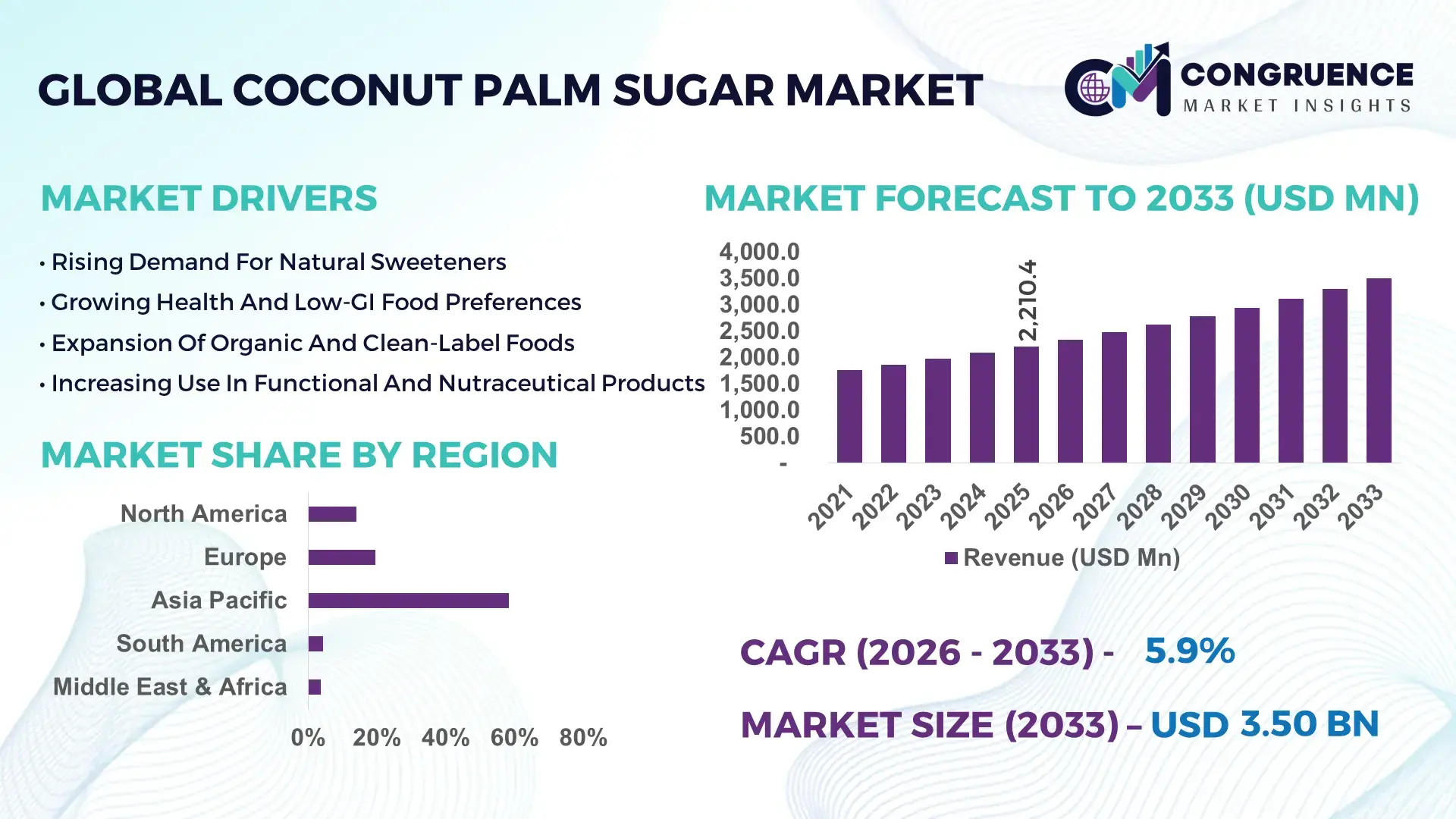
The Global Coconut Palm Sugar Market was valued at USD 2,210.4 Million in 2025 and is anticipated to reach a value of USD 3,496.5 Million by 2033 expanding at a CAGR of 5.9% between 2026 and 2033, according to an analysis by Congruence Market Insights, driven primarily by rising consumer preference for natural, low-glycemic sweeteners across food and beverage applications.
Indonesia dominates the Coconut Palm Sugar market with an estimated annual production exceeding 450,000 metric tons, supported by over 3.6 million hectares of coconut plantations. The country has seen investments exceeding USD 180 million in semi-automated tapping, hygienic sap collection systems, and low-temperature crystallization technologies. Coconut palm sugar is widely used in bakery, confectionery, functional foods, and organic retail, with nearly 38% of domestic production routed toward export-grade applications. Consumer adoption in urban Indonesian households exceeds 42%, reflecting strong integration into daily diets and processed food manufacturing.
Market Size & Growth: Valued at USD 2,210.4 Million in 2025, projected to reach USD 3,496.5 Million by 2033 at a CAGR of 5.9%, supported by clean-label food demand.
Top Growth Drivers: Natural sweetener adoption (46%), low glycemic index preference (39%), organic food penetration (31%).
Short-Term Forecast: By 2028, production efficiency improvements of 18% are expected through semi-automated sap processing.
Emerging Technologies: Low-temperature evaporation, vacuum crystallization, blockchain traceability systems.
Regional Leaders: Asia-Pacific USD 1,620 Million, Europe USD 840 Million, North America USD 620 Million by 2033, each driven by health-oriented consumption.
Consumer/End-User Trends: Rising use in vegan foods, sports nutrition, and diabetic-friendly formulations.
Pilot or Case Example: In 2026, a cooperative processing upgrade improved yield recovery by 22%.
Competitive Landscape: Market leader holds ~14% share, followed by 5 mid-scale exporters.
Regulatory & ESG Impact: Organic certification and fair-trade compliance influencing procurement.
Investment & Funding Patterns: Over USD 410 Million invested in processing, packaging, and export logistics since 2023.
Innovation & Future Outlook: Focus on fortified palm sugar blends and functional sweetener variants.
Coconut Palm Sugar demand is led by food processing at 46%, followed by household consumption at 34% and nutraceuticals at 20%. Innovations in moisture-controlled granulation, recyclable packaging, and mineral-retention processing are improving shelf stability. Asia-Pacific accounts for the highest consumption, while Europe shows rapid premiumization. Sustainability-linked farming models and clean-label regulations are shaping long-term growth.
The Coconut Palm Sugar Market holds strong strategic relevance as food systems transition toward healthier, traceable, and sustainable sweetening alternatives. Coconut palm sugar delivers nutritional advantages such as a glycemic index nearly 35% lower than refined cane sugar, supporting its positioning in diabetic-friendly and functional food formulations. Vacuum-assisted evaporation technology delivers 27% higher mineral retention compared to traditional open-pan boiling. Asia-Pacific dominates in volume, while Europe leads in premium adoption with nearly 41% of organic food brands incorporating coconut palm sugar. By 2028, AI-enabled sap yield forecasting is expected to improve farm-level productivity by 19%. ESG commitments are accelerating, with producers targeting 25% reduction in water usage and 30% recyclable packaging adoption by 2030. In 2026, a Southeast Asian cooperative achieved a 21% reduction in post-harvest losses through digital batch monitoring. These developments position the Coconut Palm Sugar Market as a resilient, compliant, and sustainability-aligned component of the global natural sweeteners ecosystem.
The Coconut Palm Sugar Market is shaped by health-driven consumer shifts, evolving food formulations, and sustainability-led sourcing. Demand is supported by rising incidences of lifestyle disorders and increasing awareness of low-glycemic diets. Food manufacturers are reformulating products to reduce refined sugar content, increasing coconut palm sugar usage in bakery, sauces, and beverages. Supply dynamics depend heavily on climatic conditions and manual labor availability, while value addition through organic certification enhances export potential. Trade policies supporting natural sweeteners and growth in plant-based diets continue to influence global demand patterns.
Health-focused dietary changes are a major driver, with over 44% of consumers actively reducing refined sugar intake. Coconut palm sugar’s lower glycemic index and higher potassium and zinc content support its integration into diabetic and sports nutrition products. Nearly 36% of clean-label packaged foods launched in 2025 included natural sweeteners, boosting industrial demand. Foodservice operators are also adopting coconut palm sugar to meet wellness-oriented menus.
Production remains labor-intensive, with sap collection yields fluctuating by up to 28% seasonally. Limited mechanization and reliance on skilled tappers constrain scalability. Moisture sensitivity leads to storage losses of nearly 12% annually in humid regions. These factors restrict consistent supply for large-scale processors and exporters.
Functional and fortified foods represent a strong opportunity, with demand rising 33% for mineral-rich sweeteners. Coconut palm sugar is increasingly blended with probiotics and plant proteins. Export-grade granulated variants command premium pricing, and value-added forms such as syrup and cubes are expanding retail reach.
Organic and fair-trade certification costs can account for up to 9% of annual operating expenses. Small producers face barriers in meeting traceability, hygiene, and export documentation requirements. Inconsistent regulatory standards across regions further complicate cross-border trade.
• Expansion of Low-Glycemic Product Formulations: Over 48% of new health-oriented food launches now emphasize glycemic control, increasing coconut palm sugar inclusion by 29% in functional snacks and beverages.
• Shift Toward Organic and Fair-Trade Sourcing: Certified organic coconut palm sugar production grew 31%, supported by premium pricing and ethical sourcing commitments.
• Processing Technology Upgrades: Adoption of closed-system evaporation improved batch consistency by 24% and reduced contamination risks by 18%.
• Retail Premiumization: Branded packaging and flavored variants increased average selling value by 21%, particularly in urban retail and e-commerce channels.
The Coconut Palm Sugar market is segmented by type, application, and end-user, reflecting diverse consumption patterns. Granulated and powdered forms dominate food manufacturing, while liquid variants gain traction in beverages. Applications span bakery, confectionery, sauces, and nutraceuticals. End-users include food processors, foodservice operators, households, and health-focused brands. Segmentation highlights strong premiumization in developed markets and volume-driven consumption in producing regions.
Granulated coconut palm sugar accounts for approximately 52% of market adoption due to ease of handling and formulation compatibility. Powdered variants hold 27%, favored in instant mixes. Liquid syrup forms are growing fastest at a CAGR of 7.1%, driven by beverage and dessert applications. Other niche formats collectively represent 21%.
Food and beverage applications lead with 58% share, driven by bakery and confectionery reformulations. Nutraceuticals are the fastest-growing segment at a CAGR of 7.6%, supported by diabetic nutrition products. Cosmetics and personal care contribute a combined 18%. In 2025, over 41% of natural snack brands reported using coconut palm sugar as a primary sweetener.
Food processors dominate end-user demand with 49% share, followed by households at 32%. Nutraceutical brands represent the fastest-growing end-user segment at a CAGR of 8.2%, driven by preventive health trends. Foodservice operators and private-label retailers together contribute 19%. In 2025, 46% of urban consumers preferred coconut palm sugar over refined sugar for daily use.
Asia-Pacific accounted for the largest market share at 58.4% in 2025 however, Europe is expected to register the fastest growth, expanding at a CAGR of 6.7% between 2026 and 2033.
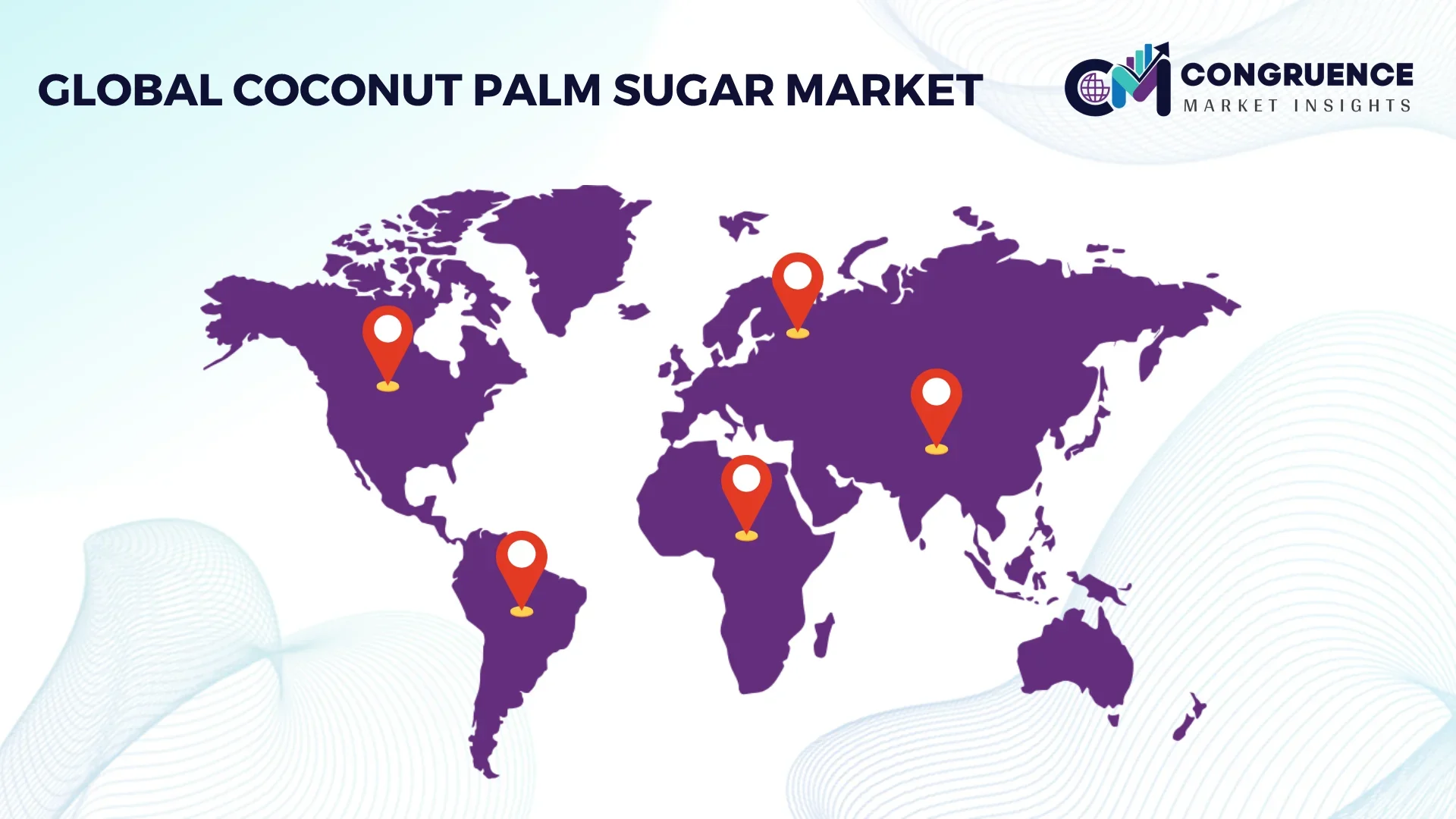
Asia-Pacific dominates global Coconut Palm Sugar consumption with annual volumes exceeding 720,000 metric tons, driven by Indonesia, India, and the Philippines. The region benefits from large-scale coconut cultivation exceeding 14 million hectares, low production costs, and rising domestic consumption. Europe, while smaller in volume at 19.6% share, is witnessing accelerated demand due to premium organic food adoption, clean-label regulations, and rising diabetic-friendly sweetener usage. North America follows with 14.1% share, supported by specialty food manufacturing and e-commerce-driven health food retail. South America and the Middle East & Africa together account for 7.9%, with growing imports into Brazil, UAE, and South Africa. Cross-border trade volumes grew by 22% between 2022 and 2025, reflecting expanding global distribution and diversified end-use applications.
The market holds approximately 14.1% share of global Coconut Palm Sugar consumption, driven primarily by food & beverage processing, nutraceuticals, and specialty retail. Bakery, functional snacks, and plant-based beverages account for nearly 62% of regional demand. Regulatory support for organic labeling and reduced added sugar formulations has increased adoption in packaged foods. Digital supply chain platforms and blockchain traceability are improving sourcing transparency. A U.S.-based organic food brand expanded coconut palm sugar usage across 1,800 retail outlets in 2025. Consumer behavior reflects higher adoption among health-conscious and diabetic populations, with 44% of urban consumers preferring natural sweeteners over refined sugar.
Europe represents 19.6% of global market share, with Germany, the UK, and France accounting for over 68% of regional consumption. Stringent sustainability directives, organic certification standards, and sugar reduction policies are accelerating adoption. Advanced food processing technologies such as vacuum evaporation and moisture-controlled granulation are widely adopted. A German organic ingredients supplier increased certified coconut palm sugar imports by 27% in 2024. European consumers demonstrate strong preference for ethically sourced products, with 51% favoring fair-trade certified sweeteners.
Asia-Pacific leads global consumption and production with over 720,000 metric tons annually, ranking first worldwide. China, India, and Japan are major consuming markets, while Indonesia and the Philippines anchor manufacturing. Investments exceeding USD 260 million have been directed toward semi-automated sap collection and hygienic processing facilities. Regional innovation hubs focus on low-temperature crystallization and mineral retention technologies. Local cooperatives expanded export-grade output by 31% in 2025. Consumer behavior is strongly influenced by affordability and e-commerce penetration, with online grocery sales contributing 38% of retail volume.
South America holds 4.3% of the global market, led by Brazil and Argentina. Food processing and beverage industries drive nearly 57% of regional demand. Infrastructure investments in cold-chain logistics and port modernization have improved import efficiency. Government incentives supporting organic food imports have increased product availability. A Brazilian health food distributor expanded coconut palm sugar SKUs by 19% in 2024. Consumers show preference for localized packaging and Portuguese/Spanish labeling, influencing purchasing decisions.
The region accounts for 3.6% of global market share, with UAE and South Africa as key growth countries. Demand is concentrated in premium food retail, hospitality, and health-focused imports. Trade partnerships with Asia-Pacific suppliers have improved supply reliability. Digital inventory management and smart warehousing adoption increased by 21% in 2025. A UAE-based distributor introduced coconut palm sugar into 320 specialty stores. Consumers favor imported, certified products, particularly in urban centers.
Indonesia – 34.8% market share: High production capacity supported by extensive coconut plantations and export-oriented processing.
India – 18.6% market share: Strong domestic consumption and expanding organic food manufacturing base.
The Coconut Palm Sugar market is moderately fragmented with over 180 active producers and exporters globally. The top five companies collectively hold approximately 46% combined share, indicating a balanced competitive environment. Market positioning is influenced by organic certification, supply chain transparency, and export readiness. Strategic initiatives include cooperative partnerships, private-label manufacturing, and product diversification into syrup and fortified variants. Innovation trends focus on moisture-stable granulation, recyclable packaging, and mineral preservation. Mid-sized players are expanding through cross-border distribution agreements and e-commerce channels, while larger firms invest in traceability and ESG-aligned sourcing. Competitive differentiation increasingly depends on certification depth and consistent quality rather than pricing alone.
Big Tree Farms
Cocowell Farm Inc.
Celebes Coconut Corporation
Franklin Baker
Nutiva
PT Mega Inovasi Organik
Earth Circle Organics
Madhava Natural Sweeteners
Treelife Organic
Thai Organic Food Products
Coco Sugar Indonesia
Technological advancements are reshaping Coconut Palm Sugar processing, quality control, and scalability. Semi-automated sap tapping systems now improve collection efficiency by 22%, reducing contamination risk. Vacuum-assisted low-temperature evaporation preserves minerals such as potassium and zinc, retaining up to 94% nutrient content compared to traditional boiling. Moisture-controlled crystallization technologies have reduced clumping losses by 18%, improving shelf life beyond 18 months. Digital traceability platforms using QR codes and blockchain enable end-to-end transparency, increasingly required by premium buyers. AI-driven yield forecasting tools are helping cooperatives optimize harvesting schedules, increasing usable sap output by 15%. Sustainable packaging technologies, including compostable pouches and recyclable glass jars, now cover 41% of premium product launches. Collectively, these technologies enhance efficiency, compliance, and export competitiveness.
In May 2024, Big Tree Farms expanded its certified organic coconut palm sugar processing facility, increasing output capacity by 28% to meet growing North American demand. Source: www.bigtreefarms.com
In September 2024, Wholesome Sweeteners introduced recyclable packaging across its coconut palm sugar portfolio, reducing plastic usage by 32%. Source: www.wholesomesweet.com
In February 2025, Navitas Organics launched mineral-fortified coconut palm sugar variants targeting functional food manufacturers. Source: www.navitasorganics.com
In July 2025, Nature Bio Foods strengthened its Asia–Europe supply chain with a new export hub handling 18,000 metric tons annually. Source: www.naturebiofoods.com
The Coconut Palm Sugar Market Report provides comprehensive coverage of global and regional market dynamics, production volumes, consumption patterns, and competitive positioning. The scope includes detailed segmentation by type, application, and end-user, highlighting granular demand trends across food & beverage, nutraceuticals, foodservice, and household consumption. Geographic analysis spans Asia-Pacific, Europe, North America, South America, and Middle East & Africa, with country-level insights for major producing and consuming markets. The report evaluates processing technologies, sustainability practices, certification frameworks, and supply chain structures influencing market development. It also assesses trade flows, import-export volumes, and evolving regulatory environments shaping adoption. Emerging segments such as fortified coconut palm sugar, syrup formats, and private-label retail are examined to provide forward-looking insights. This scope supports strategic planning, investment analysis, and competitive benchmarking for stakeholders across the value chain.
| Report Attribute/Metric | Report Details |
|---|---|
|
Market Revenue in 2025 |
USD 2,210.4 Million |
|
Market Revenue in 2033 |
USD 3,496.5 Million |
|
CAGR (2026 - 2033) |
5.9% |
|
Base Year |
2025 |
|
Forecast Period |
2026 - 2033 |
|
Historic Period |
2021 - 2025 |
|
Segments Covered |
By Type
By Application
By End-User
|
|
Key Report Deliverable |
Revenue Forecast, Growth Trends, Market Dynamics, Segmental Overview, Regional and Country-wise Analysis, Competition Landscape |
|
Region Covered |
North America, Europe, Asia-Pacific, South America, Middle East, Africa |
|
Key Players Analyzed |
Big Tree Farms, Cocowell Farm Inc., Celebes Coconut Corporation, Wholesome Sweeteners, Franklin Baker, Nutiva, PT Mega Inovasi Organik, Earth Circle Organics, Navitas Organics, Madhava Natural Sweeteners, Treelife Organic, Thai Organic Food Products, Coco Sugar Indonesia, Nature Bio Foods |
|
Customization & Pricing |
Available on Request (10% Customization is Free) |




