
Reports
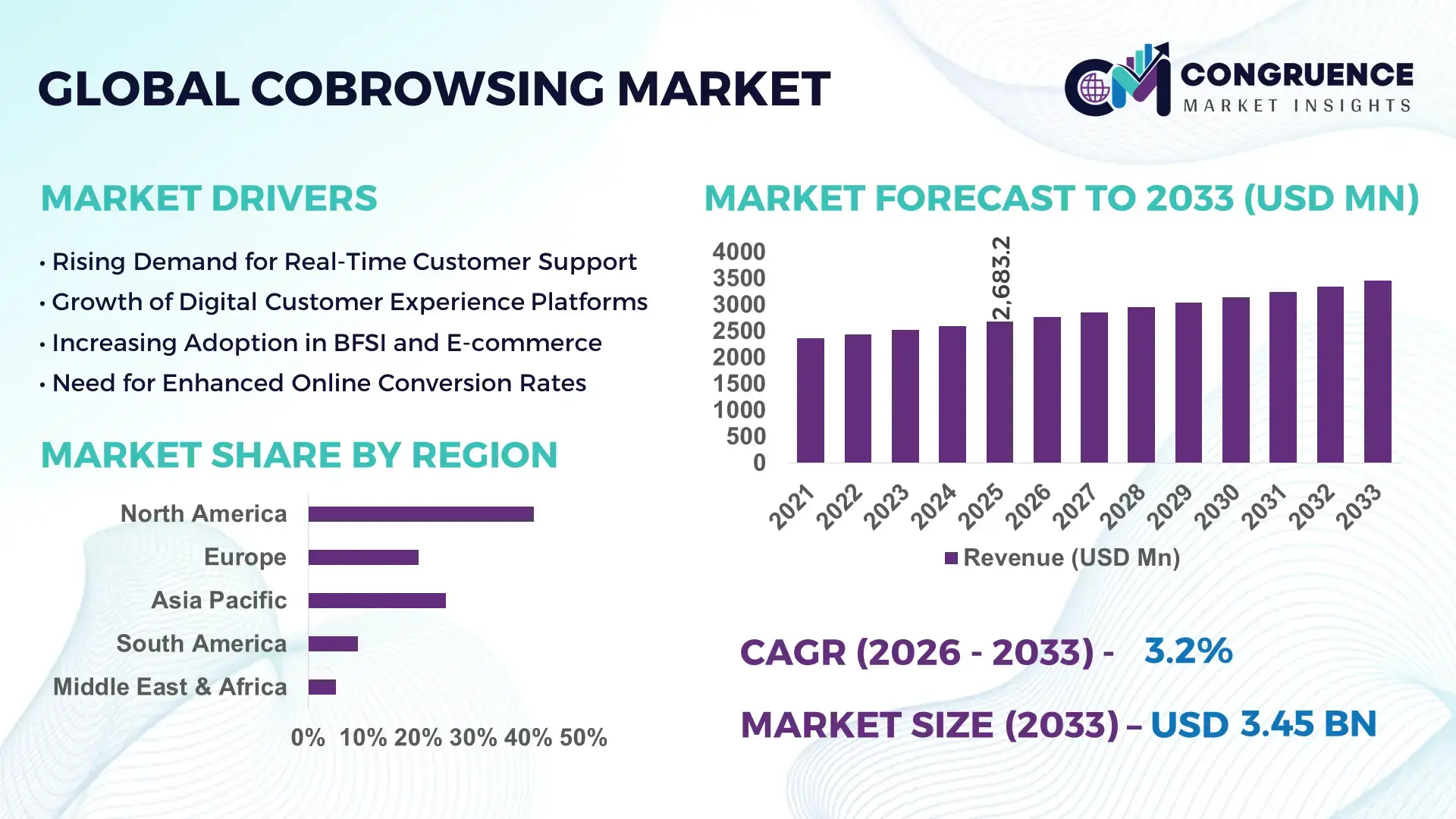
The Global Cobrowsing Market was valued at USD 2683.2 Million in 2025 and is anticipated to reach a value of USD 3452.15 Million by 2033 expanding at a CAGR of 3.2% between 2026 and 2033. The growth is primarily driven by increasing demand for real-time digital customer support solutions across online platforms.
The United States continues to exhibit strong leadership in the cobrowsing market, supported by robust digital infrastructure and enterprise-level investments in customer experience technologies. Over 68% of large enterprises in the country have integrated cobrowsing or co-navigation tools into their customer service ecosystems, particularly in sectors such as BFSI, healthcare, and e-commerce. Annual investments in customer engagement platforms exceed USD 15 billion, with cobrowsing solutions accounting for a growing share due to their ability to enhance first-call resolution rates by up to 30%. Furthermore, over 55% of customer support teams in the U.S. leverage AI-integrated cobrowsing platforms to streamline interactions and reduce handling time. The country also leads in SaaS-based deployment, with more than 70% of cobrowsing tools delivered via cloud infrastructure.
Market Size & Growth: USD 2683.2 Million in 2025, projected to reach USD 3452.15 Million by 2033, growing at 3.2% CAGR, driven by demand for seamless digital customer engagement.
Top Growth Drivers: 62% adoption increase in digital banking support, 48% improvement in customer issue resolution efficiency, 35% reduction in call handling time.
Short-Term Forecast: By 2028, AI-enabled cobrowsing is expected to improve customer support efficiency by 28% and reduce operational costs by 22%.
Emerging Technologies: AI-powered session analytics, browser-based co-navigation tools, and secure screen-sharing protocols are transforming the landscape.
Regional Leaders: North America projected at USD 1320 Million by 2033 with enterprise adoption surge, Europe at USD 890 Million driven by compliance-driven solutions, Asia-Pacific at USD 720 Million fueled by digital banking expansion.
Consumer/End-User Trends: Over 64% of enterprises prioritize cobrowsing for onboarding and troubleshooting, especially in fintech and telecom sectors.
Pilot or Case Example: In 2024, a European telecom provider improved customer issue resolution rates by 31% using AI-driven cobrowsing tools.
Competitive Landscape: Market leader holds approximately 18% share, followed by key players including Genesys, Glia, LivePerson, and Acquire.
Regulatory & ESG Impact: GDPR compliance has driven 52% of European firms to adopt secure cobrowsing solutions with data masking capabilities.
Investment & Funding Patterns: Over USD 1.2 billion invested globally in customer engagement platforms, with increased venture funding in AI-based cobrowsing startups.
Innovation & Future Outlook: Integration with CRM systems, predictive analytics, and omnichannel support platforms is shaping future growth.
Cobrowsing solutions are widely adopted across industries, with BFSI contributing nearly 35% of usage due to secure transaction support, followed by e-commerce at 28% and telecom at 18%. Recent innovations include AI-assisted navigation, real-time behavioral analytics, and zero-download browser integration, enhancing usability and scalability. Regulatory frameworks such as GDPR and CCPA have accelerated the demand for secure, compliant cobrowsing tools with encryption and session masking features. Regionally, North America leads in enterprise deployment, while Asia-Pacific is witnessing rapid adoption due to rising digital transactions and fintech expansion. Future trends indicate increasing convergence with chatbots, voice assistants, and predictive support systems, enabling proactive customer engagement and improved service outcomes.
The cobrowsing market holds significant strategic relevance as enterprises prioritize real-time digital engagement to enhance customer experience and operational efficiency. Modern cobrowsing platforms integrated with AI-driven analytics deliver approximately 32% faster issue resolution compared to traditional screen-sharing or call-based support systems. This measurable improvement underscores the transition toward interactive, guided customer journeys that reduce friction and improve satisfaction metrics.
From a regional perspective, North America dominates in volume due to its mature digital infrastructure, while Asia-Pacific leads in adoption growth, with over 58% of enterprises implementing cobrowsing tools to support expanding digital user bases. The rapid proliferation of mobile-first services and fintech platforms in emerging economies is further accelerating deployment across customer-facing channels.
In the short term, by 2028, AI-enhanced cobrowsing systems are expected to improve first-contact resolution rates by 35% while reducing average handling time by nearly 25%. Enterprises are also aligning with compliance and ESG objectives, committing to data privacy enhancements such as 40% reduction in unauthorized data exposure incidents through encrypted and masked session technologies by 2027.
A practical micro-scenario illustrates this trajectory: in 2024, a leading financial institution in Singapore achieved a 29% improvement in customer onboarding efficiency by implementing AI-powered cobrowsing integrated with identity verification tools. This demonstrates the tangible business value of combining real-time assistance with intelligent automation. Looking ahead, the cobrowsing market is positioned as a critical pillar for digital resilience, enabling organizations to deliver secure, compliant, and scalable customer support solutions while aligning with evolving regulatory and sustainability frameworks.
The exponential growth in digital customer interactions is a primary driver of the cobrowsing market. With over 72% of global consumers preferring online support channels, businesses are investing heavily in technologies that enable real-time assistance. Cobrowsing allows support agents to guide users through complex processes such as form filling, account setup, and troubleshooting, improving resolution rates by up to 30%. In the banking sector, over 65% of digital onboarding processes now incorporate guided navigation tools, reducing abandonment rates significantly. Additionally, e-commerce platforms report a 25% increase in conversion rates when cobrowsing is used during checkout assistance. The integration of AI and analytics further enhances efficiency, enabling predictive support and personalized guidance, thereby strengthening the overall customer experience.
Data privacy and security concerns remain a significant restraint for the cobrowsing market. As cobrowsing involves shared browser sessions, there is a heightened risk of exposing sensitive customer information. Approximately 58% of enterprises cite data security as a major barrier to adoption, particularly in highly regulated industries such as healthcare and finance. Compliance with regulations like GDPR and CCPA requires advanced security features, including data masking and encryption, which increase implementation complexity and costs. Additionally, concerns over unauthorized access and potential data breaches discourage small and medium enterprises from adopting these solutions. The need for continuous monitoring and compliance audits further adds to operational challenges, slowing down market penetration in certain regions.
The integration of artificial intelligence presents significant growth opportunities for the cobrowsing market. AI-powered cobrowsing platforms can analyze user behavior in real time, enabling proactive assistance and reducing resolution time by up to 28%. Over 60% of enterprises are exploring AI-driven customer support solutions to enhance efficiency and personalization. Features such as automated prompts, predictive navigation, and sentiment analysis are transforming traditional cobrowsing into an intelligent support tool. In addition, the rise of digital banking and telehealth services is creating new demand for secure and scalable cobrowsing solutions. Emerging markets in Asia-Pacific and Latin America are also witnessing increased adoption, driven by rapid digitalization and growing internet penetration, opening new avenues for market expansion.
Integration complexities and infrastructure limitations pose significant challenges to the cobrowsing market. Many enterprises operate on legacy systems that are not easily compatible with modern cobrowsing platforms, resulting in increased deployment time and costs. Approximately 47% of organizations report difficulties in integrating cobrowsing tools with existing CRM and customer support systems. Additionally, inconsistent internet connectivity in developing regions affects the performance and reliability of real-time co-navigation, limiting adoption. The need for continuous software updates and system maintenance further adds to operational burdens. Moreover, training support staff to effectively use advanced cobrowsing tools requires additional resources, creating barriers for smaller organizations with limited technical capabilities.
• AI-Driven Customer Assistance Adoption: Enterprises are rapidly integrating AI into cobrowsing platforms, with over 61% of customer support systems now leveraging AI for real-time guidance. This has led to a 27% improvement in first-contact resolution rates and a 22% reduction in customer support costs. AI-enabled session analytics is also helping companies predict user intent with nearly 75% accuracy, enhancing proactive support capabilities.
• Expansion of Cloud-Based Cobrowsing Solutions: Cloud deployment models account for approximately 70% of cobrowsing implementations globally. Businesses adopting cloud-based solutions report a 33% increase in scalability and a 26% reduction in infrastructure costs. The flexibility of SaaS platforms is particularly driving adoption among small and medium enterprises, with usage increasing by 40% over the past three years.
• Integration with Omnichannel Support Systems: Around 68% of enterprises are integrating cobrowsing with omnichannel communication platforms, including chat, voice, and video support. This integration has improved customer satisfaction scores by 30% and reduced service resolution time by 24%. Industries such as telecom and e-commerce are leading this trend, leveraging unified platforms to streamline customer interactions.
• Rise in Modular and Prefabricated Construction: The adoption of modular construction is reshaping demand dynamics in the cobrowsing market. Research suggests that 55% of the new projects witnessed cost benefits while using modular and prefabricated practices in their projects. Pre-bent and cut elements are prefabricated off-site using automated machines, reducing labor needs and speeding project timelines. Demand for high-precision machines is rising, especially in Europe and North America, where construction efficiency is critical.
The cobrowsing market segmentation reflects a structured distribution across solution types, application areas, and end-user industries, each contributing distinctively to overall adoption patterns. By type, solutions range from remote screen-sharing tools to advanced AI-enabled cobrowsing platforms, with enterprises increasingly favoring secure, browser-based deployments due to ease of integration and compliance alignment. Application-wise, customer support and digital onboarding dominate usage, collectively accounting for over 60% of implementations, as businesses prioritize seamless user experiences and reduced interaction friction. From an end-user perspective, sectors such as banking, financial services, and insurance (BFSI), along with e-commerce and telecommunications, represent the largest adopters, driven by high volumes of customer interactions and the need for real-time assistance. Additionally, healthcare and government services are emerging as important segments, particularly where guided navigation improves accessibility and service delivery. Regional adoption patterns further indicate strong enterprise penetration in North America and accelerating uptake in Asia-Pacific, highlighting a balanced mix of mature and emerging market demand.
The cobrowsing market by type includes browser-based cobrowsing, screen-sharing cobrowsing, and AI-integrated cobrowsing platforms. Browser-based cobrowsing currently leads the segment, accounting for approximately 46% of total adoption due to its secure, no-download functionality and seamless integration with existing web applications. In comparison, traditional screen-sharing solutions hold around 28%, primarily used in legacy systems and technical support scenarios. However, AI-integrated cobrowsing is the fastest-growing segment, expanding at an estimated CAGR of 5.1%, driven by its ability to deliver predictive assistance, automate workflows, and enhance user engagement through real-time analytics.
Other niche types, including mobile-first cobrowsing and API-driven custom solutions, collectively contribute nearly 26% of the market, serving specialized enterprise requirements such as app-based customer support and fintech onboarding processes. The increasing shift toward cloud-native and zero-installation platforms further strengthens the position of browser-based solutions.
In terms of application, customer support and troubleshooting dominate the cobrowsing market, accounting for approximately 44% of total usage due to the critical need for real-time issue resolution in digital environments. Digital onboarding and sales assistance follow with a combined share of around 31%, as enterprises leverage cobrowsing to guide users through complex processes such as account creation and product selection. While customer support remains the largest segment, onboarding applications are growing the fastest, with an estimated CAGR of 4.8%, supported by rising adoption in digital banking and insurance services.
Other applications, including training, technical assistance, and internal collaboration, collectively represent about 25% of the market. These use cases are particularly relevant in IT services and enterprise training programs, where guided navigation improves efficiency and reduces learning curves. The integration of cobrowsing with CRM and helpdesk platforms has further expanded its application scope across industries.
The BFSI sector remains the leading end-user of cobrowsing solutions, accounting for approximately 38% of total adoption due to the need for secure, real-time customer interaction during financial transactions and onboarding processes. E-commerce and retail follow with a combined share of around 27%, leveraging cobrowsing to enhance customer experience and increase conversion rates. While BFSI leads in adoption, the healthcare sector is emerging as the fastest-growing end-user, expanding at an estimated CAGR of 5.3%, driven by the increasing use of telehealth services and digital patient support systems.
Other end-users, including telecommunications, government, and education, collectively contribute nearly 35% of the market. Telecom companies report adoption rates exceeding 60% for customer support optimization, while government agencies are increasingly using cobrowsing to improve digital service accessibility. Educational institutions are also adopting these tools for remote guidance and student support.
Region North America accounted for the largest market share at 41% in 2025 however, Asia-Pacific is expected to register the fastest growth, expanding at a CAGR of 5.4% between 2026 and 2033.

North America’s dominance is supported by high enterprise penetration, with over 72% of large organizations deploying advanced customer engagement platforms. Europe follows with approximately 28% share, driven by regulatory compliance and data privacy mandates influencing adoption of secure cobrowsing tools. Asia-Pacific currently contributes around 21% but is witnessing rapid expansion due to digital banking growth, with over 65% of fintech platforms integrating guided navigation solutions. South America and the Middle East & Africa collectively account for nearly 10% of the market, with increasing investments in digital infrastructure and telecom services. Globally, more than 60% of enterprises prioritize cobrowsing for customer onboarding and troubleshooting, while over 48% report measurable improvements in customer satisfaction scores due to real-time interaction capabilities.
How are advanced customer experience technologies transforming enterprise digital support strategies?
North America holds approximately 41% of the cobrowsing market, driven by strong adoption across BFSI, healthcare, and e-commerce sectors. Financial institutions alone contribute over 36% of regional demand, leveraging cobrowsing for secure onboarding and transaction assistance. Regulatory frameworks such as data protection laws and compliance mandates have encouraged nearly 58% of enterprises to adopt encrypted and privacy-focused cobrowsing solutions. The region is also characterized by high cloud adoption, with over 74% of deployments operating on SaaS-based infrastructure. Technological advancements include integration with AI-driven analytics and CRM platforms, improving customer resolution efficiency by over 30%. A key regional player, Genesys, has expanded its AI-powered cobrowsing capabilities, enabling enterprises to enhance real-time engagement and reduce service delays. Consumer behavior in this region reflects a preference for seamless, guided digital experiences, with over 67% of users expecting immediate assistance during online interactions, particularly in finance and healthcare services.
Why is regulatory-driven innovation accelerating secure digital engagement solutions?
Europe accounts for nearly 28% of the cobrowsing market, with key countries such as Germany, the United Kingdom, and France leading adoption. The region’s growth is heavily influenced by stringent data protection regulations, with over 62% of enterprises prioritizing GDPR-compliant solutions that include session masking and encryption features. Financial services and telecom sectors together contribute around 49% of regional demand, driven by the need for secure customer interactions. The adoption of emerging technologies such as AI-based behavioral analytics and omnichannel integration is increasing, with approximately 54% of enterprises implementing advanced customer engagement tools. Local players such as Glia have expanded their presence by offering compliance-focused cobrowsing solutions tailored to European markets. Consumer behavior in this region emphasizes transparency and data security, with nearly 70% of users preferring platforms that clearly communicate privacy safeguards during digital interactions.
What factors are accelerating digital engagement transformation across high-growth economies?
Asia-Pacific ranks as the fastest-growing region in the cobrowsing market, contributing approximately 21% of global demand. Countries such as China, India, and Japan are leading adoption, with over 68% of digital banking platforms integrating cobrowsing capabilities to enhance customer support. Rapid expansion of internet users, exceeding 2.9 billion across the region, is driving demand for scalable customer engagement solutions. Infrastructure development and increased investments in cloud computing are enabling widespread deployment, with nearly 59% of enterprises adopting SaaS-based cobrowsing tools. Innovation hubs in cities like Bangalore, Shenzhen, and Tokyo are fostering advancements in AI-powered customer support technologies. A notable regional player, Freshworks, has strengthened its cobrowsing offerings by integrating them with its CRM ecosystem, improving customer interaction efficiency. Consumer behavior in Asia-Pacific is largely mobile-driven, with over 73% of users preferring app-based support and real-time guidance during online transactions.
How are digital transformation initiatives shaping customer engagement across emerging economies?
South America holds approximately 6% of the cobrowsing market, with Brazil and Argentina being the primary contributors. The region is witnessing gradual adoption driven by expanding telecom infrastructure and increasing digital banking penetration, with over 52% of financial institutions implementing online customer support tools. Government initiatives promoting digital inclusion and fintech innovation are further supporting market growth. Infrastructure improvements, particularly in broadband connectivity, have enabled more reliable real-time interaction capabilities. Trade policies encouraging technology imports have also facilitated the adoption of advanced customer engagement platforms. A regional example includes Brazilian fintech firms deploying cobrowsing tools to enhance onboarding efficiency, achieving improvements of over 24% in customer conversion rates. Consumer behavior in this region is influenced by language localization needs, with more than 60% of users preferring support in native languages, driving demand for customizable cobrowsing solutions.
What role does digital modernization play in enhancing enterprise customer interaction strategies?
The Middle East & Africa region accounts for nearly 4% of the cobrowsing market, with countries such as the United Arab Emirates and South Africa leading adoption. Demand is driven by sectors such as banking, telecom, and government services, where digital transformation initiatives are accelerating. Over 48% of enterprises in the region are investing in customer engagement technologies to improve service delivery. Technological modernization, including cloud adoption and AI integration, is enabling scalable deployment of cobrowsing platforms. Government-led digital transformation programs have encouraged the adoption of secure online services, particularly in the UAE, where over 65% of public services are now digitized. A regional example includes telecom providers implementing cobrowsing tools to reduce customer support time by approximately 20%. Consumer behavior reflects a growing preference for digital channels, with over 58% of users opting for online support over traditional methods.
United States Cobrowsing Market – 38% share: High enterprise adoption and advanced digital infrastructure supporting large-scale deployment of customer engagement solutions.
Germany Cobrowsing Market – 14% share: Strong regulatory framework and widespread adoption of secure, compliance-driven cobrowsing technologies across industries.
The cobrowsing market is moderately fragmented, with over 40 active global and regional players competing across various segments. The top five companies collectively account for approximately 52% of the market, indicating a competitive yet consolidated environment among leading vendors. Key players are focusing on product innovation, strategic partnerships, and acquisitions to strengthen their market position.
Technological differentiation plays a critical role, with companies investing heavily in AI-driven analytics, real-time session monitoring, and secure data-sharing capabilities. Approximately 63% of leading vendors have integrated AI functionalities into their cobrowsing platforms, enabling predictive customer support and improved operational efficiency. Strategic collaborations between software providers and financial institutions have increased by 28% over the past two years, reflecting the growing demand for industry-specific solutions.
Product launches and upgrades are frequent, with over 35% of companies introducing enhanced features such as zero-download integration and advanced encryption protocols. Additionally, mergers and acquisitions have risen by 19%, as firms aim to expand their technological capabilities and geographic presence. The competitive landscape is further influenced by the shift toward cloud-based solutions, with nearly 70% of vendors offering SaaS-based cobrowsing platforms. This dynamic environment continues to drive innovation and differentiation across the market.
Genesys
Glia
LivePerson
Acquire.io
Freshworks
Talkdesk
Surfly
Upscope
REVE Chat
RichCall
Unblu
TeamViewer
Zoho Corporation
The cobrowsing market is being reshaped by rapid advancements in artificial intelligence, cloud-native architectures, and secure browser-based technologies. One of the most significant developments is the integration of AI-driven behavioral analytics, which enables real-time tracking of user interactions and predicts intent with accuracy levels exceeding 70%. This allows support agents to proactively intervene, reducing customer drop-off rates by nearly 25% during critical digital journeys such as onboarding and checkout processes.
Another key technological evolution is the adoption of zero-download, browser-native cobrowsing solutions. These platforms eliminate the need for plugins or software installations, resulting in deployment efficiency improvements of over 40% and reducing onboarding friction for end users. Secure session masking and field-level encryption technologies are also becoming standard, with more than 60% of enterprise-grade solutions incorporating advanced privacy controls to comply with global data protection regulations.
Cloud-based infrastructure continues to dominate, with approximately 72% of cobrowsing deployments leveraging SaaS models for scalability and cost optimization. API-driven integration capabilities are enabling seamless connectivity with CRM, helpdesk, and omnichannel communication platforms, improving workflow efficiency by up to 30%. Additionally, WebRTC technology is enhancing real-time communication by enabling low-latency interactions directly within browsers, supporting both visual guidance and co-navigation features.
Emerging innovations include voice-assisted cobrowsing and augmented reality overlays, which are being piloted in sectors such as telecom and healthcare to guide users through complex processes visually. Furthermore, machine learning models are being trained to automate repetitive support tasks, reducing agent workload by approximately 35%. These technological advancements collectively position cobrowsing as a critical component of next-generation digital customer engagement ecosystems.
• In March 2025, Genesys expanded its AI-powered customer experience platform by enhancing cobrowsing capabilities with predictive engagement tools, enabling real-time customer intent detection and improving first-contact resolution rates by over 30%. Source: www.genesys.com
• In September 2024, Glia introduced an upgraded digital customer service platform featuring secure cobrowsing with advanced masking and compliance controls, supporting financial institutions in meeting stringent data privacy requirements while improving digital onboarding efficiency by 25%. Source: www.glia.com
• In May 2025, LivePerson launched enhanced conversational cloud features integrating cobrowsing with AI-driven messaging, allowing enterprises to unify chat, voice, and co-navigation, resulting in a 20% improvement in customer engagement metrics. Source: www.liveperson.com
• In November 2024, Freshworks strengthened its CRM ecosystem by integrating cobrowsing tools within its customer support suite, enabling businesses to deliver guided assistance and reducing average resolution time by approximately 18%. Source: www.freshworks.com
The cobrowsing market report provides a comprehensive analysis of industry dynamics, covering a wide spectrum of solution types, application areas, technologies, and geographic regions. The scope includes detailed segmentation across browser-based, screen-sharing, and AI-integrated cobrowsing platforms, with a focus on their deployment across cloud and on-premise environments. It evaluates key application areas such as customer support, digital onboarding, sales assistance, and internal collaboration, which collectively account for over 70% of market utilization.
Geographically, the report spans major regions including North America, Europe, Asia-Pacific, South America, and the Middle East & Africa, capturing regional variations in adoption patterns, infrastructure readiness, and regulatory frameworks. It also highlights country-level insights for leading markets, where enterprise adoption rates exceed 60% in digitally mature economies. From a technology perspective, the report examines advancements in AI-driven analytics, WebRTC-based communication, and secure data-sharing protocols, which are increasingly integrated into over 65% of modern cobrowsing solutions. Industry-specific analysis is also included, focusing on sectors such as BFSI, healthcare, e-commerce, telecom, and government services, where cobrowsing adoption is driven by the need for real-time, personalized customer engagement.
Additionally, the report explores emerging niches such as mobile-first cobrowsing and AR-assisted guidance tools, which are gaining traction in high-growth digital ecosystems. It provides insights into enterprise adoption trends, user behavior patterns, and innovation pipelines, offering decision-makers a structured understanding of the market’s breadth, operational scope, and evolving technological landscape.
| Report Attribute/Metric | Report Details |
|---|---|
|
Market Revenue in 2025 |
USD V2025 Million |
|
Market Revenue in 2033 |
USD V2033 Million |
|
CAGR (2026 - 2033) |
3.2% |
|
Base Year |
2025 |
|
Forecast Period |
2026 - 2033 |
|
Historic Period |
2021 - 2025 |
|
Segments Covered |
By Types
By Application
By End User
|
|
Key Report Deliverable |
Revenue Forecast, Growth Trends, Market Dynamics, Segmental Overview, Regional and Country-wise Analysis, Competition Landscape |
|
Region Covered |
North America, Europe, Asia-Pacific, South America, Middle East, Africa |
|
Key Players Analyzed |
Genesys, Glia, LivePerson, Acquire.io, Freshworks, Talkdesk, Surfly, Upscope, REVE Chat, RichCall, Unblu, TeamViewer, Zoho Corporation |
|
Customization & Pricing |
Available on Request (10% Customization is Free) |




