
Reports
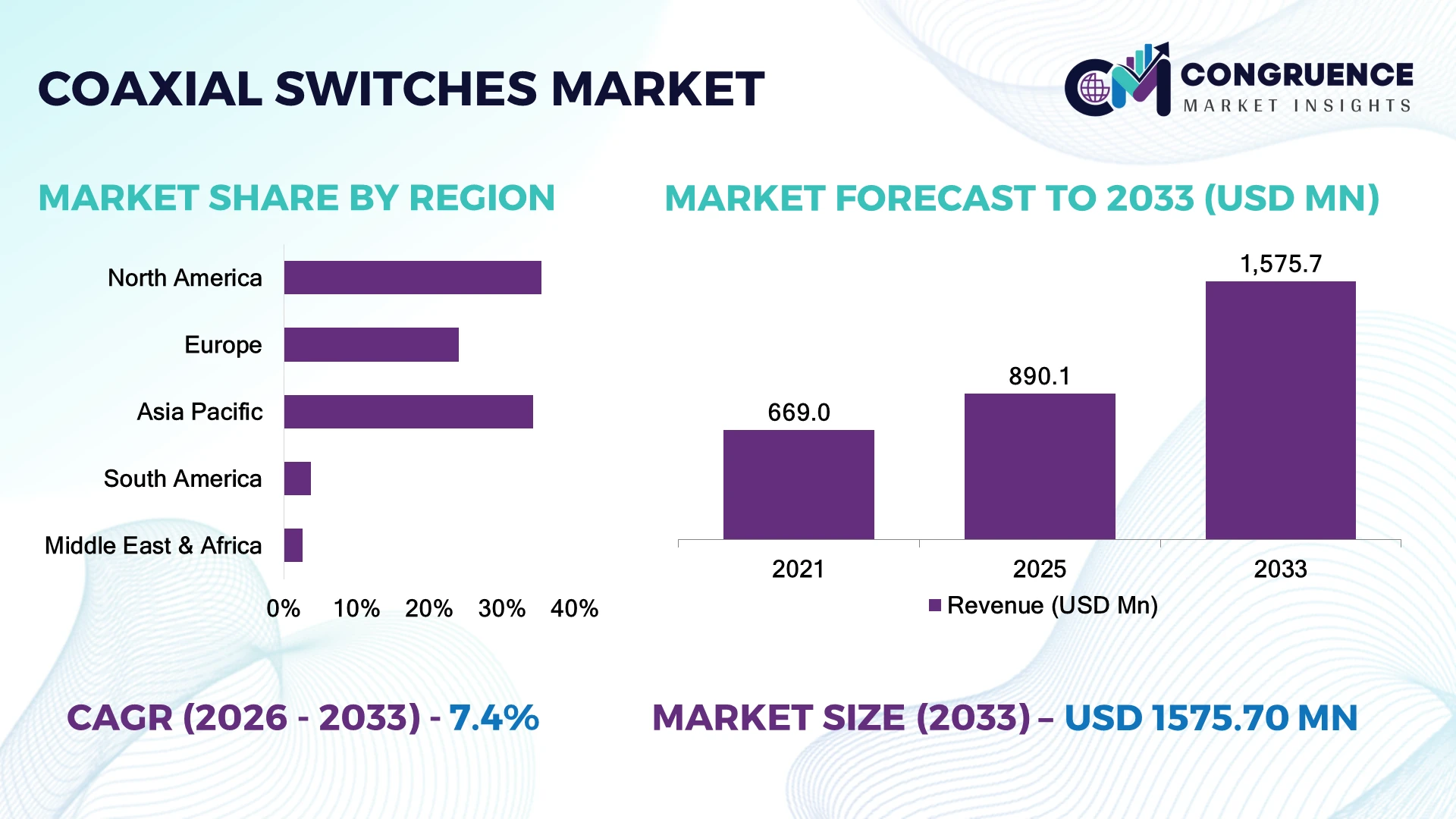
The Global Coaxial Switches Market was valued at USD 890.1 Million in 2025 and is anticipated to reach a value of USD 1,575.7 Million by 2033 expanding at a CAGR of 7.4% between 2026 and 2033. Growth is driven by expanding 5G infrastructure, satellite communications, defense radar modernization, and increasing RF test automation across aerospace and semiconductor manufacturing.
The United States dominates the global coaxial switches market with approximately 34% market share, supported by substantial investments in defense electronics, satellite communications, and advanced semiconductor testing infrastructure. Compared with Japan, the United States maintains broader deployment across military and commercial RF systems, while Japan excels in precision switching technologies. Nearly 62% of newly deployed RF test systems integrate high-frequency coaxial switching solutions. Ongoing geopolitical emphasis on secure defense supply chains and domestic semiconductor manufacturing continues accelerating investment in advanced RF components.
Manufacturers prioritizing high-frequency performance, long operational life, and automated switching capabilities are strengthening competitive positioning across aerospace, telecommunications, and electronic test applications.
Market Size & Growth: USD 890.1 million (2025) to USD 1,575.7 million (2033) at 7.4% CAGR, driven by 5G, aerospace, and RF automation.
Top Growth Drivers: 5G deployment (+29%), defense electronics (+24%), semiconductor testing (+22%).
Short-Term Forecast: By 2028, RF test efficiency improves 26% while switching downtime declines 18%.
Emerging Technologies: MEMS switching, solid-state RF switching, and AI-enabled automated test systems accelerate adoption.
Regional Leaders: North America (~USD 560 million), Asia-Pacific (~USD 470 million), Europe (~USD 340 million), supported by telecom and defense modernization.
Consumer/End-User Trends: More than 58% of new RF laboratories deploy automated coaxial switching architectures.
Pilot/Case Example: A 2026 automated aerospace RF testing upgrade reduced validation time by 27%.
Competitive Landscape: Top five vendors control approximately 45% share, led by Keysight Technologies, Teledyne, Amphenol, Radiall, and Smiths Interconnect.
Regulatory & ESG Impact: Automated RF testing lowers laboratory energy consumption by approximately 15%.
Investment & Funding: More than USD 2.8 billion supports semiconductor fabs, defense electronics, and advanced RF manufacturing.
Innovation & Future Outlook: High-frequency switching above 110 GHz and automated RF platforms reshape next-generation testing.
The coaxial switches market is becoming increasingly important across telecommunications, aerospace, defense, semiconductor testing, and satellite communication systems where reliable RF signal routing is critical. Solid-state technologies, MEMS integration, and automated RF test architectures improve switching reliability by approximately 24% while reducing maintenance requirements. Supply-chain localization and high-frequency system deployment continue influencing product development, creating a strong foundation for the strategic market transformation discussed below.
Coaxial switches have become a strategic component within modern RF infrastructure as telecom operators, aerospace manufacturers, defense contractors, and semiconductor companies require highly reliable signal routing for increasingly complex communication and test environments. Expansion of satellite constellations, Open RAN deployments, and advanced radar modernization programs is reshaping procurement priorities, while semiconductor supply-chain localization is strengthening demand for precision RF switching technologies used in automated production and validation systems.
Solid-state coaxial switches deliver switching speeds approximately 40% faster than conventional electromechanical alternatives while reducing maintenance requirements by nearly 30% in continuous-duty applications. The United States leads deployment through defense and semiconductor investments, whereas Japan and South Korea emphasize precision manufacturing and high-frequency RF innovation. Over the next two to three years, more than 55% of newly commissioned automated RF test systems are expected to incorporate programmable coaxial switching platforms supporting higher-frequency communications and advanced wireless technologies.
Manufacturers are expanding production capacity, strengthening aerospace partnerships, and investing in high-frequency product portfolios exceeding traditional RF operating ranges. Automated semiconductor testing, phased-array radar validation, and satellite payload integration increasingly depend on intelligent switching architectures. Companies capable of combining precision engineering, extended lifecycle reliability, and scalable automated RF solutions will secure long-term competitive advantage across rapidly evolving communications and defense ecosystems.
Rapid modernization of defense communications, satellite payloads, and high-frequency wireless infrastructure is accelerating demand for precision coaxial switches. More than 61% of newly commissioned RF test platforms now incorporate automated switching architectures, while adoption of millimeter-wave frequencies has increased by approximately 28% across advanced telecom applications. The United States continues expanding domestic semiconductor fabrication and defense electronics programs, increasing procurement of high-reliability RF components. This shift enables faster testing, improved signal integrity, and higher operational availability. Manufacturers are responding through expanded production capacity, investment in low-loss switching technologies, and strategic collaborations with aerospace and test-equipment providers to develop switches capable of supporting frequencies exceeding 110 GHz with extended mechanical life.
Production of high-performance coaxial switches remains dependent on specialized RF connectors, precision-machined assemblies, and low-loss dielectric materials supplied by a limited manufacturing base. Material and component procurement lead times have increased by approximately 19%, while precision machining costs remain nearly 17% above pre-disruption levels. Export controls affecting advanced electronic components have added complexity for manufacturers serving international defense and semiconductor customers. These constraints increase production costs, extend delivery schedules, and reduce operational flexibility for customized orders. Companies are mitigating risks through supplier diversification, localized precision manufacturing, long-term procurement agreements, and increased qualification of alternative component sources to improve supply resilience.
The expansion of automated semiconductor validation, satellite manufacturing, and Open RAN testing is creating substantial opportunities for intelligent coaxial switching platforms. Automated RF laboratories improve test throughput by approximately 27%, while programmable switching architectures reduce manual configuration time by nearly 32%. Japan continues investing in advanced semiconductor production and precision electronic testing, encouraging wider adoption of software-controlled RF systems. Equipment manufacturers are strengthening partnerships with automated test solution providers, expanding programmable product portfolios, and integrating remote diagnostics into switching platforms. A significant emerging opportunity lies in cloud-connected RF laboratories, where centralized test management reduces operational costs while improving equipment utilization across multiple facilities.
Maintaining consistent electrical performance above millimeter-wave frequencies presents a major long-term engineering challenge as communication systems continue increasing bandwidth and operating frequency. Signal insertion loss rises by approximately 18% at higher frequencies, while impedance deviations can reduce measurement accuracy by nearly 15% in complex RF environments. South Korea's rapid development of advanced wireless technologies is increasing demand for tighter manufacturing tolerances and improved calibration consistency. Manufacturers must invest in advanced materials, precision machining, digital calibration systems, and high-frequency validation capabilities to maintain long-term competitiveness. Solving signal integrity challenges will become essential as aerospace, defense, and next-generation communications require increasingly precise RF switching performance.
MEMS Switching Adoption Expands: MEMS-based coaxial switches are increasingly replacing traditional mechanical designs in compact RF systems, improving switching speed by approximately 35% while reducing power consumption by nearly 20%. Miniaturization requirements in satellite payloads and defense electronics are accelerating adoption. Manufacturers are expanding MEMS production capabilities and strengthening partnerships with aerospace equipment developers.
Automated Test Platform Integration: Semiconductor manufacturers are integrating programmable coaxial switches into automated RF validation systems, increasing testing throughput by approximately 29% and reducing operator intervention by nearly 24%. Advanced packaging and higher-frequency chipsets are reshaping laboratory workflows. Equipment suppliers are expanding software integration and automated calibration capabilities to improve operational efficiency.
Higher Frequency Product Development: Demand for coaxial switches supporting frequencies above 110 GHz has increased by approximately 26% as 6G research, satellite communications, and radar modernization accelerate. Precision manufacturing requirements continue tightening across advanced RF applications. Companies are investing in new connector technologies, low-loss materials, and specialized production facilities to strengthen competitive positioning.
Localized Manufacturing Strategies: Supply-chain diversification is encouraging manufacturers to establish regional production and precision assembly operations closer to defense and semiconductor customers. Local sourcing has reduced component delivery times by approximately 18%, while production flexibility has improved by nearly 16%. Companies are expanding strategic manufacturing partnerships and digital supply-chain monitoring to improve resilience against geopolitical trade disruptions.
Electromechanical coaxial switches account for approximately 61% of the global market due to their superior power handling, low insertion loss, long electrical life, and proven reliability across defense, aerospace, and RF test environments. Their ability to support demanding microwave and millimeter-wave applications makes them the preferred choice for mission-critical systems. Solid-state coaxial switches remain strategically important where rapid switching speed and compact integration outweigh higher insertion loss, while hybrid switching architectures continue expanding in specialized communication and automated testing platforms.
Solid-state coaxial switches represent the fastest-growing type as semiconductor testing, Open RAN infrastructure, and automated RF systems increasingly prioritize switching speed and remote programmability. Switching cycle efficiency has improved by approximately 34%, while compact RF module integration has increased by nearly 26%. Manufacturers are expanding solid-state product portfolios, investing in gallium nitride technologies, and strengthening partnerships with automated test equipment providers. Investment priorities are steadily shifting toward intelligent, software-controlled switching platforms capable of supporting higher-frequency and highly automated RF environments.
According to 2026 findings published by the IEEE Microwave Theory and Techniques Society, increasing deployment of automated microwave measurement systems continues driving adoption of programmable high-frequency RF switching technologies across research and industrial laboratories.
RF test and measurement represents the largest application segment, accounting for approximately 39% of market demand due to rising semiconductor validation, wireless communication testing, and aerospace electronics qualification requirements. Precision switching improves automated testing efficiency while minimizing signal degradation across high-frequency measurement environments. Telecommunications infrastructure remains a mature application supported by expanding 5G deployment, while defense communication and satellite systems continue generating stable procurement for high-reliability switching solutions. Industrial research laboratories also contribute to sustained demand through advanced RF development programs.
Satellite communication is the fastest-growing application as low Earth orbit constellations, high-throughput satellites, and ground station modernization require increasingly sophisticated RF switching architectures. Automated satellite testing has improved operational efficiency by approximately 29%, while programmable switching reduces configuration time by nearly 23%. Manufacturers are expanding high-frequency product development, integrating remote monitoring capabilities, and collaborating with satellite equipment providers. Demand is shifting toward compact, high-cycle switching solutions capable of supporting continuous operation in advanced space communication infrastructure.
Industry observations released during 2025 by the International Telecommunication Union highlighted continued expansion of satellite communication infrastructure, increasing demand for advanced RF switching and signal management technologies.
Telecommunications companies account for approximately 37% of total coaxial switch demand as continuous deployment of 5G infrastructure, Open RAN networks, and mobile backhaul systems requires reliable RF signal routing and automated network testing. High deployment volumes and ongoing network optimization sustain procurement across both infrastructure vendors and service providers. Aerospace and defense organizations continue representing a mature high-value segment requiring mission-critical switching reliability, while semiconductor manufacturers increasingly adopt programmable switching to support automated chip validation and production testing.
Semiconductor manufacturers are the fastest-growing end-user segment as advanced chip fabrication and RF device validation require highly automated testing environments. Automated production lines have increased programmable RF switching utilization by approximately 31%, while remote test management improves equipment productivity by nearly 22%. Manufacturers are introducing customized switching solutions, strengthening partnerships with automated test equipment companies, and expanding application-specific product portfolios. Competitive positioning is increasingly centered on delivering scalable, software-controlled RF switching platforms that support next-generation semiconductor manufacturing and advanced wireless technologies.
According to a 2026 enterprise assessment released by SEMI, semiconductor manufacturers continue increasing investment in automated RF test infrastructure to improve production efficiency, precision measurement capability, and high-frequency device qualification.
North America accounted for the largest market share at 35.4% in 2025 however, Asia-Pacific is expected to register the fastest growth, expanding at a CAGR of 8.2% between 2026 and 2033.

Defense Electronics and RF Automation Sustain Market Leadership
North America contributes approximately 35.4% of the global coaxial switches market, supported by advanced aerospace programs, defense electronics manufacturing, and extensive semiconductor testing infrastructure. RF component suppliers continue expanding programmable switching solutions for automated test systems, satellite communications, and next-generation wireless networks. Nearly 63% of newly commissioned high-frequency RF laboratories in the region deploy automated coaxial switching platforms to improve testing efficiency and measurement accuracy. Continued investment in domestic semiconductor production and military communication modernization is strengthening demand for high-reliability RF switching technologies while encouraging manufacturers to expand precision production capabilities and engineering partnerships.
United States Market Outlook: The United States dominates regional demand through its concentration of defense contractors, RF instrumentation manufacturers, semiconductor fabrication facilities, and satellite communication programs. Expansion of advanced packaging, radar modernization, and commercial space initiatives continues increasing procurement of high-frequency coaxial switches. More than 70% of domestic RF validation laboratories operate automated switching architectures, reinforcing demand for programmable, long-life switching solutions capable of supporting advanced microwave and millimeter-wave applications.
Precision Engineering Supports Advanced RF Systems
Europe accounts for approximately 24% of the global market, driven by strong aerospace manufacturing, industrial electronics, and advanced telecommunications infrastructure. The region emphasizes precision RF engineering, product reliability, and compliance with demanding performance specifications for defense and scientific applications. More than 56% of new RF instrumentation deployed by leading research laboratories incorporates programmable coaxial switching technologies. Manufacturers continue strengthening engineering collaboration, expanding high-frequency product development, and modernizing production facilities to support increasingly sophisticated wireless communication and satellite applications.
Germany Market Outlook: Germany leads the European market through its advanced industrial manufacturing ecosystem, precision engineering expertise, and strong presence in automotive electronics and research instrumentation. National manufacturers continue integrating automated RF testing into semiconductor development and industrial communications. Expansion of advanced research laboratories and industrial digitalization programs supports consistent demand for reliable coaxial switching technologies across high-performance electronic applications.
Semiconductor Expansion Accelerates RF Component Demand
Asia-Pacific is the fastest-expanding regional market as semiconductor manufacturing, wireless infrastructure deployment, and satellite communication investments continue accelerating. China, Japan, South Korea, and Taiwan collectively represent the largest concentration of RF component manufacturing and electronic testing capacity. Approximately 61% of newly installed semiconductor RF validation equipment in the region includes automated coaxial switching platforms. Manufacturers are increasing investment in high-frequency production capabilities, advanced materials, and localized supply chains to support growing demand across telecommunications and defense electronics.
China Market Outlook: China leads regional demand through large-scale telecommunications deployment, semiconductor manufacturing expansion, and continued investment in aerospace and satellite technologies. Domestic manufacturers are strengthening production of RF components while expanding automated testing infrastructure for advanced wireless systems. Ongoing development of high-frequency communication equipment and growing domestic electronics production continue reinforcing demand for precision coaxial switching solutions.
Telecommunications Modernization Strengthens RF Infrastructure
South America is steadily expanding its coaxial switches market through telecom infrastructure upgrades, satellite communication projects, and modernization of electronic testing capabilities. Brazil and Argentina are increasing deployment of RF equipment supporting wireless communications, defense systems, and industrial electronics. Automated RF testing capacity has expanded by approximately 21% across major electronics facilities, improving product validation efficiency. Although dependence on imported high-frequency components remains a constraint, manufacturers and distributors are strengthening regional partnerships to improve product availability and technical support.
Brazil Market Outlook: Brazil represents the largest market in the region due to its expanding telecommunications infrastructure, aerospace industry, and growing electronics manufacturing sector. National investment in wireless connectivity, satellite communications, and industrial automation continues driving demand for RF switching components. Increasing adoption of automated electronic testing platforms supports procurement of programmable coaxial switches across commercial and government technology programs.
Strategic Infrastructure Investment Expands RF Deployment
The Middle East & Africa market is advancing through sustained investment in defense modernization, satellite communications, and national digital infrastructure programs. Governments continue upgrading secure communication systems while expanding deployment of advanced RF technologies supporting aviation, public safety, and telecommunications. Approximately 37% of newly commissioned strategic communication projects incorporate programmable RF switching equipment for improved operational flexibility. International technology partnerships and infrastructure modernization initiatives are strengthening long-term demand for high-performance coaxial switching solutions.
United Arab Emirates Market Outlook: The United Arab Emirates has emerged as the region's leading market through continuous investment in aerospace, satellite communications, defense technology, and advanced telecommunications infrastructure. National smart city initiatives and secure communication projects continue increasing deployment of sophisticated RF systems requiring precision switching technologies. Expansion of high-technology industrial zones and advanced electronic testing capabilities further supports sustained market development across critical communication applications.
The market is moderately consolidated, with the top five manufacturers accounting for approximately 47% of global demand. Keysight Technologies, Teledyne Relays, Radiall, Smiths Interconnect, and Amphenol compete through high-frequency performance and automated RF integration, while specialized RF component suppliers challenge established leaders with customized, application-specific designs. Competition focuses on insertion loss, switching speed, lifecycle durability, and frequency range rather than pricing alone. High-frequency platforms improve signal integrity by approximately 22%, automated switching reduces RF validation time by nearly 27%, and precision manufacturing lowers calibration variation by around 18%. Companies are expanding millimeter-wave product portfolios, strengthening aerospace and semiconductor partnerships, integrating programmable control systems, and vertically securing precision component supply. Competition is shifting toward high-frequency, software-enabled switching architectures supporting satellite communications and advanced semiconductor testing. Strict qualification standards and precision manufacturing capabilities remain significant entry barriers. Winning requires ultra-reliable performance, programmable automation, scalable production, and sustained high-frequency innovation.
Keysight Technologies
Teledyne Relays
Radiall
Smiths Interconnect
Amphenol Corporation
Pasternack
Fairview Microwave
Ducommun Incorporated
HUBER+SUHNER
Cobham Advanced Electronic Solutions
ETL Systems
Rosenberger Hochfrequenztechnik GmbH & Co. KG
Modern coaxial switches increasingly integrate electromechanical precision, solid-state switching, MEMS technology, programmable control interfaces, and millimeter-wave compatibility to support aerospace, telecommunications, semiconductor testing, and satellite communications. Solid-state architectures improve switching speed by approximately 40%, while advanced contact materials reduce insertion loss by nearly 15%. More than 60% of newly installed automated RF test systems now utilize programmable coaxial switches with remote monitoring capabilities. These technologies improve measurement consistency, minimize downtime, and strengthen operational efficiency across high-frequency environments.
Emerging innovation is centered on gallium nitride switching circuits, MEMS miniaturization, software-defined RF routing, and AI-assisted automated calibration. Compared with conventional electromechanical systems, intelligent programmable switching platforms reduce configuration time by approximately 32% while improving test throughput by nearly 27%. Around 48% of advanced semiconductor validation facilities now deploy automated RF switching architectures. Aerospace manufacturers, satellite operators, and semiconductor fabs benefit through faster validation cycles, higher equipment utilization, and improved signal integrity across increasingly complex microwave applications.
Between 2026 and 2028, switching technologies exceeding 110 GHz, digital twin-based RF testing, and predictive equipment diagnostics will redefine precision measurement infrastructure. Manufacturers investing in programmable high-frequency platforms, advanced materials, and software-integrated switching ecosystems will strengthen competitive positioning as satellite communications, 6G research, and advanced semiconductor validation continue demanding higher performance and operational reliability.
July 2024 – Radiall introduced its SP8T Zc 40 GHz high-performance coaxial switch, engineered for automated RF test systems with operation up to 40 GHz, strengthening high-frequency measurement capability while improving switching flexibility for aerospace and semiconductor applications. Source: Radiall
April 2025 – Radiall expanded its RF portfolio with the DP3T & SPDT 67 GHz coaxial switch platform, supporting frequencies up to 67 GHz for next-generation wireless, aerospace, and defense applications. The launch reinforces leadership in millimeter-wave switching technologies. Source: Radiall Insights
April 2025 – Smiths Interconnect launched DaVinci Gen V, supporting digital signaling speeds up to 224 Gbps PAM4 and over 100 GHz for advanced semiconductor testing. The innovation enhances signal integrity and accelerates validation for AI and emerging 6G devices. Source: Smiths Group
February 2026 – Molex unveiled Cardinal Multi-Port High-Frequency Coaxial Assemblies supporting frequencies up to 145 GHz and data characterization reaching 448 Gbps, advancing AI, satellite, and 6G test environments while improving high-density RF measurement performance. Source: Molex
This report provides a comprehensive assessment of the global coaxial switches market across product types, applications, end-user industries, and key geographic regions. It evaluates electromechanical, solid-state, and hybrid switching technologies supporting RF test and measurement, telecommunications, satellite communications, aerospace, defense, and semiconductor manufacturing. The analysis covers North America, Europe, Asia-Pacific, South America, and the Middle East & Africa while examining deployment patterns, technology adoption, manufacturing trends, and competitive positioning across high-frequency RF ecosystems.
The report further analyzes programmable RF architectures, MEMS integration, gallium nitride technologies, automated calibration, and millimeter-wave switching solutions shaping market evolution between 2026 and 2033. Nearly 60% of advanced RF testing environments now utilize automated programmable switching platforms, reflecting rapid digital transformation across precision measurement infrastructure. The findings support investment planning, product innovation, expansion strategy, competitive benchmarking, and long-term market positioning by identifying technology priorities, emerging application opportunities, and evolving procurement trends across the global RF component value chain.
| Report Attribute/Metric | Report Details |
|---|---|
|
Market Revenue in 2025 |
USD 890.1 Million |
|
Market Revenue in 2033 |
USD 1,576.0 Million |
|
CAGR (2026 - 2033) |
7.4% |
|
Base Year |
2025 |
|
Forecast Period |
2026 - 2033 |
|
Historic Period |
2021 - 2025 |
|
Segments Covered |
By Type
By Application
By End-User
|
|
Key Report Deliverable |
Revenue Forecast, Growth Trends, Market Dynamics, Segmental Overview, Regional and Country-wise Analysis, Competition Landscape |
|
Region Covered |
North America, Europe, Asia-Pacific, South America, Middle East, Africa |
|
Key Players Analyzed |
Keysight Technologies, Teledyne Relays, Radiall, Smiths Interconnect, Amphenol Corporation, Pasternack, Fairview Microwave, Ducommun Incorporated, HUBER+SUHNER, Cobham Advanced Electronic Solutions, ETL Systems, Rosenberger Hochfrequenztechnik GmbH & Co. KG |
|
Customization & Pricing |
Available on Request (10% Customization is Free) |




