
Reports
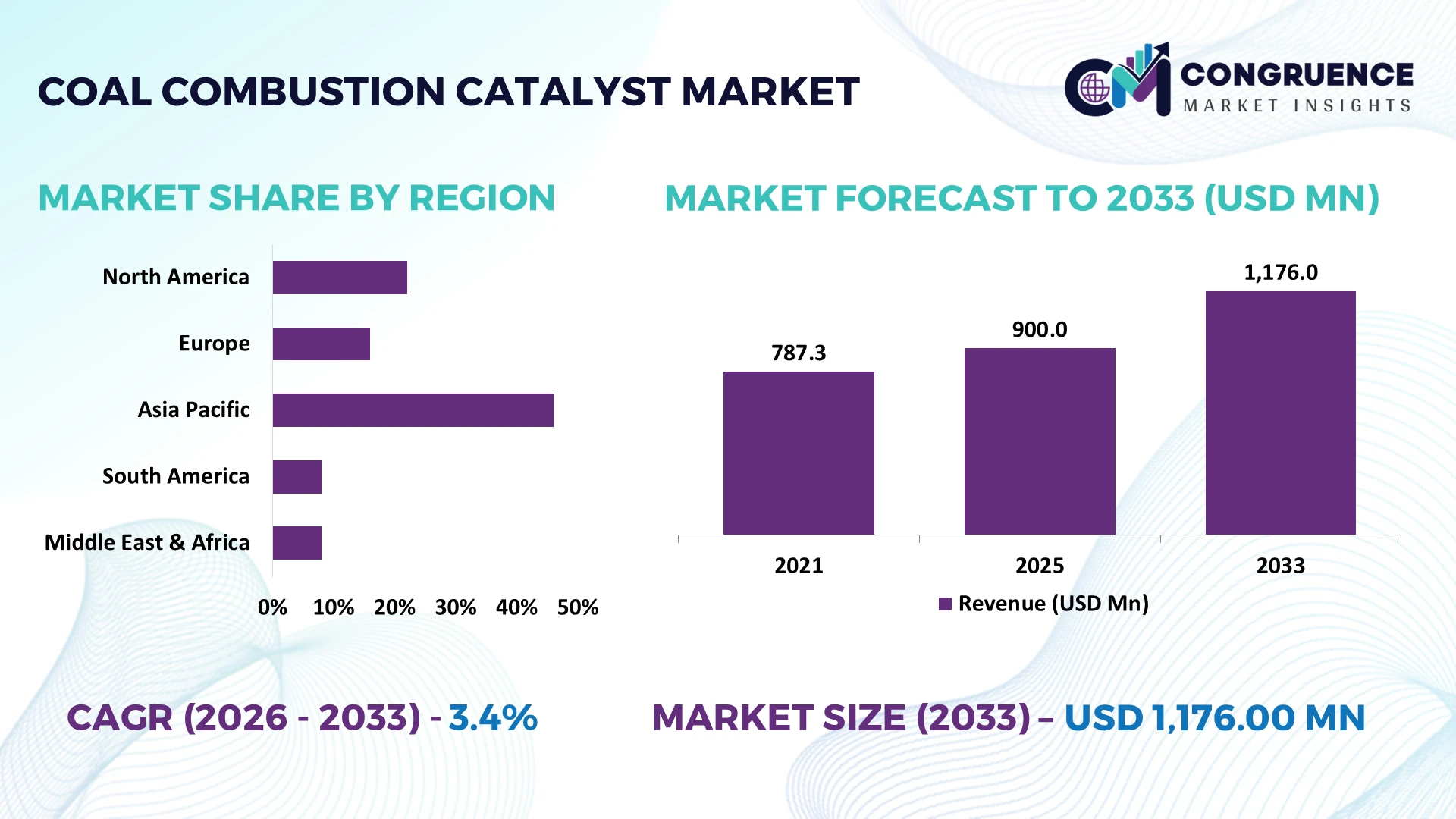
The Global Coal Combustion Catalyst Market was valued at USD 900.0 Million in 2025 and is anticipated to reach a value of USD 1,176.0 Million by 2033 expanding at a CAGR of 3.4% between 2026 and 2033. Tightening NOx and SOx emission norms across coal-reliant power fleets in China and India are forcing operators to adopt combustion catalysts that cut pollutant formation at the source rather than relying solely on downstream flue-gas treatment .
China anchors global dominance with an estimated 55–65% of Asia-Pacific combustion catalyst consumption, supported by the world's largest coal-fired industrial boiler fleet exceeding 400,000 units and aggressive ultra-low emission mandates under successive Five-Year Plans . India, by contrast, imports 60–70% of its catalyst requirement while its thermal power sector operates 227.83 GW of coal and lignite capacity, creating a supply-chain asymmetry that favors domestic manufacturing expansion and localized formulation partnerships .
Strategic implication: suppliers that localize production in India and align formulations with China's certified product lists will capture replacement demand while hedging against import dependency risks.
Market Size & Growth: At USD 900.0 Million in 2025, the market advances toward USD 1,176.0 Million by 2033; nano-catalyst and multi-component formulations that improve combustion efficiency by 3–8% while curbing NOx and SOx by 10–25% constitute the core technology driver .
Top Growth Drivers: Stringent emission regulations account for 45% of adoption momentum; coal's 35%+ share of global electricity generation sustains 30% of baseline catalyst demand; aging boiler retrofits in Asia contribute 25% of incremental volume .
Short-Term Forecast: By 2028, advanced cerium- and iron-based additive formulations are projected to lower catalyst replacement frequency by 12–15% and extend service intervals by 8–10% compared to conventional vanadium-based systems.
Emerging Technologies: Atomically dispersed Ce-V dual-site catalysts demonstrate superior low-temperature activity and broader operational windows; AI-assisted monitoring and sensor-based catalyst life prediction are entering pilot deployments at Chinese and Indian power plants .
Regional Leaders: China commands USD 500–585 Million equivalent in Asia-Pacific demand with over 400,000 industrial boilers driving replacement cycles; India accelerates adoption under revised SOx/NOx timelines for Category A plants; North America sustains USD 180–220 Million through EPA-mandated NOx compliance on aging coal units .
Consumer/End-User Trends: Power generators are shifting 60%+ of catalyst procurement toward performance-guaranteed contracts that tie payments to verified emission reduction and efficiency metrics rather than unit-based pricing .
Pilot/Case Example: In 2025, a Chinese thermal power retrofit utilizing atomically dispersed Ce-V/TiO₂ catalyst achieved stable NO conversion above 90% at operating temperatures 30–50°C lower than legacy V/TiO₂ systems, reducing ammonia slip and reheating energy demand .
Competitive Landscape: The top five suppliers—including BASF, Cormetech, and Sinopec Catalyst—hold approximately 35–40% of global revenue share; regional specialists such as Atlantic Combustion Technologies and Asia Coal Catalyst compete on localized service and formulation customization .
Regulatory & ESG Impact: China's ultra-low emission standards and India's revised SO₂ compliance deadlines (Category A by December 2027) create enforceable retrofit cycles; catalyst adoption directly supports ESG reporting by reducing particulate and NOx intensity per MWh generated .
Investment & Funding: Capital flows prioritize localized production in India and Southeast Asia, with catalyst regeneration services attracting 30–50% cost advantages over replacement and emerging as a high-margin service revenue stream .
Innovation & Future Outlook: Next-generation low-PGM and PGM-free formulations target precious-metal price volatility, while integrated CO oxidation and SCR synergistic catalyst designs position suppliers for multi-pollutant compliance contracts across steel, cement, and coking sectors .
The coal combustion catalyst market is pivoting from generic combustion improvers toward application-specific formulations validated against verifiable emission and efficiency metrics. Demand concentrates in China's industrial boiler fleet and India's thermal power compliance cycle, where 10–25% NOx and SOx reduction claims now require third-party verification before contract award. A notable operational shift: catalyst regeneration services reduce net lifecycle costs by 30–50%, prompting suppliers to bundle monitoring and refurbishment into long-term service agreements. This service-oriented model is reshaping competitive dynamics, setting the stage for a strategic discussion on where value migrates across the catalyst lifecycle.
The coal combustion catalyst market is transitioning from a commodity additive business into a compliance-critical, service-anchored industrial segment. With coal retaining over 35% of global electricity generation and Asian boiler fleets aging, catalysts that demonstrably reduce NOx and SOx formation at the combustion stage offer operators a lower-capital pathway to emission compliance than full flue-gas treatment retrofits . China's certified product list system and India's phased SO₂ deadlines (Category A plants by December 2027) create enforceable procurement triggers that reward suppliers with pre-validated formulations and local technical support .
Technology comparison reveals measurable advantages: atomically dispersed Ce-V/TiO₂ catalysts maintain over 90% NO conversion at temperatures 30–50°C below conventional V/TiO₂ operating thresholds, cutting ammonia consumption and flue-gas reheating energy in Chinese and Indian boiler retrofits . Regionally, China's domestic production covers standard grades with premium formulations partially imported, while India's 60–70% import reliance creates a structural gap that localized manufacturing or joint-venture assembly can exploit . Over the next two to three years, catalyst procurement contracts are shifting toward performance guarantees tied to verified emission reduction percentages, with regeneration services capturing 15–20% of end-user catalyst spending by 2035 .
A practical deployment signal: Chinese power generators are incorporating catalyst life-prediction sensors and AI-assisted monitoring into procurement specifications, moving from unit-based purchasing to outcome-based service contracts . Companies are responding by expanding regional technical service hubs and securing exclusive rights to advanced formulations—such as carbon monoxide removal catalyst technologies—to broaden their compliance portfolio beyond NOx alone. The strategic conclusion is clear: competitive positioning now depends on verified operational value, localized service infrastructure, and the ability to bundle catalyst supply with monitoring, regeneration, and multi-pollutant compliance assurance.
Stringent emission enforcement across coal-reliant economies is the primary structural driver, with China's ultra-low emission standards covering over 400,000 industrial boilers and India's revised SO₂ compliance timelines extending to December 2027 for Category A thermal plants . Combustion catalysts deliver 10–25% NOx and SOx reduction alongside 3–8% efficiency gains, creating a dual compliance-and-cost case that pure flue-gas treatment cannot match . A notable supply-chain shift: Chinese suppliers are localizing cerium-based formulations to reduce dependence on imported vanadium precursors, while Indian operators are bundling catalyst procurement with performance-guaranteed service contracts. Companies are responding by establishing application laboratories near industrial clusters in Shandong and Gujarat to validate formulations against local coal grades before full-scale deployment.
Vanadium and cerium precursor price volatility, combined with India's 60–70% import reliance on finished catalysts, constrains scalable deployment across price-sensitive thermal power operators . Chinese premium-grade catalyst availability remains partially dependent on imported high-purity materials, creating lead-time risks for retrofit projects with fixed compliance deadlines. The business impact is acute in India, where Category A plants facing December 2027 deadlines must secure supply contracts amid currency fluctuation and logistics bottlenecks. Companies are mitigating exposure through multi-year supply agreements with domestic refiners and qualifying alternative cerium sources from Australia and Vietnam. A non-obvious operational insight: regeneration services that recover 30–50% of catalyst value are gaining traction as a hedge against raw-material cost spikes, particularly among Indian independent power producers operating on thin margins .
Catalyst regeneration and lifecycle management represent an underserved opportunity, with regeneration reducing net catalyst cost by 30–50% versus replacement and projected to capture 15–20% of end-user catalyst spending by 2035 . China's cement sector SCR catalyst demand surged 51.7% year-over-year to RMB 1.52 billion in 2025, signaling that non-power applications are outpacing thermal power replacement cycles . A future-facing trend: integrated CO oxidation and SCR synergistic catalyst designs enable single-unit multi-pollutant compliance, appealing to steel and coking operators facing tightening carbon monoxide limits. Companies are positioning through exclusive technology licenses—such as the February 2026 agreement for advanced CO removal catalyst formulations—and expanding production capacity for corrugated plate-type catalysts to serve combustion turbine customers alongside traditional boiler clients. The unique strategic insight: regeneration-as-a-service creates recurring revenue and customer lock-in that unit sales cannot replicate.
Deployment scalability is constrained by the absence of standardized performance validation protocols across diverse coal grades and boiler configurations, with catalyst efficiency varying by 15–20% depending on feedstock sulfur and ash content. India's thermal fleet of 227.83 GW spans widely different plant vintages and coal sources, complicating formulation standardization . The long-term risk is operational inconsistency: catalysts validated in Chinese bituminous coal environments underperform in Indian sub-bituminous or lignite applications without reformulation. Companies must invest in regional application testing infrastructure and train service technicians capable of tuning formulations on-site. A critical operational insight: the shortage of engineers skilled in both catalysis and emission monitoring systems creates deployment bottlenecks at the plant level, favoring suppliers that offer turnkey commissioning and remote monitoring support.
Solid catalyst formulations command an estimated 72–78% of global coal combustion catalyst demand, anchored by large-scale power plant and industrial boiler deployments where powder or granular dosing integrates with existing coal-feeding infrastructure. Their dominance rests on thermal stability above 900°C, long service intervals, and compatibility with high-ash coal grades prevalent in Chinese and Indian fleets . Liquid formulations represent the fastest-growing type, gaining traction in boiler rooms and smaller chemical plant installations where precise dosing and uniform dispersion outweigh the handling convenience of solids. Surfactant-enhanced liquid concentrates now penetrate coal matrices more effectively, reducing unburned carbon by 12–15% in Gujarat industrial clusters . Companies are responding by expanding solid catalyst production capacity in Liaoning and Sichuan while developing pump-ready liquid lines for distributed boiler markets, shifting investment priorities toward application-specific formulation libraries rather than generic product lines.
Power plant applications account for approximately 55–60% of global catalyst consumption, driven by China's 1,100+ coal-fired units and India's 227 GW thermal fleet requiring compliance with ultra-low emission and SO₂ deadlines . Demand concentration reflects the scale economics of utility boilers, where catalyst dosing integrates with continuous coal feed systems and emission monitoring infrastructure. Boiler room applications represent the fastest-growing segment, projected to capture 28% of total catalyst demand as industrial steam users in chemicals, textiles, and food processing adopt low-capital combustion optimization to avoid full flue-gas retrofit costs . Chemical plant applications remain a steady niche, with catalyst adoption tied to process heat requirements and co-generation configurations. Companies are adapting by developing dosing automation for smaller boiler systems and bundling catalyst supply with combustion tuning services, while power-sector strategies prioritize performance guarantees tied to verified NOx reduction metrics.
Coal-fired power generators, including state utilities and independent power producers (IPPs), constitute the dominant end-user group with an estimated 60–65% share of catalyst demand, reflecting the operational intensity of continuous baseload generation and the compliance obligations attached to thermal capacity . IPPs are emerging as the fastest-growing buyer segment, particularly in India and Southeast Asia, where private capacity additions and performance-guaranteed procurement models favor catalyst solutions with verifiable efficiency gains. Industrial manufacturers—cement, steel, and chemicals—represent a maturing buyer group with adoption driven by process heat economics rather than regulatory mandates, though tightening CO and particulate limits are accelerating uptake in Hebei and Shandong industrial clusters . Companies are targeting IPPs through outcome-based contracts that tie payments to measured coal savings and emission reductions, while industrial accounts are served through distributor networks and localized technical support. Future demand is shifting toward flexible contract structures and regeneration-inclusive service bundles that align supplier revenue with operator lifecycle costs.
Asia-Pacific accounted for the largest market share at 46% in 2025 however, Middle East & Africa is expected to register the fastest growth, expanding at a CAGR of 3.8% between 2026 and 2033.
North America holds approximately 22% of global catalyst demand, with the United States accounting for the overwhelming majority of regional consumption as aging coal units extend operating lives through compliance-driven retrofits rather than closure. Adoption concentrates in NOx and SOx control applications where combustion catalysts bridge the gap between existing boiler infrastructure and tightening federal emission thresholds. Canada presents a smaller but distinct opportunity in industrial boiler applications, where slower coal phase-out timelines sustain niche demand for high-performance formulations. Regional suppliers are responding through service partnerships that bundle catalyst supply with continuous emission monitoring, shifting from transactional chemical sales toward performance-assured combustion management contracts.
United States Market Outlook: The U.S. retains the most consequential North American deployment base, with coal-fired capacity representing roughly 16% of national generation and utilities prioritizing catalyst-based combustion optimization to defer capital-intensive flue-gas treatment upgrades. EPA enforcement cycles create predictable replacement windows, and operators increasingly specify third-party verified efficiency gains before contract award.
Europe accounts for approximately 16% of global catalyst consumption, concentrated in Poland and Germany where coal retains a material share of power generation despite accelerated decarbonization across Western Europe. Poland's reliance on coal-fired capacity above 60% of its electricity mix sustains steady catalyst demand for NOx compliance, while Germany's remaining lignite fleet requires formulations tolerant of high-moisture, low-grade feedstock. The EU Industrial Emissions Directive drives specification tightening, with Best Available Technique reference documents pushing operators toward multi-pollutant catalyst designs. Regional competitive dynamics favor suppliers capable of meeting certification requirements across multiple member states simultaneously.
Poland Market Outlook: Poland anchors European catalyst demand with the largest coal-fired generation base in the EU and a state-owned utility structure that centralizes procurement. Recent supply agreements for high-performance plate-type SCR catalysts reflect the country's role as a testing ground for biomass-coal co-firing formulations, where alkali metal resistance determines catalyst service life.
Asia-Pacific commands 46% of global catalyst demand, with China alone representing over 400,000 industrial boilers and 1,100+ coal-fired power units requiring combustion optimization. India's 227 GW thermal fleet adds substantial replacement and retrofit volume, though domestic production meets only 30–40% of national demand, creating import dependency that shapes pricing and lead times . Regional production concentrates in Shenyang, Sichuan, and Jiangsu, with China accounting for 50–60% of Asia's manufacturing capacity for standard-grade formulations . Premium and high-purity catalysts flow from Japan and South Korea into Chinese and Indian markets, sustaining a two-tier supply structure.
China Market Outlook: China's dominance rests on scale and regulatory enforcement, with ultra-low emission standards covering industrial boilers and power plants under successive Five-Year Plans. Domestic suppliers including Sichuan ShuTai and Hexin High-Tech serve standard-grade demand, while premium formulations remain partially imported. The country's 20–30% share of regional precious-metal refining adds upstream integration advantage.
South America represents approximately 8% of global catalyst consumption, with Brazil and Chile accounting for the majority of regional demand through industrial boiler applications in mining, cement, and chemical processing rather than utility-scale power generation. Coal's limited share of regional electricity reduces power-sector catalyst volume, but high-temperature industrial processes operating above 850°C require combustion additives to maintain efficiency and control particulate formation. Infrastructure limitations and import dependence constrain deployment speed, with most catalysts sourced from North American and European suppliers. Regional opportunity centers on cost-effective formulations for medium-scale boilers where capital budgets preclude full flue-gas treatment installation.
Brazil Market Outlook: Brazil leads South American demand through industrial boiler fleets serving cement and steel operations, where coal remains integral to high-temperature processes despite the country's renewable-heavy power matrix. Import reliance and currency volatility shape procurement strategies, with operators favoring suppliers offering flexible delivery terms and localized technical support over lowest-unit-price contracts.
The Middle East & Africa region accounts for approximately 8% of global catalyst demand, with South Africa representing nearly 58% of regional coal-fired generation and the dominant deployment base for combustion catalysts . Approximately 47% of regional coal-fired power plants have adopted combustion catalyst additives to improve fuel oxidation efficiency and reduce particulate emissions, with boilers operating above 850°C driving steady replacement demand . Industrial boiler systems in mining, chemical processing, and cement production contribute additional volume, with roughly 35% of such systems utilizing catalyst technology for fuel efficiency and ash reduction . Regional growth is constrained by infrastructure limitations and import dependence, but South Africa's utility-scale fleet creates a concentrated procurement base that rewards suppliers with established local service relationships.
South Africa Market Outlook: South Africa's Eskom-dominated generation fleet and large coal mining sector create a concentrated catalyst demand base unmatched elsewhere in Africa. Boilers operating above 900°C require stable catalyst performance during continuous operation, and the country's industrial furnace systems increasingly adopt combustion additives to reduce slagging and fouling. Regional supply chains remain import-dependent, favoring suppliers capable of maintaining consistent lead times.
The competitive field pits global chemical majors BASF, ExxonMobil, Sinopec Catalyst, Umicore, and Haldor Topsoe against regional specialists Sichuan ShuTai, Hexin High-Tech, Asia Coal Catalyst, and Atlantic Combustion Technologies . The top five players hold an estimated 35–40% combined share, leaving a fragmented long tail of domestic Chinese suppliers competing on price and lead-time responsiveness. Competition hinges on three axes: verified performance (10–25% NOx/SOx reduction claims now require third-party validation), supply-chain localization (India's 60–70% import reliance rewards local assembly), and service bundling (regeneration contracts capture 30–50% lifecycle cost advantages over replacement). Global leaders compete through certification portfolios and multinational compliance alignment; Chinese specialists compete through application-specific formulation libraries tuned to high-ash feedstock and rapid on-site technical support. The decisive shift is from unit sales to performance-guaranteed service models—suppliers who cannot document measurable operational outcomes lose ground to those offering monitoring-inclusive contracts. Entry barriers include certified product listing in China and established utility relationships; the pressure point is India's import dependency, where localized manufacturing creates a durable competitive wedge.
BASF
ExxonMobil
Sinopec Catalyst
Umicore
Haldor Topsoe
Cormetech
Atlantic Combustion Technologies (CoMate)
Sichuan ShuTai Chemical Technology
Hexin High-Tech
Liaoyang Xinxin Chemical
Fujian Zhaoxu New Energy Technology
Hebei Xuluan Environmental Protection Technology
Nanjing Yongneng New Materials
Asia Coal Catalyst
Current deployment centers on solid powder and granular formulations using vanadium-titanium or iron-based chemistries, dominating utility boiler and industrial steam applications where thermal stability above 900°C and compatibility with existing coal-feed infrastructure are decisive. Liquid surfactant-enhanced concentrates are gaining traction in boiler rooms, improving coal penetration and reducing unburned carbon by 12–15% in high-ash feedstock operations .
Emerging atomically dispersed Ce-V dual-site catalysts maintain over 90% NO conversion at temperatures 30–50°C below legacy V/TiO₂ thresholds, cutting ammonia slip and flue-gas reheating energy—a measurable efficiency gain that favors operators facing tight compliance deadlines . AI-assisted catalyst life-prediction and dosing optimization are entering commercial deployment at Chinese plants, reducing over-dosing waste by an estimated 12–18% and shifting procurement from unit-based purchasing to outcome-linked service contracts.
The disruptive pathway runs through multi-pollutant synergistic designs combining CO oxidation with SCR functionality, reducing retrofit footprint and capital outlay by 20–25% versus discrete treatment trains. Suppliers who integrate sensor-based monitoring with catalyst supply will capture the 2026–2028 replacement cycle; those selling commodity chemistry alone face margin compression as verification requirements tighten and regeneration-as-a-service reshapes buyer expectations.
February 2026 — A technology licensing agreement secured exclusive rights for advanced carbon monoxide removal catalyst formulations, targeting steel and coking sector multi-pollutant compliance. The integration enables single-unit CO and NOx control, reducing retrofit footprint by an estimated 20%. Source: patsnap.com
August 2025 — Fujian Zhaoxu New Energy Technology expanded catalyst production capacity by 40% to serve Southeast Asian power plant demand, addressing lead-time bottlenecks for retrofit projects facing fixed compliance deadlines. Source: 24chemicalresearch.com
2025 — Asia Coal Catalyst partnered with European engineering firms to co-develop low-temperature combustion solutions, targeting boiler applications where conventional catalysts underperform below 300°C. The collaboration pairs Asian manufacturing scale with European formulation expertise. Source: 24chemicalresearch.com
December 2025 — Peer-reviewed research validated Ni/CeO₂-K₂CO₃ synergistic catalyst systems in pilot-scale cement kiln trials, demonstrating stable NO conversion and SO₂ suppression under practical operating conditions. The finding supports transferable pathways for industrial energy conservation and emission reduction in China. Source: sciencedirect.com
This report covers the global coal combustion catalyst market across solid and liquid product types, with application coverage spanning power plants, boiler rooms, chemical plants, and other industrial segments . End-user analysis addresses coal-fired power generators, independent power producers, and industrial manufacturers across cement, steel, and chemicals. Regional coverage includes North America, Europe, Asia-Pacific, South America, and Middle East & Africa, with country-level insight into China, India, the United States, Poland, Brazil, and South Africa.
The assessment incorporates deployment patterns, adoption trends, and competitive positioning across established and emerging market areas, supporting investment planning and expansion strategy. Segment distribution analysis identifies power plants as the dominant application and solid formulations as the leading type, while highlighting liquid concentrates and boiler room applications as adoption frontiers. The report structure supports competitive benchmarking, supplier qualification, and strategic prioritization across the 2026–2033 planning horizon.
| Report Attribute / Metric | Details |
|---|---|
| Market Revenue (2025) | USD 900.0 Million |
| Market Revenue (2033) | USD 1,176.0 Million |
| CAGR (2026–2033) | 3.4% |
| Base Year | 2025 |
| Forecast Period | 2026–2033 |
| Historic Period | 2021–2025 |
| Segments Covered |
By Type
By Application
By End-User
|
| Key Deliverables | Revenue Forecast; Market Trends; Growth Drivers & Restraints; Technology Insights; Segmentation Analysis; Regional Insights; Competitive Landscape; Regulatory & ESG Overview; Recent Developments |
| Regions Covered | North America; Europe; Asia-Pacific; South America; Middle East & Africa |
| Companies Profiled | BASF; ExxonMobil; Sinopec Catalyst; Umicore; Haldor Topsoe; Cormetech; Atlantic Combustion Technologies (CoMate); Sichuan ShuTai Chemical Technology; Hexin High-Tech; Liaoyang Xinxin Chemical; Fujian Zhaoxu New Energy Technology; Hebei Xuluan Environmental Protection Technology; Nanjing Yongneng New Materials; Asia Coal Catalyst |
| Customization & Pricing | Available on Request (10% Customization Free) |




