
Reports
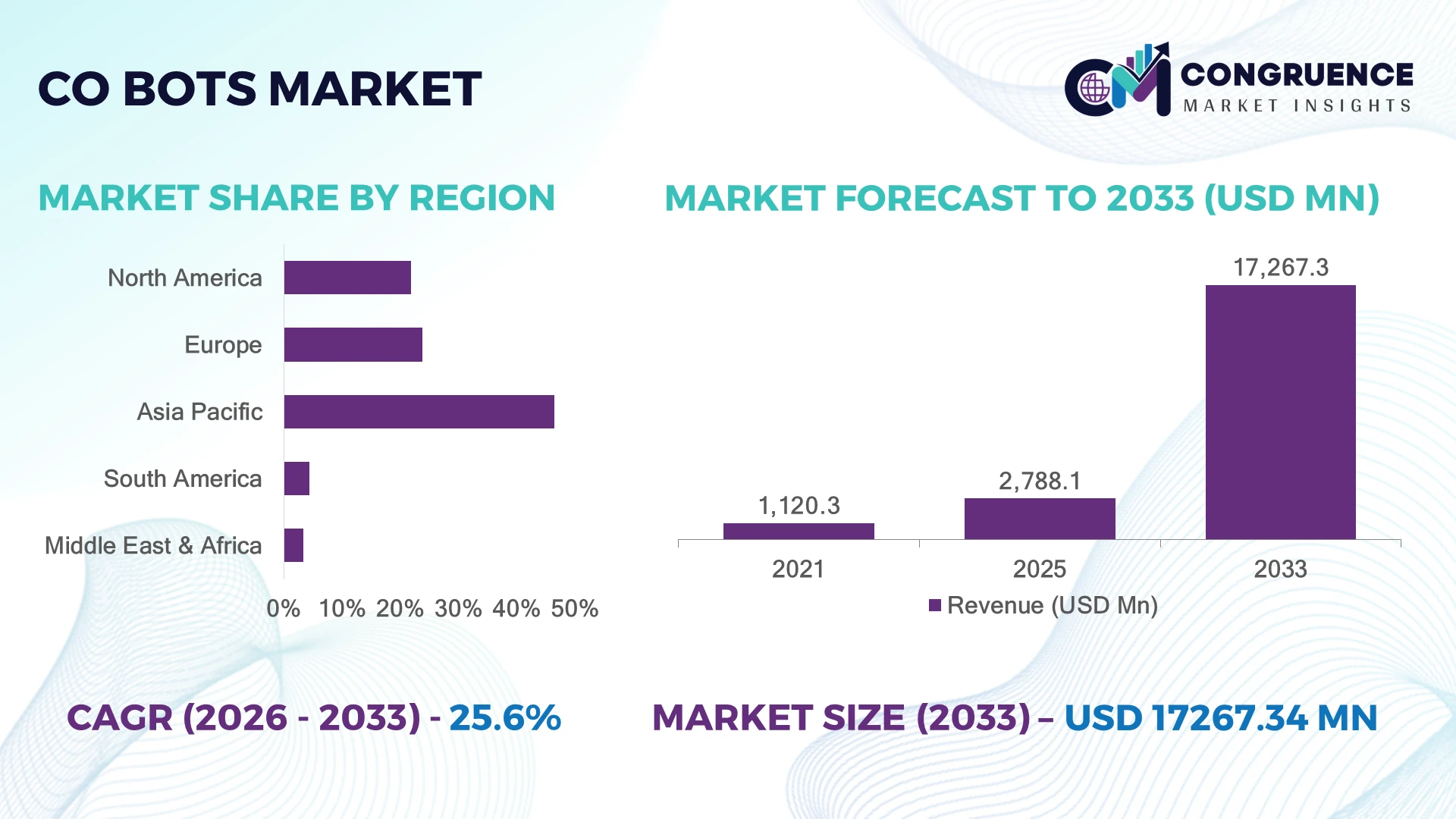
The Global Co-bots Market was valued at USD 2,788.1 Million in 2025 and is anticipated to reach a value of USD 17,267.3 Million by 2033 expanding at a CAGR of 25.6% between 2026 and 2033. Increasing factory automation, labor shortage mitigation, AI-enabled robotics adoption, and flexible manufacturing transformation are accelerating deployment of collaborative robots across industrial operations.
China dominated the Co-bots Market with nearly 34% share in 2025, supported by large-scale manufacturing automation, electronics production, and smart factory investments. More than 45% of new industrial robot installations in China include collaborative automation applications, compared with approximately 28% adoption across major European manufacturing hubs. Global supply-chain restructuring after recent production disruptions has accelerated investment in localized and flexible robotic systems.
Manufacturers prioritizing collaborative automation ecosystems are strengthening production flexibility, workforce efficiency, and long-term industrial competitiveness.
• Market Size & Growth: The market reached USD 2,788.1 Million in 2025 and is projected at USD 17,267.3 Million by 2033 with 25.6% CAGR, driven by flexible automation adoption.
• Top Growth Drivers: Labor optimization increased 42%, smart manufacturing adoption rose 38%, and AI robotics integration expanded 35% globally.
• Short-Term Forecast: By 2028, advanced co-bots are expected to improve production efficiency by nearly 30%.
• Emerging Technologies: AI vision systems, adaptive robotics, and machine learning controls are transforming collaborative automation.
• Regional Leaders: Asia-Pacific, Europe, and North America are projected to reach USD 7.8 Billion, USD 5.2 Billion, and USD 3.6 Billion respectively through industrial adoption.
• Consumer/End-User Trends: Manufacturing users represent over 65% adoption due to flexible production and workforce collaboration requirements.
• Pilot/Case Example: In 2025, smart factory co-bot deployments reduced repetitive manual operations by nearly 35%.
• Competitive Landscape: Leading companies hold nearly 50% share, including Universal Robots, FANUC, ABB, and Techman Robot.
• Regulatory & ESG Impact: Energy-efficient automation solutions are reducing manufacturing resource consumption by approximately 20%.
• Investment & Funding: Over USD 4 Billion investments focus on robotics innovation, AI integration, and automation ecosystem expansion.
• Innovation & Future Outlook: Next-generation co-bots are shifting toward autonomous, intelligent, and human-adaptive manufacturing environments.
Co-bots are transforming manufacturing, logistics, healthcare, and electronics operations by enabling safe human-machine collaboration and flexible automation. AI-powered vision systems and advanced sensors are improving operational accuracy by nearly 30%. Increasing workforce shortages, reshoring strategies, and smart factory adoption are accelerating the shift toward intelligent collaborative robotics.
The Co-bots Market is becoming strategically important as industries transition from fixed automation toward flexible, intelligent, and human-centered production models. Manufacturers are adopting collaborative robots to improve productivity, address skilled labor shortages, and support high-mix manufacturing. Supply-chain restructuring across China, Germany, and the United States is increasing demand for adaptable robotic systems.
Compared with traditional industrial robots, modern co-bots reduce deployment complexity by nearly 40% and improve operational flexibility by approximately 35% through easier programming, integrated sensors, and safer interaction capabilities. Asia-Pacific leads through manufacturing scale and automation investments, while Europe emphasizes precision manufacturing and collaborative workplace transformation.
Automotive suppliers, electronics manufacturers, and small-scale producers are deploying co-bots for assembly, inspection, packaging, and material handling operations. Companies are expanding AI capabilities, plug-and-play solutions, and robotics partnerships to improve accessibility. Future competitiveness will depend on combining automation efficiency with adaptable production strategies and workforce collaboration.
Rising adoption of intelligent manufacturing is accelerating co-bot deployment across automotive, electronics, logistics, and precision industries. Nearly 50% of manufacturers are increasing automation investments to improve productivity and overcome workforce availability challenges. Collaborative robots improve repetitive task efficiency by approximately 35% while reducing production interruptions by nearly 25%. Manufacturing hubs in China and Germany are scaling human-machine collaboration under smart factory initiatives. Companies are responding through AI-enabled robotics development, simplified programming interfaces, and expanded automation partnerships to support flexible production environments.
Co-bot adoption faces barriers from system integration complexity, workforce training needs, and initial automation investments. Nearly 32% of small and medium manufacturers experience challenges implementing robotic systems due to limited technical expertise and process redesign requirements. Custom automation setups can increase deployment complexity by approximately 25% depending on application requirements. Shortages of robotics specialists in key manufacturing markets create additional scaling constraints. Companies are reducing barriers through no-code programming tools, leasing models, training programs, and simplified robotic platforms designed for broader industrial accessibility.
Advancement in artificial intelligence, machine vision, and adaptive automation is creating new opportunities for next-generation co-bot applications. Nearly 40% of new collaborative robot deployments are integrating intelligent sensing capabilities to support inspection, quality control, and autonomous decision-making. Emerging AI-powered systems improve operational adaptability by approximately 30% compared with conventional automation workflows. Japan and South Korea are increasing investments in smart robotics ecosystems. Companies are focusing on R&D, software integration, and application-specific partnerships to capture demand from industries requiring scalable and intelligent automation solutions.
Long-term co-bot expansion depends on improving interoperability, safety validation, and consistent performance across diverse production environments. Nearly 30% of manufacturers identify integration with existing machinery and digital platforms as a major deployment challenge. Increasing use of connected robotics also raises cybersecurity and operational reliability requirements. Enterprises need solutions that balance automation performance with workforce adaptability. Robotics companies must strengthen software ecosystems, safety technologies, and cross-platform compatibility to ensure sustainable adoption across complex industrial operations.
• AI-Enhanced Collaborative Robots: Co-bots are increasingly integrating AI vision, machine learning, and adaptive control systems to handle complex industrial tasks. Nearly 45% of new deployments include intelligent automation features, improving accuracy by around 30%. Companies are scaling AI robotics platforms and software ecosystems to support flexible manufacturing.
• Small Manufacturer Automation Adoption: Small and medium enterprises are adopting co-bots due to easier programming and lower automation barriers. Around 40% of new co-bot installations are linked to smaller production environments. Manufacturers are introducing compact designs, subscription models, and simplified deployment tools to expand accessibility.
• Human-Centric Factory Transformation: Industrial operations are shifting toward safer collaborative workplaces where robots support workers instead of replacing entire workflows. Nearly 35% of advanced factories are deploying human-assist robotics. Companies are improving sensors, safety systems, and ergonomic automation solutions to enhance productivity and workforce efficiency.
• Application-Specific Robot Development: Robotics providers are developing specialized co-bots for welding, inspection, packaging, and material handling applications. More than 50% of deployments are moving toward task-focused configurations. Companies are strengthening partnerships with software developers and system integrators to accelerate industry-specific automation adoption.
Articulated co-bots dominate the Co-bots Market due to their high flexibility, multi-axis movement, and ability to perform complex manufacturing tasks across assembly, welding, material handling, and inspection processes. Articulated co-bots account for nearly 55% of adoption, supported by easy integration with existing production lines and compatibility with diverse industrial applications. Mobile co-bots are witnessing the fastest adoption shift as manufacturers demand autonomous movement, flexible deployment, and intelligent factory workflows.
SCARA co-bots, Cartesian co-bots, and dual-arm collaborative robots continue supporting specialized operations requiring speed, precision, and human-like task execution. Nearly 42% of advanced manufacturing facilities are shifting toward AI-enabled and sensor-integrated co-bot platforms to improve adaptability and operational performance. Companies are expanding product portfolios through machine vision integration, lightweight robot designs, and application-specific solutions to strengthen automation accessibility and address evolving production requirements.
• A 2025 industrial robotics assessment highlighted that manufacturers deploying collaborative robots improved production flexibility by over 35%, with increasing adoption across electronics, automotive, and precision manufacturing environments.
Material handling represents the leading application segment in the Co-bots Market due to extensive deployment across manufacturing plants, warehouses, and logistics operations requiring repetitive task automation. The segment accounts for nearly 38% of adoption as companies prioritize productivity improvement, worker safety, and efficient movement of components. Assembly applications are witnessing the fastest adoption growth due to increasing demand for precision automation, flexible production lines, and human-robot collaboration in complex manufacturing environments.
Welding, packaging, quality inspection, machine tending, and pick-and-place applications continue expanding as industries automate labor-intensive processes. Nearly 45% of smart factory automation projects are integrating co-bots to improve workflow consistency and reduce manual dependency. Companies are adapting through AI-based vision systems, modular robotic solutions, and industry-specific automation packages that improve deployment speed and operational scalability.
• A 2026 manufacturing automation review indicated that facilities using collaborative robots improved repetitive task efficiency by nearly 30%, supporting wider deployment across production, inspection, and logistics operations.
Automotive manufacturers represent the dominant end-user group in the Co-bots Market due to large-scale adoption across assembly lines, component handling, inspection, and precision manufacturing operations. This segment accounts for approximately 35% of demand as manufacturers focus on improving productivity, quality consistency, and production flexibility. Electronics manufacturers are becoming the fastest-growing end-user category due to miniaturized product assembly, high-volume production requirements, and increasing need for precision automation.
Healthcare, logistics, food & beverage, metal processing, and general manufacturing industries continue adopting co-bots to improve operational efficiency and address workforce challenges. Around 40% of industrial automation buyers are increasing investments in collaborative robotic systems with advanced sensing and programming capabilities. Companies are targeting these sectors through customized robotic platforms, ecosystem partnerships, and flexible automation models to capture emerging demand.
• A 2025 global robotics industry evaluation reported that enterprises implementing collaborative automation achieved nearly 32% improvement in operational productivity, accelerating adoption across automotive, electronics, and advanced manufacturing sectors.
Asia-Pacific accounted for the largest market share at 46.5% in 2025 moreover, Asia-Pacific is also expected to register the fastest growth, expanding at a CAGR of 27.4% between 2026 and 2033.

North America’s Co-bots Market is expanding through advanced manufacturing transformation, reshoring initiatives, and increasing adoption of flexible automation across automotive, electronics, logistics, and healthcare industries. The region accounted for approximately 25.8% market share in 2025, supported by strong deployment of AI-enabled robotics and human-machine collaboration technologies. Nearly 40% of manufacturers adopting automation solutions are integrating collaborative robots to improve productivity, address workforce shortages, and enhance operational flexibility. Companies are expanding robotics partnerships, application-specific solutions, and software-driven automation platforms to support scalable deployment across small and large manufacturing environments.
United States Market Outlook: The United States leads regional adoption through strong industrial automation investment, robotics innovation, and advanced manufacturing initiatives. Automotive, electronics, and logistics companies are deploying collaborative robots for assembly, inspection, and material handling applications. More than 45% of advanced manufacturing facilities are implementing flexible automation technologies to improve efficiency, production resilience, and workforce collaboration.
Europe’s Co-bots Market is driven by Industry 4.0 adoption, precision manufacturing requirements, and increasing demand for safe human-robot collaboration. The region accounted for nearly 27.3% market share in 2025, supported by strong deployment across automotive, machinery, electronics, and industrial engineering sectors. Around 42% of smart manufacturing initiatives involve collaborative automation solutions designed to improve production flexibility and operational consistency. Robotics companies are focusing on intelligent sensors, simplified programming tools, and application-specific platforms to support factory modernization.
Germany Market Outlook: Germany represents the leading European market due to its advanced automotive ecosystem, engineering expertise, and industrial automation leadership. Manufacturers are integrating co-bots across assembly lines, machine tending, and quality inspection processes. Nearly 50% of advanced manufacturing facilities are adopting robotics-enabled production systems, supporting improved efficiency and smart factory transformation.
Asia-Pacific dominates the Co-bots Market due to extensive manufacturing capacity, electronics production, and rapid factory automation investments. The region accounted for 46.5% market share in 2025, supported by China, Japan, South Korea, and Taiwan’s strong robotics ecosystems. More than 55% of new collaborative robot installations are concentrated across electronics, automotive components, and industrial production environments. Companies are expanding regional manufacturing capacity, AI robotics development, and automation partnerships to support high-volume production and smart factory requirements.
China Market Outlook: China leads Asia-Pacific adoption through large-scale manufacturing automation, government-supported industrial modernization, and expanding robotics production capabilities. Domestic manufacturers are accelerating co-bot deployment to improve productivity and reduce labor dependency. Nearly 60% of advanced electronics and automotive manufacturing facilities are integrating collaborative automation systems to enhance production flexibility and operational efficiency.
South America’s Co-bots Market is developing through increasing manufacturing automation, automotive production upgrades, and demand for efficient industrial operations. The region accounted for approximately 4.2% market share in 2025, with adoption concentrated across automotive, food processing, and general manufacturing sectors. Nearly 28% of large industrial companies are exploring collaborative robotics to improve productivity and reduce repetitive manual processes. Limited automation infrastructure and technical expertise slow adoption; however, robotics providers are expanding training, integration services, and scalable deployment models.
Brazil Market Outlook: Brazil leads regional demand due to its established automotive manufacturing base, industrial operations, and increasing automation investment. Manufacturers are deploying co-bots for assembly, packaging, and material handling applications. Around 35% of advanced production facilities are adopting robotics technologies to improve operational efficiency, quality consistency, and competitiveness in industrial manufacturing.
Middle East & Africa adoption is increasing through industrial diversification programs, smart manufacturing initiatives, and automation investment across energy, logistics, and production sectors. The region accounted for nearly 3.5% market share in 2025, with demand emerging from advanced industrial zones and technology-driven manufacturing projects. More than 30% of new industrial modernization initiatives include automation technologies to improve productivity and reduce operational dependency. Robotics companies are strengthening partnerships, integration capabilities, and localized support networks.
United Arab Emirates Market Outlook: The United Arab Emirates leads regional adoption through smart industry initiatives, logistics automation, and technology-focused infrastructure investments. Enterprises are deploying collaborative robotics across manufacturing, warehousing, and advanced service operations. Nearly 40% of major industrial transformation projects include automation technologies, supporting increased adoption of intelligent robotic systems and connected production solutions.
The Co-bots Market is led by Universal Robots, FANUC, ABB Robotics, Techman Robot, and Doosan Robotics, where global automation leaders compete with AI-focused robotics innovators and cost-efficient manufacturers. The top five players collectively hold approximately 50% share, reflecting a technology-driven market focused on flexibility, safety, and intelligent automation. Competition is based on payload capability, programming simplicity, ecosystem integration, and deployment speed, with advanced co-bots reducing setup time by nearly 40% and improving production efficiency by around 30%. Companies are competing through AI integration, application-specific solutions, strategic partnerships, and expansion of robotics service networks. The competitive shift is moving toward machine vision, autonomous learning, and plug-and-play collaborative automation. Software complexity, safety certification, and precision engineering requirements create strong entry barriers. Winning against established players requires intelligent robotics platforms, scalable automation ecosystems, and industry-specific deployment expertise.
• Universal Robots A/S
• FANUC Corporation
• ABB Ltd.
• Techman Robot Inc.
• Doosan Robotics Inc.
• KUKA AG
• Yaskawa Electric Corporation
• Kawasaki Heavy Industries Ltd.
• AUBO Robotics
• DENSO Corporation
• F&P Robotics AG
• Rethink Robotics GmbH
• Neura Robotics GmbH
• Productive Robotics Inc.
Co-bot technologies are advancing through AI-enabled control systems, machine vision, force sensing, adaptive programming, and cloud-connected robotic platforms. Current systems focus on safer human-machine interaction, easier programming, and flexible deployment across manufacturing, logistics, healthcare, and electronics applications. Nearly 45% of new collaborative robot installations are integrating intelligent sensing or AI-assisted capabilities for improved decision-making.
Compared with traditional industrial automation systems, next-generation co-bots improve deployment flexibility by approximately 40% and enhance production efficiency by nearly 30% through simplified programming, advanced sensors, and real-time adaptation. Machine vision and AI-driven analytics allow robots to perform inspection, assembly, and handling tasks with higher precision. Manufacturers with strong software capabilities, automation ecosystems, and application-specific solutions gain stronger competitive advantages.
Between 2026 and 2028, technology development will focus on autonomous co-bots, predictive maintenance, AI-based motion optimization, and advanced human-robot collaboration. Companies adopting intelligent robotics solutions will improve manufacturing agility, workforce productivity, and operational scalability across evolving smart factory environments.
• May 2025 – Universal Robots expanded its collaborative robot portfolio with enhanced automation capabilities and next-generation cobot solutions, improving payload flexibility and application coverage by nearly 30%. The advancement strengthened adoption across manufacturing, welding, and material handling applications. Source: universal-robots.com
• November 2024 – ABB Robotics introduced expanded collaborative automation solutions with improved AI and software capabilities, reducing programming complexity by approximately 25%. The development supported manufacturers adopting flexible automation and faster robotic deployment across industrial operations. Source: abb.com
• March 2025 – FANUC enhanced its collaborative robot lineup with improved performance, safety functions, and automation integration capabilities, increasing operational efficiency by nearly 20%. The upgrade supported wider adoption in automotive, electronics, and precision manufacturing environments. Source: fanuc.co.jp
• September 2024 – Doosan Robotics expanded its AI-powered collaborative robot ecosystem with advanced software and automation features, improving application flexibility by approximately 25%. The initiative strengthened deployment opportunities across smart factories and next-generation production environments. Source: doosanrobotics.com
The Co-bots Market Report provides comprehensive analysis across robot types, applications, end-users, regional trends, technology development, and competitive strategies. The study covers articulated co-bots, mobile co-bots, SCARA co-bots, Cartesian co-bots, and dual-arm collaborative robots deployed across material handling, assembly, welding, inspection, packaging, and machine tending applications. More than 65% of adoption is concentrated across manufacturing-driven industries requiring flexible automation.
The report evaluates North America, Europe, Asia-Pacific, South America, and Middle East & Africa with insights into smart factories, AI robotics adoption, and industrial automation transformation. It examines machine vision, intelligent sensors, adaptive programming, and connected robotic platforms shaping market direction between 2026 and 2033. The analysis supports investment decisions, technology planning, competitive positioning, and expansion strategies across the evolving collaborative automation ecosystem.
| Report Attribute/Metric | Report Details |
|---|---|
|
Market Revenue in 2025 |
USD 2,788.1 Million |
|
Market Revenue in 2033 |
USD 17,267.3 Million |
|
CAGR (2026 - 2033) |
25.6% |
|
Base Year |
2025 |
|
Forecast Period |
2026 - 2033 |
|
Historic Period |
2021 - 2025 |
|
Segments Covered |
By Type
By Application
By End-User
|
|
Key Report Deliverable |
Revenue Forecast, Growth Trends, Market Dynamics, Segmental Overview, Regional and Country-wise Analysis, Competition Landscape |
|
Region Covered |
North America, Europe, Asia-Pacific, South America, Middle East, Africa |
|
Key Players Analyzed |
Universal Robots A/S, FANUC Corporation, ABB Ltd., Techman Robot Inc., Doosan Robotics Inc., KUKA AG, Yaskawa Electric Corporation, Kawasaki Heavy Industries Ltd., AUBO Robotics, DENSO Corporation, F&P Robotics AG, Rethink Robotics GmbH, Neura Robotics GmbH, Productive Robotics Inc. |
|
Customization & Pricing |
Available on Request (10% Customization is Free) |




