
Reports
The Global CNC Router Market was valued at USD 800.7 Million in 2025 and is anticipated to reach a value of USD 1,325.2 Million by 2033 expanding at a CAGR of 6.5% between 2026 and 2033. Growth is being driven by automated nesting, shorter production runs, labor substitution, and rising adoption of digitally connected machining workflows across furniture, signage, woodworking, plastics, and composite fabrication.
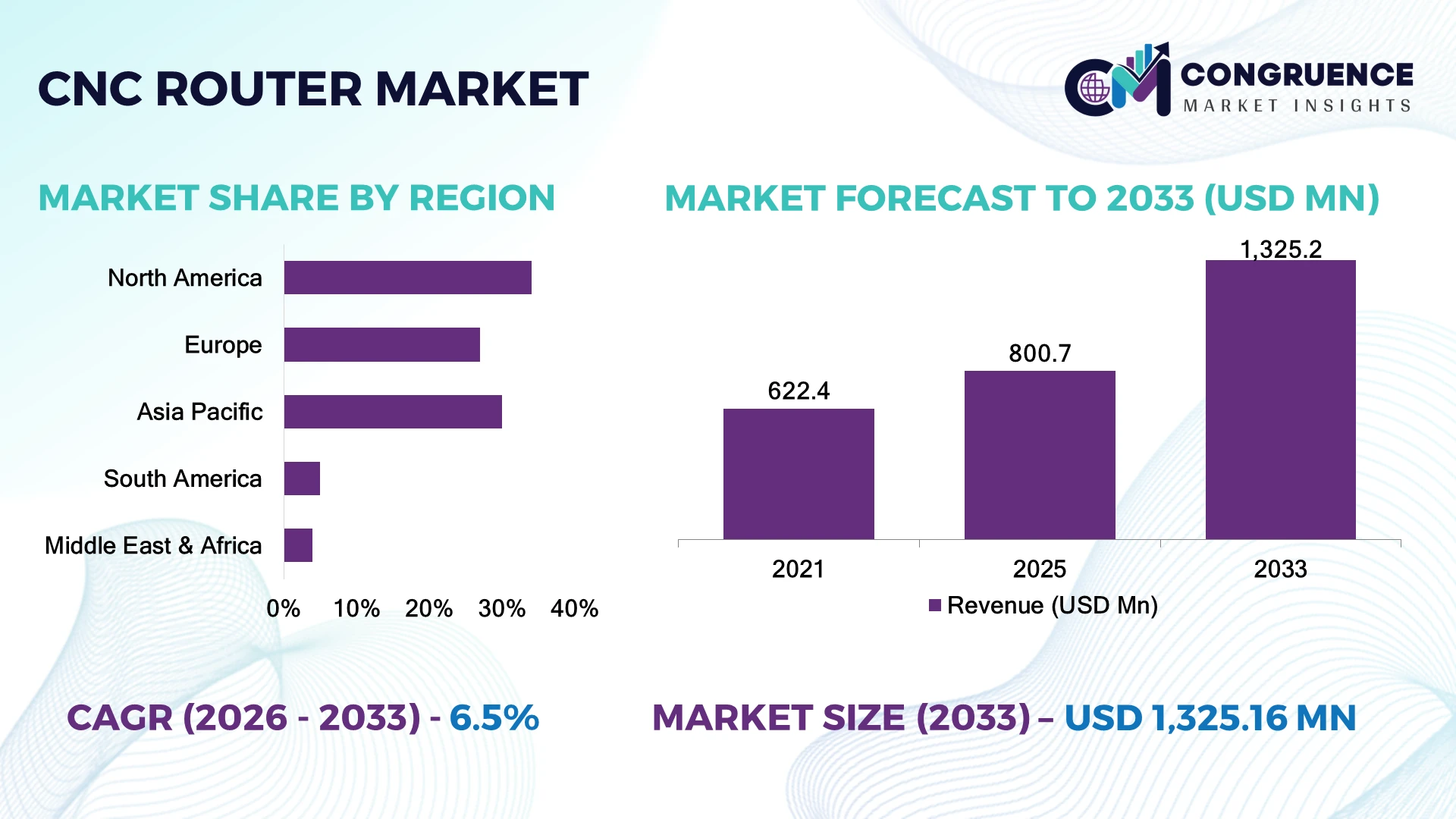
China remains the dominant CNC router manufacturing and consumption base, supported by extensive furniture and woodworking production, with approximately 30% of global CNC machine-tool production concentrated in the country. The United States emphasizes higher-value automated routing for aerospace composites, cabinetry, and custom manufacturing, while Germany prioritizes precision engineering and Industry 4.0 integration. Automated CNC workflows can reduce material waste by roughly 10–20%, strengthening the business case for advanced routers.
Strategically, manufacturers should prioritize China-linked supply ecosystems while investing in automation, software integration, and application-specific configurations for higher-margin markets.
Market Size & Growth: USD 800.7 million in 2025 to USD 1,325.2 million by 2033 at 6.5% CAGR, driven by automated nesting and digitally integrated machining.
Top Growth Drivers: Automation 28%; furniture manufacturing 22%; labor-cost pressure 18%.
Short-Term Forecast: By 2028, automated routing workflows will reduce setup time by 15–20% and improve machine utilization by 10–15%.
Emerging Technologies: AI-assisted toolpaths, automatic nesting, vision systems, and IoT monitoring are moving into mainstream industrial CNC router configurations.
Regional Leaders: Asia-Pacific leads with approximately 48% share; North America exceeds 70% adoption of digitally monitored equipment in advanced applications; Europe emphasizes Industry 4.0 integration.
Consumer/End-User Trends: Small and medium manufacturers increasingly favor compact CNC routers, with modular configurations representing roughly 20% of new workshop installations.
Pilot/Case Example: 2025 automated nesting deployments have demonstrated 12–18% material savings while reducing programming intervention by approximately 30%.
Competitive Landscape: Biesse leads premium woodworking applications, competing with SCM, HOMAG, AXYZ, and MultiCam across automation, precision, service coverage, and application customization.
Regulatory & ESG Impact: Improved nesting can lower material consumption by 10–20%, supporting waste-reduction targets and more efficient use of engineered wood and composite materials.
Investment & Funding: Industrial automation investments are increasingly directed toward integrated CNC cells, with machine-plus-software configurations commanding stronger strategic attention than standalone routers.
Innovation & Future Outlook: By 2028, connected routers, robotic loading, predictive maintenance, and AI-generated toolpaths will shift competition toward complete automated production cells.
The CNC router market is strengthening around automated furniture production, signage, cabinetry, plastics, composites, and customized woodworking. Demand is shifting toward machines with automatic tool changers, vacuum tables, multi-axis capability, and integrated nesting software. Approximately 15–20% material savings from optimized cutting is becoming an important purchasing criterion as manufacturers address input-cost volatility and tighter production schedules.
In 2026, the CNC router is strategically important because manufacturers are replacing isolated machining steps with connected digital production cells. Automated nesting, toolpath optimization, and robotic loading increasingly link design data directly to cutting operations, reducing programming intervention and improving repeatability. This shift strengthens the competitive position of manufacturers able to supply hardware, software, tooling, and service as one workflow.
Technology economics are also changing. Modern CNC routers with automatic tool changing and optimized toolpaths can deliver roughly 15% higher productive utilization than manually configured legacy equipment, while digital job setup reduces changeover requirements. China remains strongest in manufacturing scale and cost-oriented deployment, whereas Germany and the United States lead in precision automation and advanced applications.
Between 2026 and 2028, adoption will increasingly center on automated loading, vision-based positioning, predictive maintenance, and cloud-connected production monitoring. A furniture manufacturer running repeated panel designs can use nesting software to lower offcut rates while automatically generating production programs. Companies are therefore directing investment toward integrated CNC cells and application-specific partnerships rather than standalone machines. Competitive advantage will depend on reducing total production time, material waste, and operator intervention simultaneously.
Labor scarcity and shorter production runs are accelerating automated CNC router adoption, particularly across furniture and cabinetry manufacturing. Automated nesting can reduce material waste by 10–20%, while automatic tool changers improve productive utilization by approximately 10–15%. In China, large woodworking clusters are integrating CNC routing with panel processing and digital design systems to increase throughput. In the United States, composite and aerospace manufacturers are prioritizing multi-axis routing for repeatable precision. Supply-chain normalization since 2024 has also encouraged equipment upgrades after prolonged component uncertainty. Manufacturers are responding through integrated machine-software packages, robotic loading partnerships, and localized service networks. The strategic advantage is shifting from cutting speed alone toward complete cell productivity, where software, tooling, automation, and machine uptime determine investment returns.
High initial equipment costs remain a constraint for smaller fabricators, with automated CNC router cells typically requiring 20–40% more capital than manually configured machines. Imported controllers, servo drives, spindles, and precision components can account for 25–35% of equipment value, increasing exposure to currency and logistics volatility. In India, fragmented workshops also face limited access to trained CNC programmers, extending commissioning periods by 10–15% compared with established industrial facilities. Companies are reducing exposure through standardized component platforms, regional service contracts, multi-supplier sourcing, and modular machine configurations. The non-obvious pressure is lifecycle economics: cheaper routers can generate higher downtime and tooling costs, making total cost of ownership more decisive than purchase price for production-intensive users.
AI-assisted toolpath generation, vision-based positioning, and robotic material handling are creating a higher-value automation layer for CNC routers. Intelligent nesting can deliver approximately 5–12% additional material utilization, while automated loading can reduce manual handling time by 20–30%. India and Southeast Asia offer particularly attractive opportunities as furniture and engineered-panel manufacturing expands without equivalent growth in skilled machining labor. By 2028, connected routers with predictive maintenance and machine-vision inspection will increasingly support lights-out or low-intervention cells. Manufacturers are investing in software partnerships, robotic integrators, and application-specific R&D rather than competing solely on spindle specifications. The strongest opportunity lies in retrofitting installed machines with digital controls and automation, extending equipment life while creating recurring software and service revenue.
Connected CNC router deployment creates execution complexity when machines, CAD/CAM platforms, controllers, tooling databases, and factory-management systems use incompatible data structures. Integration delays can increase commissioning workloads by 10–20%, while inadequate operator training can reduce effective machine utilization by 15% or more during early deployment. German manufacturers increasingly address this through standardized Industry 4.0 interfaces, whereas smaller workshops often rely on fragmented software ecosystems. Cybersecurity also becomes more important as remote monitoring and cloud connectivity expand machine exposure. Companies must invest in interoperable controls, technician training, secure network architecture, and digital commissioning. The decisive long-term challenge is not machine capability but maintaining consistent data-to-cut workflow performance across increasingly automated production environments.
Connected Machine Monitoring: Industrial CNC routers are increasingly equipped with remote diagnostics, spindle-load monitoring, and production dashboards, with connected configurations improving equipment visibility by roughly 20–30%. Manufacturers are pairing controllers with cloud platforms to identify downtime patterns, schedule maintenance, and improve utilization without adding equivalent supervisory labor.
Vision-Guided Cutting Accuracy: Camera-based positioning and edge recognition are gaining traction for irregular panels and composite sheets, improving positioning consistency by approximately 10–15% and reducing manual alignment work by 20%. Suppliers are integrating machine vision directly into routing platforms, particularly for high-mix fabrication environments.
Automated Material Handling: Robotic loading and unloading are moving from large factories into higher-volume woodworking cells, reducing manual handling time by approximately 25–35%. Labor shortages and repetitive-task pressures are accelerating adoption, while equipment manufacturers increasingly partner with robotics specialists to deliver complete machining cells instead of standalone routers.
Hybrid Routing Platforms: CNC routers are evolving toward multifunctional platforms combining routing, drilling, cutting, engraving, and knife operations, reducing secondary processing steps by approximately 15–25%. This configuration is particularly valuable for customized furniture and signage producers, prompting manufacturers to emphasize automatic tool changing, modular heads, and flexible software rather than maximum spindle speed alone.
Large-Format CNC Routers Lead Through Throughput
Large-format CNC routers represent the leading type, estimated at 42% share, supported by higher material throughput, wider work envelopes, and suitability for furniture, signage, composites, and architectural fabrication. Their ability to process larger panels without repositioning reduces handling time by approximately 15–20% versus smaller-format configurations. Mid-range routers retain strong adoption among SMEs because of lower capital requirements, while compact desktop systems remain strategically relevant for prototyping and customized production. The mature large-format segment therefore continues to anchor commercial deployment.
The 5-axis CNC router category is the fastest-growing type, driven by complex contouring, reduced setups, and aerospace and automotive component requirements. Adoption is increasing as manufacturers target 20–25% shorter machining cycles and tighter dimensional consistency. Companies are prioritizing multi-axis platforms, automated tool changers, and integrated CAD/CAM controls rather than expanding fleets of conventional 3-axis machines. Investment is consequently shifting toward flexible systems that support high-mix production and reduce secondary machining.
Industry automation assessments in 2025 showed manufacturers continuing to increase investment in advanced production equipment to address productivity and skilled-labor constraints.
Furniture Manufacturing Anchors CNC Router Demand
Furniture manufacturing is the leading application, accounting for approximately 36% of CNC router demand, because panel processing, nesting, drilling, engraving, and edge-preparation workflows benefit directly from automated cutting. High-volume producers increasingly integrate CNC routers with nesting software and material-handling systems, reducing sheet waste by roughly 10–18%. Signage and woodworking remain established applications, while plastics and composite fabrication are gaining importance where clean, repeatable machining is required.
Composite processing is emerging as the fastest-growing application, supported by lightweight components and increasingly complex geometries. Adoption among specialized fabricators is estimated to have increased by 12–15%, while automated routing can reduce manual finishing requirements by approximately 20%. Companies are responding with dust extraction, closed-loop tooling, vacuum tables, and high-speed spindles engineered for abrasive materials. The strategic shift favors application-specific CNC configurations rather than standardized machines, strengthening demand for integrated automation and specialized service contracts.
Manufacturing surveys published in 2025 found automation investment increasingly concentrated on applications where labor availability, production consistency, and material efficiency directly affect operating capacity.
Industrial Manufacturers Remain Core Buyers
Industrial manufacturers constitute the dominant end-user group, representing an estimated 48% share because furniture plants, woodworking facilities, plastics processors, and composite manufacturers operate CNC routers at higher utilization rates than smaller workshops. Enterprise users increasingly prioritize machine uptime, automated material handling, remote diagnostics, and production integration. Utilization levels above 70% are increasingly targeted in continuous production environments, making service response and software compatibility important purchasing criteria alongside machine specifications.
Small and medium-sized enterprises are the fastest-growing buyer group, with adoption expanding as compact automated routers become easier to finance, program, and integrate. Approximately 25–30% of new SME installations increasingly incorporate automated tool changing or CAD/CAM connectivity, narrowing the productivity gap with larger factories. Companies are responding through modular product portfolios, leasing arrangements, operator training, and localized service networks. Larger manufacturers continue favoring high-throughput platforms, while SMEs prioritize flexibility, lower footprint, and rapid changeovers, shifting competitive emphasis toward scalable machine configurations.
Manufacturing workforce and automation assessments in 2026 continue to identify digital production equipment as a practical response to skilled-labor shortages and requirements for consistent output.
North America accounted for the largest market share at 34% in 2025 however, Asia-Pacific is expected to register the fastest growth, expanding at a CAGR of 8.2% between 2026 and 2033.

Automation-led machining is shifting capacity toward connected, high-throughput CNC cells
North America holds the strongest CNC router positioning, supported by furniture manufacturing, aerospace components, signage, plastics, and customized woodworking. The region represents approximately 34% of global demand, with deployment concentrated across the United States and Canada. Manufacturers increasingly favor multi-axis routing, automatic tool changers, vacuum workholding, and CAD/CAM integration to address skilled-labor shortages while improving repeatability. Automated material handling can reduce non-cutting time by approximately 15–20%, strengthening the economics of higher-specification systems. U.S. producers are also expanding domestic manufacturing capabilities as supply-chain strategies increasingly prioritize shorter lead times and localized equipment support. Companies are responding through modular machine platforms, software integration, and distributor expansion, positioning CNC routers as flexible production assets rather than standalone cutting equipment.
United States Market Outlook: The United States remains the region's primary demand center because of its large woodworking, aerospace, automotive, construction-material, and advanced manufacturing base. Approximately 70% of North American CNC router deployments are concentrated in U.S. industrial and commercial fabrication environments. Domestic manufacturers increasingly prioritize automated loading, digital job scheduling, and remote diagnostics to improve machine utilization and reduce dependence on scarce skilled operators.
Precision manufacturing and energy-conscious modernization are reshaping equipment selection
Europe maintains a strong CNC router position through Germany, Italy, France, and the Nordic manufacturing hubs, where engineered furniture, interior components, automotive materials, and specialized woodworking sustain demand. Approximately 27% of regional installations incorporate advanced automation features such as automatic tool changing, integrated probing, or production monitoring. EU sustainability requirements are also encouraging manufacturers to reduce material waste and optimize energy-intensive production processes. European machine builders increasingly compete through precision, software interoperability, compact automation, and lifecycle service rather than basic machine pricing. Investment is moving toward flexible systems capable of handling smaller production batches without sacrificing repeatability, creating opportunities for suppliers combining CNC hardware with digital workflow management.
Germany Market Outlook: Germany provides Europe with a strong industrial base for high-precision CNC router deployment, supported by machinery manufacturing, automotive suppliers, furniture producers, and engineered-material processing. More than 60% of advanced woodworking and fabrication facilities increasingly use digitally controlled machining equipment within connected production workflows. German buyers emphasize accuracy, machine availability, automation compatibility, and long-term service support, favoring premium equipment suppliers with strong engineering capabilities.
Manufacturing scale is accelerating automated routing across high-volume production hubs
Asia-Pacific is the fastest-expanding deployment zone, driven by China's furniture manufacturing, India's industrial modernization, Japan's precision engineering, and Southeast Asian export production. China alone accounts for an estimated 38% of regional CNC router installations, reflecting its extensive furniture, signage, electronics-component, and composite-processing ecosystem. Automated nesting and tool-changing systems are gaining traction as producers seek 15–20% higher throughput without proportionally increasing labor requirements. Equipment suppliers are strengthening local assembly, service networks, and application engineering to compete on delivery speed and customization. Export-oriented manufacturers increasingly require routers capable of processing wood, plastics, aluminum composites, and engineered panels, broadening demand for configurable platforms.
China Market Outlook: China remains the region's most significant CNC router manufacturing and deployment hub, supported by large-scale furniture, cabinetry, construction-material, and export-processing industries. Automated CNC equipment is increasingly integrated into factory workflows, with high-volume facilities targeting machine utilization above 75%. Domestic manufacturers benefit from established component supply chains and rapid equipment customization, while international suppliers compete through precision, software integration, and premium automation.
Furniture modernization is creating selective demand for compact automated routing
South America presents a developing CNC router market anchored by Brazil's furniture, woodworking, construction-material, and signage industries. Brazil accounts for approximately 55% of regional CNC router demand, supported by its comparatively large manufacturing base and concentration of furniture clusters. SMEs increasingly adopt compact three-axis machines because they require less floor space and lower initial investment than industrial-scale systems. Automated nesting can reduce panel waste by approximately 10–15%, improving material economics where input costs remain sensitive. Currency volatility and imported component exposure continue to influence purchasing decisions, encouraging distributors and manufacturers to maintain broader inventories of critical parts. Suppliers are responding with locally supported service packages, financing arrangements, and modular machines that allow capacity expansion without replacing entire systems.
Brazil Market Outlook: Brazil has the strongest industrial foundation for CNC router adoption in South America, particularly across furniture clusters in Paraná, Santa Catarina, and São Paulo. More than 50% of regional installations are concentrated in Brazilian manufacturing and commercial woodworking operations. Local producers increasingly prioritize automated cutting, nesting optimization, and rapid changeover capabilities to control material consumption and improve productivity while serving fragmented domestic demand.
Construction-linked fabrication is driving selective investment in automated machining
The Middle East & Africa market is increasingly linked to construction, interior fit-outs, signage, cabinetry, and architectural fabrication. The United Arab Emirates and Saudi Arabia form the principal deployment centers, together representing roughly 45% of regional demand. Large-scale construction and hospitality projects are increasing requirements for customized panels, decorative components, and rapid fabrication cycles. CNC routers equipped with automatic tool changers and vacuum tables can improve production throughput by approximately 15%, particularly in high-mix workshops. Companies are expanding regional distribution, technical training, and spare-parts availability to reduce equipment downtime. Saudi Arabia's industrial diversification programs are also encouraging localized manufacturing capabilities, gradually shifting procurement from purely imported machinery toward supported, application-specific production systems.
Saudi Arabia Market Outlook: Saudi Arabia offers the strongest strategic opportunity through industrial diversification, construction activity, and expanding fabrication capacity. CNC router adoption is concentrated around Riyadh, Jeddah, and major industrial zones, where manufacturers serve construction, interiors, signage, and engineered-panel applications. Industrial workshops increasingly target automation levels above 50% in cutting workflows, strengthening demand for digitally controlled equipment, localized maintenance, and integrated production software.
The CNC router market pits HOMAG, Biesse, and SCM against North American specialists such as Thermwood, MultiCam, and AXYZ, while Asian manufacturers compete primarily through cost, customization, and faster delivery. The top five players collectively hold an estimated 45% share, leaving meaningful room for regional specialists. Competition centers on automation, software integration, precision, service responsiveness, and machine configuration: advanced systems command roughly 10–15% premiums, while customized Asian equipment can reduce acquisition costs by 15–20%. HOMAG and Biesse are strengthening integrated production ecosystems, whereas MultiCam and ShopSabre emphasize modular automation and domestic support. SCM is pushing nesting, predictive maintenance, and flexible machining. The competitive shift is moving from machine hardware toward connected workflows, automated material handling, and lifecycle service. High engineering requirements, application expertise, dealer networks, and after-sales infrastructure remain significant entry barriers. Winning requires combining reliable hardware, rapid customization, software integration, localized service, and measurable productivity gains.
HOMAG Group
Biesse Group
SCM Group
Thermwood Corporation
Anderson Group
AXYZ Automation Group
MultiCam Inc.
ShopSabre CNC
The SHODA Company
C.R. Onsrud
Komo Machine
Carbide 3D
Exel CNC
Laguna Tools
CNC routers are shifting from standalone cutting machines toward connected production platforms integrating CAD/CAM, automated tool changing, nesting software, machine monitoring, and predictive maintenance. Automated tool management can improve workflow efficiency by 8–15%, while integrated nesting can reduce material consumption by 10–18%. Adoption is strongest in industrial woodworking and panel processing, where connected systems increasingly support continuous production and remote diagnostics.
Five-axis machining is gaining traction for complex furniture, aerospace, composite, and architectural components, reducing repositioning and secondary machining. Compared with conventional three-axis routing, optimized five-axis workflows can reduce part-handling time by up to 20–30%. Vision-based registration, closed-loop servo control, and automated loading are also improving positioning accuracy and throughput by approximately 5–12%. Premium OEMs benefit most because they can combine hardware, controls, software, and service into integrated production ecosystems.
Between 2026 and 2028, AI-assisted toolpath optimization, digital twins, cloud monitoring, and machine-vision inspection will increasingly differentiate advanced CNC routers. Deployment of connected monitoring is expected to move toward 30–40% of industrial installations as manufacturers prioritize uptime and labor efficiency. Companies investing now gain faster changeovers, lower material waste, better preventive maintenance, and stronger recurring-service opportunities, shifting competition toward intelligent manufacturing rather than machine specifications alone.
September 2024 MultiCam launched the Apex3R Evo at PRINTING United, adding automated knife and tapping capabilities, 24–32K RPM spindle options, and a 13.3 HP maximum. The modular platform reduces secondary processes and strengthens high-volume routing productivity across signage, plastics, composites, and woodworking. Source: multicam.com
August 2024 ShopSabre introduced the IS-A Series at IWF, combining a Mitsubishi M8 controller with a 12-position automatic tool changer and automated material handling. The configuration improves production continuity while supporting multiple sheet sizes, strengthening ShopSabre’s position in high-volume woodworking. Source: shopsabre.com
July 2025 SCM introduced the morbidelli X50 PRO-SPACE CNC machining centre at LIGNA, adding predictive-maintenance capabilities and automated dust-management features. Its safety bumper system stops the machine only upon operator contact, supporting safer nesting adoption and expanding accessible automated production for smaller manufacturers. Source: scmgroup.com
July 2025 C.R. Onsrud announced its A-Series CNC router for AWFS, targeting professional users seeking compact production equipment. The three-axis platform was demonstrated through a melamine cabinet nest focused on material yield, reinforcing demand for smaller-footprint routing systems without complex add-ons. Source: Woodworking Network (woodworkingnetwork.com) (Woodworking Network)
The CNC Router Market Report covers machine types including moving-gantry, moving-table, hybrid, fixed-gantry, desktop, and multi-axis configurations, with applications spanning woodworking, furniture manufacturing, signage, metalworking, plastics, composites, automotive components, aerospace fabrication, and industrial processing. End-user analysis evaluates industrial manufacturers, SMEs, commercial workshops, and specialized fabrication businesses. Regional coverage includes North America, Europe, Asia-Pacific, South America, and Middle East & Africa, with country-level assessment of major manufacturing hubs.
The report evaluates automation, multi-axis machining, CAD/CAM integration, nesting, machine vision, predictive maintenance, digital monitoring, and automated material handling. It assesses deployment patterns, segment participation, technology adoption, competitive positioning, and regional investment priorities through 2026–2033. These insights support equipment investment planning, geographic expansion, product-positioning decisions, partnership development, capacity modernization, and identification of high-value applications where productivity, customization, and labor efficiency are becoming decisive purchasing factors.
| Report Attribute/Metric | Report Details |
|---|---|
|
Market Revenue in 2025 |
USD 800.7 Million |
|
Market Revenue in 2033 |
USD 1,325.2 Million |
|
CAGR (2026 - 2033) |
6.5% |
|
Base Year |
2025 |
|
Forecast Period |
2026 - 2033 |
|
Historic Period |
2021 - 2025 |
|
Segments Covered |
By Type
By Application
By End-User
|
|
Key Report Deliverable |
Revenue Forecast, Growth Trends, Market Dynamics, Segmental Overview, Regional and Country-wise Analysis, Competition Landscape |
|
Region Covered |
North America, Europe, Asia-Pacific, South America, Middle East, Africa |
|
Key Players Analyzed |
HOMAG Group, Biesse Group, SCM Group, Thermwood Corporation, Anderson Group, AXYZ Automation Group, MultiCam Inc., ShopSabre CNC, The SHODA Company, C.R. Onsrud, Komo Machine, Carbide 3D, Exel CNC, Laguna Tools |
|
Customization & Pricing |
Available on Request (10% Customization is Free) |




