
Reports
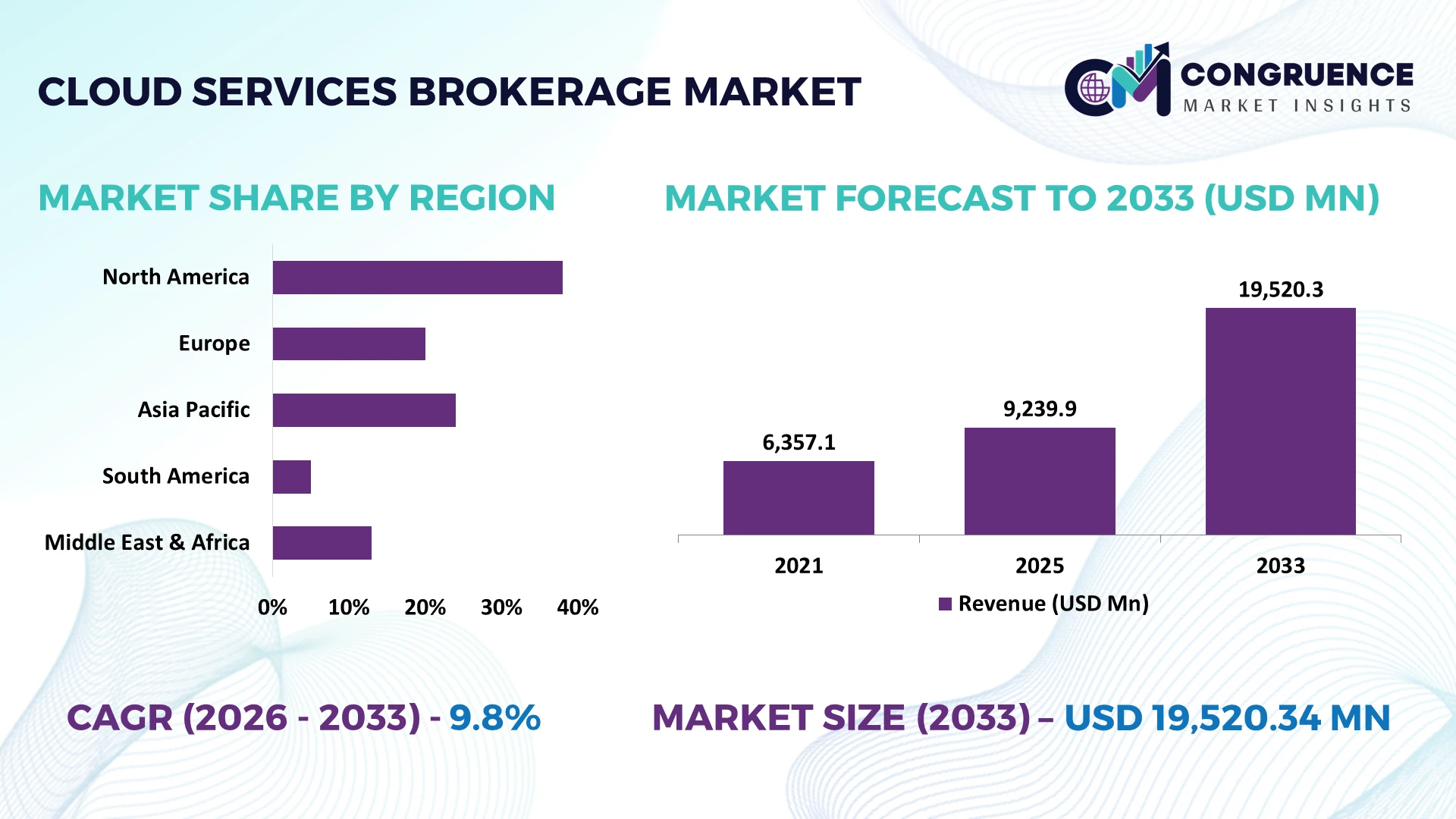
The Global Cloud Services Brokerage Market was valued at USD 9239.92 Million in 2025 and is anticipated to reach a value of USD 19520.34 Million by 2033 expanding at a CAGR of 9.8% between 2026 and 2033. Growth is driven by enterprises consolidating multi-cloud contracts, automating workload placement, strengthening FinOps controls, and requiring policy-based governance across hyperscaler environments.
The United States remains the dominant national market, supported by advanced enterprise cloud infrastructure, AI workloads, financial services, healthcare, and technology adoption; public-cloud spending in India is projected at USD 17.5 billion in 2026, growing 28.1%, while EU enterprises using paid cloud services reached 52.7% in 2025. Geopolitical data-sovereignty pressures are accelerating regional cloud brokerage strategies.
Strategic implication: providers combining FinOps, AI orchestration, compliance automation, and multi-cloud optimization are best positioned to capture enterprise brokerage budgets.
Market Size & Growth: USD 9,239.92 million in 2025 rising to USD 19,520.34 million by 2033 at 9.8% CAGR, supported by multi-cloud governance and AI infrastructure complexity.
Top Growth Drivers: Multi-cloud adoption 18%, FinOps implementation 15%, AI workload migration 22%.
Short-Term Forecast: By 2028, automated cloud optimization is positioned to reduce infrastructure waste by 15% and improve workload efficiency by 12%.
Emerging Technologies: AI-driven brokerage, autonomous workload orchestration, and policy-as-code platforms are reshaping cloud selection, pricing, security, and resource allocation.
Regional Leaders: North America is projected at about USD 8.0 billion, Europe about USD 5.0 billion, and Asia Pacific about USD 4.2 billion by 2033, with AI-cloud, sovereign-cloud, and hybrid-cloud adoption driving regional expansion.
Consumer/End-User Trends: 52.7% of EU enterprises used paid cloud services in 2025, reinforcing demand for centralized procurement, monitoring, compliance, and cloud cost management.
Pilot/Case Example: A 2026 multi-cloud optimization deployment targeting over-provisioned enterprise workloads can deliver approximately 15% infrastructure-cost reduction through automated rightsizing and scheduling.
Competitive Landscape: Accenture leads with approximately 12% share of the global Cloud Services Brokerage Market, followed by IBM, Capgemini, Wipro, and HCLTech, with competition centered on multi-cloud management, FinOps, AI orchestration, and managed cloud services.
Regulatory & ESG Impact: Data-sovereignty requirements and sustainability reporting are increasing demand for location-aware workload placement, with policy controls targeting measurable reductions in unnecessary cloud resource consumption.
Investment & Funding: AI-cloud infrastructure investment is accelerating; CoreWeave raised its 2026 capital-spending outlook to USD 35–39 billion, underscoring the capacity expansion behind advanced cloud workloads.
Innovation & Future Outlook: Next-generation brokers are shifting from advisory procurement toward AI-led autonomous optimization, sovereign-cloud orchestration, real-time FinOps, and cross-provider workload portability.
Cloud Services Brokerage Market demand is concentrating around multi-cloud cost optimization, AI workload placement, cybersecurity governance, and sovereign-cloud controls. India’s public-cloud spending is forecast to grow 28.1% in 2026, strengthening regional brokerage opportunities. FinOps automation, policy-as-code, and AI-driven orchestration are emerging as core differentiators as enterprises respond to tighter data-sovereignty requirements and increasingly fragmented cloud supply chains.
Cloud services brokerage is becoming strategically important as enterprises operate across hyperscalers, private infrastructure, SaaS platforms, and AI environments that require unified procurement and governance. In 2026, multi-cloud operating models are shifting brokerage from intermediary procurement toward active workload optimization, FinOps, cybersecurity, and compliance management. This restructuring is particularly relevant as data-sovereignty requirements reshape cloud deployment decisions.
AI-assisted brokerage platforms can analyze workload utilization continuously and deliver approximately 10–15% better infrastructure efficiency than manual rightsizing and static provisioning. The United States remains the largest innovation and enterprise-deployment hub, while India is advancing faster in cloud modernization and managed-service adoption, particularly among financial services, telecommunications, and digital-native businesses. Over the next 2–3 years, automated policy enforcement and workload portability will become core purchasing criteria.
Practically, enterprises are deploying brokerage layers to compare cloud pricing, automatically shift workloads, and enforce security policies across multiple providers. Companies are consequently directing investment toward AI orchestration, FinOps platforms, sovereign-cloud capabilities, and strategic technology partnerships rather than standalone migration services. Providers that convert fragmented cloud environments into measurable cost, compliance, and performance controls will secure stronger enterprise positioning and recurring operational value.
AI workload expansion is strengthening demand for brokerage platforms capable of continuous resource allocation and cost governance. Enterprises adopting FinOps practices can target 10–20% reductions in avoidable cloud expenditure, while automated rightsizing can improve compute utilization by roughly 15%. In the United States, rapid AI infrastructure deployment is increasing the need to coordinate workloads across hyperscaler environments rather than rely on single-provider architectures. Data-sovereignty requirements are also pushing enterprises toward policy-driven workload placement. Companies are responding by expanding managed brokerage capabilities, partnering with cloud infrastructure providers, and integrating AI-based orchestration. The non-obvious advantage is procurement intelligence: brokers can aggregate consumption data across providers, improving contract negotiations while simultaneously controlling technical resource waste.
Cloud brokerage profitability remains constrained by pricing volatility, fragmented APIs, and inconsistent service-metering models. Enterprises can face 10–15% higher management overhead when workloads span poorly integrated environments, while unused or underutilized resources can account for approximately 15–20% of cloud expenditure in inefficient deployments. India-based enterprises operating across domestic and international cloud environments also face differing compliance and data-location requirements. Hyperscaler service changes can further complicate standardized brokerage contracts and workload portability. Companies are reducing exposure through committed-use agreements, standardized cloud-management layers, provider diversification, and localized infrastructure partnerships. The key operational constraint is not cloud capacity itself but the difficulty of creating one governance framework across technically and commercially incompatible platforms.
AI-driven automation is opening higher-value brokerage opportunities beyond conventional cloud procurement. Autonomous workload placement can improve infrastructure utilization by 15–25%, while automated policy enforcement can reduce manual governance effort by around 20%. India’s accelerating public-cloud adoption creates an expanding addressable base for brokerage services across banking, telecom, healthcare, and digital commerce. Sovereign-cloud initiatives are also creating demand for location-aware orchestration, encrypted data movement, and compliance-aware workload routing. Companies are investing in R&D partnerships and ecosystem integrations that connect FinOps, cybersecurity, observability, and AI orchestration. A distinctive opportunity lies in treating cloud brokerage as an optimization control layer, enabling enterprises to balance cost, latency, compliance, and carbon efficiency simultaneously.
Long-term scalability depends on resolving integration and security pressures across increasingly distributed cloud estates. Complex multi-cloud environments can increase operational tooling requirements by 15–20%, while inconsistent identity policies can create additional exposure across interconnected workloads. AI-intensive deployments also raise bandwidth and compute-management requirements, particularly for enterprises operating data-heavy applications in the United States, Japan, and India. Regulatory frameworks are evolving alongside cross-border data transfers, forcing brokerage providers to maintain continuously updated compliance controls. Companies must therefore invest in unified identity management, API abstraction, zero-trust architecture, and specialized cloud engineering talent. The strategic challenge is maintaining consistent performance and governance as workloads become more autonomous; brokerage providers that cannot standardize controls across providers risk losing enterprise-scale contracts.
AI Automates Brokerage Workflows: AI-assisted workload analysis is moving from pilot deployments into enterprise operations, with automated rightsizing improving resource utilization by 12–18% and reducing manual optimization effort by nearly 20%. U.S. enterprises are integrating AI orchestration with FinOps and observability platforms, while providers are expanding automation partnerships to manage increasingly dynamic compute demand.
FinOps Becomes Procurement Control: Cloud cost management is shifting from post-deployment monitoring toward procurement-stage decision-making, with enterprises targeting 10–15% lower avoidable cloud expenditure and 15% faster resource-allocation decisions. Persistent cloud-price complexity and AI infrastructure spending are driving companies to consolidate usage data, renegotiate commitments, and deploy centralized brokerage dashboards.
Sovereignty Reshapes Cloud Routing: Data-location requirements are accelerating policy-based workload routing, particularly across Germany, France, India, and other markets tightening digital sovereignty controls. Automated compliance checks can reduce manual governance workload by roughly 20%, while localized infrastructure strategies improve deployment consistency. Providers are responding through sovereign-cloud partnerships, regional data controls, and policy-as-code integration.
Brokerage Shifts Toward Ecosystems: Enterprises increasingly expect brokers to connect hyperscalers, SaaS, cybersecurity, FinOps, and managed services rather than operate as standalone intermediaries. Integrated platforms can shorten provisioning workflows by 15–25%, creating measurable operational value. Companies are therefore restructuring brokerage portfolios around ecosystem partnerships, API integration, and unified service catalogs rather than expanding conventional resale capabilities.
Managed Brokerage is estimated to account for approximately 36% of the market, supported by enterprises seeking centralized governance, optimization, security, and multi-provider coordination without expanding internal cloud-operations teams. Its integrated service model improves administrative efficiency by roughly 15–20% compared with fragmented brokerage arrangements. External Brokerage remains important for procurement-led organizations, while Internal Brokerage retains relevance among large technology-intensive enterprises requiring direct control over cloud policies and architecture.
Hybrid Brokerage is the fastest-growing type, with adoption expanding at approximately 14–16% as enterprises combine internal governance with specialized external expertise. Around 30% of larger multi-cloud users increasingly favor hybrid operating models to balance control and specialized capabilities. Providers are responding through modular platforms, managed-service partnerships, and interoperable orchestration tools. The investment priority is shifting toward flexible brokerage architectures capable of supporting both centralized policy management and decentralized business-unit deployment.
Cloud Cost Management leads application demand with an estimated 34% share, reflecting direct pressure to control fragmented consumption, AI-compute expenses, and underutilized resources. Enterprises using automated FinOps controls can target approximately 10–20% reductions in avoidable cloud expenditure, making cost visibility an operational requirement rather than a reporting function. Cloud Procurement remains a mature application, particularly for contract consolidation and provider selection, while Cloud Security is gaining importance as distributed workloads increase governance complexity.
Cloud Service Integration represents the fastest-growing application, advancing as enterprises connect hyperscalers, SaaS environments, private infrastructure, and specialized AI platforms. Adoption is increasing by approximately 15%, while automated integration can reduce provisioning and workflow delays by nearly 20%. Companies are expanding API-based orchestration, unified service catalogs, and managed integration partnerships. The strategic shift is significant: brokerage value is moving from purchasing optimization toward continuous coordination of interconnected cloud services.
IT & Telecom represents the leading end-user segment with an estimated 31% market share, reflecting heavy dependence on distributed infrastructure, high data volumes, and continuous application deployment. Enterprises in this segment can achieve approximately 15% faster provisioning through automated brokerage workflows and reduce infrastructure-management overhead by around 10–15%. BFSI remains a mature high-value user because regulatory controls and transaction workloads require strict cloud governance, while Manufacturing is increasing adoption as connected production systems expand.
Healthcare is emerging as the fastest-growing end-user group, with adoption increasing approximately 14–17% as digital records, analytics, telehealth platforms, and AI workloads expand. Retail is also strengthening brokerage usage through seasonal workloads and omnichannel infrastructure requirements. Providers are responding with industry-specific compliance controls, consumption-based pricing, and partnerships tailored to regulated workloads. The competitive opportunity is shifting toward specialized brokerage models that combine cloud economics with sector-specific governance.
North America accounted for the largest market share at 41.8% in 2025 however, Asia-Pacific is expected to register the fastest growth, expanding at a CAGR of 11.6% between 2026 and 2033.
AI infrastructure expansion is shifting brokerage toward automated governance
North America held approximately 41.8% of global Cloud Services Brokerage Market activity in 2025, supported by dense hyperscaler infrastructure, mature enterprise cloud adoption, and expanding AI workloads. The United States concentrates most regional deployments across financial services, healthcare, technology, retail, and telecommunications. Enterprises are integrating FinOps, cloud security, observability, and workload orchestration into brokerage platforms, with automated optimization reducing avoidable cloud-resource expenditure by approximately 15%. Hyperscaler partnerships and managed-service expansion are strengthening integrated brokerage offerings, while data-sovereignty requirements are increasing demand for policy-controlled workload placement. The market is shifting from transactional cloud procurement toward continuous infrastructure optimization.
United States Market Outlook: The United States remains the dominant country market because of its hyperscaler concentration, AI infrastructure investment, and sophisticated enterprise-cloud ecosystem. More than 70% of large enterprises operate across multiple cloud environments, creating sustained demand for centralized procurement, FinOps, security governance, and workload optimization. Providers are prioritizing AI-enabled orchestration and strategic cloud partnerships.
Data sovereignty is redefining enterprise cloud orchestration
Europe accounted for approximately 27.0% of global brokerage activity in 2025, with Germany, the United Kingdom, France, and the Netherlands representing major enterprise deployment centers. More than 50% of EU enterprises use paid cloud services, creating a substantial installed base for optimization and governance solutions. Regulatory requirements surrounding data protection, digital resilience, and sovereignty are accelerating policy-driven workload management. German automotive and industrial companies are expanding hybrid-cloud deployments across connected manufacturing, analytics, and enterprise applications. Providers are responding through sovereign-cloud capabilities, compliance automation, localized data controls, and strategic infrastructure partnerships. Sustainability requirements are also increasing attention to infrastructure efficiency, making workload placement a combined cost, compliance, and environmental decision.
Germany Market Outlook: Germany provides strong brokerage potential through industrial cloud modernization, automotive digitization, and stringent data-governance requirements. Manufacturing enterprises are connecting cloud platforms with connected-factory systems, analytics, and AI workloads. Providers are strengthening local partnerships and infrastructure capabilities to support complex hybrid environments while maintaining regulatory compliance.
Rapid cloud modernization is creating a high-volume brokerage pipeline
Asia-Pacific accounted for approximately 21.5% of global market activity in 2025 and represents the fastest-expanding deployment base as enterprises modernize infrastructure across India, China, Japan, Singapore, and South Korea. India is particularly significant, with public-cloud spending expected to grow 28.1% in 2026, strengthening demand for procurement optimization, managed governance, and multi-cloud integration. Japanese manufacturers are adopting hybrid environments to connect production systems with analytics and AI workloads. Providers are expanding local partnerships, data-center capacity, and managed-service ecosystems. The region's distinctive advantage is the combination of mature digital economies and rapidly digitizing enterprises, enabling brokerage providers to address both advanced optimization requirements and large-scale migration programs.
India Market Outlook: India is becoming a strategic brokerage market because of accelerating enterprise digitization, expanding data-center infrastructure, and strong demand from banking, telecommunications, retail, and technology companies. Public-cloud spending is projected to reach approximately USD 17.5 billion in 2026. Providers are expanding managed services, FinOps capabilities, and local ecosystem partnerships.
Brazil-led modernization is strengthening managed cloud adoption
South America remains an emerging brokerage market, with Brazil accounting for the largest share of regional enterprise cloud activity. Financial services, retail, telecommunications, and digital commerce are leading deployment as enterprises increasingly manage workloads across domestic and international cloud providers. Brazil's expanding data-center ecosystem is improving local workload availability, although connectivity costs and infrastructure concentration remain operational constraints. Automated cloud-management tools can reduce manual resource-management workloads by approximately 15%, improving multi-provider operating efficiency. Providers are responding through partnerships with telecom operators, managed-service firms, and infrastructure specialists. The strongest competitive opportunity lies in combining local compliance expertise with international cloud access rather than competing solely through cloud-resale pricing.
Brazil Market Outlook: Brazil provides the strongest country-level opportunity through its large enterprise base, financial-sector digitization, and expanding cloud infrastructure. Banks and retailers increasingly use distributed cloud environments for analytics, digital platforms, and customer services. Brokerage providers are emphasizing local support, compliance-aware deployment, and multi-provider cost controls.
Sovereign infrastructure investment is accelerating cloud modernization
The Middle East & Africa market is being shaped by data-center investment, government digitalization, financial technology, telecommunications, and smart-city programs. The United Arab Emirates and Saudi Arabia represent key deployment centers as enterprises and public-sector organizations strengthen local cloud infrastructure and data governance. Automated cloud-management adoption can improve infrastructure efficiency by approximately 10–15%. Sovereign-cloud initiatives are encouraging providers to establish localized infrastructure and strategic partnerships rather than rely exclusively on cross-border services. Saudi Arabia's digital transformation programs are increasing demand for managed integration and security governance. Providers with local compliance expertise, hyperscaler relationships, and infrastructure access hold an advantage over transactional cloud-resale models.
Saudi Arabia Market Outlook: Saudi Arabia is emerging as a strategically important brokerage market through digital infrastructure investment, public-sector modernization, fintech expansion, and cloud adoption. Localized data infrastructure is increasingly important for regulated workloads. Providers are strengthening partnerships and managed-service capabilities to support national digital programs while improving governance and workload portability.
The Cloud Services Brokerage Market features global technology-service leaders such as Accenture, IBM, Capgemini, Wipro, and HCLTech competing with specialized cloud-management providers and regional integrators. The top five players collectively hold an estimated 38% share, leaving meaningful room for differentiated providers. Competition centers on technology integration, pricing efficiency, deployment speed, and managed-service depth. AI-based optimization can improve resource efficiency by 10–15%, while automated provisioning reduces operational effort by approximately 20%. Accenture and IBM emphasize enterprise transformation and hyperscaler alliances; Capgemini, Wipro, and HCLTech compete through managed services, localization, and industry-specific programs. The competitive shift is moving from cloud procurement toward continuous FinOps, security, and workload orchestration. High integration expertise, partner certifications, compliance capabilities, and enterprise relationships remain key entry barriers. Winning providers must combine automation, ecosystem breadth, local execution, and measurable cost-performance outcomes.
Accenture
IBM
Capgemini
Wipro
HCLTech
Tata Consultancy Services
Cognizant
Deloitte
Kyndryl
Rackspace Technology
NTT DATA
Infosys
DXC Technology
Atos
Current brokerage technology is moving from static cloud-management portals to AI-assisted FinOps, observability, and policy automation. AI rightsizing and anomaly detection typically improve resource efficiency 10–15%, while automated provisioning cuts operational handling time 15–20%. Gartner reported 90% of organizations will adopt hybrid cloud through 2027, increasing the need for cross-cloud orchestration and centralized governance. These capabilities also reduce waste from idle resources and improve contract-level consumption visibility for procurement teams.
Emerging platforms combine agentic AI, policy-as-code, API abstraction, and unified service catalogs. Compared with manual ticket-based provisioning, automated workflows can improve deployment speed by 20% and reduce configuration effort by about 15%. Adoption is strongest among large enterprises managing multiple hyperscalers, where brokerage layers connect procurement, security, FinOps, and workload placement. This integration gives service brokers stronger retention and measurable optimization value.
By 2028, disruptive brokerage architectures will increasingly use autonomous workload placement, sovereign-cloud controls, and AI agents that continuously balance cost, latency, compliance, and capacity. Gartner expects 50% of cloud compute resources to support AI workloads by 2029, intensifying orchestration requirements before that threshold. Providers with mature automation, interoperability, and hyperscaler partnerships will benefit most. Companies acting in 2026–2028 can secure operating advantages before multi-cloud complexity becomes a constraint.
April 2024 IBM agreed to acquire HashiCorp for USD 6.4 billion, adding infrastructure automation and cloud management capabilities. The 42.6% premium signaled consolidation around hybrid-cloud control, strengthening IBM’s ability to integrate provisioning, security, and multicloud operations platforms. Source: reuters.com
April 2025 IBM Cloud and BNP Paribas renewed their partnership for 10 years, with a IBM Cloud area planned in the bank’s data centers by 2028. The deployment strengthens resilience and supports regulated workloads, reinforcing managed hybrid-cloud demand. Source: ibm.com
August 2025 Wipro and Google Cloud completed an initiative delivering 200 production-ready AI agents across healthcare, banking, insurance, retail, manufacturing, and IT. The enterprise deployment expands agentic automation capabilities and strengthens brokerage opportunities around AI-enabled cloud orchestration services. Source: wipro.com
December 2025 Microsoft announced a USD 17.5 billion India investment through 2029 for cloud, AI infrastructure, skilling, and operations. The expansion strengthens local capacity and ecosystem depth, increasing demand for brokerage, governance, and managed cloud integration services globally. Source: microsoft.com
The Cloud Services Brokerage Market Report covers Internal Brokerage, External Brokerage, Managed Brokerage, and Hybrid Brokerage across Cloud Procurement, Cloud Cost Management, Cloud Security, and Cloud Service Integration. End-user analysis spans BFSI, IT & Telecom, Healthcare, Retail, and Manufacturing, with emphasis on enterprise deployment intensity, governance requirements, technology integration, service-model adoption, and workload optimization priorities across mature and emerging cloud environments.
Regional coverage evaluates North America, Europe, Asia-Pacific, South America, and the Middle East & Africa, including country-level deployment patterns and infrastructure priorities. The report assesses AI orchestration, FinOps, policy-as-code, sovereign cloud, automation, and multicloud integration, with leading providers and competitive positioning. It supports investment planning, partnership selection, market expansion, product prioritization, and competitive strategy through 2026–2033, helping decision-makers identify demand concentration, technology inflection points, operational gaps, and scalable opportunities.
| Report Attribute/Metric | Report Details |
|---|---|
Market Revenue in 2025 | USD 9239.92 Million |
Market Revenue in 2033 | USD 19520.34 Million |
CAGR (2026 - 2033) | 9.8% |
Base Year | 2025 |
Forecast Period | 2026 - 2033 |
Historic Period | 2021 - 2025 |
Segments Covered | By Type
By Application
By End-User
|
Key Report Deliverable | Revenue Forecast, Growth Trends, Market Dynamics, Segmental Overview, Regional and Country-wise Analysis, Competition Landscape |
Region Covered | North America, Europe, Asia-Pacific, South America, Middle East, Africa |
Key Players Analyzed | Accenture, IBM, Capgemini, Wipro, HCLTech, Tata Consultancy Services, Cognizant, Deloitte, Kyndryl, Rackspace Technology, NTT DATA, Infosys, DXC Technology, Atos |
Customization & Pricing | Available on Request (10% Customization is Free) |




