
Reports
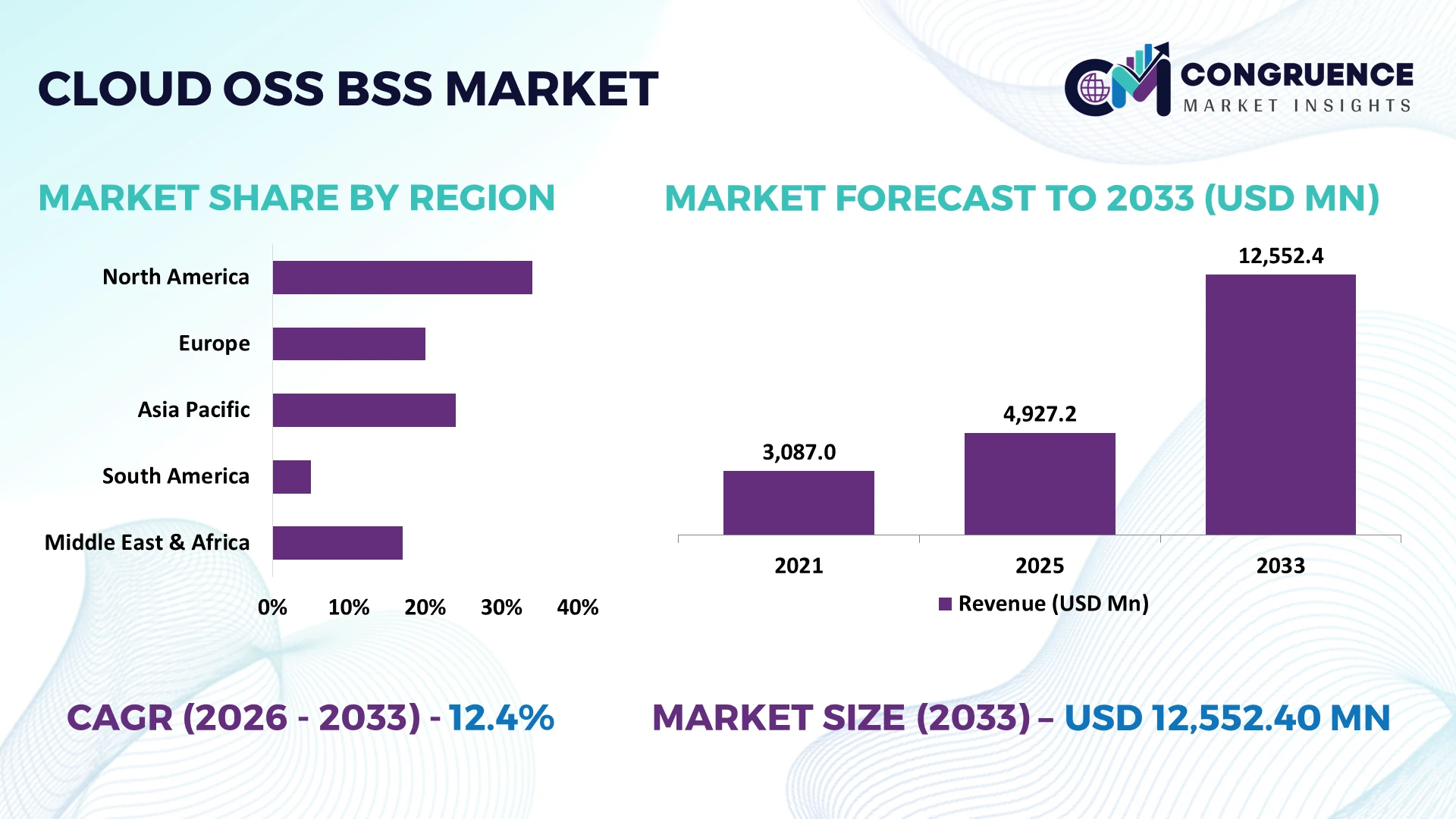
The Global Cloud OSS BSS Market was valued at USD 4927.16 Million in 2025 and is anticipated to reach a value of USD 12552.4 Million by 2033 expanding at a CAGR of 12.4% between 2026 and 2033. Growth is driven by telecom operators replacing fragmented legacy OSS/BSS stacks with cloud-native, API-led platforms that automate 5G provisioning, real-time charging, network assurance, and multi-cloud service orchestration.
India stands out as a high-adoption telecom market, with 99.8% of districts covered by 5G and 486,000 5G BTSs deployed by June 2025, while the United States retains stronger enterprise-cloud maturity and large-scale operator modernization. India’s rapid 5G expansion and data-localization priorities, reinforced by emerging network-slicing rules, are accelerating cloud OSS/BSS integration across telecom and digital-service industries.
Strategic decisions should prioritize AI-enabled automation, sovereign-cloud readiness, API interoperability, and scalable 5G service orchestration in high-growth telecom markets.
Market Size & Growth: USD 4,927.16 million in 2025 is projected to reach USD 12,552.4 million by 2033 at a 12.4% CAGR, driven by cloud-native 5G orchestration and automated service management.
Top Growth Drivers: 5G expansion 35%, AI automation 28%, and multi-cloud modernization 22% are the leading growth catalysts.
Short-Term Forecast: By 2028, AI-led workflow automation is expected to cut manual provisioning workloads by 30% and improve operational efficiency by 25%.
Emerging Technologies: AI/ML assurance, autonomous network orchestration, and generative-AI customer service are reshaping advanced OSS/BSS architectures.
Regional Leaders: North America is projected near USD 4.1 billion, Asia-Pacific near USD 3.7 billion, and Europe near USD 2.9 billion by 2033, supported by cloud migration, 5G rollout, and API-led modernization.
Consumer/End-User Trends: More than 60% of telecom customers increasingly use digital self-service channels, pushing operators toward real-time BSS analytics and automated customer engagement.
Pilot/Case Example: In 2025, India’s nationwide 5G expansion reached 99.8% of districts, with 486,000 BTSs deployed, strengthening the operational case for automated cloud OSS platforms.
Competitive Landscape: Nokia leads with approximately 14% share, followed by Ericsson at about 12%, while Amdocs, Huawei, Netcracker, and Salesforce intensify competition across cloud-native telecom platforms.
Regulatory & ESG Impact: Data-sovereignty requirements and emerging 5G network-slicing rules are increasing demand for localized cloud architectures, with private-cloud deployments representing about 39% of modernization priorities.
Investment & Funding: More than 68% of telecom enterprises increased investment in cloud-native network orchestration during 2025, while AI predictive-maintenance investment rose approximately 43%.
Innovation & Future Outlook: Next-generation OSS/BSS is shifting toward autonomous operations, digital twins, edge-cloud coordination, and AI-native service monetization, making interoperability a strategic technology priority.
The Cloud OSS BSS Market is increasingly centered on 5G service assurance, AI-driven automation, real-time billing, API-led integration, and sovereign-cloud deployment. Around 57% of telecom firms are prioritizing SaaS-based BSS platforms, while operators are restructuring architectures around data sovereignty and multi-cloud resilience. India’s rapid 5G rollout and network-slicing regulation illustrate how operational modernization is moving into strategic telecom planning.
Cloud OSS BSS is becoming strategically important because telecom operators are competing on service agility, automation, and network intelligence rather than connectivity alone. Cloud-native platforms unify provisioning, assurance, charging, and customer operations, allowing providers to monetize 5G, IoT, and enterprise services faster. India’s 5G coverage reached 99.8% of districts by June 2025, intensifying the need for scalable operational software.
The technology shift is measurable: cognitive cloud OSS/BSS architectures can achieve up to 78% automation versus roughly 15% in legacy environments, while reducing operational costs by 18–24%. Over the next 2–3 years, operators are expected to prioritize AI-assisted assurance, API-led BSS, and containerized orchestration, targeting 25–40% faster provisioning and materially lower manual intervention. North America emphasizes advanced automation and enterprise monetization, while India is scaling deployment intensity around rapid 5G infrastructure expansion.
Practical deployments are moving toward phased modernization rather than wholesale replacement. In 2025, AT&T expanded cloud-based voice-core and network-automation capabilities through a multi-year technology partnership, reflecting the industry's shift toward AI-enabled operations. Companies are reallocating investment toward modular platforms, hyperscaler ecosystems, and strategic technology partnerships. Competitive positioning will increasingly depend on how effectively operators convert cloud OSS/BSS into autonomous, interoperable, and continuously optimized operating infrastructure.
5G expansion is accelerating Cloud OSS BSS adoption as operators manage increasingly distributed, software-defined networks. More than 71% of telecom operators accelerated cloud migration in 2025, while 66% increased automation investment and 59% adopted AI-enabled network orchestration. India’s 5G rollout reached 99.8% of districts, creating substantial requirements for automated provisioning and assurance. Companies are responding through cloud-native platforms, AI partnerships, and containerized architectures. The non-obvious advantage is operational scalability: autonomous orchestration enables operators to manage network complexity without expanding manual support teams proportionally. Investment is therefore shifting from isolated OSS replacements toward integrated automation layers capable of supporting 5G slicing, edge workloads, and real-time service monetization.
Legacy integration remains a structural constraint, with approximately 48% of telecom providers reporting cybersecurity integration issues, 44% facing legacy-infrastructure incompatibility, and 39% experiencing migration delays. Proprietary billing engines, fragmented network inventories, and decades-old interfaces increase deployment complexity and extend parallel-system operating periods. This directly affects modernization economics by raising testing, data-migration, and integration workloads. Operators in the United States and Europe increasingly favor phased migration, API gateways, and modular replacement to preserve mission-critical services during transformation. Companies are also diversifying vendors and negotiating interoperability requirements into contracts. The sharper strategic issue is not cloud availability but the ability to connect new cloud-native platforms with entrenched operational systems without disrupting billing or service assurance.
AI-native OSS/BSS creates an opportunity to move beyond workflow automation toward predictive and autonomous telecom operations. Around 67% of telecom enterprises adopted AI-driven billing automation in 2025, while 62% implemented containerized OSS frameworks and 54% integrated edge-enabled BSS capabilities. Over the next several years, AI agents, digital twins, and federated intelligence can automate fault diagnosis, product configuration, and personalized service monetization. India offers a particularly strong deployment opportunity as 5G infrastructure expands across industrial and consumer applications. Companies are positioning through R&D alliances, cloud partnerships, and open API ecosystems. A key opportunity lies in using AI to coordinate customer, network, and commercial data through one decision layer, reducing the traditional separation between OSS and BSS functions.
Long-term execution is challenged by the convergence of cybersecurity, multi-cloud governance, and specialist workforce requirements. Approximately 48% of providers identify cybersecurity integration as a significant issue, while 46% of operators are moving toward multi-cloud orchestration and 58% of deployments favor multi-vendor ecosystems. This fragmentation increases API exposure, data-governance requirements, model-management complexity, and operational inconsistency. India’s expanding sovereign-cloud agenda further raises requirements for data localization and controlled AI deployment. Companies must therefore strengthen zero-trust architecture, cloud observability, API security, and telecom-AI skills while establishing standardized governance across vendors. The strategic challenge is achieving autonomous operations without creating an equally complex security and compliance layer that undermines deployment consistency.
AI-Driven Operations Scale: Around 81% of operators are testing generative AI, while 70% have partially or fully implemented it, shifting OSS/BSS workflows toward predictive assurance, automated resolution, and AI-assisted customer operations. Companies are scaling AI partnerships to reduce repetitive workloads and accelerate service decisions.
Hybrid Cloud Becomes Standard: About 17% of operators have moved at least 50% of OSS/BSS workloads to public clouds, more than doubling from 8% in 2021. Operators in the United States and Europe are combining public and private clouds to improve resilience, control vendor exposure, and modernize workloads incrementally.
Standards-Led Procurement Gains: 71% of telecom decision-makers consider standards compliance essential when purchasing OSS/BSS, making Open APIs and interoperable architectures procurement priorities. Companies are restructuring vendor contracts around modularity, portability, and integration, reducing dependence on closed platforms and accelerating multi-vendor deployment.
Intent-Based Architecture Emerges: In 2026, operators are shifting from isolated automation toward intent-based IT, connecting AI with network and business layers. Research across 50 countries highlights this transition, while fragmented data remains a major barrier. Companies are consolidating data models and orchestration layers to achieve consistent closed-loop operations.
Converged OSS/BSS leads the Cloud OSS BSS Market with an estimated 36% share, supported by unified service orchestration, charging, inventory, and customer workflows. Its integration advantage reduces duplicated data processes by approximately 20–25% and strengthens cross-domain visibility. Cloud OSS follows at nearly 29%, remaining important for network automation, provisioning, and assurance. Cloud BSS accounts for roughly 23%, with demand concentrated around digital channels, billing modernization, and customer analytics. Companies are increasingly favoring integrated architectures rather than isolated workload migration, particularly in the United States and India.
Hybrid OSS/BSS is the fastest-growing type, with adoption expanding approximately 18% annually as operators balance cloud elasticity with legacy-system continuity. Around 42% of large operators are prioritizing hybrid deployment models, enabling gradual modernization without disrupting billing or network operations. The strategic implication is clear: vendors are investing in modular platforms, API-based integration, and interoperability rather than complete legacy replacement, shifting procurement toward flexible architecture and lower migration disruption.
Service Fulfillment represents the leading application with an estimated 32% market share, reflecting operator dependence on automated provisioning, order orchestration, and faster activation across 5G and fiber services. Service Assurance follows at approximately 28%, while Customer Management holds nearly 22% as digital engagement becomes increasingly automated. Billing & Revenue Management accounts for about 18%, remaining operationally critical for complex charging and monetization models.
Service Assurance is the fastest-growing application, with adoption increasing around 19% as AI-driven fault detection, predictive maintenance, and closed-loop remediation become more practical. Approximately 55% of operators are prioritizing automated assurance workflows, reducing dependence on manual network monitoring. Companies are integrating assurance with inventory and orchestration platforms to shorten incident-resolution cycles. The non-obvious shift is that assurance is moving from a reactive support function into a commercial differentiator because consistent service quality directly influences enterprise contract performance and customer retention.
Mobile Network Operators dominate with an estimated 58% market share because large 5G footprints require continuous provisioning, assurance, charging, and network-resource coordination. Their OSS/BSS workloads are approximately 30% more automation-intensive than those of smaller fixed-service providers. Fixed-Line Operators account for about 18%, while Internet Service Providers hold nearly 16%, supported by fiber expansion and digital-service complexity. Cable Operators represent roughly 8% but remain important for converged broadband ecosystems.
Internet Service Providers are the fastest-growing end-user group, with adoption rising approximately 17% as fiber networks, cloud connectivity, and managed enterprise services expand. Around 52% of large ISPs are increasing investment in automation and customer-management platforms. Companies are responding with modular BSS packages, API partnerships, and cloud-native provisioning tools tailored to leaner operating models. The strategic shift is toward specialized platforms that let ISPs compete with larger operators without replicating their full legacy technology stacks.
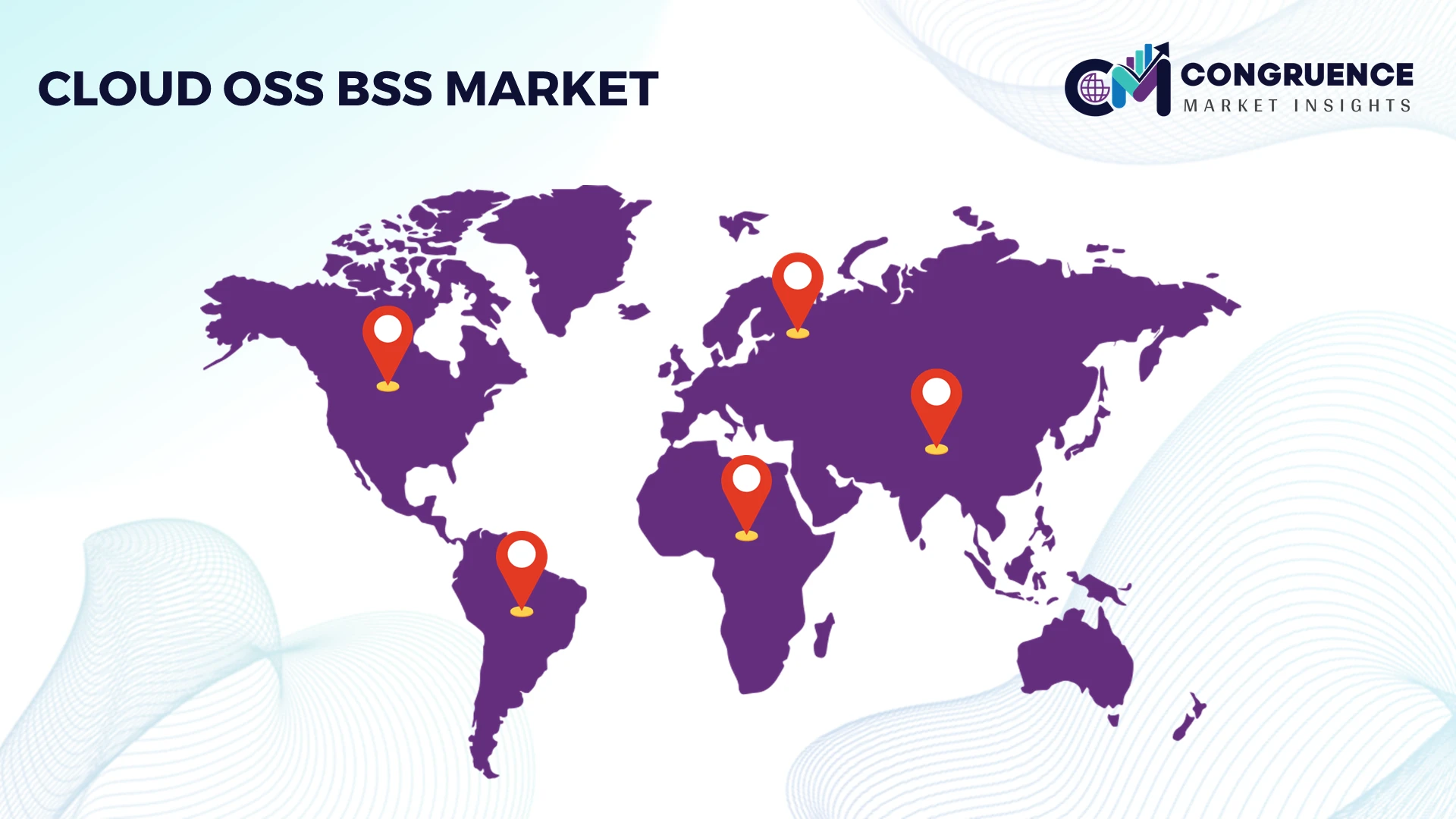
North America** accounted for the largest market share at 38% in 2025 however, Asia-Pacific** is expected to register the fastest growth, expanding at a CAGR of 14.8% between 2026 and 2033.
AI-led modernization reshapes telecom operating models
North America represents approximately 38% of the global Cloud OSS BSS Market, supported by advanced 5G infrastructure, hyperscale cloud adoption, and high enterprise spending on network automation. The United States represents the dominant deployment center, with major operators accelerating cloud-native transformation across provisioning, assurance, billing, and customer-management workloads. More than 70% of large U.S. telecom operators are prioritizing AI-enabled network automation, while private and hybrid cloud architectures remain important for mission-critical workloads. Operators are increasingly partnering with hyperscalers and software specialists to replace fragmented legacy stacks without disrupting revenue-critical systems. Canada is also expanding cloud-native telecom infrastructure, particularly for fiber and 5G services. The region’s competitive advantage comes from deep enterprise-cloud integration and early adoption of autonomous network operations.
United States Market Outlook: The United States remains the strategic center of North American OSS/BSS deployment because of its large operator base, mature cloud ecosystem, and extensive enterprise connectivity demand. Major telecom providers are investing heavily in AI-assisted assurance, software-defined networking, and API-based BSS modernization to improve service activation and operational responsiveness.
Regulation accelerates interoperable cloud modernization
Europe represents approximately 27% of the Cloud OSS BSS Market, with demand shaped by 5G deployment, data-sovereignty requirements, cybersecurity regulation, and legacy-network modernization. Germany, the United Kingdom, France, and Italy account for substantial enterprise deployment activity, while operators increasingly prioritize modular architectures capable of meeting stricter data-governance requirements. Around 63% of European telecom enterprises are increasing investment in automation and cloud-native operations, strengthening demand for AI-enabled assurance and API-led BSS. Operators are also restructuring supplier relationships to improve interoperability and reduce dependence on proprietary platforms. Sustainability requirements are encouraging energy-efficient infrastructure management and centralized software operations. The region’s key competitive distinction is its emphasis on compliant, interoperable, and resilient architecture rather than cloud migration alone.
Germany Market Outlook: Germany offers strong demand for Cloud OSS BSS through industrial connectivity, private 5G, and enterprise digitalization. More than 60% of large enterprises are advancing cloud-based infrastructure initiatives, creating opportunities for automated service orchestration, real-time assurance, and integrated billing platforms supporting industrial and telecommunications workloads.
5G scale drives high-volume cloud transformation
Asia-Pacific represents nearly 24% of the Cloud OSS BSS Market and is the fastest-expanding deployment environment, driven by extensive 5G rollout, fiber investment, digital-service adoption, and large mobile subscriber bases. China, India, Japan, and South Korea account for significant deployment activity, while operators are accelerating cloud-native OSS/BSS to manage increasingly complex networks. India’s 5G infrastructure reached 486,000 BTSs by June 2025, creating substantial requirements for automated provisioning and assurance. Approximately 68% of major operators across the region are increasing investment in AI-driven network operations. Companies are also forming partnerships with cloud providers and telecom software specialists to reduce modernization cycles. High deployment volume and growing enterprise connectivity make Asia-Pacific strategically important for vendors seeking scale and rapid platform adoption.
China Market Outlook: China remains a major technology and deployment hub, supported by extensive 5G infrastructure, large operator networks, and strong domestic cloud capabilities. More than 4.5 million 5G base stations were deployed by the end of 2025, creating substantial demand for automated network inventory, orchestration, assurance, and real-time service-management platforms.
Digital connectivity investment reshapes operator economics
South America accounts for approximately 6% of the Cloud OSS BSS Market, with Brazil and Argentina leading deployment activity through mobile modernization, fiber expansion, and digital-service adoption. Brazil represents the largest operational base, supported by extensive telecom infrastructure and rising enterprise demand for cloud connectivity. Approximately 47% of major operators are increasing spending on network automation and cloud-based service management, while fiber deployment is strengthening the case for integrated OSS/BSS platforms. Operators are prioritizing modular migration because legacy infrastructure and uneven digital maturity constrain rapid transformation. Partnerships with cloud providers and telecom software vendors are becoming important for reducing implementation complexity. The key opportunity lies in using automation to control operating costs while expanding service portfolios without proportional increases in workforce requirements.
Brazil Market Outlook: Brazil is the region’s most significant Cloud OSS BSS market because of its large telecommunications base, expanding fiber infrastructure, and growing enterprise connectivity requirements. More than 50% of major operators are increasing investment in digital operations, supporting demand for automated provisioning, assurance, customer management, and cloud-based billing.
Sovereign cloud investment accelerates telecom transformation
The Middle East & Africa accounts for approximately 5% of the Cloud OSS BSS Market, with the strongest momentum concentrated in the United Arab Emirates, Saudi Arabia, South Africa, and other digitally advancing markets. Gulf operators are investing aggressively in 5G, cloud infrastructure, AI, and smart-city connectivity, creating demand for automated orchestration and real-time service management. Approximately 52% of major telecom operators are increasing cloud transformation spending, while sovereign-cloud initiatives are strengthening demand for localized data management. Saudi Arabia and the UAE are particularly active in hyperscale infrastructure and digital-government programs. Companies are responding through cloud partnerships, AI integration, and modular OSS/BSS deployment. Infrastructure diversity remains a constraint, making scalable and remotely manageable platforms strategically valuable.
Saudi Arabia Market Outlook: Saudi Arabia is emerging as a key Cloud OSS BSS deployment market through 5G expansion, cloud infrastructure investment, and large-scale digital transformation programs. More than 90% of populated areas have access to advanced mobile connectivity, supporting demand for automated service provisioning, network assurance, and digital customer-management systems.
The Cloud OSS BSS Market pits global telecom software leaders such as Amdocs, Nokia, Ericsson, Huawei, and Netcracker against cloud-native specialists and regional integrators competing on automation, interoperability, and deployment speed. The top five players collectively hold approximately 52% of the market, indicating a moderately concentrated structure. Technology leadership influences nearly 35% of purchasing decisions, while integration flexibility affects about 28% and deployment speed around 22%. Amdocs and Netcracker emphasize end-to-end BSS/OSS modernization, while Nokia and Ericsson compete through network automation and telecom infrastructure integration. Huawei strengthens cost competitiveness through vertically integrated platforms, while cloud specialists differentiate through AI-native orchestration and modular architectures. Partnerships with hyperscalers, API ecosystem expansion, and AI-enabled assurance are reshaping competitive positioning. High switching costs, telecom-grade security requirements, and complex legacy integration remain significant entry barriers. Winning requires scalable automation, interoperability, rapid deployment, and deep operator integration.
Amdocs
Nokia
Ericsson
Huawei Technologies
Netcracker Technology
Oracle
Ciena
IBM
Cisco Systems
Salesforce
Optiva
Tecnotree
Hansen Technologies
MATRIXX Software
Cloud-native OSS/BSS is now the core modernization layer, replacing monolithic platforms with containerized, API-led architectures. AI-driven service assurance, network orchestration, and automated billing are improving operational efficiency by 18–25%, while approximately 68% of major operators are deploying or piloting cloud-native OSS/BSS environments. Integration with 5G standalone cores, edge computing, and hyperscale cloud platforms is accelerating.
Generative AI and agentic automation represent the emerging technology frontier. AI-assisted provisioning can reduce manual workflow effort by 30–40%, while predictive assurance improves fault-resolution performance by approximately 20%. Compared with legacy rule-based OSS/BSS, AI-enabled platforms deliver around 25% faster service activation and approximately 20% lower operational workload. Large operators and integrated telecom vendors benefit most because their extensive network data provides stronger training and orchestration advantages.
Between 2026 and 2028, agentic AI, digital twins, intent-based orchestration, and AI-native Open Digital Architecture will increasingly connect business, IT, and network functions. Adoption of AI-enabled telecom operations is moving from isolated pilots toward production deployment, with more than 55% of operators embedding automation into transformation programs. Companies acting now can secure faster provisioning, lower support costs, stronger interoperability, and competitive differentiation as autonomous operations become a core OSS/BSS benchmark.
June 2025 Ericsson launched more than 20 cloud-native AI and Gen-AI applications across OSS/BSS and introduced its Telco Agentic AI Studio. The expansion strengthens automated operations, accelerating intent-driven workflows and giving operators scalable tools for autonomous network transformation. Source: ericsson.com
July 2025 Nokia secured Optus’s voice-core business with a redesigned cloud-native platform, consolidating multiple network functions and claiming a two-to-three-year technology lead. The shift strengthens Nokia’s position by reducing hardware footprint and improving cloud efficiency for operators. Source: lightreading.com
February 2026 Amdocs introduced aOS, an agentic operating system designed to operate across any BSS/OSS stack and execute complex workflows. The launch moves generative AI from isolated pilots toward integrated telecom operations, improving automation, agility, and customer-service execution. Source: telecoms.com
June 2026 TM Forum members launched an AI-native ODA roadmap with Level 4+ autonomous-flow demonstrations, following research involving 110 CSP decision-makers across 50 countries. The initiative standardizes AI interoperability and governance, helping operators scale OSS/BSS operations at scale. Source: tmforum.org
The Cloud OSS BSS Market Report covers Cloud OSS, Cloud BSS, Converged OSS/BSS, and Hybrid OSS/BSS across Service Fulfillment, Service Assurance, Customer Management, and Billing & Revenue Management. End-user coverage includes Mobile Network Operators, Fixed-Line Operators, Internet Service Providers, and Cable Operators, with analysis spanning North America, Europe, Asia-Pacific, South America, and the Middle East & Africa.
The report evaluates AI-driven automation, cloud-native architectures, API-led integration, intent-based orchestration, 5G service management, digital twins, and agentic operations. With approximately 68% of major operators increasing cloud and automation investment, the analysis highlights deployment patterns, technology adoption, competitive positioning, and emerging investment priorities. Coverage supports investment planning, geographic expansion, partnership strategy, platform selection, and competitive positioning through 2026–2033, while identifying high-potential applications and evolving enterprise deployment models.
| Report Attribute/Metric | Report Details |
|---|---|
Market Revenue in 2025 | USD 4927.16 Million |
Market Revenue in 2033 | USD 12552.4 Million |
CAGR (2026 - 2033) | 12.4% |
Base Year | 2025 |
Forecast Period | 2026 - 2033 |
Historic Period | 2021 - 2025 |
Segments Covered | By Type
By Application
By End-User
|
Key Report Deliverable | Revenue Forecast, Growth Trends, Market Dynamics, Segmental Overview, Regional and Country-wise Analysis, Competition Landscape |
Region Covered | North America, Europe, Asia-Pacific, South America, Middle East, Africa |
Key Players Analyzed | Amdocs, Nokia, Ericsson, Huawei Technologies, Netcracker Technology, Oracle, Ciena, IBM, Cisco Systems, Salesforce, Optiva, Tecnotree, Hansen Technologies, MATRIXX Software |
Customization & Pricing | Available on Request (10% Customization is Free) |




