
Reports
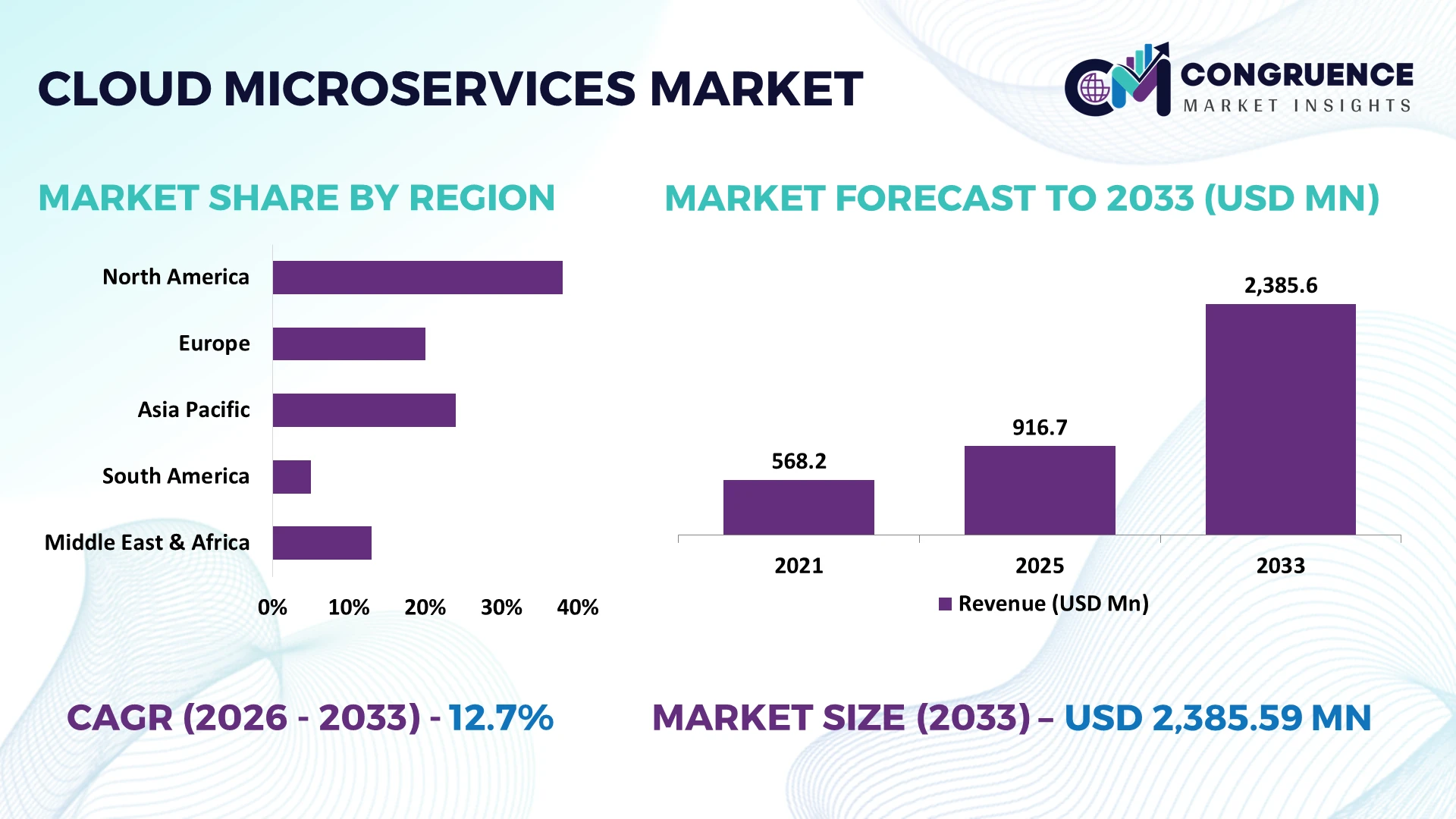
The Global Cloud Microservices Market was valued at USD 916.65 Million in 2025 and is anticipated to reach a value of USD 2385.59 Million by 2033 expanding at a CAGR of 12.7% between 2026 and 2033. Growth is being accelerated by Kubernetes-based container orchestration, API-led application modernization, DevOps automation, AI workload deployment, and enterprise migration from monolithic architectures toward independently scalable cloud-native services.
The United States remains the strongest cloud microservices deployment environment, accounting for 55% of worldwide hyperscale operational data-center capacity in 2025, supported by financial services, technology, healthcare, retail, and AI-intensive workloads. India is advancing rapidly as Amazon plans USD 48 billion of AI and cloud investment during 2026–2030. Globally, 82% of container users now operate Kubernetes in production, strengthening microservices deployment economics.
Strategically, enterprises should prioritize Kubernetes-ready platforms, automated service management, observability, FinOps, and sovereign-cloud compatibility as infrastructure investment shifts toward AI-intensive and geographically distributed architectures.
Market Size & Growth: USD 916.65 million in 2025 advances toward USD 2,385.59 million by 2033 at 12.7%, supported by containerized application modernization and AI-ready cloud architecture.
Top Growth Drivers: Kubernetes production penetration reached 82%, CI/CD supports most or all applications at 60% of organizations, and GitOps principles have reached 77% adoption.
Short-Term Forecast: By 2027, hybrid-cloud adoption is forecast to reach 90% of organizations, increasing demand for portable microservices, APIs, container orchestration, and cross-cloud management.
Emerging Technologies: AI inference, serverless microservices, automated observability, service meshes, and Kubernetes operators are reshaping architectures; 66% of surveyed AI adopters use Kubernetes to scale inference workloads.
Regional Leaders: China, North America, and Europe are forecast at approximately USD 47.4 billion, USD 16.4 billion, and USD 12.6 billion respectively in 2026 sovereign-cloud IaaS spending, strengthening localized cloud-native ecosystems.
Consumer/End-User Trends: 52.7% of EU enterprises purchased cloud services in 2025, while adoption reached 85% among large businesses, supporting continued enterprise application decomposition.
Pilot/Case Example: Miro’s 2024 Intelligent Canvas modernization used Amazon EKS while its broader Kubernetes transition delivered 80% lower compute costs and reduced deployments from weeks to minutes.
Competitive Landscape: AWS led global cloud infrastructure with 28% share in Q1 2026, followed by Microsoft at 21% and Google at 14%, with Oracle and CoreWeave expanding rapidly.
Regulatory & ESG Impact: Digital-sovereignty requirements are intensifying regional deployment strategies, with worldwide sovereign-cloud IaaS spending forecast at USD 80.4 billion during 2026.
Investment & Funding: Amazon committed an additional USD 13 billion to Indian AI and cloud infrastructure, taking planned 2026–2030 India investment to USD 48 billion.
Innovation & Future Outlook: Cloud-native techniques now reach 98% of surveyed organizations, positioning Kubernetes, AI-integrated microservices, platform engineering, and automated FinOps as core infrastructure priorities.
Cloud Microservices Market demand is concentrating around application modernization, financial services platforms, AI inference, e-commerce, healthcare systems, and real-time digital services. Kubernetes production usage has reached 82% among container users, while automated scaling, GitOps, serverless architecture, and platform engineering are reducing operational friction. Data-sovereignty requirements and geographically distributed cloud capacity increasingly shape deployment decisions, setting up the market’s next strategic phase.
Cloud microservices are becoming strategically important because enterprises increasingly compete on software-release speed, AI integration, service resilience, and infrastructure portability rather than application scale alone. Cloud-native techniques now reach 98% of surveyed organizations, while 82% of container users operate Kubernetes in production. This infrastructure modernization is shifting investment from monolithic application estates toward composable services, APIs, container orchestration, and internal developer platforms.
Operationally, microservices enable teams to scale and update individual application components without redeploying entire systems, improving resource utilization and release flexibility versus tightly coupled legacy architectures. CI/CD already supports most or all applications at 60% of organizations, while GitOps adoption has reached 77%. Finland shows 79% enterprise cloud uptake compared with 53% across EU businesses, illustrating substantial differences in deployment maturity.
Through 2028, platform engineering, AI inference, FinOps, observability, and automated security will define investment priorities. A practical example is AI deployment: 66% of organizations hosting generative AI use Kubernetes for some or all inference workloads, yet only 7% deploy models daily. Companies are therefore standardizing Kubernetes platforms, strengthening developer tooling, and integrating cost governance. Competitive advantage will increasingly depend on operating distributed microservices reliably, economically, and consistently across hybrid infrastructure.
Enterprise application modernization is the primary structural driver as Kubernetes, containers, CI/CD, and APIs replace tightly coupled deployment models. Production Kubernetes penetration reached 82% of container users in 2025, versus 66% in 2023, while 59% of organizations conduct much or nearly all development and deployment using cloud-native approaches. AI adds another workload catalyst: 66% of organizations hosting generative AI models use Kubernetes for inference. This transition enables independent service scaling, faster release cycles, and infrastructure portability across public and private environments. Companies are responding by expanding platform-engineering teams, adopting GitOps, and standardizing container platforms. The non-obvious advantage is organizational: reusable microservice platforms reduce duplicated infrastructure work, allowing development teams to concentrate engineering capacity on differentiated applications rather than environment configuration.
Microservices introduce granular infrastructure consumption that can become economically inefficient without disciplined resource governance. Organizations reported cloud budgets running 17% above plan in 2025, while an estimated 27% of cloud spending remained wasted; expected cloud spending was simultaneously rising 28%. The constraint is particularly acute when hundreds of services create duplicated compute allocations, observability charges, network traffic, and idle Kubernetes capacity. FinOps data also shows workload optimization and waste reduction remaining the leading operational priority. Enterprises are responding with automated rightsizing, commitment management, unit-cost allocation, and consolidated platform teams. The strategic constraint is therefore not simply cloud pricing: excessive service fragmentation can erase microservices’ scalability advantage. Companies increasingly require architecture governance that determines when service independence creates measurable value and when simpler application structures remain economically superior.
AI inference creates a high-value pathway for cloud microservices because models increasingly require modular APIs, independently scalable inference services, data pipelines, and distributed compute orchestration. Kubernetes already manages some or all inference workloads for 66% of organizations hosting generative AI, although only 7% deploy models daily, leaving substantial production-maturity headroom. FinOps management of AI spending expanded from 63% in 2025 to 98% in 2026, demonstrating how rapidly AI infrastructure is becoming operationally governed. Companies are investing in internal developer platforms, GPU-aware orchestration, automated observability, serverless execution, and standardized AI service interfaces. The non-obvious opportunity lies in reusable inference microservices: organizations can separate models from customer-facing applications, enabling model substitution and scaling without rebuilding entire products, materially improving experimentation speed and infrastructure flexibility.
The long-term challenge shifts from initial container adoption toward reliably operating increasingly distributed production environments. Security remains a major cloud-native workload concern, cited by 72% of surveyed practitioners in one 2025 study, alongside observability at 51%, resilience at 35%, and persistent storage at 31%. Broader CNCF research also shows organizational barriers intensifying: 47% identify development-team cultural change as the leading cloud-native challenge, while 36% cite training limitations and 34% complexity. Microservices multiply service dependencies, telemetry streams, API boundaries, and failure paths, raising incident-management requirements even when infrastructure scales successfully. Companies must invest in platform engineering, OpenTelemetry-based observability, automated vulnerability management, service-level objectives, and specialist workforce development. Competitive durability will depend less on creating more microservices than on controlling complexity while preserving deployment consistency and developer productivity.
Platform Engineering Becomes Operational Core: Internal developer platforms are replacing fragmented infrastructure workflows as cloud-native estates scale. Approximately 59% of organizations conduct much or nearly all development cloud-natively, Kubernetes production usage has reached 82%, and cloud-native adoption stands at 98%. Enterprises are centralizing golden paths, policy enforcement, observability, and self-service provisioning to reduce developer friction and standardize microservice deployment across distributed engineering teams.
API Governance Shifts Toward AI: API-first operating models are expanding as machine consumers join human developers. About 82% of organizations now apply some API-first practices, 25% operate fully API-first, and AI API calls increased 40% year over year. Companies are strengthening contract testing, machine-readable documentation, gateway governance, and lifecycle automation to support agent-driven service consumption without multiplying integration overhead.
FinOps Moves Into Engineering Workflows: Cloud-cost control is shifting from periodic finance reviews into application architecture and deployment pipelines. Organizations exceeded cloud budgets by 17%, approximately 27% of cloud spending remained wasted, and planned cloud expenditure was rising 28%. Engineering teams are embedding rightsizing, workload scheduling, unit economics, and automated policy controls directly into Kubernetes operations, making service-level cost visibility an architectural requirement rather than a finance-only metric.
Hybrid Portability Replaces Cloud Absolutism: Enterprises are optimizing workload placement instead of pursuing indiscriminate public-cloud migration. Only 21% of workloads have experienced repatriation, while more than half of enterprise and SMB workloads remain in public clouds and 79% of organizations use or plan multi-cloud deployments. Companies are standardizing containers, APIs, observability, and infrastructure automation so individual microservices can move between hyperscalers and private environments with lower switching friction.
Container-Based microservices represent the leading type, with an estimated 34% market share, reflecting their mature orchestration ecosystem, portability, workload isolation, and suitability for independently scalable enterprise applications. Kubernetes has strengthened this position by making container orchestration standard across large production environments. API-Based architectures account for approximately 27%, remaining critical for exposing business functions across internal applications, partners, mobile services, and increasingly AI agents. Enterprises are investing in API gateways, reusable service contracts, centralized observability, and container platforms to reduce application coupling while maintaining governance across distributed environments.
Serverless is the fastest-growing type as enterprises shift event-specific and variable workloads toward consumption-based execution, reducing idle infrastructure and operational administration. Event-Driven architectures are gaining strategic relevance in payments, e-commerce, telecommunications, and real-time analytics, where asynchronous processing improves responsiveness. Service Mesh remains more specialized, representing roughly 10–12% of deployments, but its importance rises as estates require service-to-service encryption, traffic policies, and distributed telemetry. Investment is consequently moving toward integrated platforms combining container orchestration, serverless execution, API control, and service-level observability rather than isolated tooling.
Application Development is the largest application segment, representing an estimated 31% of Cloud Microservices Market demand as enterprises decompose monolithic software into independently deployable services and build cloud-native digital products. API Management follows at approximately 23%, supported by growing requirements for service discovery, authentication, traffic control, partner connectivity, and machine-readable interfaces. Data Integration remains strategically important where microservices connect fragmented databases, SaaS platforms, analytics environments, and operational systems. Companies are responding through developer portals, reusable APIs, automated testing frameworks, and standardized application templates that reduce duplicated engineering effort.
DevOps Automation is the fastest-growing application because microservice estates require continuous integration, infrastructure automation, automated testing, and controlled deployment at substantially greater frequency than traditional applications. Around 75% of API-development organizations now use CI/CD pipelines, while GitHub Actions alone reaches 54% adoption among surveyed API teams. Cloud Migration remains a major transitional use case as enterprises selectively refactor high-value application components rather than undertaking full application rewrites. Investment is increasingly shifting from migration-only projects toward continuous modernization platforms that combine deployment automation, API governance, observability, and application lifecycle management.
IT & Software represents the dominant end-user group with an estimated 32% share, reflecting the sector’s high deployment frequency, developer concentration, SaaS delivery models, and dependence on elastic infrastructure. Banking follows as a mature adopter because payment processing, digital banking, fraud analytics, and customer-facing services increasingly rely on API-driven architectures. Telecommunications uses microservices to modernize network functions and digital service platforms, while Retail applies them across commerce engines, inventory synchronization, personalization, and omnichannel transactions. Providers are targeting these industries through verticalized Kubernetes platforms, managed APIs, security controls, and enterprise support packages designed around workload-specific compliance and availability requirements.
Healthcare is emerging as the fastest-growing buyer group as hospitals, health platforms, insurers, and digital-health providers modernize interoperability layers and separate patient, billing, scheduling, and analytics functions. Banking adoption remains operationally intensive because low-latency transaction services and regulatory controls favor independently governed application components. Retail demand fluctuates with transaction peaks, strengthening interest in autoscaling and event-driven services. Competitive positioning is therefore shifting toward industry-specific architecture blueprints, compliance automation, managed observability, and ecosystem partnerships rather than undifferentiated infrastructure capacity.
North America accounted for the largest market share at 39% in 2025 however, Asia-Pacific is expected to register the fastest growth, expanding at a CAGR of 15.0% between 2026 and 2033.

Hyperscale Capacity Anchors Cloud-Native Deployment
North America commands the strongest Cloud Microservices Market position, supported by hyperscale infrastructure, mature DevOps practices, SaaS concentration, and extensive Kubernetes deployment among financial services, technology, retail, and healthcare enterprises. The United States alone represented approximately 55% of worldwide hyperscale operational data-center capacity in 2025, reinforcing its ability to support latency-sensitive, containerized applications at scale. Enterprises are increasingly replacing application-specific infrastructure with shared internal developer platforms, API gateways, automated observability, and multi-cluster orchestration. AI workloads are adding pressure for independently scalable inference and data-processing services. Canadian organizations are simultaneously emphasizing hybrid architectures and controlled workload placement as privacy, resilience, and operating-cost requirements influence platform design. Hyperscaler expansion continues to strengthen availability-zone density, making distributed microservices economically viable for mission-critical enterprise workloads.
United States Market Outlook: The United States benefits from unmatched hyperscale density, mature cloud engineering talent, and concentrated investment by AWS, Microsoft, Google, Oracle, and specialized AI infrastructure providers. With more than half of global hyperscale capacity located domestically, enterprises can deploy multi-region microservices with lower latency, stronger redundancy, and broader access to managed Kubernetes, API, serverless, and observability services.
Digital Sovereignty Reshapes Deployment Architecture
Europe’s Cloud Microservices Market is increasingly shaped by sovereign-cloud requirements, regulatory control, application modernization, and enterprise migration toward modular architectures. Approximately 52.7% of EU enterprises purchased cloud computing services in 2025, rising 7.4 percentage points from 2023, while adoption among large businesses reached roughly 85%. These conditions strengthen demand for containerized services capable of operating across public, private, and sovereign environments without extensive application redesign. Financial institutions, manufacturers, public agencies, and telecommunications providers are emphasizing API governance, identity controls, workload portability, and localized data processing. Regulatory frameworks covering cybersecurity, operational resilience, and data governance are pushing enterprises toward architecture-level compliance rather than perimeter-only controls. Providers are responding with sovereign cloud zones, European data residency options, confidential computing, and policy-driven Kubernetes environments designed for regulated workloads.
Germany Market Outlook: Germany remains strategically important because of its industrial software base, regulated financial sector, advanced manufacturing ecosystem, and strong enterprise demand for hybrid infrastructure. German manufacturers increasingly integrate microservices with SAP environments, industrial IoT systems, and edge platforms, while sovereignty requirements favor architectures that separate application logic from underlying cloud infrastructure and simplify deployment across controlled environments.
Infrastructure Expansion Accelerates Distributed Deployment
Asia-Pacific is emerging as the fastest-moving Cloud Microservices Market as India, China, Japan, Singapore, Australia, and South Korea expand cloud capacity alongside digital-commerce, fintech, telecom, and AI workloads. India has become a particularly important deployment hub, with data-center capacity reaching approximately 1,700 MW in 2025 while cloud infrastructure continues expanding in Mumbai and Hyderabad. Enterprises are moving from centralized applications toward containerized services capable of scaling independently across high-volume payments, e-commerce, logistics, and consumer platforms. Local data-residency policies are also encouraging multi-region architectures within national borders. Hyperscalers are expanding availability zones, custom AI infrastructure, and managed Kubernetes services, while domestic technology firms are building platform-engineering capabilities. The region’s scale advantage increasingly lies in combining rapidly growing digital transaction volumes with newer infrastructure designed around cloud-native rather than legacy application architectures.
India Market Outlook: India is becoming a strategic microservices deployment center through large-scale cloud investment, strong software-engineering capacity, and exceptionally high digital transaction intensity. Amazon plans more than USD 21 billion of AI and cloud infrastructure investment between 2026 and 2030, expanding capacity in Mumbai and Hyderabad. Banking, telecom, e-commerce, SaaS, and government platforms provide particularly strong demand for API-driven, highly scalable distributed services.
Brazil Drives Cloud-Native Enterprise Modernization
South America’s Cloud Microservices Market is concentrated around Brazil, where financial technology, digital commerce, telecommunications, logistics, and online consumer services are increasing demand for scalable application architecture. Enterprises are moving customer-facing workloads toward managed containers and APIs while retaining selected core systems on private infrastructure, creating sustained demand for hybrid microservices orchestration. Brazil’s instant-payment ecosystem and high transaction intensity place particular pressure on application resilience, event processing, and API availability. Infrastructure expansion is also reducing latency constraints: international cloud providers are adding domestic capacity and local availability options to serve regulated workloads. However, network quality and data-center concentration remain uneven outside major hubs, making deployment economics less consistent across the continent. Companies are addressing these limitations through São Paulo-centered architectures, edge connectivity, managed Kubernetes, and partnerships with local systems integrators.
Brazil Market Outlook: Brazil represents the region’s strongest cloud-native opportunity because of its large banking, fintech, retail, and telecommunications ecosystems. Alibaba Cloud’s 2026 decision to establish two Brazilian data centers demonstrates increasing competitive infrastructure commitment. Enterprises are prioritizing localized processing, API modernization, and container orchestration to support lower-latency applications while meeting domestic cybersecurity and data-governance requirements.
Sovereign Infrastructure Investment Reshapes Adoption
Middle East & Africa deployment is being led by major sovereign digital-infrastructure programs in the UAE and Saudi Arabia, where governments and enterprises are modernizing banking, energy, aviation, public services, and telecommunications platforms. Cloud microservices are gaining relevance because national transformation programs require applications that can be upgraded independently while operating across localized cloud environments. Investment in AI-ready data centers is also expanding the infrastructure base needed for containerized inference, API services, and event-driven applications. Microsoft has committed substantial cloud and AI infrastructure expansion in the UAE through 2029, while hyperscalers continue building Saudi capacity and local service ecosystems. African adoption remains more concentrated in South Africa, Kenya, and Nigeria because of connectivity and infrastructure disparities. Providers are responding with local cloud regions, managed container services, sovereign architectures, and training partnerships aimed at addressing enterprise migration complexity and cloud-skills shortages.
United Arab Emirates Market Outlook: The UAE combines government-led digital transformation, strong hyperscaler participation, and expanding AI infrastructure. Microsoft plans more than USD 5.5 billion in AI and cloud infrastructure capital expenditure between 2026 and 2029, reinforcing Abu Dhabi and Dubai as regional deployment hubs. Financial services, aviation, government platforms, and AI companies increasingly require localized, secure microservices environments with advanced orchestration and data-residency controls.
AWS, Microsoft, Google, IBM, and Oracle form the global platform leaders, competing with Red Hat, Broadcom, Salesforce, and cloud-native specialists for microservices workloads. The top five are estimated to control about 68% of market activity, reflecting hyperscaler reach and developer ecosystems. Technology is decisive: 82% of container users run Kubernetes in production, while 59% of organizations conduct much or nearly all development cloud-natively. API-first adoption has reached 82%, shifting competition toward managed Kubernetes, serverless execution, observability, API governance, and AI-ready services. AWS, Microsoft, and Google expand cloud regions and vertically integrated tooling; IBM and Oracle emphasize hybrid, regulated, and enterprise workloads. Red Hat competes through portable OpenShift environments and ecosystem partnerships. The competitive shift is moving from container hosting toward unified platform engineering and AI orchestration. High migration complexity, security requirements, and developer skills remain entry barriers. Winning requires interoperable platforms, automation, workload portability, disciplined costs, and superior developer productivity.
Amazon Web Services (AWS)
Microsoft
IBM
Oracle
Red Hat
Broadcom
Salesforce
Cisco
SAP
VMware Tanzu
Kong
HashiCorp
Cloudflare
Kubernetes, API-first architecture, serverless computing, service meshes, and automated observability define the current Cloud Microservices Market technology stack. Kubernetes now runs in production for 82% of container users, while 59% of organizations conduct much or nearly all development cloud-natively. Compared with legacy monolithic deployment, reusable API-first architectures can reduce duplicated engineering overhead by 42%, improving release independence, infrastructure utilization, and developer productivity.
Emerging investment is concentrating on platform engineering, GitOps, eBPF observability, WebAssembly, and AI-native APIs. GitOps principles are used by 77% of organizations, whereas service-mesh adoption declined from 50% to 42% as teams reassessed operational complexity. This divergence favors lightweight networking, automated policy enforcement, and integrated telemetry over separately managed middleware. Hyperscalers and platform vendors benefit by packaging orchestration, security, API management, and developer workflows into unified managed environments.
Disruptive change through 2026–2028 will come from AI agents consuming microservices directly, GPU-aware Kubernetes scheduling, serverless inference, and machine-readable API contracts. Already, 89% of developers use generative AI, but only 24% design APIs for AI agents, exposing a major readiness gap. Companies acting now can standardize service contracts, automate security controls, and build reusable inference services before agent-driven traffic increases operational complexity, strengthening deployment speed and competitive differentiation at scale.
November 2024 CNCF graduated Dapr, the distributed application runtime originally created by Microsoft, after adoption by tens of thousands of organizations; its APIs improve developer productivity by 20–40%, strengthening standardized, portable microservices development across cloud and edge environments. Source: cncf.io
November 2025 Amazon Web Services launched EKS Capabilities with three managed Kubernetes-native features—Argo CD, ACK and KRO—offloading scaling, patching and upgrades from platform teams and accelerating standardized enterprise microservices deployment across commercial AWS regions worldwide at scale. Source: aws.com
June 2026 Amazon committed an additional USD 13 billion to Indian AI and cloud infrastructure through 2030, lifting planned investment to USD 48 billion and expanding Mumbai and Hyderabad capacity, further strengthening localized infrastructure for cloud-native enterprise applications significantly. Source: reuters.com
August 2026 Microsoft launched its India South Central cloud region in Hyderabad, bringing its Indian hyperscale footprint to four regions; strong double-digit Azure growth over two years reinforces local capacity for regulated, resilient enterprise microservices deployments at scale. Source: microsoft.com
The Cloud Microservices Market report evaluates API-Based, Container-Based, Serverless, Event-Driven, and Service Mesh architectures across Application Development, API Management, Data Integration, DevOps Automation, and Cloud Migration. Coverage extends to Banking, Retail, Healthcare, Telecommunications, and IT & Software, alongside deployment developments across North America, Europe, Asia-Pacific, South America, and Middle East & Africa. Kubernetes production adoption exceeding 80% among container users highlights the increasing operational maturity of cloud-native infrastructure.
The report examines container orchestration, API-first architecture, platform engineering, GitOps, serverless computing, observability, AI-native services, and automated infrastructure management through 2026–2033. It also assesses emerging opportunities in agentic AI integration, sovereign cloud deployment, GPU-aware orchestration, and hybrid workload portability. Competitive benchmarking, segment positioning, country-level infrastructure dynamics, technology shifts, and enterprise adoption patterns support investment planning, geographic expansion, partnership development, product positioning, and long-term strategic decision-making.
| Report Attribute/Metric | Report Details |
|---|---|
Market Revenue in 2025 | USD 916.65 Million |
Market Revenue in 2033 | USD 2385.59 Million |
CAGR (2026 - 2033) | 12.7% |
Base Year | 2025 |
Forecast Period | 2026 - 2033 |
Historic Period | 2021 - 2025 |
Segments Covered | By Type
By Application
By End-User
|
Key Report Deliverable | Revenue Forecast, Growth Trends, Market Dynamics, Segmental Overview, Regional and Country-wise Analysis, Competition Landscape |
Region Covered | North America, Europe, Asia-Pacific, South America, Middle East, Africa |
Key Players Analyzed | Amazon Web Services (AWS), Microsoft, Google, IBM, Oracle, Red Hat, Broadcom, Salesforce, Cisco, SAP, VMware Tanzu, Kong, HashiCorp, Cloudflare |
Customization & Pricing | Available on Request (10% Customization is Free) |




